anaheim-gazette 1918-09-19
Scanned page
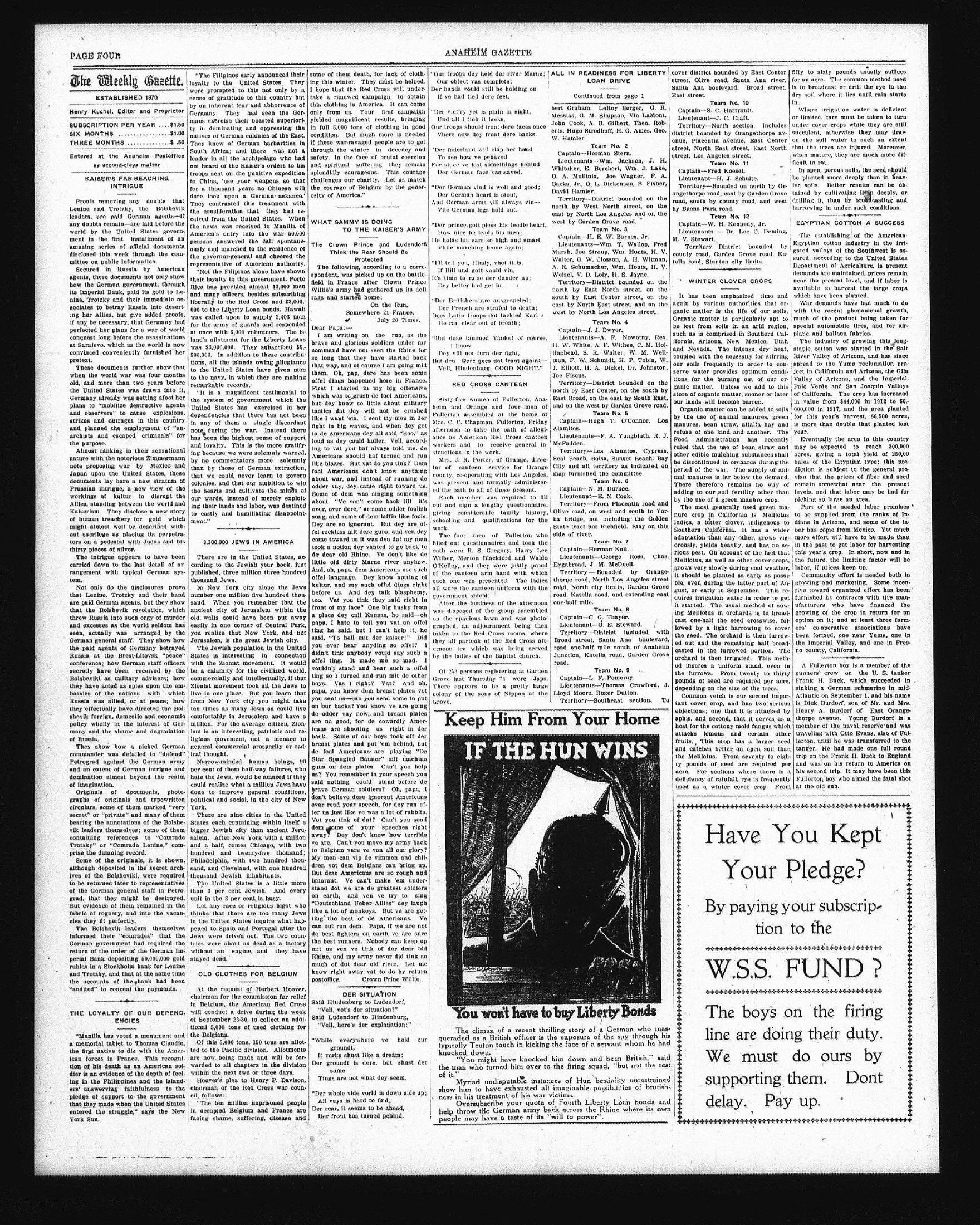
Searchable text
The Weekly Gazette.
ESTABLISHED 1870
Henry Kuchel, Editor and Proprietor
SUBSCRIPTION PER YEAR ... $1.50
SIX MONTHS ... $1.00
THREE MONTHS ... $ .50
Entered at the Anaheim Postoffice as second-class matter
KAISER'S FAR-REACHING INTRIGUE
Proofs removing any doubts that Lenine and Trotzky, the Bolshevik leaders, are paid German agents—if any doubts remain—are laid before the world by the United States government in the first installment of an amazing series of official documents disclosed this week through the committee on public information.
Secured in Russia by American agents, these documents not only show how the German government, through its Imperial Bank, paid its gold to Lenine, Trotzky and their immediate associates to betray Russia into deserting her Allies, but give added proofs, if any be necessary, that Germany had perfected her plans for a war of world conquest long before the assassinations at Sarajevo, which as the world is now convinced conveniently furnished her pretext.
These documents further show that when the world war was four months old, and more than two years before the United States was drawn into it, Germany already was setting afoot her plans to "mobilize destructive agents and observers" to cause explosions, strikes and outrages in this country and planned the employment of "anarchists and escaped criminals" for the purpose.
Almost ranking in their sensational nature with the most sensational news of the day.
"The Filipinos early announced their loyalty to the United States. They were prompted to this not only by a sense of gratitude to this country but by an inherent fear and abhorrence of Germany. They had seen the Germans exercise their boasted superiority in dominating and oppressing the natives of German colonies of the East. They knew of German barbarities in South Africa; and there was not a leader in all the archipelago who had not heard of the Kaiser's orders to his troops sent on the punitive expedition to China, 'use your weapons so that for a thousand years no Chinese will dare look upon a German askance.' They contrasted this treatment with the consideration that they had received from the United States. When the news was received in Manila of America's entry into the war 50,000 persons answered the call spontaneously and marched to the residence of the governor-general and cheered the representative of American authority.
"Not the Filipinos alone have shown their loyalty to this government. Porto Rico has provided almost 13,000 men and many officers, besides subscribing liberally to the Red Cross and $3,000,000 to the Liberty Loan bonds. Hawaii was called upon to supply 2,403 men for the army of guards and responded at once with 5,000 volunteers. The island's allotment for the Liberty Loans was $3,000,000. They subscribed $8,500,000. In addition to these contributions, all the islands owing allegiance to the United States have given men to the navy, in which they are making remarkable records.
"It is a magnificent testimonial to the system of government which the United States has exercised in her dependencies that there has not been in any of them a single discordant note during the war. Instead there has been the highest sense of support and loyalty. This is the more gratifying because we were solemnly warned,
some of them dealing this winter. Then I hope that the Red take a renewed ceil this clothing in America only from us. You yielded magnificence in full 5,000 tons of condition. But maybe if these war-ravaged through the winter safety. In the face and spiritual suffice splendidly courage challenges our chance the courage of Belosity of America."
These documents further show that when the world war was four months old, and more than two years before the United States was drawn into it, Germany already was setting afoot her plans to "mobilize destructive agents and observers" to cause explosions, strikes and outrages in this country and planned the employment of "anarchists and escaped criminals" for the purpose.
Almost ranking in their sensational nature with the notorious Zimmermann note proposing war by Mexico and Japan upon the United States, these documents lay bare a new stratum of Prussian intrigue, a new view of the workings of kultur to disrupt the Allies, standing between the world and Kaiserism. They disclose a new story of human treachery for gold which might almost well be described without sacrilege as placing its perpetrators on a pedestal with Judas and his thirty pieces of silver.
The intrigue appears to have been carried down to the last detail of arrangement with typical German system.
Not only do the disclosures prove that Lenine, Trotzky and their band are paid German agents, but they show that the Bolshevik revolution, which threw Russia into such orgy of murder and excesses as the world seldom has seen, actually was arranged by the German general staff. They show how the paid agents of Germany betrayed Russia at the Brest-Litovsk "peace" conference; how German staff officers secretly have been received by the Bolsheviks as military advisers; how they have acted as spies upon the embassies of the nations with which Russia was allied, or at peace; how they effectually have directed the Bolshevik foreign, domestic and economic policy wholly in the interest of Germany and the shame and degradation of Russia.
They show how a picked German commander was detailed to "defend" Petrograd against the German army and an extent of German intrigue and domination almost beyond the realm of imagination.
Originals of documents, photographs of originals and typewritten circulars, some of them marked "very secret" or "private" and many of them bearing the annotations of the Bolshevik leaders themselves; some of them containing references to "Comrade Trotzky" or "Comrade Lenine," comprise the damning record.
Some of the originals, it is shown, all the islands owing allegiance to the United States have given men to the navy, in which they are making remarkable records.
"It is a magnificent testimonial to the system of government which the United States has exercised in her dependencies that there has not been in any of them a single discordant note during the war. Instead there has been the highest sense of support and loyalty. This is the more gratifying because we were solemnly warned, by no commentators more solemnly than by those of German extraction, that we could never learn to govern colonies, and that our ambition to win the hearts and cultivate the minds of our wards, instead of merely exploiting their lands and labor, was destined to costly and humiliating disappointment."
3,300,000 JEWS IN AMERICA
There are in the United States, according to the Jewish year book, just published, three million three hundred thousand Jews.
In New York city alone the Jews number one million five hundred thousand. When you remember that the ancient city of Jerusalem within the old walls could have been put away easily in one corner of Central Park, you realize that New York, and not Jerusalem, is the great Jewish city.
The Jewish population in the United States is interesting in connection with the Zionist movement. It would be a calamity for the civilized world, commercially and intellectually, if that Zionist movement took all the Jews to live in one place. But you learn that from New York city you might take ten times as many Jews as could live comfortably in Jerusalem and have a million. For the average citizen, Zionism is an interesting, patriotic and religious movement, not a menace to general commercial prosperity or radical thought.
Narrow-minded human beings, 90 per cent of them half-way failures, who hate the Jews, would be amazed if they could realize what a million Jews have done to improve general conditions, political and social, in the city of New York.
There are nine cities in the United States each containing within itself a bigger Jewish city than ancient Jerusalem. After New York with a million and a half, comes Chicago, with two hundred and twenty-five thousand; Philadelphia, with two hundred thousand tions, all the islands owing allegiance to the United States have given men to the navy, in which they are making remarkable records.
"It is a magnificent testimonial to the system of government which the United States has exercised in her dependencies that there has not been in any of them a single discordant note during the war. Instead there has been the highest sense of support and loyalty. This is the more gratifying because we were solemnly warned, by no commentators more solemnly than by those of German extraction, that we could never learn to govern colonies, and that our ambition to win the hearts and cultivate the minds of our wards, instead of merely exploiting their lands and labor, was destined to costly and humiliating disappointment."
Dekey are so ignorant fel reckless mit de come toward us it took a notion dey de dear old Rhine little old dirty M And, oh, papa, dem offel language. D kultur, and say su before us. And o too. Vat you think front of my face? You a place dey call he papa, I hate to te ting he said, but said. "To hell mii you ever hear ad didn't tink anybody offel ting. It ma wouldn't stand an ing so I turned a boys. Vas I right papa, you know de you sent us—can y on our backs? You de odder vay now are no good, for ricans are shooting back. Some of our breast plates and de fool American Star Spangled Bars guns on dem plato us? You remember said nothing cou brave German sol don't believe dese ever read your spe ter us just like ve Vot you tink of de dem some of yo aw away. Dey don't ve are. Can't you to Belgium vere v My men can vip dren vot dem Bel
and an extent of German intrigue and domination almost beyond the realm of imagination.
Originals of documents, photographs of originals and typewritten circulars, some of them marked "very secret" or "private" and many of them bearing the annotations of the Bolshevik leaders themselves; some of them containing references to "Comrade Trotzky" or "Comrade Lenine," comprise the damning record.
Some of the originals, it is shown, although deposited in the secret archives of the Bolshevik, were required to be returned later to representatives of the German general staff in Petrograd, that they might be destroyed. But evidence of them remained in the fabric of roguery, and into the vacancies they fit perfectly.
The Bolshevik leaders themselves informed their "comrades" that the German government had required the return of the order of the German Imperial Bank depositing 50,000,000 gold rubles in a Stockholm bank for Lenine and Trotzky, and that at the same time the accounts of the bank had been "audited" to conceal the payments.
THE LOYALTY OF OUR DEPENDENCIES
"Manilla has voted a monument and a memorial tablet to Thomas Claudio, the first native to die with the American forces in France. This recognition of his death as an American soldier is an evidence of the depth of feeling in the Philippines and the islanders' unswerving faithfulness to the pledge of support to the government that they made when the United States entered the struggle," says the New York Sun.
OLD CLOTHES FOR BELGIUM
At the request of Herbert Hoover, chairman for the commission for relief in Belgium, the American Red Cross will conduct a drive during the week of September 23-30, to collect an additional 5,000 tons of used clothing for the Belgians.
Of this 5,000 tons, 350 tons are allotted to the Pacific division. Allotments are now being made and will be forwarded to all chapters in the division within the next two or three days.
Hoover's plea to Henry P. Davison, chairman of the Red Cross war council, follows:
"The ten million imprisoned people in occupied Belgium and France are facing shame, suffering, disease and per cent of them half-way failures, who hate the Jews, would be amazed if they could realize what a million Jews have done to improve general conditions, political and social, in the city of New York.
There are nine cities in the United States each containing within itself a bigger Jewish city than ancient Jerusalem. After New York with a million and a half, comes Chicago, with two hundred and twenty-five thousand; Philadelphia, with two hundred thousand, and Cleveland, with one hundred thousand Jewish inhabitants.
The United States is a little more than 3 per cent Jewish. And every unit in the 3 per cent is busy.
Let any race or religious bigot who thinks that there are too many Jews in the United States inquire what happened to Spain and Portugal after the Jews were driven out. The two countries were about as dead as a factory without an engine, and they have stayed dead."
DER SIN
Said Hindenburg t
"Vell, vot's der
Said Ludendorf t
"Vell, here's de
"While everywhere groundt,
It vorks shust li
Der groundt is d same
Tings are not w
"Der whole vide ve
All vays is hard
Der rear, it seems
Der front has tu
ANAHEIM GAZETTE
WHAT SAMMY IS DOING TO THE KAISER'S ARMY
The Crown Prince and Ludendorff Think the Rear Should Be Protected
The following, according to a correspondent, was picked up on the battlefield in France after Clown Prince Willie's army had gathered up its doll rags and started home:
On the Run, Somewhere in France, July 20 Times.
Dear Papa:—
I am writing on the run, as the brave and glorious soldiers under my command have not seen the Rhine for so long that they have started back that way, and of course I am going mid them. Oh, pap, dere has been some offel dings happened here in France. First I started in my big offensive which was to crush de fool Americans, but dey know so little about military tactics dat dey will not be crushed like I want 'em. I sent my men in der fight in big waves, and when dey got to de Americans dey all said "Boo," as loud as dey could holler. Vell, according to vat you haf always told me, de Americans should haf turned and run some of them death, for lack of clothing this winter. They must be helped. I hope that the Red Cross will undertake a renewed campaign to obtain this clothing in America. It can come only from us. Your first campaign yielded magnificent results, bringing in full 5,000 tons of clothing in good condition. But much more is needed if these war-ravaged people are to get through the winter in decency and safety. In the face of brutal coercion and spiritual suffering they remain splendidly courageous. This courage challenges our charity. Let us match the courage of Belgium by the generosity of America."
Our troops dey held der river Marne; Our object vas complete; Der hands would still be holding on If ve had tied dere feet.
"Der vict'ry yet is plain in sight, Und all I tink it lacks, Our troops should front dere faces once Where now dey front dere backs.
'Der faderland will clap her hand To see how ve pehaved For since ve lost somethings behind Der German face vas saved.
"Der German vind is well and good; Der German heart is stout, And German arms vill-always vin—Vile German legs hold out.
"Der prince,gott pless his leedle heart, How nice he leads his men; He holds his ears so high and smart While marching home again;
"I'll tell you, Hindy, what it is, If Bill und gott would vin, It's time to raise der dander up; Dey better had get in.
"Der Britishers are ausgespeled; Der French are strafed to death; Does Latin troops dot tackled Karl He ran clear out of breath;
"But dose tammed Yanks! of course, I know Dey vill not turn der fight, But den—Dere goes dot front again:—Vell, Hindenburg, GOOD NIGHT."
RED CROSS CANTEEN
Sixty-five women of Fullerton, Anaheim and Orange and four men of Fullerton assembled at the home of Mrs. C. C. Chapman, Fullerton, Friday afternoon to take the oath of allegiance as American Red Cross canteen workers and to receive general instructions in the work.
ALL IN READINESS FOR LIBERTY LOAN DRIVE
Continued from page 1
bert Graham, LeRoy Berger, G. R. Messias, G. M. Simpson, Vic LaMont, John Cook, A. B. Gilbert, Theo. Roberts, Hugo Strodhoff, H. G. Ames, Geo. W. Hamler.
Team No. 2
Captain—Herman Stern.
Lieutenants—Wm. Jackson, J. H. Whitaker, E. Borchert, Wm. J. Lake, O. A. Mullinix, Joe Wagner, F. A. Backs, Jr., O. L. Dickenson, B. Fisher, David Hamler.
Territory—District bounded on the north by West North street, on the east by North Los Angeles and on the west by Garden Grove road.
Team No. 3
Captain—H. E. W. Barnes, Jr.
Lieutenants—Wm. T. Wallop, Fred Marsh, Joe Stroup, Wm. Houts, H. V. Walter, G. W. Closson, A. H. Witman, A. E. Schumacher, Wm. Houts, H. V. Welsel, V. D. Loly, H. S. Jayne.
Territory—District bounded on the north by East North street, on the south by East Center street, on the east by North East street, and on the west by North Los Angeles street.
Team No. 4
Captain—J. J. Dwyer.
Lieutenants—A. F. Nowotny, Rev. H. W. White, A. F. Withee, C. M. Hollinghead, S. R. Walter, W. M. Wellman, F. W. Schmidt, H. P. Tobin, W.J. Elliott, H.A.Dickel, Dr.Johnston, Joe Fiscus.
Territory—District bounded on the north by East Center, on the south by East Broad, on the east by South East,and on the west by Garden Grove road.
Team No. 5
Captain—Hugh T.O'Connor, Los Alamitos.
Lieutenants—F.A.Yungbluth,R.J.McFadden.
Territory—Los Alamitos,Cypress,Gold Alamitos,Saint George,Boston Road
RED CROSS CANTEEN
Sixty-five women of Fullerton, Anaheim and Orange and four men of Fullerton assembled at the home of Mrs. C. C. Chapman, Fullerton, Friday afternoon to take the oath of allegiance as American Red Cross canteen workers and to receive general instructions in the work.
Mrs. J. R. Porter, of Orange, director of canteen service for Orange county, co-operating with Los Angeles, was present and formally administered the oath to all of those present.
Each member was required to fill out and sign a lengthy questionnaire, giving considerable family history, schooling and qualifications for the work.
The four men of Fullerton who filled out questionnaires and took the oath were R. S. Gregory, Harry Lee Wilber, Merton Blackford and Waldo O'Kelley, and they were justly proud of the canteen arm band with which each one was presented. The ladies all wore the canteen uniform with the government shield.
After the business of the afternoon was disposed of the group assembled on the spacious lawn and was photographed, an adjournment being then taken to the Red Cross rooms, where they all partook of the Red Cross afternoon tea which was being served by the ladies of the Baptist church.
Of 253 persons registering at Garden Grove last Thursday 74 were Japs. There appears to be a pretty large colony of the sons of Nippon at the Grove.
Keep Him From Your Home
IF THE HUN WINS
DER SITUATION
Said Hindenburg to Ludendorf,
"Vell, vot's der situation?"
Said Ludendorf to Hindenburg,
"Vell, here's der explanation:"
"While everywhere ve hold our groundt,
It vorks shust like a dream;
Der groundt is dere, but shust der same
Tings are not what dey seem.
"Der whole vide vorld is down side up;
All vays is hard to find;
Der rear, it seems to be ahead,
Der front has turned pehind."
You won't have to buy Liberty Bonds
The climax of a recent thrilling story of a German who masqueraded as a British officer is the exposure of the spy through his typically Teuton touch in kicking the face of a servant whom he had knocked down.
"You might have knocked him down and been British," said the man who turned him over to the firing squad, "but not the rest of it."
Myriad undisputable instances of Hun bestiality unrestrained show him to have exhausted all imaginable possibilities of brutishness in his treatment of his war victims.
Oversubscribe your quota of Fourth Liberty Loan bonds and help throw the German army back across the Rhine where its own people may have a taste of its "will to power".
BEG FOR LIBERTY
RIVE
By Berger, G. R.
Jenson, Vic LaMont,
Libert, Theo. RobH. G. Ames, Geo.
No. 2
Stern.
Jackson, J. H.
Hart, Wm. J. Lake,
Wagner, F. A.
Kenson, B. Fisher,
bounded on the north street, on the Angeles and on the Ave road.
No. 3
Barnes, Jr.
T. Wallop, Fred
Wm. Houts, H. V.
Won, A. H. Witman,
Wm. Houts, H. V.
I. S. Jayne.
bounded on the south street, on the street, and on the Angeles street.
No. 4
Verer.
Nowotny, Rev.
Withee, C. M. Holter,
W. M. WellH. P. Tobin, W.
Kel, Dr. Johnston,
bounded on the ear, on the south by east by South East, Garden Grove road.
No. 5
O'Connor, Los
Yungbluth, R. J.
lamitos, Cypress,
cover district bounded by East Center street, Olive road, Santa Ana river, Santa Ana boulevard, Broad street, East street.
Team No. 10
Captain—S. C. Hartranft.
Lieutenant—J. C. Craft.
Territory—North section. Includes district bounded by Orangethorpe avenue, Placentia avenue, East Center street, North East street, East North street, Los Angeles street.
Team No. 11
Captain—Fred Koesel.
Lieutenant—H. J. Schulte.
Territory—Bounded on north by Orangethorpe road, east by Garden Grove road, south by county road, and west by Buena Park road.
Team No. 12
Captain—W. H. Kennedy, Jr.
Lieutenants — Dr. Lee C. Deming.
M. V. Stewart.
Territory—District bounded by county road, Garden Grove road, Katella road, Stanton city limits.
WINTER CLOVER CROPS
It has been emphasized time and again by various authorities that organic matter is the life of our soils. Organic matter is particularly apt to be lost from soils in an arid region, such as is comprised in Southern California, Arizona, New Mexico, Utah and Nevada. The intense dry heat, coupled with the necessity for stirring our soils frequently in order to conserve water provides optimum conditions for the burning out of our organic matter. Unless we add to this store of organic matter, sooner or later our lands will become barren.
Organic matter can be added to soils by the use of animal manures, green manures, bean straw, alfalfa hay and refuse of one kind and another. The Food Administration has recently ruled that the use of bean straw and other edible mulching substances shall fifty to sixty pounds usually suffices for an acre. The common method used is to broadcast or drill the rye in the dry soil where it lies until rain starts in.
Where irrigation water is deficient or limited, care must be taken to turn under cover crops while they are still succulent, otherwise they may draw on the soil water to such an extent that the trees are injured. Moreover, when mature, they are much more difficult to rot.
In open, porous soils, the seed should be planted more deeply than in heavier soils. Better results can be obtained by cultivating it in deeply, or drilling it, than by broadcasting and harrowing in under such conditions.
EGYPTIAN COTTON A SUCCESS
The establishing of the American-Egyptian cotton industry in the irrigated valleys of the Southwest is assured, according to the United States Department of Agriculture, is present demands are maintained; prices remain near the present level, and if labor is available to harvest the large crops which have been planted.
War demands have had much to do with the recent phenomenal growth, much of the product being taken for special automobile tires, and for airplane and balloon fabrics.
The industry of growing this long-staple cotton was started in the Salt River Valley of Arizona, and has since spread to the Yuma reclamation project in California and Arizona, the Gila Valley of Arizona, and the Imperial, Palo Verde and San Joaquin Valleys of California. The crop has increased in value from $44,000 in 1912 to $6.,000,000 in 1917, and the area planted for this year's harvest, 86,500 acres, is more than double that planted last year.
Eventually the area in this country may be expected to reach 300,000 acres, giving a total yield of 250,00
our soils frequently in order to conserve water provides optimum conditions for the burning out of our organic matter. Unless we add to this store of organic matter, sooner or later our lands will become barren.
Organic matter can be added to soils by the use of animal manures, green manures, bean straw, alfalfa hay and refuse of one kind and another. The Food Administration has recently ruled that the use of bean straw and other edible mulching substances shall be discontinued in orchards during the period of the war. The supply of animal manures is far below the demand. There therefore remains no way of adding to our soil fertility other than by the use of a green manure crop.
The most generally used green manure crop in California is Melilotus indica, a bitter clover, indigenous to Southern California. It has a wider adaptation than any other, grows vigorously, yields heavily, and has no serious pest. On account of the fact that Melilotus, as well as other cover crops, grows very slowly during cool weather, it should be planted as early as possible, even during the latter part of August, or early in September. This requires irrigation water in order to get it started. The usual method of sowing Melilotus in orchards is to broadcast one-half the seed crosswise, followed by a light harrowing to cover the seed. The orchard is then furrowed out and the remaining half broadcasted in the furrowed portion. The orchard is then irrigated. This method insures a uniform stand, even in the furrows. From twenty to thirty pounds of seed are required per acre, depending on the size of the trees.
Common vetch is our second important cover crop, and has two serious objections; one that it is attacked by aphis, and second, that it serves as a host for the cottony mold fungus which attacks lemons and certain other fruits. This crop has a larger seed and catches better on open soil than the Melilotus. From seventy to eighty pounds of seed are required per acre. For sections where there is a deficiency of rainfall, rye is frequently used as a winter cover crop. From spread to the Yuma reclamation project in California and Arizona, the Gila Valley of Arizona, and the Imperial, Palo Verde and San Joaquin Valleys of California. The crop has increased in value from $44,000 in 1912 to $6,000,000 in 1917, and the area planted for this year's harvest, 86,500 acres, is more than double that planted last year.
Eventually the area in this country may be expected to reach 300,000 acres, giving a total yield of 250,000 bales of the Egyptian type; this prediction is subject to the general proviso that the prices of fiber and seed remain somewhat near the present levels, and that labor may be had for picking so large an area.
Part of the needed labor promises to be supplied from the ranks of Indians in Arizona, and some of the labor has come from Mexico. Yet much more effort will have to be made than in the past to get labor for harvesting this year's crop. In short, now and in the future, the limiting factor will be labor, if prices keep up.
Community effort is needed both in growing and marketing. Some incentive toward organized effort has been furnished by contracts with tire manufacturers who have financed the growing of the crop in return for an option on it; and at least three farmers' co-operative associations have been formed, one near Yuma, one in the Imperial Valley, and one in Fresno county, California.
A Fullerton boy is a member of the gunners' crew on the U. S. tanker Frank H. Buck, which succeeded in sinking a German submarine in mid-Atlantic on September 1, and his name is Dick Burdorf, son of Mr. and Mrs. Henry A. Burdorf of East Orange-thorpe avenue. Young Burdorf is a member of the naval reserve and was traveling with Otto Evans, also of Fullerton, until he was transferred to the tanker. He had made one full round trip on the Frank H. Buck to England and was on his return to America on his second trip. It may have been this Fullerton boy who aimed the fatal shot at the old sub.
Have You Kept Your Pledge?
By paying your subscription to the
W.S.S. FUND?
The boys on the firing line are doing their duty.
We must do ours by supporting them. Dont delay. Pay up.