anaheim-gazette 1918-09-12
Scanned page
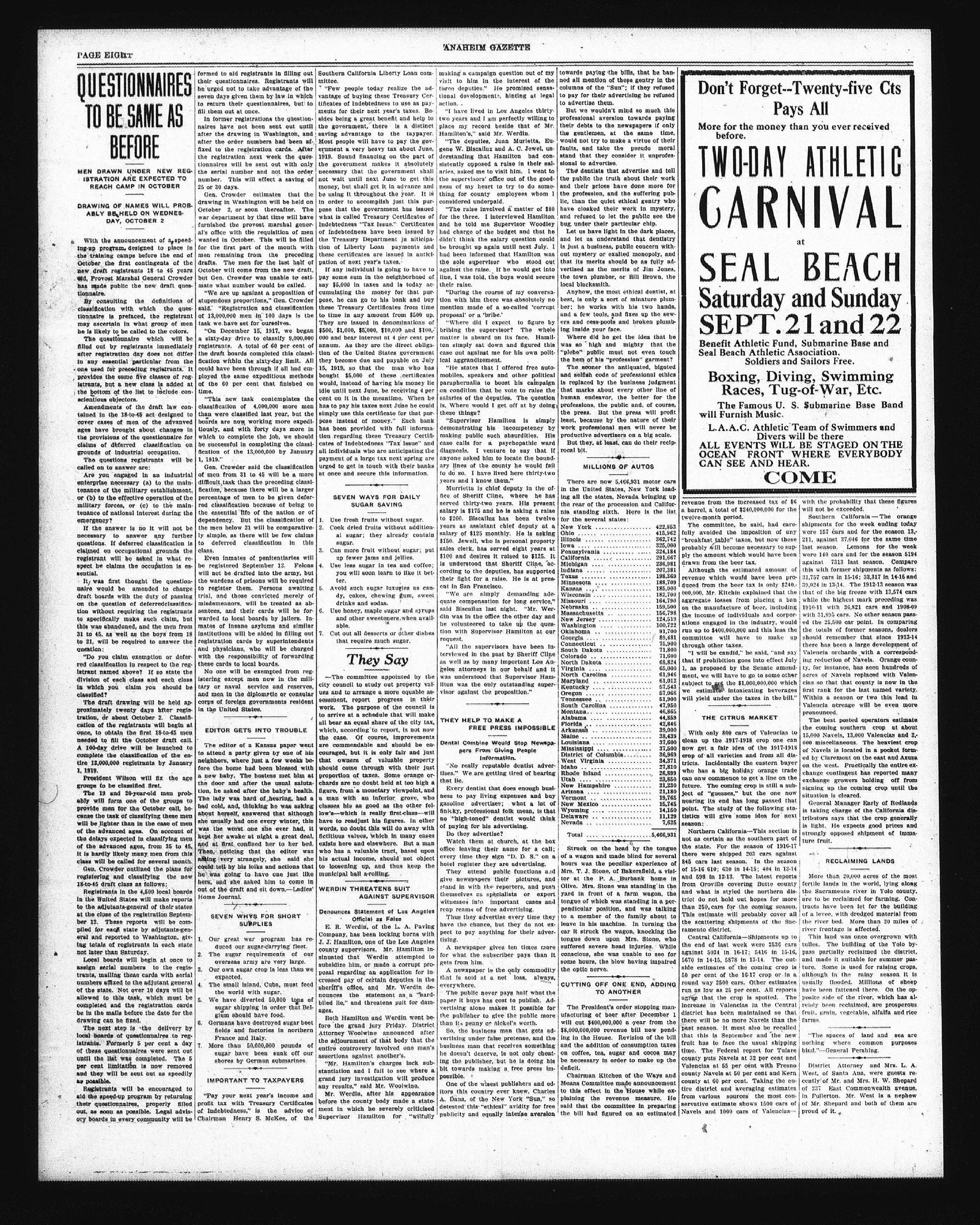
Searchable text
QUESTIONNAIRES TO BE SAME AS BEFORE
MEN DRAWN UNDER NEW REGISTRATION ARE EXPECTED TO REACH CAMP IN OCTOBER
DRAWING OF NAMES WILL PROBABLY BE HELD ON WEDNESDAY, OCTOBER 2
With the announcement of a speeding-up program, designed to place in the training camps before the end of October the first contingents of the new draft registrants 18 to 45 years old, Provost Marshal General Crowder has made public the new draft questionnaire.
By consulting the definitions of classification with which the questionnaire is prefaced, the registrant may ascertain in what group of men he is likely to be called to the colors.
The questionnaire which will be filled out by registrants immediately after registration day does not differ in any essential particular from the one used for preceding registrants. It provides the same five classes of registrants, but a new class is added at the bottom of the list to include conscientious objectors.
Amendments of the draft law contained in the 18-to-45 act designed to cover cases of men of the advanced ages have brought about changes in the provisions of the questionnaire for claims of deferred classification on grounds of industrial occupation.
formed to aid registrants in filling out their questionnaires. Registrants will be urged not to take advantage of the seven days given them by law in which to return their questionnaires, but to fill them out at once.
In former registrations the questionnaires have not been sent out until after the drawing in Washington, and after the order numbers had been fixed to the registration cards. After the registration next week the questionnaires will be sent out with only the serial number and not the order number. This will effect a saving of 25 or 30 days.
Gen. Crowder estimates that the drawing in Washington will be held on October 2, or soon thereafter. The war department by that time will have furnished the provost marshal general's office with the requisition of men wanted in October. This will be filled for the first part of the month with men remaining from the preceding drafts. The men for the last half of October will come from the new draft, but Gen. Crowder was unable to estimate what number would be called.
"We are up against a proposition of stupendous proportions," Gen. Crowder said. "Registration and classification of 13,000,000 men in 100 days is the task we have set for ourselves.
On December 15, 1917, we began a sixty-day drive to classify 9,000,000 registrants. A total of 60 per cent of the draft boards completed this classification within the sixty-day limit. All could have been through if all had employed the same expeditious methods of the 60 per cent that finished on time.
This new task contemplates the classification of 4,000,000 more men than were classified last year, but the boards are now working more expeditiously, and with forty days more in which to complete the job, we should be successful in completing the classification of the 13,000,000 by January Southern California mittee.
"Few people advantage of buying certificates of Indemnities for their sides being a great government saving advantage. Most people will armenment a very 1919. Sound find the government necessary that it not wait until money, but shall be using it through in order to accept that the gist what is called The Indebtedness "The Indebtedness of Liberty these certificated pation of next year.
If any individual pay some sum say $5,000 in cumulating the pose, he can give these Treasury funds to time in any annum. As they tion of the Unit they become due 15, 1919, so that bought $5,000 would instead oidle until next J cent on it in tha has to pay his tax simply use this pose instead o has been provision regarding cates of Indebtedness all individuals w
in any essential particular from the one used for preceding registrants. It provides the same five classes of registrants, but a new class is added at the bottom of the list to include conscientious objectors.
Amendments of the draft law contained in the 18-to-45 act designed to cover cases of men of the advanced ages have brought about changes in the provisions of the questionnaire for claims of deferred classification on grounds of industrial occupation.
The questions registrants will be called on to answer are:
Are you engaged in an industrial enterprise necessary (a) to the maintenance of the military establishment, or (b) to the effective operation of the military forces, or (c) to the maintenance of national interest during the emergency?
If the answer is no it will not be necessary to answer any further questions. If deferred classification is claimed on occupational grounds the registrant will be asked in what respect he claims the occupation is essential.
It was first thought the questionnaire would be amended to charge draft boards with the duty of passing on the question of deferred classification without requiring the registrants to specifically make such claim, but this was abandoned, and the men from 31 to 45, as well as the boys from 18 to 21, will be required to answer the question:
"Do you claim exemption or deferred classification in respect to the registrant named above? If so state the division of each class and each class in which you claim you should be classified?
The draft drawing will be held approximately twenty days after registration, or about October 2. Classification of the registrants will begin at once, to obtain the first 18-to-45 men needed to fill the October draft call. A 100-day drive will be launched to complete the classification of the entire 13,000,000 registrants by January 1, 1919.
President Wilson will fix the age groups to be classified first.
The 19 and 20-year-old men probably will form one of the groups to provide men for the October call, because the task of classifying these men will be lighter than in the case of men of the advanced ages. On account of the delays expected in classifying men of the advanced ages, from 35 to 45, it is hardly likely many men from this class will be called for several month."
President Wilson will fix the age groups to be classified first.
The 19 and 20-year-old men probably will form one of the groups to provide men for the October call, because the task of classifying these men will be lighter than in the case of men of the advanced ages. On account of the delays expected in classifying men of the advanced ages, from 35 to 45, it is hardly likely many men from this class will be called for several month.
Gen. Crowder outlined the plans for registering and classifying the new 18-to-45 draft class as follows:
Registrants in the 4,500 local boards in the United States will make reports to the adjutants-general of their states at the close of the registration September 12. These reports will be compiled for each state by adjutants-general and reported to Washington, giving totals of registrants in each state not later than Saturday.
Local boards will begin at once to assign serial numbers to the registrants, mailing these cards with serial numbers affixed to the adjutant general of the state. Not over 10 days will be allowed to this task, which must be completed and the registration cards be in the malls before the date for the drawing can be fixed.
The next step is the delivery by local boards of questionnaires to registrants. Formerly 5 per cent a day of these questionnaires were sent out until the list was completed. The 5 per cent limitation is now removed and they will be sent out as speedily as possible.
Registrants will be encouraged to aid the speed-up program by returning their questionnaires, properly filled out, as soon as possible. Legal advisory boards in every community will be
SEVEN WHYS FOR SHORT SUPPLIES
1. Our great war program has reduced our sugar-carrying fleet.
2. The sugar requirements of our overseas army are very large.
3. Our own sugar crop is less than we expected.
4. The small island, Cuba, must feed the world with sugar.
5. We have diverted 50,000 tons of sugar shipping in order that Belgium should have food.
6. Germans have destroyed sugar beet fields and factories in northern France and Italy.
7. More than 50,000,000 pounds of sugar have been sunk off our shores by German submarines.
IMPORTANT TO TAXPAYERS
"Pay your next year's income and profit tax with Treasury Certificates of Indebtedness," is the advice of Chairman Henry S. McKee, of the
ANAHEIM GAZETTE
Selling out grants will age of the coin which, but to question about untilleton, and been affords. After the question only the order saving of that the held on paper. The will have total genera of men be filled with preceding half of new draft, to esti-called. Position of Crowder classification is the we began 9,000,000 per cent of his classi-limit. All had em-ethods finished on states the more men, but the expedience more in this should the classi-January
Southern California Liberty Loan committee.
"Few people today realize the advantage of buying these Treasury Certificates of Indebtedness to use as payments for their next year's taxes. Besides being a great benefit and help to the government, there is a distinct saving advantage to the taypayer. Most people will have to pay the government a very heavy tax about June, 1919. Sound financing on the part of the government makes it absolutely necessary that the government shall not wait until next June to get this money, but shall get it in advance and be using it throughout the year. It is in order to accomplish just this purpose that the government has issued what is called Treasury Certificates of Indebtedness "Tax Issue." Certificates of Indebtedness have been issued by the Treasury Department in anticipation of next year's taxes.
If any individual is going to have to pay some sum in the neighborhood of say $5,000 in taxes and is today accumulating the money for that purpose, he can go to his bank and buy these Treasury Certificates from time to time in any amount from $500 up. They are issued in denominations of $500, $1,000, $5,000, $10,000 and $100,000 and bear interest at 4 per cent per annum. As they are the direct obligation of the United States government they become due and payable on July 15, 1919, so that the man who has bought $5,000 of these certificates would, instead of having his money lie idle until next June, be receiving 4 per cent on it in the meantime. When he has to pay his taxes next June he could simply use this certificate for that purpose instead of money." Each bank has been provided with full information regarding these Treasury Certificates of Indebtedness "Tax Issue" and all individuals who are anticipating making a campaign question out of my visit to him in the interest of the three deputies." He promised sensational developments, hinting at legal action.
"I have lived in Los Angeles thirty-two years and I am perfectly willing to place my record beside that of Mr. Hamilton's," said Mr. Werdin.
"The deputies, Juan Murletta, Eugene W. Biscalluz and A. C. Jewel, understanding that Hamilton had consistently opposed a raise in their salaries, asked me to visit him. I went to the supervisors' office out of the goodness of my heart to try to do something for county employees whom I considered underpaid.
"The raise involved a matter of $80 for the three. I interviewed Hamilton and he told me Supervisor Woodley had charge of the budget and that he didn't think the salary question could be brought up again until next July. I had been informed that Hamilton was the sole supervisor who stood out against the raise. If he would get into line, I was told, the boys would secure their raise.
"During the course of my conversation with him there was absolutely no mention made of a so-called 'corrupt proposal' or a 'bribe.'"
"Where did I expect to figure by bribing the supervisor? The whole matter is absurd on its face. Hamilton simply sat down and figured this case out against me for his own political aggrandizement.
"He states that I offered free automobiles, speakers and other political paraphernalia to boost his campaign on condition that he vote to raise the salaries of the deputies. The question is, Where would I get off at by doing these things?
"Supervisor Hamilton is simply demonstrating his incompetency by making public such absurdities. His case calls for a psychopathic ward diagnosis. I venture to say that if anyone called him to locate the bound towards paying the bills, that he banned all mention of these gentry in the columns of the "Sun"; if they refused to pay for their advertising he refused to advertise them.
But we wouldn't mind so much this professional aversion towards paying their debts to the newspapers if only the gentlemen, at the same time, would not try to make a virtue of their faults, and take the pseudo moral stand that they consider it unprofessional to advertise.
The dentists that advertise and tell the public the truth about their work and their prices have done more for the profession, and the suffering public, than the quiet ethical gentry who have cloaked their work in mystery, and refused to let the public see the bug under their particular chip.
Let us have light in dark places, and let us understand that dentistry is just a business, public concern without mystery or exalted monopoly, and that its merits should be as fully advertised as the merits of Jim Jones, the town plumber, or Bill Brown, the local blacksmith.
Anyhow, the most ethical dentist, at best, is only a sort of miniature plumber; he works with his two hands, and a few tools, and fixes up the sewers and cess-pools and broken plumbing inside your face.
Where did he get the idea that he was so high and mighty that the "plebee" public must not even touch the hem of his "profession" garment?
The sooner the antiquated, bigoted and selfish code of professional ethics is replaced by the business judgment that marks about every other line of human endeavor, the better for the professions, the public and, of course, the press. But the press will profit least, because by the nature of their work professional men will never be productive advertisers on a big scale.
But they, at least, can do their reciprocal bit.
SEVEN WAYS FOR DAILY SUGAR SAVING
1. Use fresh fruits without sugar.
2. Cook dried fruits without additional sugar; they already contain sugar.
3. Can more fruit without sugar; put up fewer jams and jellies.
4. Use less sugar in tea and coffee; you will soon learn to like it better.
5. Avoid such sugar luxuries as candy, cakes, chewing gum, sweet drinks and sodas.
6. Use honey, maple sugar and syrups and other sweeteners when available.
7. Cut out all desserts or other dishes that require much sugar.
They Say
—The committee appointed by the city council to study out property values and to arrange a more equable assessment, report progress in their work. The purpose of the council is to arrive at a schedule that will make all bear an equal share of the city tax, which, according to report, is not now the case. Of course, improvements are commendable and should be encouraged, but it is only fair and just that owners of valuable property should come through with their just proportion of taxes. Some orange orchards are no doubt held at too high a figure, from a monetary viewpoint, and a man with an inferior grove, who classes his as good as the other fellow’s—which is really first-class—will have to readjust his figures. In other words, no doubt this will do away with fictitious values, which in many cases exists here and elsewhere. But a man who has a valuable tract, based upon his actual income, should not object to losing up and thus keep the men of his profession garment?
The sooner the antiquated, bigoted and selfish code of professional ethics is replaced by the business judgment that marks about every other line of human endeavor, the better for the professions, the public and, of course, the press. But the press will profit least, because by the nature of their work professional men will never be productive advertisers on a big scale.
But they, at least, can do their reciprocal bit.
MILLIONS OF AUTOS
There are now 5,466,931 motor cars in the United States, New York leading all the states, Nevada bringing up the rear of the procession and California standing sixth. Here is the list for the several states:
New York 422,853
Ohio 415,962
Illinois 362,742
Iowa 325,000
Pennsylvania 324,184
California 291,667
Michigan 236,981
Indiana 207,381
Texas 198,369
Minnesota 188,709
Kansas 185,000
Wisconsin 182,700
Missouri 164,790
Nebraska 159,500
Massachusetts 156,798
New Jersey 124,519
Washington 100,722
Oklahoma 91,700
Georgia 89,481
Connecticut 75,900
South Dakota 71,800
Colorado 71,600
North Dakota 68,824
Virginia 65,000
North Carolina 61,946
Maryland 61,012
Kentucky 57,543
Oregon 57,066
Tennessee 51,900
South Carolina 47,950
Montana 46,865
Alabama 44,859
Florida 42,846
Arkansas 39,000
Maline 38,439
Louisiana 37,600
Mississippi 37,500
District of Columbia 36,969
West Virginia 34,371
Idaho 27,810
Rhode Island 26,899
Utah 23,850
New Hampshire 21,230
Arizona 21,180
Vermont 19,765
New Mexico 15,745
Wyoming 14,150
Delaware 11,129
Nevada 7,625
Total 5,466,931
Struck on the head by the tongue of a wagon and made blind for several hours was the peculiar experience of
WERDIN THREATENS SUIT AGAINST SUPERVISOR
Denounces Statement of Los Angeles Official as False
E. R. Werdin, of the L. A. Paving Company, has been locking horns with J. J. Hamilton, one of the Los Angeles county supervisors. Mr. Hamilton insinuated that Werdin attempted to subsidize him, or made a corrupt proposal regarding an application for increased pay of certain deputies in the sheriff's office, and Mr. Werdin denounces the statement as a "hard-billed lie," and threatens suit for damages.
Both Hamilton and Werdin went before the grand jury Friday. District Attorney Woolwine announced after the adjournment of that body that the entire controversy involved one man's assertions against another's.
"Mr. Hamilton's charges lack substantiation and I fail to see where a grand jury investigation will produce any results," said Mr. Woolwine.
Mr. Werdin, after his appearance before the county body made a statement in which he severely criticised Supervisor Hamilton for "willfully We are getting tired of hearing that lie.
Every dentist that does enough business to pay living expenses and buy gasoline advertises; what a lot of finicky, professional folk mean, is that no "high-toned" dentist would think of paying for his advertising.
Do they advertise?
Watch them at church, at the box office leaving their name for a call; every time they sign "D. D. S." on a hotel register they are advertising.
They attend public functions and give newspapers their pictures, and stand in with the reporters, and push themselves as specialists or expert witnesses into important cases and reap reams of free advertising.
Thus they advertise every time they have the chance, but they do not expect to pay anything for their advertising.
A newspaper gives ten times more for what the subscriber pays than it gets from him.
A newspaper is the only commodity that is sold at a net loss, always everywhere.
The public never pays half what the paper it buys has cost to publish. Advertising alone makes it possible for the publisher to give the public more than its penny or nickel's worth.
So, the business man that gets advertising under false pretense, and the business man that receives something he doesn't deserve, is not only cheating the publisher, but he is doing his bit towards making a free press impossible.
One of the wisest publishers and editors this country ever knew, Charles A. Dana, of the New York "Sun," so detested this "ethical" avidity for free publicity and equally intense aversion
CUTTING OFF ONE END, ADDING TO ANOTHER
The President's order stopping manufacturing of beer after December 1 will cut $400,000,000 a year from the $8,000,000,000 revenue bill now pending in the House. Revision of the bill and the addition of consumption taxes on coffee, tea, sugar and cocoa may be necessary in order to make up the deficit.
Chairman Kitchen of the Ways and Means Committee made announcement to this effect in the House while explaining the revenue measure. He said that the committee in preparing the bill had figured on an estimated
Don't Forget--Twenty-five Cts
Pays All
More for the money than you ever received
before.
TWO-DAY ATHLETIC
CARNIVAL
at
SEAL BEACH
Saturday and Sunday
SEPT.21 and 22
Benefit Athletic Fund, Submarine Base and Seal Beach Athletic Association.
Soldiers and Sailors Free.
Boxing, Diving, Swimming
Races, Tug-of-War, Etc.
The Famous U. S. Submarine Base Band will Furnish Music.
L.A.A.C. Athletic Team of Swimmers and
Divers will be there
ALL EVENTS WILL BE STAGED ON THE
OCEAN FRONT WHERE EVERYBODY
Soldiers and Sailors Free.
Boxing, Diving, Swimming
Races, Tug-of-War, Etc.
The Famous U. S. Submarine Base Band will Furnish Music.
L.A.A.C. Athletic Team of Swimmers and
Divers will be there
ALL EVENTS WILL BE STAGED ON THE
OCEAN FRONT WHERE EVERYBODY
CAN SEE AND HEAR.
COME
revenue from the increased tax of $6
a barrel, a total of $240,000,000 for the
twelve-month period.
The committee, he said, had carefully avoided the imposition of any
"breakfast table" taxes, but now these
probably will become necessary to supply the amount which would have been
drawn from the beer tax.
Although the estimated amount of
revenue which would have been produced from the beer tax is only $240,
000,000, Mr. Kitchin explained that the
aggregate losses from placing a ban
on the manufacture of beer, including
the income of individuals and corporations engaged in the industry, would
run up to $400,000,000 and this loss the
committee will have to make up
through other taxes.
"I will be candid," he said, "and say
that if prohibition goes into effect July 1,
as proposed by the Senate amendment, we will have to go to some other
subject to get the $1,000,000,000 which
we estimate intoxicating beverages
will yield under the taxes in the bill."
THE CITRUS MARKET
With only 800 cars of Valencias to clean up the 1917-1918 crop one can now get a fair idea of the 1917-1918 crop of all varieties and from all districts. Incidentally the eastern buyer who has a big holiday orange trade can now commence to get a line on the future. The coming crop is still a subject of "guesses," but the one now nearing its end has long passed that point. The study of the following statistics will give some idea for next season:
Northern California—This section is not as certain as the southern part of the state. For the season of 1916-17 there were shipped 203 cars against 845 cars last season. In the season with the probability that these figures will not be exceeded.
Southern California—The orange shipments for the week ending today were 157 cars and for the season 13,-211, against 37,046 for the same time last season. Lemons for the week were 140 cars and for the season 5194 against 7313 last season. Compare this with former shipments as follows: 31,757 cars in 15-16; 33,317 in 14-15 and 39,024 in 13-14. The 1912-13 season was that of the big freeze with 13,574 cars while the highest mark preceding was 1910-11 with 36,821 cars and 1908-09 with 31,895 cars. No other season passed the 25,500 car point. In comparing the totals of former seasons, dealers should remember that since 1913-14 there has been a large development of Valencia orchards with a corresponding reduction of Navels. Orange county, for instance, has seen hundreds of acres of Navels replaced with Valencias so that that county is now in the first rank for the last named variety. Within a season or two this lead in Valencia acreage will be even more pronounced.
The best posted operators estimate the coming southern crop at about 15,000 Navels, 13,000 Valencias and 2,-000 miscellaneous. The heaviest crop of Navels is located in a pocket formed by Claremont on the east and Axusa on the west. Practically the entire exchange contingent has reported many exchange growers holding off from signing up the coming crop until the situation is cleared.
General Manager Early of Redlands is taking charge of the California distributors says that the crop generally is light. He expects good prices and strongly opposed shipment of immature fruit.
head by the tongue made blind for several peculiar experience of of Bakersfield, a visit to Burbank home in was standing in the farm wagon, the was standing in a person, and was talking the family about to mine. In turning the wagon, knocking the on Mrs. Stone, who had injuries. While unable to see for low having impaired order stopping man after December 1, 2000 a year from the venue bill now pend. Revision of the bill of consumption taxes sugar and cocoa may order to make up the men of the Ways and made announcement the House while expense measure. He committee in preparing reed on an estimated who has a big holiday orange trade can onw commence to get a line on the future. The coming crop is still a subject of "guesses," but the one now nearing its end has long passed that point. The study of the following statistics will give some idea for next season:
Northern California—This section is not as certain as the southern part of the state. For the season of 1916-17 there were shipped 203 cars against 845 cars last season. In the season of 15-16 610; 630 in 14-15; 404 in 13-14 and 598 in 12-13. The latest reports from Oroville covering Butte county and what is styled the northern district do not hold out hopes for more than 250 cars for the coming season. This estimate will probably cover all the scattering shipments of the Sacramento district.
Central California—Shipments up to the end of last week were 2536 cars against 5034 in 16-17; 5416 in 15-16, 5670 in 14-15, 5878 in 13-14. The outside estimates of the coming crop is 50 per cent of the 16-17 crop or in a round way 2500 cars. Other estimates run as low as 25 per cent. All reports agrap that the crop is spotted. The increase in Valencias in the Central district has been maintained so that there will be no more Navels than the past season. It must also be recalled that this is September and the new fruit has to face the usual shipping time. The Federal report for Tulare county puts Navels at 32 per cent and Valencias at 55 per cent with Fresno county Navels at 50 per cent and Kern county at 60 per cent. Taking the entire district and averaging estimates from various sources the most conservative estimate shows 1500 cars of Navels and 1000 cars of Valencias—change contingent has reported many exchange growers holding off from signing up the coming crop until the situation is cleared.
General Manager Early of Redlands is taking charge of the California distributors says that the crop generally is light. He expects good prices and strongly opposed shipment of immature fruit.
RECLAIMING LANDS
More than 20,000 acres of the most fertile lands in the world, lying along the Sacramento river in Yolo county, are to be reclaimed for farming. Contracts have been let for the building of a levee, with dredged material from the river bed. More than 20 miles of river frontage is affected.
This land was once overgrown with tulles. The building of the Yolo bypass partially reclaimed the district, and made it suitable for summer pasture. Some is used for raising crops, although in the rainy season it is usually flooded. Millions of sheep have been fattened there. On the opposite side of the river, which has already been reclaimed, are prosperous fruit, grain, vegetable, alfalfa and rice farms.
"The spaces of land and sea are nothing where common purposes bind."—General Pershing.
District Attorney and Mrs. L. A. West, of Santa Ana, were guests recently of Mr. and Mrs. H. W. Shepard of 237 East Commonwealth avenue, in Fullerton. Mr. West is a nephew of Mr. Shepard and both of them are proud of it.