anaheim-gazette 1918-09-12
Scanned page
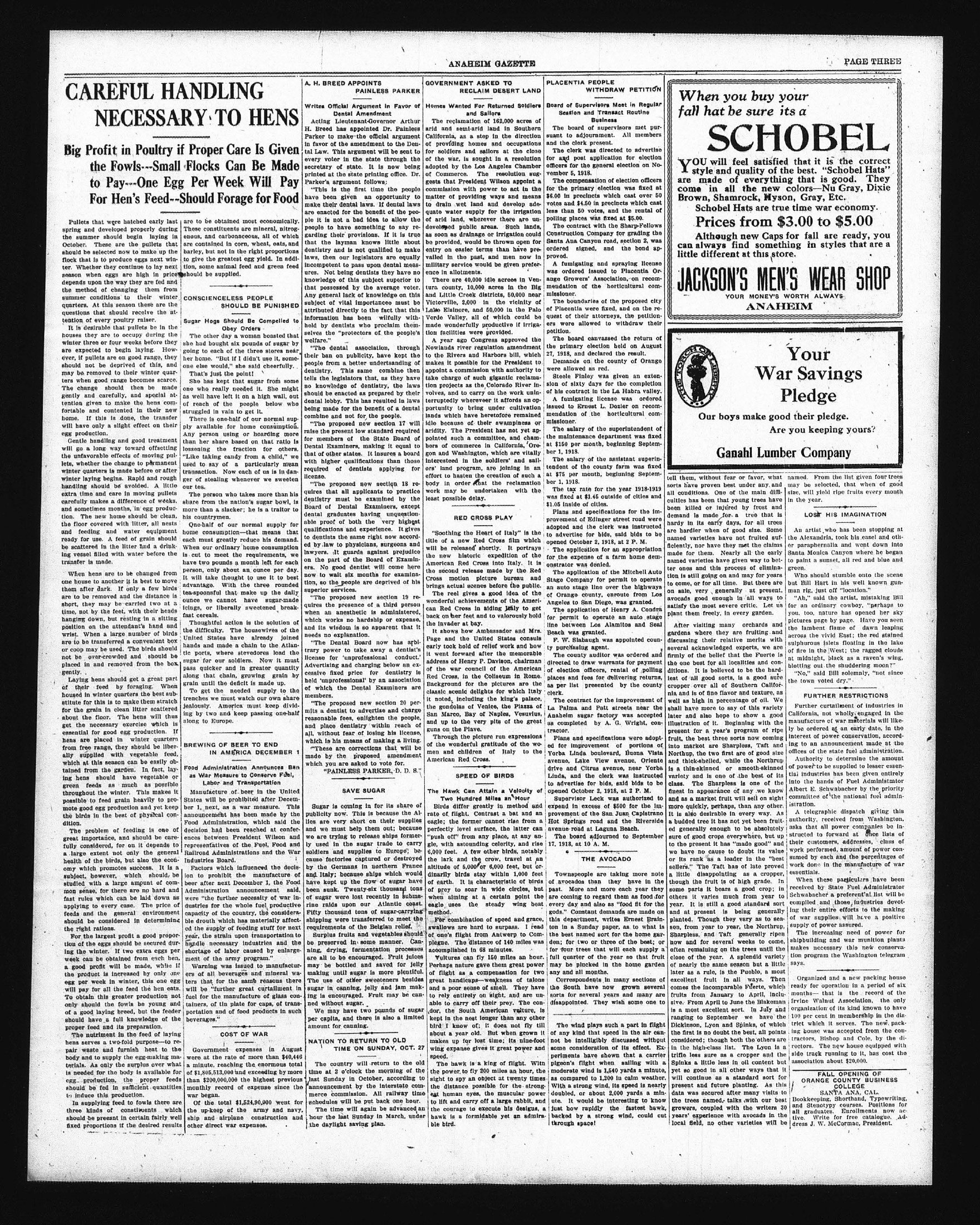
Searchable text
CAREFUL HANDLING NECESSARY TO HENS
Big Profit in Poultry if Proper Care Is Given the Fowls---Small Flocks Can Be Made to Pay---One Egg Per Week Will Pay For Hen’s Feed--Should Forage for Food
Pullets that were hatched early last spring and developed properly during the summer should begin laying in October. These are the pullets that should be selected now to make up the flock that is to produce eggs next winter. Whether they continue to lay next season when eggs are high in price depends upon the way they are fed and the method of changing them from summer conditions to their winter quarters. At this season these are the questions that should receive the attention of every poultry raiser.
It is desirable that pullets be in the houses they are to occupy during the winter three or four weeks before they are expected to begin laying. However, if pullets are on good range, they should not be deprived of this, and may be removed to their winter quarters when good range becomes scarce. The change should then be made gently and carefully, and special attention given to make the hens comfortable and contented in their new home. If this is done, the transfer will have only a slight effect on their egg production.
Gentle handling and good treatment will go a long way toward offsetting the unfavorable effects of moving pullets are to be obtained most economically. These constituents are mineral, nitrogenous, and carbonaceous, all of which are contained in corn, wheat, oats, and barley, but not in the right proportions to give the greatest egg yield. In addition, some animal feed and green feed should be supplied.
CONSCIENCELESS PEOPLE SHOULD BE PUNISHED
Sugar Hogs Should Be Compelled to Obey Orders
The other day a woman boasted that she had bought six pounds of sugar by going to each of the three stores near her home. "But if I didn't use it, someone else would," she said cheerfully.
That's just the point!
She has kept that sugar from one who really needed it. She might as well have left it on a high wall, out of reach of the people below who struggled in vain to get it.
There is one-half of our normal supply available for home consumption. Any person using or hoarding more than her share based on that ratio is lessening the fraction for others. "Like taking candy from a child," we
A. H. BREED APPROVED
Writes Official Argument
Dental Amendments
Acting Lieutenant
H. Breed has appointed Parker to make the amendments in favor of the amending Law. This argument every voter in the secretary of state printed at the state Parker's argument.
"This is the first have been given sage their dental lace are enacted for the people it is not a bad people to have some garding their provisions that the layman knows dentistry and is not laws, then our legislation incompetent to passures. Not being denied knowledge of this suit that possessed by the Any general lack of subject of vital importance attributed directly to information has been held by dentists who selves the "protector welfare."
"The dental assists their ban on public people from a better dentistry. This sam tells the legislators no knowledge of design should be enacted as dental lobby. This has being made for the b combine and not for"
"The proposed new raise the present low for members of the Dental Examiners, m that of other states."
should not be deprived of this, and may be removed to their winter quarters when good range becomes scarce. The change should then be made gently and carefully, and special attention given to make the hens comfortable and contented in their new home. If this is done, the transfer will have only a slight effect on their egg production.
Gentle handling and good treatment will go a long way toward offsetting the unfavorable effects of moving pullets, whether the change to permanent winter quarters is made before or after winter laying begins. Rapid and rough handling should be avoided. A little extra time and care in moving pullets carefully makes a difference of weeks, and sometimes months, in egg production. The new home should be clean, the floor covered with litter, all nests and feeding and water equipment ready for use. A feed of grain should be scattered in the litter and a drinking vessel filled with water before the transfer is made.
When hens are to be changed from one house to another it is best to move them after dark. If only a few birds are to be removed and the distance is short, they may be carried two at a time, not by the feet, with their heads hanging down, but resting in a sitting position on the attendant's hand and wrist. When a large number of birds are to be transferred a convenient box or coop may be used. The birds should not be over-crowded and should be placed in and removed from the box gently.
Laying hens should get a great part of their feed by foraging. When housed in winter quarters the best substitute for this is to make them stratch for the grain in clean litter scattered about the floor. The hens will thus get the necessary exercise which is essential for good egg production. If hens are placed in winter quarters from free range, they should be liberally supplied with vegetable feed, which at this season can be easily obtained from the garden. In fact, laying hens should have vegetable or green feeds as much as possible throughout the winter. This makes it possible to feed grain heavily to promote good egg production and yet keep the birds in the best of physical condition.
The problem of feeding is one of great importance, and should be carefully considered, for on it depends on a large extent not only the general health of the birds, but also the economic health of the farm.
BREWING OF BEER TO END IN AMERICA DECEMBER 1
Food Administration Announces Ban as War Measure to Conserve Fuel, Labor and Transportation
Manufacture of beer in the United States will be prohibited after December 1, next, as a war measure. This announcement has been made by the Food Administration, which said the decision had been reached at conferences between President Wilson and representatives of the Fuel, Food and Railroad Administrations and the War Industries Board.
SAVE S
Sugar is coming publicity now. This lies are very short and we must help them we are trying to really used in the sugar soldiers and supply cause factories capa-
In fact, laying hens should have vegetable or green feeds as much as possible throughout the winter. This makes it possible to feed grain heavily to promote good egg production and yet keep the birds in the best of physical condition.
The problem of feeding is one of great importance, and should be carefully considered, for on it depends to a large extent not only the general health of the birds, but also the economy which promotes success. It is a subject, however, which should be studied with a large amount of common sense, for there are no hard and fast rules which can be laid down as applying to every case. The price of feeds and the general environment should be considered in determining the right rations.
For the largest profit a good proportion of the eggs should be secured during the winter. If two extra eggs per week can be obtained from each hen, a good profit will be made, while if the product is increased by only one egg per week in winter, this one egg will pay for all the feed the hen eats. To obtain this greater production not only should the fowls be young and of a good laying breed, but the feeder should have a full knowledge of the proper feed and its preparation.
The nutriment in the feed of laying hens serves a two-fold purpose—to repair waste and furnish heat to the body and to supply the egg-making materials. As only the surplus over what is needed for the body is available for egg production, the proper feeds should be fed in sufficient quantities to induce this production.
In supplying feed to fowls there are three kinds of constituents which should be preesnt in certain fairly well fixed proportions if the desired results
Manufacture of beer in the United States will be prohibited after December 1, next, as a war measure. This announcement has been made by the Food Administration, which said the decision had been reached at conferences between President Wilson and representatives of the Fuel, Food and Railroad Administrations and the War Industries Board.
Factors which influenced the decision to prohibit the manufacture of beer after next December 1, the Food Administration announced said, were "the further necessity of war industries for the whole fuel productive capacity of the country, the considerable drought which has materially affected the supply of feeding stuff for next year, the strain upon transportation to handle necessary industries and the shortage of labor caused by enlargement of the army program."
Warning was issued to manufacturers of all beverages and mineral waters that for the same reasons there will be "further great curtailment in fuel for the manufacture of glass containers, of tin plate for caps, of transportation and of food products in such beverages."
COST OF WAR
Government expenses in August were at the rate of more than $40,446 a minute, reaching the enormous total of $1,805,513,000 and exceeding by more than $200,000,000 the highest previous monthly record of expense since the war began.
Of the total $1,524,90,000 went for the up-keep of the army and navy, ship and airplane construction and other direct war expenses.
ANAHEIM GAZETTE
A. H. BREED APPOINTS PAINLESS PARKER
Writes Official Argument in Favor of Dental Amendment
Acting Lieutenant-Governor Arthur H. Breed has appointed Dr. Painless Parker to make the official argument in favor of the amendment to the Dental Law. This argument will be sent to every voter in the state through the secretary of state. It is now being printed at the state printing office. Dr. Parker'a argument follows:
"This is the first time the people have been given an opportunity to make their dental laws. If dental laws are enacted for the benefit of the people it is not a bad idea to allow the people to have something to say regarding their provisions. If it is true that the layman knows little about dentistry and is not qualified to make laws, then our legislators are equally incompetent to pass upon dental measures. Not being dentists they have no knowledge of this subject superior to that possessed by the average voter. Any general lack of knowledge on this subject of vital importance must be attributed directly to the fact that this information has been wilfully withheld by dentists who proclaim themselves the "protectors of the people's welfare."
"The dental association, through their ban on publicity, have kept the people from a better undertanding of dentistry. This same combine then tells the legislators that, as they have no knowledge of dentistry, the laws should be enacted as prepared by their dental lobby. This has resulted in laws being made for the benefit of a dental combine and not for the people.
"The proposed new section 17 will raise the present low standard required for members of the State Board of Dental Examiners, making it equal to that of other states. It insures a board"
GOVERNMENT ASKED TO RECLAIM DESERT LAND
Homes Wanted For Returned Soldiers and Sailors
The reclamation of 162,000 acres of arid and semi-arid land in Southern California, as a step in the direction of providing homes and occupations for soldiers and sailors at the close of the war, is sought in a resolution adopted by the Los Angeles Chamber of Commerce. The resolution suggests that President Wilson appoint a commission with power to act in the matter of providing ways and means to drain wet land and develop adequate water supply for the irrigation of arid land, wherever there are undeveloped public areas. Such lands, as soon as drainage or irrigation could be provided, would be thrown open for entry on easier terms than have prevailed in the past, and men now in military service would be given preference in allotments.
There are 40,000 idle acres in Ventura county, 10,000 acres in the Big and Little Creek districts, 50,000 near Victorville, 2,000 in the vicinity of Lake Elsinore, and 50,000 in the Palo Verde Valley, all of which could be made wonderfully productive if irrigation facilities were provided.
A year ago Congress approved the Newlands river regulation amendment to the Rivers and Harbors bill, which makes it possible for the President to appoint a commission with authority to take charge of such gigantic reclamation projects as the Colorado River involves, and to carry on the work uninterruptedly whereever it affords an opportunity to bring under cultivation lands which have heretofore remained idle because of their swampiness or aridity. The President has not yet appointed such a committee, and chambers of commerce in California, Oregon and Washington, which are vitally
PLACENTIA PEOPLE WITHDRAW PETITION
Board of Supervisors Meet in Regular Session and Transact Routine Business
The board of supervisors met pursuant to adjournment. All members and the clerk present.
The clerk was directed to advertise for and post application for election officers for the general election on November 5, 1918.
The compensation of election officers for the primary election was fixed at $6.00 in precincts which cast over 50 votes and $4.50 in precincts which cast less than 50 votes, and the rental of polling places was fixed at $5.00.
The contract with the Sharp-Fellows Construction Company for grading the Santa Ana Canyon road, section 2, was ordered signed, and the bond approved.
A fumigating and spraying license was ordered issued to Placentia Orange Growers' Association, on recommendation of the horticultural commissioner.
The boundaries of the proposed city of Placentia were fixed, and on the request of their attorneys, the petitioners were allowed to withdraw their petition.
The board canvassed the return of the primary election held on August 27, 1918, and declared the result.
Demands on the county of Orange were allowed as red.
Steele Finley was given an extension of sixty days for the completion of his contract in the La Habra valley.
A fumigating license was ordered issued to Ernest L. Dozier on recommendation of the horticultural commissioner.
The salary of the superintendent of the maintenance department was fixed at $150 per month, beginning September 1, 1918.
people from a better undertaking of dentistry. This same combine then tells the legislators that, as they have no knowledge of dentistry, the laws should be enacted as prepared by their dental lobby. This has resulted in laws being made for the benefit of a dental combine and not for the people.
"The proposed new section 17 will raise the present low standard required for members of the State Board of Dental Examiners, making it equal to that of other states. It insures a board with higher qualifications than those required of dentists applying for license.
"The proposed new section 18 requires that all applicants to practice dentistry must be examined by the Board of Dental Examiners, except dental graduates having unquestionable proof of both the very highest qualifications and experience. It gives to dentists the same right now accorded by law to physicians, surgeons and lawyers. It guards against prejudice on the part of the Board of Examiners. No good dentist will come here now to wait six months for examination, so the people are deprived of his superior services.
"The proposed new section 19 requires the presence of a third person when an anesthetic is administered, which works no hardship or expense, and its wisdom is so apparent that it needs no explanation.
"The Dental Board now has arbitrary power to take away a dentist's license for 'unprofessional conduct.' Advertising and charging below an excessive fixed price for dentistry is held 'unprofessional' by an association of which the Dental Examiners are members.
"The proposed new section 20 permits a dentist to advertise and charge reasonable fees, enlighten the people, and place dentistry within reach of all, without fear of losing his license, which is his means of making a living.
"These are corrections that will be made by the proposed amendment which you are asked to vote for."
"PAINLESS PARKER, D. D. S."
SAVE SUGAR
Sugar is coming in for its share of publicity now. This is because the Allies are very short on their supplies and we must help them out; because we are trying to release ships formerly used in the sugar trade to carry soldiers and supplies to Europe; because factories captured or destroyed makes it possible for the President to appoint a commission with authority to take charge of such gigantic reclamation projects as the Colorado River involves, and to carry on the work uninterruptedly whereever it affords an opportunity to bring under cultivation lands which have heretofore remained idle because of their swampiness or aridity. The President has not yet appointed such a committee, and chambers of commerce in California, Oregon and Washington, which are vitally interested in the soldiers' and sailors' land program, are joining in an effort to hasten the creation of such a body in order that the reclamation work may be undertaken with the least possible delay.
RED CROSS PLAY
"Soothing the Heart of Italy" is the title of a new Red Cross film which will be released shortly. It portrays the new historic expedition of the American Red Cross into Italy. It is the second release made by the Red Cross motion picture bureau and brings actual scenes before the public.
The reel gives a good idea of the wonderful achievements of the American Red Cross in alding Italy to get back on her feet and to valorously hold the invader at bay.
It shows how Ambassador and Mrs. Page and the United States consuls early took hold of relief work and how it went forward after the memorable address of Henry P. Davison, chairman of the war council of the American Red Cross, in the Coliseum in Rome. Background for the pictures are the classic scenic delights for which Italy noted, including the king's palace, the gondolas of Venice, the Plazza of San Marco, Bay of Naples, Vesuvius, and up to the very plits of the great guns on the Plave.
Through the picture run expressions of the wonderful gratitude of the women and children of Italy to the American Red Cross.
SPEED OF BIRDS
The Hawk Can Attain a Velocity of Two Hundred Miles an Hour
Birds differ greatly in method and rate of flight. Contrast a bat and an eagle; the former cannot rise from a perfectly level surface, the latter can "push off" from any place, at any angle, with astounding celerity, and rise 6,000 feet. A few other birds, notably the lark and the crow, travel at an Demands on the county of Orange were allowed as red.
Steele Finley was given an extension of sixty days for the completion of his contract in the La Habra valley.
A fumigating license was ordered issued to Ernest L. Dozier on recommendation of the horticultural commissioner.
The salary of the superintendent of the maintenance department was fixed at $150 per month, beginning September 1, 1918.
The salary of the assistant superintendent of the county farm was fixed at $75 per month, beginning September 1, 1918.
The tax rate for the year 1918-1919 was fixed at $1.45 outside of cities and $1.05 inside of cities.
Plans and specifications for the improvement of Edinger street road were adopted and the clerk was instructed to advertise for bids, said bids to be opened October 2, 1918, at 2 P.M.
The application for an appropriation for the expense of a farm home demonstrator was denied.
The application of the Mitchell Auto Stage Company for permit to operate an auto stage line over the highways of Orange county, enroute from Los Angeles to San Diego, was granted.
The application of Henry A. Condra for permit to operate an auto stage line between Los Alamitos and Seal Beach was granted.
F. W. Slabaugh was appointed county purchasing agent.
The county auditor was ordered and directed to draw warrants for payment of election officers, rental of polling places and fees for delivering returns, as per list presented by the county clerk.
The contract for the improvement of La Palma and Patt streets near the Anaheim sugar factory was accepted as completed by A. G. Wright, contractor.
Plans and specifications were adopted for improvement of portions of Yorba Linda boulevard, Buena Vista avenue, Lake View avenue, Oriente drive and Citrus avenue, near Yorba Linda, and the clerk was instructed to advertise for bids, said bids to be opened October 2, 1918, at 2 P.M.
Supervisor Leck was authorized to expend in excess of $500 for the improvement of the San Juan Capistrano Hot Springs road and the Riverside avenue-road at Laguna Beach.
The board adjourned to September 17, 1918, at 10 A.M.
THE AVOCADO
"PAINLESS PARKER, D. D. S."
SAVE SUGAR
Sugar is coming in for its share of publicity now. This is because the Allies are very short on their supplies and we must help them out; because we are trying to release ships formerly used in the sugar trade to carry soldiers and supplies to Europe; because factories captured or destroyed by the Germans in northern France and Italy; because ships which would have kept up the flow of sugar have been sunk. Twenty-six thousand tons of sugar were lost recently in submarine raids upon our Atlantic coast. Fifty thousand tons of sugar-carrying shipping were transferred to meet the requirements of the Belgian relief.
Surplus fruits and vegetables should be preserved in some manner. Canning, drying, fermentation processes are all to be encouraged. Fruit juices may be bottled and saved for jelly making until sugar is more plentiful. The use of other sweeteners besides sugar in canning, jelly and jam making is encouraged. Fruit may be canned without sugar.
We may have two pounds of sugar per capita, and there is also a limited amount for canning.
NATION TO RETURN TO OLD TIME ON SUNDAY, OCT. 27
The country will return to the old time at 2 o'clock the morning of the last Sunday in October, according to announcement by the interstate commerce commission. All railway time schedules will be put back one hour.
The time will again be advanced an hour the last Sunday in March, under the daylight saving plan.
SPEED OF BIRDS
The Hawk Can Attain a Velocity of Two Hundred Miles an Hour
Birds differ greatly in method and rate of flight. Contrast a bat and an eagle; the former cannot rise from a perfectly level surface, the latter can "push off" from any place, at any angle, with astounding celerity, and rise 6,000 feet. A few other birds, notably the lark and the crow, travel at an altitude of 5,000 or 6,000 feet, but ordinarily birds stay within 1,000 feet of earth. It is characteristic of birds of prey to soar in wide circles, but when aiming at a certain point the eagle uses the steady wing beat method.
For combination of speed and grace, swallows are hard to surpass. I read of one's flight from Antwerp to Complegne. The distance of 140 miles was accomplished in 68 minutes.
Vultures can fly 150 miles an hour. Perhaps nature gave them great power of flight as a compensation for two great handicaps—weakness of talons and a poor sense of smell. They have to rely entirely on sight, and are unable to carry off their prey. The condor, the South American vulture, is kept in the nest longer than any other bird I know of; it does not fly till about a year old. But when grown it makes up for lost time; its nine-foot wing expanse gives it great power and speed.
The hawk is a king of flight. With the power to fly 200 miles an hour, the sight to spy an object at twenty times the distance possible for the strongest human eyes, the muscular power to lift and carry off a large rabbit, and the courage to execute his designs, a hawk is a formidable yet an admirable bird.
THE AVOCADO
Townspeople are taking more note of avocados than they have in the past. More and more each year they are coming to regard them as food for every day and also as "food fit for the gods." Constant demands are made on this department, writes Ernest Brainton in a Sunday paper, as to what is the best named sort for the home garden; for two or three of the best; or for four trees that will each supply a full quarter of the year so that fruit may be plucked in the home garden any and all months.
Correspondents in many sections of the South have now grown several sorts for several years and many are disappointed. They wish some one to
The wind plays such a part in flight of any kind that speed in the air cannot be intelligibly discussed without some consideration of its effect. Experiments have shown that a carrier pigeon's flight when sailing with a moderate wind is 1,540 yards a minute, as compared to 1,200 in calm weather. With a strong wind, its speed is nearly doubled, or about 2,000 yards a minute. It would be interesting to know just how rapidly the fastest hawk, backed by a strong wind, could cut through space!
When you buy your fall hat be sure its a SCHOBEL
YOU will feel satisfied that it is the correct style and quality of the best. "Schobel Hats" are made of everything that is good. They come in all the new colors—Nu Gray, Dixie Brown, Shamrock, Myson, Gray, Etc.
Schobel Hats are true time war economy.
Prices from $3.00 to $5.00
Although new Caps for fall are ready, you can always find something in styles that are a little different at this store.
JACKSON'S MEN'S WEAR SHOP
YOUR MONEY'S WORTH ALWAYS
ANAHEIM
Your War Savings Pledge
Our boys make good their pledge.
Are you keeping yours?
Ganahl Lumber Company
War Savings Pledge
Our boys make good their pledge.
Are you keeping yours?
Ganahl Lumber Company
tell them, without fear or favor, what sorts have proven best under any and all conditions. One of the main difficulties has been that young trees have been killed or injured by frost and demand is made for a tree that is hardy in its early days, for all trees are harder when of good size. Some named varieties have not fruited sufficiently, nor have they met the claims made for them. Nearly all the early named varieties have given way to better ones and this process of elimination is still going on and may for years to come, or for all time. But there are on sale, very generally at present, avocads good enough in all ways to satisfy the most severe critic. Let us plant them freely, in every garden.
After visiting many orchards and gardens where they are fruiting and discussing their relative merits with several acknowledged experts, we are firmly of the belief that the Fuente is the one best for all localities and conditions. It is believed to be the hardest of all good sorts, is a good sure cropper over all of Southern California and is of fine flavor and texture, as well as high in percentage of oil. We shall have more to say of this variety later and also hope to show a good illustration of it. Beginning with the present for a year's program of ripe fruit, the best three sorts now coming into market are Sharpless, Taft and Northup, the two first are of good size and thick-shelled, while the Northrup is a thin-skinned or smooth-skinned variety and is one of the best of its class. The Sharpless is one of the finest in appearance of any we know and as a market fruit will sell on sight more quickly, perhaps, than any other. It is also desirable in every way. As a budded tree it has not yet been fruited generally enough to be absolutely sure of good crops everywhere, but up to the present it has "made good" and we have no cause to doubt its value or its rank as a leader in the "best seller." The Taft box has late proved named. From the list given four trees may be selected, that when of good size, will yield ripe fruits every month in the year.
LOST HIS IMAGINATION
An artist who has been stopping at the Alexandria, took his easel and other paraphernalla and went down into Santa Monica Canyon where he began to paint a sunset, all red and blue and green.
Who should stumble onto the scene but Bill Hart in his well known gunman rig, just off "location."
"Ah," said the artist, mistaking Bill for an ordinary cowboy, "merhaps to you, too, nature has opened her sky pictures page by page. Have you seen the lambent flame of dawn leaping across the vivid East; the red stained sulphurous islets floating in the lake of fire in the West; the ragged clouds at midnight, black as a raven's wing, blotting out the shuddering moon?"
"No," said Bill solemnly, "not since the town voted dry."
FURTHER RESTRICTIONS
Further curtailment of industries in California, not wholly engaged in the manufacture of war materials will likely be ordered at an early date, in the interest of power conservation, according to an announcement made at the offices of the state fuel administration.
Authority to determine the amount of power to be supplied to lesser essential industries has been given entirely into the hands of Fuel Administrator Albert E. Schwabacher by the priority committee of the national fuel administration.
A telegraphic dispatch giving this authority, received from Washington, asks that all power companies be instructed to forward at once lists of their customers, addresses, class of work performed, amount of power consumed by each and the percentages of work done in the manufacture of war
making more note they have in the each year they them as food for "food fit for the hands are made on Ernest Brainer, as to what is for the home garden of the best; or will each supply a year so that fruit the home garden many sections of grown several years and many are wish some one to
with a part in flight and in the air can discussed without of its effect. Exn that a carrier sailing with a 200 yards a minute, in calm weather, its speed is nearly 1000 yards a min interesting to know the fastest hawk, wind, could cut
is a thin-skinned or smooth-skinned variety and is one of the best of its class. The Sharpless is one of the finest in appearance of any we know and as a market fruit will sell on sight more quickly, perhaps, than any other. It is also desirable in every way. As a budded tree it has not yet been fruited generally enough to be absolutely sure of good crops everywhere, but up to the present it has "made good" and we have no cause to doubt its value or its rank as a leader in the "best sellers." The Taft has of late proved a little disappointing as a cropper, though the fruit is of high grade. In some parts it bears a good crop; in others it varies much from year to year. It is still a good standard sort and at present is being generally planted. Though they vary as to season, from year to year, the Northrup, Sharpless, and Taft generally ripen now and for several weeks to come, often remaining on the trees until the close of the year. A splendid variety of nearly the same season but a little later as a rule, is the Pueblo, a most excellent fruit in all ways. Then comes the incomparable Fuerte, which fruits from January to April, inclusive. From April to June the Blakeman is a most excellent sort. In July and ranging to September we have the Dickinson, Lyon and Spinks, of which the first is no doubt the best, all points considered; though both the others are in the high-class list. The Lyon is a trifle less sure as a cropper and the Spinks a little less in oil content but yet so good in all other ways that it will continue as a standard sort for present and future planting. As this data was secured after many visits to the trees named, talks with our best growers, coupled with the writers 30 years' experience with avocads in the local field, no other varieties will be
A telegraphic dispatch giving this authority, received from Washington, asks that all power companies be instructed to forward at once lists of their customers, addresses, class of work performed, amount of power consumed by each and the percentages of work done in the manufacture of war essentials.
When these particulars have been received by State Fuel Administrator Schwabacher a preferential list will be compiled and those industries devoting their entire efforts to the making of war supplies will have a positive supply of power assured.
The increasing need of power for shipbuilding and war munition plants makes necessary this new conservation program the Washington telegram says.
Organized and a new packing house ready for operation in a period of six months—that is the record of the Irvine Walnut Association, the only organization of its kind known to have 100 per cent in membership in the district which it serves. The new packing house was accepted from the contractors, Bishop and Cole, by the directors. The new house equipped with side track running to it, has cost the association about $20,000.
FALL OPENING OF ORANGE COUNTY BUSINESS COLLEGE
SANTA ANA, CAL.
Bookkeeping, Shorthand, Typewriting, and Stenotypy courses. Positions for all graduates. Enrollments now active. Write for free catalogue. Address J. W. McCormac, President.