anaheim-gazette 1918-08-22
Scanned page
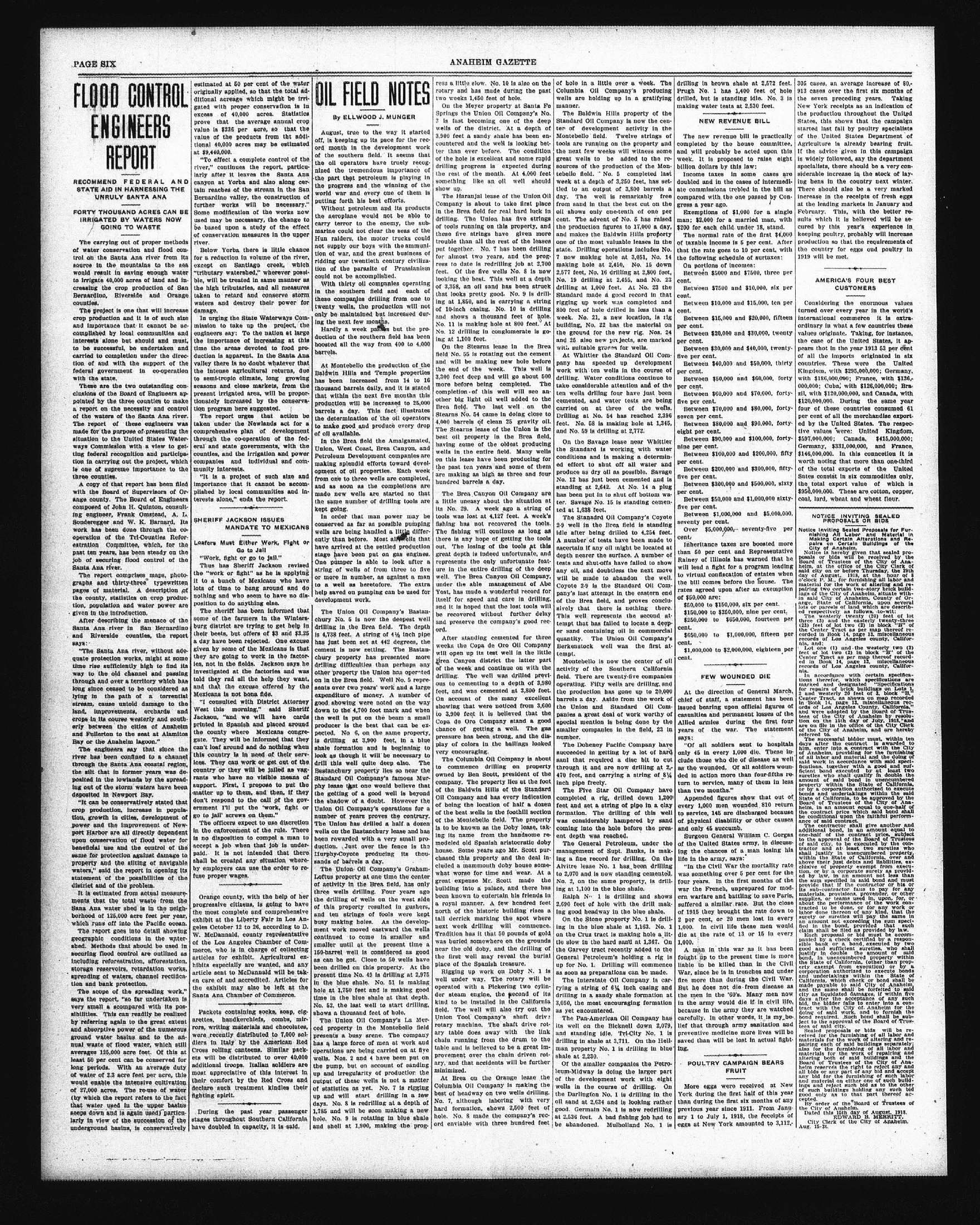
Searchable text
FLOOD CONTROL ENGINEERS REPORT
RECOMMEND FEDERAL AND STATE AID IN HARNESSING THE UNRULY SANTA ANA
FORTY THOUSAND ACRES CAN BE IRRIGATED BY WATERS NOW GOING TO WASTE
The carrying out of proper methods of water conservation and flood control on the Santa Ana river from its source in the mountains to the sea would result in saving enough water to irrigate 40,000 acres of land and increasing the crop production of San Bernardino, Riverside and Orange counties.
The project is one that will increase crop production and it is of such size and importance that it cannot be accomplished by local communities and interests alone but should and must, to be successful, be undertaken and carried to completion under the direction of and with the support of the federal government in co-operation with the state.
These are the two outstanding conclusions of the Board of Engineers appointed by the three counties to make a report on the necessity and control of the waters of the Santa Ana river. The report of these engineers was made for the purpose of presenting the situation to the United States Waterways Commission with a view to getting federal recognition and participation estimated at 50 per cent of the water originally applied, so that the total additional acreage which might be irrigated with proper conservation is in excess of 40,000 acres. Statistics prove that the average annual crop value is $236 per acre, so that the value of the products from the additional 40,000 acres may be estimated at $9,440,000.
"To effect a complete control of the river," continues the report, particularly after it leaves the Santa Ana canyon at Yorba and also along certain reaches of the stream in the San Bernardino valley, the construction of further works will be necessary."
Some modification of the works now used may be necessary, the change to be based upon a study of the effect of conservation measures in the upper river.
Below Yorba there is little chance for a reduction in volume of the river, except on Santiago creek, which "tributary watershed," wherever possible, will be treated in same manner as the high tributaries, and all measures taken to retard and conserve storm waters and destroy their power for damage.
In urging the State Waterways Commission to take up the project, the engineers say: To the nation at large the importance of increasing at this time the areas devoted to food production is apparent. In the Santa Ana valley there is no doubt whatever that the intense agricultural returns, due to semi-tropical climate, long growing seasons and close markets, from the present irrigated area, will be proportionately increased by the conservation program here suggested.
The report urges that action be taken under the Newlands act for a comprehensive plan of development through the co-operation of the federal and state governments, with the counties, and the irrigation and power
OIL FIELD
By ELLWOOD
August, true to off, is keeping up ord month in th of the southern oil operators nized the tremen-the part that pet the progress and world war and e putting forth his Without petrolthe aeroplane w carry terror to marine could not Hun raiders, they not supply our bention of war, and ridding our twention of the para could not be acco With thirty oil in the southern these companies twenty wells, they only be maintaining next few Hardly a week duction of the so boosted all the w barrels.
At Montebello Baldwin Hills and has been increse thousand barrels that within the reproduction will barrels a day. the determination to make good ane of oil available.
In the Brea fle Union, West Coast Petroleum Develo
tion of and with the support of the federal government in co-operation with the state.
These are the two outstanding conclusions of the Board of Engineers appointed by the three counties to make a report on the necessity and control of the waters of the Santa Ana river. The report of these engineers was made for the purpose of presenting the situation to the United States Waterways Commission with a view to getting federal recognition and participation in carrying out the project, which is one of supreme importance to the three counties.
A copy of that report has been filed with the Board of Supervisors of Orange county. The Board of Engineers composed of John H. Quinton, consulting engineer, Frank Omstead, A. L. Sonderegger and W. K. Barnard. Its work has been done through the cooperation of the Tri-Counties Reforestation Committee, which, for the past ten years, has been steady on the job of securing flood control of the Santa Ana river.
The report comprises maps, photographs and thirty-three typewritten pages of material. A description of the county, statistics on crop production, population and water power are given in the introduction.
After describing the menace of the Santa Ana river in San Bernardino and Riverside counties, the report says:
"The Santa Ana river, without adequate protection works, might at some time rise sufficiently high to find its way to the old channel and passing through and over a territory which has long since ceased to be considered as lying in the path of a torrential stream, cause untold damage to the land, improvements, orchards and crops in its course westerly and southly between the cities of Anaheim and Fullerton to the seat at Alamitos Bay or the Anaheim lagoon."
The engineers say that since the river has been confined to a channel through the Santa Ana coastal region, the silt that in former years was deposited in the lowlands by the spreading out of the storm waters have been deposited in Newport Bay.
"It can be conservatively stated that crop production, increase in population, growth in cities, development of power and the improvement of Newport Harbor are all directly dependent upon conservation of flood water for beneficial use and the control of the same for protection against damage to property and the slitting of navigable valley there is no doubt whatever that the intense agricultural returns, due to semi-tropic climate, long growing seasons and close markets, from the present irrigated area, will be proportionately increased by the conservation program here suggested.
The report urges that action be taken under the Newlands act for a comprehensive plan of development through the co-operation of the federal and state governments, with the counties, and the irrigation and power companies and individual and community interests.
"It is a project of such size and importance that it cannot be accomplished by local communities and interests alone," ends the report.
SHERIFF JACKSON ISSUES MANDATE TO MEXICANS
Loafers Must Either Work, Flight or Go to Jail
"Work, fight or go to jail."
Thus has Sheriff Jackson revised the "work or fight" as he is applying it to a bunch of Mexicans who have lots of time to hang around and do nothing and who seem to have no disposition to do anything else.
The sheriff has been informed that some of the farmers in the Wintersburg district are trying to get help in their beets, but offers of $3 and $3.25 a day have been rejected. One excuse given by some of the Mexicans is that they are going to work in the factories, not in the fields. Jackson says he investigated at the factories and was told they rad all the help they want, and that the excuse offered by the Mexicans is not bona fide.
"I consulted with District Attorney West this morning," said Sheriff Jackson, "and we will have cards printed in Spanish and placed around the county where Mexicans congregate. They will be informed that they can't loaf around and do nothing when this country is in need of their services. They can work or get out of the country or they will be jailed as vagrants who have no visible means of support. First, I propose to put the matter up to them, and then, if they don't respond to the call of the government I'll put the 'work, flight or go to jail' screws on them."
The officers expect to use discretion in the enforcement of the rule. There is no disposition to compel a man to accept a job when that job is underpaid. It is not intended that there shall be created any situation where-
At Montebello Baldwin Hills and has been increased thousand barrels that within the new production will be barrels a day. The determination to make good and oil available.
In the Brea flea Union, West Coast Petroleum Development making splendid development of oil prince from one to three and as soon as made new wells the same number kept going.
In order that conserved as far wells are being held entirely than before have arrived at stage have been One pumper is string of wells or more in number to a well as he help saved on pump development work.
The Union Oil chury No. 5 is now drilling in the Brea is 4,738 feet. A sash has just been seized cement is now seized property drilling difficult other property tha on in the Brea flea sentes over two year expenditure of no good showing west down to the 4,700 feet well is put on producer is thepected. No 6. ois drilling at 33 shale formation look as though it drill this well quay Bastanchury prop Standard Oil Company lease that on the getting of a shadow of a Union Oil Company number of years. The Union has dwells on the Basta been rewarded wduction. Just ov Murphy-Coyote sands of barrels
the silt that in former years was deposited in the lowlands by the spreading out of the storm waters have been deposited in Newport Bay.
"It can be conservatively stated that crop production, increase in population, growth in cities, development of power and the improvement of Newport Harbor are all directly dependent upon conservation of flood water for beneficial use and the control of the same for protection against damage to property and the slitting of navigable waters," said the report in opening its statement of the possibilities of the district and of the problem.
It is estimated from actual measurements that the total waste from the Sana Ana water shed is in the neighborhood of 125,000 acre feet per year, which runs off into the Pacific ocean.
The report goes into detail showing geographic conditions in the watershed. Methods that should be used in securing flood control are outlined as including reforestation, afforestation, storage reservoirs, retardation works, spreading of waters, channel rectification and bank protection.
The scope of the spreading work," says the report, "so far undertaken is very small a compared with its possibilities. This can readily be realized by referring again to the great extent and absorptive power of the numerous ground water basins and to the annual waste of flood water, which still averages 125,000 acre feet. Of this at least 50 per cent can be conserved for long periods. With an average duty of water of 2.3 acre feet per acre, this would enable the intensive cultivation of 27,000 acres. The re-use of water (by which the report refers to the fact that water used in the upper basins seeps down and is again used) particularly in view of the succession of the underground basins, is conservatively
Orange county, with the help of her progressive citizens, is going to have the most complete and comprehensive exhibit at the Liberty Fair in Los Angeles October 12 to 26, according to D. W. McDannald, county representative of the Los Angeles Chamber of Commerce, who is in charge of collecting articles for exhibit. Agricultural exhibits especially are wanted, and any article sent to McDannald will be taken care of and accredited. Articles for the exhibit may also be left at the Santa Ana Chamber of Commerce.
Packets containing socks, soap, cigarettes, handkerchiefs, combs, mirrors, writing materials and chocolates, were recently distributed to 7,000 soldiers in Italy by the American Red Cross rolling canteens. Similar packets will be distributed to over 40,000 additional troops. Italian soldiers are most appreciative of this interest in their comfort by the Red Cross and declare such treatment kindles their fighting spirit.
During the past year passenger stages throughout Southern California have doubled in capacity, it is said.
Bastanchury property Standard Oil Company phy lease that on the getting of a Union Oil Company number of years The Union has done wells on the Bastanchue been rewarded wreduction. Just over Murphy-Coyote sands of barrels The Union Oil Loftus property area of activity in these three wells drilling the drilling of wells of this property and ten strings busy making holdment work moved continued to continue smaller until at 150-barrel well is as can be got. Cone been drilled on the present time No. In the blue shale hole at 1,750 feet time in the blue No. 52, the last week shows a thousand.
The Union Oil ced property in presents a busy has a large force operations are better wells. Nos. 2 and the pump, but one up and irregular output of these wwf statistics as yeup and will stand days. No. 8 is red 1,785 and will be a hole. No. 9 is road and shell at 1,900
ANAHEIM GAZETTE
OIL FIELD NOTES
By ELLWOOD J. MUNGER
August, true to the way it started off, is keeping up its pace for the record month in the development work of the southern field. It seems that the oil operators have truly recognized the tremendous importance of the part that petroleum is playing in the progress and the winning of the world war and every one of them is putting forth his best efforts.
Without petroleum and its products the aeroplane would not be able to carry terror to the enemy, the submarine could not clear the seas of the Hun raiders, the motor trucks could not supply our boys with the ammunition of war, and the great business of ridding our twentieth century civilization of the parasite of Prussianism could not be accomplished.
With thirty oil companies operating in the southern field and each of these companies drilling from one to twenty wells, the production will not only be maintained but increased during the next few months.
Hardly a week passes but the production of the southern field has been boosted all the way from 400 to 4,000 barrels.
At Montebello the production of the Baldwin Hills and Temple properties has been increased from 14 to 16 thousand barrels daily, and it is stated that within the next five months this production will be increased to 25,000 barrels a day. This fact illustrates the determination of the oil operators to make good and produce every drop of oil available.
In the Brea field the Amalgamated, Union, West Coast, Brea Canyon, and Petroleum Development companies are press a little slow. No. 10 is also on the rotary and has made during the past two weeks 1,450 feet of hole.
On the Meyer property at Santa Fe Springs the Union Oil Company's No. 3 is fast becoming one of the deep wells of the district. At a depth of 3,900 feet a sandy shale has been encountered and the well is looking better than ever before. The condition of the hole is excellent and some rapid drilling progress is expected during the rest of the month. At 4,000 feet something like an oil well should show up.
The Haranjal lease of the Union Oil Company is about to take first place in the Brea field for real hard luck in drilling. The Union has five strings of tools running on this property, and these five strings have given more trouble than all the rest of the leases put together. No. 7 has been drilling for almost two years, and the progress to date is redrilling job at 2,700 feet. Of the five wells No. 8 is now looking the best. This well at a depth of 3,358, an oil sand has been struck that looks pretty good. No. 9 is drilling at 1,850, and is carrying a string of 10-inch casing. No. 10 is drilling and shows a thousand feet of hole. No. 11 is making hole at 800 feet. At No. 12 drilling in conglomerate is going at 1,100 feet.
On the Stearns lease in the Brea field No. 55 is rotating out the cement and will be making new hole before the end of the week. This well is 3,300 feet deep and will go about 500 more before being completed. The completion of this well will see another big light oil well added to the Brea field. The last well on the Stearns No. 54 came in doing close to 4,000 barrels of clean 25 gravity oil. The Stearns lease of the Union is the best oil property in the Brea field, having some of the oldest producing wells in the entire field. Many wells of hole in a little over a week. The Columbia Oil Company's producing wells are holding up in a gratifying manner.
The Baldwin Hills property of the Standard Oil Company is now the center of development activity in the Montebello field. Twelve strings of tools are running on the property and the next few weeks will witness some great wells to be added to the resources of the production of the Montebello field. No. 5 completed last week at a depth of 3,250 feet, has settled to an output of 3,800 barrels a day. The well is remarkably free from sand in that best cut on the oil shows only one-tenth of one percent. The advent of No. 5 has raised the production figures to 17,000 a day, and makes the Baldwin Hills property one of the most valuable leases in the state. Drilling operations includes No. 7 now making hole at 3,051, No. 14 making hole at 2,450, No. 15 down 2,577 feet, No. 16 drilling at 2,800 feet, No. 19 drilling at 2,455, and No. 23 drilling at 1,000 feet. At No. 23 the Standard made a good record in that rigging up work was completed and 800 feet of hole drilled in less than a week. No. 21, a new location, is rig building, No. 22 has the material on the ground for the new rig. Nos. 24 and 25 also new projects, are marked with suitable grades for wells.
At Whittier the Standard Oil Company has speeded up development work with ten wells in the course of drilling. Water conditions continue to take considerable attention and of the ten wells drilling four have just been cemented, and water tests are being carried on at three of the wells. Drilling at No. 54 has reached 2,396 feet. No. 58 is making hole at 1,345, and No. 59 is drilling at 2,772.
On the Savage lease near Whittier the Standard is working with water conditions and is making a determinate
At Montebello the production of the Baldwin Hills and Temple properties has been increased from 14 to 16 thousand barrels daily, and it is stated that within the next five months this production will be increased to 25,000 barrels a day. This fact illustrates the determination of the oil operators to make good and produce every drop of oil available.
In the Brea field the Amalgamated, Union, West Coast, Brea Canyon, and Petroleum Development companies are making splendid efforts toward development of oil properties. Each week from one to three wells are completed, and as soon as the completions are made new wells are started so that the same number of drilling tools are kept going.
In order that man power may be conserved as far as possible pumping wells are being handled a little differently than before. Most all wells that have arrived at the settled production stage have been put on gas engines. One pumper is able to look after a string of wells of from three to five or more in number, as against a man to a well as heretofore. The extra help saved on pumping can be used for development work.
The Union Oil Company's Bastanchury No. 5 is now the deepest well drilling in the Brea field. The depth is 4,738 feet. A string of 4½ inch pipe has just been set at 442 degrees, the cement is now setting. The Bastanchury property has presented more drilling difficulties than perhaps any other property the Union has operated on in the Brea field. Well No. 5 represents over two years' work and a large expenditure of money. A number of good showing were noted on the way down to the 4,700 foot mark and when the well is put on the beam a small producer is the best that can be expected. No 6, on the same property, is drilling at 3,900 feet, in a blue shale formation and is beginning to look as though it will be necessary to drill this well quite deep also. The Bastanchury property lies so near the Standard Oil Company's famous Murphy lease that one would believe that the getting of a good well is beyond the shadow of a doubt. However the Union Oil Company's operations for a number of years proves the contrary. The Union has drilled a half dozen wells on the Bastanchury lease and has been rewarded with a very small production. Just over the fence is the Murphy-Coyote producing its thousands of barrels a day.
and will be making new hole before the end of the week. This well is 3,300 feet deep and will go about 500 more before being completed. The completion of this well will see another big light oil well added to the Brea field. The last well on the Stearns No. 54 came in doing close to 4,000 barrels of clean 25 gravity oil. The Stearns lease of the Union is the best oil property in the Brea field, having some of the oldest producing wells in the entire field. Many wells on this lease have been producing for the past ten years and some of them are making as high as three and four hundred barrels a day.
The Brea Canyon Oil Company are a little uneasy about the situation at its No. 29. A week ago a string of tools was lost at 4,127 feet. A week's fishing has not recovered the tools. The fishing will continue as long as there is any hope of getting the tools out. The losing of the tools at this great depth is indeed unfortunate, and represents the only unfortunate feature in the entire drilling of the deep well. The Brea Canyon Oil Company, under the able management of Abe Yost, has made a wonderful record for itself for speed and care in drilling, and it is hoped that the lost tools will be recovered without further delay and preserve the company's good record.
After standing cemented for three weeks the Copa de Oro Oil Company will open up its test well in the little Brea Canyon district the latter part of the week and continue on with the drilling. The well was drilled previous to cementing to a depth of 3,980 feet, and was cemented at 3,800 feet. On account of the many excellent showing that were noticed from 3,600 to 3,900 feet it is believed that the Copa de Oro Company stand a good chance of getting a well. The gas pressure has been strong, and the display of colors in the ballings looked very encouraging.
The Columbia Oil Company is about to commence drilling on property owned by Ben Scott, president of the company. The property lies at the foot of the Baldwin Hills of the Standard Oil Company and has every indication of being the location of half a dozen of the best wells in the foothill section of the Montebello field. The property is to be known as the Doby lease, taking its name from the handsome remodeled old Spanish aristocratic doby house. Some years ago Mr. Scott purchased this property and the deal included a mammouth doby house some
pany has speeded up development work with ten wells in the course of drilling. Water conditions continue to take considerable attention and of the ten wells drilling four have just been cemented, and water tests are being carried on at three of the wells. Drilling at No. 54 has reached 2,396 feet. No. 58 is making hole at 1,345, and No. 59 is drilling at 2,772.
On the Savage lease near Whittier the Standard is working with water conditions and is making a determined effort to shut off all water and produce as dry oil as possible. Savage No. 12 has just been cemented and is standing at 2,642. At No. 14 a plug has been put in to shut off bottom water. Savage No. 15 is standing cemented at 1,638 feet.
The Stanadrd Oil Company's Coyote 2-9 well in the Brea field is standing idle after being drilled to 4,254 feet. A number of tests have been made to ascertain if any oil might be located at depth nearer the surface. A number of tests and shut-offs have failed to show any oil, and doubtless the next move will be made to abandon the well. Coyote 2-9 is the Standard Oil Company's last attempt in the eastern end of the Brea field, and proves conclusively that there is nothing there. This well represents the second attempt that has failed to locate a deeper sand containing oil in commercial quantity. The Union Oil Company's Berkenstock well was the first attempt.
Montebello is now the center of oil activity of the Southern California field. There are twenty-five companies operating. Fifty wells are drilling, and the production has gone up to 20,000 barrels a day. Aside from the work of the Union and Standard Oil Companies a great deal of work worthy of special mention is being done by the smaller companies in the field, 23 in number.
The Doheney Pacific Company have succeeded in getting by a lot of hard sand that required a disc bit to cut through it and are now drilling at 2-470 feet, and carrying a string of 8¼ inch pipe freely.
The Five Star Oil Company have completed a rig, drilled down 1,200 feet and set a string of pipe in a clay formation. The drilling of this well was considerably hampered by sand coming into the hole before the present depth was reached.
The General Petroleum, under the management of Supt. Banks, is making a fine record for drilling. On the Aluite lease No.1 has been drilling
Bastanchury property lies so near the Standard Oil Company's famous Murphy lease that one would believe that the getting of a good well is beyond the shadow of a doubt. However the Union Oil Company's operations for a number of years proves the contrary. The Union has drilled a half a dozen wells on the Bastanchury lease and has been rewarded with a very small production. Just over the fence is the Murphy-Coyote producing thousands of barrels a day.
The Union Oil Company's Graham-Loftus property at one time the center of activity in the Brea field, has only three wells drilling. Four years ago the drilling of wells on the west side of this property resulted in gushers, and ten strings of tools were kept busy making holes. As the development work moved eastward the wells continued to come in smaller and smaller until at the present time a 150-barrel well is considered as good as can be got. Close to 50 wells have been drilled on this property. At the present time No. 49 is drilling at 2,975 in the blue shale. No. 51 is making hole at 1,750 feet and is making good time in the blue shale at that depth. No. 52, the last well to start drilling, shows a thousand feet of hole.
The Union Oil Company's La Merced property in the Montebello field presents a busy srene. The company has a large force of men at work and operations are being carried on at five wells. Nos. 2 and 4 have been put on the pump, but on account of sanding up and irregularity of production the output of these wells is not a matter of statistics as yet. No. 7 is rigging up and will start drilling in a few days. No. 8 is redrilling at a depth of 1,785 and will be soon making a new hole. No. 9 is rotating in blue shale and shell at 1,900, making the program owned by Ben Scott, president of the company. The property lies at the foot of the Baldwin Hills of the Standard Oil Company and has every indication of being the location of half a dozen of the best wells in the foothill section of the Montebello field. The property is to be known as the Doby lease, taking its name from the handsome remodeled old Spanish aristocratic doy house. Some years ago Mr. Scott purchased this property and the deal included a mammouth doby house somewhat worse for time and wear. At great expense Mr. Scott made the building into a palace, and there has been known to entertain his friends in a royal manner. A few hundred feet north of the historic building rises a tall derrick marking the spot where next week drilling will commence. Tradition has it that 50 pounds of gold was buried somewhere on the grounds near the old doby, and the drilling of the first well may reveal the burial place of the Spanish treasure.
Rigging up work on Doby N. 1 is well under way. The rotary will be operated with a Pickering two cylinder steam engine, the second of its kind to be installed in the California field. The well will also try out the Union Tool Company's shaft drive rotary machine. The shaft drive rotary table does away with the link chain running from the drum to the table and is believed to be a great improvement over the chain driven rotary, and that accidents will be further minimized.
At Brea on the Orange lease the Columbia Oil Company is making the best of headway on two wells drilling. No. 7, although laboring with very hard formation, shows 2,500 feet of hole. No. 8 made the company's record enviable with three hundred feet through it and are now drilling at 2,470 feet, and carrying a string of 8¼ inch pipe freely.
The Five Star Oil Company have completed a rig, drilled down 1,200 feet and set a string of pipe in a clay formation. The drilling of this well was considerably hampered by sand coming into the hole before the present depth was reached.
The General Petroleum, under the management of Supt. Banks, is making a fine record for drilling. On the Alvitre lease No. 1 has been drilling to 2,070 and is now standing cemented. No. 2, on the same property, is drilling at 1,100 in the blue shale.
Ralph N. 1 is drilling and shows 2,690 feet of hole with the drill making good headway in the blue shale.
On the Stone property No. 1 is drilling in the blue shale at 1,163. No. 1 on the Cruz tract is making hole a little slow in the hard sand at 1,367. On the Garvey tract recently added to the General Petroleum's holding a rig is up for No. 1. Drilling will commence as soon as preparations can be made.
The Interstate Oil Company is carrying a string of 6¼ inch casing and drilling in a sandy shale formation at 3,050, the most encouraging formation as yet encountered.
The Pan-American Oil Company has its well on the Bicknell down 2,079, and standing idle. Tri-City No. 1 is drilling in shale at 3,711. On the Hellman property No. 1 is drilling in blue shale at 2,230.
Of the smaller companies the Petroleum-Midway is doing the larger part of the development work with eight wells in the course of drilling. On the Darlington No. 1 is drilling in the oil sand at 2,634 and is looking rather good. Germain No. 1 is now redrilling at 2,536 feet. A bad fishing job had to be abandoned. Mulholland No. 1 is
NEW REVENUE BILL
The new revenue bill is practically completed by the house committee, and will probably be acted upon this week. It is proposed to raise eight billion dollars by this law:
Income taxes in some cases are doubled and in the cases of intermediate commissions trebled in the bill as compared with the one passed by Congress a year ago.
Exemptions of $1,000 for a single man; $2,000 for a married man, with $200 for each child under 18, stand.
The normal rate of the first $4,000 of taxable income is 5 per cent. After that the rate goes to 10 per cent, with the following schedule of surtaxes:
On portions of incomes:
Between $5000 and $7500, three per cent.
Between $7500 and $10,000, six per cent.
Between $10,000 and $15,000, ten per cent.
Between $15,000 and $20,000, fifteen per cent.
Between $20,000 and $30,000, twenty per cent.
Between $30,000 and $40,000, twenty-five per cent.
Between $40,000 and $50,000, thirty per cent.
Between $50,000 and $60,000, forty per cent.
Between $60,000 and $70,000, forty-five per cent.
Between $70,000 and $80,000, forty-seven per cent.
Between $80,000 and $90,000, forty-eight per cent.
Between $90,000 and $100,000, forty-nine per cent.
Between $100,000 and $200,000, fifty
305 cases, an average increase of 80,-913 cases over the first six months of the seven preceding years. Taking New York receipts as an indication of the production throughout the United States, this shows that the campaign started last fall by poultry specialists of the United States Department of Agriculture is already bearing fruit. If the advice given in this campaign is widely followed, say the department specialists, there should be a very considerable increase in the stock of laying hens in the country next winter. There should also be a very marked increase in the receipts of fresh eggs at the leading markets in January and February. This, with the better results which it is believed will be secured by this year's experience in keeping poultry, probably will increase production so that the requirements of the country for eggs and poultry in 1919 will be met.
AMERICA'S FOUR BEST CUSTOMERS
Considering the enormous values turned over every year in the world's international commerce it is extraordinary in what a few countries these values originate. Taking, for instance, the case of the United States, it appears that in the year 1913 53 per cent of all the imports originated in six countries. These were the United Kingdom, with $295,000,000; Germany, with $186,000,000; France, with $136,-996,996; Cuba, with $126,996,996; Brazil, with $120,996,996; and Canada, with $120,996,996. During the same year four of these countries consumed 61 per cent of all the merchandise exported by the United States. The respective values were: United Kingdom, $597,997,997; Canada, $415,997,997; Germany, $331,997,997; and France, $146,997,997. In this connexion it is
Company's Coyote sea field is standing filled to 4,254 feet. Have been made to might be located at surface. A number of have failed to show the next move abandon the well. Standard Oil Company in the eastern end and proves conclusive nothing there. Sits the second attempt to locate a deep oil in commercial oil Company's was the first attempt to locate a deep oil in commercial oil Company's was the first attempt to locate a deep oil in commercial oil Company's was the first attempt to locate a deep oil in commercial oil Company's was the first attempt to locate a deep oil in commercial oil Company's was the first attempt to locate a deep oil in commercial oil Company's was the first attempt to locate a deep oil in commercial oil Company's was the first attempt to locate a deep oil in commercial oil Company's was the first attempt to locate a deep oil in commercial oil Company's was the first attempt to locate a deep oil in commercial oil Company's was the first attempt to locate a deep oil in commercial oil Company's was the first attempt to locate a deep oil in commercial oil Company's was the first attempt to locate a deep oil in commercial oil Company's was the first attempt to locate a deep oil in commercial oil Company's was the first attempt to locate a deep oil in commercial oil Company's was the first attempt to locate a deep oil in commercial油 company's was the first attempt to locate a deep oil in commercial油 company's was the first attempt to locate a deep油公司's was the first attempt to locate a深油公司's was the first attempt to locate a深油公司's was the first attempt to locate a深油公司's was the first attempt to locate a深油公司's was the first attempt to locate a深油公司's was the first attempt to locate a深油公司's was the first attempt to locate a深油公司's was the first attempt to locate a深油公司's was the first attempt to locate a深油公司'
Between $40,000 and $50,000, thirty per cent.
Between $50,000 and $60,000, forty per cent.
Between $60,000 and $70,000, forty-five per cent.
Between $70,000 and $80,000, forty-seven per cent.
Between $80,000 and $90,000, forty-eight per cent.
Between $90,000 and $100,000, forty-nine per cent.
Between $100,000 and $200,000, fifty per cent.
Between $200,000 and $300,000, fifty-five per cent.
Between $300,000 and $500,000, sixty per cent.
Between $50,000 and $1,000,000 sixty-five per cent.
Between $1,000,000 and $5,000,000, seventy-five per cent.
Over $5,000,000—seventy-five per cent.
Inheritance taxes are boosted more than 50 per cent and Representative Rainey of Illinois has warned that he will lead a fight for a program leading to virtual confiscation of estates when the bill comes before the house. The rates agreed upon after an exemption of $50,000 are:
$50,000 to $150,000, six per cent.
$150,000 to $250,000, nine per cent.
$250,000 to $650,000, fourteen per cent.
$650,000 to $1,ooo,ooo, fifteen per cent.
$1,ooo,ooo to $2,ooo,ooo,eighteen per cent.
FEW WOUNDED DIE
At the direction of General March, chief of staff, a statement has been issued bearing upon official figures of casualties and permanent losses of the Allied armies during the first four years of the war. The statement says:
"Of all soldiers sent to hospitals only 45 in every 1,ooo die. These include those who die of disease as well as the wounded. Of all soldiers wounded in action more than four-fifths return to service, many of them in less than two months."
Appended figures show that out of every 1,ooo men wounded 819 return to service, 145 are discharged because of physical disability or other causes and only 45 succumb.
Surgeon General William C. Gorgas of the United States army, in discussing the chances of a man losing his life in the army, says:
"In the Civil War the mortality rate between $40,ooo and $5oooo, thirty per cent.
Between $5oooo and $6oooo, forty-five per cent.
Between $6oooo and $7oooo, forty-seven per cent.
Between $7oooo and $8oooo, forty-seven per cent.
Between $8oooo and $9oooo, forty-eight per cent.
Between $9oooo and $1ooooo, forty-nine per cent.
Between $1ooooo and $2ooooo, fifty九 per cent.
Between $2ooooo and $3ooooo, fifty-five per cent.
Between $3ooooo and $4ooooo, fifty-five per cent.
Between $4ooooo and $5ooooo, fifty-eight per cent."
NOTICE INVITING SEALED PROPOSALS OR BIDS
Notice Inviting Sealed Proposals for Furnishing All Labor and Material in Making Certain Alterations and Repairs on Certain Buildings of the City of Anaheim.
Notice is hereby given that sealed proposals or bids will be received by the Board of Trustees of the City of Anaheim; at the office of the City Clerk of said city on or before Thursday, the 29th day of August, 1918; at the hour of 8 o'clock P.M., for furnishing all labor and material for the work of altering and repairing two certain two-story brick buildings of the City of Anaheim; situated within said city of Anaheim; counted in Orange State of California; upon several lots or parcels of land which are described respectively as follows: to-wit:
The westerly twenty (2) feet of lot three (3) and the easterly twenty-three (23) feet of lot two (2) in block "B" of the Center Tract as per map thereof recorded in Book 14, page 13, miscellaneous records of Los Angeles county, California; and;
Lot one (1) and the westerly two (2) feet of lot two (2) in block "B" of the Center Tract as per map thereof recorded in Book 14, page 13, miscellaneous records of Los Angeles county, California; and were adopted by the Board of Trustees of the City of Anaheim by resolution on the 15th day of July, 1918; and are on file in the office of the City Clerk of the City of Anaheim; and are hereby referred to.
The successful bidder must within ten days after the contract is awarded to him; enter into a contract with the City of Anaheim; providing for the furnishing of all labor and material and the doing of said work in accordance with said specifications; together with a good and sufficient bond executed by at least two sureties who shall qualify in double the amount of said bond in unencumbered property within the State of California; or by a corporation authorized to execute bonds and undertakings within the said State of California; to be approved by the Board of Trustees of the City of Anaheim; in an amount equal to one-half of the contract price which said bond shall be conditional upon the faithful performance of said contract.
The contractor shall give another and additional bond; in an amount equal to one-half of the contract price; subject to the approval of the Board of Trustees of said city; to be executed by the contractor and at least two sureties who shall justify in unencumbered property within the State of California; over and above their just debts and liabilities.
Oil Company have drilled down 1,200 mile of pipe in a clay drilling of this well hampered by sand hole before the prescribed oilroleum, under the apt. Banks, is making drilling. On the oil has been drilling standing cemented. The property, is drill-blue shale.
Drilling and shows with the drill make on the blue shale. Property No. 1 is drillable at 1,163. No. 1 is making hole a litter sand at 1,367. On recently added to the holding a rig is being will commence operations can be made.
Oil Company is carving inch casing and shale formation at encouraging formation.
Oil Company has backnell down 2,079 Tri-City No. 1 is 3,711. On the Hell-ish is drilling in blue companies the Petro-ing the larger part work with eight mile of drilling. On 1 is drilling in the mud is looking rather 1 is new redrilling fishing job had to holland No. 1 is
POULTRY CAMPAIGN BEARS FRUIT
More eggs were received at New York during the first half of this year than during the first six months of any previous year since 1911. From January 1 to July 1, 1918, the receipts of eggs at New York amounted to 3,112.
Appended figures show that out of every 1,000 men wounded 810 return to service, 145 are discharged because of physical disability or other causes and only 45 succumb.
Surgeon General William C. Gorgas of the United States army, in discussing the chances of a man losing his life in the army, says:
"In the Civil War the mortality rate was something over 5 per cent for the four years. In the first months of the war the French, unprepared for modern warfare and battling to save Paris, suffered a similar rate. But the close of 1915 they brought the rate down to 2 per cent, or 20 men lost in every 1,000. In civil life these men would die at the rate of 13 or 15 in every 1,000.
A man in this war as it has been fought up to the present time is more liable to be killed than in the Civil War, since he is in trenches and under fire more than during the Civil War. But he does not die from disease as the men in the '60's. Many men now in the army would die if in civil life, because in the army they are watched carefully. In other words, it is my belief that through army sanitation and preventive medicine more lives will be saved than will be lost in actual fighting.
Sealed proposals or bids will be received for the furnishing of all labor and materials for the work of altering and repairing each of said buildings separately; also for the furnishing of all labor and materials for the work of repairing and altering both of said buildings and the Board of Trustees of the City of Anaheim reserves the right to reject any and all bids or any part of any bid and accept any bid for the furnishing of such labor and material on either one of such buildings and reject such bid as to the other of such buildings holding any such bid good only as to that part thereof accepted by order of the Board of Trustees of the City of Anaheim.
Dated this 16th day of August, 1918.
EDWARD B. MERRITT.
City Clerk of the City of Anaheim.
Aug. 15-3t.