anaheim-gazette 1918-07-11
Scanned page
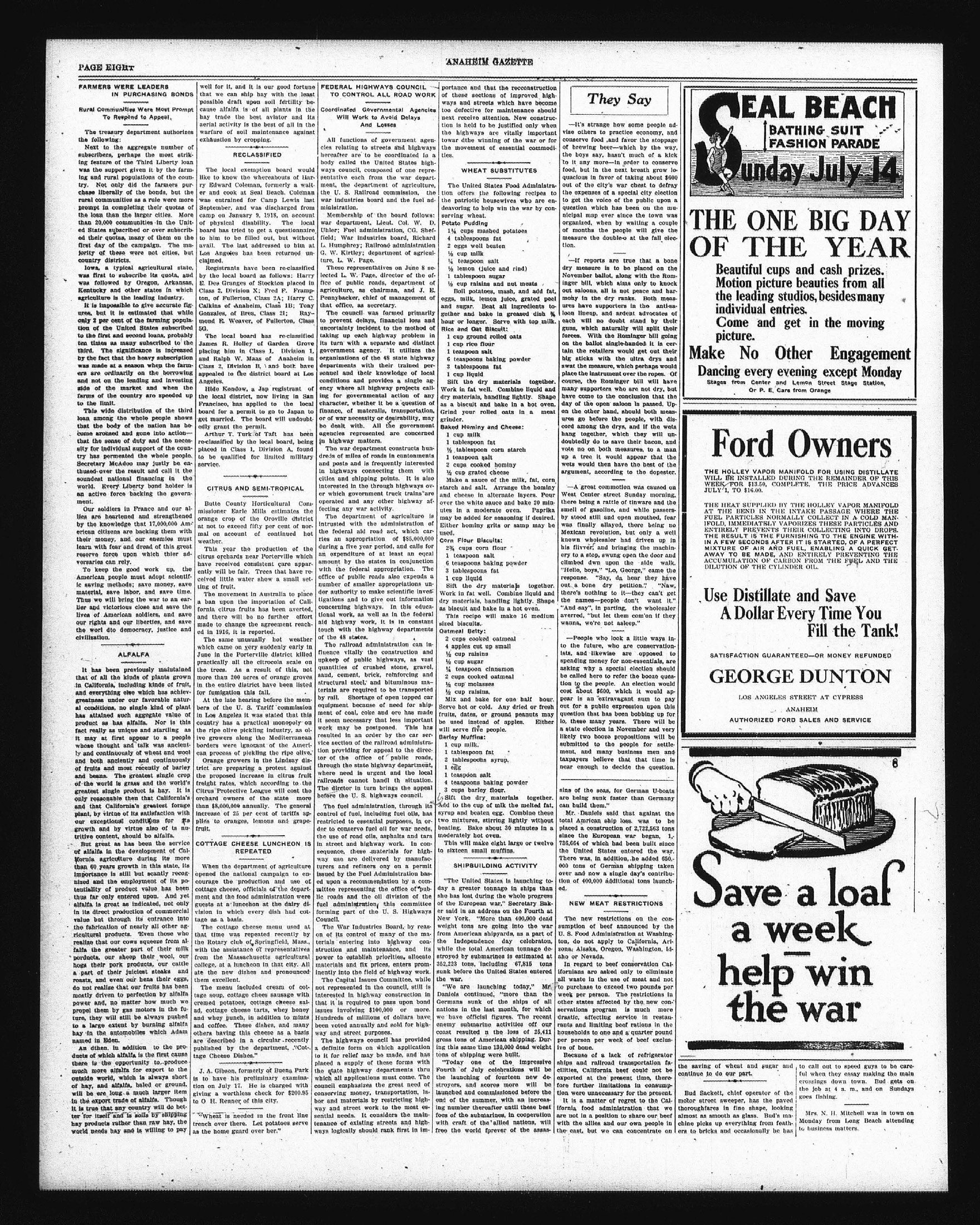
Searchable text
FARMERS WERE LEADERS IN PURCHASING BONDS
Rural Communities Were Most Prompt To Respond to Appeal.
The treasury department authorizes the following:
Next to the aggregate number of subscribers, perhaps the most striking feature of the Third Liberty loan was the support given it by the farming and rural populations of the country. Not only did the farmers purchase liberally of the bonds, but the rural communities as a rule were more prompt in completing their quotas of the loan than the larger cities. More than 20,000 communities in the United States subscribed or over subscribed their quotas, many of them on the first day of the campaign. The majority of these were not cities, but country districts.
Iowa, a typical agricultural state, was first to subscribe its quota, and was followed by Oregon, Arkansas, Kentucky and other states in which agriculture is the leading industry.
It is impossible to give accurate figures, but it is estimated that while only 2 per cent of the farming population of the United States subscribed to the first and second loans, probably ten times as many subscribed to the third. The significance is increased by the fact that the heavy subscription was made at a season when the farmers are ordinarily on the borrowing and not on the lending and investing side of the market and when the farms of the country are speeded up to the limit.
This wide distribution of the third loan among the whole people shows that the body of the nation has become aroused and gone into action—that the sense of duty and the necessity for individual support of the country has permeated the whole people.
well for it, and it is our good fortune that we can ship hay with the least possible draft upon soil fertility because alfalfa is of all plants in the hay trade the best aviator and its aerial activity is the best of all in the warfare of soil maintenance against exhaustion by cropping.
RECLASSIFIED
The local exemption board would like to know the whereabouts of Harry Edward Coleman, formerly a waiter and cook at Seal Beach. Coleman was entrained for Camp Lewis last September, and was discharged from camp on January 9, 1918, on account of physical disability. The local board has tried to get a questionnaire, to him to be filled out, but without avail. The last addressed to him at Los Angeles has been returned unclaymed.
Registrants have been re-classified by the local board as follows: Harry E. Des Granges of Stockton placed in Class 2, Division X; Fred F. Frampton, of Fullerton, Class 2A; Harry C. Calkins of Anaheim, Class 1B; Tony Gonzales, of Brea, Class 21; Raymond E. Weaver, of Fullerton, Class 5G.
The local board has re-classified James R. Holley of Garden Grove placing him in Class 1, Division 1, and Ralph W. Maas of Anaheim in Class 2, Division B, and both have appealed to the district board at Los Angeles.
Hide Kondow, a Jap registrant of the local district, now living in San Francisco, has applied to the local board for a permit to go to Japan to get married. The board will undoubtedly grant the permit.
Arthur T. Turk of Taft has been re-classified by the local board, being placed in Class 1, Division A, found to be qualified for limited military well for it, and it is our good fortune that we can ship hay with the least possible draft upon soil fertility because alfalfa is of all plants in the hay trade the best aviator and its aerial activity is the best of all in the warfare of soil maintenance against exhaustion by cropping.
FEDERAL HIGH TO CONTROL
Coordinated Governing Will Work
All functions related to hereafter are to body called this ways council, or sentative each moment, the deputy U. S. Railway war industries administration.
Membership in war department Uhler; Fuel add field; War Ind L. Humphrey; G. W. Kirtley; ture, L. W. Pa.
These repress lected L. W. P office of public agriculture, as Pennybacker, c that office, as
The council to prevent delay uncertainty including taking up each its turn with a government agency organizations or departments w sonnel and th ency where all ing for govern character, whet finance, of ma or of war neces be dealt with. agencies represent in highway ma
The war depa drels of miles o
was made at a season when the farmers are ordinarily on the borrowing and not on the lending and investing side of the market and when the farms of the country are speeded up to the limit.
This wide distribution of the third loan among the whole people shows that the body of the nation has become aroused and gone into action—that the sense of duty and the necessity for individual support of the country has permeated the whole people. Secretary McAdoo may justly be enthused over the result and call it the soundest national financing in the world. Every Liberty bond holder is an active force backing the government.
Our soldiers in France and our allies are heartened and strengthened by the knowledge that 17,000,000 American citizens are backing them with their money, and our enemies must learn with fear and dread of this great reserve force upon which thier adversaries can rely.
To keep the good work up, the American people must adopt scientific saving methods; save money, save material, save labor, and save time. Thus we will bring the war to an earlier and victorious close and save the lives of American soldiers, and save our rights and our liberties, and save the world dto democracy, justice and civilization.
ALFALFA
It has been previously maintained that of all the kinds of plants grown in California, including kinds of fruit, and everything else which has achieved greatness under our favorable natural conditions, no single kind of plant has attained such aggregate value of product as has alfalfa. Nor is this fact really as unique and startling as it may at first appear to a people whose thought and talk was anciently and continuously of wheat and wool and both anciently and continuously of fruits and most recently of barley and beans. The greatest single crop of the world is grass and the world's greatest single product is hay. It is only reasonable then that California's and that California's greatest forage plant, by virtue of its satisfaction with our exceptional conditions for its growth and by virtue also of its nutritive content, should be alfalfa.
But great as has been the service of alfalfa in the development of California agriculture during its more than 60 years growth in this state its
CITRUS AND SEMI-TROPICAL
Butte County Horticultural Commissioner Earle Mills estimates the orange crop of the Oroville district at not to exceed fifty per cent of normal account of continued hot weather.
This year the production of the citrus orchards near Porterville which have received consistent care apparently will be fair. Trees that have received little water show a small setting of fruit.
The movement in Australia to place a ban upon the importation of California citrus fruits has been averted, and there will be no further effort made to change the agreement reached in 1916, it is reported.
The same unusually hot weather which came on very suddenly early in June in the Porterville district killed practically all the citrocola scale on the trees. As a result of this, not more than 200 acres of orange groves in the entire district have been listed for fumigation this fall.
At the late hearing before the members of the U. S. Tariff commission in Los Angeles it was stated that this country has a practical monopoly on the ripe olive pickling industry, as olive growers along the Mediterranean borders were ignorant of the American process of pickling the ripe olive.
Orange growers in the Lindsay district are preparing a protest against the proposed increase in citrus fruit freight rates, which according to the Citrus Protective League will cost the orchard owners of the state more than $8,000,000 annually. The general increase of 25 per cent of tariffs applies to oranges, lemons and grape-fruit.
COTTAGE CHEESE LUNCHEON IS REPEATED
When the department of agriculture departments were sonnel and they conditions and ency where all ing for govern character, whet finance, of man or of war necessities be dealt with agencies represent in highway ma-
The war departs miles o'r posts and in highways cities and ships interested in ther which govern operated and affecting any war.
The department intrusted with the federal aldries an appropriate during a five year an expenditure amount by the with the federal office of public number of smaller authority to tigations and to concerning high tional work, as aid highway we touch with the 48 states.
The railroad fluence vitally upkeep of public quantities of cis sand, cement, b structural steel, materials are required by rail. Shortage equipment becausement of coal, co it seem necessary work may be resulted in an vice section of thion providing for toror of the office through the state where need is railroads cannot. The director in t before the U. S.
The fuel administration control of fuel, restricted to essen der to conserve use of road in street and hi sequence, these way use are de-
of fruits and most recently of barley and beans. The greatest single crop of the world is grass and the world's greatest single product is hay. It is only reasonable then that California's and that California's greatest forage plant, by virtue of its satisfaction with our exceptional conditions for its growth and by virtue also of its nutritive content, should be alfalfa.
But great as has been the service of alfalfa in the development of California agriculture during its more than 60 years growth in this state, its importance is still but scantily recognized and the employment of its potentiality of product value has been thus far only entered upon. And yet alfalfa is great as indicated, not only in its direct production of commercial value but through its entrance into the fabrication of nearly all other agricultural products. Even those who realize that our cows squeeze from alfalfa the greater part of their milk products, our sheep their wool, our hogs their pork products, our cattle a part of their juiciest steaks and roasts, and even our hens their eggs, do not realize that our fruits has been mostly driven to perfection by alfalfa power and, no matter how much we propel them by gas motors in the future, they will still be always pushed to a large extent by burning alfalfa hay in the automobiles which Adam named in Eden.
An dthen, in addition to the products of which alfalfa is the first cause there is the opportunity to produce much more alfalfa for export to the outside world, which is always short of hay, and alfalfa, baled or ground, will be ere long a much larger item in the export trade of alfalfa. Though it is true that any country will do better for itself and is soils by shipping hay products rather than raw hay, the world needs hay and is willing to pay
COTTAGE CHEESE LUNCHEON IS REPEATED
When the department of agriculture opened the national campaign to encourage the production and use of cottage cheese, officials of the department and the food administration were guests at a luncheon at the dairy division in which every dish had cottage as a basis.
The cottage cheese menu used at that time was repeated recently by the Rotary club of Springfield, Mass., with the assistance of representatives from the Massachusetts agricultural college, at a luncheon in that city. All ate the new dishes and pronounced them excellent.
The menu included cream of cottage soup, cottage chees sausage with creamed potatoes, cottage cheese salad, cottage cheese tarts, whey honey and whey punch, in addition to mints and coffee. These dishes, and many others having this cheese as a basis are described in a circular recently published by the department, "Cottage Cheese Dishes."
J. A. Gibson, formerly of Buena Park is to have his preliminary examination on July 17. He is charged with giving a worthless check for $200.95 to O H. Renner of this city.
"Wheat is needed in the front line trench over there. Let potatoes serve as the home guard over her."
ANAHEIM GAZETTE
FEDERAL HIGHWAYS COUNCIL TO CONTROL ALL ROAD WORK
Coordinated Governmental Agencies Will Work to Avoid Delays And Losses
All functions of government agencies relating to streets and highways hereafter are to be coordinated in a body called the United States highways council, composed of one representative each from the war department, the department of agriculture, the U. S. Railroad commission, the war industries board and the fuel administration.
Membership of the board follows: war department, Lieut. Col. W. D. Uhler; Fuel administration, CG. Sheffield; War Industries board, Richard L. Humphrey; Railroad administration G. W. Kirtley; department of agriculture, L. W. Page.
These representatives on June 8 selected L. W. Page, director of the office of public roads, department of agriculture, as chairman, and J. E. Pennybacker, chief of management of that office, as secretary.
The council was formed primarily to prevent delays, financial loss and uncertainty incident to the method of taking up each highway problem in its turn with a separate and distinct government agency. It utilizes the organizations of the 48 state highway departments with their trained personnel and their knowledge of local conditions and provides a single agency where all highway projects calling for governmental action of any character, whether it be a question of finance, of materials, transportation, or of war necessity or desirability, may be dealt with. All the government agencies represented are concerned in highway matters.
The war department constructs hundreds of miles of roads in cantonments importance and that the reconstruction of these sections of improved highways and streets which have become too defective for maintenance should next receive attention. New construction is held to be justified only when the highways are vitally important towar dthe winning of the war or for the movement of essential commodities.
WHEAT SUBSTITUTES
The United States Food Administration offers the following recipes to the patriotic housewives who are endeavoring to help win the war by conserving wheat.
Potato Pudding
1¼ cups mashed potatoes
4 tablespoons fat
2 eggs well beaten
½ cup milk
¼ teaspoon salt
½ lemon (juice and rind)
1 tablespoon sugar
½ cup raisins and nut meats
Boll potatoes, mash, and add fat, eggs, lemon juice, grated peel and sugar. Beat all ingredients together and bake in greased dish % hour or longer. Serve with top milk.
Rice and Oat Biscuit:
1 cup ground rolled oats
1 cup rice flour
1 teaspoon salt
6 teaspoons baking powder
3 tablespoons fat
1 cup liquid
Sift the dry materials together. Work in fat well. Combine liquid and dry materials, handling lightly. Shape as a biscuit and bake in a hot oven. Grind your rolled oats in a meat grinder.
Baked Hominy and Cheese:
1 cup milk
1 tablespoon fat
½ tablespoon corn starch
1 teaspoon salt
They Say
It's strange how some people advise others to practice economy, and conserve food, and favor the stoppage of brewing beer—which by the way, the boys say, hasn't much of a kick to it any more—in order to conserve food, but in the next breath grow loquacious in favor of taking about $600 out of the city's war chest to defray the expenses of a special city election to get the voice of the public upon a question which has been on the municipal map ever since the town was organized, when by waiting a couple of months the people will give the measure the double-o at the fall election.
If reports are true that a bone dry measure is to be placed on the November ballot, along with the Rominger bill, which aims only to knock out saloons, all is not peace and harmony in the dry ranks. Both measures have supporters in the anti-saloon lineup, and ardent advocates of each will no doubt stand by their guns, which naturally will split their forces. With the Rominger bill going on the ballot single-handed it is certain the retailers would get out their big sticks with the ultra drys and swat the measure, which perhaps would place the instrument over the ropes. Of course, the Rominger bill will have many supporters who are not dry, but have come to the conclusion that the day of the open saloon is passed. Upon the other hand, should both measures go before the people, with discord among the drys, and if the wets hang together, which they will undoubtedly do to save their bacon, and vote no on both measures, to a man up a tree it would appear that the
departments with their trained personnel and their knowledge of local conditions and provides a single agency where all highway projects calling for governmental action of any character, whether it be a question of finance, of materials, transportation, or of war necessity or desirability, may be dealt with. All the government agencies represented are concerned in highway matters.
The war department constructs hundreds of miles of roads in cantonments and posts and is frequently interested in highways connecting them with cities and shipping points. It is also interested in the through highways over which government truck trains are operated and any other highway affecting any war activity.
The department of agriculture is intrusted with the administration of the federal aid road act, which carries an appropriation of $85,000,000 during a five year period, and calls for an expenditure of at least an equal amount by the states in conjunction with the federal appropriation. The office of public roads also expands a number of smaller appropriations under authority to make scientific investigations and to give out information concerning highways. In this educational work, as well as in the federal aid highway work, it is in constant touch with the highway departments of the 48 states.
The railroad administration can influence vitally the construction and upkeep of public highways, as vast quantities of crushed stone, gravel, sand, cement, brick, reinforcing and structural steel; and bituminous materials are required to be transported by rail. Shortage of open topped car equipment because of need for shipment of coal, coke and ore has made it seem necessary that less important work may be postponed. This has resulted in an order by the car service section of the railroad administration providing for appeal to the director of the office of public roads, through the state highway department, where need is urgent and the local railroads cannot handle the situation. The director in turn brings the appeal before the U.S. highways council.
The fuel administration, through its control of fuel, including fuel oils, has restricted to essential purposes, in order to conserve fuel oil for war needs, the use of road oils, asphalts and tars in street and highway work. In consequence, these materials for highway use are delivered by manufactures of the seas, for German U-boats are being sunk faster than Germany can build them."
Mr. Daniels said that against the total American ship loss was to be placed a construction of 2,722,563 tons since the European war began, 1,736,664 of which had been built since the United States entered the war. There was, in addition, he added 650,000 tons of German shipping taken
where need is urgent and the local railroads cannot handl th situation. The director in turn brings the appeal before the U. S. highways council.
The fuel administration, through its control of fuel, including fuel oils, has restricted to essential purposes, in order to conserve fuel oil for war needs, the use of road oils, asphalts and tars in street and highway work. In consequence, these materials for highway use are delivered by manufacturers and refiners on a permit issued by the Fuel Administration based upon a recommendation by a committee representing the office of public roads and the oil division of the fuel administration, this committee forming part of the U. S. Highways Council.
The War Industries Board, by reason of its control of many of the materials entering into highway construction and maintenance, and its power to establish priorities, allocate materials and fix prices, enters prominently into the field of highway work.
The Capital Issues Committee, while not represented in the council, still is interested in highway construction in that it is required to pass upon bond issues involving $100,000 or more. Hundreds of millions of dollars have been voted annually and sold for highway and street purposes.
The highways council has provided a definite form on which application to it for relief may be made, and has placed a supply of these forms with the state highway departments thru which all applications must come. The council emphasizes the great need of conserving money, transportation, labor and materials by restricting highway and street work to the most essential needs. It considers the maintenance of existing streets and highways logically should rank first in im-
1 teaspoon salt
4 teaspoons baking powder
3 cups barley flour.
Sift the dry materials together. Add to the cup of milk the melted fat, syrup and beaten egg. Combine these two mixtures, stirring lightly without beating. Bake about 30 minutes in a moderately hot oven.
This will make eight large or twelve to sixteen small muffins.
SHIPBUILDING ACTIVITY
"The United States is launching today a greater tonnage in ships than she has lost during the whole progress of the European war," Secretary Baker said in an address on the Fourth at New York. "More than 400,000 dead weight tons are going into the war from American shipyards, as a part of the Independence day celebrator, while the total American tonnage destroyed by submarines is estimated at 352,223 tons, including 67,815 tons sunk before the United States entered the war.
"We are launching today," Mr. Daniels continued, "more than the Germans sunk of the ships of all nations in the last month, for which we have official figures. The recent enemy submarine activities off our coast resulted n the loss of 25,411 gross tons of American shipping. During this same time 130,000 dead weight tons of shipping were built.
"Today one of the impressive Fourth of July celebrations will be the launching of fourteen new destroyers, and scores more will be launched and commissioned before the end of the summer, with an increasing number thereafter until these best foes of the submarines, in cooperation with craft of the 'allied nations,' will free the world forever of the assas-
sins of the seas, for German U-boats are being sunk faster than Germany can build them."
Mr. Daniels said that against the total Amrican ship loss was to be placed a construction of 2,722,563 tons since the European war began, 1,736,664 of which had been built since the United States entered the war. There was, in addition, he added 650,000 tons of German shipping taken over and now a single day's contribution of 400,000 additional tons launched.
NEW MEAT RESTRICTIONS
The new restrictions on the consumption of beef announced by the U. S. Food Administration at Washington, do not apply to California, Arizona, Alaska, Oregon, Washington, Idaho or Nevada.
In regard to beef conservation Californians are asked only to eliminate all waste in the use of meat and not to purchase to exceed two pounds per week per person. The restrictions in other states affected by the new conservations program is much more drastic, affecting service in restaurants and limiting beef rations in the households to one and a quarter pound per person per week of beef exclusive of bone.
Because of a lack of refrigerator ships and railroad transportation facilities, California beef could not be exported at the present time, therefore further limitations in consumption were unnecessary for the present.
It is a matter of regret to the California food administration that we are not in a position to share our beef with the allies and our own people in the east, but we can concentrate on
SEAL BEACH
BATHING SUIT
FASHION PARADE
Sunday July 14
THE ONE BIG DAY
OF THE YEAR
Beautiful cups and cash prizes.
Motion picture beauties from all
the leading studios, besides many
individual entries.
Come and get in the moving
picture.
Make No Other Engagement
Dancing every evening except Monday
Stages from Center and Lemon Street Stage Station,
Or P. E. Cars from Orange
Ford Owners
Dancing every evening except Monday
Stages from Center and Lemon Street Stage Station,
Or P. E. Cars from Orange
Ford Owners
THE HOLLEY VAPOR MANIFOLD FOR USING DISTILLATE WILL BE INSTALLED DURING THE REMAINDER OF THIS WEEK FOR $13.50, COMPLETE. THE PRICE ADVANCES JULY 1, TO $16.00.
THE HEAT SUPPLIED BY THE HOLLEY VAPOR MANIFOLD AT THE BEND IN THE INTAKE PASSAGE WHERE THE FUEL PARTICLES NORMALLY COLLECT IN A COLD MANIFOLD, IMMEDIATELY VAPORIZES THESE PARTICLES AND ENTIRELY PREVENTS THEIR COLLECTING INTO DROPS. THE RESULT IS THE FURNISHING TO THE ENGINE WITHIN A FEW SECONDS AFTER IT IS STARTED, OF A PERFECT MIXTURE OF AIR AND FUEL, ENABLING A QUICK GET-AWAY TO BE MADE, AND ENTIRELY PREVENTING THE ACCUMULATION OF CARBON FROM THE FUEL AND THE DILUTION OF THE CYLINDER OIL.
Use Distillate and Save
A Dollar Every Time You Fill the Tank!
SATISFACTION GUARANTEED—OR MONEY REFUNDED
GEORGE DUNTON
LOS ANGELES STREET AT CYPRESS
ANAHEIM
AUTHORIZED FOR SALES AND SERVICE
Save a loaf
a week
help win
the war
the saving of wheat and sugar and continue to do our part.
Bud Sackett, chief operator of the motor street sweeper, has the paved thoroughfares in fine shape, looking almost as smooth as glass. Bud's machine picks up everything from feathers to bricks and occasionally he has to call out to speed guys to be careful when they essay making the main crossings down town. Bud gets on the job at 4 a.m., and on Sundays goes fishing.
Mrs. N. H. Mitchell was in town on Monday from Long Beach attending to business matters.