anaheim-gazette 1918-07-04
Scanned page
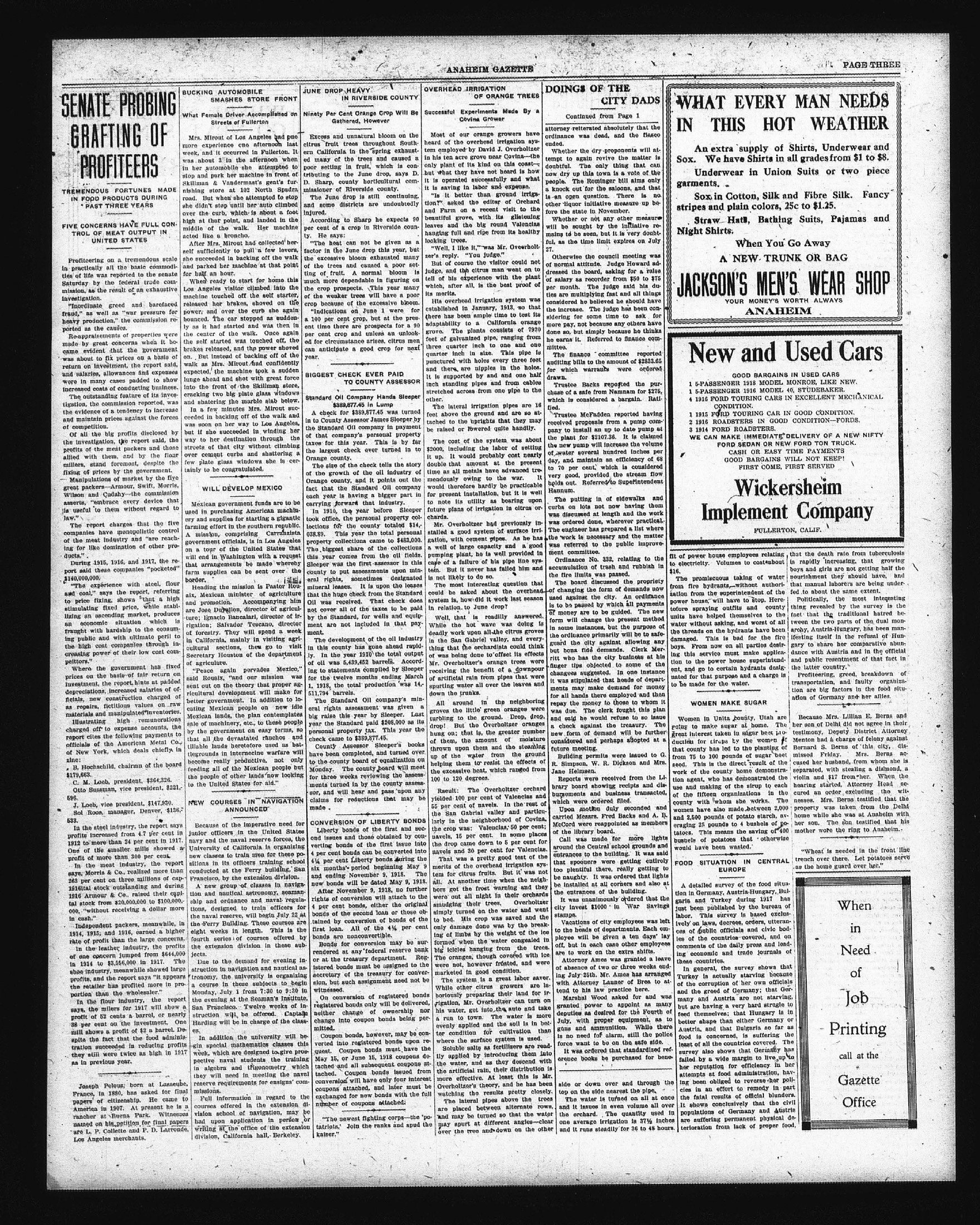
Searchable text
SENATE PROBING
GRAFTING OF
PROFITEERS
TREMENDOUS FORTUNES MADE IN FOOD PRODUCTS DURING PAST THREE YEARS
FIVE CONCERNS HAVE FULL CONTROL OF MEAT OUTPUT IN UNITED STATES
Profiteering on a tremendous scale in practically all the basic commodities of life was reported to the senate Saturday by the federal trade commission, as the result of an exhaustive investigation.
"Inordinate greed and barefaced fraud," as well as "war pressure for heavy production," the commission reported as the causes.
Re-appraisements of properties were made by great concerns when it became evident that the government was about to fix prices on a basis of return on investment, the report said, and salaries, allowances and expenses were in many cases padded to show increased costs of conducting business.
The outstanding feature of its investigation, the commission reported, was the evidence of a tendency to increase and maintain prices against the forces of competition.
Of all the big profits disclosed by the investigation, the report said, the profits of the meat packers and those allied with them and by the flour
BUCKING AUTOMOBILE SMASHES STORE FRONT
What Female Driver Accomplished on Streets of Fullerton
Mrs. Mirout of Los Angeles had one more experience one afternoon last week, and it occurred in Fullerton. It was about 3 in the afternoon when in her automobile she attempted to stop and park her machine in front of Skillman & Vandermast's gent's furnishing store at 102 North Spadra road. But when she attempted to stop she didn't stop until her auto climbed over the curb, which is about a foot high at that point, and landed in the middle of the walk. Her machine acted like a broncho.
After Mrs. Mirout had collected herself sufficiently to pull a few levers, she succeeded in backing off the walk and parked her machine at that point for half an hour.
When ready to start for home this Los Angeles visitor climbed into the machine touched off the self starter, released her brakes, shoved on the power; and over the curb she again bounced. The car stopped as suddenly as it had started and was then in the center of the walk. Once again the self started was touched off, the brakes released, and the power shoved on. But instead of backing off of the walk as Mrs. Mirout had confidently expected, the machine took a sudden lunge ahead and shot with great force into the front of the Skillman store, cracking two big plate glass windows and shattering the marble slab below.
In a few minutes Mrs. Mirout succeeded in backing off of the walk and was soon on her way to Los Angeles, but if she succeeded in winding her way to her destination through the streets of that city without climbing over cement curbs and shattering a
return on investment, the report said, and salaries, allowances and expenses were in many cases padded to show increased costs of conducting business.
The outstanding feature of its investigation, the commission reported, was the evidence of a tendency to increase and maintain prices against the forces of competition.
Of all the big profits disclosed by the investigation, the report said, the profits of the meat packers and those allied with them, end by the flour millers, stand foremost, despite the fixing of prices by the government.
Manipulations of market by the five great packers—Armour, Swift, Morris, Wilson and Cudahy—the commission asserts, "embrace every device that is useful to them without regard to law."
The report charges that the five companies have monopolistic control of the meat industry and "are reaching for like domination of other products."
During 1915, 1916, and 1917, the report said these companies "pocketed" $140,000,000.
"The experience with steel, flour and coal," says the report, referring to price fixing, shows "that a high stimulating fixed price, while stabilizing an ascending market, produces an economic situation which is fraught with hardship to the consuming public and with ultimate peril to the high cost companies through increasing power of their low cost competitors."
Where the government has fixed prices on the basis of fair return on investment, the report hints at padded depreciations, increased salaries of officials, new construction charged of as repairs, fictitious values on raw materials and manipulated inventories.
Illustrating high remunerations charged off to expense accounts, the report cites the following payments to officials of the American Metal Co., of New York, which deals chiefly in zinc:
B. Hochschild, chairman of the board $179,663.
C. M. Loeb, president, $364,326.
Otto Sussman, vice president, $221,596.
J. Loeb, vice president, $147,930.
Sol Roos, manager, Denver, $136,533.
In the steel industry, the report says profits increased from 4.7 per cent in 1912 to more than 24 per cent in 1917. One of the smaller mills showed a profit of more than 300 per cent.
In the meat industry, the report says the machine took a sudden lunge ahead and shot with great force into the front of the Skillman store, cracking two big plate glass windows and shattering the marble slab below.
In a few minutes Mrs. Mirout succeeded in backing off of the walk and was soon on her way to Los Angeles, but if she succeeded in winding her way to her destination through the streets of that city without climbing over cement curbs and shattering a few plate glass windows she is certainly to be congratulated.
WILL DEVELOP MEXICO
Mexican government funds are to be used in purchasing American machinery and supplies for starting a gigantic farming effort in the southern republic. A mission, comprising Carranzista government officials, is in Los Angeles on a tour of the United States that will end in Washington with a request that arrangements be made whereby farm supplies can be sent over the border.
Heading the mission is Pastor Roualx, Mexican minister of agriculture and promotion. Accompanying him are Jose Duyllon, director of agriculture; Ignacio Bancalari, director of irrigation; Salvador Tescano, director of forestry. They will spend a week in California, mainly in visiting agricultural sections, then go to visit Secretary Houston of the department of agriculture.
"Peace again pervades Mexico," said Roualx, "and our mission was sent out on the theory that proper agricultural development will make for better government. In addition to locating Mexican people on new Idle Mexican lands, the plan contemplates sale of machinery, etc., to these people by the government on easy terms, so that all the devastated ranchos and tillable lands herefore used as battlegrounds in internecine warfare will become really productive, not only feeding all of the Mexican people but the people of other lands now looking to the United States for aid."
NEW COURSES IN NAVIGATION ANNOUNCED
Because of the imperative need for junior officers in the United States navy and the naval reserve forces, the University of California is organizing new classes to train men for these positions in its officers training school.
CONVERSION OF LIBERTY bonds owed issues and thou verting bonds of 4 per cent bonds c
NEW COURSES IN NAVIGATION ANNOUNCED
Because of the imperative need for junior officers in the United States navy and the naval reserve forces, the University of California is organizing new classes to train men for these positions in its officers training school conducted at the Ferry building, San Francisco, by the extension division.
A new group of classes in navigation and nautical astronomy, seamanship and ordnance and naval regulations, designed to train officers for the naval reserve, will begin July 22 at the Ferry Building. These courses are eight weeks in length. This is the fourth series of courses offered by the extension division in these subjects.
Due to the demand for evening instruction in navigation and nautical astronomy, the university is organizing a course in these subjects to begin Monday, July 1 from 7:30 to 9:30 in the evening at the Seaman's Institute, San Francisco. Twelve weeks of instruction will be offered. Captain Harding will be in charge of the classes.
In addition the university will begin special mathematics classes this week, which are designed to give prospective naval students the training in algebra and trigonometry which they will need in meeting the naval reserve requirements for ensigns' commissions.
Full information in regard to the courses offered in the extension division school of navigation, may be had upon application in person or writing at the office of the extension division, California hall, Berkeley.
CONVERSION OF LIBERTY bonds on end issues and those vertting bonds of 4 per cent bonds can 4½ per cent Liberty six months' period and ending November new bonds will be.
After November rights of conversion 4 per cent bonds, bonds of the second retained by conversion first loan. All of bonds are nonconforming.
Bonds for conversion at any time or at the treasuryistered bonds must secretary of the commission, but such assis witnessed.
On conversion registered bonds cannot change into coupon mitted.
Coupon bonds, vertied into register quest. Coupon bld May 15, or June tached and all su tached. Coupon conversion will have coupons attached exchanged for new number of coupon.
"The newest fft tatriots.' Join th kaiser."
JUNE DROP HEAVY IN RIVERSIDE COUNTY
Ninety Per Cent Orange Crop Will Be Gathered, However
Excess and unnatural bloom on the citrus fruit trees throughout Southern California in the spring exhausted many of the trees and caused a poor setting in fruit, which is contributing to the June drop, says D. D. Sharp, county horticultural commissioner of Riverside county.
The June drop is still continuing, and some districts are undoubtedly injured.
According to Sharp he expects 90 per cent of a crop in Riverside county. He says:
"The heat can not be given as a factor in the June drop this year, but the excessive bloom exhausted many of the trees and caused a poor setting of fruit. A normal bloom is much more dependable in figuring on the crop prospects. This year many of the weaker trees will have a poor crop because of the excessive bloom."
"Indications on June 1 were for a 100 per cent crop, but at the present time there are prospects for a 90 per cent crop and unless an unlocked for circumstance arises, citrus men can anticipate a good crop for next year."
BIGGEST CHECK EVER PAID TO COUNTY ASSESSOR
Standard Oil Company Hands Sleeper $389,877.45 in Lump
A check for $389,877.45 was turned in to County Assessor James Sleeper by the Standard Oil company in payment of that company's personal property taxes for this year. This is by far the largest check ever turned in to County.
OVERHEAD IRRIGATION OF ORANGE TREES
Successful Experiments Made By a Covina Grower
Most of our orange growers have heard of the overhead irrigation system employed by David J. Overholtzer in his ten acre grove near Covina—the only plant of its kind on this coast—but what they have not heard is how it is operated successfully and what it is saving in labor and expense.
"Is it better than ground irrigation?" asked the editor of Orchard and Farm on a recent visit to the beautiful grove, with its glistening leaves and the big round Valencias hanging full and ripe from its healthy looking trees.
"Well, I like it," was Mr. Overholtzer's reply. "You judge."
But of course the visitor could not judge, and the citrus man went on to tell of his experience with the plant which, after all, is the best proof of its merits.
His overhead irrigation system was established in January, 1913, so that there has been ample time to test its adaptability to a California orange grove. The plants consists of 7920 feet of galvanized pipe, ranging from three quarter inch to one and one quarter inch in size. This pipe is punctured with holes every three feet and there are nipples in the holes. It is supported by and one half inch standing pipes and from cables stretched across from one pipe to the other.
The lateral irrigation pipes are 16 feet above the ground and are so attached to the uprights that they may be raised or lowered quite handily.
The cost of the system was about $2000, including the labor of setting it up. It would probably cost nearly
DOINGS OF THE CITY DADS
Continued from Page 1
attorney reiterated absolutely that the ordinance was dead, and the flasco ended.
Whether the dry-proponents will attempt to again revive the matter is doubtful. The only thing that can now dry up this town is a vote of the people. The Rominger bill aims only a knock out for the saloons, and that is an open question. There is no other liquor initiative measure up before the state in November.
Whether or not any other measure will be sought by the initiative remains to be seen, but it is very doubtful, as the time limit expires on July 27.
Otherwise the council meeting was of normal attitude. Judge Howard addressed the board, asking for a raise of salary as recorder from $50 to $75 per month. The judge said his duties are multiplying fast and all things considered he believed he should have the increase. The judge has been considering for some time to ask for more pay, not because any others have done so, but simply because he thinks he earns it. Referred to finance committee.
The finance committee reported auditing bills to the amount of $2833.65 for which warrants were ordered drawn.
Trustee Backs reported the purchase of a safe from Namnam for $275, which is considered a bargain. Ratified.
Trustee McFadden reported having received proposals from a pump company to install an up to date pump at the plant for $2107.36. It is claimed the new pump will increase the volume of water several hundred inches per
BIGGEST CHECK EVER PAID TO COUNTY ASSESSOR
Standard Oil Company Hands Sleeper $389,877.45 In Lump
A check for $389,877.45 was turned in to County Assessor James Sleeper by the Standard Oil company in payment of that company's personal property taxes for this year. This is by far the largest check ever turned in to Orange county.
The size of the check tells the story of the growth of the oil industry of Orange county, and it points out the fact that the Standard Oil company each year is having a bigger part in carrying forward that industry.
In 1910, the year before Sleeper took office, the personal property collections for the county totaled $14,038.89. This year the total personal property collections came to $483,000. The biggest share of the collections this year comes from the oil fields. Sleeper was the first assessor in this county to put assessments upon mineral rights, sometimes designated mineral leases. It is upon the leases that the huge check from the Standard Oil was received. That check does not cover all of the taxes to be paid by the Standard, for wells and equipment are not included in that payment.
The development of the oil industry in this county has gone ahead rapidly. In the year 1910 the total output of oil was 5,439,452 barrels. According to statements compiled by Sleeper for the twelve months ending March 1, 1918, the total production was 14,511,794 barrels.
The Standard Oil company's mineral rights assessment was given a big raise this year by Sleeper. Last year the Standard paid $208,000 as its personal property tax. This year the check came to $389,877.45.
County Assessor Sleeper's books have been completed, and turned over to the county board of equalization on Monday. The county board will meet for three weeks reviewing the assessments turned in by the county assessor, and will hear and pass upon any claims for reductions that may be made.
CONVERSION OF LIBERTY BONDS
Liberty bonds of the first and second issues and those obtained by converting bonds of the first issue into 4 per cent bonds can be converted into 4½ per cent Liberty bonds during the month of May.
Rseult: The Overholtzer orchard yielded 100 per cent of Valenclas and 55 per cent of navels. In the rest of the San Gabriel valley and particularly in the neighborhood of Covina, the crop was: Valenclas; 50 per cent; navels, 15 per cent. In some places the drop came down to 5 per cent for navels and 30 per cent for Valenclas.
That was a pretty good test of the worth of the overhead irrigation sys-
auditing bills to the amount of $2833.65 for which warrants were ordered drawn.
Trustee Backs reported the purchase of a safe from Namnam for $275, which is considered a bargain. Ratified.
Trustee McFadden reported having received proposals from a pump company to install an up to date pump at the plant for $2107.36. It is claimed the new pump will increase the volume of water several hundred inches per day, and maintain an efficiency of 68 to 70 per cent, which is considered very good, provided the stream flow holds out. Referred to Superintendent Hannum.
The putting in of sidewalks and curbs on lots not now having them was discussed at length and the work was ordered done, wherever practical. The engineer has prepared a list where the work is necessary and the matter was referred to the public improvement committee.
Ordinance No. 332, relating to the accumulation of trash and rubbish in the fire limits was passed.
The board discussed the propriety of changing the form of demands now used against the city. An ordinance is to be passed by which all payments of money are to be guided. The new form will change the present method in some instances, but the purpose of the ordinance primarily will be to safeguard the city against allowing any but bona fide demands. Clerk Merritt who has the city business at his finger tips objected to some of the changes suggested. In one instance it was stipulated that heads of departments may make demand for money for all hands there employed and then repay the money to those to whom it was due. The clerk fought this plan and said he would refuse to so issue a check against the treasury. The new form of demand will be further considered and perhaps adopted at a future meeting.
Building permits were issued to G. R. Simpson, W. R. Dickson and Mrs. Jane Helmson.
Reports were received from the Library board showing receipts and disbursements and business transacted, which were ordered filed.
Upon motion duly seconded and carried Messrs. Fred Backs and A. B. McCord were reappointed as members of the library board.
Call was made for more lights around Central school grounds and entrances to the building. It was said that spooners were getting entirely
CONVERSION OF LIBERTY BONDS
Liberty bonds of the first and second issues and those obtained by converting bonds of the first issue into 4 per cent bonds can be converted into 4½ per cent Liberty bonds during the six months' period beginning May 9 and ending November 9, 1918. The new bonds will be dated May 9, 1918.
After November 9, 1918, no further rights of conversion will attach to the 4 per cent bonds, either the original bonds of the second loan or those obtained by conversion of bonds of the first loan. All of the 4½ per cent bonds are nonconvertible.
Bonds for conversion may be surrendered at any federal reserve bank or at the treasury department. Registered bonds must be assigned to the secretary of the treasury for conversion, but such assignment need not be witnessed.
On conversion of registered bonds registered bonds only will be delivered, neither change of ownership nor change into coupon bonds being permitted.
Coupon bonds, however, may be converted into registered bonds upon request. Coupon bonds must have the May 15, or June 15, 1918 coupons detached and all subsequent coupons attached. Coupon bonds issued from conversion will have only four interest coupons attached, and later must be exchanged for new bonds with the full number of coupons attached:
"The newest fighting corps—the 'potatriots,' Join the ranks and spud the kaiser."
Rseult: The Overholtzer orchard yielded 100 per cent of Valenclas and 55 per cent of navels. In the rest of the San Gabriel valley and particularly in the neighborhood of Covina, the crop was: Valenclas; 50 per cent; navels, 15 per cent. In some places the drop came down to 5 per cent for navels and 30 per cent for Valenclas.
That was a pretty good test of the merits of the overhead irrigation system for citrus fruits. But it was not all. At another time when the neighbors got the frost warning and they were out all night in their orchards smudging their trees, Overholtzer simply turned on the water and went to bed. His crop was saved and the only damage done was by the breaking of limbs by the weight of the ice formed when the water congealed in big icicles hanging from the trees. The oranges, though covered with ice were not, however frosted, and were marketed in good condition.
The system is a great labor saver. While other citrus growers are laboriously preparing their land for irrigation, Mr. Overholtzer can turn on his water, get into the auto and take a run to town. The water is more evenly applied and the soil is in better condition for cultivation than where the surface system is used.
Soluble salts as fertilizers are readily applied by introducing them into the water, and as they descend with the artificial rain, their distribution is more effective. At least this is Mr. Overholtzer's theory, and he has been watching the results pretty closely.
The lateral pipes above the trees are placed between alternate rows, and may be turned so that the water may spur at different angles—clear over the tree and down on the other
Jane Helmsen.
Reports were received from the Library board showing receipts and disbursements and business transacted, which were ordered filed.
Upon motion duly seconded and carried Messrs. Fred Backs and A. B. McCord were reappointed as members of the library board.
Call was made for more lights around the Central school grounds and entrances to the building. It was said that spooners were getting entirely too plentiful there, really getting to be naughty. It was ordered that lights be installed at all corners and also at the entrances of the building.
It was unanimously ordered that the city invest $1000 in War Savings stamps.
Vacations of city employees was left to the heads of departments. Each employee will be given a ten days' lay off, but in each case other employees are to work on the extra shifts.
Attorney Ames was granted a leave of absence of two or three weeks ending July 25th. Mr. Ames has arranged with Attorney Launer of Brea to attend to his law practice here.
Marshal Wood asked for and was granted power to appoint as many deputies as desired for the Fourth of July, with proper equipment, as to guns and ammunition. While there is no need for alarm, still the police force want to be on the safe side.
It was ordered that standardized reference books be purchased for bene-
side or down over and through the top on the side nearest the pipe.
The water is turned on all at once and it issues in even volume all over the orchard. The quantity used in one average irrigation is 37½ inches and it runs steadily for 36 to 48 hours.
WHAT EVERY MAN NEEDS IN THIS HOT WEATHER
An extra supply of Shirts, Underwear and Sox. We have Shirts in all grades from $1 to $8.
Underwear in Union Suits or two piece garments.
Sox in Cotton, Silk and Fibre Silk. Fancy stripes and plain colors, 25c to $1.25.
Straw Hat, Bathing Suits, Pajamas and Night Shirts.
When You Go Away
A NEW TRUNK OR BAG
JACKSON'S MEN'S WEAR SHOP
YOUR MONEY'S WORTH ALWAYS
ANAHEIM
New and Used Cars
GOOD BARGAINS IN USED CARS
1 5-PASSENGER 1918 MODEL MONROE, LIKE NEW.
1 5-PASSENGER 1916 MODEL 40, STÜDEBAKER.
4 1916 FORD TOURING CARS IN EXCELLENT MECHANICAL CONDITION.
1 1915 FORD TOURING CAR IN GOOD CONDITION.
2 1916 ROADSTERS IN GOOD CONDITION—FORDS.
3 1914 FORD ROADSTERS.
WE CAN MAKE IMMEDIATE DELIVERY OF A NEW NIFTY FORD SEDAN OR NEW FORD TON TRUCK.
CASH OR EASY TIME PAYMENTS
GOOD BARGAINS IN USED CARS
1 5-PASSENGER 1918 MODEL MONROE, LIKE NEW.
1 5-PASSENGER 1916 MODEL 40, STUDEBAKER.
4 1916 FORD TOURING CARS IN EXCELLENT MECHANICAL CONDITION.
1 1915 FORD TOURING CAR IN GOOD CONDITION.
2 1916 ROADSTERS IN GOOD CONDITION—FORDS.
3 1914 FORD ROADSTERS.
WE CAN MAKE IMMEDIATE DELIVERY OF A NEW NIFTY FORD SEDAN OR NEW FORD TON TRUCK.
CASH OR EASY TIME PAYMENTS
GOOD BARGAINS WILL NOT KEEP!
FIRST COME, FIRST SERVED
Wickersheim Implement Company
FULLERTON, CALIF.
fit of power house employees relating to electricity. Volumes to cost about $16.
The promiscuous taking of water from fire hydrants without authorization from the superintendent of the power house, will have to stop. Herefore spraying outfits and county units have helped themselves to the water without asking, and worst of all the threads on the hydrants have been damaged. This is bad for the fire boys. From now on all parties desiring this service must make application to the power house superintendent, and go to certain hydrants designated for that purpose and a charge is to be made for the water.
WOMEN MAKE SUGAR
Women in Unita County, Utah are going to make sugar at home. The great interest taken in sugar beet production for crops by the women if that county has led to the planting of from 75 to 100 pounds of sugar beet seed. This is the direct result of the work of the county home demonstration agent, who has demonstrated the use and making of the sirup to each of the fifteen organizations in the county with whom she works. The women have also made between 2,000 and 2,500 pounds of potato starch, averaging 25 pounds to 4 bushels of potatoes. This means the saving of 400 bushels of potatoes that otherwise would have been wasted.
FOOD SITUATION IN CENTRAL
that the death rate from tuberculosis is rapidly increasing, that growing boys and girls are not getting half the nourishment they should have, and that manual laborers are being under-fed to about the same extent.
Politically, the most integesting thing revealed by the survey is the fact that the traditional hatred between the two parts of the dual monarchy, Austria-Hungary, has been manifesting itself in the refusal of Hungary to share her comparative abundance with Austria and in the official and public resentment of that fact in the latter country.
Profiteering, greed, breakdown of transportation, and faulty organization are big factors in the food situation of Germany and her allies.
Because Mrs. Lillian E. Berns and her son of Delhi did not agree in their testimony, Deputy District Attorney Menton had a charge of felony against Bernard S. Berns of this city, dismissed Friday. Mrs. Berns accused her husband, from whom she is separated, with stealing a diamond, a violin and $17 from her. When the hearing started, Attorney Head secured an order excluding the witnesses. Mrs. Berns testified that the property was taken from the Delhi home while she was at Anahelm with her son. The son testified that his mother wore the ring to Anahelm.
"Wheat is needed in the front line trench over there. Let potatoes serve the home guard over her."
work of the county home demonstration agent, who has demonstrated the use and making of the sirup to each of the fifteen organizations in the county with whom she works. The women have also made between 2,000 and 2,500 pounds of potato starch, averaging 25 pounds to 4 bushels of potatoes. This means the saving of 400 bushels of potatoes that otherwise would have been wasted.
FOOD SITUATION IN CENTRAL EUROPE
A detailed survey of the food situation in Germany, Austria-Hungary, Bulgaria and Turkey during 1917 has just been published by the bureau of labor. This survey is based exclusively on laws, decrees, orders, utterances of public officials and civic bodies of the countries covered, and on comments of the daily press and leading economic and trade journals of these countries.
In general, the survey shows that Turkey is actually starving because of the corruption of her own officials and the greed of Germany; that Germany and Austria are not starving, but are having a very hard struggle to feed themselves; that Hungary is in better shape than either Germany or Austria, and that Bulgaria so far as food is concerned, is suffering the least of all the countries covered. The survey also shows that Germany has failed by a wide margin to live up to her reputation for efficiency in her attempts at food administration, having been obliged to reverse her policies in an effort to remedy in part the fatal results of official blunders. It shows conclusively that the civil populations of Germany and Austria are suffering permanent physical deterioration from lack of proper food,
"Wheat is needed in the front line trench over there. Let potatoes serve as the home guard over her."
When in Need of Job Printing call at the Gazette Office