anaheim-gazette 1918-06-06
Scanned page
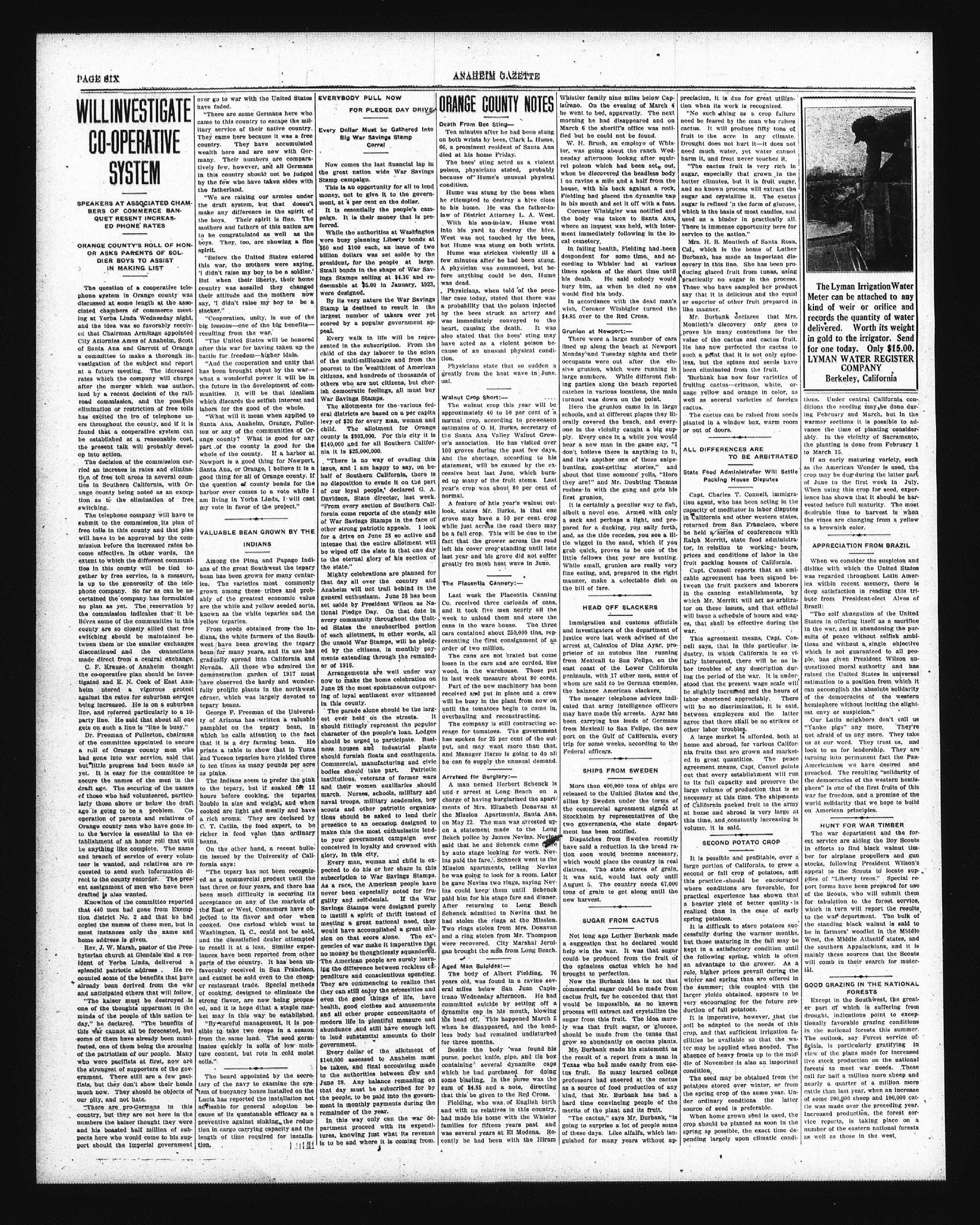
Searchable text
WILLINVESTIGATE CO-OPERATIVE SYSTEM
SPEAKERS AT ASSOCIATED CHAMBERS OF COMMERCE BANQUET RESENT INCREASED PHONE RATES
ORANGE COUNTY'S ROLL OF HONOR ASKS PARENTS OF SOLDIER BOYS TO ASSIST IN MAKING LIST
The question of a cooperative telephone system in Orange county was discussed at some length at the associated chambers of commerce meeting at Yorba Linda Wednesday night, and the idea was so favorably received that Chairman Armitage appointed City Attornies Ames of Anaheim, Scott of Santa Ana and Garrett of Orange a committee to make a thorough investigation of the subject and report at a future meeting. The increased rates which the company will charge after the merger which was authorized by a recent decision of the railroad commission, and the possible elimination or restriction of free tolls has excited theire of telephone users throughout the county, and if it is found that a cooperative system can be established at a reasonable cost, the present talk will probably develop into action.
ever go to war with the United States have faded.
"There are some Germans here who came to this country to escape the military service of their native country. They came here because it was a free country. They have accumulated wealth here and are now with Germany. Their numbers are comparatively few, however, and all Germans in this country should not be judged by the few who have taken sides with the fatherland.
"We are raising our armies under the draft system, but that doesn't make any difference in the spirit of the boys. Their spirit is fine. The mothers and fathers of this nation are to be congratulated as well as the boys. They, too, are showing a fine spirit.
"Before the United States entered this war, the mothers were saying, 'I didn't raise my boy to be a soldier.' But when their liberty, their home country was assailed they changed their attitude and the mothers now say, 'I didn't raise my boy to be a slacker.'"
Cooperation, unity, is one of the big lessons—one of the big benefits—resulting from the war.
The United States will be honored after this war for having taken up the battle for freedom—higher idals.
And the cooperation and unity that has been brought about by the war—what a wonderful power it will be in the future in the development of communities. It will be that idealism which discards the selfish interest and labors for the good of the whole.
What will it mean when applied to Santa Ana, Anaheim, Orange, Fullerton or any of the communities of Orange county? What is good for any part of the county is good for the whole of the county. If a harbor at ever go to war with the United States have faded.
EVERYBODY FOR
Every Dollar M Big War
Now comes the great national Stamp campaign.
This is an open money, not to mention, at 4 per cent. It is essential palign. It is thus ferred.
While the autumn were busy planning $50 and $100 billion dollars president, for the Small bonds inings Stamps seem deemable at $2 were designed.
By its very new Stamp is death largest number scored by a peal.
Every walk sented in the side child of the day of the multi-million poorest to the citizens, and hus others who are lish democratic War Savings St.
The allotmenteral districts are levy of $20 for each child. The county is $903,000; $140,000 and for nia it is $25,000.
vestigation of the subject and report at a future meeting. The increased rates which the company will charge after the merger which was authorized by a recent decision of the railroad commission, and the possible elimination or restriction of free tolls has excited theire of telephone users throughout the county, and if it is found that a cooperative system can be established at a reasonable cost, the present talk will probably develop into action.
The decision of the commission carried an increase in rates and elimination of free toll areas in several counties in Southern California, with Orange county being noted as an exception as to the elimination of free switching.
The telephone company will have to submit to the commission its plan of free tolls in this county and that plan will have to be approved by the commission before the increased rates become effective. In other words, the extent to which the different communities in this county will be tied together by free service, in a measure, is up to the generosity of the telephone company. So far as can be ascertained the company has formulated no plan as yet. The reservation by the commission indicates that it believes some of the communities in this county are so closely allied that free switching should be maintained between them or the smaller exchanges discontinued and the connections made direct from a central exchange.
C. F. Krause of Anaheim thought the co-operative plan should be investigated and E. N. Cook of East Anaheim intered a vigorous protest against the rates for suburban service being increased. He is on a suburban line, and referred particularly to a 10-party line. He said that about all one gets on such a line is "line is busy."
Dr. Freeman of Fullerton, chairman of the committee appointed to secure a roll of Orange county men who had gone into war service, said that but little progress had been made as yet. It is easy for the committee to secure the names of the men in the draft age. The securing of the names of those who had volunteered, particularly those above or below the draft age is going to be a problem. Cooperation of parents and relatives of Orange county men who have gone into the service is essential to the establishment of an honor roll that will be anything like complete. The name and branch of service of every volunteer is wanted, and relatives are re-
"And the cooperation and unity that has been brought about by the war—what a wonderful power it will be in the future in the development of communities. It will be that idealism which discards the selfish interest and labors for the good of the whole.
"What will it mean when applied to Santa Ana, Anaheim, Orange, Fullerton or any of the communities of Orange county? What is good for any part of the county is good for the whole of the county. If a harbor at Newport is a good thing for Newport, Santa Ana, or Orange, I believe it is a good thing for all of Orange county. If the question of county bonds for the harbor ever comes to a vote while I am living in Yorba Linda, I will cast my vote in favor of the project."
VALUABLE BEAN GROWN BY THE INDIANS
Among the Pima and Papago Indians of the great Southwest the tepary bean has been grown for many centuries. The varieties most commonly grown among these tribes and probably of the greatest economic value are the white and yellow seeded sorts, known as the white teparies and the yellow teparies.
From seeds obtained from the Indians, the white farmers of the Southwest have been growing the tepary bean for many years, and its use has gradually spread into California and Nevada. All those who admired the demonstration garden of 1917 must have observed the hardy and wonderfully prolific plants in the northwest corner, which was largely devoted to tepary beans.
George F. Freeman of the University of Arizona has written a valuable pamphlet on the tepary bean, in which he calls attention to the fact that it is a dry farming bean. He prints a table to show that in Yuma and Tucson teparies have yielded three to ten times as many pounds per acre as pinks.
The Indians seem to prefer the pink to the tepary, but if soaked for 12 hours before cooking, the teparies double in size and weight, and when cooked are light and mealy and have a rich aroma. They are declared by C. T. Catlin, the food expert, to be richer in food value than ordinary beans.
On the other hand, a recent bulletin issued by the University of California says:
Mighty celebrates that day all our Anaheim will general enthusiasm set aside by National Pledge Every communicated States thereof each allotmentthe unsold War ed by the citi ment extensions er of 1918.
Arrangements now to make this June 28 the mo nging of loyal serv i n this county.
The parade a west ever held should fittingly character of th e should be urgeness houses a should furnish Commercial, m bodies should institutions, ve and their work march. Nurses naval troops, r scouts and oth tions should b presence to an make this th e to your govern conceived in lo glory, in this w Every man, v
yet. It is easy for the committee to secure the names of the men in the draft age. The securing of the names of those who had volunteered, particularly those above or below the draft age is going to be a problem. Cooperation of parents and relatives of Orange county men who have gone into the service is essential to the establishment of an honor roll that will be anything like complete. The name and branch of service of every volunteer is wanted, and relatives are requested to send such information direct to the county recorder. The present assignment of men who have been drafted is also wanted.
Knowlton of the committee reported that 440 men had gone from Exemption district No. 2 and that he had copied the names of these men, but in most instances only the name and home address is given.
Rev. J. W. Marsh, pastor of the Presbyterian church at Glendale and a resident of Yorba Linda, delivered a splendid patriotic address. He recounted some of the benefits that have already been derived from the war and anticipated others that will follow.
"The kaiser must be destroyed is one of the thoughts uppermost in the minds of the people of this nation today," he declared. "The benefits of this war cannot all be forecasted, but some of them have already been manifested, one of them being the arousing of the patriotism of our people. Many who were pacifists at first, now are the strongest supporters of the government. There still are a few pacifists, but they don't show their heads much now. They should be objects of our pity, and not hate."
"There are pro-Germans in this country, but they are not here in the numbers the kaiser thought they were and his boasted half million of subjects here who would come to his support should the Imperial government as pinks.
The Indians seem to prefer the pink to the teary, but if soaked for 12 hours before cooking, the teparies double in size and weight, and when cooked are light and meally and have a rich aroma. They are declared by C. T. Catlin, the food expert, to be richer in food value than ordinary beans.
On the other hand, a recent bulletin issued by the University of California says:
"The tepary has not been recognized as a commercial product until the last three or four years, and there has been much difficulty in securing its acceptance on any of the markets of the East or West. Consumers have objected to its flavor and odor when cooked. One carload which went to Washington, D. C., could not be sold, and the dissatisfied dealer attempted to resell it at a loss. Similar experiences have been reported from other parts of the country. It has been unfavorably received in San Francisco, and cannot be sold even to the cheaper restaurant trade. Special methods of cooking, designed to eliminate the strong flavor, are now being proposed, and it is hope dthat a staple market may in this way be established.
"By careful management, it is possible to take two crops in a season from the same land. The seed germinates quickly in soils of low moisture content, but rots in cold moist sols."
The board appointed by the secretary of the navy to examine the system of buoyancy boxes installed on the Lucia has reported the installation not admissible for general adoption because of its questionable efficacy as a preventive against sinking; the reduction in cargo carrying capacity and the length of time required for installation.
Every man, expected to do his subscription to As a race, the never been established gality and self-Savings Stampage to instill a splitting meeting a great would have accession on that same genicles of war no money be tha The American flag the different penditure and they are comm they can still end even the good health, good cleanliness and all other modern life in abundance, and to lend substantial government.
Every dollar $140,000 assessed be taken, and to the author June 28. Any that day must be the people, to be ment in month remainder of this
In this way partment procedures knowledges is to be and whi
ANAHEIM GAZETTE
EVERYBODY PULL NOW
FOR PLEDGE DAY DRIVE
Every Dollar Must be Gathered Into Big War Savings Stamp Campaign.
Now comes the last financial lap in the great nation wide War Savings Stamp campaign.
This is an opportunity for all to lend money, not to give it to the government, at 4 per cent on the dollar.
It is essentially the people's campaign. It is their money that is preferred.
While the authorities at Washington were busy planning Liberty bonds at $50 and $100 each, an issue of two billion dollars was set aside by the president, for the people at large. Small bonds in the shape of War Savings Stamps selling at $4.16 and redeemable at $5.00 in January, 1923, were designed.
By its very nature the War Savings Stamp is destined to result in the largest number of takers ever yet scored by a popular government appeal.
Every walk in life will be represented in the subscription. From the child of the day laborer to the son of the multi-millionaire and from the poorest to the wealthiest of American citizens, and hundreds of thousands of others who are not citizens, but cherish democratic feelings, all must buy War Savings Stamps.
The allotments for the various federal districts are based on a per capita levy of $20 for every man, woman and child. The allotment for Orange county is $903,000. For this city it is $140,000 and for all Southern California it is $25,000,000.
ORANGE COUNTY NOTES
Death From Bee Sting—
Ten minutes after he had been stung on both wrists by bees, Clark L. Hume, 66, a prominent resident of Santa Ana died at his home Friday.
The bees' sting acted as a violent poison, physicians stated, probably because of Hume's unusual physical condition.
Hume was stung by the bees when he attempted to destroy a hive close to his home. He was the father-in-law of District Attorney L. A. West.
With his son-in-law, Hume went into his yard to destroy the hive. West was not touched by the bees, but Hume was stung on both wrists.
Hume was stricken violently ill a few minutes after he had been stung. A physician was summoned, but before anything could be done, Hume was dead.
Physicians, when told of the peculiar case today, stated that there was a probability that the poison injected by the bees struck an artery and was immediately conveyed to the heart, causing the death. It was also stated that the bees' sting may have acted as a violent poison because of an unusual physical condition.
Physicians state that so sudden a greatly from the heat wave in Juneual.
Walnut Crop Short—
The walnut crop this year will be approximately 40 to 50 per cent of a normal crop, according to pre-season estimates of O. H. Burke, secretary of the Santa Ana Valley Walnut Grower's association. He has visited over 100 groves during the past few days, and the shortage according to his Whistler family nine miles below Capistrano. On the evening of March 4 he went to bed, apparently. The next morning he had disappeared and on March 6 the sheriff's office was notified but he could not be found.
W. H. Brush, an employee of Whisler, was going about the ranch Wednesday afternoon looking after squirrel poison which had been set out, when he discovered the headless body I na ravine a mile and a half from the house, with his back against a rock, Fielding had placed the dynamite cap in his mouth and set it off with a fuse.
Coroner Winbigler was notified and the body was taken to Santa Ana, where an inquest was held, with interment immediately following in the local cemetery.
In falling health, Fielding had been despondent for some time, and according to Whisler had at various times spoken of the short time until his death. He said nobody would bury him, as when he died no one would find his body.
In accordance with the dead man's wish, Coroner Winbigler turned the $4.85 over to the Red Cross.
Grunion at Newport—
There were a large number of cars lined up along the beach at Newport Monday and Tuesday nights and their occupants were out after the elusive grunion, which were running in large numbers. While different fishing parties along the beach reported catches in various locations, the main turnout was down on the point.
Here the grunion came in in large schools, and at different places they literally covered the beach, and everyone in the vicinity caught a big supply. Every once in a while you would hear a new man in the game say, "I don't believe there is anything to it."
BY THE
Mago Indine tepary
by centurly commonly
and problic value
added sorts,
and the
for the Inthe Southtepary
use has
urnia and
raired the
1917 must
wonder-northwest
evoted to
Universivaluable bean,
in the fact
man. He
in Yuma
added three
per acre
The pink
had 12 teparies
and when
and have
declared by
t, to be
ordinary
ont bulleer of Cali-
of the multi-millionaire and from the poorest to the wealthiest of American citizens, and hundreds of thousands of others who are not citizens, but cherish democratic feelings, all must buy War Savings Stamps.
The allotments for the various federal districts are based on a per capita levy of $20 for every man, woman and child. The allotment for Orange county is $903,000. For this city it is $140,000 and for all Southern California it is $25,000,000.
“There is no way of evading this issue, and I am happy to say, on behalf of Southern California, there is no disposition to evade it on the part of our loyal people,” declared G. A. Davidson, State director, last week.
“From every section of Southern California come reports of the steady sale of War Savings Stamps in the face of other strong patriotic appeals. I look for a drive on June 28 so active and intense that the entire allotment will be wiped off the slate in that one day to the eternal glory of his section of the state.”
Mighty celebrations are planned for that day all over the country and Anaheim will not trail behind in the general enthusiasm. June 28 has been set aside by President Wilson as National Pledge Day. On that date in every community throughout the United States the unsubscribed portion of each allotment, in other words, all the unsold War Stamps, will be pledged by the citizens, in monthly payments extending through the remainder of 1918.
Arrangements are well under way now to make the home celebration on June 28 the most spontaneous outpouring of loyal sentiment ever witnessed in this county.
The parade alone should be the largest ever held on the streets. It should fittingly represent the popular character of the people's loan. Lodges should be urged to participate. Business houses and industrial plants should furnish floats and contingents. Commercial, manufacturing and civic bodies should take part. Patriotic institutions, veterans of former wars and their women auxillaries should march. Nurses, schools, military and naval troops, military academies, boy scouts and other patriotic organizations should be asked to lend their presence to an occasion designed to make this the most enthusiastic lend-to your government campaign ever conceived in loyalty and crowned with glory, in this city.
Every man, woman and child is exphysicians state that so sudden a greatly from the heat wave in June.
Walnut Crop Short:—
The walnut crop this year will be approximately 40 to 50 per cent of a normal crop, according to pre-season estimates of O. H. Burke, secretary of the Santa Ana Valley Walnut Grower's association. He has visited over 100 groves during the past few days, and the shortage, according to his statement, will be caused by the excessive heat last June, which burned up many of the fruit stems. Last year's crop was about 80 per cent of normal.
A feature of htis year's walnut outlook, states Mr. Burke, is that one grove may have a 50 per cent crop while just across the road there may be a full crop. This will be due to the fact that the grower across the road left his cover crop standing until late last year and his grove did not suffer greatly fro mtech heat wave in June.
The Placentia Cannery:—
Last week the Placentia Canning Co. received three carloads of cans, and it took five men nearly all the week to unload them and store the cans in the warehouse. The three cars contained about 250,000 tins, representing the first consignment of an order of two million.
The cans are not crated but come loose in the cars and are corded, like wood, in the warehouse. Those put in last week measure about 80 cords.
Part of the new machinery has been received and put in place and a crew will be busy in the plant from now on until the tomatoes begin to come in, overhauling and reconstructing.
The company is still contracting accrage for tomatoes. The government has spoken for 25 per cent of the output, and may want more than that, and Manager Harzo is going to do all he can fo supply the unusual demand.
Arretsed for Burglary:—
A man nemed Herbert Schenck is und r arrest at Long Beach on a charge of having burglarized the apartments of Mrs. Elizabeth Donavan at the Mission Apartments, Santa Ana, on May 22. The man was arrested upon a statement made to the Long Beach police by James Nevins. Nevins said that he and Schenck came there by auto stage looking for work. Nevins paid the fare. Schneck went to the occupants were out after the elusive grunion, which were running in large numbers. While different fishing parties along the beach reported catches in various locations, the main turnout was down on the point.
Here the grunion came in in large schools, and at different places they literally covered the beach, and everyone in the vicinity caught a big supply. Every once in a while you would hear a new man in the game say, "I don't believe there is anything to it, and its another one of those snipe-hunting, goat-getting stories," and about that time someone yells, "Here they are!" and Mr. Doubtling Thomas rushes-in with the gang and gets his first grunion.
It is certainly a peculiar way to fish, albeit a novel one. Armed with only a sack and perhaps a light, and prepared for a ducking, you sally forth, and as the tide recedes, you see a little wiggle in the sand, which if you grab quick, proves to be one of the little fellows that your are hunting. While small, grunion are really very fine eating, and prepared in the right manner, make a selectable dish on the bill of fare.
HEAD OFF SLACKERS
Immigration and customs officials and investigators of the department of justice were last week advised of the arrest at Calexico of Diaz Ayar, proprietor of an autobus line running from Mexicall to San Felipe, on the east coast of the Lower California peninsula, with 17 other men, some of whom are said to be German enemies, the balance American slackers.
The meager telephone advices indicated that army Intelligence officers may have made the arrests. Ayar has been carrying bus loads of Germans from Mexicall to San Felipe, the new port on the Gulf of California, every trip for some weeks, according to the Federal officers.
SHIPS FROM SWEDEN
More than 400,000 tons of ships are released to the Unitied States and the allies by Sweden under the terms of the commercial agreement signed at Stockholm by representatives of the two governments, the state department has been notified.
Dispatches from Sweden recently have said a reduction in the bread ration soon would become necessary, which would place the country in real
recognize until the there has incurring its markets of have obey when went to be sold, attempted war experimen other been unfrancisco, cheap methodsinate the proposable mar-stablished. It is posa seasoned germ now molsold moist
the secrete the sys- sed on the nation notation beacy as a the reduc- and the installa-
Every man, woman and child is expected to do his or her share in this subscription to War Savings Stamps. As a race, the American people have never been especially noted for frugality and self-denial. If the War Savings Stamps were designed purely to instill a spirit of thrift instead of meeting a great national need, they would have accomplished a great mission on that score alone. The exigencies of war make it imperative that no money be thoughtlessly squandered. The American people are surely learning the difference between reckless expenditure and conscientious spending. They are commencing to realize that they can still enjoy the necessities and even the good things of life, have health, good clothes and amusements and all other proper concomitants of modern life in plentiful measure and abundance and still have enough left to lend substantial amounts to their government.
Every dollar of the allotment of $140,000 assessed to Anaheim must be taken, and final accounting made to the authorities between now and June 28. Any balance remaining on that day must be subscribed for by the people, to be paid into the government in monthly payments during the remainder of the year.
In this way only can the war department proceed with its expenditures, knowing just what its revenue is to be and where it is coming from.
Arretsed for Burglary:—
A man nemed Herbert Schenck is undr arrest at Long Beach on a charge of having burglarized the apartments of Mrs. Elizabeth Donavan at the Mission Apartments, Santa Ana, on May 22. The man was arrested upon a statement made to the Long Beach police by James Nevins. Nevins said that he and Schenck came here by auto stage looking for work. Nevins paid the fare. Schneck went to the Mission apartments, telling Nevins he was going to look for a room. Later he gave Nevins two rings, saying Nevins could keep them until Schenck paid him for his stage fare and dinner. After returning to Long Beach Schenck admitted to Nevins that he had stolen the rings at the Mission. Two rings stolen from Mrs. Donavan and a ring stolen from Mr. Thompson were recovered. City Marshal Jernigan brought the man from Long Beach.
Aged Man Suicides:—
The body of Albert Fielding, 76 years old, was found in a ravine several miles below San Juan Capistrano Wednesday afternoon. He had committed suicide by setting off a dynamite cap in his mouth, blowing his head off. This happened March 5 when he disappeared, and the headless body had remained undisturbed for three months.
Beside the body was found his purse, pocket knife, pipe, and tin box containing several dynamite caps which he had purchased for doing some blasting. In the purse was the sum of $4.85 and a note, directing that this be given to the Red Cross.
Fielding, who was of English birth and with no relatives in this country, had made his home with the Whisler families for fifteen years past and was several years at El Modena. Recently he had been with the Hiram
SHIPS FROM SWEDEN
More than 400,000 tons of ships are released to the Unitied States and the allies by Sweden under the terms of the commercial agreement signed at Stockholm by representatives of the two governments, the state department has been notified.
Dispatches from Sweden recently have said a reduction in the bread ration soon would become necessary, which would place the country in real distress. The state stores of grain, it was said, would last only until August 5. The country needs 67,000 tons of grain to get along until the new harvest.
SUGAR FROM CACTUS
Not long ago Luther Burbank made a suggestion that he declared would help win the war. It was that sugar could be produced from the fruit of the spineless cactus which he had brought to perfection.
Now the Burbank idea is not that commercial sugar could be made from cactus fruit, for he conceded that that would be impossible, as no known process will extract and crystallize the sugar from this fruit. The idea merely was that fruit sugar, or glucose, should be made from the tunas that grow so abundantly on cactus plants.
Mr. Burbank made his statement as the result of a report from a man in Texas who had made candy from cactus fruit. So many learned college professors had sneered at the cactus as a source of food production of any kind, that Mr. Burbank has had a hard time convincing people of the merits of the plant and its fruit.
"The cactus," says Mr. Burbank, "is going to surprise a lot of people some of these days. Like alfalfa, which languished for many years without ap-
one miles below Capovening of March 4
apparently. The next
disappeared and on
Suff's office was notinot be found.
An employee of Whisout the ranch Wedlookng after squirhad been set out,
and the headless body
and a half from the
back against a rock,
and the dynamite cap
set it off with a fuse.
The water was notified and
kken to Santa Ana,
was held, with interfollowing in the lom.
Fielding had been
some time, and acter had at various
the short time until
said nobody would
he died no one
body.
With the dead man's
inbigler turned the
Red Cross.
Port:
Large number of cars
the beach at Newport
today nights and their
out after the eluch were running in.
While different fishthe beach reported
locations, the main
on the point.
Con came in in large
different places they litthe beach, and everyty caught a big supin a while you would
in the game say, "I
are is anything to it,
preclation, it is due for great utilization when its work is recognized.
"No such thing as a crop failure
need be feared by the man who raises cactus. It will produce fifty tons of fruit to the acre in any climate. Drought does not hurt it—it does not need much water, yet water cannot harm it, and frost never touches it.
"The cactus fruit is very rich in sugar, especially that grown in the hotter climates, but it is fruit sugar, and no known process will extract the sugar and crystallize it. The cactus sugar is refined 'n the form of glucose, which is the basis of most candles, and used as a binder in practically all. There is immense opportunity here for service to the nation."
Mrs. H. B. Montleth of Santa Rosa,
Cal., which is the home of Luther Burbank, has made an important discovery in this line. She has been produc ing glaced fruit from tunas, using practically no sugar in the process. Those who have sampled her product say that it is delicious and the equal or superior of other fruit prepared in like manner.
Mr. Burbank declares that Mrs. Montleth's discovery only goes to prove his many contentions for the value of the cactus and cactus fruit. He has now perfected the cactus to such a point that it is not only spine- less, but the spines and seeds have been eliminated from the fruit.
Burbank has now four varieties of fruiting cactus—crimson, white, orange yellow and orange in color, as well as several varieties of foreign cactus.
The cactus can be raised from seeds planted in a window box, warm room or out of doors.
ALL DIFFERENCES ARE
TO BE ARBITRATED
The Lyman Irrigation Water Meter can be attached to any kind of weir or orifice and records the quantity of water delivered. Worth its weight in gold to the irrigator. Send for one today. Only $15.00.
LYMAN WATER REGISTER COMPANY
Berkeley, California
Under central California condi tions the seeding may be done duri ng February and March, but in the warmer sections it is possible to advance the time of planting consider- ably. In the vicinity of Sacramento, the planting is done from February 1 to March 15.
ALL DIFFERENCES ARE TO BE ARBITRATED
State Food Administrator Will Settle Packing House Disputes
Capt. Charles T. Connell, immigration agent, who has been acting in the capacity of meditator in labor disputes in California and other western states, returned from San Francisco, where he held series of conferences with Ralph Merritt, state food administrator, in relation to working hours, prices and conditions of labor in the fruit packing houses of California.
Capt. Connell reports that an amicable agreement has been signed between the fruit packers and laborers in the canning establishments, by which Mr. Merritt will act as arbitrator on these issues, and that official will issue a schedule of hours and wages, that shall be effective during the war.
This agreement means, Capt. Connell says, that in this particular industry, in which California is so vitally interested, there will be no labor troubles of any description during the period of the war. It is understood that the present wage scale will be slightly increased and the hours of labor shortened appreciably. There will be no discrimination, it is said, between employees and the latter agree that there shall be no strikes or other labor troubles.
A large market is afforded, both at home and abroad, for various California fruits that are grown and marketed in great quantities. The peace agreement means, Capt. Connel points out that every establishment will run to its full capacity and preserve the large volume of production that is so necessary at this time. The shipments of California packed fruit to the army at home and abroad is very large at this time, and constantly increasing in volume, it is said.
SECOND POTATO CROP
It is possible and profitable, over a large portion of California, to grow a
tions. Under central California conditions the seeding may be done during February and March, but in the warmer sections it is possible to advance the time of planting considerably. In the vicinity of Sacramento, the planting is done from February 1 to March 15.
If an early maturing variety, such as the American Wonder is used, the crop may be dug during the latter part of June to the first week in July. When using this crop for seed, experience has shown that it should be harvested before full maturity. The most desirable time to harvest is when the vines are changing from a yellow to a brownish color.
APPRECIATION FROM BRAZIL
When we consider the suspicion and dislike with which the United States was regarded throughout Latin America within recent memory, there is deep satisfaction in reading this tribute from President-elect Alves of Brazil:
"The self abnegation of the United States in offering itself as a sacrifice in the war, and in abandoning the pursuits of peace without selfish ambitions and without a single objective which is not guaranteed to all people, has given President Wilson unquestioned moral authority and has raised the United States in universal estimation to a position from which it can accomplish the absolute solidarity of the democracies of the western hemisphere without inciting the slightest envy or suspicion."
Our Latin neighbors don't call us "Yanke pigs" any more. They're not afraid of us any more. They take us at our word. They trust us, and look to us for leadership. They are turning into permanent fact the Pan-Americanism we have desired and preached. The resulting "solidarity of the democracies of the western hemisphere" is one of the first fruits of this war for freedom, and a promise of the world solidarity that we hope to build on American principles.
HUNT FOR WAR TIMBER
The war department and the forest service are aiding the Boy Scouts in efforts to find black walnut timber for airplane propellers and gun stocks, following President Wilson's
FROM SWEDEN
from Sweden recently action in the bread raid become necessary, like the country in real state stores of grain, would last only until country needs 67,000 get along until the
FROM CACTUS
but he declared would be. It was that sugar seed from the fruit of cactus which he had action.
bank idea is not that it could be made from the conceded that that possible, as no known fact and crystallize the fruit. The idea mere-t sugar, or glucose, from the tunas that tally on cactus plants. Made his statement as export from a man in made candy from cacao learned college neared at the cactus production of any Burbank has had a growing people of the east and its fruit.
Days Mr. Burbank, "is a lot of people some like alfalfa, which lately years without ap-
SECOND POTATO CROP
It is possible and profitable, over a large portion of California, to grow a second or fall crop of potatoes, and this practice should be encouraged where conditions are favorable, for practical experience has shown that a heavier yield of better quality is realized than in the case of early spring potatoes.
It is difficult to store potatoes successfully during the warmer months, but those maturing in the fall may be kept in a satisfactory condition until the following spring, which is often an advantage to the grower. As a rule, higher prices prevail during the winter and spring than are offered in the summer; this coupled with the larger yields obtained, appears to be very encouraging for the future production of fall potatoes.
It is imperative, however, that the soil be adapted to the needs of this crop, and that sufficient irrigation facilities be available so that the water may be applied when needed. The absence of heavy frosts up to the middle of November is also an important condition.
The seed may be obtained from the potatoes stored over winter, or from the spring crop of the same year. Under ordinary conditions the latter source of seed is preferable.
When home grown seed is used, the crop should be planted as soon in the spring as possible, the exact time depending largely upon climatic condition that every establishment will run to its full capacity and preserve the large volume of production that is so necessary at this time. The shipments of California packed fruit to the army at home and abroad is very large at this time, and constantly increasing in volume, it is said.
HUNT FOR WAR TIMBER
The war department and the forest service are aiding the Boy Scouts in efforts to find black walnut timber for airplane propellers and gun stocks, following President Wilson's appeal to the Scouts to locate supplies of "Liberty trees." Special report forms have been prepared for use of the Scouts, who will submit them for tabulation to the forest service, which in turn will report the results to the war department. The bulk of the standing black walnut is said to be in farmers' woodlot in the Middle West, the Middle Atlantic states, and the southern Appalachians, and it is mainly these sources that the Scouts will comb in their search for material.
GOOD GRAZING IN THE NATIONAL FORESTS
Except in the Southwest, the greater part of which is suffering from drought, indications point to exceptionally favorable grazing conditions in the national forests this summer. The outlook, say Forest service officials, is particularly gratifying in view of the plans made for increased live stock production on the national forests to meet war needs. These call for half a million more sheep and nearly a quarter of a million more cattle than last year, when an increase of some 200,000 sheep and 100,000 cattle was made over the preceding year. Increased production, the forest service reports, is taking place on a number of the eastern national forests as well as those in the west.