anaheim-gazette 1918-06-06
Scanned page
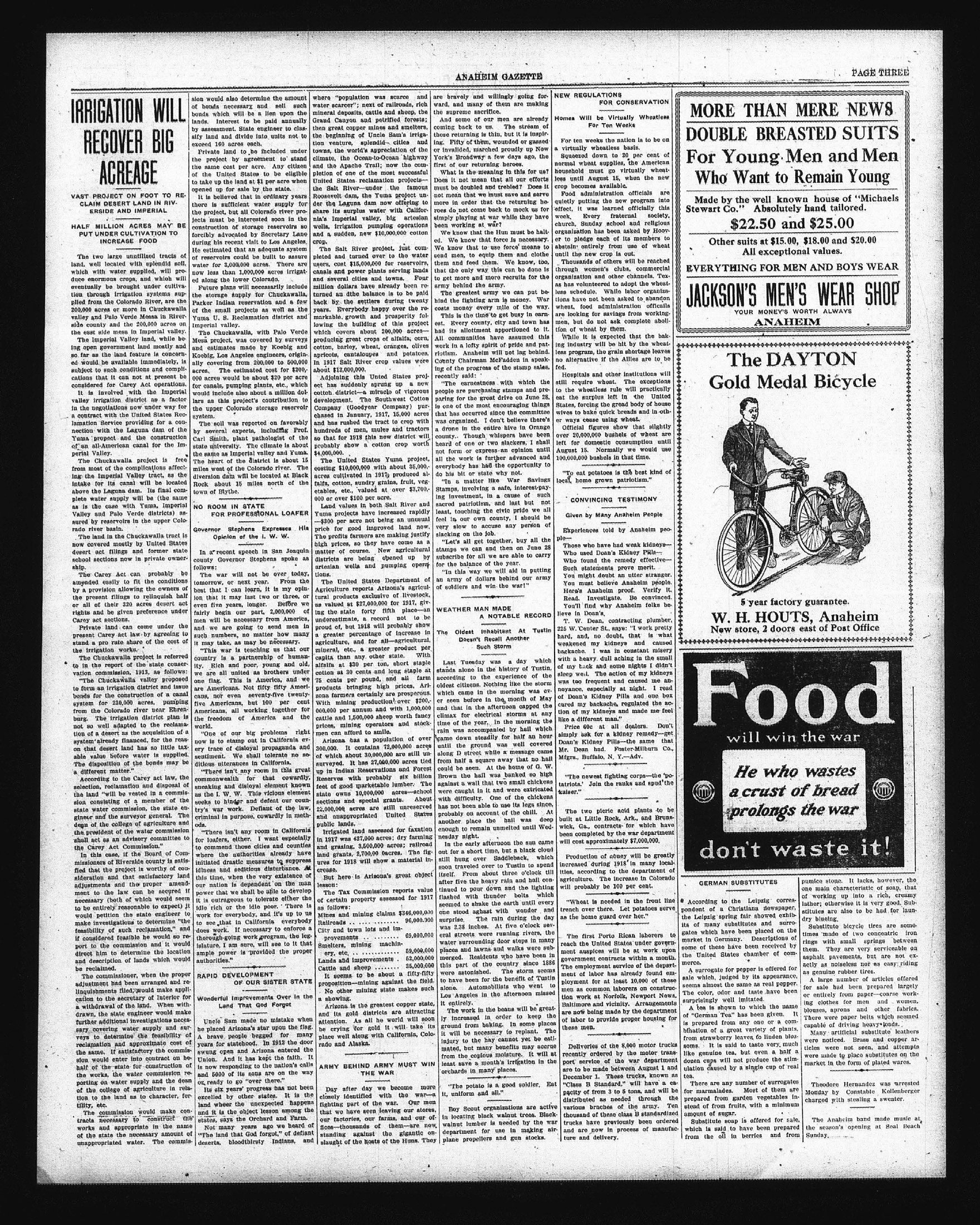
Searchable text
IRRIGATION WILL RECOVER BIG ACREAGE
VAST PROJECT ON FOOT TO RECLAIM DESERT LAND IN RIVERSIDE AND IMPERIAL
HALF MILLION ACRES MAY BE PUT UNDER CULTIVATION TO INCREASE FOOD
The two large unutilized tracts of land, well located with splendid soil, which with water supplied, will produce enormous crops, and which will eventually be brought under cultivation through irrigation systems supplied from the Colorado River, are the 200,000 acres or more in Chuckawalla valley and Palo Verde Messa in River-side county and the 200,000 acres on the east side mesa in Imperial valley.
The Imperial Valley land, while being open government land mostly and so far as the land feature is concerned would be available immediately, is subject to such conditions and complications that it can not at present be considered for Carey Act operations.
It is involved with the Imperial valley irrigation district as a factor in the negotiations now under way for a contract with the United States Reclamation Service providing for a connection with the Laguna dam of the Yuma propect and the construction of an all-American canal for the Imperial Valley.
The solution would also determine the amount of bonds necessary and sell such bonds which will be a lien upon the lands. Interest to be paid annually by assessment. State engineer to classify land and divide into units not to exceed 160 acres each.
Private land to be included under the project by agreement to stand the same cost per acre. Any citizen of the United States to be eligible to take up the land at $1 per acre when opened up for sale by the state.
It is believed that in ordinary years there is sufficient water supply for the project, but all Colorado river projects must be interested soon in the construction of storage reservoirs so forcibly advocated by Secretary Lane during his recent visit to Los Angeles. He estimated that an adequate system of reservoirs could be built to assure water for 3,000,000 acres. There are now less than 1,000,000 acres irrigated along the lower Colorado.
Future plans will necessarily include the storage supply for Chuckawalla, Parker Indian reservation and a few of the small projects as well as the Yuma U. S. Reclamation district and Imperial valley.
The Chuckawalla, with Palo Verde Mesa project, was covered by surveys and estimates made by Koebig and Koebig, Los Angeles engineers, originally covering from 200,000 to 500,000 acres. The estimated cost for $200,000 acres would be about $20 per acre for canals, pumping plants, etc., which would include also about a million dollars as this project's contribution to the upper Colorado storage reservoir system.
The soil was reported on favorably by several experts, including Prof. Carl Smith, plant pathologist of the state university. The climate is about the same as Imperial valley and Yuma.
where "population" water scarcer; no mineral deposits; Grand Canyon and then great copper; the beginning of a town, the world's climate; the Oceans and the Apache Tiepletion of one of United States reckons the Salt River—Roosevelt dam; therder the Laguna dale share its surplus nia's Imperial wells, irrigation and a sudden new crop.
The Salt River pleted and turned users, cost $15,000 canals and power and several cities million dollars has turned an dte back by the set years. Everybody markable, growth lowing the build which covers abo producing great cotton, barley, wapricots, cantaloum In 1917 Salt River about $12,000,000.
Adjoining this sect has suddenly cotton district—a development. The Company (Goody) chased in January and has rushed the hundreds of men so that for 1918 it probably show s $4,000,000.
ed would be available immediately, is subject to such conditions and complications that it can not at present be considered for Carey Act operations.
It is involved with the Imperial valley irrigation district as a factor in the negotiations now under way for a contract with the United States Reclamation Service providing for a connection with the Laguna dam of the Yuma propect and the construction of an all-American canal for the Imperial Valley.
The Chuckawalla project is free from most of the complications affecting the Imperial Valley tract, as the intake for its canal will be located above the Laguna dam. Its final complete water supply will be (the same as is the case with Yuma, Imperial Valley and Palo Verde districts) assured by reservoirs in the upper Colorado river basin.
The land in the Chuckawalla tract is now covered mostly by United States desert act filings and former state school sections now in private ownership.
The Carey Act can probably be amended easily to fit the conditions by a provision allowing the owners of the present filings to relinquish half or all of their 320 acres desert act rights and be given preference under Carey act sections.
Private land can come under the present Carey act law by agreeing to stand a pro rate share of the cost of the irrigation works.
The Chuckawalla project is referred to in the report of the state conservation commission, 1913, as follows:
"The Chuckawalla valley proposed to form an irrigation district and issue bonds for the construction of a canal system for 230,000 acres, pumping from the Colorado river near Ehrenburg. The irrigation district plan is not so well adapted to the reclamation of a desert as the acquisition of a system already financed, for the reason that desert land has so little taxable value before water is supplied. The disposition of the bonds may be a different matter."
According to the Carey act law, the selection, reclamation and disposal of the land "will be vested in a commission consisting of a member of the state water commission, the state engineer and the surveyor general. The dean of the college of agriculture and the president of the water commission shall act as an advisory committee to the Carey Act Commission."
In this case, if the Board of Commissioners of Riverside county is satisfied would be available immediately, is subject to such conditions and complications that it can not at present be considered for Carey Act operations.
It is involved with the Imperial valley irrigation district as a factor in the negotiations now under way for a contract with the United States Reclamation Service providing for a connection with the Laguna dam of the Yuma propect and the construction of an all-American canal for the Imperial Valley.
The Chuckawalla project is free from most of the complications affecting the Imperial Valley tract, as the intake for its canal will be located above the Laguna dam. Its final complete water supply will be (the same as is the case with Yuma, Imperial Valley and Palo Verde districts) assured by reservoirs in the upper Colorado river basin.
The land in the Chuckawalla tract is now covered mostly by United States desert act filings and former state school sections now in private ownership.
The Carey Act can probably be amended easily to fit the conditions by a provision allowing the owners of the present filings to relinquish half or all of their 320 acres desert act rights and be given preference under Carey act sections.
Private land can come under the present Carey act law by agreeing to stand a pro rate share of the cost of the irrigation works.
The Chuckawalla project is referred to in the report of the state conservation commission, 1913, as follows:
"The Chuckawalla valley proposed to form an irrigation district and issue bonds for the construction of a canal system for 230,000 acres, pumping from the Colorado river near Ehrenburg. The irrigation district plan is not so well adapted to the reclamation of a desert as the acquisition of a system already financed, for the reason that desert land has so little taxable value before water is supplied. The disposition of the bonds may be a different matter."
According to the Carey act law, the selection, reclamation and disposal of the land "will be vested in a commission consisting of a member of the state water commission, the state engineer and the surveyor general. The dean of the college of agriculture and the president of the water commission shall act as an advisory committee to the Carey Act Commission."
In this case, if the Board of Commissioners of Riverside county is satisfied would be available immediately, is subject to such conditions and complications that it can not at present be considered for Carey Act operations.
It is involved with the Imperial valley irrigation district as a factor in the negotiations now under way for a contract with the United States Reclamation Service providing for a connection with the Laguna dam of the Yuma propect and the construction of an all-American canal for the Imperial Valley.
The Chuckawalla project is free from most of the complications affecting the Imperial Valley tract, as the intake for its canal will be located above the Laguna dam. Its final complete water supply will be (the same as is the case with Yuma, Imperial Valley and Palo Verde districts) assured by reservoirs in the upper Colorado river basin.
The land in the Chuckawalla tract is now covered mostly by United States desert act filings and former state school sections now in private ownership.
The Carey Act can probably be amended easily to fit the conditions by a provision allowing the owners of the present filings to relinquish half or all of their 320 acres desert act rights and be given preference under Carey act sections.
Private land can come under the present Carey act law by agreeing to stand a pro rate share of the cost of the irrigation works.
The Chuckawalla project is referred to in the report of the state conservation commission, 1913, as follows:
"The Chuckawalla valley proposed to form an irrigation district and issue bonds for the construction of a canal system for 230,000 acres, pumping from the Colorado river near Ehrenburg. The irrigation district plan is not so well adapted to the reclamation of a desert as the acquisition of a system already financed, for the reason that desert land has so little taxable value before water is supplied. The disposition of the bonds may be a different matter."
According to the Carey act law, the selection, reclamation and disposal of the land "will be vested in a commission consisting of a member of the state water commission, the state engineer and the surveyor general. The dean of the college of agriculture and the president of the water commission shall act as an advisory committee to the Carey Act Commission."
In this case, if the Board of Commissioners of Riverside county is satisfied would be available immediately, is subject to such conditions and complications that it can not at present be considered for Carey Act operations.
It is involved with the Imperial valley irrigation district as a factor in the negotiations now under way for a contract with the United States Reclamation Service providing for a connection with the Laguna dam of the Yuma procept and the construction of an all-American canal for the Imperial Valley.
The Chuckawalla project is free from most of these complications affecting the Imperial Valley tract, as the intake for its canal will be located above the Laguna dam. Its final complete water supply will be (the same as is the case with Yuma, Imperial Valley and Palo Verde districts) assured by reservoirs in upper Colorado river basin.
The land in the Chuckawalla tract is now covered mostly by United States desert act filings and former state school sections now in private ownership.
The Carey Act can probably be amended easily to fit the conditions by a provision allowing the owners of the present filings to relinquish half or all of their 320 acres desert act rights and be given preference under Carey act sections.
Private land can come under this present Carey act law by agreeing to stand a pro rate share of this cost of irrigation works.
The Chuckawalla project is referred to in this report of state conservation commission, 1913, as follows:
"The Chuckawalla valley proposed to form an irrigation district and issue bonds for construction of a canal system for 230,000 acres, pumping from Colorado river near Ehrenburg. The irrigation district plan is not so well adapted to reclamation of a desert as acquisition of system already financed, for reason that desert land has so little taxable value before water is supplied. The disposition of bonds may be a different matter."
According to this Carey act law, selection, reclamation and disposal of land "will be vested in a commission consisting of a member of state water commission, state engineer and surveyor general. The dean of college agriculture and president of water commission shall act as advisory committee to Carey Act Commission."
In 1917 Salt River about $12,000,000.
Adjoining this sect has suddenly cotton district—a development. The Company (Goody chased in January) has rushed hundreds of men so that for 1918 probably show $4,000,000.
The United States costing $10,000,000 acres cultivated falfa, cotton, sunflower etables etc., valuation over $100 or more.
Land values in Yuma projects have $300 per acre price for good products farmers must undertake; a proud of but 1918 greater percentage agriculture; and mineral etc., capita than any alfalfa at $30 per cotton at 30 cents 75 cents per product bringing zona farmers cereal With mining prices 000,000 per annuity cattle and 1,500,000 prices mining men can afford them.
Arizona has about 300,000. It contains which about 3 surveys. It has up in Indian Reserves with feet of good man state owns 10,000 sections and spends 22,000,000 acres and unappropriated public lands.
Irrigated lands in 1917 was 437,000 and grazing, 3,554 land grants, 2,766ures for 1918 wil
According to the Carey act law, the selection, reclamation and disposal of the land "will be vested in a commission consisting of a member of the state water commission, the state engineer and the surveyor general. The dean of the college of agriculture and the president of the water commission shall act as an advisory committee to the Carey Act Commission."
In this case, if the Board of Commissioners of Riverside county is satisfied that the project is worthy of consideration and that satisfactory land adjustments and the proper amendment to the law can be secured if necessary (both of which would seem to be entirely reasonable to expect), it would petition the state engineer to make investigations to determine "the feasibility of such reclamation," and if considered feasible he would so report to the commission and it would direct him to determine the location and description of lands which would be reclaimed.
The commissioner, when the proper adjustment had been arranged and relinquishments filed, would make application to the secretary of Interior for a withdrawal of the land. When withdrawn, the state engineer would make further additional investigations necessary covering water supply and surveys to determine the feasibility of reclamation and approximate cost of the same. If satisfactory the commission would enter into contract on behalf of the state for construction of the works, the water commission reporting on water supply and the dean of the college of agriculture in relation to the land as to character, fertility, etc.
The commission would make contracts necessary to construct the works and appropriate in the name of the state the necessary amount of unappropriated water. The commis-
"There isn't any room in this great commonwealth for that cowardly, sneaking and disloyal element known as the I. W. W. This vicious element seeks to hinder and defeat our country's war work. Defiant of the law, criminal in purpose, cowardly in methods.
"There isn't any room in California for loafers, either. I want especially to commend those cities and counties where the authorities already have initiated drastic measures to suppress idleness and seditious disturbance. At this time, when the very existence of our nation is dependent on the man power that we shall be able to develop it is outrageous to tolerate either the idle rich or the idle poor. There is work for everybody, and it's up to us to see that in California everybody does work. If necessary to enforce a thorough-going work program, the legislature, I am sure, will see to it that ample power is provided the proper authorities."
RAPID DEVELOPMENT OF OUR SISTER STATE
Wonderful improvements Over in the Land That God Forgot
Uncle Sam made no mistake when he placed Arizona's star upon the flag. A brave people begged for many years for statehood. In 1912 the door swung open and Arizona entered the Union. And it has kept the faith. It is now responding to the nation's calls and 5000 of its sons are on the way or ready to go "over there."
Its six years' progress has not been excelled by other states. It is the land wheer the unexpected happens and it is the object lesson among the states, says the Orchard and Farm.
Not many years ago we heard of "The land that God forgot," of defiant deserts, bloodthirsty Indians, and
ANAHEIM GAZETTE
amount such on the annually so class not to under stand citizen negligible when years only for pro in the airs so Lane Angeles, system pressure here are irrigation include sawalla, a few was the act and Verde surveys big and origin-500,000 $200,000 acre which cotton dolton to reservoir favorably Prof. of the is about Yuma.
where "population was scarce and water scarcer"; next of railroads, rich mineral deposits, cattle and sheep, the Grand Canyon and petrified forests; then great copper mines and smelters, the beginning of Uncle Sam's irrigation venture, splendid cities and towns, the world's appreciation of the climate, the Ocean-to-Ocean highway and the Apache Trail; now the completion one of the most successful United States reclamation projects—the Salt River—under the famous Roosevelt dam, the Yuma project under the Laguna dam now offering to share its surplus water with California's Imperial valley, big artesian wells, irrigation pumping operations and a sudden, new $10,000,000 cotton crop.
The Salt River project, just completed and turned over to the water users, cost $15,000,000 for reservoirs, canals and power plants serving lands and several cities and towns. Four million dollars have already been returned an dthe balance is to be paid back by the settlers during twenty years. Everybody happy over the remarkable growth and prosperity following the building of this project which covers about 200,000 acres—producing great crops of alfalfa, corn, cotton, barley, wheat, oranges, olives apricots, cantaloupes and potatoes. In 1917 Salt River crop values were about $12,000,000.
Adjoining this United States project has suddenly sprung up a new cotton district—a miracle of vigorous development. The Southwest Cotton Company (Goodyear Company) purchased in January, 1917, 15,000 acres and has rushed the tract to crop with hundreds of men, mules and tractors so that for 1918 this new district will probably show a cotton crop worth $4,000,000.
are bravely and willingly going forward, and many of them are making the supreme sacrifice.
And some of our men are already coming back to us. The stream of those returning is thin, but it is inspiring. Fifty of them, wounded or gassed or invalidled, marched proudly up New York's Broadway a few days ago, the first of our returning heroes.
What is the meaning in this for us? Does it not mean that all our efforts must be doubled and trebled? Does it not mean that we must save and serve more in order that the returning heroes do not come back to mock us for simply playing at war while they have been working at war?
We know that the Hun must be halted. We know that force is necessary. We know that to use force means to send men, to equip them and clothe them and feed them. We know, too, that the only way this can be done is to get more and more recruits for the army behind the army.
The greatest army we can put behind the fighting arm is money. War costs money every mile of the way.
This is the time to get busy in earnest. Every county, city and town has had its allotment apportioned to it. All communities have assumed this work in a lofty spirit of pride and patriotism. Anaheim will not lag behind. County Chairman McFadden in speaking of the progress of the stamp sales, recently said:
"The earnestness with which the people are purchasing stamps and preparing for the great drive on June 28, is one of the most encouraging things that has occurred since the committee was organized. I don't believe there's a drone in the entire hive in Orange county.. Though whispers have been heard of one or two slackers, I shall not form or express-an opinion until work is farther advanced and
NEW REGULATIONS FOR CONSERVATION
Homes Will be Virtually Wheatless For Ten Weeks
For ten weeks the nation is to be on a virtually wheatless basis.
Squeezed down to 20 per cent of normal wheat supplies, the American household must go virtually wheatless until August 15, when the new crop becomes available.
Food administration officials are quietly putting the new program into effect, it was learned officially this week. Every fraternal society, church, Sunday school and religious organization has been asked by Hoover to pledge each of its members to abstain entirely from use of wheat until the new crop is out.
Thousands of others will be reached through women's clubs, commercial organization and other channels. Texas has volunteered to adopt the wheatless schedule. While labor organizations have not been asked to abandon wheat, food administration officials are looking for savings from workingmen, but do not ask complete abolition of wheat by them.
While it is expected that the baking industry will be hit by the wheatless program, the grain shortage leaves no alternative if the Allies are to be fed.
Hospitals and other institutions will still require wheat. The exceptions to the wheatless rule will practically eat the surplus left in the United States, forcing the greed body of house wives to bake quick breads and in-other ways cease using wheat.
Official figures show that slightly over 20,000,000 bushels of wheat are left for domestic consumption until August 15. Normally we would use 100,000,000 bushels in that time.
In 1917 Salt River crop values were about $12,000,000.
Adjoining this United States project has suddenly sprung up a new cotton district—a miracle of vigorous development. The Southwest Cotton Company (Goodyear Company) purchased in January, 1917, 15,000 acres and has rushed the tract to crop with hundreds of men, mules and tractors so that for 1918 this new district will probably show a cotton crop worth $4,000,000.
The United States Yuma project, costing $10,000,000 with about 35,000 acres cultivated in 1917, produced alfalfa, cotton, sundry grains, fruit, vegetables, etc., valued at over $3,700,000 or over $100 per acre.
Land values in both Salt River and Yuma projects have increased rapidly—$300 per acre not being an unusual price for good improved land now. The profits farmers are making justify high prices, so they have come as a matter of course. New agricultural districts are being opened up by artesian wells and pumping operations.
The United States Department of Agriculture reports Arizona's agricultural products exclusive of livestock, as valued at $27,000,000 for 1917, giving the state forty fifth place—an underestimate, a record not to be proud of, but 1918 will probably show a greater percentage of increase in agriculture, and for all—agricultural, mineral, etc., a greater product per capita than any other state. With alfalfa at $30 per ton, short staple cotton at 30 cents and long staple at 75 cents per pound, and all farm products bringing high prices, Arizona farmers certainly are prosperous. With mining production over $200,000,000 per annum and with 1,000,000 cattle and 1,500,000 sheep worth fancy prices, mining operators and stockmen can afford to smile.
Arizona has a population of over 300,000. It contains 72,000,000 acres of which about 30,000,000 are still surveyed. It has 27,000,000 acres tied up in Indian Reservations and Forest Reserves with probably six billion feet of good marketable lumber. The state owns 10,000,000 acres—school sections and special grants. About 22,000,000 acres are still unreserved and unappropriated United States public lands.
Irrigated land assessed for taxation in 1917 was 437,000 acres; dry farming and grazing, 3,500,000 acres; railroad land grants, 2,700,000 acres. The figures for 1918 will show a material increase in the progress of the stamp sales, recently said:
"The earnestness with which the people are purchasing stamps and preparing for the great drive on June 28 is one of the most encouraging things that has occurred since the committee was organized. I don't believe there's a drone in the entire hive in Orange county.. Though whispers have been heard of one or two slackers, I shall not form or express an opinion until all the work is further advanced and everybody has had the opportunity to do his bit or state why not.
"In a matter like War Savings Stamps, involving a safe, interest-paying investment, in a cause of such sacred patriotism, and last but not least, touching the civic pride we all feel in our own county. I should be very slow to accuse any person of slacking on the job.
"Let's all get together, buy all the stamps we can and then on June 28 subscribe for all we are able to carry for the balance of the year.
"In this way we will aid in putting an army of dollars behind our army of soldiers and win the war!"
WEATHER MAN MADE A NOTABLE RECORD
The Oldest Inhabitant At Tustin Doesn't Recall Another Such Storm
Last Tuesday was a day which stands alone in the history of Tustin, according to the experience of the oldest citizens. Nothing like the storm which came in the morning was ever seen before in the month of May and that in the afternoon capped the climax for electrical storms at any time of the year. In the morning the rain was accompanied by hail which came down steadily for half an hour until the ground was well covered along D street while a message came from half a square away that no hail could be seen. At the home of G. W. Brown the hall was banked so high against a wall that two small chickens were caught in it and were extricated with difficulty. One of the chickens has not been able to use its legs since probably on account of the chill. At another place the hall was deep enough to remain unmelted until Wednesday night.
In the early afternoon the sun came out for a short time, but a black cloud still hung over Saddleback, which invaded over Tustin to spend County Chairman Merudden in speaking of the progress of the stamp sales, recently said:
"The earnestness with which the people are purchasing stamps and preparing for the great drive on June 28 is one of the most encouraging things that has occurred since the committee was organized. I don't believe there's a drone in the entire hive in Orange county.. Though whispers have been heard of one or two slackers, I shall not form or express an opinion until all the work is further advanced and everybody has had the opportunity to do his bit or state why not.
"In a matter like War Savings Stamps, involving a safe, interest-paying investment, in a cause of such sacred patriotism, and last but not least, touching the civic pride we all feel in our own county. I should be very slow to accuse any person of slacking on the job.
"Let's all get together, buy all the stamps we can and then on June 28 subscribe for all we are able to carry for the balance of the year.
"In this way we will aid in putting an army of dollars behind our army of soldiers and win the war!"
CONVINCING TESTIMONY
Given by Many Anaheim People
Experiences told by Anaheim people—
Those who have had weak kidneys—Who used Doan's Kidney Pills—Who found the remedy effective—Such statements prove merit.
You might doubt an utter stranger. You must believe Anaheim people. Here's Anaheim proof. Verify it. Read. Investigate. Be convinced.
You'll find why Anaheim folks believe in Doan's.
T. W. Dean, contracting plumber,
225 W. Center St., says: "I work pretty hard, and no doubt, that is what weakened my kidneys and caused backache. I was in constant misery with a heavy dull aching in the small of my back and some nights I didn't sleep well. The action of my kidneys was too frequent and caused me annoyance, especially at night. I read of Doan's Kidney Pills and one box cured my backache, regulated the action of my kidneys and made me feel like a different man."
Price 60c at all dealers. Don't simply ask for a kidney remedy—get Doan's Kidney Pills—the same that Mr. Dean had. Foster-Milburn Co., Mfrgs., Buffalo, N. Y.-Adv.
"The newest fighting corps—the 'potatriots.' Join the ranks and spud'the kaiser."
The two picnic acid plants to be built at Little Rock, Ark., and Brunswick, Ga., contracts-for which have been completed by the war department will cost approximately $7,000,000.
Production of honey will be greatly increased during 1918 in many local-
up in Indian Reservations and Forest
Reserves with probably six billion
feet of good marketable lumber. The
state owns 10,000,000 acres—school
sections and special grants. About
22,000,000 acres are still unreserved
and unappropriated United States
public lands.
Irrigated land assessed for taxation
in 1917 was 437,000 acres; dry farming
and grazing, 3,500,000 acres; railroad
land grants, 2,700,000 acres. The figures for 1918 will show a material increase.
But here is Arizona's great object
lesson:
The Tax Commission reports value
of certain property assessed for 1917
as follows:
Mines and mining claims $346,000,000
Railroads . . . . . . . . . . . . . . . . . . . . . . . . . . . . . . . . . . . . . . . . . . . . . . . 96,000,000
City and town lots and improvements ..... 69,000,000
Smelters, mining machiery, etc. ..... 59,000,000
Lands and improvements. 52,000,000
Cattle and sheep ..... 35,000,000
It seems to be about a fifty-fifty
proposition—mining against the field.
No other mining state makes such
a showing.
Arizona is the greatest copper state,
and its gold districts are attracting
attention. As all he world will soon
be crying for gold it will take its
place well along with California, Colorado and Alaska.
ARMY BEHIND ARMY MUST WIN THE WAR
Day after day we become more closely identified with the war—a fighting part of the war. Our men that we have seen leaving our stores,
our factories, our farms, and our offices—thousands of them—are now, standing against the gigantic onslaught of the hosts of the Huns. They
"The potato is a good soldier. Eat it, uniform and all."
Boy Scout organizations are active in locating black walnut trees. Black-walnut lumber is needed by the war department for use in making airplane propellers and gun stocks.
"The newest fighting corps—the 'potatiots.' Join the ranks and spud' the kaiser."
The two picnic acid plants to be built at Little Rock, Ark., and Brunswick, Ga., contracts for which have been completed by the war department will cost approximately $7,000,000.
Production of money will be greatly increased during 1918 in many localities, according to the department of agriculture. The increase in Colorado will probably be 100 per cent.
"Wheat is needed in the front line trench over there. Let potatoes serve as the home guard over her."
The first Porto Rican laborers to reach the United States under government auspices will be at work upon government contracts within a month. The employment service of the department of labor has already found employment for at least 10,000 of these men as common laborers on construction work at Norfolk, Newport News, Baltimore and vicinity. Arrangements are now being made by the department of labor to provide proper housing for these men.
Delliveries of the 8,000 motor trucks recently ordered by the motor transport service of the war department are to be made between August 1 and December 1. These trucks, known as "Class B Standard," will have a capacity of from 3 to 5 tons, and will be distributed as needed through the various branches of the army. Ten thousand of these class B standardized trucks have previously been ordered and are now in process of manufacture and delivery.
MORE THAN MERE NEWS
DOUBLE BREASTED SUITS
For Young Men and Men
Who Want to Remain Young
Made by the well known house of "Michaels Stewart Co." Absolutely hand tailored.
$22.50 and $25.00
Other suits at $15.00, $18.00 and $20.00
All exceptional values.
EVERYTHING FOR MEN AND BOYS WEAR
JACKSON'S MEN'S WEAR SHOP
YOUR MONEY'S WORTH ALWAYS
ANAHEIM
The DAYTON
Gold Medal Bicycle
The DAYTON
Gold Medal Bicycle
5 year factory guarantee.
W. H. HOUTS, Anaheim
New store, 2 doors east of Post Office
Food
will win the war
He who wastes
a crust of bread
prolongs the war
don't waste it!
GERMAN SUBSTITUTES
According to the Leipzig correspondent of a Christiana newspaper, the Leipzig spring fair showed exhibits of many substitutes and surrogates which have been placed on the market in Germany. Descriptions of some of these have been received by the United States chamber of commerce.
A surrogate for pepper is offered for sale which, judged by its appearance, seems almost the same as real pepper. The color, odor and taste have been surprisingly well imitated.
A tea is shown to which the name of "German Tea" has been given. It is prepared from any one or a combination of a great variety of plants, from strawberry leaves to linden blossoms. It is said to taste very much like genuine tea, but even a half a dozen cups will not produce the stimulation caused by a single cup of real tea.
There are any number of surrogates for marmalades. Most of them are prepared from garden vegetables instead of from fruits, with a minimum amount of sugar.
Substitute soap is offered for sale, which is said to have been prepared from the oil in berries and from pumice stone. It lacks, however, the one main characteristic of soap, that of working up into a rich, creamy lather; otherwise it is very good. Substitutes are also to be had for laundry blueing.
Substitute bicycle tires are sometimes made of two concentric iron rings with small springs between them. They are very serviceable on asphalt pavements, but are not exactly as noiseless nor as easy riding as genuine rubber tires.
A large number of articles offered for sale had been prepared largely or entirely from paper—coarse working clothes for men and women, blouses, aprons and other fabrics. There were paper belts which seemed capable of driving heavy loads.
Many artificial substitute leathers were noticed. Brass and copper articles were not seen, and attempts were made to place substitutes on the market in the form of plated wares.
Theodore Hernandez was arrested Monday by Constable Kellenberger charged with stealing a sweater.
The Anaheim band made music at the season's opening at Seal Beach Sunday.