anaheim-gazette 1918-04-25
Scanned page
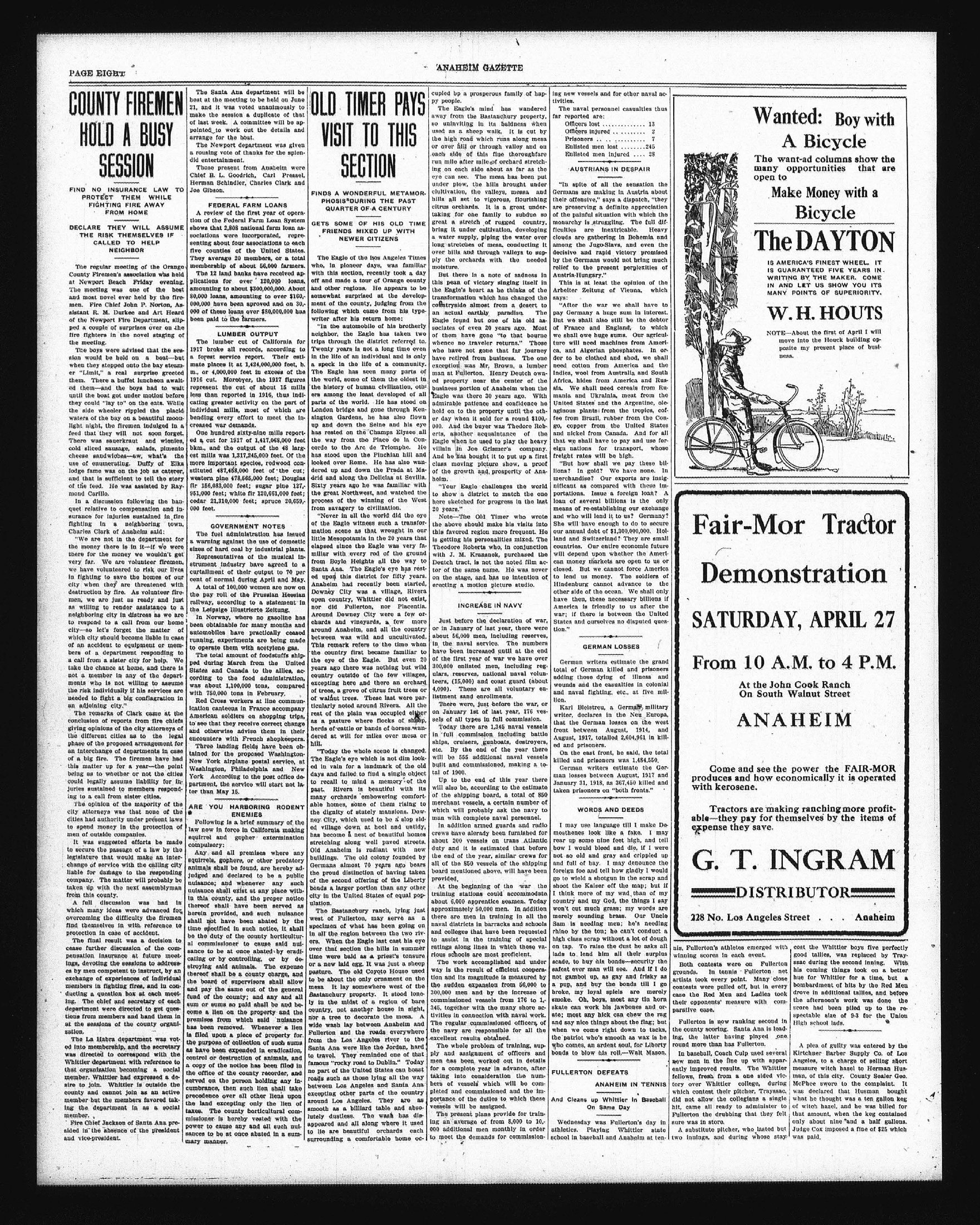
Searchable text
COUNTY FIREMEN
HOLD A BUSY
SESSION
FIND NO INSURANCE LAW TO
PROTECT THEM WHILE
FIGHTING FIRE AWAY
FROM HOME
DECLARE THEY WILL ASSUME
THE RISK THEMSELVES IF
CALLED TO HELP
NEIGHBOR
The regular meeting of the Orango County Firemen's association was held at Newport Beach Friday evening. The meeting was one of the best and most novel ever held by the firemen. Fire Chief John P. Norton, Assistant R. M. Durkee and Art Heard of the Newport Fire Department, slipped a couple of surprises over on the fire fighters in the novel staging of the meeting.
The boys were advised that the session would be held on a boat—but when they stepped onto the bay steamer "Limit," a real surprise greeted them. There a buffet luncheon awaited them—and the boys had to wait until the boat got under motion before they could "lay to" on the eats. While the side wheeler rippled the placid waters of the bay on a beautiful moonlight night, the firemen indulged in a feed that they will not soon forget. There was sauerkraut and wienles, cold sliced sausage, salads, pimento cheese sandwiches—aw, what's the
The Santa Ana department will be host at the meeting to be held on June 21, and it was voted unanimously to make the session a duplicate of that of last week. A committee will be appointed to work out the details and arrange for the boat.
The Newport department was given a rousing vote of thanks for the splendid entertainment.
Those present from Anabeim were Chief B. L. Goodrich, Carl Pressel, Herman Schindler, Charles Clark and Joe Gibson.
FEDERAL FARM LOANS
A review of the first year of operation of the Federal Farm Loan System shows that 2,808 national farm loan associations were incorporated, representing about four associations to each five counties of the United States. They average 20 members, or a total membership of about 56,000 farmers.
The 12 land banks have received applications for over 120,000 loans, amounting to about $300,000,000. About 80,000 loans, amounting to over $160,000,000 have been approved and on 30,000 of these loans over $80,000,000 has been paid to the farmers.
LUMBER OUTPUT
The lumber cut of California for 1917 broke all records, according to a forest service report. Their estimate places it at 1,424,000,000 feet, bm., or 4,000,000 feet in excess of the 1916 cut. Moreover, the 1917 figures represent the cut of about 15 mills less than reported in 1916, thus indicating greater activity on the part of individual mills, most of which are bending every effort to meet the increased war demands.
One hundred sixty-nine mills reported a cut for 1917 of 1,417,068,000 feet bkm., and the output of the 48 largest mills was 1,317,245,000 feet. Of the
OLD TIMES VISIT TIME SECRET
FINDS A WONDERFUL PHOSIS DURING QUARTER OF GETS SOME OF FRIENDS MIX NEWER
The Eagle of the who, in pioneer with this section, off and made a tour and other regions somewhat surprising ment of the county following which c writer after his re
"In the automobile neighbor, the East trips through the Twenty years is near in the life of an in a speck in the life The Eagle has seen the world, some of the history of humers among the less parts of the world London bridge and sington Gardens up and down they has rested on the way from the corde to the Arc has stood upon th
when they stepped onto the bay steamer "Limit," a real surprise greeted them. There a buffet luncheon awaited them—and the boys had to wait until the boat got under motion before they could "lay to" on the eats. While the side wheeler rippled the placid waters of the bay on a beautiful moonlight night, the firemen indulged in a feed that they will not soon forget. There was sauerkraut and wienies, cold sliced sausage, salads, pimento cheese sandwiches—aw, what's the use of enumerating. Duffy of Elka lodge fame was on the job as caterer, and that is sufficient to tell the story of the feed. He was assisted by Raymond Carillo.
In a discussion following the banquet relative to compensation and insurance for injuries sustained in fire fighting in a neighboring town, Charles Clark of Anaheim said:
"We are not in the department for the money there is in it—if we were there for the money we wouldn't get very far. We are volunteer firemen, we have volunteered to risk our lives in fighting to save the homes of our city when they are threatened with destruction by fire. As volunteer firemen, we are just as ready and just as willing to render assistance to a neighboring city in distress as we are to respond to a call from our home city—so let's forget the matter of which city should become liable in case of an accident to equipment or members of a department responding to a call from a sister city for help. We take the chance at home, and there is not a member in any of the departments who is not willing to assume the risk individually if his services are needed to fight a big conflagration in an adjoining city."
The remarks of Clark came at the conclusion of reports from fire chiefs giving opinions of the city attorneys of the different cities as to the legal phase of the proposed arrangement for an interchange of departments in case of a big fire. The firemen have had this matter up for a year—the point being as to whether or not the cities could legally assume liability for injuries sustained to members responding to a call from sister cities.
The opinion of the majority of the city attorneys was that none of the cities had authority under present laws to spend money in the protection of men outside companies.
It was suggested efforts be made to secure the passage of a law by the legislature that would make an interchange of service with the calling city mate places it at 1,424,000,000 feet, bm., or 4,000,000 feet in excess of the 1916 cut. Moreoyer, the 1917 figures represent the cut of about 15 mills less than reported in 1916, thus indicating greater activity on the part of individual mills, most of which are bending every effort to meet the increased war demands.
One hundred sixty-nine mills reported a cut for 1917 of 1,417,068,000 feet bkm., and the output of the 48 largest mills was 1,317,245,000 feet. Of the more important species, redwood constituted 487,468,000 feet of the cut; western pine 478,565,000 feet; Douglas fir 156,083,000 feet; sugar pine 127,951,000 feet; white fir 120,661,000 feet; cedar 21,310,000 feet; spruce 20,659,000 feet.
GOVERNMENT NOTES
The fuel administration has issued a warning against the use of domestic sizes of hard coal by industrial plants.
Representatives of the musical instrument industry have agreed to a curtailment of their output to 70 percent of normal during April and May.
A total of 100,000 women are now on the pay roll of the Prussian Hessian railway, according to a statement in the Leipsige Illustrierte Zeitung.
In Norway, where no gasoline has been obtainable for many months and automobiles have practically ceased running, experiments are being made to operate them with acetylene gas.
The total amount of foodstuffs shipped during March from the United States and Canada to the allies, according to the food administration, was about 1,100,000 tons, compared with 750,000 tons in February.
Red Cross workers at line communication canteens in France accompany American soldiers on shopping trips, to see that they receive correct change and otherwise advise them in their encounters with French shopkeepers.
Three landing fields have been obtained for the proposed Washington-New York airplane postal service, at Washington, Philadelphia and New York. According to the post office department, the service will start not later than May 15.
ARE YOU HARBORING RODENT ENEMIES
Following is a brief summary of the law now in force in California making squirrel and gopher extermination compulsory:
Any and all premises where any squirrels, gophers, or other predatory speck in the life world, some of the history of humans among the less parts of the world London bridge and sington Gardens, up and down them has rested on them the way from the corde to the Arcade has stood upon them looked over Rome dered up and down drid and along them Sixty years ago he great Northwest process of the whi from savagery to
"Never in all tha of the Eagle witness scene as tha little Mesopotamia elapsed since tha millar with every from Boyle Heil Santa Ana. The B ed upon this dist Anahelm had reca Downey City was open country. Wh nor did Fullerton Around Downey Chards and vineyrs around Anahelm between was wilf This remark refere tthe country first ta tha eye of the E years ago there w countrys outside o excepting here an oof trees, a grove o f walnut trees. Ticularly noted arro rest of the plain w as a pasture wh herds o f cattle or b dered at will for hill.
"Today the whole The Eagle's eye wh ed in vain for a la days and failed to re to recall to mind past. Rivera is many orchards er able homes, someth e the dignity of stat ney City, which us ed village down a has become a nest stretching along Old Anaheim is buildings. The old Germans almost
The opinion of the majority of the city attorneys was that none of the cities had authority under present laws to spend money in the protection of men of outside companies.
It was suggested efforts be made to secure the passage of a law by the legislature that would make an interchange of service with the calling city liable for damage to the responding company. The matter will probably be taken up with the next assemblyman from this county.
A full discussion was had in which many ideas were advanced for overcoming the difficulty the firemen find themselves in with reference to protection in case of accident.
The final result was a decision to cease further discussion of the compensation insurance at future meetings, devoting the sessions to addresses by men competent to instruct, by an exchange of experiences of individual members in fighting fires, and in conducting a question box at each meeting. The chief and secretary of each department were directed to get questions from members and hand them in at the sessions of the county organization.
The La Habra department was voted into membership, and the secretary was directed to correspond with the Whittler department with reference to that organization becoming a social member. Whittler had expressed a desire to join. Whittler is outside the county and cannot join as an active member but the members favored taking the department in as a social member.
Fire Chief Jackson of Santa Ana presided in the absence of the president and vice-president.
ARE YOU HARBORING RODENT ENEMIES
Following is a brief summary of the law now in force in California making squirrel and gopher extermination compulsory:
Any and all premises where any squirrels, gophers, or other predatory animals shall be found, are hereby adjudged and declared to be a public nuisance; and whenever any such nuisance shall exist at any place within this county, and the proper notice thereof shall have been served as herein provided, and such nuisance shall not have been abated by the time specified in such notice, it shall be the duty of the county horticultural commissioner to cause said nuisance to be at once abated by eradicating or by controlling, or by destroying said animals. The expense thereof shall be a county charge, and the board of supervisors shall allow and pay the same out of the general fund of the county; and any and all sum or sums so paid shall be and become a lien on the property and the premises from which said nuisance has been removed. Whenever a lien is filed upon a piece of property for the purpose of collection of such sums as have been expended in eradication, control or destruction of animals, and a copy of the notice has been filed in the office of the county recorder, and served on the person holding any incumbrance, then such lien shall take precedence over all other liens upon the land excepting only the lien of taxes. The county horticultural commissioner is hereby vested with the power to cause any and all such nuisances to be at once abated in a summary manner.
Rivera is many orchards en able homes, some the dignity of state ney City, which us ed village down ad has become a nest stretching along Old Anaheim is buildings. The old Germans almost 70 the proud distinctio f of the second offer bonds a larger por city in the United U pulation.
The Bastanchury west of Fullerton, specimen of what in all the region be ers. When the Eagles over that section t time were bald as or a new laid egg. pasture. The old to be about the only mesa It lay some Bastanchury properly in the midst oi country, not another nor a tree to deco wide wash lay bet Fullerton and th e from the Los Anas Santa Ana were like to travel. They re famous "rocky road no part of the United roads such as those between Los Angeles excepting other pa arround Los Angeles smooth as a billiar lately dustless. T appeared and all al to lie are beautiful surrounding a com
OLD TIMER PAYS VISIT TO THIS SECTION
FINDS A WONDERFUL METAMORPHOSIS DURING THE PAST QUARTER OF A CENTURY
GETS SOME OF HIS OLD TIME FRIENDS MIXED UP WITH NEWER CITIZENS
The Eagle of the Los Angeles Times who, in pioneer days, was familiar with this section, recently took a day off and made a tour of Orange county and other regions. He appears to be somewhat surprised at the development of the county, judging from the following which came from his typewriter after his return home:
"In the automobile of his brotherly neighbor, the Eagle has taken two trips through the district referred to. Twenty years is not a long time even in the life of an individual and is only a speck in the life of a community. The Eagle has seen many parts of the world, some of them the oldest in the history of human civilization, others among the least developed of all parts of the world. He has stood on London bridge and gone through Kensington Gardens, he has also flown up and down the Seine and his eye has rested on the Champs Elysee all the way from the Place de la Concorde to the Arc de Triomphe. He has stood upon the Pinchinl hill and coupled bp a prosperous family of happy people.
The Eagle's mind has wandered away from the Bastanchury property, so uninviting in its baldness when used as a sheep walk. It is cut by the high road which runs along mesa or over hill or through valley and on each side of this fine thoroughfare run mile after mile of orchard stretching on each side about as far as the eye can see. The mesa has been put under plow, the hills brought under cultivation, the valleys, messa and hills all set to vigorous, flourishing citrus orchards. It is a great undertaking for one family to subdue so great a stretch of rugged country, bring it under cultivation, developing a water supply, piping the water over long stretches of mesa, conducting it over hills and through valleys to supply the orchards with the needed moisture.
But there is a note of sadness in this pean of victory singing itself in the Eagle's heart as he thinks of the transformation which has changed the countryside almost from a desert to an actual earthly paradise. The Eagle found but one of his old associates of even 20 years ago. Most of them have gone "to that bourne whence no traveler returns." Those who have not gone that far journey have retired from business. The one exception was Mr. Brown, a lumber man at Fullerton. Henry Deutch owned property near the center of the business portion of Anaheim when the Eagle was there 30 years ago. With admirable patience and confidence he held on to the property until the other day when it sold for a round $100,000. And the buyer was Theodore Roberts, another acquaintance of the Eagle when he used to play the heavy villain in Joe Grismer's company. And he has bought it to put up a first ing new vessels and for other naval activities.
The naval personnel casualties thus far reported are:
Officers lost ... 13
Officers injured ... 2
Prisoners ... 7
Enlisted men lost ... 245
Enlisted men injured ... 28
AUSTRIANS IN DESPAIR
"In spite of all the sensation the Germans are making in Austria about their offensive," says a dispatch, "they are preserving a definite appreciation of the painful situation with which the monarchy is struggling. The full difficulties are inextricable. Heavy clouds are gathering in Bohemia and among the Jugo-Slavs, and even the decisive and rapid victory promised by the Germans would not bring much relief to the present perplexities of Austria-Hungary."
This is at least the opinion of the Arbeiter Zeitung of Vienna, which says:
"After the war we shall have to pay Germany a huge sum in interest. But we shall also still be the debtor of France and England, to which we shall owe huge sums. Our agriculture will need machines from America, and Algerian phosphates. In order to be clothed and shod, we shall need cotton from America and the Indies, wool from Australia and South Africa, hides from America and Russia. We shall need cereals from Manania and Ukrainia, meat from the United States and the Argentine, oleaginous plants from the tropics, coffee from Brazil, rubber from the Congo, copper from the United States and nickel from Canada. And for all that we shall have to pay and use foreign nations for transport, whose freight rates will be high."
The Eagle has seen many parts of the world, some of them the oldest in the history of human civilization, others among the least developed of all parts of the world. He has stood on London bridge and gone through Kensington Gardens, he has also flown up and down the Selne and his eye has rested on the Champs Elysee all the way from the Place de la Concorde to the Arc de Triomphe. He has stood upon the Pinchian hill and looked over Rome. He has also wandered up and down the Prada at Madrid and along the Delicias at Sevilla. Sixty years ago he was familiar with the great Northwest, and watched the process of the winning of the West from savagery to civilization.
"Never in all the world did the eye of the Eagle witness such a transformation scene as that wrought in our little Mesopotamia in the 20 years that elapsed since the Eagle was very familiar with every rod of the ground from Boyle Heights all the way to Santa Ana. The Eagle's eye has rested upon this district for fifty years. Anaheim had recently been started, Downey City was a village, Rivera open country, Whittier did not exist, nor did Fullerton, nor Placentia. Around Downey City were a few orchards and vineyards, a few more around Anaheim, and all the country between was wild and uncultivated. This remark refers to the time when the country first became familiar to the eye of the Eagle. But even 20 years ago there was nothing but wild country outside of the few villages, excepting here and there an orchard of trees, a grove of citrus fruit trees or walnut trees. These last were particularly noted around Rivera. All the rest of the plain was occupied either as a pasture where flocks of sheep, herds of cattle or bands of horses wandered at will for miles over mesa or hill.
"Today the whole scene is changed. The Eagle's eye which is not dim looked in vain for a landmark of the old days and failed to find a single object to recall to mind a memory of the past. Rivera is beautiful with its many orchards embowering comfortable homes, some of them rising to the dignity of stately mansions. Downey City, which used to be a slop sided village down at heel and untidy, has become a nest of beautiful homes stretching along well paved streets. Old Anaheim is radiant with new buildings. The old colony founded by Germans almost 70 years ago bears a speck in the life of a community. The Eagle has seen many parts of the world, some of them the oldest in the history of human civilization, others among the least developed of all parts of the world. He has stood on London bridge and gone through Kensington Gardens, he has also flown up and down the Selne and his eye has rested on the Champs Elysee all the way from the Place de la Concorde to the Arc de Triomphe. He has stood upon the Pinchian hill and looked over Rome. He has also wandered up and down the Prada at Madrid and along the Delicias at Sevilla. Sixty years ago he was familiar with the great Northwest, and watched the process of the winning of the West from savagery to civilization.
"Never in all the world did the eye of the Eagle witness such a transformation scene as that wrought in our little Mesopotamia in the 20 years that elapsed since the Eagle was very familiar with every rod of the ground from Boyle Heights all the way to Santa Ana. The Eagle's eye has rested upon this district for fifty years. Anaheim had recently been started, Downey City was a village, Rivera open country, Whittier did not exist, nor did Fullerton, nor Placentia. Around Downey City were a few orchards and vineyards, a few more around Anaheim, and all the country between was wild and uncultivated. This remark refers to the time when the country first became familiar to the eye of the Eagle. But even 20 years ago there was nothing but wild country outside of the few villages, excepting here and there an orchard of trees, a grove of citrus fruit trees or walnut trees. These last were particularly noted around Rivera. All the rest of the plain was occupied either as a pasture where flocks of sheep, herds of cattle or bands of horses wandered at will for miles over mesa or hill."
Note—The Old Timer who wrote the above should make his visits into this favored region more frequent. He is getting his personalities mixed. The Theodore Roberts who, in conjunction with J. M. Kransnek, purchased the Deutch tract, is not the noted film actor of the same name. He was never on the stage, and has no intention of erecting a motion picture studio.
INCREASE IN NAVY
Just before the declaration of war, or in January of last year, there were about 56,000 men, including reserves, in the naval service. The numbers have been increased until at the end of the first year of war we have over 300,000 enlisted men, including regulars, reserves, national naval volunteers, (15,000) and coast guard (about 4,000). These are all voluntary enlistment sand enrollments.
There were, just before the war, or on January 1st of last year, 176 vessels of all types in full commission.
Today there are 1,345 naval vessels in full commission including battle ships, cruisers, gunboats, destroyers, etc. By the end of the year there will be 555 additional naval vessels built and commissioned, making a total of 1900.
Up to the end of this year there will also be, according to the estimate of the shipping board, a total of 850 merchant vessels, a certain number of which will probably ask the navy to man with complete naval personnel.
In addition armed guards and radio crews have already been furnished for about 200 vessels on trans Atlantic duty and it is estimated that before the end of the year, similar crews for all of the 850 vessels of the shipping
GERMAN LOSSES
German writers estimate the grand total of German killed and prisoners adding those dying of illness and wounds and the casualties in colonial and naval fighting, etc., at five million.
Karl Bleistreu, a German military writer, declares in the Neu Europa, that the German losses on the west front between August, 1914, and August, 1917, totalled 2,604,961 in killed and prisoners.
On the east front, he said, the total killed and prisoners was 1,484,550.
German writers estimate the German losses between August, 1917 and January 31, 1918, as 367,450 killed and taken prisoners on "both fronts."
WORDS AND DEEDS
I may use language till I make Demosthenes look like a fake. I may rear up some nine feet high, and tell how I would bleed and die, if I were not so old and gray and crippled up and full of hay. I may denounce
days and failed to find a single object to recall to mind a memory of the past. Rivera is beautiful with its many orchards embowering comfortable homes, some of them rising to the dignity of stately mansions. Downey City, which used to be a slop sided village down at heel and untidy, has become a nest of beautiful homes stretching along well paved streets. Old Anaheim is radiant with new buildings. The old colony founded by Germans almost 70 years ago bears the proud distinction of having taken of the second offering of the Liberty bonds a larger portion than any other city in the United States of equal population.
The Bastanchury ranch, lying just west of Fullerton, may serve as a specimen of what has been going on in all the region between the two rivers. When the Eagle last cast his eye over that section the hills in summer time were bald as a priest's tonsure or a new laid egg. It was just a sheep pasture. The old Coyote House used to be about the only ornament on the mesa. It lay somewhere west of the Bastanchury property. It stood lonely in the midst of a region of bare country, not another house in sight, nor a tree to decorate the mesa. A wide wash lay between Anaheim and Fullerton and the roads everywhere from the Los Angeles river to the Santa Ana were like the Jordan, hard to travel. They reminded one of that famous "rocky road to Dublin." Today no part of the United States can boast roads such as those lying all the way between Los Angeles and Santa Ana excepting other parts of the country around Los Angeles. They are as smooth as a billiard table and absolutely dustless. The wash has disappeared and all along where it used to lie are beautiful orchards each surrounding a comfortable home o
Up to the end of this year there will also be, according to the estimate of the shipping board, a total of 850 merchant vessels, a certain number of which will probably ask the navy to man with complete naval personnel.
In addition armed guards and radio crews have already been furnished for about 200 vessels on trans Atlantic duty and it is estimated that before the end of the year, similar crews for all of the 850 vessels of the shipping board mentioned above, will have been provided.
At the beginning of the war the training stations could accommodate about 6,000 apprentice seamen. Today approximately 50,000 men. In addition there are men in training in all the naval districts in barracks and schools and colleges that have been requested to assist in the training of special ratings along lines in which these various schools are most proficient.
The work accomplished and under way is the result of efficient cooperation and its magnitude is measured by the sudden expansion from 56,000 to 300,000 men and by the increase of commissioned vessels from 176 to 1,345, together with the many shore activities in connection with naval work. The regular commissioned officers of the navy are responsible for all the excellent results obtained.
The whole problem of training, supply and assignment of officers and men has been worked out in details for a complete year in advance, after taking into consideration the numbers of vessels which will be completed and commissioned and the importance of the duties to which these vessels will be assigned.
The present plans provide for training an average of from 8,000 to 10,000 additional men monthly in order to meet the demands for commission-
WORDS AND DEEDS
I may use language till I make Demosthenes look like a fake. I may rear up some nine feet high, and tell how I would bleed and die, if I were not so old and gray and crippled up and full of hay. I may denounce the foreign foe and tell how gladly I would go to wield a shotgun in the scrap and shoot the Kaiser off the map; but if I think more of my wad than of my country and my God, the things I say won't cut much grass; my words are morely sounding brass. Our Uncle Sam is needing men; he's needing rhino by the ton; he can't conduct a high class scrap without a lot of dough on tap. To raise the dust he asks all lads to lend him all their surplus scade, to buy his bonds—security the safest ever man will see. And if I do not gambol up, as gay and frisky as a pup, and buy the bonds till I go broke, my loyal spiels are merely smoke. Oh, boys, most any tin horn skate can work his jawbones and orate; most any hick can chew the rag and say nice things about the flag; but when we come right down to tacks, the patriot who's smooth as wax is he who comes, an ardent soul, for Liberty bonds to blow his roll—Walt Mason.
FULLERTON DEFEATS
ANAHEIM IN TENNIS
And Cleans up Whittier in Baseball On Same Day
Wednesday was Fullerton's day in athletics. Playing Whittier state school in baseball and Anaheim at ten-
Wanted: Boy with
A Bicycle
The want-ad columns show the many opportunities that are open to
Make Money with a
Bicycle
The DAYTON
IS AMERICA'S FINEST WHEEL. IT IS GUARANTEED FIVE YEARS IN WRITING BY THE MAKER. COME IN AND LET US SHOW YOU ITS MANY POINTS OF SUPERIORITY.
W. H. HOUTS
NOTE—About the first of April I will move into the Houck building opposite my present place of business.
Fair-Mor Tractor Demonstration
SATURDAY, APRIL 27
From 10 A.M. to 4 P.M.
At the John Cook Ranch
On South Walnut Street
ANAHEIM
Come and see the power the FAIR-MOR produces and how economically it is operated with kerosene.
Tractors are making ranching more profitable—they pay for themselves by the items of expense they save.
G. T. INGRAM
Tractors are making ranching more profitable—they pay for themselves by the items of expense they save.
G. T. INGRAM
DISTRIBUTOR
228 No. Los Angeles Street . . . Anaheim
nis, Fullerton's athletes emerged with winning scores in each event.
Both contests were on Fullerton grounds. In tennis Fullerton net artists took every point. Many close contests were pulled off, but in every case the Red Men and Ladies took their opponents' measure with comparative ease.
Fullerton is now ranking second in the county scoring. Santa Ana is leading, the latter having played one round more than has Fullerton.
In baseball, Coach Culp used several new men in the line up with apparently improved results. The Whittler fellows, fresh from a one sided victory over Whittler college, during which contest their pitcher, Trayssac, did not allow the collegians a single hit, came all ready to administer to Fullerton the drubbing that they felt sure was in store.
A substitute pitcher, who lasted but two innings, and during whose stay cost the Whittler boys five perfectly good tallies, was replaced by Trayssac during the second inning. With his coming things took on a better hue for Whittler for a time, but a bombardment of hits by the Red Men drove in additional tallies, and before the afternoon's work was done the score had been piled up to the respectable size of 9-3 for the Union High school lads.
A plea of guilty was entered by the Kirtchner Barber Supply Co. of Los Angeles, to a charge of selling short measure witch hazel to Herman Husman, of this city. County Sealer Geo. McPhee swore to the complaint. It was declared that Husman bought what he thought was a ten gallon keg of witch hazel, and he was billed for that amount, when the keg contained only about nine and a half gallons. Judge Cox imposed a fine of $25 which was paid.