anaheim-gazette 1918-04-11
Scanned page
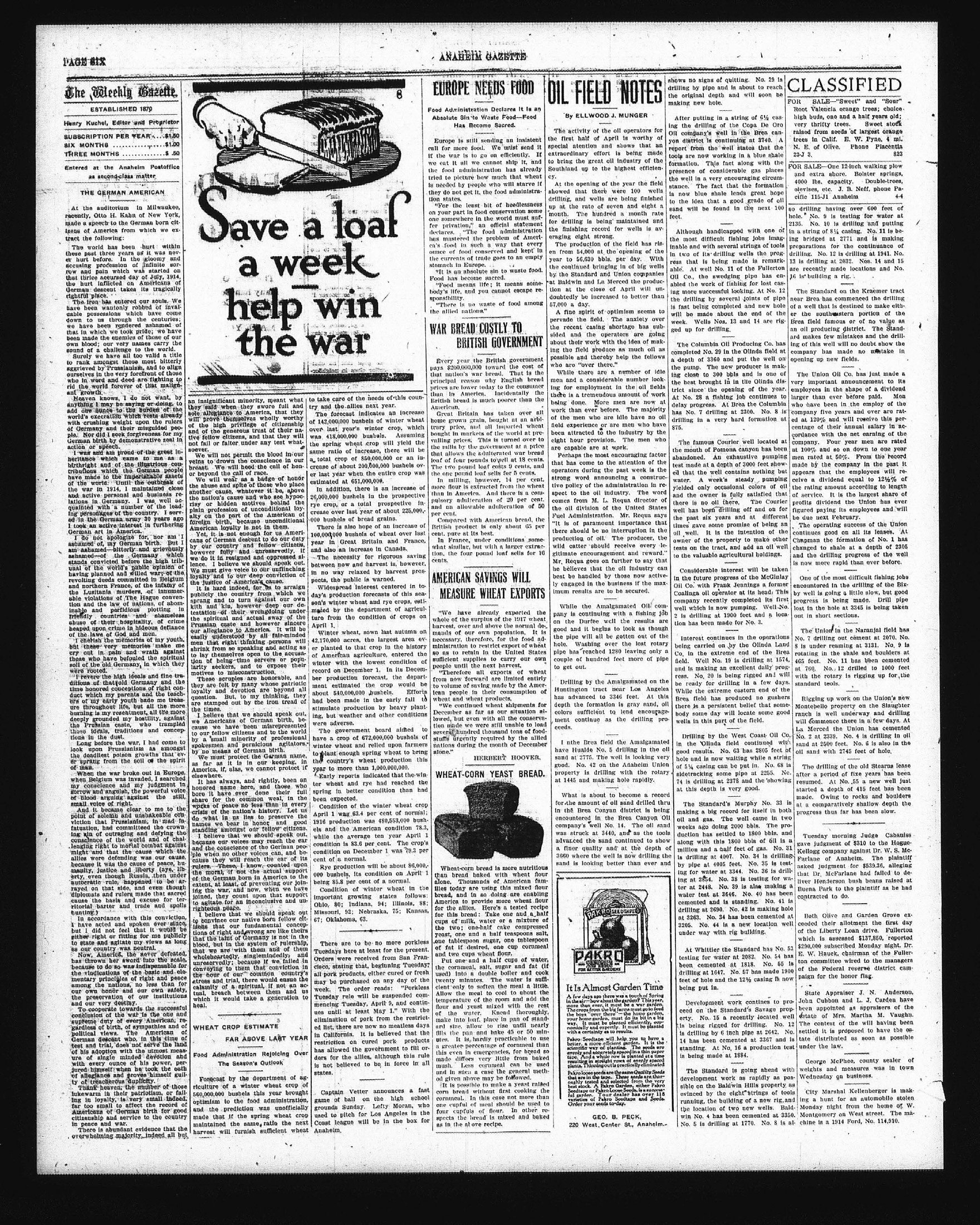
Searchable text
The Weekly Gazette
ESTABLISHED 1879
Henry Kuchel, Editor and Proprietor
SUBSCRIPTION PER YEAR ... $1.50
SIX MONTHS ... $1.00
THREE MONTHS ... $ .50
Entered at the Anaheim Postoffice as second-class matter
THE GERMAN AMERICAN
At the auditorium in Milwaukee, recently, Otto H. Kahn of New York, made a speech to the German born citizens of America from which we extract the following:
The world has been hurt within these past three years as it was never hurt before. In the gloomy and accusing procession of infinite sorrow and pain which was started on that thrice accursed day of July, 1914, the hurt inflicted on Americans of German descent takes its tragically rightful place.
The iron has entered our souls. We have been wantonly robbed of invaluable possessions which have come down to us through the centuries; we have been rendered ashamed of that in which we took pride; we have been made the enemies of those of our own blood; our very names carry the sound of a challenge to the world.
Surely we have all too valid a title to rank amongst those most bitterly aggrieved by Prussianism, and to align ourselves in the very forefront of those who in word and deed are fighting to rid the world forever of that malignant growth.
Heaven knows, I do not want, by anything I may be saying or doing, to add one ounce to the burden of the world's execution which rests already with crushing weight upon the rulers of Germany and their misguided people. Nor did I seek forgiveness for my German birth by demonstrative zeal in action or speech.
I was and am proud of the great insignificant minority, meant what they said when they swore full and sole allegiance to America, that they will prove themselves wholly worthy of the high privilege of citizenship and of the generous trust of their native fellow citizens, and that they will not fall or falter under any test whatsoever.
We will not permit the blood in our
to rank amongst those most bitterly aggrieved by Prussianism, and to align ourselves in the very forefront of those who in word and deed are fighting to rid the world forever of that malignant growth.
Heaven knows, I do not want, by anything I may be saying or doing, to add one ounce to the burden of the world's execution which rests already with crushing weight upon the rulers of Germany and their misguided people. Nor did I seek forgiveness for my German birth by demonstrative zeal in action or speech.
I war and am proud of the great inheritance which came to me as a birthright and of the illustrious contributions which the German people have made to the Imperishable assets of the world. Until the outbreak of the war in 1914, I maintained close and active personal and business relations in Germany. I was well acquainted with a number of the leading personages of the country. I served in the German army 30 years ago I took an active interest in furthering German art in America.
I do not apologize for, nor am I ashamed of, my German birth. But I am ashamed—bitterly and grievously ashamed—of the Germany which stands convicted before the high tribunal of the world's public opinion of having planned and willed wary of the revolting deeds committed in Belgium and northern France, of the infamy of the Lusitania murders, of innumerable violations of The Hague convention and the law of nations, of abominable and perfidious plotting in friendly countries and shameless abuse of their hospitality, of crime heaped upon crime in hideous defiance of the laws of God and men.
I cherish the memories of my youth, but these very memories make me cry out in pain and wrath against those who have befouled the spiritual soil of the old Germany, in which they were rooted.
I revere the high ideals and fine traditions of that old Germany and the time honored conceptions of right conduct which my parents and the teachers of my early youth bade me treasure throughout life, but all the more burning is my resentment, all the more deeply grounded my hostility, against the Prussian caste, who trampled those ideals, traditions and conceptions in the dust.
Long before the war, I had come to look upon Prussianism as amongst the deadliest poison growths that ever sprang from the soil of the spirit of man.
When the war broke out in Europe, when Belgium was invaded, I searched my conscience and my judgment in sorrow and anguish, the powerful voice of blood arguing against the still small voice of right.
And it became clear to me to the point of solemn and unshakeable conviction that Prussianism, in mad infatuation, had committed the crowning sin of outraging and defying the conscience of the world and of challenging right to mortal combat against might and that the cause which the allies were defending was our cause, because it was the cause of peace, hu-
an insignificant minority, meant what they said when they swore full and sole allegiance to America, that they will prove themselves wholly worthy of the high privilege of citizenship and of the generous trust of their native fellow citizens, and that they will not fail or falter under any test whatsoever.
We will not permit the blood in our veins to drown the conscience in our breast. We will heed the call of honor beyond the call of race.
We will wear as a badge of honor the abuse and spite of those who place another cause, whatever it be, above the nation's cause and who see hypocrisy or hidden motives behind the plain profession of unconditional loyalty on the part of the American of foreign birth, because unconditional American loyalty is not in them.
Yet, it is not enough for us Americans of German descent to do our duty by our country and fellow citizens, however fully and unreservedly, if we do it in resigned and oppressed silence. I believe we should speak out. We must give voice to our unfilching loyalty and to our deep conviction of the justice of American cause.
It is hard indeed, for us to arraign publicly the country from which we sprang and to turn against our own kith and kin, however deep our detestation of their wrongdoing under the spiritual and actual sway of the Prussian caste and however sincere our allegiance to America. It will be easily understood by all fair-minded men that right thinking persons will shrink from so speaking and acting as to lay themselves open to the accusation of being time servers or popularity seekers, and to expose their motives to misconstruction.
These scruples are honorable, and they are felt by many whose patriotic loyalty and devotion are beyond all question. But, to my thinking, they are stamped out by the iron tread of the times.
I believe that we should speak out, we Americans of German birth, because we have been misrepresented to our fellow citizens and to the world by a small minority of professional spokesmen and pernicious agitators; by no means of German birth.
We must protect the German name, as far as it is in our keeping, in America, if, alas, we cannot protect it elsewhere.
It has always, and rightly, been an honored name here, and those who bore it have ever done their full share for the common weal, in the works of peace no less than in every crisis of the nation's history. Let us do what in us lies to preserve the names we bear in honor and good standing amongst our fellow citizens.
I believe that we should speak out, because our voices may reach the ear and the conscience of the German people when no other voices can, and because they will reach the ear of its audience. I know counted upon to take care of them try and the allies.
The forecast income of 142,000,000 bushels over last year's was 418,000,000 by the spring wheat same ratio of increase a total crop of 85 crease of about 200 er last year when estimated at 651,000.
In addition, there are 26,000,000 bushels rye crop or a total crease over last year 1000 bushels of bread.
There is also also honoring 100,000,000 bushels year in Great Britain and also an increase.
The necessity is between now and next in no way relaxes pects, the public life.
Widespread inter-day's production for son's winter wheat made by the depot from the company April 1.
Winter wheat, size 42,170,000 acres, ther plantated to that of American agriculture winter with the record on December ber production for about 540,000,000 had been made in stimulate producing, but weather were adverse.
The government have a crop of 67 winter wheat and to plant enough since the country's winter year to more than Early reports in ter wheat and rye spring in better been expected.
Condition of April 1 wag_63.4 1916 production wels and the Ameri while the average condition is 83.6 condition on Decen cent of a normal.
When the war broke out in Europe, when Belgium was invaded, I searched my conscience and my judgment in sorrow and anguish, the powerful voice of blood arguing against the still small voice of right.
And it became clear to me to the point of solemn and unshakeable conviction that Prussianism, in mad infatuation, had committed the crowning act of outraging and defying the conscience of the world and of challenging right to mortal combat against might and that the cause which the allies were defending was our cause, because it was the cause of peace, humanity, justice and liberty (aye, liberty, even though Russia, then under autocratic rule, happened to be arrayed on that side, and even though diplomats and rulers made that sacred cause the basis and excuse for territorial barter and trade and spoils hunting.)
In accordance with this conviction, I have acted and spoken ever since, but I did not feel that it would be either right or fitting for me publicly to state and agitate my views as long as our country was neutral.
Now, America, the never defeated, has thrown her sword into the scale, because to do so was indispensable for the vindications of the basic and elementary principles of right and peace among the nations, no less than for our own honor and our own safety, the preservation of our institutions and our very destiny.
To cooperate towards the successful conclusion of the war is the one and supreme duty of every American, regardless of birth, of sympathies and of political views. The American of German descent who, in this time of test and trial, does not serve the land of his adoption with the utmost measure of single minded devotion and with every ounce of his power, perjured himself when he took the oath of allegiance and proves himself guilty of treacherous duplicity.
Thank heaven; the number of those lukewarm in their patriotism, or failing in loyalty, is very small indeed; far too small to affect the record of Americans of German birth for good citizenship and service to the country in peace and war.
There is abundant evidence that the overwhelming majority indeed all but
WHEAT CROP ESTIMATE
FAR ABOVE LAST YEAR
Food Administration Rejoicing Over The Season's Outlook
Forecast by the department of agriculture of a winter wheat crop of 560,000,000 bushels this year brought optimism to the food administration, and the prediction was unofficially made that if the spring wheat crop maintained the same ratio the next harvest will furnish sufficient wheat
America, if, alas, we cannot protect it elsewhere.
It has always, and rightly, been an honored name here, and those who bore it have ever done their full share for the common weal, in the weeks of peace no less than in every crisis of the nation's history. Let us do what in us lies to preserve the names we bear in honor and good standing amongst our fellow citizens.
I believe that we should speak out, because our voices may reach the ear and the conscience of the German people when no other voices can, and because they will reach the ear of its rulers. These I know, counted upon the moral, if not the actual support of the German born in America to the extent, at least, of preventing our joining the war, and now, when we have joined, they count upon that support to agitate for an inconclusive and unrighteous peace.
I believe that we should speak out to convince our native born fellow citizens that our fundamental conceptions of right and wrong are like therms that the taint of Germany is not in the blood, but in the system of rulership, that we are with them and of them wholeheartedly, singlemindedly, and unreservedly; because if we failed in conveying to them that conviction in the hour of our common country's stress and trial, there would ensue the calamity of a spiritual, if not an actual breach between them and us which it would take a generation to heal.
Tuesday rules will mencing Tuesday unless at least elimination of pooled list; there are no in California. It restriction on crops has allowed the girders for the allelion is not believed to states.
Captain Vetter game of ball or grounds Sunday used to pitch for Coast league will Anaheim.
EUROPE NEEDS FOOD
Food Administration Declares It Is an Absolute Sin to Waste Food—Food Has Become Sacred.
Europe is still sending an insistent call for more food. We must send it if the war is to go on efficiently. If we eat it all we cannot ship it, and the food administration has already tried to picture how much that wheat is needed by people who will starve if they do not get it, the food administration states.
"For the least bit of heedlessness on your part in food conservation some one somewhere in the world must suffer privation," an official statement declares. "The food administration has mastered the problem of America's food in such a way that every ounce of food conserved and kept in the currents of trade goes to an empty stomach in Europe."
"It is an absolute sin to waste food. Food has become sacred."
"Food means life; it means somebody's life, and you cannot escape responsibility."
"There is no waste of food among the allied nations."
WAR BREAD COSTLY TO BRITISH GOVERNMENT
Every year the British government pays $200,000,000 toward the cost of that nation's war bread. That is the principal reason why English bread prices are lower today to the consumer than in America. Incidentally the British bread is much poorer than the American.
Great Britain has taken over all home grown grain, bought at an arbitrary price, and all imported wheat bought in markets of the world at prevailing prices. This is turned over to the mills by the government at a price that allows the adulterated war bread
OIL FIELD NOTES
By ELLWOOD J. MUNGER
The activity of the oil operators for the first half of April is worthy of special attention and shows that an extraordinary effort is being made to bring the great oil industry of the Southland up to the highest efficiency.
At the opening of the year the field showed that there were 100 wells drilling, and wells are being finished up at the rate of seven and eight a month. The hundred a month rate for drilling is being maintained and the finishing record for wells is averaging eight strong.
The production of the field has risen from 54,000 at the opening of the year to 56,630 bbls. per day. With the continued bringing in of big wells by the Standard and Union companies at Baldwin and La Merced the production at the close of April will undoubtedly be increased to better than 57,000 a day.
A fine spirit of optimism seems to pervade the field. The anxiety over the recent casing shortage has subsided and the operators are going about their work with the idea of making the field produce as much oil as possible and thereby help the fellows who are "over there."
While there are a number of idle men and a considerable number looking for employment in the oil fields there is a tremendous amount of work being done. More men are now at work than ever before. The majority of the men who are idle have no oil field experience or are men who have been attracted to the industry by the eight hour provision. The men who are capable are at work.
Perhaps the most encouraging factor
to take care of the needs of this country and the allies next year.
The forecast indicates an increase of 142,000,000 bushels of winter wheat over last year's winter crop, which was 418,000,000 bushels. Assuming the spring wheat crop will yield the same ratio of increase, there will be a total crop of 850,000,000 or an increase of about 200,000,000 bushels over last year when the entire crop was estimated at 651,000,000.
In addition, there is an increase of 26,000,000 bushels in the prospective rye crop, or a total prospective increase over last year of about 225,000,000 bushels of bread grains.
There is also hope of an increase of 100,000,000 bushels of wheat over last year in Great Britain and France, and also an increase in Canada.
The necessity for rigorous saving between now and harvest is, however, in no way relaxed by harvest prospects, the public is warned.
Widespread interest centered in today's production forecasts of this season's winter wheat and rye crops, estimated by the department of agriculture from the condition of crops on April 1.
Winter wheat, sown last autumn on 42,170,000 acres, the largest area ever planted to that crop in the history of American agriculture, entered the winter with the lowest condition of record on December 1. In its December production forecast, the department estimated the crop would be about 540,000,000 bushels. Efforts had been made in the early fall to stimulate production by heavy planting, but weather and other conditions were adverse.
The government board aimed to have a crop of 672,000,000 bushels of winter wheat and relied upon farmers to plant enough spring wheat to bring the country's wheat production this year to more than 1,000,000,000.
Early reports indicated that the winter wheat and rye had reached the spring in better condition than had been expected.
Condition of the winter wheat crop April 1 was 63.4 per cent of normal; 1916 production was 480,553,000 bushels and the American condition 78.3, while the average ten year April 1 condition is 83.6 per cent. The crop's condition on December 1 was 79.3 per cent of a normal.
Every year the British government pays $200,000,000 toward the cost of that nation's war bread. That is the principal reason why English bread prices are lower today to the consumer than in America. Incidentally the British bread is much poorer than the American.
Great Britain has taken over all home grown grain, bought at an arbitrary price, and all imported wheat bought in markets of the world at prevailing prices. This is turned over to the mills by the government at a price that allows the adulterated war bread leaf of four pounds to sell at 18 cents. The two pound loaf costs 9 cents, and the one pound loaf sells for 5 cents.
In milling, however, 14 per cent more flour is extracted from the wheat than in America. And there is a compulsory adulteration of 20 per cent, and an allowable adulteration of 50 per cent.
Compared with American bread, the British product is only about 65 per cent pure at its best.
In France, under conditions somewhat similar, but with a larger extraction, the four pound loaf sells for 16 cents.
AMERICAN SAVINGS WILL MEASURE WHEAT EXPORTS
"We have already exported the whole of the surplus of the 1917 wheat harvest, over and above the normal demands of our own population. It is necessary, therefore, for the food administration to restrict export of wheat so as to retain in the United States sufficient supplies to carry our own people until the next harvest.
"Therefore all exports of wheat from now forward are limited entirely to volume of saving made by the American people in their consumption of wheat and wheat products."
"We continued wheat shipments for December as far as our situation allowed, but even with all the conservation made we were still unable to load several hundred thousand tons of foodstuffs urgently required by the allied nations during the month of December alone."
HERBERT HOOVER.
WHEAT-CORN YEAST BREAD.
While there are a number of idle men and a considerable number looking for employment in the oil fields there is a tremendous amount of work being done. More men are now at work than ever before. The majority of the men who are idle have no oil field experience or are men who have been attracted to the industry by the eight hour provision. The men who are capable are at work.
Perhaps the most encouraging factor that has come to the attention of the operators during the past week is the strong word announcing a constructive policy of the administration in respect to the oil industry. The word comes from M. L. Requa director of the oil division of the United States Fuel Administration. Mr. Requa says "It is of paramount importance that there should be no interruption in the production of oil. The producer, the wild catter should receive every legitimate encouragement and reward." Mr. Requa goes on further to say that he believes that the oil industry can best be handled by those now actively engaged in the business if the maximum results are to be secured.
While the Amalgamated Oil company is continuing with a fishing job on the Durfee well the results are good and it begins to look as though the pipe will all be gotten out of the hole. Washing over the lost rotary pipe has reached 1280 leaving only a couple of hundred feet more of pipe to get out.
Drilling by the Amalgamated on the Huntington tract near Los Angeles has advanced to 3346 feet. At this depth the formation is gray sand, oil colors sufficient to lend encouragement continue as the drilling proceeds.
I nthe Brea field the Amalgamated have Hualde No. 5 drilling in the oil sand at 2775. The well is looking very good. No. 42 on the Anaheim Union property is drilling with the rotary at 1445 and making hole rapidly.
What is about to become a record for the amount of oil sand drilled thru in the Brea Conyan district is being encountered in the Brea Canyon Oil company's well No. 14. The oil sand was struck at 3440, and as the tools advanced the sand continued to show a finer quality and at the depth of 3660 where the well is now drilling the sand is looking better than ever and
Early reports indicated that the winter wheat and rye had reached the spring in better condition than had been expected.
Condition of the winter wheat crop April 1 wag 63.4 per cent of normal; 1916 production was 480,553,000 bushels and the American condition 78.3, while the average ten year April 1 condition is 83.6 per cent. The crop's condition on December 1 was 79.3 per cent of a normal.
Rye production will be about 86,000,000 bushels, its condition on April 1 being 85.8 per cent of a normal.
Condition of winter wheat in the important growing states follows: Ohio, 80; Indiana, 94; Illinois, 88; Missouri, 92; Nebraska, 75; Kansas, 67; Oklahoma, 63.
There are to be no more porkless Tuesdays here at least for the present. Orders were received from San Francisco, stating that, beginning Tuesday, all pork products, either cured or fresh may be purchased on any day of the week. The order reads: "Porkless Tuesday rule will be suspended commencing Tuesday, April 9, and continues until at least May 1." With the elimination of pork from the restricted list, there are now no meatless days in California. It is believed that the restriction on cured pork products has allowed the government to fill orders for the allies, although this rule is not believed to be in force in all states.
Captain Vetter announces a fast game of ball on the high school grounds Sunday. Lefty Moran, who used to pitch for Los Angeles in the Coast league will be in the box for Anaheim.
Wheat-corn bread is more nutritious than bread baked with wheat flour alone. Thousands of American families today are using this mixed flour bread, and in so doing are enabling America to provide more wheat flour for the allies. Here's a tested recipe for this bread: Take one and a half cups of milk, water or a mixture of the two; one-half cake compressed yeast, one and a half teaspoons salt, one tablespoon sugar, one tablespoon of fat if desired, one cup cornmeal and two cups wheat flour.
Put one-and-a half cups of water, the cornmeal, salt, sugar and fat (if used) into a double boiler and cook twenty minutes. The water is sufficient only to soften the meal a little. Allow the meal to cool to about the temperature of the room and add the flour and yeast mixed with the rest of the water. Knead thoroughly, make into loaf, place in pan of standard size, allow to rise until nearly dills the pan and bake 45 or 50 minutes. It is hardly practicable to use a greater percentage of cornmeal than this even in emergencies, for bread so made differs very little from baked mush. Less cornmeal can be used and in such a case the general method given above may be followed.
It is possible to make a yeast raised corn bread without first cooking the cornmeal. In this case not more than one cupful of meal should be used to four cupfuls of flour. In other respects the bread is mixed and baked as in the above recipe.
What is about to become a record for the amount of oil sand drilled thru in the Brea Conyan district is being encountered in the Brea Canyon Oil company's well No. 14. The oil sand was struck at 3440, and as the tools advanced the sand continued to show a finer quality and at the depth of 3660 where the well is now drilling the sand is looking better than ever and
It Is Almost Garden Time
A few days ago there was a touch of Spring in the air—how about the garden? This year, more than ever, it must be a war garden. The crops from the big farms must go to feed the boys' over there—the home garden, your home garden, must do its bit in a big way. It must be planted efficiently, economically and expertly. It must be planted with a certainty as to results.
Pakro Seedtape will help you to have a better, a more efficient garden. It is the scientific way of planting. The seeds are evenly and accurately spaced in a thin paper tape. And a whole row is planted at a time resulting in straight rows of evenly spaced plants. Thinning out is practically eliminated.
Pakro loose seeds are the same Quality Seeds that are in the tape. These seeds are thoroughly tested and selected from the very best stock. A Pakro Garden, either Pakro Seedtape or Pakro Loose Seeds, is a successful garden. Your dealer has over 115 varieties of Pakro Seedtape and Seeda Order your seeds to-day.
GEO. B. PECK,
220 West Center St., Anaheim.-
NOTES
MUNGER
oil operators for the oil is worthy of shows that an industry of the highest efficiency.
The year the field were 100 wells being finished even and eight a month rate maintained and for wells is avail.
The field has risen in opening of the per day. With ing in of big wells Union companies served the produc April will un- to better than optimism seems to the anxiety over shortage has sub-ators are going the idea of make as much oil as help the fellows.
number of idle number look in the oil fields amount of work men are now at the majority idle have no oil men who have industry by the The men who work, encouraging factor shows no signs of quitting. No. 29 is drilling by pipe and is about to reach the original depth and will soon be making new hole.
After putting in a string of 6½ casing the drilling of the Copa De Oro Oil company's well in the Brea canyon district is continuing at 3740. A report from the well states that the tools are now working in a blue shale formation. This fact along with the presence of considerable gas places the well in a very encouraging circumstance. The fact that the formation is now blue shale lends great hope to the idea that a good grade of oil sand will be found in the next 100 feet.
Although handicapped with one of the most difficult fishing jobs imaginable and with several strings of tools in two of its drilling wells the progress that is being made is remarkable. At well No. 11 of the Fullerton Oil Co., the swedging pipe has enabled the work of fishing for lost casing more successful looking. At No. 12 the drilling by several joints of pipe is fast being completed and new hole will be made about the end of the week. Wells Nos. 13 and 14 are rigged up for drilling.
The Columbia Oil Producing Co. has completed No. 29 in the Olinda field at a depth of 3360 and put the well on the pump. The new producer is making close to 300 bbls and is one of the best brought in in the Olinda district since the opening of the year. At No. 28 a fishing job continues to delay progress. At Brea the Columbia has No. 7 drilling at 2300. No. 8 is drilling in a very hard formation at 875.
The famous Courier well located at the mouth of Pomona canyon has been abandoned. An exhaustive dumping so drilling having over 600 feet of hole. No. 9 is testing for water at 2135. No. 10 is drilling and putting in a string of 8¼ casing. No. 11 is being bridged at 2771 and is making preparations for the continuance of drilling. No. 12 is drilling at 1941. No. 13 is drilling at 2032. Nos. 14 and 15 are recently made locations and No. 16 is building a rig.
The Standard on the Kraemer tract near Brea has commenced the drilling of a well that is destined to make either the southwestern portion of the Brea field famous or of no value as an oil producing district. The Standard makes few mistakes and the drilling of this well will no doubt show the company has made no mistake in opening up new fields.
The Union Oil Co. has just made a very important announcement to its employees in the shape of a dividend larger than ever before paid. Men who have been in the employ of the company five years and over are rated at 120% and will receive this percentage of their annual salary in accordance with the net earning of the company. Four year men are rated at 100% and so on down to one year men rated at 50%. From the record
The number of idleable number look-in in the oil fields is amount of work men are now at ease. The majority of idle have no oil where men who have the industry by the men who work.
Encouraging factor the attention of the past week is the pressing a construc-tion administration in re-industry. The word Requa director of the United States Mr. Requa says it is important that interruption in the producer, the receive every le-ment and reward." Further to say that the oil industry can those now active-business if the max-be secured.
Amalgamated Oil com-mitted with a fishing job and the results are to look as though gotten out of the or the lost rotary 80 leaving only a feet more of pipe.
Amalgamated on the near Los Angeles 346 feet. At this is gray sand, oil lend encourage-ment the drilling pro-
the Amalgamated drilling in the oil well is looking very the Anaheim Union with the rotary hole rapidly.
become a record oil sand drilled thru district is being Brea Canyon Oil 14. The oil sand and as the tools continued to show at the depth of is now drilling the better than ever and
The famous Courier well located at the mouth of Pomona canyon has been abandoned. An exhaustive pumping test made at a depth of 3000 feet showed that the well contains nothing but water. A week's steady pumping yielded only occasional colors of oil and the owner is fully satisfied that there is no oil there. The Courier well has been drilling off and on for the past six years and at different times gave some promise of being an oil well. It is the intention of the owner of the property to make other tests on the tract, and add an oil well to the valuable agricultural holdings.
Considerable interest will be taken in the future progress of the McGinlay Oil Co. with Frank Jennings a former Coalinga oil operator at its head. This company recently completed its first well which is now pumping. Well No. 2 is drilling at 1900 feet and a location has been made for No. 3.
Interest continues in the operations being carried on by the Olinda Land Co. in the extreme end of the Brea field. Well No. 19 is drilling at 1574, and is making an excellent daily progress. No. 20 is being rigged and will be ready for drilling in a few days. While the extreme eastern end of the Brea field has produced no gushers there is a persistent belief that somebody some day will locate some good wells in this part of the field.
Drilling by the West Coast Oil Co. in the Olinda field continued with good results. No. 63 has 2805 feet of hole and is now waiting while a string of 5¼ casing can be put in. No. 68 is sidetracking some pipe at 2255. No. 74 is drilling at 2378 and the showing at this depth is very good.
The Standard's Murphy No. 33 is making a big record for itself in both oil and gas. The well came in two weeks ago doing 2000 bbls. The production has settled to 1800 bbls, and along with this 1800 bbls of oil is a million and a half feet of gas. No. 31 is drilling at 4007. No. 34 is drilling by pipe at 4005 feet. No. 35 is test-opening up new fields.
The Union Oil Co. has just made a very important announcement to its employees in the shape of a dividend larger than ever before paid. Men who have been in the employ of the company five years and over are rated at 120% and will receive this percentage of their annual salary in accordance with the net earning of the company. Four year men are rated at 100% and so on down to one year men rated at 50%. From the record made by the company in the past it appears that the employees will receive a dividend equal to 12½% of the rating amount according to length of service. It is the largest share of profits dividend the Union has ever figured paying its employees and will be due next February.
The operating success of the Union continues good on all its leases. At Chapman the formation of No. 1 has changed to shale at a depth of 2305 and the drilling progress of the well is now more rapid than ever before.
One of the most difficult fishing jobs encountered in the drilling of the Bixby well is going a little slow, but good progress is being made. Drill pipe lost in the hole at 3345 is being taken out in short sections.
The Union in the Naranjal field has No. 7 drilling out cement at 2070. No. 8 is under reaming at 3131. No. 9 is rotating in the shale and boulders at 465 feet. No. 11 has been cemented at 760. No. 12 drilled to 1000 feet with the rotary is rigging up for the standard tools.
Rigging up work on the Union's new Montebello property on the Slaughter ranch is well underway and drilling will commence there in a few days. At La Merced the Union has cemented No. 2 at 2339. No. 4 is drilling in oil sand at 2500 feet. No. 6 is also in the oil sand with 2745 feet of hole.
The drilling of the old Stearns lease after a period of fixe years has been resumed. At No. 55 a new well just started a depth of 415 feet has been made. Owing to rocks and boulders at a comparatively shallow depth the progress thus far has been slow.
Tuesday morning Judge Cabaniss gave judgment of $310 to the Hogue-Kellogg company against Dr. W. S. McFarlane of Anaheim. The plaintiff asked judgment for $539,36 alleging
The Standard's Murphy No. 33 is making a big record for itself in both oil and gas. The well came in two weeks ago doing 2000 bbls. The production has settled to 1800 bbls, and along with this 1800 bbls of oil is a million and a half feet of gas. No. 31 is drilling at 4007. No. 34 is drilling by pipe at 4005 feet. No. 35 is testing for water at 3344. No. 36 is drilling at 2854. No. 38 is testing for water at 2448. No. 39 is also making a water test at 3646. No. 40 has been cemented and is standing. No. 41 is drilling at 2690. No. 42 is making hole at 3263. No. 34 has been cemented at 3205. No. 44 is a new location well under way with rig building.
At Whittier the Standard has No. 53 testing for water at 2082. No. 54 has been cemented at 1818. No. 55 is drilling at 1647. No. 57 has made 1900 feet of hole and the 12½ casing is now being put in.
Development work continues to proceed on the Standard's Savage property. No. 15 a recently located well is being rigged for drilling. No. 12 is drilling by 6 inch pipe at 2642. No. 14 has been cemented at 3367 and is standing. At No. 16 a production test is being made at 1884.
The Standard is going ahead with development work as rapidly as possible on the Baldwin Hills property as evinced by the eight strings of tools running, the building of a new rig, and the location of two new wells. Baldwin No. 4 has been cemented at 3350. No. 5 is drilling at 1770. No. 8 is al
Tuesday morning Judge Cabaniss gave judgment of $310 to the Hogue-Kellogg company against Dr. W. S. McFarlane of Anaheim. The plaintiff asked judgment for $539.36, alleging that Dr. McFarlane had failed to deliver Henderson bush beans raised at Buena Park to the plaintiff as he had contracted to do.
Both Olive and Garden Grove exceeded their allotment the first day of the Liberty Loan drive. Fullerton which is assessed $137,850, reported $290,000 subscribed Monday night. Dr. E. W. Hauck, chairman of the Fullerton committee wired to the managers of the Federal reserve district campaign for the honor flag.
State Appraiser J. N. Anderson, John Cubbon and L. J. Carden have been appointed as appraisers of the estate of Mrs. Martha M. Vaughn. The contest of the will having been settled it is proposed to have the estate distributed as soon as possible under the law.
George McPhee, county sealer of weights and measures was in town Wednesday on business.
City Marshal Kellenberger is making a hunt for an automobile stolen Monday night from the home of W. Montgomery on West street. The machine is a 1914 Ford, No. 114,910.