anaheim-gazette 1918-04-11
Scanned page
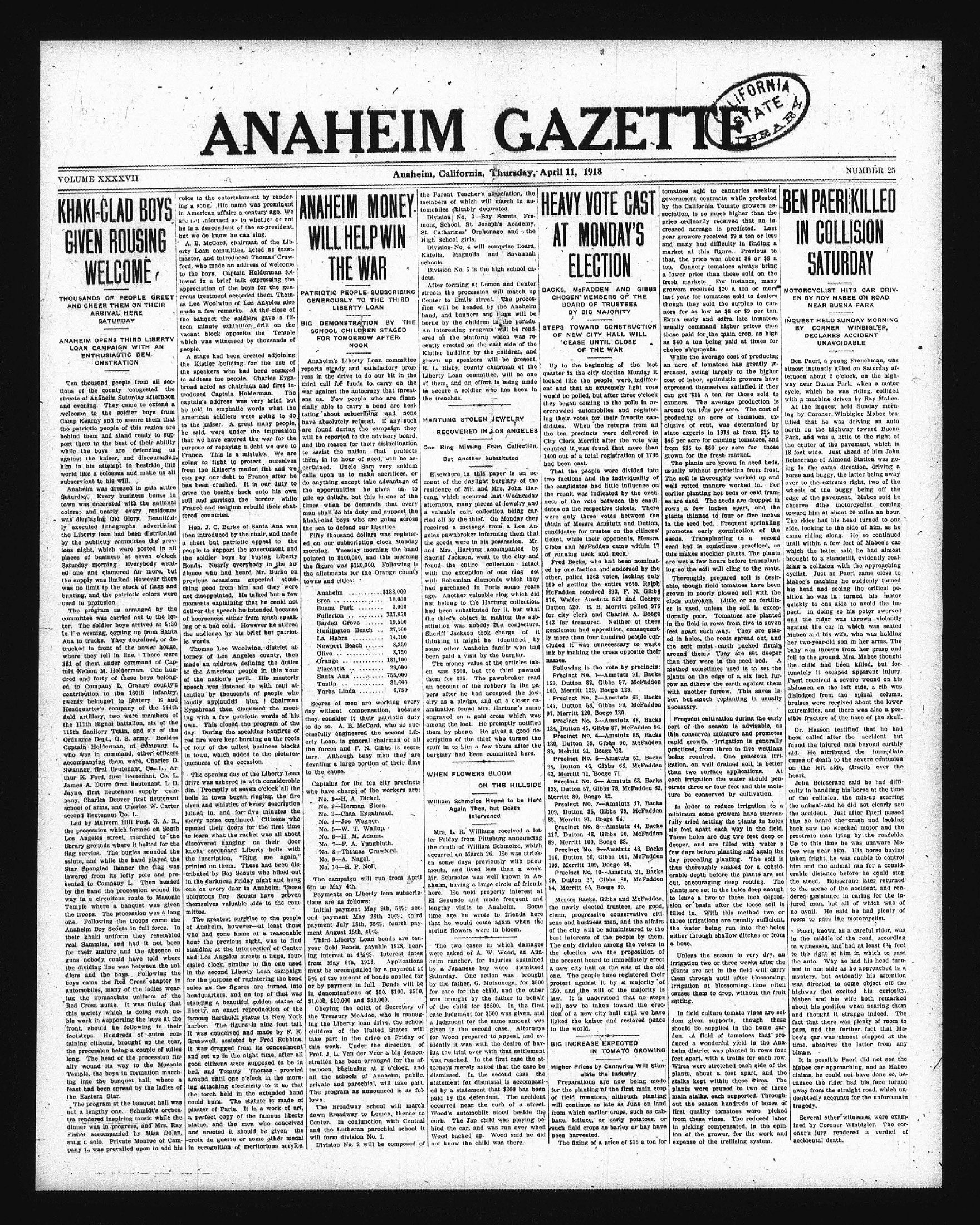
Searchable text
KHAKI-CLAD BOYS GIVEN ROUSING WELCOMÉ
THOUSANDS OF PEOPLE GREET AND CHEER THEM ON THEIR ARRIVAL HERE SATURDAY
ANAHEIM OPENS THIRD LIBERTY LOAN CAMPAIGN WITH AN ENTHUSIASTIC DEMONSTRATION
Ten thousand people from all sections of the county congested the streets of Anaheim Saturday afternoon and evening. They came to extend a welcome to the soldier boys from Camp Kearny and to assure them that the patriotic people of this region are behind them and stand ready to support them to the best of their ability while the boys are defending us voice to the entertainment by rendering a song. His name was prominent in American affairs a century ago. We are not informed as to whether or not he is a descendant of the ex-president, but we do know he can sing.
A. B. McCord, chairman of the Liberty Loan committee, acted as toastmaster, and introduced Thomas Crawford, who made an address of welcome to the boys. Captain Holderman followed in a brief talk expressing the appreciation of the boys for the generous treatment accorded them. Thomas Lee Woolwine of Los Angeles also made a few remarks. At the close of the banquet the soldiers gave a fifteen minute exhibition drill on the vacant block opposite the Temple which was witnessed by thousands of people.
A stage had been erected adjoining the Kistler building for the use of the speakers who had been engaged to address the people. Charles Eyga-broad acted as chairman and first introduced Captain Holderman. The captain's address was very brief, but he told in emphatic words what the American soldiers were going to do to the kaiser. A great many people, he said, were under the impression that we have entered the war for the purpose of repaying a debt we owe to France. This is a mistake. We are
ANAHEIM WILL HEAL THE W
PATRIOTIC PEOPLE GENEROUSLY TO LIBERTY
BIG DEMONSTRATE SCHOOL CHILDREN FOR TOMORROW NOON
Anaheim's Liberty reports steadily and stress in the drive to third call for funds war against the autoconsens us. Few people cially able to carry tating about subscript have absolutely refused are found during the will be reported to th and the reason for th to assist the nation
Ten thousand people from all sections of the county congested the streets of Anaheim Saturday afternoon and evening. They came to extend a welcome to the soldier boys from Camp Kearny and to assure them that the patriotic people of this region are behind them and stand ready to support them to the best of their ability while the boys are defending us against the kaiser, and discouraging him in his attempt to bestride, this world like a colossus and make us all subservient to his will.
Anaheim was dressed in gala attire Saturday. Every business house in town was decorated with the national colors; and nearly every residence was displaying Old Glory. Beautifully executed lithographs advertising the Liberty loan had been distributed by the publicity committee the previous night, which were posted in all places of business at seven o'clock Saturday morning. Everybody wanted one and clamored for more, but the supply was limited. However there was no limit to the stock of flags and bunting, and the patriotic colors were used in profusion.
The program as arranged by the committee was carried out to the letter. The soldier boys arrived at 5:30 in the evening, coming up from Santa Ana in trucks. They detrained, or detrucked in front of the power house, where they fell in line. There were 181 of them under command of Captain Nelson M. Holderman. One hundred and forty of these boys belonged to Company L, Orange county's contribution to the 160th infantry, twenty belonged to Battery E and Headquarter's company of the 144th field artillery, two were members of the 111th Signal battalion, six of the 115th Sanitary Train, and six of the Ordnance Dept., U. S. army. Besides Captain Holderman, of Company L, who was in command, other officers accompanying them were Charles D. Swanner, first lieutenant, G. L., Arthur K. Ford, first lieutenant, Co. L, James A. Dutro first lieutenant, I. D. Jayne, first lieutenant supply company, Charles Deaver first lieutenant school of arms, and Charles W. Carter second lieutenant Co. L.
Led by Malvern Hill Post, G. A. R., the procession which formed on South Los Angeles street, marched to the library grounds where it halted for the flag service. The bugles sounded the salute, and while the band played the Kistler building for the use of the speakers who had been engaged to address the people. Charles Eygabroad acted as chairman and first introduced Captain Holderman. The captain's address was very brief, but he told in emphatic words what the American soldiers were going to do to the kaiser. A great many people, he said, were under the impression that we have entered the war for the purpose of repaying a debt we owe to France. This is a mistake. We are going to fight to protect ourselves from the Kaiser's mailed fist and we can pay our debt to France after he has been crushed. It is our duty to drive the bosche back onto his own soil and garrison the border while France and Belgium rebuild their shattered countries.
Hon. J. C. Burke of Santa Ana was then introduced by the chair, and made a short but patriotic appeal to the people to support the government and the soldier boys by buying Liberty Bonds. Nearly everybody in the audience who had heard Mr. Burke on previous occasions expected something good from him and they were not disappointed. He talked but a few moments explaining that he could not deliver the speech he intended because of hoarseness either from much speaking or a bad cold. However he stirred the audience by his brief but patriotic words.
Thomas Lee Woolwine, district attorney of Los Angeles county, then made an address, defining the duties of the American people in this hour of the nation's peril. His masterly speech was listened to with rapt attention by thousands of people who loudly applauded him! Chairman Eygabroad then dismissed the meeting with a few patriotic words of his own. This closed the program of the day. During the speaking bonfires of red fire were kept burning on the roofs of four of the tallest business blocks in town, which added to the picturesqueness of the occasion.
The opening day of the Liberty Loan drive was ushered in with considerable din. Promptly at seven o'clock all the bells in town began ringing, the fire alren and whistles of every description joined in, and for five minutes the merry noise continued. Citizens who opened their doors for the first time to learn what the racket was all about discovered hanging on their door knobs cardboard Liberty bells with the inscription, "Ring me again," printed on them. These had been disused in the drive to our third call for funds war against the autoconsensus us. Few people cially able to carry it tating about subscrip have absolutely refused are found during this will be reported to them and the reason for them to assist the nation them, in its hour of certaind. Uncle S calls upon us to make anything except to the opportunities he pile up dollars, but times when he deman man shall do his duty khaki-clad boys who see sea to defend our Fifty thousand dolled on our subscription morning. Tuesday marked to $100,000, the figure was $120,000 allotments for th towns and cities:
Anaheim ... Brea ... Buena Park ... Fullerton ... Garden Grove ... Huntington Beach ... La Habra ... Newport Beach ... Olive ... Orange ... Placentia ... Santa Ana ... Tustin ... Yorba Linda ... Scores of men and day without competition they consider it th to do so. A. B. Mccessfully engineerederty Loan, is generaethe forces and F. Mary. Although bus devoting a large pointeo cause.
Captains for th who have charge of No. 1—H. A. Dr No. 2—Herman No. 3—Chas. Ey No. 4—Joe Wag No. 5—W. T. V No. 6—H. M. A No. 7—F. A. X No. 8—Thomas No. 9—A. Nagel
Swanner, first lieutenant, Co. L., Arthur K. Ford, first lieutenant, I. D. James A. Dutro first lieutenant, I. D. Jayne, first lieutenant supply company, Charles Deaver first lieutenant school of arms, and Charles W. Carter second lieutenant Co. L.
Led by Malvern Hill Post, G. A. R., the procession which formed on South Los Angeles street, marched to the library grounds where it halted for the flag service. The bugles sounded the salute, and while the band played the Star Spangled Banner the flag was lowered from its lofty pole and presented to Company L. Then headed by the band the procession wound its way in a circultous route to Masonic Temple where a banquet was given the troops. The procession was a long one. Following the troops came the Anaheim Boy Scouts in full force. In their khaki uniform they resembled real Sammies, and had it not been for their stature and the absence of guns nobody could have told where the dividing line was between the soldiers and the boys. Following the boys came the Red Cross chapter in automobiles, many of the ladies wearing the immaculate uniform of the Red Cross nurse. It was fitting that this society which is doing such noble work in supporting the boys at the front, should be following in their footsteps. Hundreds of autos containing citizens, brought up the rear, the procession being a couple of miles long. The head of the procession finally wound its way to the Masonic Temple, the boys in formation marching into the banquet hall, where a feast had been spread by the ladies of the Eastern Star.
The program at the banquet hall was not a lengthy one. Schmidt's orchestra rendered inspiring music while the dinner was in progress, and Mrs. Ray Fisher accompanied by Miss Dolan, sng r. solo. Private Monroe of Company L, was prevalued upon to add his
The opening day of the Liberty Loan drive was ushered in with considerable din. Promptly at seven o'clock all the bells in town began ringing, the fire alren and whistles of every description joined in, and for five minutes the merry noise continued. Citizens who opened their doors for the first time to learn what the racket was all about discovered hanging on their door knobs cardboard Liberty bells with the inscription, "Ring me again," printed on them. These had been distributed by Boy Scouts who hiked out in the darkness Friday night and hung one on every door in Anaheim. Those ubiquitous Boy Scouts have proven themselves valuable aide to the committee.
The greatest surprise to the people of Anaheim, however—at least those who had gone home at a reasonable hour the previous night, was to find standing at the intersection of Center and Los Angeles streets a huge, four-dialed clock, similar to the one used in the second Liberty Loan campaign for the purpose of registering the bond sales as the figures are turned into headquarters, and on top of that was standing a beautiful golden statue of liberty, an exact reproduction of the famous Bartholdi statue in New York harbor. The figure is nine feet tall. It was conceived and made by F. K. Gresswell, assisted by Fred Robbins. It was dragged from its concealment and set up in the night time, after all good citizens were supposed to be in bed, and Tommy Thomas prowled around until one o'clock in the morning attaching electricity to it so that the torch held in the extended hand could burn. The statute is made of plaster of Paris. It is a work of art, a perfect copy of the famous liberty statue, and the men who conceived and erected it should be given the croix du guerre or some other medal in recognition of meritorious service.
Captains for the who have charge of No. 1—H. A. Dhon No. 2—Herman No. 3—Chas. Ex No. 4—Joe Wagga No. 5—W. T. W No. 6—H. M. A No. 7—F. A. Y No. 8—Thomas No. 9—A. Nage No. 10—H. P. N
The campaign wiled 6th to May 4th.
Payments on Liberties are as follows:
Initial payment May payment July August 15th, 18th
Third Liberty Loan year Gold Bonds, paying interest at 4% from May 9th, 19th must be accompanied 5% of the amount owed or by payment in form denominations of $1,000, $10,000 and obeying the edict Treasury McAdams lying children of the U take part in the this week. Under Prof. J. L. Van der Strain has been sent termoon, beginning all the schools of private and parochial The program as allows:
The Broadway down Broadway to Center. In conjunction with the Lutheran will form division Division No. 2 w
AHEIM GAZETTE
Anaheim, California, Thursday, April 11, 1918
ANAHEIM MONEY WILL HELP WIN THE WAR
PATRIOTIC PEOPLE SUBSCRIBING GENEROUSLY TO THE THIRD LIBERTY LOAN
BIG DEMONSTRATION BY THE SCHOOL CHILDREN STAGED FOR TOMORROW AFTER-NOON
Anaheim's Liberty Loan committee reports stgady and satisfactory progress in the drive to do our bit in the third call for funds to carry on the war against the autocracy that threatens us. Few people who are financially able to carry a bond are hesitating about subscribing and none have absolutely refused. If any such are found during the campaign they will be reported to the advisory board, and the reason for their disinclination to assist the nation that protects the Parent Teacher's association, the members of which will march in automobiles suitably decorated.
Division No. 3—Boy Scouts, Fremont School, St. Joseph's Academy, St. Catharines' Orphanage and the High School girls.
Division No. 4 will comprise Loara, Katella, Magnolia and Savannah schools.
Division No. 5 is the high school cadets.
After forming at Lemon and Center streets the procession will march up Center to Emily street. The procession will be headed by the Anaheim band, and banners and flags will be borne by the children in the parade. An interesting program will be rendered on the platform which was recently erected on the east side of the Kistler building by the children, and grown up speakers will be present. R. L. Bisby, county chairman of the Liberty Loan committee, will be one of them, and an effort is being made to secure a soldier who has been in the trenches.
HARTUNG STOLEN JEWELRY
RECOVERED IN LOS ANGELES
One Ring Missing From Collection,
HEAVY VOTE CAST AT MONDAY'S ELECTION
BACKS, McFADDEN AND GIBBS CHOSEN MEMBERS OF THE BOARD OF TRUSTEES BY BIG MAJORITY
STEPS TOWARD CONSTRUCTION OF NEW CITY HALL WILL CEASE UNTIL CLOSE OF THE WAR
Up to the beginning of the last quarter in the city election Monday it looked like the people were indifferent and that an extremely light vote would be polled, but after three o'clock they began coming to the polls in overcrowded automobiles and registering their votes for their favorite candidates. When the returns from all the ten precincts were delivered to City Clerk Merritt after the vote was counted it was found that more than 1400 out of a total registration of 1796
While there an acre orcreased, cost of laceexpressed can get canners around ten producing clusive ostate expires $45 per acrfrom $35 grown for
Anaheim's Liberty Loan committee reports stigdy and satisfactory progress in the drive to do our bit in the third call for funds to carry on the war against the autocracy that threatens us. Few people who are financially able to carry a bond are hesitating about subscribing and none have absolutely refused. If any such are found during the campaign they will be reported to the advisory board, and the reason for their disinclination to assist the nation that protects them, in its hour of need, will be ascertained. Uncle Sam very seldom calls upon us to make sacrifices, or do anything except take advantage of the opportunities he gives us to pile up dollars, but this is one of the times when he demands that every man shall do his duty and support the khaki-clad boys who are going across the sea to defend our liberties.
Fifty thousand dollars was registered on our subscription clock Monday morning. Tuesday morning the hand pointed to $100,000, and this morning the figure was $120,000. Following is the allotments for the Orange county towns and cities:
- Anaheim: $188,000
- Brea: 10,000
- Buena Park: 3,000
- Fullerton: 137,850
- Garden Grove: 19,500
- Huntington Beach: 27,100
- La Habra: 14,100
- Newport Beach: 8,250
- Olive: 8,750
- Orange: 181,100
- Placentia: 29,000
- Santa Ana: 755,000
- Tustin: 31,600
- Yorba Linda: 6,750
Scores of men are working every day without compensation, because they consider it their patriotic duty to do so. A. B. McCord, who so successfully engineered the second Liberty Loan, is general chairman of all the forces and F. N. Gibbs is secretary. Although busy men they are devoting a large portion of their time to the cause.
Captains for the ten city precincts who have charge of the workers are:
No. 1—H. A. Dickel.
No. 2—Herman Stern.
No. 3—Chas. Eygabroad.
No. 4—Joe Wagner.
No. 5—W. T. Wallop.
No. 6—H. M. Adams.
No. 7—F. A. Yungbluth.
No. 8—Thomas Crawford.
No. 9—A. Nagel.
WHEN FLOWERS BLOOM
ON THE HILLSIDE
William Schmolze Hoped to be Here Again Then, but Death Intervened
Mrs. L. R. Williams received a letter Friday from Pittsburgh announcing the death of William Schmolze, which occurred on March 26. He was stricken some days previously with pneumonia.
Up to the beginning of the last quarter in the city election Monday it looked like the people were indifferent and that an extremely light vote would be polled, but after three o'clock they began coming to the polls in overcrowded automobiles and registering their votes for their favorite candidates. When the returns from all the ten precincts were delivered to City Clerk Merritt after the vote was counted it was found that more than 1400 out of a total registration of 1796 had been cast.
That the people were divided into two factions and the individuality of the candidates had little influence on the result was indicated by the evenness of the vote between the candidates on the respective tickets. There were only three votes between the totals of Messrs Amstutz and Dutton, candidates for trustee on the citizens' ticket, while their opponents, Messrs Gibbs and McFadden came within 17 of running neck and neck.
Fred Backs, who had been nominated by one faction and endorsed by the other, polled 1263 votes, lacking only 150 of getting the entire vote. Ralph McFadden received 893, F. N. Gibbs 876, Walter Amstutz 523 and George Dutton 520. E. B. Merritt polled 976 for city clerk and Charles A. Boege 943 for treasurer. Neither of these gentlemen had opposition, consequently more than four hundred people concluded it was unnecessary to waste ink by making the cross opposite their names.
Following is the vote by precincts:
Precinct No. 1—Amstutz 91, Backs 159, Dutton 82, Gibbs 97, McFadden 100, Merritt 129, Boege 129.
Precinct No. 2—Amstutz 65, Backs 147, Dutton 58, Gibbs 99, McFadden 97, Merritt 120, Boege 120.
Precinct No. 3—Amstutz 48, Backs 134, Dutton 45, Gibbs 87, McFadden 96.
Precinct No. 4—Amstutz 55, Backs 130, Dutton 59, Gibbs 90, McFadden 89, Merritt 91, Boege 92.
Precinct No. 5—Amstutz 51, Backs 94, Dutton 46, Gibbs 65, McFadden 62, Merritt 71, Boege 71.
Precinct No. 6—Amstutz 63, Backs 128, Dutton 57, Gibbs 78, McFadden 82, Merritt 80, Boege 82.
Precinct No. 7—Amstutz 37, Backs 109, Dutton 35, Gibbs 79, McFadden 85, Merritt 91, Boege 84.
Precinct No. 8—Amstutz 44, Backs 117, Dutton 46, Gibbs 90, McFadden 89, Merritt 100, Boege 88.
Precinct No. 9—Amstutz 48, Backs 146, Dutton 55, Gibbs 101, McFadden 109, Merritt 109, Boege 98.
In order to minimize fully trich six feet these deeper few days day pre
Captains for the ten city precincts who have charge of the workers are:
No. 1—H. A. Dickel.
No. 2—Herman Stern.
No. 3—Chas. Eygabroad.
No. 4—Joe Wagner.
No. 5—W. T. Wallop.
No. 6—H. M. Adams.
No. 7—F. A. Yungbluth.
No. 8—Thomas Crawford.
No. 9—A. Nagel.
No. 10—H. P. Noll.
The campaign will run from April 6th to May 4th.
Payments on Liberty loan subscriptions are as follows:
Initial payment May 9th, 5%; second payment May 28th 20%; third payment July 18th, 35%; fourth payment August 15th, 40%.
Third Liberty Loan bonds are ten-year Gold Bonds, payable 1928, bearing interest at 4½%. Interest dates from May 9th, 1918.
Applications must be accompanied by a payment of 5% of the amount of bonds applied for or by payment in full. Bonds will be in denominations of $50, $100, $500, $1,000, $10,000 and $50,000.
Obeying the edict of Secretary of the Treasury McAdoo, who is managing the Liberty loan drive, the school children of the United States will take part in the drive on Friday of this week. Under the direction of Prof. J. L. Van der Veer a big demonstration has been arranged for the afternoon, beginning at 2 o'clock, and all the schools of Anaheim, public, private and parochial, will take part. The program as announced is as follows:
The Broadway school will march down Broadway to Lemon, thence to Center. In conjunction with Central and the Lutheran parochial school it will form division No. 1.
Division No. 2 will be composed of
WHEN FLOWERS BLOOM
ON THE HILLSIDE
William Schmolze Hoped to be Here Again Then, but Death Intervened
Mrs. L. R. Williams received a letter Friday from Pittsburg announcing the death of William Schmolze, which occurred on March 26. He was stricken some days previously with pneumonia, and lived less than a week.
Mr. Schmolze was well known in Anaheim, having a large circle of friends here. He held property interest at El Segundo and made frequent and lengthy visits to Anaheim. Some time ago he wrote to friends here that he would come again when the spring flowers were in bloom.
The two cases in which damages were asked of A. W. Wood, an Anaheim rancher, for injuries sustained by a Japanese boy were dismissed Saturday. One action was brought by the father, G. Matsunaga, for $500 for care for the child, and the other was brought by the father in behalf of the child for $2500. In the first case judgment for $500 was given, and a judgment for the same amount was given in the second case. Attorneys for Wood prepared to appeal, and evidently it was with the desire of having the trial over with that settlement was reached. In the first case the attorneys merely asked that the case be dismissed. In the second case the statement for dismissal is accompanied by a statement that $300 has been paid by the defendant. The accident occurred near the curb of a street. Wood's automobile stood beside the curb. The Jap child was playing behind the car, and was run over when Wood backed up. Wood said he did not know the child was there.
Messrs Backs, Gibbs and McFadden, the newly elected trustees, are good, clean, progressive conservative citizens and business men, and the affairs of the city will be administered to the best interests of the people by them.
The only division among the voters in the election was the proposition of the present board to immediately erect a new city hall on the site of the old one. The people have registered their protest against it by a majority of 350, and the will of the majority is law. It is understood that no steps will now be taken toward the erection of a new city hall until we have licked the kaiser and restored peace to the world.
BIG INCREASE EXPECTED
IN TOMATO GROWING
Higher Prices by Canneries Will Stimulate the Industry
Preparations are now being made for the planting of the first main crop of field tomatoes, although planting will continue as late as June on land from which earlier crops, such as cabbage, lettuce, or early potatoes, or such field crops as barley or hay have been harvested.
The fixing of a price of $15 a ton for
THE CAST
DAY'S
ON
AND GIBBS
OF THE
MOSTEES
RITY
INSTRUCTION
ALL WILL
CLOSE
AR
of the last
lon Monday it
were indifferently light vote
for three o'clock
the polls in ovand registerer favorite canturns from all
is delivered to
or the vote was
that more than
navigation of 1796
tomatoes sold to canneries seeking government contracts while protested by the California Tomato growers association, is so much higher than the price ordinarily received that an increased acreage is predicted. Last year growers received $9 a ton or less and many had difficulty in finding a market at this figure. Previous to that, the price was about $6 or $8 a ton. Cannery tomatoes always bring a lower price than those sold on the fresh markets. For instance, many growers received $20 a ton or more last year for tomatoes sold to dealers though they sold the surplus to canners for as low as $8 or $9 per ton. Extra early and extra late tomatoes usually command higher prices than those paid for the main crop, as high as $40 a ton being paid at times for choice shipments.
While the average cost of producing an acre of tomatoes has greatly increased, owing largely to the higher cost of labor, optimistic growers have expressed themselves satisfied if they can get $15 a ton for those sold to canners. The average production is around ten tons per acre. The cost of producing an acre of tomatoes, exclusive of rent, was determined by state experts in 1914 at from $25 to $45 per acre for canning tomatoes, and from $35 to $50 per acre for those grown for the fresh market.
BEN PAERI KILLED
IN COLLISION
SATURDAY
MOTORCYCLIST HITS CAR DRIVEN BY ROY MABEE ON ROAD NEAR BUENA PARK
INQUEST HELD SUNDAY MORNING BY CORNER WINBIGLER, DECLARES ACCIDENT UNAVOIDABLE
Ben Paeri, a young Frenchman, was almost instantly killed on Saturday afternoon about 2 o'clock, on the highway near Buean Park, when a motorcycle, which he was riding, collided with a machine driven by Ray Mabee.
At the inquest held Sunday morning by Coroner Winbigler Mabee testified that he was driving an auto north on the highway toward Buena Park, and was a little to the right of the center of the pavement, which is 18 feet wide. Just ahead of him John
the last Monday it were indifferently light vote for three o'clock the polls in over and register favorite canvases from all who delivered to the vote was that more than 1796 came within 17 queck.
been nominated by the officials lacking only dire vote. Ralph 32, F. N. Gibbs 23 and George Harritt polled 976 Charles A. Boege neither of the theses on consequent hired people necessary to waste its opposite their
by precincts: Stutz 91, Backs 97, McFadden 129. Stutz 65, Backs 99, McFadden 120. Stutz 48, Backs 77, McFadden 96. Stutz 55, Backs 90, McFadden 92. Stutz 51, Backs 65, McFadden 71. Stutz 63, Backs 88, McFadden 82. Stutz 37, Backs 79, McFadden 84. Stutz 44, Backs 90, McFadden 88. Stutz 48, Backs 101, McFadden 98.
an acre of tomatoes has greatly increased, owing largely to the higher cost of labor, optimistic growers have expressed themselves satisfied if they can get $15 a ton for those sold to canners. The average production is around ten tons per acre. The cost of producing an acre of tomatoes, exclusive of rent, was determined by state experts in 1914 at from $25 to $45 per acre for canning tomatoes, and from $35 to $50 per acre for those grown for the fresh market.
The plants are grown in seed beds, usually without protection from frost. The soil is thoroughly worked up and well rotted manure worked in. For earlier planting hot beds or cold frames are used. The seeds are dropped in rows a few inches apart, and the plants thinned to four or five inches in the seed bed. Frequent sprinkling promotes early germination of the seeds. Transplanting to a second seed bed is sometimes practiced, as this makes stockier plants. The plants are wet a few hours before transplanting so the soil will cling to the roots.
Thoroughly prepared soil is desirable, though field tomatoes have been grown in poorly plowed soil with the clods unbroken. Little or no fertilizer is used, unless the soil is exceptionally poor. Tomatoes are planted in the field in rows from five to seven feet apart each way. They are placed in holes, the roots spread out, and the soft moist earth packed firmly around them. They are set deeper than they were in the seed bed. A method sometimes used is to set the plants on the edge of a six inch furrow an dthrow the earth against them with another furrow. This saves labor, but much replanting is usually necessary.
Frequent cultivation during the early part of the season is advisable, as this conserves moisture and promotes rapid growth. Irrigation is generally practiced, from three to five wettings being required. One generous irrigation, on well drained soil, is better than two surface applications. At each irrigation the water should penetrate three or four feet and this moisture be conserved by cultivation.
In order to reduce irrigation to a minimum some growers have successfully tried setting the plants in holes six feet apart each way in the field. These holes are dug two feet deep or deeper, and are filled with water a few days before planting and again the day preceding planting. The soil is almost instantly killed on Saturday afternoon about 2 o'clock, on the highway near Buean Park, when a motor cycle, which he was riding, collided with a machine driven by Ray Mabee.
At the inquest held Sunday morning by Coroner Winbigler Mabee testified that he was driving an auto north on the highway toward Buena Park, and was a little to the right of the center of the pavement, which is 18 feet wide. Just ahead of him John Boisseranc of Almond Station was going in the same direction, driving a horse and buggy, the latter being away over to the extreme right, two of the wheels of the buggy being off the edge of the pavement. Mabee said he observe dthe motorcyclist coming toward him at about 20 miles an hour. The rider had his head turned to one side, looking to the side of him, as he came riding along. He so continued until within a few feet of Mabee's car which the latter said he had almost brought to a standstill, evidently realizing a collision with the approaching cyclist. Just as Paeri came close to Mabee's machine he suddenly turned his head and seeing the critical position he was in turned his motor quickly to one side to avoid the impact. In doing so his potor swerved and the rider was thrown violently against the car in which was seated Mabee and his wife, who was holding her two-year-old son in her arms. The baby was thrown from her grasp and fell to the ground. Mrs. Mabee thought the child had been killed, but fortunately it escaped apparent injury. Paeri received a severe wound on his abdomen on the left side, a rib was dislodged from the spinal column, bruises were received about the lower extremities, and there was also a possible fracture at the base of the skull.
Dr. Hasson testified that he had been called after the accident but found the injured man beyond earthly aid. He attributed the immediate cause of death to the severe contusion on the left side, directly over the heart.
John Boisseranc said he had difficulty in handling his horse at the time of the collision, the mix-up scarring the animal-and he did not clearly see the accident. Just after Paeri passed him he heard the crash and looking back saw the wrecked motor and the prostrate man lying by the roadside. Up to this time he was unaware Mabee was near him. His horse having taken fright, he was unable to control him and the animal ran for a consid-
and McFadden,
mistees, are good,
conservative citinists, and the affairs
ministered to the
people by them.
bringing the voters in
the proposition of
immediately erect
the site of the old
registered their
by a majority of
the majority is
ad that no steps
toward the erectail until we have
restored peace
IN ORDER TO REDUCE IRRIGATION TO A MINIMUM SOME GROWERS HAVE Successfully tried setting the plants in holes six feet apart each way in the field. These holes are dug two feet deep or deeper, and are filled with water a few days before planting and again the day preceding planting. The soil is thus thoroughly soaked for a considerable depth before the plants are set out, encouraging deep rooting. The plants are set in the holes deep enough to leave a two- or three inch depression or basin after the loose soil is filled in. With this method two or three irrigations are usually sufficient, the water being run into the holes either through shallow ditches or from a hose.
UNLESS THE SEASON IS VERY DRY, AN IRRIGATION TWO OR THREE WEEKS AFTER THE PLANTS ARE SET IN THE FIELD WILL CARRY THEM THROUGH UNTIL AFTER BLOSSOMING. Irrigation at blossoming time often causes them to drop, without the fruit setting.
In field culture tomato vines are seldom given supports, though these should be supplied in the home garden. A field of tomatoes that produced a wonderful yield in the Anaheim district was planted in rows four feet apart, with a trellis for each row. Wires were stretched each side of the plants, about a feet apart, and the stalks kept within these wires. The plants were pruned to two or three main stalks, each supported. Throughout the season hundreds of boxes of first quality tomatoes were picked from these vines. The reduced labor in picking compensated, in the opinion of the grower, for the work and expense of the trellising system.
John Boissercanc said he had difficulty in handling his horse at the time of the collision, the mix-up scarring the animal-and he did not clearly see the accident. Just after Paeri passed him he heard the crash and looking back saw the wrecked motor and the prostrate man lying by the roadside. Up to this time he was unaware Mabee was near him. His horse having taken fright, he was unable to control him and the animal ran for a considerable distance before he could stop the steed. Boissercanc later returned to the scene of the accident, and rendered assistance in caring for the injured man, but all of which was of no avail. He said he had plenty of room to pass the motorcyclist.
Paeri, known as a careful rider, was in the middle of the road, according to witnesses, and had at least 6½ feet to the right of him in which to pass the auto. Why he had his head turned to one side as he approached is a mystery, but evidently his attention was directed to some object off the highway that excited his curiosity. Mabee and his wife both remarked about his position when nearing them and thought it strange indeed. The fact that there was plenty of room to pass, and the further fact that Mabee's car was almost stopped at the time, absolves the latter from any blame.
It is possible Paeri did not see the Mabee car approaching, and as Mabee claims, he could not have done so, because the rider had his face turned away from the straight road, which undoubtedly accounts for the unfortunate tragedy.
Several other witnesses were examined by Coroner Winbigler. The coroner's jury rendered a verdict of accidental death.