anaheim-gazette 1918-04-04
Scanned page
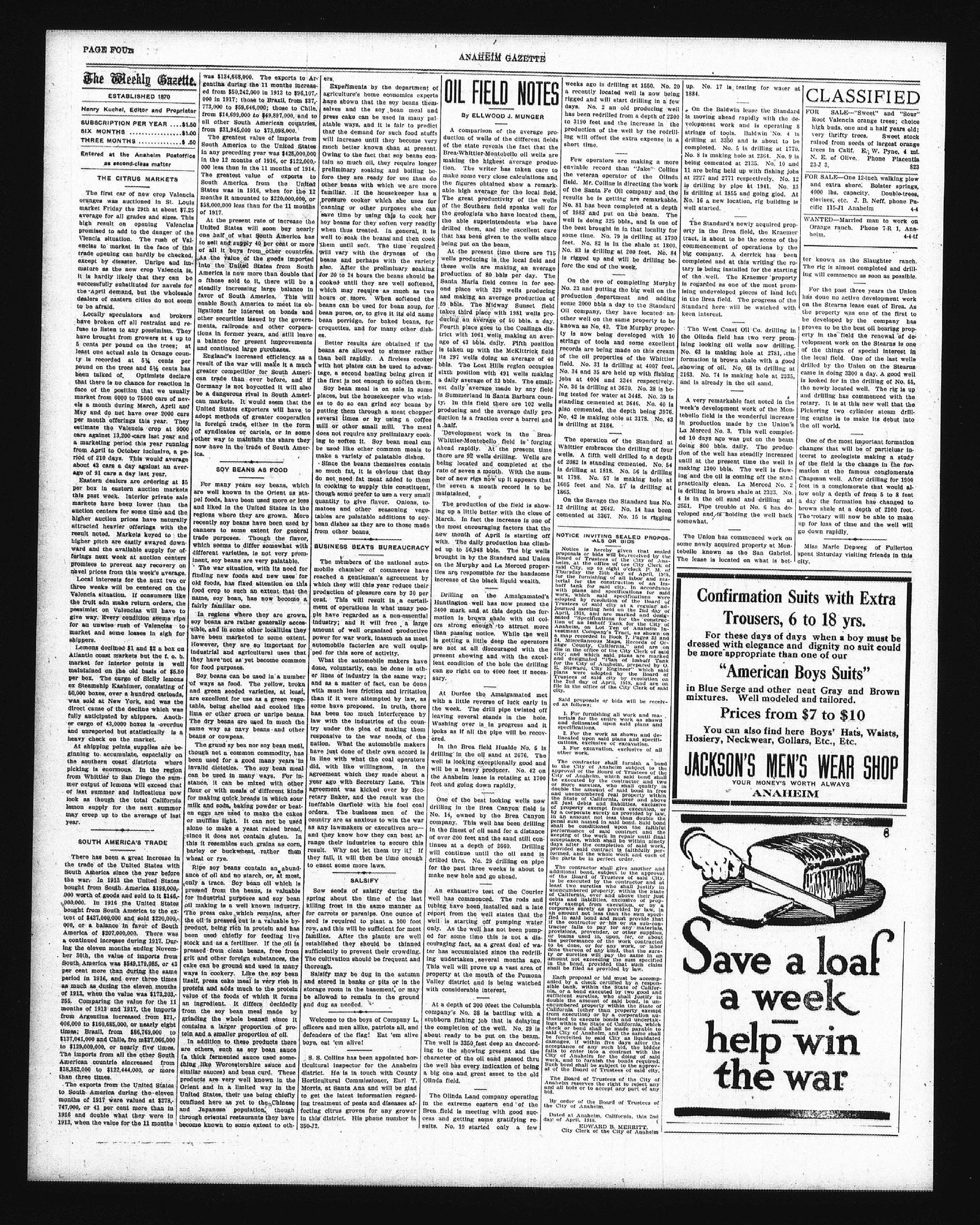
Searchable text
The Weekly Gazette
ESTABLISHED 1870
Henry Kuchel, Editor and Proprietor
SUBSCRIPTION PER YEAR ...$1.50
SIX MONTHS ...$1.00
THREE MONTHS ...$ .50
Entered at the Anaheim Postoffice as second-class matter
THE CITRUS MARKETS
The first car of new crop Valencia oranges was auctioned in St. Louis market Friday the 29th at about $7.25 average for all grades and sizes. This high result on opening Valencias promised to add to the danger of the Viencia situation. The rush of Valencias to market in the face of this trade opening can hardly be checked, except by disaster. Unripe and immature as the new crop Valencia is, it is hardly likely that they can be successfully substituted for navels for the April demand, but the wholesale dealers of eastern cities do not seem to be afraid.
Locally speculators and brokers have broken off all restraint and refuse to listen to any pessimism. They have brought from growers at 4 up to 5 cents per pound on the trees; at least one actual sale in Orange county is recorded at 5½ cents per pound on the trees and 5½ cents has been talked of. Optimists declare that there is no chance for reaction in face of the position that we usually market from 6000 to 75000 cars of nevels a month during March, April and May and do not have over 2000 cars per month offerings this year. They estimate the Valencia crop at 9000 cars against 13,200 cars last year and a marketing period this year running from April to October inclusive, a period was $134,668,000. The exports to Argentina during the 11 months increased from $50,242,000 in 1913 to $96,107,000 in 1917; those to Brazil, from $37,773,000 to $59,646,000; those to Chile, from $14,699,000 to $49,897,000, and to all other South American countries, from $31,945,000 to $73,098,000.
The greatest value of imports from South America to the United States in any preceding year was $425,000,000 in the 12 months of 1916, or $122,000,000 less than in the 11 months of 1914. The greatest value of exports to South America from the United States was in 1916, when for the 12 months it amounted to $220,000,000, or $58,000,000 less than for the 11 months of 1917.
At the present rate of increase the United States will soon buy nearly one half of what South America has to sell and supply 40 per cent or more of all it buys from other countries. As the value of the goods imported into the United States from South America is now more than double that o f those sold to it, there will be a steadily increasing large balance in favor of South America. This will enable South America to meet its obligations for interest on bonds and other securities issued by the governments, railroads and other corporations in former years, and still leave a balance for present improvements and continued large purchases.
England's increased efficiency as a result of the war will make it a much greater competitor for South American trade than ever before, and if Germany is not boycotted it will also be a dangerous rival in South American markets. It would seem that the United States exporters will have to adopt methods of greater cooperation in foreign trade, either in the form of syndicates or cartels, or in some other way to maintain the share they now have in the trade of South America.
Experiments on agriculture's ability have shown that selves and their press cake can attable ways, and that the demand will increase much better than Owing to the fact so much preliminary so far they are not other beans with familiar. If the pressure cooked canning or other save time by soy beans for them when thus treated well to soak them until soft will vary with bean purée, or bean porridge, croquettes, and es.
Better results beans are allow than boil rapioli with hot plates a stage, a second K the first is not e Soy bean meal places, but the bites to do so can putting them three several times o mill or other s does not require ing to soften it. be used like other make a variety y
Eastern dealers are ordering at $5 per box in eastern auction markets this past week. Interior private sale markets have been lower than the auction centers for some time and the higher auction prices have naturally attracted heavier offerings with the result noted. Markets keyed to the higher pitch are easily swayed downward and the available supply for offerings next week at auction centers promises to prevent any recovery on naval prices from this week's average.
Local interests for the next two or three weeks will be centered on the Valencia situation. If consumers like the fruit adn make return orders, the pessimist on Valencias will have to give way. Every condition seems ripe for an unwise rush of Valencias to market and some losses in sigh for shippers.
Lemons declined $1 and $2 a box on Atlantic coast markets but the f. o. b. market for interior points is well maintained on the old basis of $5.50 per box. The cargo of Sicily lemons ex Steamship Kashimer, consisting of 50,000 boxes, over a hundred carloads, was sold at New York, and was the direct cause of the decline which was fully anticipated by shippers. Another cargo of 43,0000 boxes is overdue and unreported but statistically is a heavy check on the market.
At shipping points supplies are beginning to accumulate, especially on the southern coast districts where picking is enormous. In the region from Whittier to San Diego the summer output of lemons will exceed that of last summer and indications now look as though the total California lemon supply for the next summer may creep up to the average of last year.
SOUTH AMERICA'S TRADE
There has been a great increase in the trade of the United States with pound on the trees and 5½ cents has been talked of. Optimists declare that there is no chance for reaction in face of the position that we usually market from 6000 to 75000 cars of nevels a month during March, April and May and do not have over 2000 cars per month offerings this year. They estimate the Valencia crop at 9000 cars against 13,200 cars last year and a marketing period this year running from April to October inclusive, a period of 210 days. This would average about 43 cars a day against an average of 91 cars a day last year.
SOY BEANS AS FOOD
For many years soy beans, which are well known in the Orient as stapel foods, have been used more or less and liked in the United States in the regions where they are grown. More recently soy beans have been used by canners to some extent for general trade purposes. Though the flavor, which seems to differ somewhat with different varieties, is not very prominent, soy beans are very palatable.
The war situation, with its need for finding new foods and new uses for old foods, has fixed attention on this food crop to such an extent that the name, soy bean, has now become a fairly familiar one.
In regions where they are grown, soy beans are rather generally accessible, and in some other localities they have been marketed to some extent. However, they are so important for industrial and agricultural uses that they have 'not as yet become common for food purposes.
Soy beans can be used in a number of ways as food. The yellow, broken and green seeded varieties, at least, are excellent for use as a green vegetable, being shelled and cooked like lima or other green or unripe beans. The dry beans are used in much the same way as navy beans and other beans or cowpeas.
The ground sy bea nor soy bean meal, though not a common commodity, has been used for a good many years in invalid dietetics. The soybean meal can be used in many ways. For instance, it can be mixed with other flour or with meals of different kinds for making quick breads in which sour milk and soda, baking powder or beaten eggs are used to make the cakes or muffins light. It can not be used alone to make a yeast raised bread, since it does not contain gluten. In this it resembles such grains as corn, barley or buckwheat, rather than wheat or rye.
BUSINESS BEAUTY
The members of mobile chamber reached a gentleman which they will produce of pleasing cent. This will ment of operation people have regarded industry; and it amount of well power for war work automobile factory ped for this sore area.
What the automobiles done, voluntarily, er lines of industry and as a matter of with much less fright than if it were at some have proposed has been too much law with the industry under the pleas responsive to the nation. What the have just done of in line with what did, with like wil agreement which year ago with Secrete agreement was kind retary Baker, and ineffable Garfield orders. The business country are as anxious as any lawmakers and they know how range their industry result. Why not let they fail, it will th
SOUTH AMERICA'S TRADE
There has been a great increase in the trade of the United States with South America since the year before the war. In 1913 the United States bought from South America $198,000,000 worth of goods and sold to it $146,000,000. In 1916 the United States bought from South America to the extent of $427,000,000 and sold $220,000,000, or a balance in favor of South America of $207,000,000. There was a continued increase during 1917. During the eleven months ending November 30th, the value of imports from South America was $549,179,085, or 43 per cent more than during the same period in 1916, and over three times as much as during the eleven months of 1913, when the value was $173,203,255. Comparing the value for the 11 months of 1913 and 1917, the imports from Argentina increased from $21,006,000 to $160,685,000, or nearly eight times; Brazil, from $86,769,000 to $137,041,000 and Chile, from m$27,066,000 to $129,009,000, or nearly five times. The imports from all the other South American countries increased from $38,362,000 to $122,444,000, or more than three times.
The exports from the United States to South America during the eleven months of 1917 were valued at $278,747,000, or 41 per cent more than in 1916 and double what they were in 1913, when the value for the 11 months can be used in many ways. For instance, it can be mixed with other flour or with meals of different kinds for making quick breads in which sour milk and soda, baking powder or beaten eggs are used to make the cakes or muffins light. It can not be used alone to make a yeast raised bread, since it does not contain gluten. In this it resembles such grains as corn, barley or buckwheat, rather than wheat or rye.
Ripe soy beans contain an abundance of oil and no starch, or at most, only a trace. Soy bean oil which is pressed from the beans, is valuable for industrial purposes and soybean oil making is a well known industry. The press cake which remains after the oil is pressed out is a valuable by-product, being rich in protein and has been used chiefly for feeding live stock and as a fertilizer. If the oil is pressed from clean beans, free from grit and other foreign substances, the cake can be ground and used in many ways in cookery. Like the soy bean itself, press cake meal is very rich in protein and adds much to the protein value of the foods of which it forms an ingredient. It differs decidedly from the soy bean meal made by grinding the whole beans since it contains a larger proportion of protein and a smaller proportion of oil.
In addition to these products there are others, such as soy bean sauce (a thick fermented sauce used something like Worcestershire sauce and similar sauces) and bean curd. These products are very well known in the Orient and in a limited way in the United States, their use being chiefly confined here as yet to the Chinese and Japanese population, though through oriental restaurants they have become known to some extent to oth-
ANAHEIM GAZETTE
OIL FIELD NOTES
By ELLWOOD J. MUNGER
A comparison of the average production of wells of the different fields of the state reveals the fact that the Brea-Whittier-Montebello oil wells are making the highest average production. The writer has taken care to make some very close calculations and the figures obtained show a remarkable high average for the local field. The great productivity of the wells of the Southern field speaks well for the geologists who have located them, the able superintendents who have drilled them, and the excellent care that has been given to the wells since being put on the beam.
At the present time there are 715 wells producing in the local field and these wells are making an average production of 80 bbls per day. The Santa Maria field comes in for second place with 329 wells producing and making an average production of 89 bbls. The Midway Sunset field takes third place with 1981 wells producing an average of 50 bbls. a day. Fourth place goes to the Coalinga district with 1061 wells making an average of 43 bbls daily. Fifth position is taken up with the McKittrick field its 297 wells doing an average of 40 bbls. The Lost Hills region occupies sixth position with 491 wells making a daily average of 32 bbls. The smallest daily average made by any field is Summerland in Santa Barbara county. In this field there are 102 wells producing and the average daily production is a fraction over a barrel and a half.
Development work in the Brea-Whittier-Montebello field is forging ahead rapidly. At the present time there are 92 wells drilling. Wells are weeks ago is drilling at 1550. No. 20 a recently located well is now being rigged and will start drilling in a few days. No. 2 an old producing well has been redrilled from a depth of 2300 to 3190 feet and the increase in the production of the well by the redrilling will offset the extra expense in a short time.
Few operators are making a more enviable record than "Jake" Collins the veteran operator of the Olinda field. Mr. Collins is directing the work of the Santa Fe Oil company and the results he is getting are remarkable. No. 81 has been completed at a depth of 1983 and put on the beam. The well is doing 325 bbls., and is one of the best brought in in that locality for some time. No. 79 is drilling at 1790 feet. No. 82 is in the shale at 1800. No. 83 is drilling at 200 feet. No. 84 is rigged up and will be drilling before the end of the week.
On the eve of completing Murphy No. 23 and putting the big well on the production department and adding some 2000 bbls a day to the Standard Oil company, they have located another well on the same property to be known as No. 42. The Murphy property is now being developed with 10 strings of tools and some excellent records are being made on this cream of the oil properties of the Whittier field. No. 31 is drilling at 4007 feet. No. 34 and 35 are held up with fishing jobs at 4004 and 3344 respectively. No. 36 is drilling at 3670. No. 38 is being tested for water at 3448. No. 39 is standing cemented at 3646. No. 40 is also cemented, the depth being 3976. No. 42 is making ole at 3178. No. 43 is drilling at 3184.
The operation of the Standard at Whittier embraces the drilling of four wells. A fifth well drilled to a depth
with hot plates can be used to advantage, a second heating being given if the first is not enough to soften them.
Soy bean meal is on sale in some places, but the housekeeper who wishes to do so can grind soy beans by putting them through a meat chopper several times or by using a coffee mill or other small mill. The meal does not require any preliminary cooking to soften it. Soy bean meal can be used like other common meals to make a variety of palatable dishes.
Since the beans themselves contain so much fat, it is obvious that they do not need fat meat added to them in cooking to supply this constituent, though some prefer to use a very small quantity to give flavor. Onions, tomatoes and other seasoning vegetables are palatable additions to soybean dishes as they are to those made from other beans.
BUSINESS BEATS BUREAUCRACY
The members of the national automobile chamber of commerce have reached a gentleman's agreement by which they will this year reduce their production of pleasure cars by 30 per cent. This will result in a curtailment of operations in what many people have regarded as a non-essential industry; and it will free a large amount of well organized productive power for war work, inasmuch as most automobile factories are well equipped for this sore of activity.
What the automobile makers have done, voluntarily, can be done in other lines of industry in the same way; and as a matter of fact, can be done with much less friction and irritation than if it were attempted by law, as some have proposed. In truth, there has been too much interference by law with the industries of the country under the plea of making them responsive to the war needs of the nation. What the automobile makers have just done of their own accord is in line with what the coal operators did, with like willingness, in the agreement which they made about a year ago with Secretary Lane. This agreement was kicked over by Secretary Baker, and the result was the ineffable Garfield with his fool coal orders. The business men of the country are as anxious to win the war as any lawmakers or executives are—and they know how they can best arrange their industries to secure this result. Why not let them try it? If they fail, it will then be time enough to enact some more laws.
The Lost Hills region occupies sixth position with 491 wells making a daily average of 32 bbls. The smallest daily average made by any field is Summerland in Santa Barbara county. In this field there are 102 wells producing and the average daily production is a fraction over a barrel and a half.
Development work in the Breathier-Montebello field is forging ahead rapidly. At the present time there are 92 wells drilling. Wells are being located and completed at the rate of seven a month. With the number of new rigs now up it appears that the seven a month record is to be maintained.
The production of the field is showing up a little better with the close of March. In fact the increase is one of the most encouraging factors that the new month of April is starting off with. The daily production has climbed up to 56,948 bbls. The big wells brought in by the Standard and Union on the Murphy and La Merced properties are responsible for the handsome increase of the black liquid wealth.
Drilling on the Amalgamated's Huntington well has now passed the 3400 mark and at this depth the formation is brown shale with oil colors strong enough to attract more than passing notice. While the well is getting a little deep the operators are not at all discouraged with the present showing and with the excellent condition of the hole the drilling can go right on to 4000 feet if necessary.
At Durfee the Amalgamated met with a little reverse of luck early in the week. The drill pipe twisted off leaving several stands in the hole. Washing over is in progress and it looks as if all the pipe will be recovered.
In the Brea field Hualde No. 5 is drilling in the oil sand at 2676. The well is looking exceptionally good and will be a heavy producer. No. 42 on the Anaheim lease is rotating at 1700 feet and going down rapidly.
One of the best looking wells now drilling in the Brea Canyon field is No. 14, owned by the Brea Canyon company. This well has been drilling in the finest of oil sand for a distance of over 200 feet and the sand still continues at a depth of 3660. Drilling will continue until the oil sand is drilled thru. No. 29 drilling on pipe field. No. 31 is drilling at 4007 feet. No. 34 and 35 are held up with fishing jobs at 4004 and 3344 respectively. No. 36 is drilling at 3670. No. 38 is being tested for water at 3448. No. 39 is standing cemented at 3646. No. 40 is also cemented, the depth being 3976. No. 42 is making oble at 3178. No. 43 is drilling at 3184.
The operation of the Standard at Whittier embraces the drilling of four wells. A fifth well drilled to a depth of 2082 is standing cemented. No. 54 is drilling at 1818. No. 56 is drilling at 1798. No. 57 is making hole at 1605 feet and No. 57 is drilling at 1865.
On the Savage the Standard has No. 12 drilling at 2642. No. 14 has been cemented at 3367. No. 15 is rigging
NOTICE INVITING SEALED PROPOSALS OR BIDS
Notice is hereby given that sealed proposals or bids will be received by the Board of Trustees of the City of Anaheim, at the office of the City Clerk of said City, up to eight o'clock F.M. of Thursday the 25th day of April, 1918, for the furnishing of all labor and material for the construction of an unhoff tank for said city, in accordance with plans and specifications for said work, which said specifications were adopted by resolution of the Board of Trustees of said city at a regular adjourned meeting held on the 2nd day of April, 1918, and are marked and designated "Specifications for the construction of an unhoff Tank for the City of Anaheim, on Lot Ten of Anaheim Investment Company's Trust, as shown on a map recorded in Book 7 Pages 33 and 34, Miscellaneous Maps, Records of Orange County, California, on file in the office of the City Clerk of said city; and which said plans are marked and designated "Plan of Unhoff Tank for the City of Anaheim, prepared by O.E. Steward, City Engineer" which said plans were adopted by the Board of Trustees of said city by resolution on the 2nd day of April, 1918, and are on file in the office of the City Clerk of said city.
Said proposals or bids will be received as follows:
1. For furnishing all work and materials for the entire work as shown and delineated upon said plans and specifications.
2. For the work as shown and delineated upon said plans and specifications, exclusive or excavation.
3. For excavation, exclusive of all other work.
The contractor shall furnish a bond to the City of Anaheim subject to the approval of the Board of Trustees of the City of Anaheim, which said bond shall be executed by the contractor and two or more sureties, who shall qualify in double the amount of said bond in free and unencumbered real property within the State of California, over and above all just debts and liabilities, exclusive or exempt from execution, or by a corporate surety as provided by law, in an amount not less than double the penal sum named in said bond. Said bond shall be conditioned upon that faithful performance of said contract and keeping of the work in repair until final acceptance, which shall be within ninety days after the completion of said work, provided said contract is faithfully performed, and the whole work and each of the parts be in perfect order.
SALSIFY
Sow seeds of salsify during the spring about the time of the last killing frost in the same manner as for carrots or parsnips. One ounce of seed is required to plant a 100 foot row, and this will be sufficient for most families. After the plants are well established they should be thinned sufficiently to prevent their crowding. The cultivation should be frequent and thorough.
Salsify may be dug in the autumn and stored in banks or pits or in the storage room in the basement, or may be allowed to remain in the ground and dug as needed.
Welcome to the boys of Company L, officers and men alike, patriots all, and defenders of the flag! Eat 'em alive!
S. S. Collins has been appointed horticultural inspector for the Anaheim district. He is in touch with County Horticultural Commissioner, Earl T. Morris, at Santa Ana and will be glad to get the latest information regarding treatment of pests and diseases affecting citrus groves for any grower in this district. His phone number is 350-J2.
One of the best looking wells now drilling in the Brea Canyon field is No. 14, owned by the Brea Canyon company. This well has been drilling in the finest of oil sand for a distance of over 200 feet and the sand still continues at a depth of 3660. Drilling will continue until the oil sand is drilled thru. No. 29 drilling on pipe for the past three weeks is about to make new hole and go ahead.
An exhaustive test of the Courier well has commenced. The rods and tubing have been installed and a late report from the well states that the well is starting off pumping water only. As the well has not been pumped for some time this is not a discouraging fact, as a great deal of water has accumulated since the redrilling undertaken several months ago. This well will prove up a vast area of property at the mouth of the Pomona Valley district and is being watched with considerable interest.
At a depth of 300 0feet the Columbia company's No. 28 is battling with a stubborn fishing job that is delaying the completion of the well. No. 29 is about ready to be put on the beam. The well is 3350 feet deep an daccording to the showing present and the character of the oil sand passed thru the well has every indication of being a big one and great asset to the old Olinda field.
The Olinda Land company operating in the extreme eastern end of the Brea field is meeting with good success and getting some gratifying results. No. 19 started only a few
The contractor shall give another and additional bond, subject to the approval of the Board of Trustees of the City of Anaheim, which said bond shall be executed by the contractor and two or more sureties, who shall qualify in double the amount of said bond in free and unencumbered real property within the State of California, over and above all just debts and liabilities, exclusive of property exempt from execution, or by a corporate surety as provided by law, in an amount not less than double the penal sum named in said bond. Said bond shall be conditioned upon the faithful performance of said contract and the keeping of the work in repair until final acceptance, which shall be within ninety days after the completion of said work, provided said contract is faithfully performed, and the whole work and each of the parts be in perfect order.
Each proposal or bid must be accompanied by a check certified by a responsible bank, within the State of California, or a bond executed by two good and sufficient sureties, who shall justify in double the amount of said bond in unencumbered property within the State of California (other than property exempt from execution) or by a corporation authorized to execute bonds and undertakings within the State of California, which check or bond shall be made payable to said City of Anaheim, and the same shall be forefelt to said City as liquidated damages. If within five days after the acceptance of any such bid, the bidder fails to enter into a contract with the City of Anaheim for the doing of said work, and to furnish the bonds required. Such bond shall be subject to the approval of the Board of Trustees of said city.
The Board of Trustees of the City of Anaheim reserves the right to reject any and all bids or to accept any part of any bid.
By order of the Board of Trustees of the City of Anaheim.
Dated at Anaheim, California, this 2nd day of April, 1918.
EDWARD B. MERRITT.
City Clerk of the City of Anaheim
CLASSIFIED
FOR SALE—"Sweet" and "Sour"
Root Valencia orange trees; choice high buds, one and a half years old; very thrifty trees. Sweet stock raised from seeds of largest orange trees in Calif. E. W. Pyne, 4 mi. N. E. of Olive. Phone Placentia 23-J 3.
FOR SALE—One 12-inch walking plow and extra shore. Bolster springs, 4000 lbs. capacity. Double-trees, clevises, etc. J. B. Neff, phone Pacific 115-J1 Anaheim 4-4
WANTED—Married man to work on Orange ranch. Phone 7-R 1, Anaheim 4-4-tf
For the past three years the Union has done no active development work on the Stearns lease east of Brea. As the property was one of the first to be developed by the company has proven to be the best oil bearing property in the field the renewal of development work on the Stearns is one of the things of special interest in the local field. One of the last well drilled by the Union on the Stearns came in doing 3300 a day. A good well is looked for in the drilling of No. 55, the newly located well. The rig is up and drilling has commenced with the rotary. It is at this new well that the Pickering two cylinder steam drilling engine is to make its debut into the oil world.
One of the most important formation changes that will be of particuar interest to geologists making a study...
A very remarkable fact noted in the week's development work of the Montebello field is the wonderful increase in production made by the Union's La Merced No. 3. This well completed 10 days ago was put on the beam doing 800 bbls daily. The production of the well has steadily increased until at the present time the well is making 1300 bbls. The well is flowing and the oil is coming off the sand practically clean. La Merced No. 2 is drilling in brown shale at 2323. No. 4 is in the oil sand and drilling at 2551. Pipe trouble at No. 6 has developed and is holding the well back somewhat.
The Union has commenced work on some newly acquired property at Montebello known as the San Gabriel. The lease is located on what is bet-
One of the most important formation changes that will be of particular interest to geologists making a study of the field is the change in the formation at the famous conglomerate Chapman well. After drilling for 1900 feet in a conglomerate that would allow only a depth of from 5 to 8 feet a day the formation has changed to brown shale at a depth of 2100 feet. The rotary will now be able to make up for loss of time and the well will go down rapidly.
Miss Marie Depweg of Fullerton spent Saturday visiting friends in this city.
Confirmation Suits with Extra Trousers, 6 to 18 yrs.
For these days of days when a boy must be dressed with elegance and dignity no suit could be more appropriate than one of our "American Boys Suits"
in Blue Serge and other neat Gray and Brown mixtures. Well modeled and tailored.
Prices from $7 to $10
You can also find here Boys' Hats, Waists, Hosiery, Neckwear, Gollars, Etc., Etc.
JACKSON'S MEN'S WEAR SHOP
YOUR MONEY'S WORTH ALWAYS
ANAHEIM
Save a loaf
a week
help win
the war