anaheim-gazette 1918-03-07
Scanned page
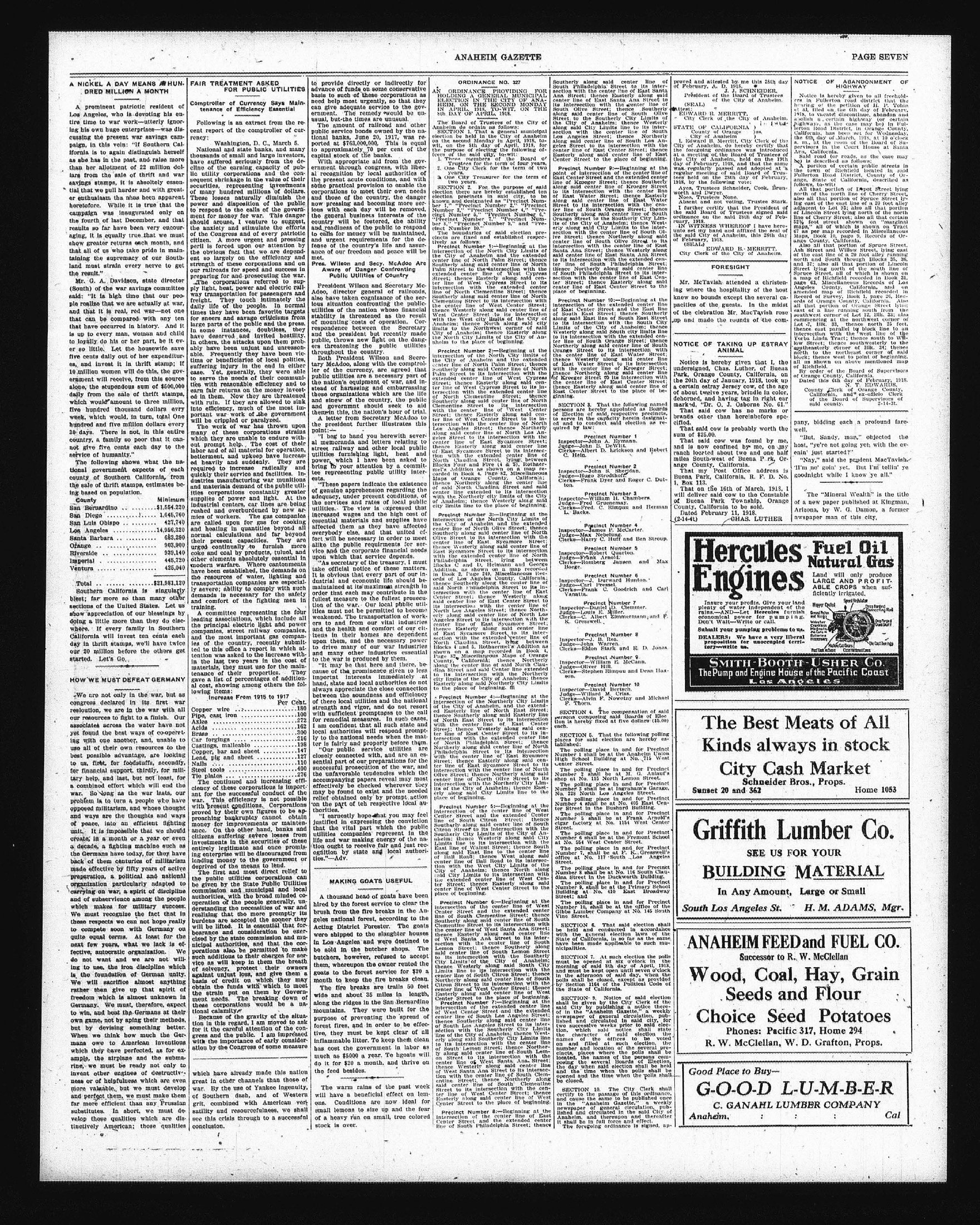
Searchable text
A NICKEL A DAY MEANS HUNDRED MILLION A MONTH
A prominent patriotic resident of Los Angeles, who is devoting his entire time to war work—utterly ignoring his own huge enterprises—was discussing the present war savings campaign, in this vein: "If Southern California is to again distinguish herself as she has in the past, and raise more than her allotment of 22 million dollars from the sale of thrift and war savings stamps, it is absolutely essential that we pull harder and with greater enthusiasm that has been apparent heretofore. While it is true that the campaign was inaugurated only on the fourth of last December, and that results so far have been very encouraging, it is equally true that we must show greater returns each month, and that all of us who take pride in maintaining the supremacy of our Southland must strain every nerve to get the result."
Mr. G. A. Davidson, state director (South) of the war savings committee said: "It is high time that our people realize that we are actually at war, and that it is real, red war—not one that can be compared with any ten that have occurred in history. And it is up to every man, woman and child to loyally do his or her part, be it ever so little. Let the housewife save five cents daily out of her expenditures, and invest it in thrift stamp; if 10 million women will do this, the government will receive, from this source alone, the stipendous sum of $500,000 daily from the sale of thrift stamps, which would amount to three million, five hundred thousand dollars every week, which would, in turn, total one hundred and five million dollars every 30 days. There is not, in this entire country, a family so poor that it cannot give five cents each day to the service of humanity."
FAIR TREATMENT ASKED FOR PUBLIC UTILITIES
Comptroller of Currency Says Maintenance of Efficiency Essential
Following is an extract from the recent report of the comptroller of currency:
Washington, D. C., March 5.
National and state banks, and many thousands of small and large investors, have suffered seriously from the decline of the earning capacity of public utility corporations and the consequent shrinkage in the value of their securities, representing investments of many hundred millions of dollars. These losses naturally diminish the power and disposition of the public to respond to the calls of the government for money for war. This danger should arouse, I venture to suggest, the anxiety and stimulate the efforts of the Congress and of every patriotic citizen. A more urgent and pressing peril is forced upon our attention by the obvious fact that we are dependent so largely on the efficiency and strength of these corporations and on our railroads for speed and success in preparing for and prosecuting the war.
The corporations referred to supply light, heat, power and electric railway transportation for passengers and freight. They touch intimately the daily life of the people. In normal times they have been favorite targets for sneers and savage criticisms from large parts of the public and the press. In some instances, doubtless, they have deserved and invited hostility. In others, the attacks upon them probably have been unjust and unreasonable. Frequently they have been victims or beneficiaries of local politics, suffering injury in the end in either case. Yet, generally, they were able to serve the needs of their communities with reasonable efficiency and to earn fair returns on the money invested in them. Now they are threatened with ruin. If they are allowed to sink into efficiency, much of the most important war work of the government will be crippled or paralyzed.
The work of war has thrown upon many of these corporations strains which they are unable to endure without prompt help. The cost of their labor and of all material for operation, betterment, and upkeep have increased to provide directly advance of funds on basis to such of the need help most urgently can give adequate errumment. The rest usual, but-the-time.
The amount of public service bonusional banks, June ported at $763,000 to approximately $capital stock of thieves with each day the general business country will be free and readiness of thieves to calls for money and urgent requireance of the councils of our freedom met.
Pres. Wilson and Aware of Dam Public Utility President Wilson Adoo, director go also have taken conscious situation contributions to the national stability is threat of mounting costs; responidence between and the president public, throws new threats throughout the country.
Both President McAdoo, along with the current public utilities are the nation's equipment stead of harassing these organizations and sinew of the and government since them in this, the m
A letter from the president furnishing:
"I beg to hand al memoranda and street railway and utilities furnishing."
es, and invest it in thrift stamp; if 10 million women will do this, the government will receive, from this source alone, the stupendous sum of $500,000 daily from the sale of thrift stamps, which would amount to three million, five hundred thousand dollars every week, which would, in turn, total One hundred and five million dollars every 30 days. There is not, in this entire country, a family so poor that it cannot give five cents each day to the service of humanity."
The following shows what the national government expects of each county of Southern California, from the sale of thrift stamps, estimates being based on population.
| County | Minimum |
| :--- | :--- |
| San Bernardino | $1,554,220 |
| San Diego | 1,645,760 |
| San Luis Obispo | 427,740 |
| Los Angeles | 14,956,320 |
| Santa Barbara | 683,280 |
| Orange | 903,900 |
| Riverside | 939,140 |
| Imperial | 445,720 |
| Ventura | 425,040 |
Total: $21,981,120
Southern California is singularly blest; far more so than many other sections of the United States. Let us show appreciation of our blessings by doing a little more than they do elsewhere. If every family in Southern California will invest ten cents each day in thrift stamps, we'll have twice our 20 million before the others get started. Let's Go.
HOW WE MUST DEFEAT GERMANY
We are not only in the war, but as congress declared in its first war resolution, we are in the war with all our resources to fight to a finish. Our associates across the water have not yet found the best ways of co-operating with one another, and unable to use all of their own resources to the best possible advantage, are looking to us, first, for foodstuffs, secondly, for financial support thirdly, for military help, and last, but not least, for a combined effort which will end the war. So long as the war lasts, our problem is to turn a people who have opposed militarism, and whose thought and ways are the thoughts and ways of peace, into an efficient fighting unit. It is impossible that we should create in a month or a year or even a decade, a fighting machine such as the Germans have today, for they have back of them centuries of militarism.
Increase From 1915 to 1917
Per Cent.
Copper wire ... 180
Pipe, cast iron ... 100
Axles ... 272
Acids ... 162
Brass ... 300
Car forgings ... 216
Castings, malleable ... 198
Copper, bar and sheet ... 147
Lead, pig and sheet ... 127
Nails ... 110
Steel tools ... 400
Tie plates ... 276
The continued and increasing efficiency of these corporations is important for the successful conduct of the war. This efficiency is not possible with present conditions. Corporations proved by their own figures to be approaching bankruptcy cannot obtain money for improvements or maintenance. On the other hand, banks and citizens suffering severe losses from investments in the securities of these entirely legitimate and once promising enterprise will be discouraged from lending money to the government or beneficiaries of local politics, suffering injury in the end in either case. Yet generally, they were able to serve the needs of their communities with reasonable efficiency and to earn fair returns on the money invested in them. Now they are threatened with ruin. If they are allowed to sink into efficiency, much of the most important war work of the government will be crippled or paralyzed.
The work of war has thrown upon many of these corporations strains which they are unable to endure without prompt help. The cost of their labor and of all material for operation, betterment, and upkeep have increased heavily and suddenly. They are required to increase radically and quickly their service and facilities. Industries manufacturing war munitions and materials demand of the public utilities corporations constantly greater supplies of power and light. At the industrial centers, car lines are being rushed and overburdened by new armies of workers. The gas companies are called upon for gas for cooking and heating in quantities beyond all normal calculations and far beyond their present capacities. They are urged continually to furnish more coke and coal by products, tulol, and other elements absolutely essential in modern warfare. Where cantonments have been established, the demands on the resources of water, lighting and transportation companies are especially severe; ability to comply with such demands is necessary for the safety and comfort of the fighting men in training.
A committee representing the four leading associations, which include all the principal electric light and power companies, street railway companies, and the most important gas companies of the country, recently submitted to this office a report in which attention was asked to the increase within the last two years in the cost of materials, they must use for the maintenance of their properties. They gave a list of percentages of additional cost, showing among others the following items:
Increase From 1915 to 1917
Per Cent.
Copper wire ... 180
Pipe, cast iron ... 100
Axles ... 272
Acids ... 162
Brass ... 300
Car forgings ... 216
Castings, malleable ... 198
Copper, bar and sheet ... 147
Lead, pig and sheet ... 127
Nails ... 110
Steel tools ... 400
Tie plates ... 276
The continued and increasing efficiency of these corporations is important for the successful conduct of the war. This efficiency is not possible with present conditions. Corporations proved by their own figures to be approaching bankruptcy cannot obtain money for improvements or maintenance. On the other hand, banks and citizens suffering severe losses from investments in the securities of these entirely legitimate and once promising enterprise will be discouraged from lending money to the government or beneficiaries of local politics, suffering injury in the end in either case. Yet generally, they were able to serve the needs of their communities with reasonable efficiency and to earn fair returns on the money invested in them. Now they are threatened with ruin. If they are allowed to sink into efficiency, much of the most important war work of the government will be crippled or paralyzed.
The work of war has thrown upon many of these corporations strains which they are unable to endure without prompt help. The cost of their labor and of all material for operation, betterment, and upkeep have increased heavily and suddenly. They are required to increase radically and quickly their service and facilities. Industries manufacturing war munitions and materials demand of the public utilities corporations constantly greater supplies of power and light. At the industrial centers, car lines are being rushed and overburdened by new armies of workers. The gas companies are called upon for gas for cooking and heating in quantities beyond all normal calculations and far beyond their present capacities. They are urged continually to furnish more coke and coal by products, tulol, and other elements absolutely essential in modern warfare. Where cantonments have been established, the demands on the resources of water, lighting and transportation companies are especially severe; ability to comply with such demands is necessary for the safety and comfort of the fighting men in training.
A committee representing the four leading associations, which include all the principal electric light and power companies, street railway companies, and the most important gas companies of the country, recently submitted to this office a report in which attention was asked to the increase within the last two years in the cost of materials, they must use for the maintenance of their properties. They gave a list of percentages of additional cost, showing among others the following items:
Increase From 1915 to 1917
Per Cent.
Copper wire ... 180
Pipe, cast iron ... 100
Axles ... 272
Acids ... 162
Brass ... 300
Car forgings ... 216
Castings, malleable ... 198
Copper, bar and sheet ... 147
Lead, pig and sheet ... 127
Nails ... 110
Steel tools ... 400
Tie plates ... 276
The continued and increasing efficiency of these corporations is important for the successful conduct of the war. This efficiency is not possible with present conditions. Corporations proved by their own figures to be approaching bankruptcy cannot obtain money for improvements or maintenance. On the other hand, banks and citizens suffering severe losses from investments in the securities of these entirely legitimate and once promising enterprise will be discouraged from lending money to the government or beneficiaries of local politics, suffering injury in the end in either case. Yet generally, they were able to serve the needs of their communities with reasonable efficiency, under pressure at its order that each man fulfill measure to tion of the war.
As secretary of take official notice it is obvious that industrial and economic maintained at its order that each man fulfill measure to tion of the war.
"Our public se closely connected sental part of our successful prosecute unfavorable th accompanying paper effectively be che may be found to a relief obtained on on part of teh thorites.
"I earnestly hope justified in express that the vital part utilities company life and war make cognition by state ties."—Adv.
for financial support, thirdly, for military help, and last, but not least, for a combined effort which will end the war. So long as the war lasts, our problem is to turn a people who have opposed militarism, and whose thought and ways are the thoughts and ways of peace, into an efficient fighting unit. It is impossible that we should create, in a month or a year or even a decade, a fighting machine such as the Germans have today, for they have back of them centuries of militarism made effective by fifty years of active preparation, a political and national organization particularly adapted to carrying on war, a spirit of discipline and of subservience among the people which makes for military success. We must recognize the fact that in these respects we can not hope really to compete soon with Germany on quite equal terms. At least for the next few years, what we lack is effective, autocratic organization. We do not want and we are not willing to use, the iron discipline which is the foundation of German unity. We will sacrifice almost anything rather than give up that spirit of freedom which is almost unknown in Germany. We must, therefore, expect to win, and beat the Germans at their own game, not by aping their methods, but by devising something better. When we think how much the Germans owe to American inventions which they have perfected, as for example, the airplane and the submarine, we must be ready not only to invent other engines of destructiveness or of helpfulness which are even more valuable, but we must develop and perfect them, we must make them far more efficient than any Prussian substitutes. In short, we must develop those qualities which are distinctively American; those qualities which have already made this nation great in other channels than those of war. By the use of Yankee ingenuity, of Southern dash, and of Western grit, combined with American vertatility and resourcefulness, we shall see this crisis through to a successful conclusion.
The continued and increasing efficiency of these corporations is important for the successful conduct of the war. This efficiency is not possible with present conditions. Corporations proved by their own figures to be approaching bankruptcy cannot obtain money for improvements or maintenance. On the other hand, banks and citizens suffering severe losses from investments in the securities of these entirely legitimate and once promising enterprise will be discouraged from lending money to the government or deprived of the means to lend.
The first and most direct relief to the public utilities corporations can be given by the State Public Utilities commission and municipal and local authorities, with the broad minded cooperation of the people generally, understanding the necessities of war and realizing that the more promptly its burdens are accepted the sooner they will be lifted. It is essential that bearance and consideration be exercised by the state commission and municipal authorities, and that the corporations also be permitted to make such additions to their charges for service as will keep in them the breath of solvency, protect their owners against unjust loss, and give them a basis of credit on which they may obtain the funds with which to meet the strain put on them by Government needs. The breaking down of these corporations would be a national calamity.
Because of the gravity of the situation in this regard, I am moved to ask for it the careful attention of the congress and the public. I am impressed with the importance of early consideration by the Congress of some measure.
MAKING GOOD
A thousand heads hired by the forestry brush from the five gales national forest fires and in Los Angeles are shipped to work in Los Angeles and be sold in the butchers, however them, whereupon goats to the forest month to keep them.
The fire breaks wide and about along the ridges in mountains. They purpose of prevent forest fires, and active, they must inflammable litter has cost the government much as $5000 a day it for $20 a day the feed besides.
The warm rain will have a beneficial effect on small lemons to aid of a heavy run of stock is over.
ANAHEIM GAZETTE
to provide directly or indirectly for advance of funds on some conservative basis to such of these corporations as need help most urgently, so that they can give adequate service to the government. The remedy would be unusual, but-the times are unusual.
The amount of railroad and other public service bonds owned by the national banks, June 20, 1917, was reported at $763,000,000. This is equal to approximately 70 per cent of the capital stock of the banks.
With appropriate aid from the government through congress, with liberal recognition by local authorities of the present acute conditions, and with some practical provision to enable the corporations to meet their own needs and those of the country, the danger now pressing and becoming more serious with each day will be removed, the general business interests of the country will be fostered, the ability and readiness of the public to respond to calls for money will be maintained, and urgent requirements for the defense of the country's life and assurance of our freedom and peace will be met.
Pres. Wilson and Secy. McAdoo Are Aware of Danger Confronting Public Utilities of Country
President Wilson and Secretary McAdoo, director general of railroads, also have taken cognizance of the serious situation confronting the public utilities of the nation whose financial stability is threatened as the result of mounting costs of operation. Correspondence between the Secretary and the president but recently made public, throws new light on the dangers threatening the public utilities throughout the country.
Both President Wilson and Secretary McAdoo, along with the comptroller of the currency, are agreed that public utilities are a necessary part of the nation's equipment of war, and instead of harassing and embarrassing these organizations which are the life and sinew of the country, the public and government should seek to aid them in this, the nation's hour of trial.
A letter from Secretary McAdoo to the president further illustrates this point:
"I beg to hand you herewith several memoranda and letters relating to street railway and other local public utilities furnishing light, heat and electricity."
ORDINANCE NO. 327
AN ORDINANCE PROVIDING FOR HOLDING A GENERAL MUNICIPAL ELECTION IN THE CITY OF ANAHEIM, ON THE SECOND MONDAY IN APRIL 1918, TO-WIT, ON THE 5TH DAY OF APRIL 1918.
The Board of Trustees of the City of Anaheim to ordain as follows:
SECTION 1. That a general municipal election be held in the City of Anaheim on the second Monday in April, 1918, to wit, on the 5th day of April, 1918, for the purpose of electing the following officers of the said city, to-wit:
1. Three members of the Board of Trustees for the term of four years.
2. One City Clerk for the term of two years.
3. One City Treasurer for the term of two years.
SECTION 2. For the purpose of said election there are hereby established ten election precincts in said city, to be known and designated as "Precinct Number 1." "Precinct Number 2." "Precinct Number 3." "Precinct Number 4." "Precinct Number 5." "Precinct Number 6." "Precinct Number 7." "Precinct Number 8." "Precinct Number 9," and "Precinct Number 10."
The boundaries of said election precincts are fixed and established respectively as follows:
Precinct Number 1:—Beginning at the intersection of the North City Limits of the City of Anaheim and the extended center line of North Palm Street; thence Southerly along said center line of North Palm Street to its intersection with the extended center line of West Cypress Street; thence Easterly along said center line of West Cypress Street to its intersection with the extended center line of North Clementine Street; thence Southerly along said center line of North Clementine Street to its intersection with the center line of West Center Street; thence Westerly along said center line of West Center Street to its intersection with the West city limits of the City of Anaheim; thence North along said city limits to the Northwest corner of said City of Anaheim; thence Easterly along said city limits to the Northwest corner of said City of Anaheim; thence Westerly along said city limits to its intersection with the extended center line of North Clementine Street; thence Southerly along said center line of North Clementine Street to its intersection with the center line of West Center Street; thence Westerly along said center line of East Water Street to its intersection with the center line of East Water Street to its intersection with the center line of South Orange Street; thence Southerly along said center line of South Orange Street to the Southern City Limits of the City of Anaheim; thence Westerly along said City Limits to the intersection with the center line of South Olive Street; thence Northerly along said center line of East Center Street to the place of beginning.
Precinct Number 9:—Beginning at the point of intersection of the center line of East Center Street and the extended center line of Kroeger Street; thence Southerly along said center line of Kroeger Street to its intersection with the center line of East Water Street; thence Westerly along said center line of East Water Street to its intersection with the center line of South Orange Street; thence Southerly along said center line of South Orange Street to the Southern City Limits of the City of Anaheim; thence Westerly along said City Limits to its intersection with the extended center line of East Center Street; thence Northerly along said center line of East Center Street to the place of beginning.
Precinct Number 10:—Beginning at the intersection of the extended center line of East Center Street and the East Line of South East Street; thence Southerly along said east line of South East Street to its intersection with the south city limits to the northwest corner of said City of Anaheim; thence Westerly along said city limits to the northwest corner of said City of Anaheim; thence Westerly along said city limits to its intersection with the extended center line of South Orange Street; thence Northerly along said center line of South Orange Street to its intersection with the extended center line of South Olive Street; thence Northerly along said center line of South Olive Street to its intersection with the center line of East Water Street; thence Westerly along said center line of East Water Street to its intersection with the center line of South Sycamore Street; thence Easterly along said center line of East Sycamore Street to its intersection with the extended center line of Robert C. Heinle.
PRECINCT NUMBER 1
Inspector—John A. Eymann.
Judge—John B. DeWitt.
Clerks—Albert D. Erickson and Robert C. Heinle.
tary McAdoo, along with the comptroller of the currency, are agreed that public utilities are a necessary part of the nation's equipment of war, and instead of harassing and embarrassing these organizations which are the life and sinew of the country, the public and government should seek to aid them in this, the nation's hour of tral.
A letter from Secretary McAdoo to the president further illustrates this point:
"I beg to hand you herewith several memoranda and letters relating to street railway and other local public utilities furnishing light, heat and power, which I have been asked to bring to your attention by a committee representing public utility interests.
"These papers indicate the existence of genuine apprehension regarding the adequacy, under present conditions, of the services and rates of local public utilities. The view is expressed that increased wages and the high cost of essential materials and supplies have affected them as they have affected everybody else, and that united effort will be necessary in order to meet alike the public requirements for service and the corporate financial needs upon which that service depends.
"As secretary of the treasury, I must take official notice of these matters. It is obvious that every part of our industrial and economic life should be maintained at its maximum strength in order that each may contribute in the fullest measure to the fullest prosecution of the war. Our local public utilities must not be permitted to become weakened. The transportation of workers to and from our vital industries and the health and comfort of our citizens in their homes are dependent upon them, and the necessary power to drive many of our war industries and many other industries essential to the war is produced by them.
"It may be that here and there, because of the prominence given to less important interests immediately at hand, state and local authorities do not always appreciate the close connection between the soundness and efficiency of these local utilities and the national strength and vigor, and do not resort with sufficient promptness to the call for remedial measures. In such cases, I am confident that all such state and local authorities will respond promptly to the national needs when the matter is fairly and properly before them.
"Our public service utilities are closely connected with, and are an essential part of our preparations for the successful prosecution of the war, and the unfavorable tendencies which the accompanying papers reveal may most effectively be checked wherever they may be found to exist and the needed relief obtained only by prompt action on the part of teh respective local authorities.
"I earnestly hope that you may feel justified in expressing the conviction that the vital part which the public utilities companies represent in the life and war making energy of the nation ought to receive fair and just recognition by state and local authorities."—Adv.
MAKING GOATS USEFUL
A thousand head of goats have been hired by the forest service to clear the brush from the fire breaks in the Angeles national forest, according to the Acting District Forester. The goats were shipped to the slaughter houses in Los Angeles and were destined to be sold in the butcher shops. The butchers, however, refused to accept them, whereupon the owner rented the goats to the forest service for $20 a month to keep the fire breaks clean.
The fire breaks are trails 50 feet wide and about 35 miles in length, along the ridges in the San Bernardino mountains. They were built for the purpose of preventing the spread of forest fires, and in order to be effective, they must be kept clear of all inflammable litter. To keep them clean has cost the government in labor as much as $5000 a year. To hgoats will do it for $20 a month, and thrive on the feed besides.
The warm rains of the past week will have a beneficial effect on lemons. Conditions are now ideal for small lemons to size up and the fear of a heavy run on small, tree colored stock is over.
Precinct Number 5—Beginning at the intersection of the center line of West Center Street and the extended Center line of South Citron Street; thence Southerly along said center line of South Citron Street to its intersection with the Southerly City Limits of the City of Anaheim; thence Westerly along said City Limits to its intersection with the East line of Walnut Street; thence South along said East line to the center line of Ball Road to its intersection with the West City Limits of the City of Anaheim; thence North along said City Limits to its intersection with the extended center line of West Center Street; thence Easterly along said center line of West Center Street to the place of beginning.
Precinct Number 6—Beginning at the intersection of the center line of West Center Street and the extended Center line of South Clementine Street; thence Southerly along said center line of South Clementine Street to its intersection with the center line of West Santa Ana Street; thence Easterly along said center line of West Santa Ana Street to its intersection with the East line of Walnut Street; thence South along said center line of South Clementine Street to its intersection with the Southerly City Limits of the City of Anaheim; thence Westerly along said City Limits to its intersection with the center line of South Los Angeles Street; thence Southerly along said center line of South Los Angeles Street to its intersection with the Southerly City Limits of the City of Anaheim; thence Westerly along said City Limits to its intersection with the center line of West Santa Ana Street; thence Westerly along said center line of West Santa Ana Street to its intersection with the center line of South Los Angeles Street; thence Northerly along said center line of South Lemon Street to its intersection with the center line of West Santa Ana Street; thence Westerly along said center line of West Santa Ana Street to its intersection with the center line of South Los Angeles Street; thence Northerly along said center line of South Lemon Street to its intersection with the center line of West Santa Ana Street; thence Westerly along said center line of West Santa Ana Street to its intersection with the center line of South Los Angeles Street; thence Northerly along said center line of South Lemon Street to its intersection with the center line of West Santa Ana Street; thence Northerly along said center line of South Lemon Street to its intersection with the center line of West Santa Ana Street; thence Northerly along said center line of South Lemon Street to its intersection with the center line of West Santa Ana Street; thence Northerly along said center line of South Lemon Street to its intersection with the center line of West Santa Ana Street; thence Northerly along said center line of South Lemon Street to its intersection with the center line of West Santa Ana street; thence Northerly along said center line of South Lemon Street to its intersection with the center line of West Santa Ana street; thence Northerly along said center line of South Lemon Street to its intersection with the center line of West Santa Ana street; thence Northerly along said center line of South Lemon Street to its intersection with the center line of West Santa Ana street; thence Northerly along said center line of South Lemon Street to its intersection with the center line of West Santa Ana street; thence Northerly along said center line of South Lemon Street to its intersection with the center line of West Santa Ana street; thence Northerly along said center line of South Lemon Street to its intersection with the center line of West Santa Ana street; thence Northerly along said center line of South Lemon Street to its intersection with the center line of West Santa Ana street; thence Northerly along said center line of South Lemon Street to its intersection with the center line of West Santa Ana street; thence Northerly along said center line of South Lemon Street to its intersection with the center
PAGE SEVEN
PROVED and attested by me this 28th day of February, A. D. 1918.
J. J. SCHNEIDER,
President of the Board of Trustees
of the City of Anaheim.
(SEAL)
Attest:
EDWARD B. MERRITT,
City Clerk of the City of Anaheim.
STATE OF CALIFORNIA
County of Orange
City of Anaheim
I. Edward B. Merritt, City Clerk of the City of Anaheim, do hereby certify that the foregoing ordinance was introduced at a meeting of the Board of Trustees of the City of Anaheim, held on the 19th day of February, 1918, and that the same was regularly passed and adopted at a regular meeting of said Board of Trustees held on the 28th day of February, 1918, by the following vote:
Ayes, Trustees Schneider, Cook, Brunworth and Dwyer.
Noes, Trustees None.
Absent and not voting, Trustee Stark.
I further certify that the President of the said Board of Trustees signed ordinance on the said 28th day of February, 1918.
IN WITNESS WHEREOF I have hereunto set my hand and affixed the seal of the said City of Anaheim, this 28th day of February, 1918.
(SEAL)
EDWARD B. MERRITT,
City Clerk of the City of Anaheim.
FORESIGHT
Mr. McTavish attended a christening where the hospitality of the host knew no bounds except the several capacities of the guests. In the midst of the celebration Mr. MacTavish rose up and made the rounds of the com-munity.
NOTICE OF TAKING UP ESTRAY ANIMAL
Notice is hereby given that I, the undersigned, Chas. Luther, of Buena Park, Orange County, California, on the 20th day of January, 1918, took up a certain estray Jersey cow, of the age of about twelve years, brindle in color, dehorned, and having tag in right ear marked, "Dr. O. J. Osborne No. 61."
That said cow has no marks or brands other than hereinbefore specified.
That said cow is probably worth the sum of $25.00.
That said cow was found by me, and is now confined by me, on my ranch located about two and one half miles, bidding each a profound farewell.
But, Sandy, man," objected the host, "ye're not going yet, with the evenin' just started?"
Notice is hereby given that I, the undersigned, Chas. Luther, of Buena Park, Orange County, California, on the 20th day of January, 1918, took up a certain eatray Jersey cow, of the age of about twelve years, brindle in color, dehorned, and having tag in right ear marked, "Dr. O. J. Osborne No. 61."
That said cow has no marks or brands other than hereinbefore specified.
That said cow is probably worth the sum of $25.00.
That said cow was found by me, and is now confined by me, on my ranch located about two and one half miles South-west of Buena Park, Orange County, California.
That my Post Office address is Buena Park, California, R. F. D. No. 1, Box 113.
That on the 16th of March, 1918, I will deliver said cow to the Constable of Buena Park Township, Orange County, California to be sold.
Dated February 11, 1918.
(2-14-4t) CHAS. LUTHER
Hercules Fuel Oil Natural Gas Engines
Insure your profits. Give your land plenty of water independent of the rains.—AND—Let Hercules furnish economical power for pumping. Don't Wait—Write or call.
Submit your pumping problems to us.
DEALERS: We have a very liberal proposition for unoccupied territory—write us.
SMITH-BOOTH-USHER CO.
The Pump and Engine House of the Pacific Coast
Los Angeles
The Best Meats of All Kinds always in stock
City Cash Market
Schneider Bros., Props.
Sunset 20 and 362
Home 1053
Griffith Lumber Co.
SEE US FOR YOUR
City Cash Market
Schneider Bros., Props.
Sunset 20 and 362 Home 1053
Griffith Lumber Co.
SEE US FOR YOUR
BUILDING MATERIAL
In Any Amount, Large or Small
South Los Angeles St. H. M. ADAMS, Mgr.
ANAHEIM FEED and FUEL CO.
Successor to R. W. McClellan
Wood, Coal, Hay, Grain
Seeds and Flour
Choice Seed Potatoes
Phones: Pacific 317, Home 294
R. W. McClellan, W. D. Grafton, Props.
Good Place to Buy—
G-O-O-D L-U-M-B-E-R
C. GANAHL LUMBER COMPANY
Anaheim. : : : Cal