anaheim-gazette 1918-02-28
Scanned page
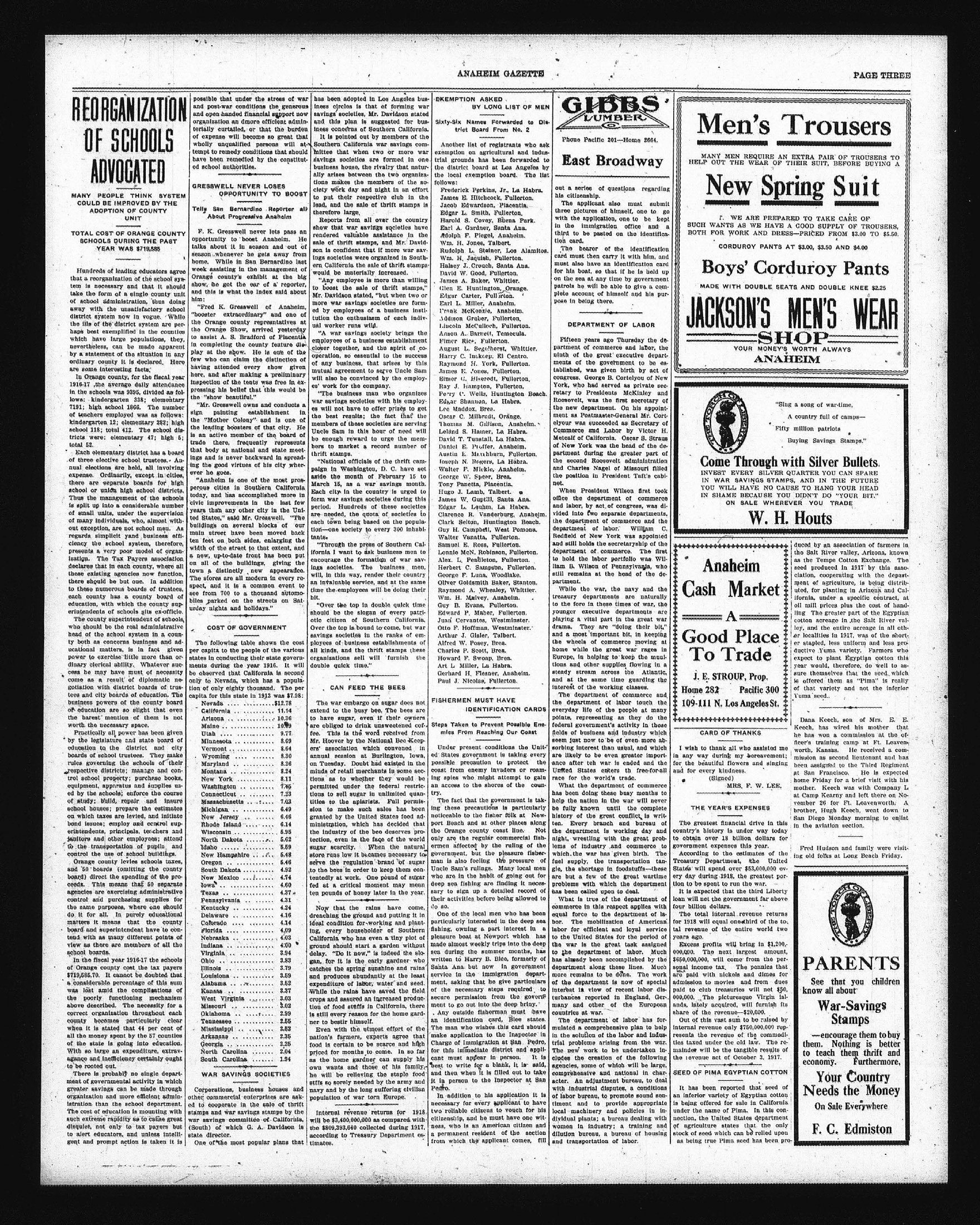
Searchable text
REORGANIZATION OF SCHOOLS ADVOCATED
MANY PEOPLE THINK SYSTEM COULD BE IMPROVED BY THE ADOPTION OF COUNTY UNIT
TOTAL COST OF ORANGE COUNTY SCHOOLS DURING THE PAST YEAR WAS $719,585
Hundreds of leading educators agree that a reorganization of the school system is necessary and that it should take the form of a single county unit of school administration, thus doing away with the unsatisfactory school district system now in vogue. While the lilies of the district system are perhaps best exemplified in the counties which have large populations, they, nevertheless, can be made apparent by a statement of the situation in any ordinary county it is declared. Here are some interesting facts:
In Orange county, for the fiscal year 1916-17, the average daily attendance in the schools was 9395, divided as follows: kindergarten 338; elementary 7191; high school 1866. The number of teachers employed was as follows: kindergarten 12; elementary 282; high school 118; total 412. The school districts were: elementary 47; high 5; total 52.
Each elementary district has a board possible that under the stress of war and post-war conditions the generous and open handed financial support now organization an dmore efficient administrally curtailed, or that the burden of expense will become so great that wholly unqualified persons will attempt to remedy conditions that should have been remedied by the constituted school authorities.
GRESSWELL NEVER LOSES OPPORTUNITY TO BOOST
Tells San Bernardino Reporter all About Progressive Anaheim
F. K. Gresswell never lets pass an opportunity to boost Anaheim. He talks about it in season and out of season whenever he gets away from home. While in San Bernardino last week assisting in the management of Orange county's exhibit at the big show, he got the ear of a reporter, and this is what the Index said about him:
"Fred K. Gresswell of Anaheim, "booster extraordinary" and one of the Orange county representatives at the Orange Show, arrived yesterday to assist A. S. Bradford of Placentia in completing the county feature display at the show. He is one of the few who can claim the distinction of having attended every show given here, and after making a preliminary inspection of the tents was free in expressing his belief that this would be the "show beautiful."
Mr. Gresswell owns and conducts a sign painting establishment in the "Mother Colony" and is one of the leading boosters of that city. He is an active member of the board of trade there, frequently represents that body at national and state meetings and is never backward in spread.
has been adopted in fitness circles is the savings societies, and this plan is iness concerns of.
It is pointed out Southern California mittee that when savings societies business house, they ally arises between tions makes the clety work day and to put their resale lead, and the sale therefore large.
Reports from show that war surrendered valuable sale of thrift stock son is confident things societies wereern California thwould be material.
"A war savings employees of a bus closer together, an operation, so essenof any business mutual agreement will also be conviis work for the c
"The business war savings societies will not have to the best results; members of these Uncle Sam in this be enough reward bers to market a thrift stamps."
In Orange county, for the fiscal year 1916-17, the average daily attendance in the schools was 9395, divided as follows: kindergarten 338; elementary 7191; high school 1866. The number of teachers employed was as follows: kindergarten 12; elementary 282; high school 118; total 412. The school districts were: elementary 47; high 5; total 52.
Each elementary district has a board of three elective school trustees. Annual elections are held, all involving expense. Ordinarily, except in cities, there are separate boards for high school or union high school districts. Thus the management of the schools is split up into a considerable number of small units, under the supervision of many individuals, who, almost without exception, are not school men. As regards simplicity and business efficiency the school system, therefore, presents a very poor model of organization. The Tax Payers association declares that in each county, where all these existing agencies now function, there should be but one. In addition to these numerous boards of trustees, each county has a county board of education, with which the county superintendents of schools gits ex-officio.
The county superintendent of schools who should be the real administrative head of the school system in a county both as concerns business and educational matters, is in fact given power to exercise little more than ordinary clerical ability. Whatever success he may have must of necessity come as a result of diplomatic negotiation with district boards of trustees and city boards of education. The business powers of the county board of education are so slight that even the barest mention of them is not worth the necessary space.
Practically all power has been given by the legislature and state board of education to the district and city boards of school trustees. They make rules governing the schools of their respective districts; manage and control school property; purchase books, equipment, apparatus and supplies used by the schools; enforce the course of study; build, repair and insure school houses; prepare the estimates on which taxes are levied, and initiate bond issues; employ and control superintendents, principals, teachers and janitors and other employees; attend to the transportation of pupils and control the use of school buildings.
Orange county levies schools taxes,
Mr. Gresswell owns and conducts a sign painting establishment in "Mother Colony" and is one of the leading boosters of that city. He is an active member of the board of trade there, frequently represents that body at national and state meetings and is never backward in spreading the good virtues of his city wherever he goes.
"Anaheim is one of the most prosperous cities in Southern California today, and has accomplished more in civic improvements in the last few years than any other city in the United States," said Mr. Gresswell. "The buildings on several blocks of our main street have been moved back ten feet on both sides, enlarging the width of the street to that extent, and a new, up-to-date front has been put on all of the buildings, giving the town a distinctly new appearance. The stores are all modern in every respect, and it is a common event to see from 700 to a thousand automobiles parked on the streets on Saturday nights and holidays."
COST OF GOVERNMENT
The following table shows the cost per capita to the people of the various states in conducting their state governments during the year 1916. It will be observed that California is second only to Nevada, which has a population of only eighty thousand. The per capita for this state in 1913 was $7.98:
- Nevada: $12.78
- California: $11.14
- Arizona: $10.36
- Maine: $10.99
- Utah: $9.77
- Minnesota: $8.69
- Vermont: $8.64
- Wyoming: $8.30
- Maryland: $8.26
- Montana: $8.24
- New York: $8.11
- Washington: $7.45
- Connecticut: $7.23
- Massachusetts: $7.03
- Michigan: $6.49
- New Jersey: $6.46
- Rhode Island: $6.14
- Wisconsin: $5.95
- North Dakota: $5.62
- Idaho: $5.59
- New Hampshire: $5.48
- Oregon: $5.46
The war embargo extends to the busiest to have sugar, even obliged to drink fee. This is the way Mr. Hoover by the ers' association w annual session att on Tuesday. Doubly minds of retail mer tions as to whether permitted under tions to sell sugar titles to the apiar sion to make sugr granted by the Uni ministration, which the industry of th ection, even in th e sugar scarcity.
store runs low it be serve the regulati
respective districts; manage and control school property; purchase books, equipment, apparatus and supplies used by the schools; enforce the course of study; build, repair and insure school houses; prepare the estimates on which taxes are levied, and initiate bond issues; employ and control superintendents, principals, teachers and janitors and other employees; attend to the transportation of pupils and control the use of school buildings.
Orange county levies schools taxes, and 50 boards (omitting the county board) direct the spending of the proceeds. This means that 50 separate agencies are exercising administrative control and purchasing supplies for the same purposes, where one should do it for all. In purely educational matters it means that the county board and superintendent have to contend with as many different points of view as there are members of all the school boards.
In the fiscal year 1916-17 the schools of Orange county cost the tax payers $719,585.70. It cannot be doubted that a considerable percentage of this sum was lost amid the complications of the poorly functioning mechanism above described. The necessity for a correct organization throughout each county becomes particularly clear when it is stated that 44 per cent of all the money spent by the 57 counties of the state is going into education. With so large an expenditure, extravagance and inefficiency certainly ought to be rooted out.
There is probably no single department of governmental activity in which greater savings can be made through organization and more efficient administration than the school department. The cost of education is mounting with such extreme rapidity as to cause great disquiet, not only to tax payers but to alert educators, and unless intelligent and prompt action is taken it is
WAR SAVINGS SOCIETIES
Corporations, business houses and other commercial enterprises are asked to cooperate in the sale of thrift stamps and war savings stamps by the war savings committee of California, (South) of which G. A. Davidson is state director.
One of the most popular plans that minds of retail merchants as to whether permitted under the titles to sell sugar titles to the aplation to make sure granted by the Uniform Administration, which the industry of the protection, even in the sugar scarcity, store runs low it serves the regulation to the bees in order tentedly at work. Fed at a critical ten pounds of honey.
Now that the drenching the ground ideal condition forming every househall California who has ground should start delay. "Do it now," gan, for it is the catches the spring and produces abun expenditure of labor. While the rains his crops and assured a tion of food stuffs is still every reasonner to bestir himsele.
Even with the union's farmers, food is certain to be priced for months as the home garden own wants and they will be relieved stiffs so sorely need navy and by the local population of war.
Internal revenue will be $3,400,000,000 the $809,393,640 according to Treas timates.
ANAHEIM GAZETTE
has been adopted in Los Angeles business circles is that of forming war savings societies, Mr. Davidson stated and this plan is suggested for business concerns of Southern California.
It is pointed out by members of the Southern California war savings committee that when two or more war savings societies are formed in one business house, the rivalry that naturally arises between the two organizations makes the members of the society work day and night in an effort to put their respective club in the lead, and the sale of thrift stamps is therefore large.
Reports from all over the country show that war savings societies have rendered valuable assistance in the sale of thrift stamps, and Mr. Davidson is confident that if more war savings societies were organized in Southern California the sale of thrift stamps would be materially increased.
"Any employee is more than willing to boost the sale of thrift stamps," Mr. Davidson stated, "but when two or more war savings societies are formed by employees of a business institution the enthusiasm of each individual worker runs wild.
"A war savings society brings the employees of a business establishment closer together, and the spirit of cooperation, so essential to the success of any business, that arises by this mutual agreement to serve Uncle Sam will also be convinced by the employees' work for the company.
"The business man who organizes war savings societies with his employees will not have to offer prizes to get the best results; the fact that the members of these societies are serving Uncle Sam in this hour of need will be enough reward to urge the members to market a record number of thrift stamps."
EXEMPTION ASKED BY LONG LIST OF MEN
Sixty-Six Names Forwarded to District Board From No. 2
Another list of registrants who ask exemption on agricultural and industrial grounds has been forwarded to the district board at Los Angeles by the local exemption board. The list follows:
Frederick Perkins, Jr., La Habra.
James E. Hitchcock, Fullerton.
Jacob Edwardson, Placentia.
Edgar L. Smith, Fullerton.
Harold S. Covey, Buena Park.
Earl A. Gardner, Santa Ana.
Adolph F. Plegel, Anaheim.
Wm. H. Jones, Talbert.
Rudolph L. Steiner, Los Alamitos.
Wm. H. Jaquish, Fullerton.
Halsey J. Crouch, Santa Ana.
David W. Good, Fullerton.
James A. Baker, Whittier.
Glen E. Huntington, Orange.
Edgar Carter, Fullerton.
Earl L. Miller, Anaheim.
Frank McKenzie, Anaheim.
Addison Gruber, Fullerton.
Lincoln McCulloch, Fullerton.
Anson A. Barnett, Temecula.
Elmer Rice, Fullerton.
August L. Segelhorst, Whittier.
Harry C. Inskep, El Centro.
Raymond H. York, Fullerton.
James E. Jones, Fullerton.
Elmer G. Hiserodt, Fullerton.
Ray J. Hampton, Fullerton.
Perry C. Wells, Huntington Beach.
Edgar Shannon, La Habra.
Lee Maddox, Brea.
Oscar C. Milbrecht, Orange.
Thomas M. Gillison, Anaheim.
Leland S. Hamer, La Habra.
David T. Tunstall, La Habra.
Daniel E. Pfeffer, Anaheim.
Austin E. Marshburn, Fullerton.
out a series of questions regarding his citizenship.
The applicant also must submit three pictures of himself, one to go with the application, one to be kept in the immigration office and a third to be pasted on the identification card.
The bearer of the identification card must then carry it with him, and must also have an identification card for his boat, so that if he is held up on the sea at any time by government patrols he will be able to give a complete account of himself and his purpose in being there.
DEPARTMENT OF LABOR
Fifteen years ago Thursday the department of commerce and labor, the ninth of the great executive departments of the government to be established, was given birth by act of congress. George B. Cortelyou of New York, who had served as private secretary to Presidents McKinley and Roosevelt, was the first secretary of the new department. On his appointment as Postmaster-General Mr. Cortelyour was succeeded as Secretary of Commerce and Labor by Victor H. Metcalf of California. Oscar S. Straus of New York was the head of the department during the greater part of
of any business, that arises by this mutual agreement to serve Uncle Sam will also be convinced by the employees' work for the company.
"The business man who organizes war savings societies with his employees will not have to offer prizes to get the best results; the fact that the members of these societies are serving Uncle Sam in this hour of need will be enough reward to urge the members to market a record number of thrift stamps.
"National officials of the thrift campaign in Washington, D.C. have set aside the month of February 15 to March 15, as a war savings month. Each city in the country is urged to form war savings societies during this period. Hundreds of these societies are needed, the quota of societies to each town being based on the population—one society to every 300 inhabitants.
"Through the press of Southern California I want to ask business men to encourage the formation of war savings societies. The business men, will, in this way, render their country an invaluable service, and at the same time the employees will be doing their bit.
"Over the top in double quick time should be the slogan of every patriotic citizen of Southern California. Over the top is bound to come, but war savings societies in the ranks of employees of business establishments of all kinds, and the thrift stamps these organizations sell will furnish the double quick time."
CAN FEED THE BEES
The war embargo on sugar does not extend to the busy bee. The bees are to have sugar, even if their owners are obliged to drink unsweetened coffee. This is the word received from Mr. Hoover by the National Bee Keepers' association which convened in annual session at Burlington, Iowa, on Tuesday. Doubt had existed in the minds of retail merchants in some sections as to whether they would be permitted under the federal restrictions to sell sugar in unlimited quantities to the apiarists. Full permission to make such sales has been granted by the United States food administration, which has decided that the industry of the bee deserves protection, even in the face of the world sugar scarcity. When the natural store runs low it becomes necessary to serve the regulation brand of sugar
RAYMOND H. YORK, FULLERTON.
James E. Jones, Fullerton.
Elmer G. Hiserodt, Fullerton.
Ray J. Hampton, Fullerton.
Perry C. Wells, Huntington Beach.
Edgar Shannon, La Habra.
Lee Maddox, Bres.
Oscar C. Milbread, Orange.
Thomas M. Gillison, Anaheim.
Leland S. Hamer, La Habra.
David T. Tunstall, La Habra.
Daniel E. Poffer, Anaheim.
Austin E. Marshburn, Fullerton.
Joseph N. Rogers, La Habra.
Walter F. Mickle, Anaheim.
George W. Speer, Brea.
Tony Panetta, Placentia.
Hugo J. Lamb, Talbert.
James W. Guptill, Santa Ana.
Edgar L. Leuhm, La Habra.
Clarence R. Vanderburg, Anaheim.
Clark Selton, Huntington Beach.
Guy H. Campbell, West Pomona.
Walter Vanatta, Fullerton.
Samuel E. Ross, Fullerton.
Lonnie McN. Robinson, Fullerton.
Alex L. Penileton, Fullerton.
Herbert C. Sampson, Fullerton.
George F. Luna, Woodlake.
Oliver Goldsmith Baker, Stanton.
Raymond A. Whealey, Whittler.
Wm. H. Mulvey, Anaheim.
Guy B. Evans, Fullerton.
Edward P. Maher, Fullerton.
Juan Cervantes, Westminster.
Otto F. Hoffman, Westminster.
Arthur J. Glsler, Talbert.
Alfred W. Posey, Brea.
Charles P. Scott, Brea.
Howard F. Swoap, Brea.
Art L Miller, La Habra.
Gerhard H. Flesner, Anaheim.
Paul J. Nicolas, Fullerton.
FISHERMEN MUST HAVE IDENTIFICATION CARDS
Steps Taken to Prevent Possible Enemies From Reaching Our Coast
Under present conditions the United States government is taking every possible precaution to protect the coast from enemy invaders or roaming spies who might attempt to gain an access to the shores of the country.
The fact that the government is taking these precautions is particularly noticeable to the fisher folk at Newport Beach and at other places along the Orange county coast line. Not only are the regular commercial fishermen affected by the ruling of the government, but the pleasure fisherman is also feeling the pressure of
The department of commerce and the department of labor touch the everyday life of the people at many points, representing as they do the federal government's activity in those fields of business and industry which seem just now to be of even more absorbing interest than usual, and which are likely to be even greater importance after ten war is ended and the United States enters th free-for-all race for the world's trade.
What the department of commerce has been doing these busy months to help the nation in the war will never be fully known until the complete history of the great conflict is written. Every branch and bureau of the department is working day and night, wrestling with the great problems of industry and commerce to which the war has given birth. The fuel supply, the transportation tan-
Now that the rains have come, drenching the ground and putting it in ideal condition for working and planting, every householder of Southern California who has even a tiny plot of ground should start a garden without delay. "Do it now," is indeed the slogan, for it is the early gardner who catches the spring sunshine and rains and produces abundantly at the least expenditure of labor, water and seed. While the rains have saved the field crops and assured an increased production of food stuffs in California, there is still every reason for the home gardener to bestir himself.
Even with the utmost effort of the nation's farmers, experts agree that food is certain to be scarce and high priced for months to come. In so far as the home gardner can supply his own wants and those of his family, he will be relieving the staple food stuffs so sorely needed by the army and navy and by the long suffering civilian population of war torn Europe.
Internal revenue returns for 1918 will be $3,400,000,000 as compared with the $809,393,640 collected during 1917, according to Treasury Department estimates.
The fact that the government is taking these precautions is particularly noticeable to the fisher folk at Newport Beach and at other places along the Orange county coast line. Not only are the regular commercial fishermen affected by the ruling of the government, but the pleasure fisherman is also feeling the pressure of Uncle Sam's rulings. Many local men who are in the habit of going out for deep sea fishing are finding it necessary to sign up a detailed record of their activities before being allowed to do so.
One of the local men who has been particularly interested in the deep sea fishing, owning a part interest in a pleasure boat at Newport which has made almost weekly trips into the deep sea during the summer months, has written to Harry B. Blee, formerly of Santa Ana, but now in government service in the immigration department, asking that he give particulars of the necessary steps required to secure permission from the government to go out into the deep briny.
Any outside fisherman must have an identification card, Blee states. The man who wishes this card should make application to the Inspector in Charge of Immigration at San Pedro, for this immediate district and applicant must appear in person. It is best to write for a blank, it is said, and then when it is filled out to take it in person to the Inspector at San Pedro.
In addition to his application it is necessary for every applicant to have two reliable citizens to vouch for his citizenship, and he must have one witness, who is an American citizen and a permanent resident of the section from which the applicant comes, fill
What the department of commerce has been doing these busy months to help the nation in the war will never be fully known until the complete history of the great conflict is written. Every branch and bureau of the department is working day and night, wrestling with the great problems of industry and commerce to which the war has given birth. The fuel supply, the transportation tangle, the shortage in foodstuffs—these are but a few of the great wartime problems with which the department has been called upon to deal.
What is true of the department of commerce in this respect applies with equal force to the department of labor. The mobilization of American labor for efficient and loyal service to the United States for the period of the war is the great task assigned to the department of labor. Much has already been accomplished by the department along these lines. Much more remains to be done. The work of the department is now of special interest in view of recent labor disturbances reported in England, Germany and other of the European countries at war.
The department of labor has formulated a comprehensive plan to help in the solution of the labor and industrial problems arising from the war. The new work to be undertaken includes the creation of the following agencies, some of which will be large, comprehensive and national in character. An adjustment bureau, to deal with industrial disputes, a conditions of labor bureau, to promote sound sentiment and to provide appropriate local machinery and policies in individual plants; a bureau dealing with women in industry; a training and dilution bureau, a bureau of housing and transportation of labor.
Men's Trousers
MANY MEN REQUIRE AN EXTRA PAIR OF TROUSERS TO HELP OUT THE WEAR OF THEIR SUIT, BEFORE BUYING A
New Spring Suit
WE ARE PREPARED TO TAKE CARE OF SUCH WANTS AS WE HAVE A GOOD SUPPLY OF TROUSERS,
BOTH FOR WORK AND DRESS—PRICED FROM $3.00 TO $5.50.
CORDUROY PANTS AT $3.00, $3.50 AND $4.00
Boys' Corduroy Pants
MADE WITH DOUBLE SEATS AND DOUBLE KNEE $2.25
JACKSON'S MEN'S WEAR SHOP
YOUR MONEY'S WORTH ALWAYS
ANAHEIM
"Sing a song of war-time,
A country full of camps—
Fifty million patriots
Buying Savings Stamps."
"Sing a song of war-time,
A country full of camps—
Fifty million patriots
Buying Savings Stamps."
Come Through with Silver Bullets.
INVEST EVERY SILVER QUARTER YOU CAN SPARE IN WAR SAVINGS STAMPS, AND IN THE FUTURE YOU WILL HAVE NO CAUSE TO HANG YOUR HEAD IN SHAME BECAUSE YOU DIDN'T DO "YOUR BIT."
ON SALE WHEREVER YOU TRADE
W. H. Houts
Anaheim Cash Market
A Good Place To Trade
J. E. STROUP, Prop.
Home 282 Pacific 300
109-111 N. Los Angeles St.
CARD OF THANKS
I wish to thank all who assisted me in any way during my bereavement; for the beautiful flowers and singing and for every kindness.
(Signed)
MRS. F. W. LEE,
THE YEAR'S EXPENSES
The greatest financial drive in this country's history is under way today to obtain over 18 billion dollars for government expenses this year.
According to the estimates of the Treasury Department, the United
Dana Keech, son of Mrs. E. E. Keech, has wired his mother that he has won a commission at the officer's training camp at Ft. Leavenworth, Kansas. He received a commission as second lieutenant and has been assigned to the Third Regiment at San Francisco. He is expected home Friday for a brief visit with his mother. Keech was with Company L at Camp Kearny and left there on November 26 for Ft. Leavenworth: A brother, Hugh Keech, went down to San Diego Monday morning to enlist in the aviation section.
Fred Hudson and family were visiting old folks at Long Beach Friday.
THE YEAR'S EXPENSES
The greatest financial drive in this country's history is under way today to obtain over 18 billion dollars for government expenses this year.
According to the estimates of the Treasury Department, the United States will spend over $53,000,000 every day during 1918, the greatest portion to be spent to run the war.
It is expected that the third Liberty loan will not the government far above four billion dollars.
The total internal revenue returns for 1918 will equal one third of the total revenue of the entire world two years ago.
Excess profits will bring in $1,200,000,000. The next largest amount, $650,000,000, will come from the personal income tax. The pennies that are paid with nickels and dimes for admission to movies and from dues paid to club treasuries will net $50,000,000. The picturesque Virgin Islands, lately acquired, will furnish its share of the revenue—$20,000.
Out of this vast sum to be raised by internal revenue only $750,000,000 represents the revenue of the commodities taxed under the old law. The remainder will be the tangible results of the revenue act of October 3, 1917.
SEED OF PIMA EGYPTIAN COTTON
It has been reported that seed of an inferior variety of Egyptian cotton is being offered for sale in California under the name of Pima. In this connection, the United States department of agriculture states that the only stock of seed which can be relied upon as being true Pima seed has been pro-
at San Francisco. He is expected home Friday for a brief visit with his mother. Keech was with Company L at Camp Kearny and left there on November 26 for Ft. Leavenworth: A brother, Hugh Keech, went down to San Diego Monday morning to enlist in the aviation section.
Fred Hudson and family were visiting old folks at Long Beach Friday.
PARENTS
See that you children know all about
War-Savings Stamps
encourage them to buy them. Nothing is better to teach them thrift and economy. Furthermore,
Your Country Needs the Money
On Sale Everywhere
F. C. Edmiston