anaheim-gazette 1918-01-31
Scanned page
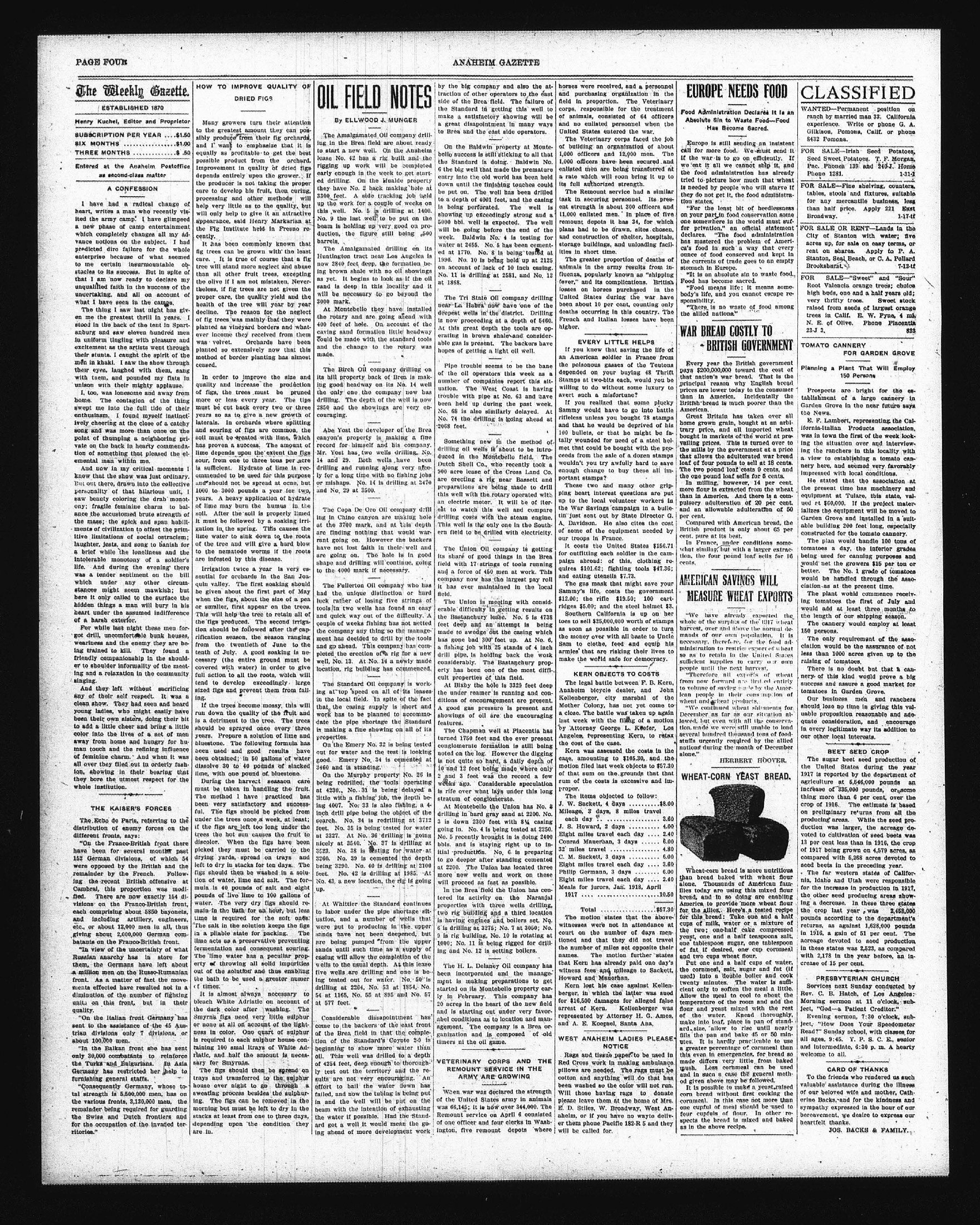
Searchable text
The Weekly Gazette.
ESTABLISHED 1870
Henry Kuchel, Editor and Proprietor
SUBSCRIPTION PER YEAR ... $1.50
SIX MONTHS ... $1.00
THREE MONTHS ... $ .50
Entered at the Anaheim Postoffice as second-class matter
A CONFESSION
I have had a radical change of heart, writes a man who recently visited the army camp. I have glimpsed a new phase of camp entertainment which completely changes all my advance notions on the subject. I had predicted dire failure for the whole enterprise because of what seemed to me certain insurmountable obstacles to its success. But in spite of that I am now ready to declare my unqualified faith in the success of the undertaking, and all on account of what I have seen in the camps.
The thing I saw last night has given me the greatest thrill in years. I stood in the back of the tent in Spartanburg and saw eleven hundred men in uniform tingling with pleasure and excitement as the artists went through their stunts. I caught the spirit of the men in khaki. I saw the show through their eyes, laughed with them, sang with them, and pounded my fists in unison with their mighty applause.
I, too, was lonesome and away from home. The contagion of the thing swept me into the full tide of their enthusiasm. I found myself instinctively cheering at the close of a catchy song and was more than once on the point of thumping a neighboring private on the back in hearty commendation of something that pleased the el-
HOW TO IMPROVE QUALITY OF DRIED FIGS
Many growers turn their attention to the greatest amount they can possibly produce from their fig orchards, and I want to emphasize that it is equally as profitable to get the best possible product from the orchard. Improvement in quality of dried figs depends entirely upon the grower. If the producer is not taking the proper care to develop his fruit, then curing, processing and other methods will help very little as to the quality, but will only help to give it an attractive appearance, said Henry Markarian at the Fig Institute held in Fresno recently.
It has been commonly known that fig trees can be grown with the least care. It is true of course that a fig tree will stand more neglect and abuse than all other fruit trees, excepting the olive if I am not mistaken. Nevertheless, if fig trees are not given the proper care, the quality yield and the health of the tree will year by year decline. The reason for the neglect of fig trees was mainly that they were planted as vineyard borders and whatever income they received from them was velvet. Orchards have been planted so extensively now that this method of border planting has almost ceased.
In order to improve the size and quality and increase the production of figs, the trees must be pruned more or less every year. The tips must be cut back every two or three years so as to give a new growth of laterals. In orchards where splitting and souring of figs are common, the soil must be created with lime, which has proven a success. The amount of lime depends upon the extent of the figs.
OIL FIELD
By ELLWOOD
The Amalgamating in the Breast to start a new lease No. 42 has rigging up work early enough in ed drilling. Only they have No. 23300 feet. A slip up the work for this well. No. No. 9 the last beam is holding duction, the fig barrels.
The Amalgam Huntington track now 2840 feet deep brown shale as yet. It begins sand is deep in will be necessary 3000 mark.
At Montebello the rotary and 400 feet of hole caving sand form could be made w and the change made.
The Birch Oil its hill property good headwash the only one the drilling. The depth 2850 and the sloping couraging.
Abe Yost the canyon's proper record for him Mr. Yost has tw
men in khaki. I saw the show through their eyes, laughed with them, sang with them, and pounded my fists in unison with their mighty applause.
I, too, was lonesome and away from home. The contagion of the thing swept me into the full tide of their enthusiasm. I found myself instinctively cheering at the close of a catchy song and was more than once on the point of thumping a neighboring private on the back in hearty commendation of something that pleased the elemental man within me.
And now in my critical moments I know that the show was just ordinary. But out there, drawn into the collective personality of that hilarious unit, I saw beauty coloring the drab monotony; fragile feminine charm to balance the accustomed brute strength of the mass; the spick and span habiliments of civilization to offset the primitive limitations of social ostracism; laughter, jests, and song to banish for a brief while the loneliness and the intolerable monotony of a soldier's life. And during the evening there was a tender sentiment on the bill which under any other circumstances might seem mawkish; but here it only called to the surface the hidden things a man will bury in his heart under the assumed indifference of a harsh exterior.
For while last night these men forgot drill, uncomfortable bunk houses, weariness and the enemy they are being trained to kill. They found a friendly companionship in the shoulder to shoulder informality of the meeting and a relaxation in the community singing.
And they left without sacrificing any of their self respect. It was a clean show. They had seen and heard young ladies, who might easily have been their own sisters, doing their bit to add a little cheer and bring a little color into the lives of a set of men away from home and hungry for human touch and the refining influence of feminine charm. And when it was all over they filed out in orderly fashion, showing in their bearing that they bore the utmost respect for the whole institution.
THE KAISER'S FORCES
The Echo de Paris, referring to the distribution of enemy forces on the different fronts, says:
"On the Franco-British front there have been for several months past 152 German divisions, of which 54 were enclosed by the British and the French."
In order to improve the size and quality and increase the production of figs, the trees must be pruned more or less every year. The tips must be cut back every two or three years so as to give a new growth of laterals. In orchards where splitting and souring of figs are common, the soil must be treated with lime, which has proven a success. The amount of lime depends upon the extent the figs sour, from one to three tons per acre is sufficient. Hydrate of lime is recommended to be used for this purpose and should not be spread at ocean, but 1000 to 3000 pounds a year for two years. A heavy application of hydrate of lime may burn the humus in the soil. After the soil is properly limed it must be followed by a soaking irrigation in the spring. This causes the lime water to sink down to the roots of the tree and will give a hard blow to the nematode worms if the roots are infested by this disease.
Irrigation twice a year is very essential for orchards in the San Joaquin valley. The first soaking should be given about the first part of May when the figs, about the size of a pea or smaller, first appear on the trees. This will help the tree to retain all of the figs produced. The second irrigation should be followed after the capification season, the season ranging from the twentieth of June to the tenth of July. A good soaking is necessary (the entire ground must be covered with water) in order to give full action to all the roots, which will tend to develop exceedingly large sized figs and prevent them from falling.
If the trees become mossy, this will run down the quality of the fruit and is a detriment to the tree. The trees should be sprayed once every three years. Prepare a solution of lime and bluestone. The following formula has been used and good results have been obtained; in 50 gallons of water dissolve 30 to 40 pounds of slacked lime, with one pound of bluestone.
During the harvest season care must be taken in handling the fruit. The method I have practiced has been very satisfactory and successful. The figs should be picked from under the trees once a week, at least; if the figs are left too long under the trees the hot sun causes the fruit to discolor. When the figs have been picked they must be carried to the drying yards, spread on trays and left to dry in stacks for ten days.
The Birch Oil its hill property ing good headway only one thrilling drilling. The de 2850 and the shiouraging.
Abe Yost the canyon's proper record for himself Mr. Yost has two 14 and 29. Bo drilling and run slowly for a long time or mishaps. No. and No. 29 at 35.
The Copa De ling in Chino car at the 3700 man are finding nothing going on. have not lost fa are going on. shape and drilling to the 4000 marble.
The Fullerton had the unique luck rather of tools in two well and quick way of couple of weeks that company any ment has decided and go ahead. T pleted the erecti well, No. 13. At location, rig built.
The Standard ing at top speed in the local field that the casing work has to be date the pipe s is making a fine properties.
On the Emery cut for water and good. Emery N 3460 and is stam.
On the Murph being redrilled, at 4230.. No. 33 little with a fish ing 4007. No: 33 inch drill pipe be search. No. 34 feet. No. 35 is b at 3327. At Not nicely at 3540.. No. 3523. No. 38 is 3260. No. 39 is being 3290..
THE KAISER'S FORCES
The Echo de Paris, referring to the distribution of enemy forces on the different fronts, says:
"On the Franco-British front there have been for several months past 152 German divisions, of which 54 were opposed by the British and the remainder by the French. Following the recent British offensive at Cambrai, this proportion was modified. There are now exactly 154 divisions on the Franco-British front, each comprising about 5850 bayonets, and including artillery, engineers, etc., or about 12,000 men in all, thus giving about 2,000,000 German combatants on the Franco-British front.
In view of the uncertainty of what Russian anarchy has in store for them, the Germans have left about a million men on the Russo-Rumanian front. As a matter of fact the movements effected have resulted not in a diminution of the number of fighting units on this front, but in their quality.
On the Italian front Germany has sent to the assistance of the 45 Austrian divisions only 7 divisions, or about 100,000 men.
In the Balkan front she has sent only 30,000 combatants to reinforce the Turks and Bulgarians. In Asia Germany has restricted her help to furnishing general staffs.
Consequently Germany, whose total strength is 5,500,000 men, has on the various fronts, 3,130,000 men, the remainder being required for guarding the Swiss and Dutch frontiers and for the occupation of the invaded territories."
During the harvest season care must be taken in handling the fruit. The method I have practiced has been very satisfactory and successful. The figs should be picked from under the trees once a week, at least; if the figs are left too long under the trees the hot sun causes the fruit to discolor. When the figs have been picked they must be carried to the drying yards, spread on trays and left to dry in stacks for ten days. The figs should then be washed in a solution of water, lime and salt. The formula is 40 pounds of salt and eight pounds of live lime to 100 gallons of water. The very dry figs should remain in the bath for an hour, but less time is required for the soft ones. The salt in the solution keeps the figs in a pliable state for packing. The lime acts as a preservative preventing fermentation and consequent souring. The lime water has a peculiar property of throwing all solid impurities out of the solution and thus enabling the bath to be used a greater numer of times.
It is almost always necessary to bleach White Adriatic on account of the dark color after washing. The Smyrna figs need very little sulphur or none at all on account of the lightness in color. One quart of sulphur is required to each sulphur house containing 100 small litrays of White Adriatic, and half the amount is necessary for Smyrnas.
The figs should then be spread on trays and transferred to the sulphur house over night to go through a sweating process besides the sulphuring. The figs can be removed in the morning but must be left to dry in the stacks at least from one to three days, depending upon the condition they are in.
ANAHEIM GAZETTE
OIL FIELD NOTES
By ELLWOOD J. MUNGER
The Amalgamated Oil company drilling in the Brea field are about ready to start a new well. On the Anaheim lease No. 42 has a rig built and the rigging up work will be completed early enough in the week to get started drilling. On the Hualde property they have No. 2 back making hole at 3300 feet. A side tracking job held up the work for a couple of weeks on this well. No. 5 is drilling at 1400. No. 9 the last well to be put on the beam is holding up very good on production, the figure still being 500 barrels.
The Amalgamated drilling on its Huntington tract near Los Angeles is now 2840 feet deep, the formation being brown shale with no oil showings as yet. It begins to look as if the oil sand is deep in this locality and it will be necessary to go beyond the 3000 mark.
At Montebello they have installed the rotary and are going ahead with 400 feet of hole. On account of the caving sand formation little headway could be made with the standard tools and the change to the rotary was made.
The Birch Oil company drilling on its hill property back of Brea is making good headway on its No. 14 well the only one the company now has drilling. The depth of the well is now 2850 and the showings are very encouraging.
Abe Yost the developer of the Brea canyon's property is making a fine record for himself and his company. Mr. Yost has two wells drilling, No.
by the big company and also the attraction of other operators to the east side of the Brea field. The failure of the Standard in getting this well to make a satisfactory showing will be a great disappointment in many ways to Brea and the east side operators.
On the Baldwin property at Montebello success is still sticking to all that the Standard is doing. Baldwin No. 6 the big well that made the premature entry into the old world has been held down until the finishing touches could be put on. The well has been drilled to a depth of 4001 feet, and the casing is being perforated. The well is showing up exceedingly strong and a 5000 bbl. well is expected. The well will be going before the end of the week. Baldwin No. 4 is testing for water at 2455. No. 5 has been cemented at 1770. No. 8 is being tested at 1990. No. 10 is being held up at 2125 on account of lack of 10 inch casing. No. 11 is drilling at 2581, and No. 12 at 1868.
The Tri State Oil company drilling near La Habra now have one of the deepest wells in the district. Drilling is now proceeding at a depth of 5460. At this great depth the tools are operating in brown shale and considerable gas is present. The backers have hopes of getting a light oil well.
Pipe trouble seems to be the bane of the oil operators this week as a number of companies report this situation. The West Coast is having trouble with pipe at No. 63 and have been held up during the past week. No. 68 is also similarly delayed. At No. 74 the drilling is going ahead at 2068 feet.
Something new in the method of drilling oil wells is about to be introduced in the Montebello field.
horses were received, and a personnel and purchasing organization in the field in proportion. The Veterinary corps, responsible for the treatment of animals, consisted of 64 officers and no enlisted personnel when the United States entered the war.
The Veterinary corps faced the job of building an organization of about 1,000 officers and 12,000 men. The 1,000 officers have been secured and enlisted men are being transferred at a rate which will soon bring it up to its full authorized strength.
The Remount service had a similar task in securing personnel. Its present strength is about 300 officers and 11,000 enlisted men. In place of five remount depots it has 34, for which plans had to be drawn, sites chosen, and construction of shelter, hospitals, storage buildings, and unloading facilities in short time.
The greater proportion of deaths of animals in the army results from influenza, popularly known as "shipping fever," and its complications. British losses on horses purchased in the United States during the war have been about 10 per cent, counting only deaths occurring in this country. The French and Italian losses have been higher.
EVERY LITTLE HELPS
If you knew that saving the life of an American soldier in France from the poisonous gasses of the Teutons depended on your buying 48 Thrift Stamps at two-bits each, would you be willing to do without some luxury to avert such a misfortune?
If you realized that some plucky Sammy would have to go into battle rifleless unless you bought 78 stamps and that he would be deprived of his 100 bullets, or that he might be fatally wounded for need of a steel helmet that could be bought with the proceeds from the sale of a dozen stamps
The Birch Oil company drilling on its hill property back of Brea is making good headway on its No. 14 well the only one the company now has drilling. The depth of the well is now 2850 and the showings are very encouraging.
Abe Yost the developer of the Brea canyon's property is making a fine record for himself and his company. Mr. Yost has two wells drilling, No. 14 and 29. Both wells have been drilling and running along very nicely for a long time with no fishing jobs or mishaps. No. 14 is drilling at 3470 and No. 29 at 3500.
The Copa De Oro Oil company drilling in Chino canyon are making hole at the 3700 mark, and at tails depth are finding nothing that would warrant going on. However the backers have not lost faith in their well and are going on. The hole is in good shape and drilling will continue, going to the 4000 mark if necessary.
The Fullerton Oil company who has had the unique distinction or hard luck rather of losing five strings of tools in two wells has found an easy and quick way out of the difficulty. A couple of weeks fishing has not netted the company any thing so the management has decided to drill by the tools and go ahead. This company has completed the erection of a rig for a new well, No. 13. At No. 14 a newly made location, rig building has commenced.
The Standard Oil company is working at top speed on all of its leases in the local field. In spite of the fact that the casing supply is short and work has to be planned to accommodate the pipe shortage the Standard is making a fine showing on all of its properties.
On the Emery No. 32 is being tested out for water and the test is looking good. Emery No. 34 is cemented at 3460 and is standing.
On the Murphy property No. 26 is being redrilled, the tools operating at 4230. No. 31 is being delayed a little with a fishing job, the depth being 4007. No: 33 is also fishing, a 4-inch drill pipe being the object of the search. No. 34 is redrilling at 3712 feet. No. 35 is being tested for water at 3327. At No. 36 drilling is going nicely at 3540. No. 37 is drilling at 3523. No. 38 is testing for water at 3260. No. 39 is cemented the depth being 3290. No. 40 is drilling at 2100
Pipe trouble seems to be the bane of the oil operators this week as a number of companies report this situation. The West Coast is having trouble with pipe at No. 63 and have been held up during the past week. No. 68 is also similarly delayed. At No. 74 the drilling is going ahead at 2068 feet.
Something new in the method of drilling oil wells is about to be introduced in the Montebello field. The Dutch Shell Co., who recently took a 900 acre lease of the Cross Land Co. are erecting a rig near Bassett and preparations are being made to drill this well with the rotary operated with an electric motor. It will be of interest to watch this well and compare drilling costs with the steam engine. This well is the only one in the Southern field to be drilled with electricity.
The Union Oil company is getting its share of good things in the Brea field with 17 strings of tools running and a force of 450 men at work. This company now has the largest pay roll it has ever maintained in the local field.
The Union is meeting with considerable difficulty in getting results on the Bastanchury lease. No. 5 is 4738 feet deep and an attempt is being made to swede out the casing which has gone bad 300 feet up. At No. 6, a fishing job with 25 stands of 4 inch drill pipe, is holding back the work considerably. The Bastanchury property has been one of the most difficult properties of this field.
At Bixby the hole is 3329 feet deep under reamer is running and conditions of encouragement are present. A good gas pressure is present and showings of oil are the encouraging features.
The Chapman well at Placentia has turned 1750 feet and the ever present conglomerate formation is still being noted on the log. However the digging is not quite so hard, a daily depth of 10 and 12 feet being made where only 2 and 3 feet was the record a few weeks ago. Considerable speculation is rife over what lays under this long stratum of conglomerate.
At Montebello the Union has No. 2 drilling in hard gray sand at 2200. No. 3 is down 2300 feet with 8¼ casing going in. No. 4 is being tested at 2250. No. 5 recently brought in is doing 2400 bbls, and is staying right up to initial production. No. 6 is preparing to go deeper after standing comented the poisonous gasses of the Teutons depended on your buying 48 Thrift Stamps at two-bits each, would you be willing to do without some luxury to avert such a misfortune?
If you realized that some plucky Sammy would have to go into battle rifleless unless you bought 78 stamps and that he would be deprived of his 100 bullets, or that he might be fatally wounded for need of a steel helmet that could be bought with the proceeds from the sale of a dozen stamps wouldn't you try awfully hard to save enough change to buy these all important stamps?
These two and many other gripping heart interest questions are put up to the local volunteer workers in the War Savings campaign in a bulletin just sent out by State Director G. A. Davidson. He also cites the cost of some of the equipment needed by our troops in France.
It costs the United States $156.71 for outfitting each soldier in the campaign abroad: of this, clothing requires $101.62; fighting tools $47.36; and eating utensils $7.73.
The gas mask that might save your Sammy's life, costs the government $12.00; the rifle $19.50; 100 cartridges $5.00; and the steel helmet $3.
Southern California is up on her toes to sell $25,000,000 worth of stamps as soon as possible in order to turn the money over with allaste to Uncle Sam to clothe, feed and equip his armies that are risking their lives to make the world safe for democracy.
KERN OBJECTS TO COSTS
The legal battle between F.B.Kern, Anaheim bicycle dealer, and John Kellenberger, city marshal of the Mother Colony, has not yet come to a close. The battle was taken up again last week with the filing of a motion by Attorney George L.Keefer, Los Angeles, representing Kern, to retax the cost of the case.
Kern was assessed the costs in the case, amounting to $105.30, and the motion filed last week objects to $57.30 of that sum on the grounds that that sum of the costs is excessive and improper.
The items objected to follow:
J.W.Sackett,4 days.....$8.00 Mileage,3 days,8 miles travel each day.....3.60
J.S.Howard,2 days.....4.00
Eight miles travel each day.....2.40
Conrad Mauerhan,3 days.....6.00
32 miles travel.....4.80
C.M.Sackett,3 days.....6.00
Eight miles travel each day.....3.60
On the Murphy property No. 26 is being redrilled, the tools operating at 4230. No. 31 is being delayed a little with a fishing job, the depth being 4007. No: 33 is also fishing, a 4-inch drill pipe being the object of the search. No. 34 is redrilling at 3712 feet. No. 35 is being tested for water at 3327. At No. 36 drilling is going nicely at 3540. No. 37 drilling at 3523. No. 38 is testing for water at 3260. No. 39 is cemented the depth being 3290. No. 40 is drilling at 2100 feet. No. 42 is drilling at 1985. At No. 43, a new location, the rig is going up.
At Whittier the Standard continues to labor under the pipe shortage situation, and a number of wells that were put to producing in the upper sands have not been deepened, but are being pumped from the upper sands until such time as a supply of easing will allow the completion of the wells to the usual depth. At this lease five wells are drilling and one is being tested out for water. No. 50 is drilling at 2264, No. 53 at 1854, No. 54 at 1165, No. 55 at 895 and No. 57 at 577 feet.
Considerable dissapointment has come to the backers of the east front of the Brea field in that the completion of the Standard's Coyote 2-9 is beginning to show more water than oil. This well was drilled to a depth of 4254 feet, deep enough to thoroughly test out the territory and the results are not very encouraging. An effort to ball the water down has failed, and now the tubing is being put in and the well will be put on the beam with the intention of exhausting the water if possible. Had the Standard got a well it would mean the going ahead of more development work.
VETERINARY CORPS AND THE REMOUNT SERVICE IN THE ARMY ARE GROWING
When war was declared the strength of the United States army in animals was 66,145; it is now over 344,000. The Remount service on April 6 consisted of one officer and four clerks in Washington, five remount depots where
The items objected to follow:
J. W. Sackett, 4 days ... $8.00 Mileage, 3 days, 8 miles travel each day ... 3.60 J. S. Howard, 2 days ... 4.00 Eight miles travel each day ... 2.40 Conrad Mauerhan, 3 days ... 6.00 32 miles travel ... 4.80 C. M. Sackett, 3 days ... 6.00 Eight miles travel each day ... 3.60 Philip Germann, 3 days ... 6.00 Eight miles travel each day ... 2.40 Meals for jurors, Jan. 1918, April 1917 ... 10.50
Total ... $57.30
The motion states that the above-witnesses were not in attendance at court on the number of days mentioned and that they did not travel the number of miles set opposite their names. The motion further states that Kern has already paid one day's witness fees and mileage to Sackett, Howard and Mauerhan.
Kern lost his case against Kellenberger, in which the latter was sued for $16,500 damages for alleged false arrest of Kern. Kellenberger was represented by Attorney H. G. Ames, and A. E. Koepsel, Santa Ana.
WEST ANAHEIM LADIES PLEASE NOTICE
Rags and tissue paper to be used in Red Cross work in making ambulance pillows are needed. The rags must be cotton and anything will do that has been washed so the color will not run. Will those having rags to donate please leave them at the home of Mrs. E. D. Stiles, W. Broadway, West Anaheim, or if you have no way to deliver them phone Pacific 182-R 5 and they will be called for.
EUROPE NEEDS FOOD
Food Administration Declares It is an Absolute Sin to Waste Food—Food Has Become Sacred.
Europe is still sending an insistent call for more food. We must send it if the war is to go on efficiently. If we eat it all we cannot ship it, and the food administration has already tried to picture how much that wheat is needed by people who will starve if they do not get it, the food administration states.
"For the least bit of heedlessness on your part in food conservation some one somewhere in the world must suffer privation," an official statement declares. "The food administration has mastered the problem of America's food in such a way that every ounce of food conserved and kept in the currents of trade goes to an empty stomach in Europe.
"It is an absolute sin to waste food, Food has become sacred.
"Food means life; it means somebody's life, and you cannot escape responsibility.
"There is no waste of food among the allied nations."
WAR BREAD COSTLY TO - BRITISH GOVERNMENT
Every year the British government pays $200,000,000 toward the cost of that nation's war bread. That is the principal reason why English bread prices are lower today to the consumer than in America. Incidentally the British bread is much poorer than the American.
Great Britain has taken over all home grown grain, bought at an arbitrary price, and all imported wheat bought in markets of the world at prevailing prices. This is turned over to the mills by the government at a price that allows the adulterated bread
CLASSIFIED
WANTED—Permanent position on ranch by married man 33. California experience. Write or phone G. A. Gilkison, Pomona, Calif. or phone 8432 Pomona.
FOR SALE—Irish Seed Potatoes, Seed Sweet Potatoes. T. F. Morgan, Pac. Phones 139 and 240-J. Home Phone 1281. 1-31-1
FOR SALE—Fine shelving, counters, tables, stools and fixtures, suitable for any mercantile business, less than half price. Apply 221 East Broadway. 1-17-1f
FOR SALE OR RENT—Lands in the City of Stanton with water; five acres up, for sale on easy terms, or rent on shares. Apply to P. A. Stanton, Seal Beach, or C. A. Pollard Brookshurst. 7-12-tf
FOR SALE—"Sweet" and "Sour" Root Valencia orange trees; choice high buds, one and a half years old; very thrifty trees. Sweet stock raised from seeds of largest orange trees in Calif. E. W. Pyne, 4 mi. N. E. of Olive. Phone Placentia 23-J 3. 823
TOMATO CANNERY FOR GARDEN GROVE
Planning a Plant That Will Employ 150 Persons
Prospects are bright for the establishment of a large cannery in Garden Grove in the near future says the News.
E. F. Lambert, representing the California-Italian Products association, was in town first of the week looking the situation over and interviewing the ranchers in this locality with
Every year the British government pays $200,000,000 toward the cost of that nation's war bread. That is the principal reason why English bread prices are lower today to the consumer than in America. Incidentally the British bread is much poorer than the American.
Great Britain has taken over all home grown grain, bought at an arbitrary price, and all imported wheat bought in markets of the world at prevailing prices. This is turned over to the mills by the government at a price that allows the adulterated war bread loaf of four pounds to sell at 18 cents. The two pound loaf costs 9 cents, and the one pound loaf sells for 5 cents.
In milling, however, 14 per cent more flour is extracted from the wheat than in America. And there is a compulsory adulteration of 20 per cent and an allowable adulteration of 50 per cent.
Compared with American bread, the British product is only about 65 per cent pure at its best.
In France, under conditions somewhat similar but with a larger extraction, the four pound loaf sells for 16 cents.
AMERICAN SAVINGS WILL MEASURE WHEAT EXPORTS
"We have already exported the whole of the surplus of the 1917 wheat harvest, over and above the normal demands of our own population. It is necessary, therefore, for the food administration to restrict export of wheat so as to retain in the United States sufficient supplies to carry our own people until the next harvest.
"Therefore all exports of wheat from now forward are limited entirely to volume of saving made by the American people in their consumption of wheat and wheat products."
"We continued wheat shipments for December as far as our situation allowed, but even with all the conservation made we were still unable to load several hundred thousand tons of foodstuffs urgently required by the allied nations during the month of December alone."
HERBERT HOOVER.
WHEAT-CORN YEAST BREAD.
Planning a Plant That Will Employ 150 Persons
Prospects are bright for the establishment of a large cannery in Garden Grove in the near future says the News.
E. F. Lambert, representing the California-Italian Products association, was in town first of the week looking the situation over and interviewing the ranchers in this locality with a view to establishing a tomato cannery here, and seemed very favorably impressed with local conditions.
He stated that the association at the present time has machinery and equipment at Tulare, this state, valued at $60,000. If the project materializes the equipment will be moved to Garden Grove and installed in a suitable building 200 feet long, especially constructed for the tomato cannery.
The plan would handle 100 tons of tomatoes a day, the inferior grades being used for canning purposes and would not net the growers $15 per ton or better. The No. 1 grade of tomatoes would be handled through the association-as at the present time.
The plant would commence receiving tomatoes the first of July and would add at least three months to the length of our shipping season.
The cannery would employ at least 150 persons.
The only requirement of the association would be the assurance of not less than 1000 acres given up to the raising of tomatoes.
There is no doubt but that a cannery-of this kind would prove a big success and assure a good market for tomatoes in Garden Grove.
Our business men and ranchers should lose no time in giving this valuable proposition reasonable and adequate consideration, and encourage in every legitimate way its addition to our other local interests.
BEET SEED CROP
The sugar beet seed production of the United States during the year 1917 is reported by the department of agriculture at 5,546,000 pounds an increase of 335,000 pounds, or some thing more than 6 per cent, over the crop of 1916. The estimate is based on preliminary returns from all the producing areas. While the seed production was larger, the acreage devoted to cultivation of seed beets was 13 per cent less than in 1916, the crop of 1917 being grown on 4,579 acres, as compared with 5,268 acres devoted to seed beets in the preceding year.
WHEAT-CORN YEAST BREAD.
Wheat-corn bread is more nutritious than bread baked with wheat flour alone. Thousands of American families today are using this mixed flour bread, and in so doing are enabling America to provide more wheat flour for the allies. Here's a tested recipe for this bread: Take one and a half cups of milk, water or a mixture of the two; one-half cake compressed yeast, one and a half teaspoons salt, one tablespoon sugar, one tablespoon of fat if desired, one cup cornmeal and two cups wheat flour.
Put one and a half cups of water, the cornmeal, salt, sugar and fat (if used) into a double boiler and cook twenty minutes. The water is sufficient only to soften the meal a little. Allow the meal to cool to about the temperature of the room and add the flour and yeast mixed with the rest of the water. Knead thoroughly, make into loaf, place in pan of standard size, allow to rise until nearly fills the pan and bake 45 or 50 minutes. It is hardly practicable to use a greater percentage of cornmeal than this even in emergencies, for bread so made differs very little from baked mush. Less cornmeal can be used and in such a case the general method given above may be followed.
It is possible to make a yeast-raised corn bread without first cooking the cornmeal. In this case not more than one cupful of meat should be used to four cupfuls of flour. In other respects the bread is mixed and baked as in the above recipe.
Wheat-corn bread is more nutritious than bread baked with wheat flour alone. Thousands of American families today are using this mixed flour bread, and in so doing are enabling America to provide more wheat flour for the allies. Here's a tested recipe for this bread: Take one and a half cups of milk, water or a mixture of the two; one-half cake compressed yeast, one and a half teaspoons salt, one tablespoon sugar, one tablespoon of fat if desired, one cup cornmeal and two cups wheat flour.
Put one and a half cups of water, the cornmeal, salt, sugar and fat (if used) into a double boiler and cook twenty minutes. The water is sufficient only to soften the meal a little. Allow the meal to cool to about the temperature of the room and add the flour and yeast mixed with the rest of the water. Knead thoroughly, make into loaf, place in pan of standard size, allow to rise until nearly fills the pan and bake 45 or 50 minutes. It is hardly practicable to use a greater percentage of cornmeal than this even in emergencies, for bread so made differs very little from baked mush. Less cornmeal can be used and in such a case the general method given above may be followed.
It is possible to make a yeast-raised corn bread without first cooking the cornmeal. In this case not more than one cupful of meat should be used to four cupfuls of flour. In other respects the bread is mixed and baked as in the above recipe.
Wheat-corn bread is more nutritious than bread baked with wheat flour alone. Thousands of American families today are using this mixed flour bread, and in so doing are enabling America to provide more wheat flour for the allies. Here's a tested recipe for this bread: Take one and a half cups of milk, water or a mixture of the two; one-half cake compressed yeast, one and a half teaspoons salt, one tablespoon sugar, one tablespoon of fat if desired, one cup cornmeal and two cups wheat flour.
Put one and a half cups of water, the cornmeal, salt, sugar and fat (if used) into a double boiler and cook twenty minutes. The water is sufficient only to soften the meal a little. Allow the meal to cool to about the temperature of the room and add the flour and yeast mixed with the rest of the water. Knead thoroughly, make into loaf, place in pan of standard size, allow to rise until nearly fills the pan and bake 45 or 50 minutes. It is hardly practicable to use a greater percentage of cornmeal than this even in emergencies, for bread so made differs very little from baked mush. Less cornmeal can be used and in such a case the general method given above may be followed.
It is possible to make a yeast-raised corn bread without first cooking the cornmeal. In this case not more than one cupful of meat should be used to four cupfuls of flour. In other respects the bread is mixed and baked as in the above recipe.
Wheat-corn bread is more nutritious than bread baked with wheat flour alone. Thousands of American families today are using this mixed flour bread, and in so doing are enabling America to provide more wheat flour for the allies. Here's a tested recipe for this bread: Take one and a half cups of milk, water or a mixture of the two; one-half cake compressed yeast, one and a half teaspoons salt, one tablespoon sugar, one tablespoon of fat if desired, one cup cornmeal and two cups wheat flour.
Put one and a half cups of water, the cornmeal, salt, sugar and fat (if used) into a double boiler and cook twenty minutes. The water is sufficient only to soften the meal a little. Allow the meal to cool to about the temperature of the room and add the flour and yeast mixed with the rest of the water. Knead thoroughly, make into loaf, place in pan of standard size, allow to rise until nearly fills the pan and bake 45 or 50 minutes. It is hardly practicable to use a greater percentage of cornmeal than this even in emergencies, for bread so made differs very little from baked mush. Less cornmeal can be used and in such a case the general method given above may be followed.
It is possible to make a yeast-raised corn bread without first cooking the cornmeal. In this case not more than one cupful of meat should be used to four cupfuls of flour. In other respects the bread is mixed and baked as in the above recipe.
Wheat-corn bread is more nutritious than bread baked with wheat flour alone. Thousands of American families today are using this mixed flour bread, and in so doing are enabling America to provide more wheat flour for the allies. Here's a tested recipe for this bread: Take one and a half cups of milk, water or a mixture of the two; one-half cake compressed yeast, one and a half teaspoons salt, one tablespoon sugar, one tablespoon of fat if desired, one cup cornmeal and two cups wheat flour.
Put one and a half cups of water, the cornmeal, salt, sugar and fat (if used) into a double boiler and cook twenty minutes. The water is sufficient only to soften the meal a little. Allow the meal to cool to about the temperature of the room and add the flour and yeast mixed with the rest of the water. Knead thoroughly, make into loaf, place in pan of standard size, allow to rise until nearly fills the pan and bake 45 or 50 minutes. It is hardly practicable to use a greater percentage of cornmeal than this even in emergencies, for bread so made differs very little from baked mush. Less cornmeal can be used and in such a case the general method given above may be followed.
It is possible to make a yeast-raised corn bread without first cooking the cornmeal. In this case not more than one cupful of meat should be used to four cupfuls of flour. In other respects the bread is mixed and baked as in the above recipe.
Wheat-corn bread is more nutritious than bread baked with wheat flour alone. Thousands of American families today are using this mixed flour bread, and in so doing are enabling America to provide more wheat flour for the allies. Here's a tested recipe for this bread: Take one and a half cups of milk, water or a mixture of the two; one-half cake compressed yeast, one and a half teaspoons salt, one tablespoon sugar, one tablespoon of fat if desired, one cup cornmeal and two cups wheat flour.
Put one and a half cups of water, the cornmeal, salt, sugar and fat (if used) into a double boiler and cook twenty minutes. The water is sufficient only to soften the meal a little. Allow the meal to cool to about the temperature of the room and add the flour and yeast mixed with the rest of the water. Knead thoroughly, make into loaf, place in pan of standard size, allow to rise until nearly fills the pan and bake 45 or 50 minutes. It is hardly practicable to use a greater percentage of cornmeal than this even in emergencies, for bread so made differs very little from baked mush. Less cornmeal can be used and in such a case the general method given above may be followed.
It is possible to make a yeast-raised corn bread without first cooking the cornmeal. In this case not more than one cupful of meat should be used to four cupfuls of flour. In other respects the bread is mixed and baked as in the above recipe.
Wheat-corn bread is more nutritious than bread baked with wheat flour alone. Thousands of American families today are using this mixed flour bread, and in so doing are enabling America to provide more wheat flour for the allies. Here's a tested recipe for this bread: Take one and a half cups of milk, water or a mixture of the two; one-half cake compressed yeast, one and a half teaspoons salt, one tablespoon sugar, one tablespoon of fat if desired, one cup cornmeal and two cups wheat flour.
Put one and a half cups of water, the cornmeal, salt, sugar and fat (if used) into a double boiler and cook twenty minutes. The water is sufficient only to soften the meal a little. Allow the meal to cool to about the temperature of the room and add the flour and yeast mixed with the rest of the water. Knead thoroughly, make into loaf, place in pan of standard size, allow to rise until nearly fills the pan and bake 45 or 50 minutes. It is hardly practicable to use a greater percentage of cornmeal than this even in emergencies, for bread so made differs very little from baked mush. Less cornmeal can be used and in such a case the general method given above may be followed.
It is possible to make a yeast-raised corn bread without first cooking the cornmeal. In this case not more than one cupful of meat should be used to four cupfuls of flour. In other respects the bread is mixed and baked as in the above recipe.
Wheat-corn bread is more nutritious than bread baked with wheat flour alone. Thousands of American families today are using this mixed flour面包,and in so doing are enabling America to provide more wheat flour forthe allies.Here'sa testedrecipeforthisbread:Takeoneandahalfcupsofwheatwater,thecornmeal,salt,sugarandfat(ifused)intoadoubleboilerandcooktwentyminutes.Thewateris sufficientonlytosoftenthemealaittle.Allowthemealcooltobeforeatthetemperatureoftheroomandaddtheflourandyeastmixedwiththerestofthewater.Kneadthoroughly,makesintoloadplaceinpanofstandardsizeallowtoreiseuntilnearlyfillsthepanandbake45or50minutes.Itshardlypracticabletouseagreaterpercentageofcornmealthanthiseveninemergencies,fors面包somadediffersverylittlefrombakedmush.Lesscornmealcanbeusedandinsuchacasethegeneralmethodgivenabelowmaybeforeanincreaseof15percent.
PRESBYTERIAN CHURCH
Services next Sunday conducted by Rev.C.B.Hatch.ofLosAngeles:Morning sermon at 11 o'clock subject,"God—aPatient Creditor."
Evening sermon,7:30 o'clock,subject,"How Does Your Speedometer Read?"Sunday school,with classesforallages,9:45.Y.P.S.C.E.,seniorandintermediate,6:30 p.m.Ahearty welcometo all.
CARD OF THANKS
Tothefriendswhederedussuchvaluableassistanceduringtheillnessofoubeloved wifeandmother,CatherineBacks,andforthekindnessandsympathyexpressedinthehourofourebereavementwedesiretoexpressoursheartfelt thanks.JOS.BACKS&FAMILY.