anaheim-gazette 1918-01-24
Scanned page
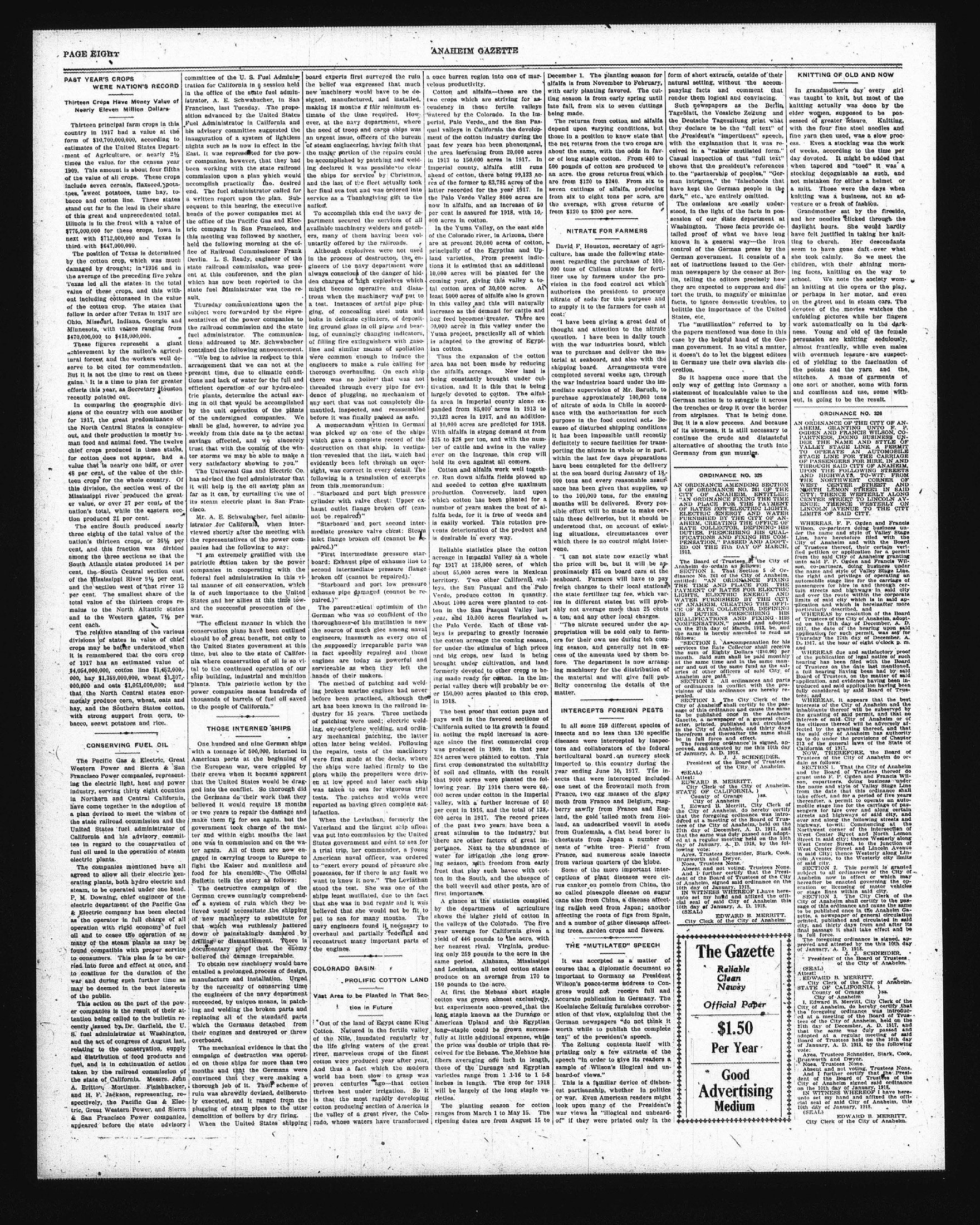
Searchable text
PAST YEAR'S CROPS
WERE NATION'S RECORD
Thirteen Crops Have Money Value of Nearly Eleven Million Dollars
Thirteen principal farm crops in this country in 1917 had a value at the form of $10,700,000,000, according to estimates of the United States Department of Agriculture, or nearly 2½ times the value for the census year 1909. This amount is about four fifths of the value of all crops. These crops include seven cereals, flaxseed, potatoes, sweet potatoes, tame hay, tobacco and cotton line. Three states stand out far in the lead in their share of this great and unprecedented total. Illinois is in the front with a value of $775,000,000 for these crops, Iowa is next with $712,000,000 and Texas is third with $647,000,000.
The position of Texas is determined by the cotton crop, which was much damaged by drought; in 1916 and in the average of the preceding five years Texas led all the states in the total value of these crops, and this without including cottonseed in the value of the cotton crop. The states that follow in order after Texas in 1917 are Ohio, Missouri, Indiana, Georgia and Minnesota, with values ranging from $470,000,000 to $418,000,000.
These figures represent a giant achievement by the nation's agricultural forces, and the workers well deserve to be cited for commendation. But it is not the time to rest on these gains. It is a time to plan for greater efforts this year, as Secretary Houston recently pointed out.
In comparing the geographic divisions of the country with one another for 1917, the great predominance of the North Central States is conspicuously out, and their production is mostly human food and animal feed. The twelve chief crops produced in these states, for cotton does not appear, had a committee of the U.S. Fuel Administration for California in a session held in the office of the state fuel administrator, A. E. Schwabacher, in San Francisco, last Tuesday. The proposition advanced by the United States Fuel Administrator in California and his advisory committee suggested the inauguration of a system of lightless nights such as is now in effect in the East. It was represented for the power companies, however, that they had been working with the state railroad commission upon a plan which would accomplish practically the desired end. The fuel administrator called for a written report upon the plan. Subsequent to this hearing, the executive heads of the power companies met at the office of the Pacific Gas and Electric company in San Francisco, and this meeting was followed by another, held the following morning at the office of Railroad Commissioner Frank Devlin. L. S. Ready, engineer of the state railroad commission, was present at this conference, and the plan which has now been reported to the state fuel administrator was the result.
Thursday communications upon the subject were forwarded by the representatives of the power companies to the railroad commission and the state fuel administrator. The communications addressed to Mr. Schwabacher contained the following announcement.
"We beg to advise in respect to this arrangement that we can not at the present time, due to climatic conditions and lack of water for the full and efficient operation of our hydro-electric plants, determine the actual saving in oil that would be accomplished by the unit operation of the plants of the undersigned companies. We shall be glad, however, to advise you weekly from this date as to the actual savings effected, and we sincerely trust that with the coming of the winter storms we may be able to make board experts first on the belief was expressed new machinery would signed, manufacture making 18 months at a time ever, at the navy or the need of troop and an urgent issue, offload of steam engineering the major portion of be accomplished by being declared it was the ships for service and the last of the her final sea test and service as a Thanksgiving nation.
To accomplish this partment secured to available machinery many of them untarily offered by us.
Although explosives in the process of engineers of the navy always conscious of den charges of high might become operus when the man a test. Instances of ging, of concealing bolts in delicate cycling ground glass ing, of cunningly cutting fire extinguish line and similar maze were common enough engineers to make thorough overhaul there was no body threaded through dence of plugging any sort that was mantled, inspected before it was finally removed."
A memorandum was picked up on which gave a com destruction on tha tion revealed that
tural forces, and the workers will serve to be cited for commendation. But it is not the time to rest on these gains. It is a time to plan for greater efforts this year, as Secretary Houston recently pointed out.
In comparing the geographic divisions of the country with one another for 1917, the great predominance of the North Central States is conspicuously out, and their production is mostly human food and animal feed. The twelve chief crops produced in these states, for cotton does not appear, had a value that is nearly one half, or over 48 per cent, of the value of the thirteen crops for the whole country. Of this division, the section west of the Mississippi river produced the greater value, or over 27 per cent, of the nation's total, while the eastern section produced 21 per cent.
The entire South produced nearly three eights of the total value of the nation's thirteen crops, or 36½ per cent, and this fraction was divided among the three sections so that the South Atlantic states produced 14 per cent, the South Central section east of the Mississippi River 9½ per cent, and the section west of that river 13 per cent. The smallest share of the total value of the thirteen crops remains to the North Altantic states and to the Western states, 7½ per cent each.
The relative standing of the various divisions of states in value of chief crops may be better understood when it is remembered that the corn crop of 1917 has an estimated value of $4,054,000,000, cotton line $1,452,000,000, hay $1,359,000,000, wheat $1,307,000,000 and oats $1,061,000,000; and that the North Central states enormously produce corn, wheat, oats and hay, and the Southern States cotton, with strong support from corn, tobacco, seewt potatoes and rice.
CONSERVING FUEL OIL
The Pacific Gas & Electric, Great Western Power and Sierra & San Francisco Power companies, representing the electric light, heat and power industry, serving thirty eight counties in Northern and Central California, have come together in the adoption of a plan devised to meet the wishes of the state railroad commission and the United States fuel administrator of California and his advisory committee in regard to the conservation of fuel oil used in the operation of steam electric plants.
THOSE INTERNED SHIPS
One hundred and nine German ships with a tonnage of 500,000, interned in American ports at the beginning of the European war, were crippled by their crews when it became apparent that the United States would be dragged into the conflict. So thorough did the Germans do their work that they believed it would require 18 months or two years to repair the damage and make them fit for sea again. but the government took charge of the matter and within eight months the last one was in commission and on the water again. All of them are now engaged in carrying troops to Europe to fight the Kaiser and munitions and arrangement that we can not at the present time, due to climatic conditions and lack of water for the full and efficient operation of our hydro-electric plants, determine the actual saving in oil that would be accomplished by the unit operation of the plants of the undersigned companies. We shall be glad, however, to advise you weekly from this date as to the actual savings effected, and we sincerely trust that with the coming of the winter storms we may be able to make a very satisfactory showing to you."
The Universal Gas and Electric Co. has advised the fuel administrator that it will help in the oil saving plan as far as it can, by curtailing the use of its steam electric plant in San Francisco.
Mr. A. E. Schwabacher, fuel administrator for California, when interviewed shortly after the meeting with the representatives of the power companies had the following to say:
"I am extremely gratified with the patriotic action taken by the power companies in cooperating with the federal fuel administration in this vital manner of oil conservation, which is of such importance to the United States and her allies at this time toward the successful prosecution of the war.
"The efficient manner in which the conservation plans have been outlined should be of great benefit, not only to the United States government at this time, but also to the state of California where conservation of oil is so vital to the continued operation of our ship building, industrial and munition plants. This patriotic action by the power companies means hundreds of thousands of barrels of fuel oil saved to the people of California."
THE PARENTETIC GERMAN WHO WAS THOROUGHNESS OF HIS SOURCE OF MUSCLE ENGINEERS IN ASMUNITIES THE SUPPosedLY IRRIGATED IN FACT SPEEDILY ENGINES ARE TODAY SERVICABLE AS WHAT HANDS OF THEIR MAN.
The method of ing broken marine before been praised art has been known dustry for 15 years of patching were ing, oxy-acetylene mechanical ply often later being repairs tests were first made by the ships were lined pliers while the piles at low speed was taken to sea tests. The patch reported as having isfaction.
When the Levk Vaterland and then was put into common States government a trial trip, her o American naval o
Western Power and Sierra & San Francisco Power companies, representing the electric light, heat and power industry, serving thirty eight counties in Northern and Central California, have come together in the adoption of a plan devised to meet the wishes of the state railroad commission and the United States fuel administrator of California and his advisory committee in regard to the conservation of fuel oil used in the operation of steam electric plants.
The companies mentioned have all agreed to allow all their electric generating plants, both hydro electric and steam, to be operated under one head. P. M. Downing, chief engineer of the electric department of the Pacific Gas & Electric company has been elected as the operator in full charge of all operation with rigid economy of fuel oil and to cease the operation of as many of the steam plants as may be found compatible with proper service to consumers. This plan is to be carried into force and effect at once, and to continue for the duration of the war and during such further time as may be deemed in the best interests of the public.
This action on the part of the power companies is the result of their attention being called to the bulletin recently issued by Dr. Garfield, the U.S. fuel administrator at Washington, and the act of congress of August last, relating to the conservation, supply and distribution of food products and fuel, and is in continuation of action taken by the railroad commission of the state of California. Messrs. John A. Britton, Mortimer Fleishhacker, and H. F. Jackson, representing, respectively, the Pacific Gas & Electric, Great Western Power, and Sierra & San Francisco Power companies, appeared before the state advisory
their crews when it became apparent that the United States would be dragged into the conflict. So thorough did the Germans do their work that they believed it would require 18 months or two years to repair the damage and make them fit for sea again, but the government took charge of the matter and within eight months the last one was in commission and on the water again. All of them are now engaged in carrying troops to Europe to fight the Kaiser and munitions and food for his enemies. The Official Bulletin tells the story as follows:
The destructive campaign of the German crews cunningly comprehended a system of ruin which they believed would necessitate the shipping of new machinery to substitute for that which was ruthlessly battered down or painstakingly damaged by drilling or dismantlement. There is documentary proof that the enemy believed the damage irreparable.
To obtain new machinery would have entailed a prolonged process of design, manufacture and installation. Urged by the necessity of conserving time the engineers of the navy department succeeded, by unique means, in patching and welding the broken parts and replacing all of the standard parts which the Germans detached from their engines and destroyed or threw overboard.
The mechanical evidence is that the campaign of destruction was operated on these ships for more than two months and that the Germans were convinced that they were making a thorough job of it. Their scheme of ruin was shrewdly devised, deliberately executed, and it ranged from the plugging of steam pipes to the utter demolition of boilers by dry firing.
When the United States shipping
ANAHEIM GAZETTE
board experts first surveyed the ruin the belief was expressed that much new machinery would have to be designed, manufactured, and installed, making 18 months of fair minimum estimate of the time required. However, at the navy department, where the need of troop and cargo ships was an urgent issue, officers of the bureau of steam engineering, having faith that the major portion of the repairs could be accomplished by patching and welding declared it was possible to clear the ships for service by Christmas, and the last of the fleet actually took her final sea test and was ordered into service as a Thanksgiving gift to the nation.
To accomplish this end the navy department secured the services of all available machinery welders and patchers, many of them having been voluntarily offered by the railroads.
Although explosives were not used in the process of destruction, the engineers of the navy department were always conscious of the danger of hidden charges of high explosives which might become operative and disastrous when the machinery was put to a test. Instances of artful pipe plugging, of concealing steel nuts and bolts in delicate cylinders, of depositing ground glass in oil pipes and bearing, of cunningly changing indicators, of filling fire extinguishers with gasoline and similar means of spoliation were common enough to induce the engineers to make a rule calling for thorough overhauling. On each ship there was no boiler that was not threaded through every pipe for evidence of plugging, no mechanism of any sort that was not completely dismantled, inspected, and reassembled before it was finally passed as safe.
A memorandum written in German was picked up on one of the ships which gave a complete record of the destruction on that ship. In vestigation revealed that the list, which had
a once barren region into one of marvelous productivity.
Cotton and alfalfa—these are the two crops which are striving for ascendency in those fertile valleys watered by the Colorado. In the Imperial, Palo Verde, and the San Pasqual valleys in California the development of the cotton industry during the past few years has been phenomenal, the area increasing from 20,000 acres in 1913 to 150,000 acres in 1917. In Imperial county, alfalfa still runs ahead of cotton, there being 99,123 acres of the former to 83,785 acres of latter recorded for the year 1917. In the Palo Verde Valley 8000 acres are now in alfalfa, and an increase of 50 per cent is assured for 1918, with 10,000 acres in cotton.
In the Yuma Valley, on the east side of the Colorado river, in Arizona, there are at present 20,000 acres of cotton, principally of the Egyptian and Upland varieties. From present indications it is estimated that an additional 10,000 acres will be planted for the coming year, giving this valley a total cotton area of 30,000 acres. At least 5000 acres of alfalfa also is grown in this valley and this will naturally increase as the demand for cattle and hog feed becomes greater. There are 30,000 acres in this valley under the Yuma project, practically all of which is adapted to the growing of Egyptian cotton.
Thus the expansion of the cotton area has not been made by reducing the alfalfa acreage. New land is being constantly brought under cultivation, and it is this that is being largely devoted to cotton. The alfalfa area in Imperial county alone expanded from 85,000 acres in 1913 to 99,123 acres in 1917, and an additional 10,000 acres are predicted for 1918. With alfalfa in strong demand at from $25 to $28 per ton, and with the number of cattle and swine in the valley ever on the increase, this crop will December 1. The planting season for alfalfa is from November to February, with early planting favored. The cutting season is from early spring until late fall, from six to seven cuttings being made.
The returns from cotton, alfalfa depend upon varying conditions, but those in a position to know state that the net returns from the two crops are about the same, with the odds in favor of long staple cotton. From 400 to 500 pounds of cotton are produced to an acre. The gross returns from which are from $120 to $240. From six to seven cuttings of alfalfa, producing from six to eight tons per acre, are the average, with gross returns of from $120 to $200 per acre.
NITRATE FOR FARMERS
David F. Houston, secretary of agriculture, has made the following statement regarding the purchase of 100,000 tons of Chilean nitrate for fertilizer use by farmers under the provision in the food control act which authorizes the president to procure nitrate of soda for this purpose and to supply it to the farmers for cash at cost:
"I have been giving a great deal of thought and attention to the nitrate question. I have been in daily touch with the war industries board, which was to purchase and deliver the material at seaboard, and also with the shipping board. Arrangements were completed several weeks ago, through the war industries board under the immediate supervision of Mr. Baruch, to purchase approximately 100,000 tons of nitrate of soda in Chile in accordance with the authorization for such purpose in the food control act. Because of disturbed shipping conditions it has been impossible until recently definitely to secure facilities for transporting the nitrate in whole or in part."
The stood, in session with Washinton tailed pigs known control Germany set off man near Lincoln they are tortured facts, their belittles States.
The only way statement Germanythe treasuredfrom But it its continuing alternatem Germany
engineers to make a rule calling for thorough overhauling. On each ship there was no boiler that was not threaded through every pipe for evidence of plugging, no mechanism of any sort that was not completely dismantled, inspected, and reassembled before it was finally passed as safe.
A memorandum written in German was picked up on one of the ships which gave a complete record of the destruction on that ship. In vestigation revealed that the list, which had evidently been left through an oversight, was correct in every detail. The following is a translation of excerpts from this memorandum:
"Starboard and port high pressure cylinder with valve chest: Upper exhaust outlet flange broken off (cannot be repaired)."
"Starboard and port low pressure exhause pipe damaged (cannot be repaired.)"
"The parenthetical optimism of the German who was so confident of the thoroughness of his mutilation is now the source of much glue among naval engineers, inasmuch as every one of the supposedly irreparable parts was in fact speedily repaired and those engines are today as powerful and serviceable as when they left the hands of their makers.
The method of patching and welding broken marine engines had never before been practised, although the art has been known in the railroad industry for 15 years. Three methods of patching were used; electric welding, oxy-acetylene welding, and ordinary mechanical patching, the latter often later being welded. Following the repairs, tests of the machinery were first made at the docks, where the ships were lashed firmly to the piers while the propellers were driven at low speed and later each ship was taken to sea for vigorous trial tests. The patches and welds were reported as having given complete satisfaction.
When the Leviathan, formerly the Vaterland and the largest ship afloat was put into commission by the United States government and sent to sea for a trial trip, her commander, a young American naval officer, was ordered to "exert every pound of pressure she area has not been made by reducing the alfalfa acreage. New land is being constantly brought under cultivation, and it is this that is being largely devoted to cotton. The alfalfa area in Imperial county alone expanded from 85,000 acres in 1913 to 99,123 acres in 1917, and an additional 10,000 acres are predicted for 1918. With alfalfa in strong demand at from $25 to $28 per ton, and with the number of cattle and swine in the valley ever on the increase, this crop will hold its own against all comers.
Cotton and alfalfa work well together. Run down alfalfa fields plowed up and seeded to cotton give maximum production. Conversely, land upon which cotton has been planted for a number of years makes the best of alfalfa beds, for it is free of weeds and is easily worked. This rotation prevents deterioration of the product and is desirable in every way.
Reliable statistics place the cotton acreage in Imperial Valley as a whole for 1917 at 138,000 acres, of which about 55,000 acres were in Mexican territory. Two other California valleys, the San Pasqual and the Palo Verde, produce cotton in quantity. About 1000 acres were planted to cotton in the San Pasqual Valley last year, and 10,000 acres flourished in the Palo Verde. Each of these valleys is preparing to greatly increase the cotton acreage the coming season, for under the stimulus of high prices and big crops, new land is being brought under cultivation, and land formerly devoted to other crops is being made ready for cotton. In the Imperial valley there will probably be over 150,000 acres planted to this crop, in 1918.
The best proof that cotton pays and pays well in the favored sections of California suited to its growth is found in noting the rapid increase in acreage since the first commercial crop was produced in 1909. In that year 324 acres were planted to cotton. This first crop demonstrated the suitability of soil and climate, with the result that 9000 acres were planted the following year. By 1914 there were 60,000 acres under cotton in the Imperial valley, with a further increase of 50 per cent in 1916, and the total of 138,000 acres in 1917. The record prices of the past two years have been a great stimulus to the industry, but there are other factors of great importance. Next to the abundance of water for irrigation, the long growing season, with freedom from early area has not been made by reducing the alfalfa acreage. New land is being constantly brought under cultivation, and it is this that is being largely devoted to cotton. The alfalfa area in Imperial county alone expanded from 85,000 acres in 1913 to 99,123 acres in 1917, and an additional 10,000 acres are predicted for 1918. With alfalfa in strong demand at from $25 to $28 per ton, and with the number of cattle and swine in the valley ever on the increase, this crop will hold its own against all comers.
Cotton and alfalfa work well together. Run down alfalfa fields plowed up and seeded to cotton give maximum production. Conversely, land upon which cotton has been planted for a number of years makes the best of alfalfa beds, for it is free of weeds and is easily worked. This rotation prevents deterioration of the product and is desirable in every way.
Reliable statistics place the cotton acreage in Imperial Valley as a whole for 1917 at 138,000 acres, of which about 55,000 acres were in Mexican territory. Two other California valleys, the San Pasqual and the Palo Verde, produce cotton in quantity. About 1000 acres were planted to cotton in the San Pasqual Valley last year, and 10,000 acres flourished in the Palo Verde. Each of these valleys is preparing to greatly increase the cotton acreage the coming season, for under the stimulus of high prices and big crops, new land is being brought under cultivation, and land formerly devoted to other crops is being made ready for cotton. In the Imperial valley there will probably be over 150,000 acres planted to this crop, in 1918.
The best proof that cotton pays and pays well in the favored sections of California suited to its growth is found in noting the rapid increase in acreage since the first commercial crop was produced in 1909. In that year 324 acres were planted to cotton. This first crop demonstrated the suitability of soil and climate, with the result that 9000 acres were planted to棉花 in the Imperial valley, with a further increase of 50 per cent in 1916, and the total of 138,000 acres in 1917. The record prices of the past two years have been a great stimulus to the industry, but there are other factors of great importance. Next to the abundance of water for irrigation,the long growing seasonwith freedom from early area has not been made by reducingthe alfalfa acreage.New land is being constantly brought under cultivation,and it is this that is being largely devoted to cotton.The alfalfa area in Imperial county alone expanded from 85,000 acres in 1913 to 99,123 acres in 1917,and an additional 10,000 acres are predicted for 1918.With alfalfa in strong demand at from $25 to $28 per ton,and with the number of cattle and swine in the valley ever on the increase,这 crop will hold its own against all comers.
Cotton and alfalfa work well together.Run down alfalfa fields plowed up and seeded to cotton give maximum production.Conversely,Land upon which cotton has been planted for a number of years makes the best of alfalfa beds.for it is free of weeds and is easily workedThis rotation prevents deteriorationoftheproductandisdesirableineveryway.ReliablestatisticsplacethecottonacreageinImperialValleyasawholleforseaboard,andalsowiththeshippingboard.Arrangementswerecompletedseverewtimesago,thewarindustriesboardundermidatesupervisionofMr.Baruch,topurchaseapproximately100,000tonsofnitrateof sodainChileinaccordancewiththeauthorizationforsuchpurposeinthefoodcontrolact.Becauseofdisturbedshippingconditionsithasbeenimpossibleuntildefinitelytosecurefacilitiesfortransportingthenitrateinwholeorinpart.withinthelast fewdayspreparationshavebeencompletedfordireveryattheseaboardduringJanuaryof18,ooo tonsandeveryreasonableassurancehasbeengiventhatsupplies.uptothe100,oootons,fortheensuingmonthswillbellearned.Everypossibleeffortwillbemadetomakecertainthesedeliveries,bbutitshouldbefoundstoodthat.onaccountofexisting situations,circumstancesoverwhichthereisnocontrolmightintervene.
"I cannotstatenowexactlywhatthepricewillbe,b但itwillbeaproximately$75onboardcarsattheseaboard.Farmerswillhavetheyusefreighchargestothirelocalstations,thestatefertilizertagfee,whichvariesin differentstatesbutwillprobablynotaveragemorethan25centsaton,andanyotherlocalcharges.
"Thenitratesecuredundertheappropriationwillbeb Soldonlyto farmersfor theirownuse duringthecomingseason,andgenerallynotinexcessoftheamountusedbythebefore.Thedepartmentisnowarrangingmachineryfortheditributionofthematerialandwillgivefullpublicityconcerningthedetailsofthe matter."
INTERCEPTPSFOREIGNPESTS
Inallsome259differentspeciesofinsectsandno less than130specific diseaseswereinterceptedbyinspectorsandcollaboratorsofthe federalhorticulturalboard.onnurserystockimportedtocthiscountryduringtheyearendingJune30,1917.TheinsectsthatwereinterceptedincludedonenestofthebrowntailmothfromFrance,twoeggmassesoftheglipsymothfromFranceandBelgium,raspberrysawflyfromFranceandEngland,thegoldtailedmothfromHolland,theundescribedweevillinseedsfromGuatemala,aflatheadborerinchestnutsof"whitetree-Pierid"fromFrance,andnumerousscaleinsectsfromvariousquartersoftheglobe."
When the Leviathan, formerly the Vaterland and the largest ship afloat was put into commission by the United States government and sent to sea for a trial trip, her commander, a young American naval officer, was ordered to "exert every pound of pressure she possesses, for if there is any fault we want to know it now." The Leviathan stood the test. She was one of the ships least mutilated, due to the fact that she was in bad repair and it was believed that she would not be fit to put to sea for many months. The navy engineers found it necessary to overhaul and partially redesign and reconstruct many important parts of the engines.
COLORADO BASIN
PROLIFIC COTTON LAND
Vast Area to be Planted in That Section in Future
Out of the land of Egypt came King Cotton. Natured in the fertile valley of the Nile, inundated regularly by the life giving waters of the great river, marvelous crops of the finest cotton were produced year after year. And thus a fact which the modern world has been slow to grasp was proven centuries ago—that cotton thrives best under irrigation. So it is that the most rapidly developing cotton producing section of America is the valley of a great river, the Colorado, whose waters have transformed of soil and climate, with the result that 9000 acres were planted the following year. By 1914 there were 60,000 acres under cotton in the Imperial valley, with a further increase of 50 per cent in 1916, and the total of 138,000 acres in 1917. The record prices of the past two years have been a great stimulus to the industry, but there are other factors of great importance. Next to the abundance of water for irrigation, the long growing season, with freedom from early frost that play such havoc with cotton in the South, and the absence of the boll weevil and other pests, are of first importance.
A glance at the statistics compiled by the department of agriculture shows the higher yield of cotton in the valleys of the Colorado. The five year average for California gives a yield of 446 pounds to the acre, with her nearest rival. Virginia, producing only 259 pounds to the acre in the same period. Alabama, Mississippi and Louisiana, all noted cotton states produce on an average from 170 to 180 pounds to the acre.
At first the Mebans short staple cotton was grown almost exclusively, but experiments soon proved that the long staple known as the Durango or American Upland and the Egyptian long-staple could be grown successfully at little additional expense, while the price was double or triple that received for the Bebane. The Mebane has fibers averaging one inch in length, those of the Durange and Egyptian varieties range from 1 1-16 to 1 5-8 inches in length. The crop for 1918 will be largely of the long staple varieties.
The planting season for cotton ranges from March 1 to May 15. The ripening dates are from August 15 to year ending June 30, 1917. The insects that were intercepted included one nest of the browntail moth from France, two egg masses of the gipsy moth from France and Belgium, raspberry sawfly from France and England, the gold tailed moth from Holland, an undescribed weevil in seeds from Guatemala, a flat head borer in chestnuts from Japan a number of nests of "white tree Pierid" from France, and numerous scale insects from various quarters of the globe.
Some of the more important interceptions of plant diseases were citrus canker on pomelo from China, so called pineapple disease on sugar cane also from China, a disease affecting radish seed from Japan; another affecting the roots of figs from Spain, and a number of other diseases affecting trees, garden crops and flowers.
THE "MUTILATED" SPEECH
It was accepted as a matter of course that a diplomatic document so important to Germany as President Wilson's peace-terms address to Congress would not receive full and accurate publication in Germany. The Koelnische Zeltung furnishes corroboration of that view, explaining that the German newspapers "do not think it worth while to publish the complete text" of the president's speech.
The Zeltung contents itself with printing only a few extracts of the speech "in order to give its readers a sample of Wilson's illogical and unheard-of views."
This is a familiar device of dishonest partisanship, whether in politics or war. Even American readers might look upon many of the President's war views as "illogical and unheard-of" if they were printed only in the
KNITTING OF OLD AND NOW
In grandmother's day every girl was taught to knit, but most of the knitting actually was done by the elder women, supposed to be possessed of greater fidelity. Knitting, with the four fine steel needles and fine yarn then used, was a slow process. Even a stocking was the work of weeks, according to the time per day devoted. It might be added that when tapered and "toed" it was a stocking decognizable as such, and not mistaken for either a helmet or a mitt. Those were the days when knitting was a business, not an adventure or a freak of fashion.
Grandmother sat by the fireside, and her needles clicked through the daylight hours. She would hardly have felt justified in taking her knitting to church. Her descendants seem to have gone daft over what she took calmly. So we meet the children, with their shining morning faces, knitting on the way to school. We note the society woman knitting at the opera or the play, or perhaps in her motor, and even on the street and in steam cars. The devotee of the movies watches the unfolding pictures while her fingers work automatically on in the darkness. Young and old of the female persuasion are knitting sedulously, almost frantically, while even males with overmuch leisure are suspected of yielding to the fascination of the points and the yarn and the stitches. A mass of garments of one sort or another, some with form and comliness and use, some without, is going to be the result.
ORDINANCE NO. 326
AN ORDINANCE OF THE CITY OF ANAHEIM, GRANTING UNTO F. P. OGDEN AND FRANCIS WILSON, CO-PARTNERS, DOING BUSINESS UNDER THE NAME AND STYLE OF VALLEY STAGE LINE, A PERMIT TO OPERATE AN AUTOMOBILE STAGE LINE FOR THE CARRIAGE
ORDINANCE NO. 325
AN ORDINANCE AMENDING SECTION 5 OF ORDINANCE NO. 261 OF THE CITY OF ANAHEIM, ENTITLED: "AN ORDINANCE FIXING THE TIME AND PLACE FOR THE PAYMENT OF RATES FOR ELECTRIC LIGHTS, ELECTRIC ENERGY AND WATER FURNISHED BY THE CITY OF ANAHEIM, CREATING THE OFFICE OF RATE COLLECTOR, DEFINING HIS DUTIES, PRESCRIBING HIS QUALIFICATIONS AND FIXING HIS COMPENSATION." PASSED AND ADOPTED ON THE 27th DAY OF MARCH, 1913.
The Board of Trustees of the City of Anaheim do ordain as follows:
SECTION 1. That Section 5 of Ordinance No. 261 of the City of Anaheim, entitled: "AN ORDINANCE FIXING THE TIME AND PLACE FOR THE PAYMENT OF RATES FOR ELECTRIC LIGHTS, ELECTRIC ENERGY AND WATER FURNISHED BY THE CITY OF ANAHEIM, CREATING THE OFFICE OF RATE COLLECTOR, DEFINING HIS DUTIES, PRESCRIBING HIS QUALIFICATIONS AND FIXING HIS COMPENSATION," passed and adopted on the 27th day of March, 1913, be, and the same is hereby amended to read as follows:
"SECTION 5. As compensation for his services the Rate Collector shall receive the sum of Eighty Dollars ($80.00) per month. Said sum shall be paid monthly at the same time and in the same manner and out of the same fund as the salaries of other officers of said City of Anaheim are paid."
SECTION 2. All ordinances and parts of ordinances in conflict with the provisions of this ordinance are hereby repealed.
SECTION 3. The City Clerk of the City of Anaheim shall certify to the passage of this ordinance and cause the same to be published once in the Anaheim Gazette, a newspaper of a general character, printed, published and circulated in the City of Anaheim, and thirty days therefrom and thereafter the same shall be in full force and effect.
The foregoing ordinance is signed, approved, and attested by me this 10th day of January, A.D. 1918.
J. J. SCHNEIDER,
President of the Board of Trustees
of the City of Anaheim.
(SEAL)
Attest:
EDWARD B. MERRITT,
City Clerk of the City of Anaheim.
STATE OF CALIFORNIA.)
County of Orange)
City of Anaheim)
I. Edward B. Merritt, City Clerk of the City of Anaheim, do hereby certify that the foregoing ordinance was introduced at a meeting of the Board of Trustees of the City of Anaheim, held on the 27th day of December, A.D. 1917, and that the same was duly passed and adopted at a regular meeting held on the 10th day of January, A.D. 1918, by the following vote:
Ayes, Trustees Schneider, Stark, Cook, Brunworth and Dwyer.
Noes, Trustees None.
ORDINANCE NO. 326
AN ORDINANCE OF THE CITY OF ANAHEIM, GRANTING UNTO F. P. OGDEN AND FRANCIS WILSON, CO-PARTNERS, DOING BUSINESS UNDER THE NAME AND STYLE OF VALLEY STAGE LINE, A PERMIT TO OPERATE AN AUTO-MOBILE STAGE LINE FOR THE CARRIAGE OF PASSENGERS FOR HIRE, IN AND THROUGH SAID CITY OF ANAHEIM, UPON THE FOLLOWING STREETS AND HIGHWAYS, TO-WIT; FROM THE NORTHWEST CORNER OF WEST CENTER STREET AND NORTH LEMON STREET IN SAID CITY; THENCE WESTERLY ALONG CENTER STREET TO LINCOLN AVENUE; THENCE WESTERLY ON LINCOLN AVENUE TO THE CITY LIMITS OF SAID CITY.
WHEREAS, F. P. Ogden and Francis Wilson, co-partners doing business under the name and style of Valley Stage Line, have heretofore filed with the City of Anaheim and with the Board of Trustees thereof, their certain verified petition or application for a permit from the said City of Anaheim granting unto said F. P. Ogden and Francis Wilson, co-partners, doing business under the name and style of Valley Stage Line, the right and privilege of operating an automobile stage line for the carriage of passengers for hire in and through certain streets and highways in said city and over the route within the corporate limits of said city which is in said application and which is hereinafter more particularly described, and
WHEREAS by resolution of the Board of Trustees of the City of Anaheim, adopted on the 17th day of December, A.D. 1917, the date of the hearing upon said application for such permit, was set for Thursday the 27th day of December, A.D. 1917, at the hour of eight o'clock p.m.
WHEREAS due and satisfactory proof of the publication of legal notice of such hearing has been filed with the Board of Trustees on the date last mentioned, a full hearing having been had by said Board of Trustees, on the matter of said application, and evidence having been introduced and said application having been fully considered by said Board of Trustees; and
WHEREAS it appears that the best interests of the City of Anaheim and the inhabitants thereof will be subserved by the granting of said permit, and that no interest of said City of Anaheim or of the citizens thereof will be adversely affected by the granting thereof, and that the said city of Anaheim has authority so to do under the provisions of Chapter 213 of the general laws of the State of California of 1917.
NOW, THEREFORE, the Board of Trustees of the City of Anaheim do ordain as follows:
SECTION 1. That the City of Anaheim and the Board of Trustees thereof do grant unto F. P. Ogden and Francis Wilson, co-partners doing business under the name and style of Valley Stage Line from the date that this ordinance shall take effect, and for a period of five years thereafter, a permit to operate an automobile stage line for the carriage of passengers for hire over and along certain streets and highways in said city, and over and along the following streets and highway, to-wit: Commencing at the Northwest corner of the intersection of West Center Street and North Lemon Street in said city; thence Westerly along West Center Street, to the junction of West Center Street and Lincoln Avenue in said city; thence Westerly along Lincoln Avenue, to the Westerly city limits of said city.
The Gazette
Reliable
Clean
Nasty
Official Paper
$1.50
Per Year
Good Advertising Medium
Attest:
EDWARD B. MERRITT,
City Clerk of the City of Anaheim.
STATE OF CALIFORNIA, )
County of Orange
City of Anaheim
I. Edward B. Merritt, City Clerk of the City of Anaheim, do hereby certify that the foregoing ordinance was introduced at a meeting of the Board of Trustees of the City of Anaheim, held on the 27th day of December, A. D. 1917, and that the same was duly passed and adopted at a regular meeting held on the 10th day of January, A. D. 1918, by the following vote:
Ayes, Trustees Schneider, Stark, Cook, Brunworth and Dwyer.
Noes, Trustees None.
Absent and not voting, Trustees None.
And I further certify that the President of the Board of Trustees of the City of Anaheim, signed said ordinance on the 10th day of January, 1918.
IN WITNESS WHEREOF I have hereunto set my hand and affixed the official seal of said City of Anaheim this 10th day of January, A. D. 1918.
(SEAL)
EDWARD B. MERRITT,
City Clerk of the City of Anaheim:
SECTION 2. This permit is granted subject to all ordinances of the City of Anaheim now in effect or which may hereafter be enacted governing the operation or licensing of motor vehicles or stage lines within said city.
SECTION 3. The City Clerk of the City of Anaheim shall certify to the passage of this ordinance and cause the same to be published once in the Anaheim Gazette, a newspaper of general circulation printed, published and circulated in said city, and thirty days from and after its final passage it shall take effect and be in full force.
The foregoing ordinance is signed, approved and attested by me this 10th day of January, A. D. 1918.
J. J. SCHNEIDER,
President of the Board of Trustees of the City of Anaheim.
Attest:
EDWARD B. MERRITT,
City Clerk of the City of Anaheim.
STATE OF CALIFORNIA, )
County of Orange
City of Anaheim
I. Edward B. Merritt, City Clerk of the City of Anaheim, do hereby certify that the foregoing ordinance was introduced at a meeting of the Board of Trustees of the City of Anaheim, held on the 27th day of December, A. D. 1917, and that the same was duly passed and adopted at a regular meeting of said Board of Trustees held on the 10th day of January, A. D. 1918, by the following vote:
Ayes, Trustees Schneider, Stark, Cook, Brunworth and Dwyer.
Noes, Trustees None.
Absent and not voting, Trustees None.
And I further certify that the President of the Board of Trustees of the City of Anaheim signed said ordinance on the 10th day of January, 1918.
IN WITNESS WHEREOF I have hereunto set my hand and affixed the official seal of said City of Anaheim, this 10th day of January, A. D. 1918.
(SEAL)
EDWARD B. MERRITT,
City Clerk of the City of Anaheim.