anaheim-gazette 1918-01-24
Scanned page
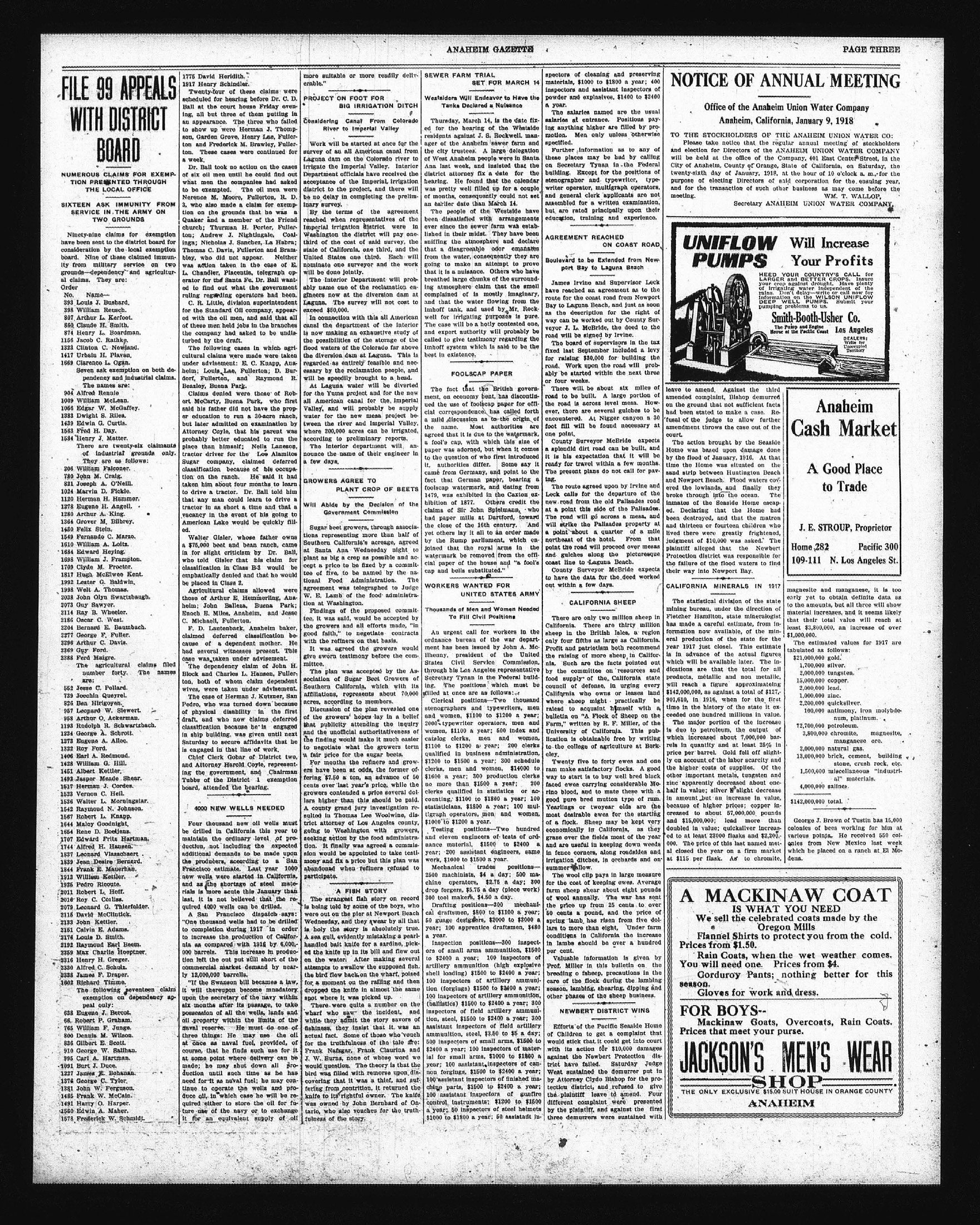
Searchable text
FILE 99 APPEALS WITH DISTRICT BOARD
NUMEROUS CLAIMS FOR EXEMPTION PRESENTED THROUGH THE LOCAL OFFICE
SIXTEEN ASK IMMUNITY FROM SERVICE IN THE ARMY ON TWO GROUNDS
Ninety-nine claims for exemption have been sent to the district board for consideration by the local exemption board. Nine of these claimed immunity from military service on two grounds—dependency and agricultural claims. They are:
Order
No. Name—
393 Louis J. Bushard.
398 William Reusch.
807 Arthur L. Kerfoot.
860 Claude H. Smith.
874 Henry L. Boardman.
1156 Jacob C. Rathke.
1323 Clinton C. Newland.
1417 Urbain H. Plavan.
1669 Clarence L. Ogan.
Seven ask exemption on both dependency and industrial claims. The names are:
904 Alfred Rennle
1009 William McLean.
1056 Edgar W. McGaffey.
1883 Dwight S. Rilea.
1439 Edwin G. Curtis.
1563 Fred H. Day.
1584 Henry J. Matter.
There are twenty-six claimants of industrial grounds only.
1775 David Heridith.
1917 Henry Schindler.
Twenty-four of these claims were scheduled for hearing before Dr. C. D. Ball at the court house Friday evening, all but three of them putting in an appearance. The three who failed to show up were Herman J. Thompson, Garden Grove, Henry Lae, Fullerton and Frederick M. Brawley, Fullerton. These cases were continued for a week.
Dr. Ball took no action on the cases of six oil men until he could find out what men the companies had asked to be exempted. The oil men were Nerence M. Moore, Fullerton, R. D. 3, who also made a claim for exemption on the grounds that he was a Quaker and a member of the Friend church; Thurman H. Porter, Fullerton; Andrew J. Nightingale, Coalings; Nicholas J. Sanchez, La Habra; Thomas C. Davis, Fullerton and Brambley, who did not appear. Neither was action taken in the case of E. L. Chandler, Placentia, telegraph operator for the Santa Fe Dr. Ball wanted to find out what the government ruling regarding operators had been.
C. R. Little, division superintendent for the Standard Oil company, appeared with the oil men, and said that all of these men held jobs in the branches the company had asked to be undisturbed by the draft.
The following cases in which agricultural claims were made were taken under advisement: E. C. Knapp, Anaheim; Louis Lae, Fullerton; D. Burdorf, Fullerton, and Raymond R. Beazley, Buena Park.
Claims denied were those of Robert McCarty, Buena Park, who first said his father did not have the proper education to run a 30-acre ranch, but later admitted on examination by Attorney Coyle, that his parent was probably better educated to run the place than himself; Neils Laneson, tractor driver for the Los Alamitos more suitable or more erable."
PROJECT ON FOOTBIG IRRIGATE THE IMPERIAL DEPARTMENT OFFICIALS ACCEPTANCE OF THE INDIVIDUAL DISTRICT TO THE PROJECT BE NO DELAY IN COMPLIING INARY SURVEY.
By the terms of reached when repressed Imperial irrigation Washington the district third of the cost of state of California, one United States one nominate one survey will be done jointly.
The Interior Departmentably name one of the gneers now at the Laguna. The survey exceed $50,000.
In connection with canal the department is now making an exeptions of the flood waters of the C diversion dam at regarded as entirely essary by the reclamation will be speedily browng At Laguna water for the Yuma project all American canal Valley, and will provide water for the new between the river and where 200,000 acres according to preliminary.
The interior department nounce the name of
1669 Clarence L. Ogan.
Seven ask exemption on both dependency and industrial claims.
The names are:
904 Alfred Rennle
1009 William McLean.
1056 Edgar W. McGaffey.
1833 Dwight S. Rilea.
1439 Edwin G. Curtis.
1563 Fred H. Day.
1584 Henry J. Matter.
There are twenty-six claimants of industrial grounds only. They are as follows:
206 William Falconer.
780 John M. Craig.
821 Joseph A. O'Neill.
1024 Marvin D. Fickle.
1120 Herman H. Hammer.
1278 Eugene H. Angell.
1280 Arthur A. King.
1364 Grover M. Bilbrey.
1430 Felix Stein.
1549 Fernando C. Marzo.
1610 William A. Loitz.
1684 Edward Heying.
1698 William J. Frampton.
1709 Clyde M. Proctor.
1817 Hugh McElwee Kent.
1992 Lester G. Baldwin.
1998 Welt A. Thomas.
2038 John Olyn Swartzbaugh.
2073 Guy Sawyer.
2114 Ray B. Wheeler.
2186 Oscar C. West.
2204 Bernard E. Baumbach.
2277 George F. Fuller.
2296 Arthur C. Davis.
2369 Guy Ford.
2388 Ferd Maigre.
The agricultural claims filed number forty. The names are:
552 Jesse C. Pollard.
739 Joechin Queyrel.
826 Ben Hirigoyen.
957 Leopard W. Siewert.
958 Arthur O. Ackerman.
1193 Rudolph R. Schwartzbach.
1234 George A. Schrott.
1273 Eugene A. Allec.
1322 Roy Ford.
1406 Earl A. Redmond.
1428 William G. Hill.
1451 Albert Kettler.
1492 Jasper Meade Shear.
1617 Herman J. Cordes.
1523 Vernon C. Heil.
1536 Walter L. Morningstar.
1542 Raymond N. Johnson.
1567 Robert L. Knapp.
1644 Maloy Goodnight,
1654 Rene D. Boeljens.
1707 Edward Fritz Hartman.
1744 Alfred H. Hansen.
1837 Leonard Vlasschaert.
1839 Jean Desire Bernard.
under advisement: E. C. Knapp, Anaheim; Louis Lae, Fullerton; D. Burdorf, Fullerton, and Raymond R. Beazley, Buena Park.
Claims denied were those of Robert McCarty, Buena Park, who first said his father did not have the proper education to run a 30-acre ranch, but later admitted on examination by Attorney Coyle, that his parent was probably better educated to run the place than himself; Nells Laneson, tractor driver for the Los Alamitos Sugar company, claimed deferred classification because of his occupation on the ranch. He said it had taken him about four months to learn to drive a tractor. Dr. Ball told him that any man could learn to drive a tractor in as short a time and that a vacancy in the event of his going to American Lake would be quickly filled.
Walter Gisler, whose father owns a $75,000 beet and bean ranch, came in for slight criticism by Dr. Ball, who told Gisler that his claim for classification in Class B-3 would be emphatically denied and that he would be placed in Class 2.
Agricultural claims allowed those of Arthur E. Hemmerling, Anaheim; John Balleza, Buena Park; Enoch E. Miles, Anaheim, and Jesse C. Michaell, Fullerton.
F. D. Lautenback, Anaheim baker, claimed deferred classification because of a dependent mother. He had several witnesses present. This case was taken under advisement.
The dependency claim of John H. Block and Charles L. Hansen, Fullerton, both of whom claim dependent wives, were taken under advisement.
The case of Herman J. Kutzner, San Pedro, who was turned down because of physical disability in the first draft, and who now claims deferred classification because he is engaged in ship building, was given until next Saturday to secure affidavits that he is engaged in that line of work.
Chief Clerk Gobar of District two, and Attorney Harold Coyle, representing the government, and Chairman Tubbs of the District 1 exemption board, attended the hearing.
4000 NEW WELLS NEEDED
Four thousand new oil wells must be drilled in California this year to maintain the ordinary level of production, not including the expected additional demands to be made upon the producers, according to a San
regarded as entirely necessary by the reclamation will be speedily brought at Laguna water for the Yuma project all American canal Valley, and will provide water for the new tween the river and where 200,000 acres according to preliminary.
The interior department nounce the name of a few days.
GROWERS AGREE
PLANT CO.
Will Abide by the Government Co.
Sugar beet growers representations representing many Southern California's at Santa Ana Wedge plant as big a crop as accept a price to be fifteen of five, to be national Food Administration agreement was telegram W.E.Lamb of the nation at Washington.
Findings of the petee, it was said, would the growers and all good faith," to negate with the refiners on it.
It was agreed that give sworn testimony mittee.
The plan was accoassociation of Sugar Southern California affiliations, represent acres, according to no discussion of the petee of the growers' hope that publicity attention and the unofficial auction the finding would make to negotiate what they a fair price for the petee.
For months the rears have been at oderfering $7.50 a ton, a cents over last year's growers contended a dollars higher than this.A county grand jury suited in Thomas Lodge district attorney of Los Angeles seeking action by the tion. It finally was sion would be appointed money and fix a price
1451 Albert Kettler.
1492 Jasper Meade Shear.
1617 Herman J. Cordes.
1523 Vernon C. Hell.
1536 Walter L. Morningstar.
1642 Raymond N. Johnson.
1567 Robert L. Knapp.
1644 Maloy Goodnight.
1654 Rene D. Boeljens.
1707 Edward Fritz Hartman.
1744 Alfred H. Hansen.
1837 Leonard Vlasschaert.
1839 Jean Desire Bernard.
1844 Frank E. Mauerhan.
1913 William Kettler.
1925 Pedro Ricoute.
2011 Robert L. Hoff.
2016 Roy C. Coillss.
2079 Leonard G. Thierfelder.
2115 David McClintick.
2133 John Kettler.
2151 Calvin E. Adams.
2176 Louis D. Smith.
2192 Raymond Earl Beem.
2259 Max Charlie Hoeptner.
2316 Henry H. Greger.
2330 Alfred C. Schulz.
2338 James F. Draper.
1602 Richard Timme.
The following seventeen claim exemption on dependency appeal only:
638 Eugene J. Bercot.
66. Robert P. Graham.
765 William F. Junge.
800 Dennis M. Wilson.
836 Gilbert E. Scott.
910 George W. Salihan.
995 Carl A. Hartman.
1091 Burt J. Duce.
1227 James E. Bohanan.
1376 George C. Tyler.
1381 John W. Ferguson.
1485 Frank W. McCain.
1491 Harry O. Harper.
1560 Edwin A. Maher.
1578 Frederick W. Schmidt.
Four thousand new oil wells must be drilled in California this year to maintain the ordinary level of production, not including the expected additional demands to be made upon the producers, according to a San Francisco estimate. Last year 1000 new wells were started in California, and as the shortage of steel materials is more acute this January than last, it is not believed that the required 4000 wells can be drilled.
A San Francisco dispatch says: "One thousand wells had to be drilled to completion during 1917 in order to increase the production of California as compared with 1916 by 6,000,000 barrels. This increase in production left the out put still short of the commercial market demand by nearly 12,000,000 barrels.
"If the Swanson bill becomes a law, it will thereupon become mandatory upon the secretary of the navy within six months after its passage, to take possession of all the wells, lands and oil property within the limits of the naval reserve. He must do one of three things: He may use the oil at once as naval fuel, provided, of course, that he finds such use for it at some point where delivery can be made; he may shut down all production until such time as he has need for it as naval fuel; he may continue to operate the wells and produce oil, in which case he will be required either to store the oil for future use of the navy or to exchange it for an equivalent supply of oil."
A county grand jury sued in Thomas L. trict attorney of Los Angeles going to Washington seeking action by the tion. It finally was a sion would be appoint money and fix a price abandoned when re-participate.
A FISH S
The strangest fish is being told by someone were out on the pier Wednesday, and they is holy the story in A sea gull, evidently handled bait knife fored the knife up in it on the water. After attempts to swallow the bird flew back on for a moment on the dropped the knife in spot where it was plotted.
There were quite a wharf who saw the while they admit the fishiness, they insist actual fact. Some o for the truthfulness Frank Nafzgar, Frank J. W. Burns, none o would question. The bird was filled with covering that it was fering from contrife knife to its rightful owner by John tario, who also voulu fulness of the story.
more suitable or more readily deliverable."
PROJECT ON FOOT FOR BIG IRRIGATION DITCH
Considering Canal From Colorado River to Imperial Valley
Work will be started at once for the survey of an all American canal from Laguna dam on the Colorado river to irrigate the Imperial Valley. Interior Department officials have received the acceptance of the Imperial irrigation district to the project, and there will be no delay in completing the preliminary survey.
By the terms of the agreement reached when representatives of the Imperial irrigation district were in Washington the district will pay one-third of the cost of said survey, the state of California, one third, and the United States one third. Each will nominate one surveyor and the work will be done jointly.
The Interior Department will probably name one of the reclamation engineers now at the diversion dam at Laguna. The survey will not cost to exceed $50,000.
In connection with this all American canal the department of the interior is now making an exhaustive study of the possibilities of the storage of the flood waters of the Colorado far above the diversion dam at Laguna. This is regarded as entirely feasible and necessary by the reclamation people, and will be speedily brought to a head.
At Laguna water will be diverted for the Yuma project and for the new all American canal for the Imperial Valley, and will probably be supply water for the new mesa project between the river and Imperial Valley, where 200,000 acres can be irrigated, according to preliminary reports.
The interior department will announce the name of their engineer in
SEWER FARM TRIAL SET FOR MARCH 14
Westsiders Will Endeavor to Have the Tanks Declared a Nuisance
Thursday, March 14, is the date fixed for the hearing of the Westside residents against J. S. Rockwell, manager of the Anaheim sewer farm and the city trustees. A large delegation of West Anaheim people were in Santa Ana last week, and insisted that the district attorney fix a date for the hearing. He found that the calendar was pretty well filled up for a couple of months, consequently could not set an earlier date than March 14.
The people of the Westside have been dissatisfied with arrangements ever since the sewer farm was established in their midst. They have been sniffing the atmosphere and declare that a disagreeable odor emanates from the water, consequently they are going to make an attempt to prove that it is a nuisance. Others who have breathed large chunks of the surrounding atmosphere claim that the smell complained of is mostly imaginary, and that the water flowing from the Imhoff tank, and used by Mr. Rockwell for irrigating purposes is pure. The case will be a hotly contested one, and expert authority will probably be called to give testimony regarding the Imhoff system which is said to be the best in existence.
FOOLSCAP PAPER
The fact that the British government, on economy bent, has discontinued the use of foolscap paper for official correspondence, has called forth a mild discussion as to the origin of the name. Most authorities are agreed that it is due to the watermark, a fool's cap, with which this size of paper was adorned, but when it comes to the question of who first introduced it spectors of cleaning and preserving materials, $1000 to $1800 a year; 400 inspectors and assistant inspectors of powder and explosives, $1400 to $2400 a year.
The salaries named are the usual salaries at entrance. Positions paying anything higher are filled by promotion. Men only unless otherwise specified.
Further information as to any of these places may be had by calling on Secretary Tynan in the Federal building. Except for the positions of stenographer and typewriter operator, multigraph operators, and general clerk applicants are not assembled for a written examination, but are rated principally upon their education, training and experience.
AGREEMENT REACHED ON COAST ROAD
Boulevard to be Extended from Newport Bay to Laguna Beach
James Irvine and Supervisor Leck have reached an agreement as to the route for the coast road from Newport Bay to Laguna Beach, and just as soon as the description for the right of way can be worked out by County Surveyor J. L. McBride, the deed to the road will be signed by Irvine.
The board of supervisors in the tax fixed last September included a levy for raising $30,000 for building the road. Work upon the road will probably be started within the next three or four weeks.
There will be about six miles of road to be built. A large portion of the road is across level mesa. However, there are several gulches to be encountered. At Nigger canyon a 30 foot fill will be found necessary at one point.
County Surveyor McBride expects a splendid dirt road can be built, and it is his expectation that it will be
GROWERS AGREE TO PLANT CROP OF BEETS
Will Abide by the Decision of the Government Commission
Sugar beet growers, through associations representing more than half of Southern California's acreage, agreed at Santa Ana Wednesday night to plant as big a crop as possible and accept a price to be fixed by a committee of five, to be named by the national Food Administration. The agreement was telegraphed to Judge W. E. Lamb of the food administration at Washington.
Findings of the proposed committee, it was said, would be accepted by the growers and all efforts made, "in good faith," to negotiate contracts with the refiners on that basis.
It was agreed the growers would give sworn testimony before the committee.
The plan was accepted by the Association of Sugar Beet Growers of Southern California, which with its affiliations, represents about 70,000 acres, according to members.
Discussion of the plan revealed one of the growers' hopes lay in a belief that publicity attending the inquiry and the unofficial authoritativeness of the finding would make it much easier to negotiate what the growers term a fair price for the sugar beets.
For months the refiners and growers have been at odds, the former offering $7.50 a ton, an advance of 50 cents over last year's price, while the growers contended a price several dollars higher than this should be paid. A county grand jury investigation resulted in Thomas Lee Woolwine, district attorney of Los Angeles county, going to Washington with growers, seeking action by the food administration. It finally was agreed a commission would be appointed to take testimony and fix a price but this plan was
FOOLSCAP PAPER
The fact that the British government, on economy bent, has discontinued the use of foolscap paper for official correspondence, has called forth a mild discussion as to the origin of the name. Most authorities are agreed that it is due to the watermark, a fool's cap, with which this size of paper was adorned, but when it comes to the question of who first introduced it, authorities differ. Some say it came from Germany, and point to the fact that German paper, bearing a foolscap watermark, and dating from 1479, was exhibited in the Caxton exhibition of 1877. Others credit the claims of Sir John Spielmann, who had paper mills at Dartford, toward the close of the 16th century. And yet others lay it all to an order made by the Rump parliament, which enjoined that the royal arms in the watermark be removed from the official paper of the house and "a fool's cap and bells substituted."
WORKERS WANTED FOR UNITED STATES ARMY
Thousands of Men and Women Needed To Fill Civil Positions
An urgent call for workers in the ordnance bureau of the war department has been issued by John A. McIlhenny, president of the United States Civil Service Commission, through his Los Angeles representative Secretary Tynan in the Federal building. The positions which must be filled at once are as follows:
Clerical positions—Two thousand stenographers and typewriters, men and women, $1100 to $1200 a year; 2000-typewriter operators, men and women, $1100 a year; 500 index and catalog clerks, men and women, $1100 to $1200 a year; 200 clerks qualified in business administration, $1200 to $1500 a year; 300 schedule clerks, men and women, $1400 to $1600 a year; 300 production clerks no more than $1500 a year; 200 clerks qualified in statistics or accounting, $1100 to $1800 a year; 100 statisticians, $1800 a year; 100 multigraph operators, men and women, $1000 to $1200 a year.
Testing positions—Two hundred and eleven engineers of tests of ordnance material, $1500 to $2400 a year; 200 assistant engineers, same work, $1000 to $1500 a year.
CALIFORNIA SHEEP
There are only two million sheep in California. There are thirty million sheep in the British Isles, a region only four fifths as large as California. Profit and patriotism both recommend the raising of more sheep in California. Such are the facts pointed out by the committee on resources and food supply of the California state council of defense, in urging every California who owns or leases land where sheep might practically be raided to acquaint himself with a bulletin on "A Flock of Sheep on the Farm," written by R. F. Miller, of the University of California. This publication is obtainable free by writing to the college of agriculture at Berkeley.
Twenty-five to forty ewes and one ram make satisfactory flocks. A good way to start is to buy well bred black faced ewes carrying considerable Merino blood, and to mate these with a good pure bred mutton type of ram. Yearlings or twoyear olds are the most desirable ewes for the starting of a flock. Sheep may be kept very economically in California, as they graze over the fields most of the year and are useful in keeping down weeds in fence corners, along roadsides and irrigation ditches, in orchards and on road. Work upon the road will probably be started within the next three or four weeks.
There will be about six miles of road to be built. A large portion of the road is across level mesa. However, there are several gulches to be encountered. At Nigger canyon a 30 foot fill will be found necessary at one point.
County Surveyor McBride expects a splendid dirt road can be built, and it is his expectation that it will be ready for travel within a few months. The present plans do not call for paving.
The route agreed upon by Irvine and Leck calls for the departure of the new road from the old Palisades road at a point this side of the Palisades. The road will go across a mesa, and will strike the Palisades property at a point about a quarter of a mile northeast of the hotel. From that point the road will proceed over mesas and gulches along the picturesque coast line to Laguna Beach.
County Surveyor McBride expects to have the data for the deed worked out within a few days.
CALIFORNIA SHEEP
There are only two million sheep in California. There are thirty million sheep in the British Isles, a region only four fifths as large as California. Profit and patriotism both recommend the raising of more sheep in California. Such are the facts pointed out by the committee on resources and food supply of the California state council of defense, in urging every California who owns or leases land where sheep might practically be raided to acquaint himself with a bulletin on "A Flock of Sheep on the Farm," written by R. F. Miller, of the University of California. This publication is obtainable free by writing to the college of agriculture at Berkeley.
Twenty-five to forty ewes and one ram make satisfactory flocks. A good way to start is to buy well bred black faced ewes carrying considerable Merino blood, and to mate these with a good pure bred mutton type of ram. Yearlings or twoyear olds are the most desirable ewes for the starting of a flock. Sheep may be kept very economically in California, as they graze over the fields most of the year and are useful in keeping down weeds in fence corners, along roadsides and irrigation ditches, in orchards and on road. Work upon the road will probably be started within the next three or four weeks.
There will be about six miles of road to be built. A large portion of the road is across level mesa. However, there are several gulches to be encountered. At Nigger canyon a 30 foot fill will be found necessary at one point.
County Surveyor McBride expects a splendid dirt road can be built, and it is his expectation that it will be ready for travel within a few months. The present plans do not call for paving.
The route agreed upon by Irvine and Leck calls for the departure of the new road from the old Palisades road at a point this side of the Palisades. The road will go across a mesa, and will strike the Palisades property at a point about a quarter of a mile northeast of the hotel. From that point the road will proceed over mesas and gulches along the picturesque coast line to Laguna Beach.
County Surveyor McBride expects to have the data for the deed worked out within a few days.
CALIFORNIA SHEEP
There are only two million sheep in California. There are thirty million sheep in the British Isles, a region only four fifths as large as California. Profit and patriotism both recommend the raising of more sheep in California. Such are the facts pointed out by the committee on resources and food supply of the California state council of defense, in urging every California who owns or leases land where sheep might practically be raided to acquaint himself with a bulletin on "A Flock of Sheep on the Farm," written by R. F. Miller, of the University of California. This publication is obtainable free by writing to the college of agriculture at Berkeley.
Twenty-five to forty ewes and one ram make satisfactory flocks. A good way to start is to buy well bred black faced ewes carrying considerable Merino blood, and to mate these with a good pure bred mutton type of ram. Yearlings or twoyear olds are the most desirable ewes for the starting of a flock. Sheep may be kept very economically in California, as they graze over the fields most of the year and are useful in keeping down weeds in fence corners, along roadsides and irrigation ditches, in orchards and on road. Work upon the road will probably be started within the next three or four weeks.
There will be about six miles of road to be built. A large portion of the road is across level mesa. However, there are several gulches to be encountered. At Nigger canyon a 30 foot fill will be found necessary at one point.
County Surveyor McBride expects a splendid dirt road can be built, and it is his expectation that it will be ready for travel within a few months. The present plans do not call for paving.
The route agreed upon by Irvine and Leck calls for the departure of the new road from the old Palisades road at a point this side of the Palisades. The road will go across a mesa, and will strike the Palisades property at a point about a quarter of a mile northeast of the hotel. From that point the road will proceed over mesas and gulches along the picturesque coast line to Laguna Beach.
County Surveyor McBride expects to have the data for the deed worked out within a few days.
CALIFORNIA SHEEP
There are only two million sheep in California. There are thirty million sheep in the British Isles, a region only four fifths as large as California. Profit and patriotism both recommend the raising of more sheep in California. Such are the facts pointed out by the committee on resources and food supply of the California state council of defense, in urging every California who owns or leases land where sheep might practically be raided to acquaint himself with a bulletin on "A Flock of Sheep on the Farm," written by R. F. Miller, of the University of California. This publication is obtainable free by writing to the college of agriculture at Berkeley.
Twenty-five to forty ewes and one ram make satisfactory flocks. A good way to start is to buy well bred black faced ewes carrying considerable Merino blood, and to mate these with a good pure bred mutton type of ram. Yearlings or twoyear olds are the most desirable ewes for the starting of a flock. Sheep may be kept very economically in California, as they graze over the fields most of the year and are useful in keeping down weeds in fence corners, along roadsides and irrigation ditches, in orchards and on road.
Work upon the road will probably be started within the next three or four weeks.
There will be about six miles of road to be built. A large portion of the road is across level mesa. However, there are several gulches to be encountered. At Niger canyon a 30 foot fill will be found necessary at one point.
County Surveyor McBride expects a splendid dirt road can be built, and it is his expectation that it will be ready for travel within a few months. The present plans do not call for paving.
The route agreed upon by Irvine and Leck calls for the departure of the new road fromthe old Palisades road at a point this side ofthe Palisades.The road will go acrossa mesa,andwill strikethePalisadespropertyataconthe NortheastoftheHotel.FromthatpointtheroadwillproceedovermesasandgulchesalongthepicturesquecoastlinetoLagunaBeach.
Twenty-five to forty ewes and one ram make satisfactory flocks.A good way to start is to buy well bred black faced ewes carrying considerable Merino blood,andtomatethesewithagoodpurebredmuttontypeofram.Learningsortwoyearoldsarethemostdesirableewesforthestartingofaflock.SheepmaybekeptveryeconomicallyinCalifornia,aastheygrazeoverthefieldsmostoftheyearandareusefulinkeepingdownweedsinfencecornersalongroadsidesandirrigationditchesinorchardsandonclementsoftheground.
CALIFORNIA SHEEP
There are only two million sheep in California. There are thirty million sheep inthe British Isles,aregiononlyfourfifthsaslargeascalifornia.ProfitsandpatriotismbothrecommendtheraisingofmoresheepsinCalifornia.Sucharethefactspointedoutbythecommitteeonresourcesandfoodsupplyofthecaliforniastatecouncilofdefense.inurgingeverycaliforniawhoownsorleaseslandwheresheepmightpracticallyberaidedtoacquaintimselfwithabulletinon"AFlockofSheepontheFarm,"writtenbyR.F.Miller,theUniversityofCalifornia.ThepublicationisobtainablefreebywritingtothecollegeofagricultureatBerkeley.
Twenty-five to forty ewes和one ram make satisfactory flocks.A good way to start is to buy well bred black faced ewes carrying considerable Merino blood,andtomatethesewithagoodpurebredmuttontypeofram.Learningsortwoyearoldsarethemostdesirableewesforthestartingofaflock.SheepmaybekeptveryeconomicallyinCalifornia,aastheygrazeoverthefieldsmostoftheyearandareusefulinkeepingdownweedsinfencecornersalongroadsidesandirrigationditchesinorchardsandonclementsoftheground.
CALIFORNIA SHEEP
There are only two million sheep in California. There are thirty million sheep inthe British Isles,aregiononlyfourfifthsaslargeascalifornia.ProfitsandpatriotismbothrecommendtheraisingofmoresheepsinCalifornia.Sucharethefactspointedoutbythecommitteeonresourcesandfoodsupplyofthecaliforniastatecouncilofdefense.inurgingeverycaliforniawhoownsorleaseslandwheresheepmightpracticallyberaidedtoacquaintimselfwithabulletinon"AFlockofSheepontheFarm,"writtenbyR.F.Miller,theUniversityofCalifornia.ThepublicationisobtainablefreebywritingtothecollegeofagricultureatBerkeley.
Twenty-five to forty ewes和one ram make satisfactory flocks.A good way to start is to buy well bred black faced ewes carrying considerable Merino blood,andtomatethesewithagoodpurebredmuttontypeofram.Learningsortwoyearoldsarethemostdesirableewesforthestartingofaflock.SheepmaybekeptveryeconomicallyinCalifornia,aastheygrazeoverthefieldsmostoftheyearandareusefulinkeepingdownweedsinfencecornersalongroadsidesandirrigationditchesinorchardsandonclementsoftheground.
CALIFORNIA SHEEP
There are only two million sheep in California. There are thirty million sheep inthe British Isles,aregiononlyfourfifthsaslargeascalifornia.ProfitsandpatriotismbothrecommendtheraisingofmoresheepsinCalifornia.Sucharethefactspointedoutbythecommitteeon ResourcesandFoodSupplyOfTheCaliforniaStateCouncilOfDefense.InUrgentEveryCaliforniaWhoOwnsOrLeasesLandWhereSheepMightPracticallyBeGrazedOverTheFieldsMostOfTheYearAndAreUsefulInKeepingDownWeedsInFenceCornersAlongRoadsidesAndIrrigationDitchesInOrchardsAndOnTheGroundWhereSheepMightPracticallyBeGrazedOverTheFieldsMostOfTheYearAndAreUsefulInKeepingDownWeedsInFenceCornersAlongRoadsidesAndIrrigationDitchesInOrchardsAndOnTheGroundWhereSheepMightPracticallyBeGrazedOverTheFieldsMostOfTheYearAndAreUsefulInKeepingDownWeedsInFenceCornersAlongRoadsidesAndIrrigationDitchesInOrchardsAndOnTheGroundWhereSheepMightPracticallyBeGrazedOverTheFieldsMostOfTheYearAndAreUsefulInKeepingDownWeedsInFenceCornersAlongRoadsidesAndIrrigationDitchesInOrchardsAndOnTheGroundWhereSheepMightPracticallyBeGrazedOverTheFieldsMostOfTheYearAndAreUsefulInKeepingDownWeedsInFenceCornersAlongRoadsidesAndIrrigationDitchesInOrchardsAndOnTheGroundWhereShepe
A FISH STORY
The strangest fish story on record is being told by some of the boys, who were out on the pier at Newport Beach Wednesday, and they swear by all that is holy the story is absolutely true. A sea gull, evidently mistaking a pearl-handled bait knife for a sardine, picked the knife up in its bill and flew out on the water. After making several attempts to swallow the supposed fish, the bird flew back on the wharf, poised for a moment on the railing and then dropped the knife in almost the same spot where it was picked up.
There were quite a number on the wharf who saw the incident, and while they admit the story savors of fishiness, they insist that it was an actual fact. Some of those who vouch for the truthfulness of the tale are: Frank Nafxgar, Frank Claurina and J. W. Burns, none of whose word we would question. The theory is that the bird was filled with remorse upon discovering that it was a thief, and suffering from constriction, it returned the knife to its rightful owner. The knife was owned by John Bernhard of Ontario, who also vouches for the truthfulness of the story.
Testing positions—Two hundred and eleven engineers of tests of ordnance material, $1500 to $2400 a year; 200 assistant engineers, same work, $1000 to $1500 a year.
Mechanical trades positions—2500 machinists, $4 a day; 500 machine operators, $2.75 a day; 800 drop forgers, $5.75 a day (piece work) 300 tool makers, $4.50 a day.
Drafting positions—300 mechanical draftsmen, $800 to $1100 a year; 50 guage designers, $2000 to $3000 a year; 100 apprentice draftsmen, $480 a year.
Inspection positions—300 inspectors of small arms ammunition, $1500 to $2400 a year; 100 inspectors of artillery ammunition (high explosive shell loading) $1500 to $2400 a year; 100 inspectors of artillery ammunition (forgings) $1500 to $2400 a year; 100 inspectors of artillery ammunition (ballistics) $1500 to $2400 a year; 300 inspectors of field artillery ammunition, steel, $1500 to $2400 a year; 300 assistant inspectors of field artillery ammunition, steel, $3.50 to $5 a day; 500 inspectors of small arms, $1500 to $2400 a year; 100 inspectors of material for small arms, $1000 to $1800 a year; 100 assistant inspectors of cannon forgings, $1500 to $2400 a year; 100 assistant inspectors of finished machine parts, $1500 to $2400 a year; 100 assistant inspectors of gunfire control instruments; $1200 to $1500 a year; 50 inspectors of steel helmets $1000 to $1800 a year; 50 assistant inspectors of steel helmets $1000 to $1800 a year.
The wool clip pays in large measure for the cost of keeping ewes. Average farm sheep shear about eight pounds of wool annually. The war has sent the price up from 25 cents to over 50 cents a pound, and the price of spring lamb has risen from five dollars to more than eight. Under farm conditions in California the increase in lambs should be over a hundred per cent.
Valuable information is given by Prof. Miller in this bulletin on the breeding o f sheep, precautions in the care of the flock during the lambing season, lambing, shearing, dipping and other phases of the sheep business.
NEWBERT DISTRICT WINS
Efforts of the Pacific Seaside Home of Children to get a complaint that would stick that it could get into court with its action for $10,000 damages against the Newbert Protection district have failed. Saturday Judge West sustained the demurrer put in by Attorney Clyde Bishop for the protection district, and refused to give the plaintiff leave to amend. Four different complaints were presented by the plaintiff, and against the first three demurrers were sustained with
NOTICE OF ANNUAL MEETING
Office of the Anaheim Union Water Company
Anaheim, California, January 9, 1918
TO THE STOCKHOLDERS OF THE ANAHEIM UNION WATER CO:
Please take notice that the regular annual meeting of stockholders and election for Directors of the ANAHEIM UNION WATER COMPANY will be held at the office of the Company, 401 East Center Street, in the City of Anaheim, County of Orange, State of California, on Saturday, the twenty-sixth day of January, 1918, at the hour of 10 o'clock a.m., for the purpose of electing Directors of said corporation for the ensuing year, and for the transaction of such other business as may come before the meeting.
WM. T. WALLOP,
Secretary ANAHEIM UNION WATER COMPANY,
UNIFLOW PUMPS Your Profits
HEED YOUR COUNTRY'S CALL for LARGER and BETTER CROPS. Insure your crop against drought. Have plenty of irrigating water independent of the rains. Don't delay—write or call now for information on the WILSON UNIFLOW DEEP WELL PUMPS. Submit your pumping problems to us.
Smith-Booth-Usher Co.
The Pump and Engine House of the Pacific Coast Los Angeles
DEALERS: Write for Unoccupied Territory
leave to amend. Against the third amended complaint, Bishop demurred on the ground that not sufficient facts had been stated to make a case. Refusal of the judge to allow further amendment throws the case out of the court.
The action brought by the Seaside Home was based upon damage done by the flood of January 1916. At that
Anaheim Cash Market
A Good Place to Trade
J. E. STROUP, Proprietor
Home 282 Pacific 300
109-111 N. Los Angeles St.
CALIFORNIA MINERALS IN 1917
The statistical division of the state mining bureau, under the direction of Fletcher Hamilton, state mineralogist has made a careful estimate, from information now available, of the mineral production of the state for the year 1917 just closed. This estimate is in advance of the actual figures which will be available later. The indications are that the total for all products, metallic and non metallic, will reach a figure approximating $142,000,000, as against a total of $127,901,610, in 1916, when for the first time in the history of the state it exceeded one hundred millions in value.
The major portion of the increase is due to petroleum, the output of which increased about 7,000,000 barrels in quantity and at least 25% in price per barrel. Gold fell off slightly on account of the labor scarcity and the higher costs of supplies. Of the other important metals, tungsten and zinc apparently decreased about one-half in value; silver slight decrease in amount but an increase in value, because of higher prices; copper increased to about 57,000,000 pounds and $15,000,000; lead more than doubled in value; quicksilver increased to at least 23,000 flasks and $2,200,000. The price of this last named metal closed the year on a firm market at $115 per flask. As to chromite,
magnesite and manganese, it is too early yet to obtain definite data as to the amounts, but all three will show material increases, and it seems likely that their total value will reach at least $3,800,000, an increase of over $1,000,000.
The estimated values for 1917 are tabulated as follows:
$21,000,000 gold.
1,700,000 silver.
2,000,000 tungsten.
15,000,000 copper.
2,000,000 lead.
1,000,000 zinc.
2,200,000 quicksilver.
100,000 antimony, iron molybdenum, platinum.
72,700,000 petroleum.
3,800,000 chromite, magnesite, manganese ore.
2,000,000 natural gas.
13,000,000 brick, cement, building stone, crush rock, etc.
1,500,000 miscellaneous "industrial" materials.
4,000,000 salines.
$142,000,000 total.
George J. Brown of Tustin has 15,500 colonies of bees working for him at various points. He received 550 colonies from New Mexico last week which he placed on a ranch at El Modena.
A MACKINAW COAT
IS WHAT YOU NEED
We sell the celebrated coats made by the
Oregon Mills
Flannel Shirts to protect you from the cold.
Prices from $1.50.
Rain Coats, when the wet weather comes.
You will need one. Prices from $4.
Corduroy Pants; nothing better for this
season.
Gloves for work and dress.
FOR BOYS--
Mackinaw Goats, Overcoats, Rain Coats.
Prices that meet your purse.
JACKSON'S MEN'S WEAR
SHOP
THE ONLY EXCLUSIVE $15.00 SUIT HOUSE IN ORANGE COUNTY
ANAHEIM