anaheim-gazette 1918-01-10
Scanned page
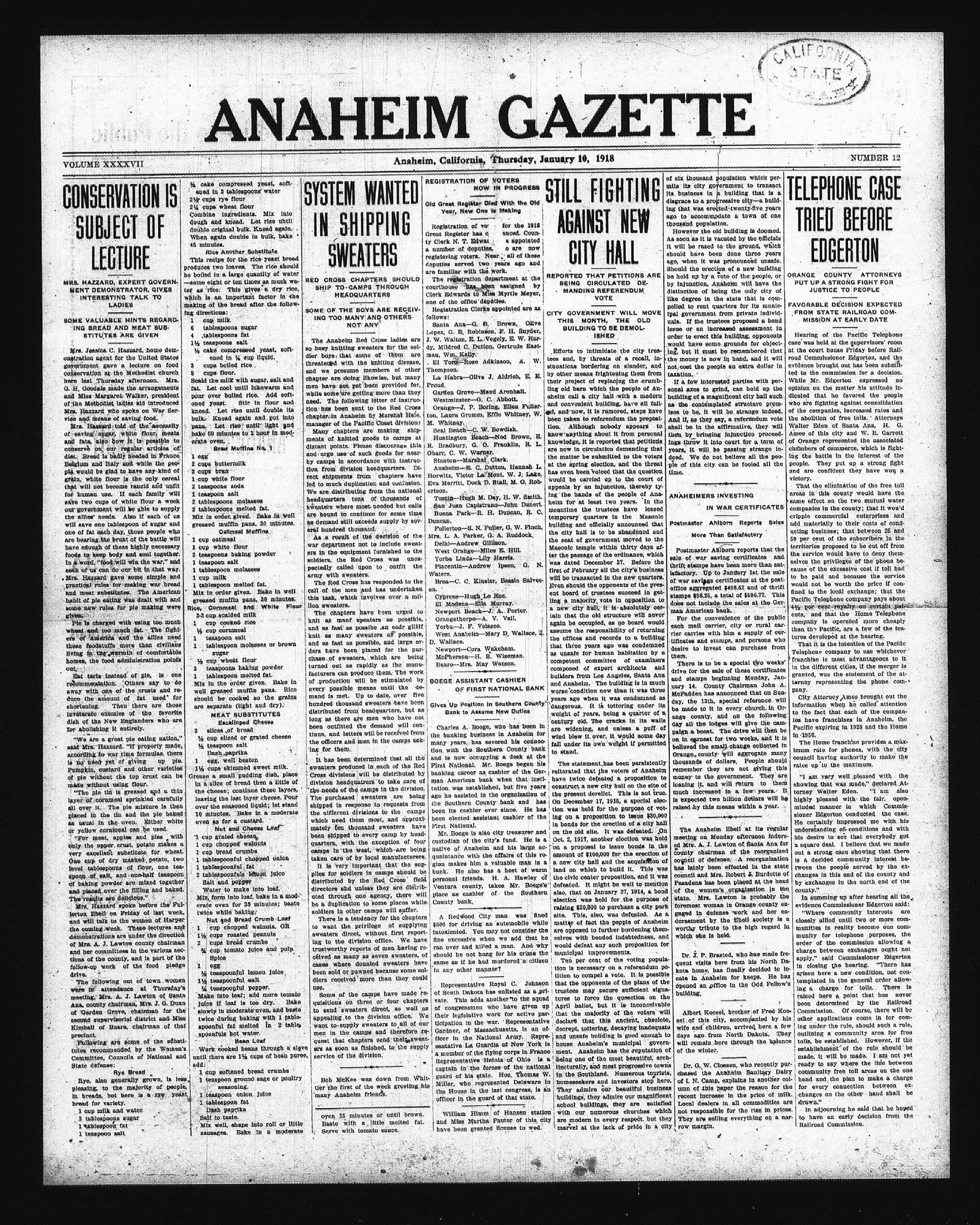
Searchable text
VOLUME XXXXVII
CONSERVATION IS SUBJECT OF LECTURE
MRS. HAZZARD, EXPERT GOVERNMENT DEMONSTRATOR, GIVES INTERESTING TALK TO LADIES
SOME VALUABLE HINTS REGARDING BREAD AND MEAT SUBSTITUTES ARE GIVEN
Mrs. Jessica C. Hazzard, home demonstration agent for the United States government gave a lecture on food conservation at the Methodist church here last Thursday afternoon. Mrs. G. H. Goodale made the arrangements and Miss Margaret Walker, president of the Methodist ladies aid introduced Mrs. Hazzard who spoke on War Service and means of saving food.
Mrs. Hazzard told of the necessity of saving sugar, white flour, meats and fats, also how it is possible to conserve on our regular articles of diet. Bread is badly needed in France.
½ cake compressed yeast, softened in 2 tablespoons water
2½ cups rye flour
2¼ cups wheat flour
Combine ingredients. Mix into dough and knead. Let rise until double original bulk. Knead again. When again double in bulk, bake 45 minutes.
Rice Another Substitute
This recipe for the rice-yeast bread produces two loaves. The rice should be boiled in a large quantity of water—some eight or ten times as much water as rice. This gives a dry rice, which is an important factor in the making of the bread after the following directions:
1 cup milk
6 tablespoons sugar
4 tablespoons fat
1½ teaspoons salt
½ cake compressed yeast, softened in ¼ cup liquid.
3 cups boiled rice
8 cups flour.
Scald the milk with sugar, salt and fat. Let cool until lukewarm and pour over boiled rice. Add softened yeast. Stir in flour and knead. Let rise until double its bulk. Knead again and put into pans. Let rise until light and bake 50 minutes to 1 hour in moderate oven.
Bran Muffins No. 1
1 egg
government gave a lecture on food conservation at the Methodist church here last Thursday afternoon. Mrs. G. H. Goodale made the arrangements and Miss Margaret Walker, president of the Methodist ladies aid introduced Mrs. Hazzard who spoke on War Service and means of saving food.
Mrs. Hazzard told of the necessity of saving sugar, white flour, meats and fats, also how it is possible to conserve on our regular articles of diet. Bread is badly needed in France Belgium and Italy and while the people would be glad to have any kind of grain, white flour is the only cereal that will not become rancid and unfit for human use. If each family will save two cups of white flour a week our government will be able to supply the allies' needs. Also if each of us will save one tablespoon of sugar and one of fat each day, those people who are bearing the brunt of the battle will have enough of these highly necessary foods to keep body and soul together. In a word, "food will win the war," and each of us can do our bit in that way. Mrs. Hazzard gave some simple and practical rules for making war bread and meat substitutes. The American habit of pie eating was dealt with and some new rules for pie making were given.
Pie is charged with using too much wheat and too much fat. The fighters of America and the allies need these foodstuffs more than civilians living in the warmth of comfortable homes, the food administration points out.
Eat tarts instead of pie, is one recommendation. Others say to do away with one of the crusts and reduce the amount of fat used for shortening. Then there are those inveterate enemies of the favorite dish of the New Englanders who are for abolishing it entirely.
"We are a great pie eating nation," said Mrs. Hazzard. "If properly made, according to war time formulas, there is no need yet of giving up pie. Pumpkin, custard and other varieties of pie without the top crust can be made without using flour.
"The pie tin is greased and a thin layer of cornmeal sprinkled carefully all over it. The pie mixture is then placed in the tin and the pie baked as usual in the oven. Either white or yellow cornmeal can be used."
"For meat, apples and pies with only the upper crust, potato makes a very excellent substitute for wheat. One cup of dry mashed potato, two cups boiled rice
8 cups flour.
Scald the milk with sugar, salt and fat. Let cool until lukewarm and pour over boiled rice. Add softened yeast. Stir in flour and knead. Let rise until double its bulk. Knead again and put into pans. Let rise until light and bake 50 minutes to 1 hour in moderate oven.
Bran Muffins No. 1
1 egg
2 cups buttermilk
2 cups bran
1 cup white flour
2 teaspoons soda
1 teaspoon salt
2 tablespoons molasses
2 tablespoons melted fat.
Mix in order given. Bake in well greased muffin pans, 30 minutes.
Oatmeal Muffins
1 cup oatmeal
1 cup white flour
3 teaspoons baking powder
1 teaspoon salt
1 tablespoon molasses
1 cup milk
1 tablespoon melted fat.
Mix in order given. Bake in well greased muffin pans, 30 minutes.
Rice, Cornmeal and White Flour
2-3 cup scalded milk
1 cup cooked rice
½ cup cornmeal
1 teaspoon salt
1 tablespoon molasses or brown sugar
½ cup wheat flour
3 teaspoons baking powder
1 tablespoon melted fat.
Mix in the order given. Bake in well greased muffin pans. Rice should be cooked so the grains are separate (light and dry).
MEAT SUBSTITUTES
Escalloped Cheese
3 slices of bread
½ cup sliced or grated cheese
½ teaspoon salt
Dash paprika
1 egg, well beaten
1½ cups skimmed sweet milk.
Grease a small pudding dish, place in a slice of bread then a little of the cheese; continue these layers, leaving the last layer cheese. Pour over the seasoned liquid; let stand 10 minutes. Bake in a moderate oven as for a custard.
Nut and Cheese Loaf
1 cup grated cheese
1 cup chopped walnuts
1 cup bread crumbs
1 tablespoonful chopped onion threatened with them and we presume no chapter are doing it men have not yet left while some are getting need. The following tion has been sent to chapter in Anaheim manager of the Pack.
Many chapters addments of knitted gird distant points. Please urge use of such by camps in accordance from division direct shipments from much duplicate We are distributing headquarters tens sweaters where most are bound to coat as demand still exceeds hundred thousands.
As a result of this war department notors in the equipment soldiers, the Redpectedly called upon army with sweaters.
The Red Cross has call of the men and this task, which includes sweaters.
The chapters have knit as manf spared and as fast as poss knit as many sweets and as fast as possders have been chase of sweaters, turned out as rap facturers can produce of production will every possible meet mand is met. Up hundred thousand distributed from long as there are been outfitted the tinue, and letters wthe officers and meeting for them.
It has been detected sweaters produced Cross divisions will division headquarter the needs of the ca The purchased sw shipped in response different division which need them mutely fen thousands been shipped to quarters, with the camps in the west taken care of by
Pumpkin, custard and other varieties of pie without the top crust can be made without using flour.
"The pie tin is greased and a thin layer of cornmeal sprinkled carefully all over it. The pie mixture is then placed in the tin and the pie baked as usual in the oven. Either white or yellow cornmeal can be used.
"For meat, apples and pies with only the upper crust, potato makes a very excellent substitute for wheat. One cup of dry mashed potato, two level tablespoons of flour, one teaspoon of salt, and one-half teaspoon of baking powder are mixed together and placed over the filling and baked. The results are delicious."
Mrs. Hazzard spoke before the Fullerton Ebell on Friday of last week, and will talk to the women of Harper the coming week. These lectures and demonstrations are under the direction of Mrs. A. J. Lawton county chairman and her committees in the various sections of the county, and is part of the follow-up work of the food pledge drive.
The following out of town women were in attendance at Thursday's meeting, Mrs. A. J. Lawton of Santa Ana, county chairman, Mrs. J. G. Dunn of Garden Grove, chairman for the second supervisorial district and Miss Kimball of Buara, chairman of that precinct.
Following are some of the substitutes recommended by the Women's Committee, Councils of National and State defense:
Rye Bread
Rye, also generally grown, is less pleasing, to the majority of people, in breads, but here is a rye yeast bread for variety.
1 cup milk and water
2 tablespoons sugar
1 tablespoon fat
1 teaspoon salt
Nut and Cheese Loaf
1 cup grated cheese
1 cup chopped walnuts
1 cup bread crumbs
1 tablespoonful chopped onion
1 tablespoonful fat
2 tablespoonful lemon juice
Salt and pepper
Water to make into loaf.
Mix form into loaf, bake in a moderate oven for 30 minutes; baste twice while baking.
Nut and Bread Crumb Loaf
1 cup chopped walnuts, OR
1½ cups roasted peanuts
2 cups bread crumbs
¾ cup tomato juice and pulp
Spice
1 egg
½ teaspoonful lemon juice
1½ teaspoonful salt
¼ teaspoonful pepper.
Make into loaf; add more tomato juice if loaf is too dry. Bake slowly in moderate oven, and baste twice during baking with 1 tablespoonful fat melted in 2 tablespoonfuls hot water.
Bean Loaf
Work cooked beans through a sieve until there are 1½ cups of bean puree, add:
1 cup softened bread crumbs
1 teaspoon ground sage or poultry seasoning.
1 teaspoon onion juice
1 tablespoon fat
Dash paprika
Salt to taste.
Mix well, shape into roll or little sausages. Bake in a moderate
AHEIM GAZETTE
Anaheim, California, Thursday, January 10, 1918
SYSTEM WANTED IN SHIPPING SWEATERS
RED CROSS CHAPTERS SHOULD SHIP TO-CAMPS THROUGH HEADQUARTERS
SOME OF THE BOYS ARE RECEIVING TOO MANY AND OTHERS NOT ANY
The Anaheim Red Cross ladies are so busy knitting sweaters for the soldier boys that some of them are threatened with the knitting disease, and we presume members of other chapter are doing likewise, but many men have not yet been provided for, while some are getting more than they need. The following letter of instruction has been sent to the Red Cross chapter in Anaheim by Marshal Hale, manager of the Pacific Coast division:
Many chapters are making shipments of knitted goods to camps at distant points. Please discourage this and urge use of such goods for near-
REGISTRATION OF VOTERS NOW IN PROGRESS
Old Great Register Died With the Old Year, New One is Making
Registration of voters for the 1918 Great Register has confirmed. County Clerk N. T. Edwars appointed a number of deputies, o are now registering voters. Near all of these deputies served two years ago and are familiar with the work.
The registration department at the courthouse has been assigned by Clerk Edwards to Miss Myrtle Meyer, one of the office deputies.
Registration Clerks appointed are as follows:
Santa Ana—G. B. Brown, Olive Lopez, G. E. Robinson, F. H. Snyder, J. W. Walton, E. L. Vegely, E. W. Hardy, Mildred C. Dutton, Gertrude Eastman, Wm. Kelly.
El Toro—Rose Adkinson, A. W. Thompson.
La Habra—Olive J. Aldrich, E. E. Proud.
Garden Grove—Maud Arohhalt.
Westminster—G. C. Abbott.
Orange—J. P. Boring, Ellen Fullerton, Laura Grumm, Effie Whitney, W. M. Whitney.
Seal Beach—C. W. Bowdish.
Huntington Beach—Ned Brown, E. R. Bradbury, G. O. Franklin, R. L. Obarr, C. W. Warner.
STILL FIGHTING AGAINST NEW CITY HALL
REPORTED THAT PETITIONS ARE BEING CIRCULATED DEMANDING REFERENDUM VOTE
CITY GOVERNMENT WILL MOVE THIS MONTH, THE OLD BUILDING TO BE DEMOLISHED
Efforts to intimidate the city trustees and, by threats of a recall, insinuations bordering on slander, and by other means frightening them from their project of replacing the crumbling old barn which the people of Anaheim call a city hall with a modern and convenient building, have all failed, and now, it is rumored, steps have been taken to referendum the proposition.
Although nobody appears to know anything about it from personal knowledge, it is reported that petitions are now in circulation demanding that the matter be submitted to the voters
and
hand
rift
ands
to
and
bedwells.
flour
wn
in
ice
drills
e
ace
of
sweaters,
four
and
rate
It has been determined that all the sweaters produced in each of the Red Cross divisions will be distributed by division headquarters to take care of the needs of the camps in the division. The purchased sweaters are being shipped in response to requests from the different divisions to the camps which need them most, and approximately ten thousand sweaters have been shipped to every camp by headquarters, with the exception of four camps in the west, which are being taken care of by local manufacturers.
It is very important that the sun threatened with the knitting disease, and we presume members of other chapter are doing likewise, but many men have not yet been provided for, while some are getting more than they need. The following letter of instruction has been sent to the Red Cross chapter in Anaheim by Marshal Hale, manager of the Pacific Coast division:
Many chapters are making shipments of knitted goods to camps at distant points. Please discourage this and urge use of such goods for nearby camps in accordance with instruction from division headquarters. Direct shipments from chapters have led to much duplication and confusion. We are distributing from the national headquarters tens of thousands of sweaters where most needed but calls are bound to continue for some time as demand still exceeds supply by several hundred thousand.
As a result of the decision of the war department not to include sweaters in the equipment furnished to the soldiers, the Red Cross was unexpectedly called upon to outfit the army with sweaters.
The Red Cross has responded to the call of the men and has undertaken this task, which involves over a million sweaters.
The chapters have been urged to knit as manufetters as possible, and as fast as possible, an eadr gliHf knit as many sweaters as possible, and as fast as possible, and large orders have been placed for the purchase of sweaters, which are being turned out as rapidly as the manufacturers can produce them. The work of production will be stimulated by every possible means until the demand is met. Up to date, over five hundred thousand sweaters have been distributed from headquarters, but as long as there are men who have not been outfitted the demand will continue, and letters will be received from the officers and men in the camps asking for them.
It has been determined that all the sweaters produced in each of the Red Cross divisions will be distributed by division headquarters to take care of the needs of the camps in the division. The purchased sweaters are being shipped in response to requests from the different divisions to the camps which need them most, and approximately ten thousand sweaters have been shipped to every camp by headquarters, with the exception of four camps in the west, which are being taken care of by local manufacturers.
It is very important that the sun threatened with the knitting disease, and we presume members of other chapter are doing likewise, but many men have not yet been provided for, while some are getting more than they need. The following letter of instruction has been sent to the Red Cross chapter in Anaheim by Marshal Hale, manager of the Pacific Coast division:
Many chapters are making shipments of knitted goods to camps at distant points. Please discourage this and urge use of such goods for nearby camps in accordance with instruction from division headquarters. Direct shipments from chapters have led to much duplication and confusion. We are distributing from the national headquarters tens of thousands of sweaters where most needed but calls are bound to continue for some time as demand still exceeds supply by several hundred thousand.
As a result of the decision of the war department not to include sweaters in the equipment furnished to the soldiers, the Red Cross was unexpectedly called upon to outfit the army with sweaters.
The Red Cross has responded to the call of the men and has undertaken this task, which involves over a million sweaters.
The chapters have been urged to knit as manufetters as possible, and as fast as possible, an eadr gliHf knit as many sweaters as possible, and as fast as possible, and large orders have been placed for the purchase of sweaters, which are being turned out as rapidly as the manufacturers can produce them. The work of production will be stimulated by every possible means until the demand is met. Up to date, over five hundred thousand sweaters have been distributed from headquarters, but as long as there are men who have not been outfitted the demand will continue, and letters will be received from the officers and men in the camps asking for them.
It has been determined that all the sweaters produced in each of the Red Cross divisions will be distributed by division headquarters to take care of the needs of the camps in the division. The purchased sweaters are being shipped in response to requests from the different divisions to the camps which need them most, and approximately ten thousand sweaters have been shipped to every camp by headquarters, with the exception of four camps in the west, which are being taken care of by local manufacturers.
It is very important that the sun threatened with the knitting disease, and we presume members of other chapter are doing likewise, but many men have not yet been provided for, while some are getting more than they need. The following letter of instruction has been sent to the Red Cross chapter in Anaheim by Marshal Hale, manager of the Pacific Coast division:
Many chapters are making shipments of knitted goods to camps at distant points. Please discourage this and urge use of such goods for nearby camps in accordance with instruction from division headquarters. Direct shipments from chapters have led to much duplication and confusion. We are distributing from the national headquarters tens of thousands of sweaters where most needed but calls are bound to continue for some time as demand still exceeds supply by several hundred thousand.
As a result of the decision of the war department not to include sweaters in the equipment furnished to the soldiers, the Red Cross was unexpectedly called upon to outfit the army with sweaters.
The Red Cross has responded to the call of the men and has undertaken this task, which involves over a million sweeters.
The chapters have been urged to knit as manufetters as possible, and as fast as possible, an eadr gliHf knit as many sweaters as possible, and as fast as possible, and large orders have been placed for the purchase of sweaters, which are being turned out as rapidly as the manufacturers can produce them. The work of production will be stimulated by every possible means until the demand is met. Up to date, over five hundred thousand sweaters have been distributed from headquarters, but as long as there are men who have not been outfitted the demand will continue, and letters will be received from the officers and men in the camps asking for them.
It has been determined that all the sweathers produced in each of the Red Cross divisions will be distributed by division headquarters to take care of the needs of the camps in the division. The purchased sweaters are being shipped in response to requests from the different divisions to the camps which need them most, and approximately ten thousand sweathers have been shipped to every camp by headquarters, with the exception of four camps in the west, which are being taken care of by local manufacturers.
It is very important that the sun threatened with the knitting disease, and we presume members of other chapter are doing likewise, but many men have not yet been provided for, while some are getting more than they need. The following letter of instruction has been sent to the Red Cross chapter in Anaheim by Marshal Hale, manager of the Pacific Coast division:
Many chapters are making shipments of knitted goods to camps at distant points. Please discourage this and urge use of such goods for nearby camps in accordance with instruction from division headquarters. Direct shipments from chapters have led to much duplication and confusion. We are distributing from the national headquarters tens of thousands of sweaters where most needed but calls are bound to continue for some time as demand still exceeds supply by several hundred thousand.
As a result of the decision of the war department not to include sweaters in the equipment furnished to the soldiers, the Red Cross was unexpectedly called upon to outfit the army with sweaters.
The Red Cross has responded to the call of the men and has undertaken this task, which involves over a million sweeters.
The chapters have been urged to knit as manufetters as possible, and as fast as possible, an eadr gliHf knit as many sweaters as possible, and as fast as possible, and large orders have been placed for the purchase of sweaters, which are being turned out as rapidly as the manufacturers can produce them. The work of production will be stimulated by every possible means until the demand is met. Up to date, over five hundred thousand sweaters have been distributed from headquarters, but as long as there are men who have not been outfitted the demand will continue, and letters will be received from the officers and men in the camps asking for them.
It has been determined that all the sweathers produced in each of the Red Cross divisions will be distributed by division headquarters to take care of the needs of the camps in the division. The purchased sweaters are being shipped in response to requests from the different divisions to the camps which need them most, and approximately ten thousand sweathers have been shipped to every camp by headquarters, with the exception of four camps in the west, which are being taken care of by local manufacturers.
It is very important that the sun threatened with the knitting disease, and we presume members of other chapter are doing likewise, but many men have not yet been provided for, while some are getting more than they need. The following letter of instruction has been sent to the Red Cross chapter in Anaheim by Marshal Hale, manager of the Pacific Coast division:
Many chapters are making shipments of knitted goods to camps at distant points. Please discourage this and urge use of such goods for nearby camps in accordance with instruction from division headquarters. Direct shipments from chapters have led to much duplication and confusion. We are distributing from the national headquarters tens of thousands of sweaters where most needed but calls are bound to continue for some time as demand still exceeds supply by several hundred thousand.
As a result of the decision of the war department not to include sweaters in the equipment furnished to the soldiers, the Red Cross was unexpectedly called upon to outfit the army with sweaters.
The Red Cross has responded to the call of the men and has undertaken this task, which involves over a million sweeters.
The chapters have been urged to knit as manufetters as possible, and as fast as possible, an eadr gliHf knit as many sweaters as possible, and as fast as possible, and large orders have been placed for the purchase of sweaters, which are being turned out as rapidly as the manufacturers can produce them. The work of production will be stimulated by every possible means until the demand is met. Up to date, over five hundred thousand sweathers have been distributed from headquarters, but as long as there are men who have not been outfitted the demand will continue, and letters will be received fromthe officers and men inthe camps askingforthem.
It has been determined that allthe sweathers producedin eachoftheRedCrossdivisionswillbedistributedbydivisionheadquarterstotakecareoftheneedsofthecampsinthenationismetupettingforthedemandismetupettingforthedemandismetupettingforthedemandismetupettingforthedemandismetupettingforthedemandismetupettingforthedemandismetupettingforthedemandismetupettingforthedemandismetupettingforthedemandismetupettingforthedemandismетupettingforthedemandismетupettingforthedemandismетupetting forthedemandismетupettingforthedemandismетupettingforthedemandismетupettingforthedemandismетupettingforthedemandismетupettingforthedemandismетupettingforthedemandismетupettingforthedemandismетupettingforthedemandismometopettingforthedemandismometopettingforthedemandismometopettingforthedemandismometopettingfortthedemandismometopettingfortthedemandismometopettingfortthedemandismometopettingfortthedemandismometopettingfortthedemandismometopettingfortthedemandismometopettingfortthedemandismometopettingfortthedemandismometopettingfortthedemandismometopetting fortthedemandismometopetting fortthedemandismometopetting fortthedemandismometopetting fortthedemandismometopetting fortthedemandismometopetting fortthe demandismometopetting fortthe demandismometopetting fortthe demandismometopetting fortthe demandismometopetting fortthe demandismometopetting fortthe demandismometopetting fortthe demandismometopetting fortthe demandismometopetting fortthe demandismometopetting fortthe demandismometopetting fortthe demandismometopetalternationismetupettingfortthedemandismometopetalternationismetupettingfortthedemandismometopetalternationismetupettingfortthedemandismometopetalternationismetupettingfortthedemandismometopetalternationismetupetting FortthedemandismometopetalternationismetupestingfortthedemandismometopetalternationismetupestingFortthedemandismometopetalternationismetupestingFortthedemandismusmetopetalternationismetupestingFortthedemandismusmetopetalternationismetupestingFortthedemandismusmetopetalternationismetupestingFortthedemandismusmetopetalternationismetupestingFortthedemandismusmetopetalternationismetupestingFortthedemandismusmetopetalternationismetupestingFortthedemandismusmetopetalternationismetuperationismetuperationismetuperationismetuperationisметuperationisметuperationisметuperationisметuperationisметuperationisметuperationisметuperationisметuperationisметuperationisметuperationisметuperationisметuperationisметuperationisметuperationisметuperationisметuperationisметuperationisметuperationisметuperationисметuperationисметuperationисметuperationисметuperationисметuperationисметuperationисметuperationисметuperationисметuperationисметuperationисметuperationисметuperationисметuperationисметuperationисметuperationисметuperationисметuperATIONисметuperацияисметuperацияисметyperацияисметyperацияисметyperацияисметyperацияисметyperацияисметyperацияисматериализацияисматериализацияисматериализацияисматериализацияисматериализацияисматериализацияисматериализацияисматериализацияисматериализацияисматериализацияисматериализацияисматериализациюисматерилизализацииматерилизализацииматтеризализацииматтеризisationsматтеризisationsматтеризisationsматтеризisationsматтеризisationsматтеризisationsматтеризisationsматтеризisationsматтеризisationsматтеризisationsматтеризisationsматтеризisationsматтеризisationsматтеризisationsматтеризisationsматтеризisationsматтеризisationsматтеризisationsматынализизацииматынализizationsматынализizationsматынализizationsматынализizationsматынализizationsматынализizationsматынализizationsматынализizationsматынализizationsматынализizationsматынализizationsматынализizationsматынализizationsматыннизализацииматыннизализацииматыннизализацииматыннизализацииматыннизализацииматыннизализацииматыннизализацииматыннизализацииматыннизализацииматыннизализацииматыннизализацииматыннизализацииматыннизализацииматыннизализацииматыннизализациимытеризизациимытеризisationsмытеризisationsмытеризisationsмытеризisationsмытеризisationsмытеризisationsмытеризisationsмытеризisationsмытеризisationsмытеризisationsмытеризisationsмытеризisationsмытеризisationsмытеризisationsмытеризisationsмытеризisationsмытеризisationsмытеризisationsмытеризisationsмытертинозизациимытертинозizioniмытертинозizioniмытертинозizioniмытертинозizioniмытертинозizioniмытертинозizioniмытертинозizioniмытертинозizioniмытертинозizioniмытертинозizioniмытертинозizioniмытертинозizioniмытертінозazioniмытертінозazioniме士отринг,introduction,introduction,introduction,introduction,introduction,introduction,introduction,introduction,introduction,introduction,introduction,introduction,introduction,introduction,introduction,introduction,introduction,introduction,introduction,introduction,introduction,introduction,introduction,introduction,introduction,introduction,introduction,introduction,introduction,introduction,introduction,introduction,introduction,introduction,introduction,introduction,introduction,introduction,introduction,introduction.introduccion,introduccion,introduccion,introduccion,introduccion,introduccion,introduccion,introduccion,introduccion,introduccion,introduccion,introduccion,introduccion,introduccion,introduccion,introduccion,introduccion,introduccion,introduccion,introduccion,introduccion,introduccion,introduccion,introduccion,introduccion,introduccion,introduccion.introduccion.introduccion.introduccion.introduccion.introduccion.introduccion.introduccion.introduccion.introduccion.introduccion.introduccion.introduccion.introduccion.introduccion.introduccion.introduccion.introduccion.introduccion.introduccion.introduccion.introduccion.introducciónintroducciónintroducciónintroducciónintroducciónintroducciónintroducciónintroducciónintroducciónintroducciónintroducciónintroducciónintroducciónintroducciónintroducciónintroducciónintroducciónintroducciónintroducciónintroducciónintroducciónintproducciónintproducciónintproducciónintproducciónintproducciónintproducciónintproducciónintproduciónintproducciónintproduciónintproduciónintproduciónintproduciónintproduciónintproduciónintproduciónintproduciónintproduciónintproduciónintproduciónintproduciónintproduciónintproduciónintprodución(intproducciónintprodución(intproducciónintprodución(intproducciónintprodución(intproducciónintprodución(intproducciónintprodución(intproducciónintprodución(intproducciónintprodución(intproducciónintprodución(intproducciónintprodución(intproducciónintprodución(intproducciónintprodución(intproducción intprodución intprodución intprodución intprodución intprodución intprodución intprodución intprodución intprodución intprodución intprodución intprodución intprodución intprodución intproducion intproducion intproducion intproducion intproducion intproducion intproducion intproducion intproducion intproducion int producion int producion int producion int producion int producion int producion int producion int producion int producion int producion int producion int producion int producion int producion int producion int producion int producion int producion int producion int producion int producion int producion int producion int producion int producion int producion int producion int produciones int produciones int produciones int produciones int produciones int produciones int produciones int produciones int produciones int produciones int produciones int produciones int producciones int produciones int produciones int produciones int produciones int produciones int produciones int produciones int produciones INTProductionsINTProductionsINTProductionsINTProductionsINTProductionsINTProductionsINTProductionsINTProductionsINTProductionsINTProductionsINTProductionsINTProductionsINTProductionsINTProductionsINTProductionsINTProductionsINTProductionsINTProductionsINTProductionsINTProductionsINTProductionsINTProductionsINTProductionsINTProductionsINTProductionsINTProductionsINTProductionsINTProductionsINTProductionsINTProductionsINTProductionsINTProductionsINTProductionsINTProduccionesINTProduccionesINTProduccionesINTProduccionesINTProduccionesINTProduccionesINTProduccionesINTProduccionesINTProduccionesINTProduccionesINTProduccionesINTProduccionesINT Producciones INT Producciones INT Producciones INT Producciones INT Producciones INT Producciones INT Producciones INT Producciones INT Producciones INT Producciones INT Producciones INT Producciones INT Producciones INT Producciones INT Producciones INT Producciones INT Producciones INT Producciones INT Producciones INT Producciones INT Producciones INT Producciones INT Producciones INT Producciones INT Producciones INT Producciones INT Producciones INT Producciones INT Producciones INT Producciones INT Producciones INT Producciones INT Producciones INT Producciones INT Producciones INT Producciones INT Producciones INT Producciones INT Producciones INT Producciones INT Producciones INT Producciones INT Produuciones INT Produuciones INT Produuciones INT Produuciones INT Produuciones INT Produuciones INT Produuciones INT Produuciones INT Produuciones INT Produuciones INT Produuciones INT Produuciones INT Produuciones INT Produuciones INT Produuciones_INTProduuciones_INTProduuciones_INTProduuciones_INTProduuciones_INTProduuciones_INTProduuciones_INTProduuciones_INTProduuciones_INTProduuciones_INTProduuciones_INTProduuciones_INTProduuciones_INTProduuciones_INTProduuciones_INTProduuciones_INTProduuciones_INTProduuciones_INTProduuciones_INTProduuciones_INTProduuciones_INTProduuciones_INTProduciones_INTProduciones_INTProduciones_INTProduciones_INTProduciones_INTProduciones_INTProduciones_INTProduciones_INTProduciones_INTProduciones_INTProduciones_INTProduciones_INTProduciones_INTProduciones_INTProduciones_INTProduciones_INTProduciones_INTProduciones_INTProduciones_INTProduciones_INTProduciones_INTProduciones_INTProduciones_INTProduciones_INTProducionesIntProducionesIntProducionesIntProducionesIntProducionesIntProducionesIntProducionesIntProducionesIntProducionesIntProducionesIntProducionesIntProducionesIntProducionesIntProducionesIntProducionesIntProducionesIntProducionesIntProducionesIntProducionesIntProducionesIntProducionesIntProducionesIntProducionesIntProduconesIntProduconesIntProduconesIntProduconesIntProduconesIntProduconesIntProduconesIntProduceIntProduceIntProduceIntProduceIntProduceIntProduceIntProduceIntProduceIntProduceIntProduceIntProcereIntProcereIntProcereIntProcereIntProcereIntProcereIntProcereIntProcereIntProcereIntProcereIntProcereIntelIntelIntelIntelIntelIntelIntelIntelIntelIntelIntelIntelIntelIntelIntelIntelIntelIntelIntelIntelIntelIntelIntelIntelIntelIntelIntelIntelIntelIntelIntelIntelIntelIntelIntelIntelIntelIntelIntelIntelIntelIntelIntelIntelIntelIntel IntelIntelIntelIntelIntelIntelIntelIntelIntelIntelIntelIntelIntelIntelIntel Intel Intel Intel Intel Intel Intel Intel Intel Intel Intel Intel Intel Intel Intel Intel Intel Intel Intel Intel Intel Intel Intel Intel Intel Intel Intel Intel Intel Intel Intel Intel Intel Intel Intel Intel Intel Intel Intel Intel Intel Intel Intel Intel Intel Intel Intel Intel Intel Intel Intel Intel Intel Intel Intel Intel Intel Intel Intel Intel Intel Intel Intel Intel Intel Intel Intel Intel Intel Intel Intel Intel Intel Intel Intel Intel Intel Intel ElectricalElectricalElectricalElectricalElectricalElectricalElectricalElectricalElectricalElectricalElectricalElectricalElectricalElectricalElectricalElectricalElectricalElectricalElectricalElectricalElectricalElectricalElectricalElectricalElectricalElectricalElectricalElectricalElectricalElectricalElectricalElectricalElectricalElectricalElectricalElectricalElectricalElectricalElectricalElectricalElectricalElectricalElectricalElectricalElectricalElectricalElectricalElectricalElectricalElectricallyElectricallyElectricallyElectricallyElectricallyElectricallyElectricallyElectricallyElectricallyElectricallyElectricallyElectricallyElectricallyElectricallyElectricallyElectricallyElectricallyElectricallyElectricallyElectricallyElectricallyElectricallyElectricallyElectricallyElectricallyElectricallyElectricallyElectricallyElectricallyElectricallyElectricallyElectricallyElectricallyElectricallyExtractExtractExtractExtractExtractExtractExtractExtractExtractExtractExtractExtractExtractExtractExtractExtractExtractExtractExtractExtractExtractExtractExtractExtractExtractExtractExtractExtractExtractExtractExtractExtractExtractExtractExtractExtractExtractExtractExtract ExtractionExtractionExtractionExtractionExtractionExtractionExtractionExtractionExtractionExtractionExtractionExtractionExtractionExtractionExtractionExtensionsExtensionsExtensionsExtensionsExtensionsExtensionsExtensionsExtensionsExtensionsExtensionsExtensionsExtensionsExtensionsExtensionsExtensionsExtensionsExtensionsExtensionsExtensionsExtensionsExtensionsExtensionsExtensionsExtensionsExtensionsExtensionsExtensionsExtensionsExtensionsExtensionsExtensionsExtensionsExtensionsExtensionsExtensionsExtensionsExtensionsExtensionsExtensionsExtensionsExtensionsExtensionsExtensionsExtensionsExtensionsExtensionsExtensionsExtensionsExtensionsExtensionsExtensionsExtensionsExtensionsExtensionsExtensionsExtensionsExtensionsExtensionsExtensionsExtensionsExtensionsExtensionsExtensionsExtensionsExtensionsExtensionsExtensionsExtensionExtensionExtensionExtensionExtensionExtensionExtensionExtensionExtensionExtensionExtensionExtensionExtensionExtensionExtensionExtensionExtensionExtensionExtensionExtensionExtensionExtensionExtensionExtensionExtensionExtensionExtensionExtensionExtensionExtensionExtensionExtensionExtensionExtensionExtensionExtensionExtensionExtensionExtensionExtensionExtensionExtensionExtensionExtensionExtensionExtensionExtensionExtension ExtensionExtensionExtensionExtensionExtensionExtensionExtensionExtensionExtensionCompletionCompletionCompletionCompletionCompletionCompletionCompletionCompletionCompletionCompletionCompletionCompletionCompletionCompletionCompletionCompletionCompletionCompletionCompletionCompletionCompletionCompletionCompletionCompletionCompletionCompletionCompletionCompletionCompletionCompletionCompletionCompletionCompletionCompletionCompletionCompletionCompletionCompletionCompletionCompletionCompletionCompletionCompletionCompletionCompletionCompletionCompletionCompletionCompletionCompletionCompletionCompletionCompletionCompletionCompletionCompletionCompletionCompletionCompletionCompletionCompletionCompletionCompletionCompletionCompletionCompletionCompletionCompletedCompletionCompletedCompletionCompletedCompletionCompletedCompletionCompletedCompletionCompletedCompletionCompletedCompletionCompletedCompletionCompletedCompletionCompletedCompletionCompletedCompletionCompletedCompletionCompletedCompletionCompletedCompletionCompletedCompletionCompletedCompletionCompletedCompletionCompletedComclusionCompletedComclusionCompletedComclusionCompletedComclusionCompletedComclusionCompletedComclusionCompletedComclusionCompletedComclusionCompletedComclusionCompletedComclusionCompletedComclusionCompletedComclusionCompletedComclusionCompletedComclusionCompletedComclusionCompletedComclusionCompleted CompletionCompletedCompletionCompletedCompletionCompletedCompletionCompletedCompletionCompletedCompletionCompletedCompletionCompletedCompletionCompletedCompletionCompletedCompletionCompletedCompletionCompletedCompletionCompletedCompletionCompletedCompletionCompletedComclusionCompletedComclusion completedComclusion completedComclusion completedComclusion completedComclusion completedComclusion completedComclusion completedComclusion completedComclusion completedComclusion completedComclusion completedComclusion completedComclusion completedComclusion completedComclusion completedComclusion completedComclusion completedComclusion completedComclusion completedComclusion completedComclusion completedComclusion completedComclusion completedComclusion completedComclusion completedComclusion completedComclusion completedComclusion completedComclusion completedComclusion completedComposition completedComposition completedComposition completedComposition completedComposition completedComposition completedComposition completedComposition completedComposition completedComposition completedComposition completed Composition completed Composition completed Composition completed Composition completed Composition completed Composition completed Composition completed Composition completed Composition completed Composition completed Composition completed Composition completed Composition completed Composition completed Composition completed Composition completed Composition completed Compositionpleted Compositionpleted Compositionpleted Compositionpleted Compositionpleted Compositionpleted Compositionpleted Compositionpleted Compositionpleted Compositionpleted Compositionpleted Compositionpleted Compositionduled Compositionduled Compositionduled Compositionduled Compositionduled Compositionduled Compositionduled Compositionduled Compositionduled Compositionduled Compositionduled Compositionduled Compositionduled Compositionduled Compositionduled Compositionduled Compositionduled Compositionduled Compositionduled Compositionduled Composition scheduled Composition scheduled Composition scheduled Composition scheduled Composition scheduled Composition scheduled Composition scheduled Composition scheduled Composition scheduled Composition scheduled Composition scheduled Composition scheduled Composition scheduled Composition scheduled Composition scheduled Composition scheduled Composition scheduled Composition scheduled Composition scheduled
Cross divisions will be distributed by division headquarters to take care of the needs of the camps in the division. The purchased sweaters are being shipped in response to requests from the different divisions to the camps which need them most, and approximately ten thousand sweaters have been shipped to every camp by headquarters, with the exception of four camps in the west, which are being taken care of by local manufacturers.
It is very important that the supplies for soldiers in camps should be distributed by the Red Cross field directors and unless they are distributed through one agency, there will be a duplication to some places while soldiers in other camps will suffer.
There is a tendency for the chapters to want the privilege of supplying sweaters direct, without first reporting to the division office. We have trustworthy reports of men having received as many as seven sweaters, of cases where donated sweaters have been sold or pawned because some soldiers received more than they could use.
Some of the camps have made requisitions on three or four chapters to send sweaters direct, as well as appealing to the division office. We want to supply sweaters to all of our men in the camps and therefore request that chapters send their sweaters as soon as finished, to the supply service of the division.
Bob McKee was down from Whittier the first of the week greeting his many Anaheim friends.
Representative Royal C. Johnson of South Dakota has enlisted as a private. This adds another to the squad of congressmen who have given up their legislative work for active participation in the war. Representative Gardner, of Massachusetts, is an officer in the National Army. Representative La Guardia of New York is a member of the flying corps in France. Representative Heintz of Ohio is a captain in the forces of the national guard of his state. Hon. Thomas W. Miller, who represented Delaware in the House in the last congress, is an officer in the guard of that state.
William Himm of Hansen station and Miss Martha Pauter of this city have been granted license to wed.
reiterated that the voters of Anaheim have twice defeated a proposition to construct a new city hall on the site of the present derelict. This is not true. On December 17, 1915, a special election was held for the purpose of voting on a proposition to issue $30,000 in bonds for the erection of a city hall on the old site. It was defeated. On Oct. 2, 1917, another election was held on a proposal to issue bonds in the amount of $100,000 for the erection of a new city hall and the acquisition of land on which to build it. This was the civic center proposition, and it was defeated. It might be well to mention also that on January 27, 1914, a bond election was held for the purpose of raising $20,000 to purchase a city park site. This, also, was defeated. As a matter of fact the people of Anaheim are opposed to further burdening themselves with bonded indebtedness, and would defeat any such proposition for municipal improvements.
Ten per cent of the voting population is necessary on a referendum petition to compel a vote. It is possible that the opponents of the plans of the trustees may secure sufficient signatures to force the question on the April ballot, but it is inconceivable that the majority of the voters will declare that this ancient, obsolete, decrept, tottering, decaying inadequate and unsafe building is good enough to house Anaheim's municipal government. Anaheim has the reputation of being one of the most beautiful architecturally, and most progressive towns in the Southland. Numerous tourists, homeseekers and investors stop here. They admire our beautiful business buildings; they admire our magnificent school buildings; they are satisfied with our numerous churches which are modern in every respect, but they marvel at the lack of pride in a city banking career as cashier of the German American bank when that institution was established, but five years ago he assisted in the organization of the Southern County bank and has been its cashier ever since. He has been elected assistant cashier of the First National.
Mr. Boege is also city treasurer and custodian of the city's fund. He is a native of Anaheim and his large acquaintance with the affairs of this region makes him a valuable man in a bank. He also has a host of warm personal friends. H. A. Hawley of Ventura county, takes Mr. Boege's place as cashier of the Southern County bank.
Bob McKee was down from Whittier the first of the week greeting his many Anaheim friends.
oyen 25 minutes or until brown.
Baste with a little melted fat.
Serve with tomato sauce.
LIGHTING FOR NEW HALL
PETITIONS ARE RATED DEPRENDUM
WILL MOVE THE OLD DEMOLthe city truss of a recall, in-ion slander, and ening them from crumbwith a modern ing, have all fail-ored, steps have sum the proposidy appears to it from personal sed that petitions demanding that
led to the voters
of six thousand population which permits its city government to transact its business in a building that is a disgrace to a progressive city—a build-ing that was erected twenty-five years ago to accommodate a town of one thousand population.
However the old building is doomed. As soon as it is vacated by the officials it will be razed to the ground, which should have been done three years ago, when it was pronounced unsafe. Should the erection of a new building be held up by a vote of the people, or by injunction, Anaheim will have the distinction of being the only city of like degree in the state that is compelled to rent quarters for its municipal government from private individuals. If the trustees proposed a bond issue or an increased assessment in order to erect this building, opponents would have some grounds for objecting, but it must be remembered that the money is now in hand, and it will not cost the people an extra dollar in taxation.
If a few interested parties with personal axes to grind, can hold up the building of a magnificent city hall such as the contemplated structure promises to be, it will be strange indeed. And if, as they say, a referendum vote shall be in the affirmative, they will then by bringing injunction proceedings throw it into court for a term of years, it will be passing strange indeed. We do not believe all the neo-
TELEPHONE CASE TRIED BEFORE EDGERTON
ORANGE COUNTY ATTORNEYS PUT UP A STRONG FIGHT FOR JUSTICE TO PEOPLE
FAVORABLE DECISION EXPECTED FROM STATE RAILROAD COMMISSION AT EARLY DATE
Hearing of the Pacific Telephone case was held at the supervisors' room at the court house Friday before Railroad Commissioner Edgerton, and the evidence brought out has been submitted to the commission for a decision. While Mr. Edgerton expressed no opinion on the matter his attitude indicated that he favored the people who are fighting against consolidation of the companies, increased rates and the abolition of free tolls. Attorneys Walter Eden of Santa Ana, H. G. Ames of this city and W. R. Garrett of Orange represented the associated chambers of commerce, which is fighting the battle in the interest of the
ANAHEIMERS INVESTING
IN WAR CERTIFICATES
Postmaster Ahlborn Reports Sales
More Than Satisfactory
Postmaster Ahlborn reports that the sale of war saving certificates and thrift stamps have been more than satisfactory. Up to January 1st the sale of war savings certificates at the post office aggregated $498.52 and of thrift stamps $98.25, a total of $596.77. This does not include the sales at the German American bank.
For the convenience of the public each mail carrier, city or rural carrier carries with him a supply of certificates and stamps, and persons who desire to invest can purchase from them.
There is to be a special two weeks' drive for the sale of these certificates and stamps beginning Monday, January 14. County Chairman John A. McFadden has announced that on Sunday, the 13th, special reference will be made to it in every church in Orange county, and on the following day all the lodges will give the campaign a boost. The drive will then be on in earnest for two weeks, and it is believed the small change collected in Orange county will aggregate many thousands of dollars. People should remember they are not giving this money to the government. They are loaning it, and will return to them much increased in a few years. It is expected two billion dollars will be raised by this means within a year.
The Anaheim Ebell at its regular meeting on Monday afternoon indorsed Mrs. A. J. Lawton of Santa Ana for county chairman of the reorganized council of defense. A reorganization evidence brought out has been submitted to the commission for a decision. While Mr. Edgerton expressed no opinion on the matter his attitude indicated that he favored the people who are fighting against consolidation of the companies, increased rates and the abolition of free tolls. Attorneys Walter Eden of Santa Ana, H. G. Ames of this city and W. R. Garrett of Orange represented the associated chambers of commerce, which is fighting the battle in the interest of the people. They put up a strong fight and are confident they have won a victory.
That the elimination of the free toll areas in this county would have the same effect on the two mutual water companies in the county; that it would cripple commercial enterprises and add materially to their costs of conducting business; that between 25 and 50 per cent of the subscribers in the territories proposed to be cut off from the service would have to deny themselves the privileges of the phone because of the excessive cost if toll had to be paid and because the service would not be worth the price if confined to the local exchange; that the Pacific Telephone company pays about 4½ per cent royalty on certain patients, and that the Home Telephone company is operated more cheaply than the Pacific, are a few of the features developed at the hearing.
That it is the intention of the Pacific Telephone company to use whichever franchise is most advantageous to it in the different cities, if the merger is granted, was the statement of the attorney representing the phone company.
City Attorney Ames brought out the information when he called attention to the fact that each of the companies have franchises in Anaheim, the Pacific expiring in 1928 and the Home in 1956.
The Home franchise provides a maximum rate for phones, with the city council having authority to make the rates up to the maximum.
"I am very well pleased with the showing that was made," declared Attorney Walter Eden. "I am also highly pleased with the fair, open-minded manner in which Commissioner Edgerton conducted the case. He certainly impressed me with his understanding of conditions and with his desire to see that everybody got a square deal. I believe that we made out a strong case showing that there is a decided community interest be-
The Anaheim Ebell at its regular meeting on Monday afternoon indorsed Mrs. A. J. Lawton of Santa Ana for county chairman of the reorganized council of defense. A reorganization has lately been effected in the state council and Mrs. Robert J. Burdette of Pasadena has been placed at the head of the women's organization in the state. Mrs. Lawton is probably the foremost woman in Orange county engaged in defense work and her endorsement by the Ebell society is a worthy tribute to the high regard in which she is held.
Dr. J. P. Brasted, who has made frequent visits here from his North Dakota home, has finally decided to locate in Anaheim for keeps. He has opened an office in the Odd Fellow's building.
Albert Koesel, brother of Fred Koesel of this city, accompanied by his wife and children, arrived here a few days ago from North Dakota. They will remain here through the balance of the winter.
Dr. G. W. Clossen, who recently purchased the Anaheim Sanitary Dairy of I. N. Camp, explains in another column of this paper the reason for the recent increase in the price of milk. Local dealers in all commodities are not responsible for the rise in prices. They are selling everything on a narrow margin.
"I am very well pleased with the showing that was made," declared Attorney Walter Eden. "I am also highly pleased with the fair, open-minded manner in which Commissioner Edgerton conducted the case. He certainly impressed me with his understanding of conditions and with his desire to see that everybody got a square deal. I believe that we made out a strong case showing that there is a decided community interest between the people served by the exchanges in this end of the county and by exchanges in the north end of the county."
In summing up after hearing all the evidence Commissioner Edgerton said:
"Where community interests are closely allied until two or more communities in reality become one community for telephone purposes, the order of the commission allowing a charge between exchanges ought not apply," said Commissioner Edgerton in closing the hearing. "There has arisen here a new condition, not contemplated in the general order allowing a charge for tolls. There is raised here a point that has never been determined by the Railroad Commission. Of course, there will be other applications come in for coming under the rule, should such a rule, outlining a community area for free tolls, be established. However, if the establishment of the rule should be made, it will be made. I am not yet ready to say where the line between community free toll areas on the one hand and the plan to make a charge for every connection between exchanges on the other hand shall be drawn."
In adjourning he said that he hoped to have an early decision from the Railroad Commission.