anaheim-gazette 1917-11-01
Scanned page
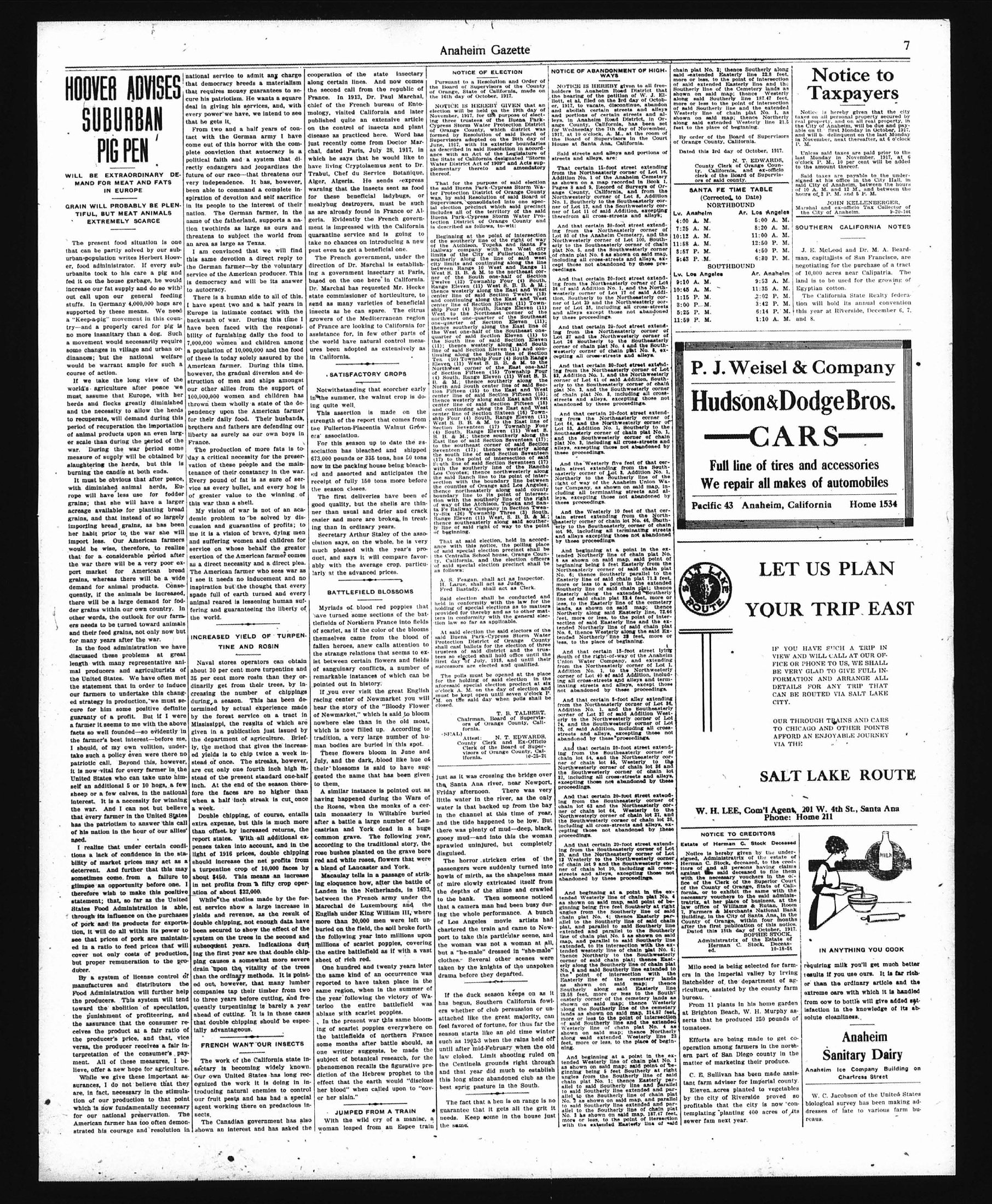
Searchable text
HOOVER ADVISES
SUBURBAN
PIG PEN
WILL BE EXTRAORDINARY DEMAND FOR MEAT AND FATS IN EUROPE
GRAIN WILL PROBABLY BE PLENTIFUL, BUT MEAT ANIMALS EXTREMELY SCARCE
The present food situation is one that can be partly solved by our suburban population writes Herbert Hoover, food administrator. If every suburbanite took to his care a pig and fed it on the house garbage, he would increase our fat supply and do so without call upon our general feeding stuffs. In Germany 4,000,000 hogs are supported by these means. We need a "Keep-a-pig" movement in this country—and a properly cared for pig is no more insanitary than a dog. Such a movement would necessarily require some changes in village and urban ordinances; but the national welfare would be warrant ample for such a course of action.
If we take the long view of the world's agriculture after peace we must assume that Europe, with her herds and flocks greatly diminished and the necessity to allow the herds to recuperate, will demand during this period of recuperation the importation of animal products upon an even larger scale than during the period of the war. During the war period some national service to admit any charge that democracy breeds a materialism that requires money guarantees to secure his patriotism. He wants a square deal in giving his services, and, with every power we have, we intend to see that he gets it.
From two and a half years of contact with the German army I have come out of this horror with the complete conviction that autocracy is a political faith and a system that directly endangers and jeopardizes the future of our race—that threatens our very independence. It has, however, been able to command a complete inspiration of devotion and self sacrifice in its people to the interest of their nation. The German farmer, in the name of the fatherland, supports a nation twothirds as large as ours and threatens to subject the world from an area as large as Texas.
I am convinced that we will find this same devotion a direct reply to the German farmer—by the voluntary service of the American producer. This is democracy and will be its answer to autocracy.
There is a human side to all of this. I have spent two and a half years in Europe in intimate contact with the backwash of war. During this time I have been faced with the responsibility of furnishing daily the food to 7,000,000 women and children among a population of 10,000,000 and the food of these is today solely assured by the American farmer. During this time, however, the gradual diversion and destruction of men and ships amongst our other allies from the support of 100,000,000 women and children has thrown them wholly a state of the dependency upon the American farmer for their daily food. Their husbands, brothers and fathers are defending our liberty as surely as our own boys in France.
cooperation of the second call from France. In 1913, D. chief of the French mology, visited Calais published quite an article on the control of disease as practiced just recently come in chal, dated Paris, which he says that he have living Cryptolai Trabut, Chef du Seal Alger, Algeria. He warning that the insistence for these beneficial mealybug destroyers as are already found geria. Evidently the moment is impressed with quarantine service we take no chances on the pest even to get a beetle.
The French government direction of Dr. Manning a government based on the one by Dr. Marchal has requested state commissioner send as many variegated insects as he can growers of the Meadow of France are looking assistance for, in fear the world have natures been adopted in California.
SATISFACTORY
Notwithstanding tilt in the summer, the ing quite well.
This assertion strength of the report the Fullerton-Placerers' association.
For this season
but the national welfare would be warrant ample for such a course of action.
If we take the long view of the world's agriculture after peace we must assume that Europe, with her herds and flocks greatly diminished and the necessity to allow the herds to recuperate, will demand during this period of recuperation the importation of animal products upon an even larger scale than during the period of the war. During the war period some measure of supply will be obtained by slaughtering the herds, but this is burning the candle at both ends.
It must be obvious that after peace, with diminished animal herds, Europe will have less use for fodder grains; that she will have a larger acreage available for planting bread grains, and that instead of so largely importing bread grains, as has been her habit prior to the war she will import less. Our American farmers would be wise, therefore, to realize that for a considerable period after the war there will be a very poor export market for American bread grains, whereas there will be a wide demand for animal products. Consequently, if the animals be increased, there will be a large demand for fodder grains within our own country. In other words, the outlook for our farmers needs to be turned toward animals and their feed grains, not only now but for many years after the war.
In the food administration we have discussed these problems at great length with many representative animal producers and agriculturists of the United States. We have often met the statement that in order to induce our farmers to undertake this changed strategy in production, we must secure for him some positive definite guaranty of a profit. But if I were a farmer it seems to me with the above facts so well founded—so evidently in the farmer's best interest—before me, I should, of my own volition, undertake such a policy even were there no patriotic call. Beyond this, however, it is now vital for every farmer in the United States who can take unto himself an additional 5 or 10 hogs, a few sheep or a few calves, in the national interest. It is a necessity for winning the war. And I can not but believe that every farmer in the United States has the patriotism to answer this call of his nation in the hour of our allies' need.
I realize that under certain conditions of these is today solely assured by the American farmer. During this time, however, the gradual diversion and destruction of men and ships amongst our other allies from the support of 100,000,000 women and children has thrown them wholly a state of the dependency upon the American farmer for their daily food. Their husbands, brothers and fathers are defending our liberty as surely as our own boys in France.
The production of more fats is today a critical necessity for the preservation of these people and the maintenance of their constancy in the war. Every pound of fat is as sure of service as every bullet, and every hog is of greater value to the winning of this war than a shell.
My vision of war is not of an academic problem to be solved by discussion and guarantees of profits; to me it is a vision of brave, dying men and suffering women and children for service on whose behalf the greater exertion of the American farmer comes as a direct necessity and a direct plea. The American farmer who sees war as I see it needs no inducement and no inspiration but the thought that every spade full of earth turned and every animal reared is lessening human suffering and guaranteeing the liberty of the world.
INCREASED YIELD OF TURPENTINE AND ROSIN
Naval stores operators can obtain about 30 per cent more turpentine and 35 per cent more rosin than they ordinarily get from their trees, by increasing the number of chippings during a season. This has been determined by actual experience made by the forest service on a tract in Mississippi, the results of which are given in a publication just issued by the department of agriculture. Briefly, the method that gives the increased yields is to chip twice a week instead of once. The streaks, however, are cut only one fourth inch high instead of the present standard one-half inch. At the end of the season therefore the faces are no higher than when a half inch streak is cut once a week.
Double chipping, of course, entails extra expense, but this is much more than offset by increased returns, the report states. With all additional expenses taken into account, and in the
I realize that under certain conditions a lack of confidence in the stability of market prices may act as a deterrent. And further that this may sometimes come from a failure to glimpse an opportunity before one. I therefore wish to make this positive statement; that, so far as the United States Food Administration is able, through its influence on the purchases of pork and its products for exportation, it will do all within its power to see that prices of pork are maintained in a ratio to feed prices that will cover not only costs of production, but proper remuneration to the producer.
By a system of license control of manufactures and distributors the Food Administration will further help the producers. This system will tend toward the abolition of speculation, the punishment of profiteering, and the assurance that the consumer receives the product at a fair ratio of the producer's price, and that, vice versa, the producer receives a fair interpretation of the consumer's payment. All of these measures, I believe, offer a new hope for agriculture.
While we give these important assurances, I do not believe that they are, in fact, necessary in the stimulation of our production to that point which is now fundamentally necessary for our national preservation. The American farmer has too often demonstrated his courage and resolution in
FRENCH WANT OUR INSECTS
The work of the California state insectary is becoming widely known. Our own United States has long recognized the work it is doing in introducing natural enemies to control our fruit pests and has had a special agent working there on predacious insects.
The Canadian government has also shown an interest and has asked the
Anaheim Gazette
cooperation of the state insectary along certain lines. And now comes the second call from the republic of France. In 1913, Dr. Paul Marchal, chief of the French bureau of Entomology, visited California and later published quite an extensive article on the control of insects and plant disease as practiced here. Word has just recently come from Doctor Marchal, dated Paris, July 28, 1917, in which he says that he would like to have living Cryptolaemus sent to Dr. Trabut, Chef du Service Botanique, Alger, Algeria. He sends express warning that the insects sent as food for these beneficial ladybugs, or mealybug destroyers, must be such as are already found in France or Algeria. Evidently the French government is impressed with the California quarantine service and is going to take no chances on introducing a new pest even to get a beneficial one.
The French government, under the direction of Dr. Marchal is establishing a government insectary at Paris, based on the one here in California. Dr. Marchal has requested Mr. Hecke state commissioner of horticulture, to send as many varieties of beneficial insects as he can spare. The citrus growers of the Mediterranean region of France are looking to California for assistance for, in few other parts of the world have natural control measures been adopted as extensively as in California.
SATISFACTORY CROPS
Notwithstanding that scorcher early in the summer, the walnut crop is doing quite well.
This assertion is made on the strength of the report that comes from the Fullerton-Placentia Walnut Growers' association.
For this season up to date the assistance of the state insectary along certain lines. And now comes the second call from the republic of France. In 1913, Dr. Paul Marchal, chief of the French bureau of Entomology, visited California and later published quite an extensive article on the control of insects and plant disease as practiced here. Word has just recently come from Doctor Marchal, dated Paris, July 28, 1917, in which he says that he would like to have living Cryptolaemus sent to Dr. Trabut, Chef du Service Botanique, Alger, Algeria. He sends express warning that the insects sent as food for these beneficial ladybugs, or mealybug destroyers, must be such as are already found in France or Algeria. Evidently the French government is impressed with the California quarantine service and is going to take no chances on introducing a new pest even to get a beneficial one.
The French government, under the direction of Dr. Marchal is establishing a government insectary at Paris, based on the one here in California. Dr. Marchal has requested Mr. Hecke state commissioner of horticulture, to send as many varieties of beneficial insects as he can spare. The citrus growers of the Mediterranean region of France are looking to California for assistance for, in few other parts of the world have natural control measures been adopted as extensively as in California.
NOTICE OF ELECTION
Pursuant to a Resolution and Order of the Board of Supervisors of the County of Orange, State of California, made on the 16th day of October, 1917.
NOTICE IS HEREBY GIVEN that an election will be held on the 19th day of November, 1917, for the purpose of electing three trustees of the Buena Park-Cypress Storm Water Protection District of Orange County, which district was formed by Resolution of said Board of Supervisors adopted on the 20th day of June, 1917, with its exterior boundaries as described in said Resolution in accordance with an Act of the Legislature of the State of California designated "Storm Water District Act of 1909" and Acts supplementary thereto and amendatory thereof.
That for the purpose of said election said Buena Park-Cypress Storm Water Protection District of Orange County was, by said Resolution of said Board of Supervisors, consolidated into one special election precinct which said precinct includes all of the territory of the said Buena Park-Cypress Storm Water Protection District of Orange County and is described as follows, to-wit:
Beginning at the point of intersection of the southerly line of the right of way of the Atchison Topka and Santa Fe Highway company with the West city limits of the City of Fullerton; thence southerly along the line of said west city limits and continuing along the line between Range 10 West and Range 11 West S. B. B. & M. to the northeast corner of the South one-half of Section Twelve (12) Township Four (4) South Range Eleven (11) West S. B. B. & M.; thence westerly along the East and West center line of Section Twelve (12) and continuing along the East and West center line of Section Eleven (11) Township Four (4) South Range Eleven (11) West to the Northeast corner of the northwest one-quarter of Section Eleven (11); thence southerly along the East line of West one-half of the Southeast one-quarter of said Section Eleven (11) to the South line of said Section Eleven (11); thence westerly along said South line of said Section Eleven (11) and continuing along the South line Ten (10) Township Four (4) South Range Eleven (11) West S. B. B. & M. to the Northwest corner of the East one-half of Section Fifteen (15) Township Four (4) South Range Eleven (11) West S. B. B. & M.; thence southerly along the North and South center line of said Section Fifteen (15) to the East and West center line of said Section Fifteen (15); thence westerly along said East and West center line of said Section Fifteen (15) and continuing along the East and West center line of Section Sixteen (16) Township Four (4) South Range Eleven (11) West S. B. B. & M.; to the East line of Section Seventeen (17) Township Four (4) South Range Eleven (11) West S. B. B. & M.; thence southerly along the East line of said Section Seventeen (17) to the southeast corner of said Section Seventeen (17); thence southerly along the East line of said Section Seventeen (17); thence southerly along the East line of said Section Seventeen (17); thence southerly along the East line of said Section Seventeen (17); thence southerly along the East line of said Section Seventeen (17); thence southerly along the East line of said Section Seventeen (17); thence southerly along the East line of said Section Seventeen (17); thence southerly along
SATISFACTORY CROPS
Notwithstanding that scorcher early in the summer, the walnut crop is doing quite well.
This assertion is made on the strength of the report that comes from the Fullerton-Placentia Walnut Growers' association.
For this season up to date the association has bleached and shipped 673,000 pounds or 335 tons, has 50 tons now in the packing house being bleached and assorted and anticipates the receipt of fully 150 tons more before the season closes.
The first deliveries have been of good quality, but the shells are thinner than usual and drier and crack easier and more are broken, in treating than in ordinary years.
Secretary Arthur Staley of the association says, on the whole, he is very much pleased with the year's product, and says it will compare favorably with the average crop, particularly at the advanced prices.
BATTLEFIELD BLOSSOMS
Myriads of blood red poppies that have turned some sections of the battlefields of Northern France into fields of scarlet, as if the color of the blooms themselves came from the blood of fallen heroes, anew calls attention to the strange relations that seems to exist between certain flowers and fields of sanguinary conflicts, a number of remarkable instances of which can be pointed out in history.
If you ever visit the great English racing center of Newmarket you will hear the story of the "Bloody Flower of Newmarket," which is said to bloom nowhere else than in the old moat, which is now filled up. According to tradition, a very large number of human bodies are buried in this spot.
These flowers bloom in June and July, and the dark, blood like hue of their blossoms is said to have suggested the name that has been given to them.
A similar instance is pointed out as having happened during the Wars of the Roses, when the monks of a certain monastery in Wiltshire buried after a battle a large number of Lancastrian and York dead in a huge common grave. The following year, according to the traditional story, the plants were planted on the gravel bed along the South Arm.
Ten (10) Township Four (4) South Range Eleven (11) West S. B. & M. to the Northwest corner of the East one-half of Section Fifteen (15) Township Four (4) South, Range Eleven (11) West S. B. & M.; thence southerly along the North and South center line of said Section Fifteen (15); thence westerly along said East and West center line of said Section Fifteen (15); thence westerly along said East and West center line of said Section Fifteen (15); and continuing along the East West center line of Section Sixteen (16) Township Four (4) South Range Eleven (11) West S. B. & M. to the East line of Section Seventeen (17) Township Four (4) South, Range Eleven (11) West S. B. & M.; thence southerly along the East line of said Section Seventeen (17); thence westerly along the south line of said Section Seventeen (17); to the point of intersection of said South line of said Section Seventeen (17); with the early line of the Rancho Cocteous; thence northwesterly along the said Ranch line to its point of intersection with the boundary line between the counties of Orange and Los Angeles; thence northeastern along said county boundary line to its point of intersection with the southerly line of the right way of the Atchison, Topeka and Santa Fe Railway Company in Section Twenty-Six (28) Township Four (4) South, Range Eleven (11) West S. B. & M.; thence northeastern along said southern line of said right of way to the point of beginning.
That at said election, held in accordance with this notice, the polling place of special election precinct shall be the Centralla School house, Orange County, California, and the election officers of special election precinct shall be follows:
A. S. Feagan, shall act as Inspector.
H. Larue, shall act as Judge.
Fred Bastady, shall act as Clerk.
Said election shall be conducted and held in conformity with the law for the holding of special elections as to matters provided for thereby and as to other matters in conformity with the general election law so far as applicable.
At said election the said electors of said Buena Park-Cypress Storm Water Protection District of Orange County shall cast ballots for the election of three trustees of said district and the trustees so elected shall hold office until the first day of July, 1918, and until their successors are elected and qualified.
The polls must be opened at the place for the holding of said election in the aforesaid special election precinct at six o'clock A. M. on the day of election and must be kept open until seven o'clock P. M. on the said day when polls shall be closed.
T. B. TALBERT,
Chairman, Board of Supervisors of Orange County, California.
Attest: N. T. EDWARDS,
County Clerk and Ex-officio Clerk of the Board of Supervisors of Orange County, California.
just as it was crossing the bridge over the Santa Ana river, near Newport, Friday afternoon. There was very little water in the river, as the only water is that backed up from the bay in the channel at this time of year, and the tide happened to be low. But there was plenty of mud—deep, black, gooey mud—and into this the woman sprawled uninjured, but completely excepting all cross-streets and alleys.
And that certain 20-foot street extending from the Northeasterly corner of Lot 62, Addition No. 1, and the Northeasterly corner of Lot 64, and the Northeasterly corner of chain plat No. 2, and the Southeasterly corner of chain plat No. 3, including all cross-streets and alleys, excepting those not abandoned by these proceedings.
And that certain 20-foot street extending from the Northeasterly corner of Lot 63, Addition No. 1, Southerly to the Southeasterly corner of chain plat No. 2, and the Southeasterly corner of chain plat No. 3, including all terminating streets and alleys, excepting those not abandoned by these proceedings.
And that certain 20-foot street lying South of the right-of-way of the Anaheim Union Water Company, and extending from the Northeasterly corner of Lot 1, Addition No. 1, to the Southeasterly corner of Lot 40 of said Addition, including all cross-streets and alleys, excepting those not abandoned by these proceedings.
And that certain 5-foot alley extending from the Northeasterly corner of Lot 38, Addition No. 1, and the Southeasterly corner of Lot 40 of said Addition, including all cross-streets and alleys, excepting those not abandoned by these proceedings.
And that certain 20-foot street extending from the Southeasterly corner of chain lot 64, Westerly to the Northwestern corner of chain lot 64, Westerly to the Northwestern corner of chain lot 27, and the Southeastern corner of chain lot 28, including all cross-streets and alleys, excepting those not abandoned by these proceedings.
And that certain 20-foot street extending from the Southeasterly corner of Lot 62, Addition No. 1, and the Northeasterly corner of Lot 64, and the Northeasterly corner of chain plat No. 2, including all cross-streets and alleys, excepting those not abandoned by these proceedings.
And that certain 20-foot street extending from the Southeasterly corner of chain lot 64, Westerly to the Northwestern corner of chain plat No. 2, including all cross-streets and alleys, excepting those not abandoned by these proceedings.
And that certain 20-foot street extending fromthe Southeasterly cornerof Lot62.AdditionNo.1,andtheNortheasterlycornerofLot64,andtheNortheasterlycornerofchainplatNo.2,andtheNortheasterlycornerofchainplatNo.3,包括allcrossstreets和alleys,除exceptingthosenotabandonedbytheseproceedings。
And that certain 20-foot street extendingfromtheNortheasterlycornerofLot62.AdditionNo.1,andtheNortheasterlycornerofLot64,andtheNortheasterlycornerofchainplatNo.2,andtheNortheasterlycornerofchainplatNo.3,包括allcrossstreets和alleys,除exceptingthosenotabandonedbytheseproceedings。
July, and the dark, blood like hue of their blossoms is said to have suggested the name that has been given to them.
A similar instance is pointed out as having happened during the Wars of the Roses, when the monks of a certain monastery in Wiltshire buried after a battle a large number of Lancastrian and York dead in a huge common grave. The following year, according to the traditional story, the rose bushes planted on the grave bore red and white roses, flowers that were a blend of Lancaster and York.
Macaulay tells in a passage of striking eloquence how, after the battle of Landen in the Netherlands, in 1693, between the French army under the Marechal de Luxembourg and the English under King William III, more than 20,000 men were left unburied on the field, the soil broke forth the following year into millions upon millions of scarlet poppies, covering the entire battlefield as if with a vast sheet of rich red.
One hundred and twenty years later the same kind of an occurrence was reported to have taken place in the same region, when in the summer of the year following the victory of Waterloo the entire battlefield was ablaze with scarlet poppies.
In the present war this same blooming of scarlet poppies everywhere on the battlefields of northern France some months after battle should, as one writer suggests, be made the subject of botanical research, for the phenomenon recalls the figurative prediction of the Hebrew prophet to the effect that the earth would "disclose her blood" when called upon to "cover her slain."
JUMPED FROM A TRAIN
With the wild cry of a maniac, a woman leaped from an Espee train just as it was crossing the bridge over the Santa Ana river, near Newport, Friday afternoon. There was very little water in the river, as the only water is that backed up from the bay in the channel at this time of year, and the tide happened to be low. But there was plenty of mud—deep, black, goey mud—and into this the woman sprawled uninjured, but completely disgusted.
The horror stricken cries of the passengers were suddenly turned into howls of mirth, as the shapeless mass of mire slowly extricated itself from the depths of the slime and crawled to the bank. Then someone noticed that a camera man had been busy during the whole performance. A bunch of Los Angeles movie artists had chartered the train and came to Newport to take this particular scene, and the woman was not a woman at all, but a "he-male" dressed in "she-male" clothes. Several other scenes were taken by the knights of the unspoken drama before they departed.
If the duck season keeps on as it has begun, Southern California fowlers whether of club persuasion or unattached like the great majority, can feel favored of fortune, for thus far the season starts like an old time winter such as 1902-3 when the rains held off until after mid-February when the old law closed. Limit shooting ruled on the Centinela grounds right through and that year did much to establish this long since abandoned club as the best sprig pasture in the South.
The fact that a hen is on range is no guarantee that it gets all the grit it needs. Keep some in the house just the same.
And beginning at a point in the extended Westerly line of chain plat No. 4 as shown on said map, said point of beginning being five feet Southerly at right angles from the Westerly line of said chain plat No. 4; thence Easterly parallel to the Southerly line of said chain plat and parallel to said Southerly line extended and parallel to the Southerly line of chain plat No. 5 as shown on said map, and parallel to said Southerly line extended, to its intersection with the extended Westerly line of chain plat No. 6; thence Northerly to the Southwestern corner of said chain plat; thence Easterly along the Southerly line of chain plat; thence Easterly along the Southerly line of chain plat No. 6 and said Southerly line extended to the point of intersection with the Easterly line of the cemetery lands as shown on said map; thence Southerly along said Easterly line 29.58 feet, more or less to the Southwestern corner of the cemetery lands as shown on said map; thence Westerly along the Southerly line of the cemetery lands as shown on said map; 214.87 feet, more or less to the point of intersection with said Southerly line and the extended Westerly line of chain plat No. 4 as shown on said map; thence Northerly along said extended Westerly line 23 feet, more or less, to the place of beginning.
And beginning at a point in the extended Westerly line of chain plat No. 1 as shown on said map; said point of beginning being 5 feet Southerly at right angles from the Westerly line of said chain plat No. 1; thence Easterly parallel to said Southerly line extended and parallel to the Southerly line of chain plat No. 2 as shown on said map, and parallel to said Southerly line extended and parallel to the Southerly line of chain plat No. 3 as shown on said map; 187.47 feet, more or less, to the point of intersection with the extended Easterly line of said
NOTICE to Taxpayers
Notice is hereby given that the city taxes on personal property secured by real property, and on all real property, in the City of Anaheim, will be due and payable on the first Monday in October, 1917, and will be delinquent on the last Monday in November, next thereafter, at 6 o'clock P.M.
Unless said taxes are paid prior to the last Monday in November, 1917, at 6 o'clock P.M., 10 per cent will be added to the amount thereof.
Said taxes are payable to the undersigned at his office in the City Hall, in said City of Anaheim, between the hours of 10 A.M. and 12 M., and between the hours of 2 P.M. and 5 P.M.
JOHN KELLENBERGER,
Marshal and ex-officio Tax Collector of
the City of Anaheim.
SOUTHERN CALIFORNIA NOTES
J. E. McLeod and Dr. M. A. Beardman, capitalists of San Francisco, are negotiating for the purchase of a tract of 10,000 acres near Calipatria. The land is to be used for the growing of Egyptian cotton.
The California State Realty federation will hold its annual convention this year at Riverside, December 6, 7, and 8.
P. J. Weisel & Company
Hudson&DodgeBros.
CARS
Full line of tires and accessories
We repair all makes of automobiles
Pacific 43 Anaheim, California Home 1534
LET US PLAN
YOUR TRIP EAST
IF YOU HAVE SUCH A TRIP IN VIEW AND WILL CALL AT OUR OFFICE OR PHONE TO US, WE SHALL BE VERY GLAD TO GIVE FULL INFORMATION AND ARRANGE ALL DETAILS FOR ANY TRIP THAT CAN BE ROUTED VIA SALT LAKE CITY.
OUR THROUGH TRAINS AND CARS TO CHICAGO AND OTHER POINTS AFFORD AN ENJOYABLE JOURNEY VIA THE
SALT LAKE ROUTE
W. H. LEE, Com'l Agent, 201 W. 4th St., Santa Ana
Phone: Home 211
NOTICE TO CREDITORS
Estate of Herman C. Stock Deceased
SALT LAKE ROUTE
W. H. LEE, Com'l Agent, 201 W. 4th St., Santa Ana
Phone: Home 211
NOTICE TO CREDITORS
Estate of Herman C. Stock Deceased
Notice is hereby given by the undersigned, Administratrix of the estate of Herman C. Stock, deceased, to the creditors of and all persons having claims against the said deceased to file them with the necessary vouchers in the office of the Clerk of the Superior Court of the County of Orange, State of California, or to exhibit the same with the necessary vouchers to the said administratrix, at her place of business, at the law office of Williams & Rutan, Room 7, Farmers & Merchants National Bank Building, in the City of Santa Ana, in the County of Orange, within four months after the first publication of this notice.
Dated this 18th day of October, 1917.
SOPHIE STOCK,
Administratrix of the Estate of Herman C. Stock, Deceased.
Milo seed is being selected for farmers in the Imperial valley by Irving Batchelder of the department of agriculture, assisted by the county farm bureau.
From 11 plants in his home garden at Brighton Beach, W. H. Murphy asserts that he produced 250 pounds of tomatoes.
Efforts are being made to get cooperation among farmers in the northern part of San Diego county in the matter of marketing their produce.
C. E. Sullivan has been made assistant farm adviser for Imperial county.
Eleven acres planted to vegetables by the city of Riverside proved so profitable that the city is now contemplating planting 400 acres of its sewer fam next year.
IN ANYTHING YOU COOK
requiring milk you'll get much better results if you use ours. It is far richer than the ordinary article and the extreme care with which it is handled from cow to bottle will give added satisfaction in the knowledge of its absolute cleanliness.
Anaheim
Sanitary Dairy
Anaheim Ice Company Building on Chartress Street
W. C. Jacobson of the United States biological survey has been making addresses of late to various farm bureaus.