anaheim-gazette 1917-09-06
Scanned page
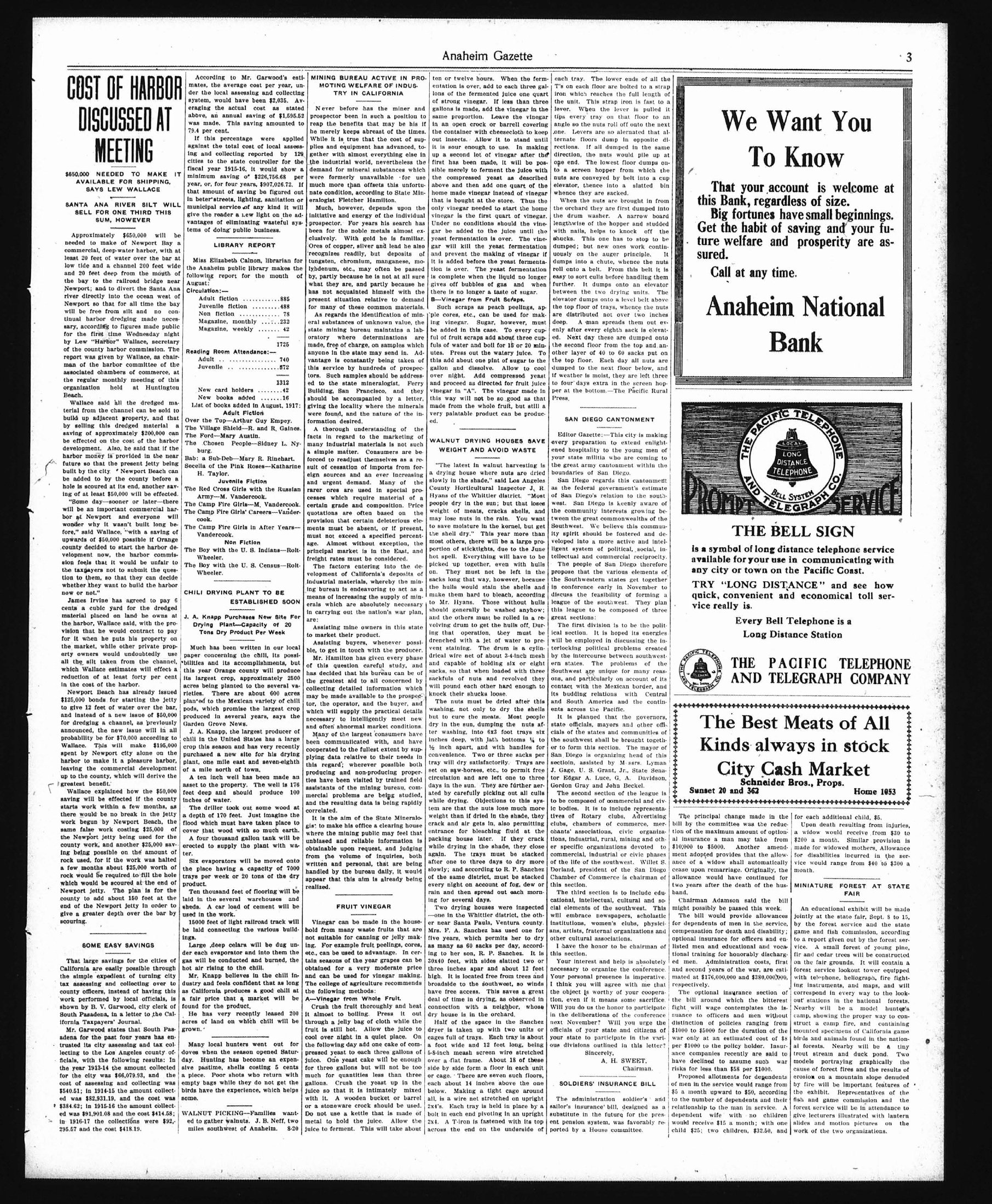
Searchable text
COST OF HARBOR DISCUSSED AT MEETING
$650,000 NEEDED TO MAKE IT AVAILABLE FOR SHIPPING, SAYS LEW WALLACE
SANTA ANA RIVER SILT WILL SELL FOR ONE THIRD THIS SUM, HOWEVER
Approximately $650,000 will be needed to make of Newport Bay a commercial, deep-water harbor, with at least 20 feet of water over the bar at low tide and a channel 200 feet wide and 20 feet deep from the mouth of the bay to the railroad bridge near Newport; and to divert the Santa Ana river directly into the ocean west of Newport so that for all time the bay will be free from silt and no continual harbor dredging made necessary, according to figures made public for the first time Wednesday night by Lew "Harbor" Wallace, secretary of the county harbor commission. The report was given by Wallace, as chairman of the harbor committee of the associated chambers of commerce, at the regular monthly meeting of this organization held at Huntington Beach.
Wallace said all the dredged material from the channel can be sold to build up adjacent property, and that by selling this dredged material a saving of approximately $200,000 can be effected on the cost of the harbor development. Also, he said that if the According to Mr. Garwood's estimates, the average cost per year, under the local assessing and collecting system, would have been $2,035. Averaging the actual cost as stated above, an annual saving of $1,595.52 was made. This saving amounted to 79.4 per cent.
If this percentage were applied against the total cost of local assessing and collecting reported by 129 cities to the state controller for the fiscal year 1915-16, it would show a minimum saving of $226,756.68 per year, or, for four years, $907,026.72. If that amount of saving be figured out in better streets, lighting, sanitation or municipal service of any kind it will give the reader a Lew light on the advantages of eliminating wasteful systems of doing public business.
LIBRARY REPORT
Miss Elizabeth Calnon, librarian for the Anaheim public library makes the following report for the month of August:
Circulation:—
Adult fiction . . . . . . . . . . . . . . . . . . . . . . . . . . . . . . . . . . . . . . . . . . . . . . . . 885
Juvenile fiction . . . . . . . . . . . . . . . . . . . . . . . . . . . . . . . . . . . . . . . . . . 488
Non fiction . . . . . . . . . . . . . . . . . . . . . . . . ... 78
Magazine, monthly ... ... 232
Magazine, weekly ... ... 42
1725
Reading Room Attendance:—
Adult ..... 740
Juvenile ..... 572
1312
New card holders ..... 42
New books added ..... 16
List of books added in August, 1917:
Adult Fiction
Over the Top—Arthur Guy Empey.
The Village Shield—R. and R. Gaines.
The Ford—Mary Austin.
The Chosen People—Sidney L. Ny-
MINING BUREAU MOTING WELFA TRY IN CAUSE
Never before had prospector been in reap the benefits that he merely keeps abre While it is true that plies and equipment gether with almost the industrial world demand for minerals were formerly unavailable more than often in nate condition, accord eralogist Fletcher H Much, however, o initiative and energy prospector. For years been for the noble exclusively. With gold Ores of copper, silver recognizes readily, tungsten, chromium, lybdenum, etc., may by partly because he what they are, and has not acquainted present situation refor many of these c As regards the ideal substances of ur state mining bureau oratory where det made, free of charge, anyone in the state advantage is constantly this service by hunters. Such samples sed to the state min Building, San Frank should be accompany giving the locality w were found, and the formation desired.
A thorough under facts in regard to many industrial matter
Wallace said all the dredged material from the channel can be sold to build up adjacent property, and that by selling this dredged material a saving of approximately $200,000 can be effected on the cost of the harbor development. Also, he said that if the harbor money is provided in the near future so that the present jetty being built by the city Newport Beach can be added to by the county before a hole is scoured at its end, another saving of at least $50,000 will be effected.
"Some day—sooner or later—there will be an important commercial harbor at Newport and everyone will wonder why it wasn't built long before," said Wallace, "with a saving of upwards of $50,000 possible if Orange county decided to start the harbor development now, the harbor commission feels that it would be unfair to the taxpayers not to submit the question to them, so that they can decide whether they want to build the harbor now or not."
James Irvine has agreed to pay 6 cents a cubic yard for the dredged material placed on land he owns at the harbor, Wallace said, with the provision that he would contract to pay for it when he puts his property on the market, while other private property owners would undoubtedly use all the silt taken from the channel, which Wallace estimates will affect a reduction of at least forty per cent in the cost of the harbor.
Newport Beach has already issued $125,000 bonds for starting the jetty to give 12 feet of water over the bar, and instead of a new issue of $50,000 for dredging a channel, as previously announced, the new issue will in all probability be for $70,000 according to Wallace. This will make $195,000 spent by Newport city alone on the harbor to make it a pleasure harbor, leaving the commercial development up to the county, which will derive the greatest benefit.
Wallace explained how the $50,000 saving will be effected if the county starts work within a few months, as there would be no break in the jetty work begun by Newport Beach, the same false work costing $25,000 of the Newport jetty being used for the county work, and another $25,000 savings report was given by Wallace, as chairman of the harbor committee of the associated chambers of commerce, at the regular monthly meeting of this organization held at Huntington Beach.
Wallace said all the dredged material from the channel can be sold to build up adjacent property, and that by selling this dredged material a saving of approximately $200,000 can be effected on the cost of the harbor development. Also, he said that if the harbor money is provided in the near future so that the present jetty being built by the city Newport Beach can be added to by the county before a hole is scoured at its end, another saving of at least $50,000 will be effected.
"Some day—sooner or later—there will be an important commercial harbor at Newport and everyone will wonder why it wasn't built long before," said Wallace, "with a saving of upwards of $50,000 possible if Orange county decided to start the harbor development now, the harbor commission feels that it would be unfair to the taxpayers not to submit the question to them, so that they can decide whether they want to build the harbor now or not."
James Irvine has agreed to pay 6 cents a cubic yard for the dredged material placed on land he owns at the harbor, Wallace said, with the provision that he would contract to pay for it when he puts his property on the market, while other private property owners would undoubtedly use all the silt taken from the channel, which Wallace estimates will affect a reduction of at least forty per cent in the cost of the harbor.
Newport Beach has already issued $125,000 bonds for starting the jetty to give 12 feet of water over the bar, and instead of a new issue of $50,000 for dredging a channel, as previously announced, the new issue will in all probability be for $70,000 according to Wallace. This will make $195,000 spent by Newport city alone on the harbor to make it a pleasure harbor, leaving the commercial development up to the county, which will derive the greatest benefit.
Wallace explained how the $50,000 saving will be effected if the county starts work within a few months, as there would be no break in the jetty work begun by Newport Beach, the same false work costing $25,000 of the Newport jetty being used for the county work, and another $25,000 savings report was given by Wallace, as chairman of the harbor committee of the associated chambers of commerce, at the regular monthly meeting of this organization held at Huntington Beach.
Wallace said all the dredged material from the channel can be sold to build up adjacent property, and that by selling this dredged material a saving of approximately $200,000 can be effected on the cost of the harbor development. Also, he said that if the harbor money is provided in the near future so that the present jetty being built by the city Newport Beach can be added to by the county before a hole is scoured at its end, another saving of at least $50,000 will be effected.
"Some day—sooner or later—there will be an important commercial harbor at Newport and everyone will wonder why it wasn't built long before," said Wallace, "with a saving of upwards of $50,000 possible if Orange county decided to start the harbor development now, the harbor commission feels that it would be unfair to the taxpayers not to submit the question to them, so that they can decide whether they want to build the harbor now or not."
James Irvine has agreed to pay 6 cents a cubic yard for the dredged material placed on land he owns at the harbor, Wallace said, with the provision that he would contract to pay for it when he puts his property on the market, while other private property owners would undoubtedly use all the silt taken from the channel, which Wallace estimates will affect a reduction of at least forty per cent in the cost of the harbor.
Newport Beach has already issued $125,000 bonds for starting the jetty to give 12 feet of water over the bar, and instead of a new issue of $50,000 for dredging a channel, as previously announced, the new issue will in all probability be for $70,000 according to Wallace. This will make $195,000 spent by Newport city alone on the harbor to make it a pleasure harbor, leaving the commercial development up to the county, which will derive the greatest benefit.
Wallace explained how the $50,000 saving will be effected if the county starts work within a few months, as there would be no break in the jetty work begun by Newport Beach, the same false work costing $25,000 of the Newport jetty being used for the county work, and another $25,0
Wallace explained how the $50,000 saving will be effected if the county starts work within a few months, as there would be no break in the jetty work begun by Newport Beach, the same false work costing $25,000 of the Newport jetty being used for the county work, and another $25,000 saving being possible on the amount of rock used, for if the work was halted a few months about $25,000 worth of rock would be required to fill the hole which would be scoured at the end of Newport jetty. The plan is for the county to add about 150 feet at the end of the Newport jetty in order to give a greater depth over the bar by scouring.
SOME EASY SAVINGS
That large savings for the cities of California are easily possible through the simple expedient of turning city tax assessing and collecting over to county officers, instead of having this work performed by local officials, is shown by B. V. Garwood, city clerk of South Pasadena, in a letter to the California Taxpayers' Journal.
Mr. Garwood states that South Pasadena for the past four years has entrusted its city assessing and tax collecting to the Los Angeles county officials, with the following results: In the year 1913-14 the amount collected for the city was $66,079.93, and the cost of assessing and collecting was $540.51; in 1914-15 the amount collected was $82,931.19, and the cost was $384.62; in 1915-16 the amount collected was $91,901.08 and the cost $414.58; in 1916-17 the collections were $92,295.57 and the cost $418.19.
Large deep celara will be dug under each evaporator and into them the gas will be conducted and burned, the hot air rising to the chill.
Mr. Knapp believes in the chill industry and feels confident that as long as California produces a good chill at a fair price that a market will be found for the product.
He has very recently leased 200 acres of land on which chill will be grown.
Many local hunters went out for doves when the season opened Saturday. Hunting has become an expensive pastime, shells costing 5 cents a piece. Poor shots who return with empty bags while they do not get the birds have the experience, which helps some.
WALNUT PICKING—Families wanted to gather walnuts. J. B. Neff, two miles southwest of Anaheim. 8:20
Vinegar can be made from many wastes not suitable for canning. For example fruit etc., can be used to obtain seasons of the ye obtained for a very and can be used for The college of agriculture the following method A—Vinegar from Wh.
Crush the fruit thou it almost to boiling through a jelly bag or fruit is still hot. All cool over night in a following day add pressed yeast to each juice. One yeast cake for three gallons but much for quantities gallons. Crush the juice so that it is in with it. A wooden metal to hold the juice to ferment. This
MINING BUREAU ACTIVE IN PROMOTING WELFARE OF INDUSTRY IN CALIFORNIA
Never before has the miner and prospector been in such a position to reap the benefits that may be his if he merely keeps abreast of the times. While it is true that the cost of supplies and equipment has advanced, together with almost everything else in the industrial world, nevertheless the demand for mineral substances which were formerly unavailable for use much more than offsets this unfortunate condition, according to State Mineralogist Fletcher Hamilton.
Much, however, depends upon the initiative and energy of the individual prospector. For years his search has been for the noble metals almost exclusively. With gold he is familiar. Ores of copper, silver and lead he also recognizes readily, but deposits of tungsten, chromium, manganese, molybdenum, etc., may often be passed by, partly because he is not at all sure what they are, and partly because he has not acquainted himself with the present situation relative to demand for many of these common materials.
As regards the identification of mineral substances of unknown value, the state mining bureau maintains a laboratory where determinations are made, free of charge, on samples which anyone in the state may send in. Advantage is constantly being taken of this service by hundreds of prospectors. Such samples should be addressed to the state mineralogist, Ferry Building, San Francisco, and they should be accompanied by a letter, giving the locality where the minerals were found, and the nature of the information desired.
A thorough understanding of the facts in regard to the marketing of many industrial materials is not such ten or twelve hours. When the fermentation is over, add to each three gallons of the fermented juice one quart of strong vinegar. If less than three gallons is made, add the vinegar in the same proportion. Leave the vinegar in an open crock or barrell covering the container with cheesecloth to keep out insects. Allow it to stand until it is sour enough to use. In making up a second lot of vinegar after the first has been made, it will be possible merely to ferment the juice with the compressed yeast as described above and then add one quart of the home-made vinegar instead of vinegar that is bought at the store. Thus the only vinegar needed to start the home vinegar is the first quart of vinegar. Under no conditions should the vinegar be added to the juice until the yeast fermentation is over. The vinegar will kill the yeast fermentation and prevent the making of vinegar if it is added before the yeast fermentation is over. The yeast fermentation is complete when the liquid no longer gives off bubbles of gas and when there is no longer a taste of sugar.
B—Vinegar from Fruit Scraps.
Such scraps as peach peelings, apple cores, etc., can be used for making vinegar. Sugar, however, must be added in this case. To every cupful of fruit scraps add about three cups of water and boil for 15 or 20 minutes. Press out the watery juice. To this add about one pint of sugar to the gallon and dissolve. Allow to cool over night. Add compressed yeast and proceed as directed for fruit juice vinegar in "A". The vinegar made in this way will not be so good as that made from the whole fruit, but still a very palatable product can be produced.
WALNUT DRYING HOUSES SAVE WEIGHT AND AVOID WASTE
each tray. The lower ends of all the T's on each floor are bolted to a strap iron which reaches the full length of the unit. This strap iron is fast to a lever. When the lever is pulled it tips every tray on that floor to an angle so the nuts roll off onto the next one. Levers are so alternated that alternate floors dump in opposite directions. If all dumped in the same direction, the nuts would pile up at one end. The lowest floor dumps onto a screen hopper from which the nuts are conveyed by belt into a cup elevator, thence into a slatted bin whence they are sacked.
When the nuts are brought in from the orchard they are first dumped into the drum washer. A narrow board lengthwise of the hopper and studded with nails, helps to knock off the shucks. This one has to stop to be dumped; but new ones work continuously on the auger principle. It dumps into a chute, whence the nuts roll onto a belt. From this belt it is easy to sort culls before handling them further. It dumps onto an elevator between the two drying units. The elevator dumps onto a level belt above the top floor of trays, whence the nuts are distributed not over two inches deep. A man spreads them evenly after every eighth sack is elevated. Next day these are dumped onto the second floor from the top and another layer of 40 to 60 sacks put on the top floor. Each day all nuts are dumped to the next floor below, and if weather is moist, they are left three to four days extra in the screen hopper at the bottom—The Pacific Rural Press.
SAN DIEGO CANTONMENT
Editor Gazette:—This city is making every preparation to extend enlightened hospitality to the younger members of our community.
advantage is constantly being taken of this service by hundreds of prospectors. Such samples should be addressed to the state mineralogist, Ferry Building, San Francisco, and they should be accompanied by a letter, giving the locality where the minerals were found, and the nature of the information desired.
A thorough understanding of the facts in regard to the marketing of many industrial materials is not such a simple matter. Consumers are be forced to readjust themselves as a result of cessation of imports from foreign sources and an ever increasing and urgent demand. Many of the rarer ores are used in special processes which require material of a certain grade and composition. Price quotations are often based on the provision that certain deleterious elements must be absent, or if present, must not exceed a specified percentage. Almost without exception, the principal market is in the East, and freight rates must be considered.
The factors entering into the development of California's deposits of industrial materials, whereby the mining bureau is endeavoring to act as a means of increasing the supply of minerals which are absolutely necessary in carrying out the nation's war plan, are:
Assisting mine owners in this state to market their product.
Assisting buyers, whenever possible, to get in touch with the producer.
Mr. Hamilton has given every phase of this question careful study, and has decided that his bureau can be of the greatest aid to all concerned by collecting detailed information which may be made available to the prospector, the operator, and the buyer, and which will supply the practical details necessary to intelligently meet new and often abnormal market conditions.
Many of the largest consumers have been communicated with, and have cooperated to the fullest extent by supplying data relative to their needs in this regard; wherever possible both producing and non-producing properties have been visited by trained field assistants of the mining bureau, commercial problems are being studied, and the resulting data is being rapidly correlated.
It is the aim of the State Mineralogist: to make his office a clearing house where the mining public may feel that unblased and reliable information is obtainable upon request, and judging
WALNUT DRYING HOUSES SAVE WEIGHT AND AVOID WASTE
"The latest in walnut harvesting is a drying house where nuts are dried slowly in the shade," said Los Angeles County Horticultural Inspector J. R. Hyans of the Whittier district. "Most people dry in the sun; but that loses weight of meats, cracks shells, and may lose nuts in the rain. You want to save moisture in the kernel, but get the shell dry." This year more than most others, there will be a large proportion of sticktights, due to the June hot spell. Everything will have to be picked up together, even with hulls on. They must not be left in the sacks long that way, however, because the hulls would stain the shells and make them hard to bleach, according to Mr. Hyans. Those without hulls should generally be washed anyhow; and the others must be rolled in a revolving drum to get the hulls off. During that operation, they must be drenched with a jet of water to prevent staining. The drum is a cylindrical wire net of about 3-4-inch mesh and capable of holding six or eight sacks, so that when loaded with three sackfuls of nuts and revolved they will pound each other hard enough to knock their shucks loose.
The nuts must be dried after this washing, not only to dry the shells but to cure the meats. Most people dry in the sun, dumping the nuts after washing, into 6x3 foot trays six inches deep, with lath bottoms ¼ to ½ inch apart, and with handles for convenience. Two or three sacks per tray will dry satisfactorily. Trays are set on saw-horses, etc., to permit free circulation and are left one to three days in the sun. They are further aerated by carefully picking out all culls while drying. Objections to this system are that the nuts lose much more weight than if dried in the shade, they crack and air gets in, also permitting entrance for bleaching fluid at the packing house later. If they crack while drying in the shade, they close Press out one pint of sugar to the gallon and dissolve. Allow to cool over night. Add compressed yeast and proceed as directed for fruit juice vinegar in "A". The vinegar made in this way will not be so good as that made from whole fruit, but still a very palatable product can be produced.
SAN DIEGO CANTONMENT
Editor Gazette:—This city is making every preparation to extend enlightened hospitality to the young men of your state militia who are coming to the great army cantonment within the boundaries of San Diego.
San Diego regards this cantonment as the federal government's estimate of San Diego's relation to the southwest. San Diego is keenly aware of the community interests growing between the great commonwealths of the Southwest. We believe this community spirit should be fostered and developed into a more active and intelligent system of political, social, intellectual and commercial reciprocity.
The people of San Diego therefore propose that the various elements of the Southwestern states get together in conference early in November to discuss the feasibility of forming a league of the southwest. They plan this league to be composed of three great sections:
The first division is to be the political section. It is hoped its energies will be employed in discussing the interlocking political problems created by the intercourse between southwestern states. The problems of the Southwest are unique for many reasons, and particularly on account of its contact with the Mexican border, and its budding relations with Central and South America and the continents across the Pacific.
It is planned that the governors, state officials, mayors and other officials of the states and communities of the southwest shall be brought together to form this section. The mayor of San Diego is organizing head of this sectioin, assisted by Mssrs. Lyman J. Gage, U. S. Grant, Jr., State Senator Edgar A. Luce, G. A. Davidson, Gordon Gray and John Beckel.
The second section of the league is to be composed of commercial and civic bodies. It is to include representatives of Rotary clubs, Advertising clubs, chambers of commerce, merchants' associations, civic organizations, industrial, rural, mining and other specific organizations devoted to
FRUIT VINEGAR
Vinegar can be made in the household from many waste fruits that are not suitable for canning or jelly making. For example fruit peelings, cores, etc., can be used to advantage. In certain seasons of the year grapes can be obtained for a very moderate price and can be used for vinegar making. The college of agriculture recommends the following methods:
A—Vinegar from Whole Fruit.
Crush the fruit thoroughly and heat it almost to boiling. Press it out through a jelly bag of cloth while the fruit is still hot. Allow the juice to cool over night in a quiet place. On the following day add one cake of compressed yeast to each three gallons of juice. One yeast cake will be enough for three gallons but will not be too much for quantities less than three gallons. Crush the yeast up in the juice so that it is intimately mixed with it. A wooden bucket or barrel or a stoneware crock should be used. Do not use a kettle that is made of metal to hold the juice. Allow the juice to ferment. This will take about two drying houses were inspected—one in the Whittier district, the other near Santa Paula, Ventura county. Mrs. F. A. Sanchez has used one for five years, which permits her to dry as many as 60 sacks per day, according to her son, R. P. Sanchez. It is 30x40 feet, with sides slatted two or three inches apar and about 12 feet high. It is located free from trees and broadside to the southwest, so winds have free access. This saves a great deal of time in drying, as observed in connection with a neighbor, whose dry house is in the orchard.
Half of the space in the Sanchez dryer is taken up with two units or cages full of trays. Each tray is about a foot wide and 12 feet long, being 5-8-inch meash screen wire stretched over a flat frame. About 18 of these side by side form a floor in each unit or cage. There are seven such floors, each about 14 inches above the one below. Making a tight cage around all, is a wire net stretched on upright 2x4's. Each tray is held in place by a bolt in each end pivoting in an upright 2x4. A T-iron is fastened with its top across the end on the underside of tray will dry satisfactorily. Trays are set on saw-horses, etc., to permit free circulation and are left one to three days in the sun. They are further aerated by carefully picking out all culls while drying. Objections to this system are that the nuts lose much more weight than if dried in the shade, they crack and air gets in, also permitting entrance for bleaching fluid at the packing house later. If they crack while drying in the shade, they close again. The trays must be stacked after one to three days to dry more slowly; and according to R. P. Sanchez of the same district, must be stacked every night on account of fog, dew or rain and then spread out each morning for several days.
Two drying houses were inspected—one in the Whittier district, the other near Santa Paula, Ventura county. Mrs. F. A. Sanchez has used one for five years, which permits her to dry as many as 60 sacks per day, according to her son, R. P. Sanchez. It is 30x40 feet, with sides slatted two or three inches apar and about 12 feet high. It is located free from trees and broadside to the southwest, so winds have free access. This saves a great deal of time in drying, as observed in connection with a neighbor, whose dry house is in the orchard.
Half of the space in the Sanchez dryer is taken up with two units or cages full of trays. Each tray is about a foot wide and 12 feet long, being 5-8-inch meash screen wire stretched over a flat frame. About 18 of these side by side form a floor in each unit or cage. There are seven such floors, each about 14 inches above the one below. Making a tight cage around all, is a wire net stretched on upright 2x4's. Each tray is held in place by a bolt in each end pivoting in an upright 2x4. A T-iron is fastened with its top across the end on the underside of tray will dry satisfactorily. Trays are set on saw-horses, etc., to permit free circulation and are left one to three days in the sun. They are further aerated by carefully picking out all culls while drying. Objections to this system are that the nuts lose much more weight than if dried in the shade, they crack and air gets in, also permitting entrance for bleaching fluid at the packing house later. If they crack while drying in the shade, they close again. The trays must be stacked after one to three days to dry more slowly; and according to R. P. Sanchez of the same district, must be stacked every night on account of fog, dew or rain and then spread out each morning for several days.
Two drying houses were inspected—one in the Whittier district, the other near Santa Paula, Ventura county. Mrs. F. A. Sanchez has used one for five years, which permits her to dry as many as 60 sacks per day, according to her son, R. P. Sanchez. It is 30x40 feet, with sides slatted two or three inches apar and about 12 feet high. It is located free from trees and broadside to the southwest, so winds have free access. This saves a great deal of time in drying, as observed in connection with a neighbor, whose dry house is in the orchard.
Half of the space in the Sanchez dryer is taken up with two units or cages full of trays. Each tray is about a foot wide and 12 feet long, being 5-8-inch meash screen wire stretched over a flat frame. About 18 of these side by side form a floor in each unit or cage. There are seven such floors, each about 14 inches above the one below. Making a tight cage around all, is a wire net stretched on upright 2x4's. Each tray is held in place by a bolt in each end pivoting in an upright 2x4. A T-iron is fastened with its top across the end on the underside of tray will dry satisfactorily. Trays are set on saw-horses, etc., to permit free circulation and are left one to three days in the sun. They are further aerated by carefully picking out all culls while drying. Objections to this system are that the nuts lose much more weight than if dried in the shade, they crack and air gets in, also permitting entrance for bleaching fluid at the packing house later. If they crack while drying in the shade, they close again. The trays must be stacked after one to three days to dry more slowly; and according to R. P. Sanchez of the same district, must be stacked every night on account of fog, dew or rain and then spread out each morning for several days.
Two drying houses were inspected—one in the Whittier district, the other near Santa Paula, Ventura county. Mrs. F. A. Sanchez has used one for five years, which permits her to dry as many as 60 sacks per day, according to her son, R. P. Sanchez. It is 30x40 feet, with sides slatted two or three inches apar and about 12 feet high. It is located free from trees and broadside to the southwest, so winds have free access. This saves a great deal of time in drying, as observed in connection with a neighbor, whose dry house is in the orchard.
Half of the space in the Sanchez dryer is taken up with two units or cages full of trays. Each tray is about a foot wide and 12 feet long, being 5-8-inch meash screen wire stretched over a flat frame. About 18 of these side by side form a floor in each unit or cage. There are seven such floors, each about 14 inches above the one below. Making a tight cage around all, is a wire net stretched on upright 2x4's. Each tray is held in place by a bolt in each end pivoting in an upright 2x4. A T-iron is fastened with its top across the end on the underside of tray will dry satisfactorily. Trays are set on saw-horses, etc., to permit free circulation and are left one to three days in the sun. They are further aerated by carefully picking out all culls while drying. Objections to this system are that the nuts lose much more weight than if dried in the shade, they crack and air gets in, also permitting entrance for bleaching fluid at the packing house later. If they crack while drying in the shade, they close again. The trays must be stacked after one to three days to dry more slowly; and according to R. P. Sanchez of the same district, must be stacked every night on account of fog, dew or rain and then spread out each morning for several days.
Two drying houses were inspected—one in the Whittier district, the other near Santa Paula, Ventura county. Mrs. F. A. Sanchez has used one for five years, which permits her to dry as many as 60 sacks per day, according to her son, R. P. Sanchez. It is 30x40 feet, with sides slatted two or three inches apar and about 12 feet high. It is located free from trees and broadside to the southwest, so winds have free access. This saves a great deal of time in drying, as observed in connection with a neighbor, whose dry house is in the orchard.
Half of the space in the Sanchez dryer is taken up with two units or cages full of trays. Each tray is about a foot wide and 12 feet long, being 5-8-inch meash screen wire stretched over a flat frame. About 18 of these side by side form a floor in each unit or cage. There are seven such floors, each about 14 inches above the one below. Making a tight cage around all, is a wire net stretched on upright 2x4's. Each tray is held in place by a bolt in each end pivoting in an upright 2x4. A T-iron is fastened with its top across the end on the underside of tray will dry satisfactorily.
Trays are set on saw-horses, etc., to permit free circulation and are left one to three days in the sun. They are further aerated by carefully picking out all culls while drying. Objections to this system are that the nuts lose much more weight than if dried in the shade, they crack and air gets in, also permitting entrance for bleaching fluid at the packing house later.
If they crack while drying in the shade, they close again.
The second section of the league is to be composed of commercial and civic bodies. It is to include representatives of Rotary clubs, Advertising clubs, chambers of commerce, merchants' associations, civic organizations, industrial, rural, mining and other specific organizations devoted to commercial, industrial or civic phases of life of the southwest. Willet S.Dorland, president of the San Diego Chamber of Commerce is chairman of this section.
The third section is to include educational, intellectual, cultural and social elements of the southwest. This will embrace newspapers, scholastic institutions, women's clubs, physicians, artists, fraternal organizations and other cultural associations.
I have the honor to be chairman of this section.
Your interest and help is absolutely necessary to organize the conference Your personal presence is imperative I think you will agree with me that the object is worthy of your cooperation even if it means some sacrifice Will you do us the honor to participate in the deliberations of the conference next November? Will you urge the officials of your state and citizens of your state to participate in the various divisions outlined in this letter?
Sincerely,
A.H.SWEET,
Chairman.
SOLDIERS' INSURANCE BILL
The administration soldier's aid sailor's insurance bill designed as a substitute in the future for present pension system was favorably reported by a House committee.
The prince bill by this al insurance $10;000 ten ment adoptance of al cease upon $10;000 nineiance com have declares risks for al propose al men inc $5 a month to tha nrelations dependent would reci child $25
We Want You
To Know
That your account is welcome at this Bank, regardless of size.
Big fortunes have small beginnings. Get the habit of saving and your future welfare and prosperity are assured.
Call at any time.
Anaheim National Bank
THE PACIFIC TELEPHONE AND TELEGRAPH COMPANY
PROMPT SERVICE
THE BELL SIGN
is a symbol of long distance telephone service available for your use in communicating with any city or town on the Pacific Coast.
TRY “LONG DISTANCE” and see how quick, convenient and economical toll service really is.
Every Bell Telephone is a Long Distance Station
THE PACIFIC TELEPHONE AND TELEGRAPH COMPANY
The Best Meats of All Kinds always in stock
City Cash Market
Schnaider Bros., Props.
Sunset 20 and 362 Home 1053
The principal change made in the bill by the committee was the reduction of the maximum amount of optional insurance a man may take from $10,000 to $5000. Another amendment for each additional child, $5.
Upon death resulting from injuries, a widow would receive from $30 to $200 a month. Similar provision is made for widowed mothers. Allowance
City Cash Market
Schneider Bros., Props.
Sunset 20 and 362
Home 1053
The principal change made in the bill by the committee was the reduction of the maximum amount of optional insurance a man may take from $10,000 to $5000. Another amendment adopted provides that the allowance of a widow shall automatically cease upon remarriage. Originally, the allowance would have continued for two years after the death of the husband.
Chairman Adamson said the bill might possibly be passed this week.
The bill would provide allowances for dependents of men in the service, compensation for death and disability; optional insurance for officers and enlisted men and educational and vocational training for honorably discharged men. Administration costs, first and second years of the war, are estimated at $176,000,000 and $380,000,000, respectively.
The optional insurance section of the bill around which the bitterest fight will wage contemplates the issuance to officers and men without distinction of policies ranging from $1000 to $5000 for the duration of the war only at an estimated cost of $8 per $1000 to the policy holder. Insurance companies recently are said to have declined to assume such war risks for less than $58 per $1000.
Proposed allotments for dependents of men in the service would range from $5 a month upward to $50, according to the number of dependents and their relationship to the man in service. A dependent wife with no children would receive $15 a month; with one child $25; two children, $32.50, and for each additional child, $5.
Upon death resulting from injuries, a widow would receive from $30 to $200 a month. Similar provision is made for widowed mothers. Allowance for disabilities incurred in the service would range from $40 to $300 a month.
MINIATURE FOREST AT STATE FAIR
An educational exhibit will be made jointly at the state fair, Sept. 8 to 15, by the forest service and the state game and fish commission, according to a report given out by the forest service. A small forest of young pine, fir and cedar trees will be constructed on the fair grounds. It will contain a forest service lookout tower equipped with telephone, heliograph, fire fighting instruments, and maps, and will correspond in every way to the look-out stations in the national forests. Nearby will be a model hunter's camp, showing the proper way to construct a camp fire, and containing mounted specimens of California game birds and animals found in the national forests. Nearby will be a tiny trout stream and duck pond. Two models portraying graphically the cause of forest fires and the results of erosion on a mountain slope denuded by fire will be important features of the exhibit. Representatives of the fish and game commission and the forest service will be in attendance to give lecturers illustrated with lantern slides and motion pictures on the work of the two organizations.