anaheim-gazette 1917-09-06
Scanned page
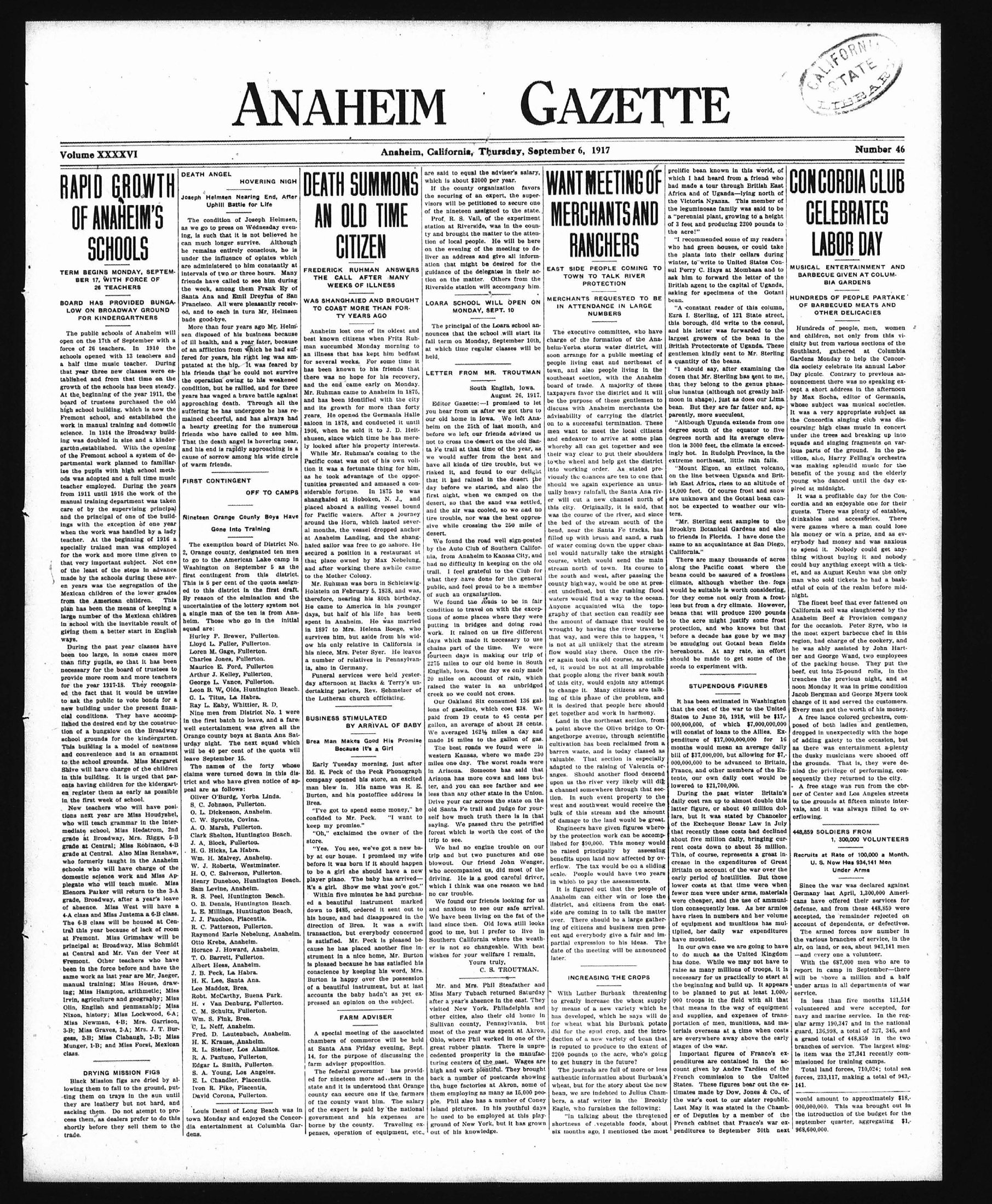
Searchable text
RAPID GROWTH OF ANAHEIM'S SCHOOLS
TERM BEGINS MONDAY, SEPTEMBER 17, WITH FORCE OF 26 TEACHERS
BOARD HAS PROVIDED BUNGA-LOW ON BROADWAY GROUND FOR KINDERGARTNERS
The public schools of Anaheim will open on the 17th of September with a force of 26 teachers. In 1910 the schools opened with 13 teachers and a half time music teacher. During that year three new classes were established and from that time on the growth of the schools has been steady. At the beginning of the year 1911, the board of trustees purchased the old high school building, which is now the Fremont school, and established the work in manual training and domestic science. In 1914 the Broadway building was doubled in size and a kindergarten established. With the opening
DEATH ANGEL HOVERING NIGH
Joseph Helmsen Nearing End, After Uphill Battle for Life
The condition of Joseph Helmsen, as we go to press on Wednesday evening, is such that it is not believed he can much longer survive. Although he remains entirely conscious, he is under the influence of opiates which are administered to him constantly at intervals of two or three hours. Many friends have called to see him during the week, among them Frank Ey of Santa Ana and Emil Dreyfus of San Francisco. All were pleasantly received, and to each in turn Mr. Helmsen bade good-bye.
More than four years ago Mr. Helmsen disposed of his business because of ill health, and a year later, because of an affliction from which he had suffered for years, his right leg was amputated at the hip. It was feared by his friends that he could not survive the operation owing to his weakened condition, but he rallied, and for three years has waged a brave battle against approaching death. Through all the suffering he has undergone he has remained cheerful, and has always had a hearty greeting for the numerous friends who have called to see him. That the death angel is hovering near, and his end is rapidly approaching is a
schools opened with 13 teachers and a half time music teacher. During that year three new classes were established and from that time on the growth of the schools has been steady. At the beginning of the year 1911, the board of trustees purchased the old high school building, which is now the Fremont school, and established the work in manual training and domestic science. In 1914 the Broadway building was doubled in size and a kindergarten established. With the opening of the Fremont school a system of departmental work planned to familiarize the pupils with high school methods was adopted and a full time music teacher employed. During the years from 1911 until 1916 the work of the manual training department was taken care of by the supervising principal and the principal of one of the buildings with the exception of one year when the work was handled by a lady teacher. At the beginning of 1916 a specially trained man was employed for the work and more time given to that very important subject. Not one of the least of the steps in advance made by the schools during these seven years was the segregation of the Mexican children of the lower grades from the American children. This plan has been the means of keeping a large number of the Mexican children in school with the inevitable result of giving them a better start in English ways.
During the past year classes have been too large, in some cases more than fifty pupils, so that it has been necessary for the board of trustees to provide more room and more teachers for the year 1917-18. They recognized the fact that it would be unwise to ask the public to vote bonds for a new building under the present financial conditions. They have accomplished the desired end by the construction of a bungalow on the Broadway school grounds for the kindergarten. This building is a model of neatness and convenience and is an ornament to the school grounds. Miss Margaret Shive will have charge of the children in this building. It is urged that parents having children for the kindergarten register them as early as possible in the first week of school.
New teachers who will have positions next year are Miss Houdyshel, who will teach grammar in the Intermediate school, Miss Hedstrom, 2nd grade at Broadway, Mrs. Riggs, 5-B grade at Central; Miss Robinson, 4-B
FIRST CONTINGENT
OFF TO CAMPS
Nineteen Orange County Boys Have Gone Into Training
The exemption board of District No. 2, Orange county, designated ten men to go to the American Lake camp in Washington on September 5 as the first contingent from this district. This is 5 per cent of the quota assigned to this district in the first draft. By reason of the elimination and the uncertainties of the lottery system not a single man of the ten is from Anaheim. Those who go in the initial squad are:
Hurley P. Brewer, Fullerton.
Lloyd L. Fuller, Fullerton.
Loren M. Gage, Fullerton.
Charles Jones, Fullerton.
Maurice E. Ford, Fullerton.
Arthur J. Kelley, Fullerton.
George L. Vance, Fullerton.
Leon B. W. Olds, Huntington Beach.
G. L. Titus, La Habra.
Ray L. Eaby, Whittler, R. D.
Nine men from District No. 1 were in the first batch to leave, and a farewell entertainment was given all the Orange county boys at Santa Ana Saturday night. The next squad which will be 40 per cent of the quota will leave September 15.
The names of the forty whose claims were turned down in this district and who have given notice of appeal are as follows:
Oliver O'Burdg, Yorba Linda.
S. C. Johnson, Fullerton.
O. L. Dickenson, Anaheim.
C. W. Sprotte, Covina.
A. O. Marsh, Fullerton.
Clark Shelton, Huntington Beach.
J. A. Block, Fullerton.
H G. Hicks, La Habra.
an illness that has kept for several weeks. He has been known to have there was no hope for and the end came easy Mr. Ruhman came to Anaheim and has been identified and its growth for many years. He opened their saloon in 1878, and coined 1906, when he sold it shusen, since which they looked after his property.
While Mr. Ruhman's Pacific coast was not noticed it was a fortunate as he took advantage tunities presented and siderable fortune.
Shanghai at Hoboken placed aboard a sail for Pacific waters around the Horn, while at Anaheim Landing, hailed sailor was free secured a position in that place owned by and after working there to the Mother Colony.
Mr. Ruhman was born Holstein on February 9 therefore, nearing his He came to America days, but half of his spent in Anaheim.
In 1897 to Mrs. Helm survives him, but asks how his only relative his niece, Mrs. Peter a number of relatives also in Germany.
Funeral services were day afternoon at Bacchertaking parliors, Reed the Lutheran church.
BUSINESS STIMULATION BY ART
Early Tuesday morning Ed. E. Peck of the company opened his man blew in. His Burton, and his post Brea.
"I've got to spend confided to Mr. Peck keep my promise."
"Oh," exclaimed the store.
"Yes. You see, we
Miss Margaret Shive will have charge of the children in this building. It is urged that parents having children for the kidergarten register them as early as possible in the first week of school.
New teachers who will have positions next year are Miss Houdyshel, who will teach grammar in the intermediate school, Miss Hedstrom, 2nd grade at Broadway, Mrs. Riggs, 5-B grade at Central; Miss Robinson, 4-B grade at Central. Also Miss Renshaw, who formerly taught in the Anaheim schools who will have charge of the domestic science work and Miss Applegate who will teach music. Miss Elenora Parker will return to the 3-A grade, Broadway, after a year's leave of absence. Miss West will have a 4-A class and Miss Justema a 6-B class. The 6-B class will be housed at Central this year because of lack of room at Fremont. Miss Grimshaw will be principal at Broadway, Miss Schmidt at Central and Mr. Van der Veer at Fremont. Other teachers who have been in the force before and have the same work as last year are Mr. Jaeger, manual training; Miss House, drawing; Miss Hampton, arithmetic; Miss Irvin, agriculture and geography; Miss Olin, English and penmanship; Miss Nixon, history; Miss Lockwood, 6-A; Miss Newman, 4-B; Mrs. Garrison, 3-B; Miss Graves, 2-A; Mrs. J. T. Burgess, 2-B; Miss Clabaugh, 1-B; Miss Munger, 1-B; and Miss Forst, Mexican class.
DRYING MISSION FIGS
Black Mission figs are dried by allowing them to fall to the ground, putting them on trays in the sun until they are leathery but not hard, and sacking them. Do not attempt to process them, as dealers prefer to do this shortly before they sell them to the trade.
The names of the forty whose claims were turned down in this district and who have given notice of appeal are as follows:
Oliver O'Burdg, Yorba Linda.
S. C. Johnson, Fullerton.
O. L. Dickenson, Anaheim.
C. W. Sprotte, Covina.
A. O. Marsh, Fullerton.
Clark Shelton, Huntington Beach.
J. A. Block, Fullerton.
H. G. Hicks, La Habra.
Wm. H. Malvey, Anaheim.
W. J. Roberts, Westminster.
H. O. C. Salverson, Fullerton.
Henry Dunehoo, Huntington Beach.
Sam Levine, Anaheim.
R. S. Peel, Huntington Beach.
O. B. Dennis, Huntington Beach.
L. E. Millings, Huntington Beach.
J. J. Pauchon, Placentia.
R. C. Patterson, Fullerton.
Raymond Earle Nebelung, Anaheim.
Otto Krebs, Anaheim.
Horace J. Howard, Anaheim.
T. O. Barrett, Fullerton.
Albert Hess, Anaheim.
J. B. Peck, La Habra.
H. K. Lee, Santa Ana.
Lee Maddox, Brea.
Robt. McCarthy, Buena Park.
H. V. Van Denburg, Fullerton.
C. M. Schultz, Fullerton.
Wm. S. Fink, Brea.
C. L. Neff, Anaheim.
Fred. D. Lautenbach, Anaheim.
H. K. Krause, Anaheim.
R. L. Sténer, Los Alamitos.
R. A. Pantuso, Fullerton.
Edgar L. Smith, Fullerton.
S. A. Young, Los Angeles.
E. L. Chandler, Placentia.
Ivon R. Pike, Placentia.
David Corona, Fullerton.
Louis Denni of Long Beach was in town Monday and enjoyed the Concordia entertainment at Columbia Gardens.
Early Tuesday morning Ed. E. Peck of the company opened his man blew in. His Burton, and his post office.
"I've got to spend confided to Mr. Peck keep my promise."
"Oh," exclaimed the store.
"Yes. You see, we by at our house. I pref before it was born if to be a girl she she player piano. The bain's a girl. Show me within five minutes ed a beautiful instr down to $485, ordered his house, and had direction of Brea transaction, but even is satisfied. Mr.Peck cause he has placed instrument in a nice h is pleased because he conscience by keeping Burton is happy over of a beautiful instru accounts the baby h pressed an opinion o"
FARM AD
A special meeting chambers of commer at Santa Ana Frida 14, for the purpose farm adviser proposes The federal govern ed for nineteen more state and it is under county can secure o of the county want of the expert is paid government and h borne by the county penses, operation of
NAHEIM GAZETTE
Anaheim, California, Thursday, September 6, 1917
DEATH SUMMONS
AN OLD TIME
CITIZEN
FREDERICK RUHMAN ANSWERS
THE CALL AFTER MANY WEEKS OF ILLNESS
WAS SHANGHAIED AND BROUGHT TO COAST MORE THAN FOR-TY YEARS AGO
Anaheim lost one of its oldest and best known citizens when Fritz Ruhman succumbed Monday morning to an illness that has kept him bedfast for several weeks. For some time it has been known to his friends that there was no hope for his recovery, and the end came early on Monday. Mr. Ruhman came to Anaheim in 1875, and has been identified with the city and its growth for more than forty years. He opened the Germania Halle saloon in 1878, and conducted it until 1906, when he sold it to J. D. Heitshusen, since which time he has merely looked after his property interests.
Anaheim lost one of its oldest and best known citizens when Fritz Ruhman succumbed Monday morning to an illness that has kept him bedfast for several weeks. For some time it has been known to his friends that there was no hope for his recovery, and the end came early on Monday. Mr. Ruhman came to Anaheim in 1875, and has been identified with the city and its growth for more than forty years. He opened the Germania Halle saloon in 1878, and conducted it until 1906, when he sold it to J. D. Heitshusen, since which time he has merely looked after his property interests.
DEATH SUMMONS
AN OLD TIME
CITIZEN
FREDERICK RUHMAN ANSWERS
THE CALL AFTER MANY WEEKS OF ILLNESS
WAS SHANGHAIED AND BROUGHT TO COAST MORE THAN FOR-TY YEARS AGO
Anaheim lost one of its oldest and best known citizens when Fritz Ruhman succumbed Monday morning to an illness that has kept him bedfast for several weeks. For some time it has been known to his friends that there was no hope for his recovery, and the end came early on Monday. Mr. Ruhman came to Anaheim in 1875, and has been identified with the city and its growth for more than forty years. He opened the Germania Halle saloon in 1878, and conducted it until 1906, when he sold it to J. D. Heitshusen, since which time he has merely looked after his property interests.
LOARA SCHOOL WILL OPEN ON MONDAY, SEPT. 10
The principal of the Loara school announces that the school will start its fall term on Monday, September 10th, at which time regular classes will be held.
LETTER FROM MR. TROUTMAN
South English, Iowa.
August 26, 1917.
Editor Gazette:—I promised to let you hear from us after we got thru to our old home in Iowa. We left Anaheim on the 25th of last month, and before we left our friends advised us not to cross the desert on the old San Diego trail at that time of the year.
WANT MEETING OF MERCHANTS AND RANCHERS
EAST SIDE PEOPLE COMING TO TOWN TO TALK RIVER PROTECTION
MERCHANTS REQUESTED TO BE IN ATTENDANCE IN LARGE NUMBERS
The executive committee, who have charge of the formation of the Anaheim-Yorba storm water district, will soon arrange for a public meeting of people living east and northeast of town, and also people living in the southeast section, with the Anaheim board of trade. A majority of these taxpayers favor the district and it will be the purpose of these gentlemen to discuss with Anaheim merchants the advisability of carrying the district on to a successful termination. These men want to meet the local citizens and endeavor to arrive at some plan whereby all can get together and see prolific best which I have made Africa and the Victorian leguminous a "perennial" of 3 feet and the acre!"
"I recommend who had given the plants winter, to sul Perry Cox ask him to British agent asking for bean.
"A conste Ezra I. Stain this borough and his largest grove British Proven gentlemen a quantity."
"I should dozen that they will olus lunature moon in shiny bean. But parently, m.
"Although degree souls degrees notion is 3000."
an illness that has kept him bedridden for several weeks. For some time it has been known to his friends that there was no hope for his recovery, and the end came early on Monday. Mr. Ruhman came to Anaheim in 1875, and has been identified with the city and its growth for more than forty years. He opened the Germania Halle saloon in 1878, and conducted it until 1906, when he sold it to J. D. Heltshusen, since which time he has merely looked after his property interests.
While Mr. Ruhman's coming to the Pacific coast was not of his own volition it was a fortunate thing for him, as he took advantage of the opportunities presented and amassed a considerable fortune. In 1875 he was shanghailed at Hoboken, N. J., and placed aboard a sailing vessel bound for Pacific waters. After a journey around the Horn, which lasted several months, the vessel dropped anchor at Anaheim Landing, and the shanghaled sailor was free to go ashore. He secured a position in a restaurant at that place owned by Max Nebelung, and after working there awhile came to the Mother Colony.
Mr. Ruhman was born in Schleiswig-Holstein on February 5, 1838, and was therefore, nearing his 80th birthday. He came to America in his younger days, but half of his life has been spent in Anaheim. He was married in 1897 to Mrs. Helena Boege, who survives him, but aside from his widow his only relative in California is his niece, Mrs. Peter Syer. He leaves a number of relatives in Pennsylvania, also in Germany.
Funeral services were held yesterday afternoon at Backs & Terry's undertaking parlors, Rev. Schmelzer of the Lutheran church officiating.
BUSINESS STIMULATED BY ARRIVAL OF BABY
Brea Man Makes Good His Promise Because it's a Girl
Early Tuesday morning, just after Ed. E. Peck of the Peck Phonograph company opened his store, an excited man blew in. His name was R. E. Burton, and his postoffice address is Brea.
"I've got to spend some money," he confided to Mr. Peck. "I want to keep my promise."
"Oh," exclaimed the owner of the store.
"Yes. You see, we've got a new hold."
LETTER FROM MR. TROUTMAN
South English, Iowa.
August 26, 1917.
Editor Gazette:—I promised to let you hear from us after we got thru to our old home in Iowa. We left Anaheim on the 25th of last month, and before we left our friends advised us not to cross the desert on the old Santa Fe trail at that time of the year, as we would suffer from the heat and have all kinds of tire trouble, but we risked it, and found to our delight that it had rained in the desert the day before we started, and also the first night, when we camped on the desert, so that the sand was settled, and the air was cooled, so we said no tire trouble, nor was the heat oppressive while crossing the 250 mile of desert.
We found the road well sign-posted by the Auto Club of Southern California, from Anaheim to Kansas City, and had no difficulty in keeping on the old trail. I feel grateful to the Club for what they have done for the general public, and feel proud to be a member of such an organization.
We found the roads to be in fair condition to travel on with the exceptions of some places where they were putting in bridges and doing road work. It rained on us five different days which made it necessary to use chains part of the time. We were fourteen days in making our trip of 2275 miles to our old home in South English, Iowa. One day we only made 20 miles on account of rain, which raised the water in an unbridged creek so we could not cross.
Our Oakland Six consumed 136 gallons of gasoline, which cost $38. We paid from 19 cents to 45 cents per gallon, an average of about 28 cents. We averaged 162½ miles a day and made 16 miles to the gallon of gas.
The best roads we found were in western Kansas, where we made 230 miles one day. The worst roads were in Arizona. Someone has said that Arizona has more cows and less butter, and you can see farther and see less than any other state in the Union. Drive your car across the state on the old Santa Fe trail and judge for yourself how much truth there is in that saying. We passed thru the petrified forest which is worth the cost of the trip to see.
We had no engine trouble on our soon arrange for a public meeting of people living east and northeast of town, and also people living in the southeast section, with the Anaheim board of trade. A majority of these taxpayers favor the district and it will be the purpose of these gentlemen to discuss with Anaheim merchants the advisability of carrying the district on to a successful termination. These men want to meet the local citizens and endeavor to arrive at some plan whereby all can get together and see their way clear to put their shoulders to the wheel and help get the district into working order. As stated previously the chances are ten to one that should we again experience an unusually heavy rainfall, the Santa Ana river will cut a new channel north of this city. Originally, it is said, that was the course of the river, and since the bed of the stream south of the bend, near the Santa Fe tracks, has filled up with brush and sand, a rush of water coming down the upper channel would naturally take the straight course, which would send the main stream north of town. Its course to the south and west, after passing the county highway, would be one at present undefined, but the rushing flood waters would find a way to the ocean. Anyone acquainted with the topography of that section can readily see the amount of damage that would be wrought by having the river traverse that way, and were this to happen, it is not at all unlikely that the stream flow would stay there. Once the river again took its old course, as outlined, it would be not at all improbable that people along the river bank south of this city would enjoin any attempt to change it. Many citizens are talking of this phase of the problem, and it is desired that people here should get together and work in harmony.
Land in the northeast section, from a point above the Olive bridge to Orangethorpe avenue, through scientific cultivation has been reclaimed from a barren waste, and is today classed as valuable. That section is especially adapted to the raising of Valencia oranges. Should another flood descend upon us the river very likely will dig a channel somewhere through that section. In such event property to the west and southwest would receive the bulk of this stream and the amount of damage to the land would be great.
Engineers have given figures whereby the protection work can be accomplished for $90,000. This money would be raised principally by assessing
Early Tuesday morning, just after Ed. E. Peck of the Peck Phonograph company opened his store, an excited man blew in. His name was R. E. Burton, and his postoffice address is Brea.
"I've got to spend some money," he confided to Mr. Peck. "I want to keep my promise."
"Oh," exclaimed the owner of the store.
"Yes. You see, we've got a new baby at our house. I promised my wife before it was born if it should happen to be a girl she should have a new player piano. The baby has arrived—it's a girl. Show me what you've got."
Within five minutes he had purchased a beautiful instrument marked down to $485, ordered it sent out to his house, and had disappeared in the direction of Brea. It was a swift transaction, but everybody concerned is satisfied. Mr. Peck is pleased because he has placed another fine instrument in a nice home, Mr. Burton is pleased because he has satisfied his conscience by keeping his word, Mrs. Burton is happy over the possession of a beautiful instrument, but at last accounts the baby hadn't as yet expressed an opinion on the subject.
FARM ADVISER
A special meeting of the associated chambers of commerce will be held at Santa Ana Friday evening, Sept. 14, for the purpose of discussing the farm adviser proposition.
The federal governor has provided for nineteen more advisers in the state and it is understood that Orange county can secure one if the farmers of the county want him. The salary of the expert is paid by the national government and his expenses are borne by the county. Traveling expenses, operation of equipment, etc., western Kansas, where we made 200 miles one day. The worst roads were in Arizona. Someone has said that Arizona has more cows and less butter, and you can see farther and see less than any other state in the Union. Drive your car across the state on the old Santa Fe trail and judge for yourself how much truth there is in that saying. We passed thru the petrified forest which is worth the cost of the trip to see.
We had no engine trouble on our trip and but two punctures and one blowout. Our friend John Wenger, who accompanied us, did most of the driving. He is a good careful driver, which I think was one reason we had no car trouble.
We found our friends looking for us and anxious to see our safe arrival. We have been living on the fat of the land since then. Old Iowa still looks good to me, but I prefer to live in Southern California where the weather is not so changeable. With best wishes for your welfare I remain,
Yours truly,
C. S. TROUTMAN.
Mr. and Mrs. Phil Steafather and Miss Mary Tubach returned Saturday after a year's absence in the east. They visited New York, Philadelphia and other cities, also their old home in Sullivan county, Pennsylvania, but most of the year was spent at Akron, Ohio, where Phil worked in one of the great rubber plants. There is unprecedented prosperity in the manufacturing centers of the east. Wages are high and work plentiful. They brought back a number of postcards showing the huge factories at Akron, some of them employing as many as 15,000 people. Phil also has a number of Coney Island pictures. In his youthful days he used to be employed at this playground of New York, but it has grown out of his knowledge.
INCREASING THE CROPS
With Luther Burbank threatening to greatly increase the wheat supply by means of a new variety which he has developed, which he says will do for wheat what his Burbank potato did for the spud crop, and the introduction of a new variety of bean that is reputed to produce to the extent of 2200 pounds to the acre, who's going to get hungry in the future?
The journals are full of more or less authentic information about Burbank's wheat, but for the story about the new bean, we are indebted to Julius Chambers, a staff writer in the Brooklyn Eagle, who furnishes the following:
"In talking about the threatened shortness of vegetable foods, about six months ago, I mentioned the most valuable. That section is especially adapted to the raising of Valencia oranges. Should another flood descend upon us the river very likely will dig a channel somewhere through that section. In such event property to the west and southwest would receive the bulk of this stream and the amount of damage to the land would be great.
Engineers have given figures whereby the protection work can be accomplished for $90,000. This money would be raised principally by assessing benefits upon land now affected by overflow. The tax would be on a sliding scale. People would have two years in which to pay the assessments.
It is figured out that the people of Anaheim can either win or lose the district, and citizens from the east-side are coming in to talk the matter over. There should be a large gathering of citizens and business men present and everybody give a fair and impartial expression to his ideas. The date of the meeting will be announced later."
LETTE
Number 46
ING OF
SAND
RS
COMING TO
RIVER
N
TED TO BE
IN LARGE
prolific bean known in this world, of which I had heard from a friend who had made a tour through British East Africa and of Uganda—lying north of the Victoria Nyanza. This member of the leguminosae family was said to be a "perennial plant, growing to a height of 3 feet and producing 2200 pounds to the acre!"
"I recommended some of my readers who had green houses, or could take the plants into their cellars during winter, to write to United States Consul Perry C. Hays at Mombasa and to ask him to forward the letter of the British agent to the capital of Uganda, asking for specimens of the Gotani bean.
"A constant reader of this column, Ezra I. Sterling, of 121 State street, this borough, did write to the consul, and his letter was forwarded to the largest growers of the bean in the British Protectorate of Uganda. These gentlemen kindly sent to Mr. Sterling a quantity of the beans.
"I should say, after examining the dozen that Mr. Sterling has sent to me, that they belong to the genus phaseolus lunatus (although not greatly half-moon in shape), just as does our Lima bean. But they are far fatter and, apparently, more succulent.
"Although Ugunda extends from one degree south of the equator to five degrees north and its average elevation is 3000 feet, the climate is exceed-
CONCORDIA CLUB
CELEBRATES
LABOR DAY
MUSICAL ENTERTAINMENT AND BARBECUE GIVEN AT COLUMBIA GARDENS
HUNDREDS OF PEOPLE PARTAKE OF BARBECUED MEATS AND OTHER DELICACIES
Hundreds of people, men, women and children, not only from this vicinity but from various sections of the Southland, gathered at Columbia Gardens Monday to help the Concordia society celebrate its annual Labor Day picnic. Contrary to previous announcement there was no speaking except a short address in the afternoon by Max Socha, editor of Germania, whose subject was musical societies. It was a very appropriate subject as the Concordia singing club was discoursing high class music in concert under the trees and breaking up into squads and singing fragments on var-
"I should say, after examining the dozen that Mr. Sterling has sent to me, that they belong to the genus phaseolus lunatus (although not greatly half-moon in shape), just as does our Lima bean. But they are far fatter and, apparently, more succulent.
"Although Uganda extends from one degree south of the equator to five degrees north and its average elevation is 3000 feet, the climate is exceedingly hot. In Rudolph Province, in the extreme northeast, little rain falls.
"Mount Elgon, an extinct volcano, on the line between Uganda and British East Africa, rises to an altitude of 14,000 feet. Of course frost and snow are unknown and the Gotani bean cannot be expected to weather our winters.
"Mr. Sterling sent samples to the Brooklyn Botanical Gardens and also to friends in Florida. I have done the same to an acquaintance at San Diego, California."
There are many thousands of acres along the Pacific coast where the beans could be assured of a frostless climate, although whether the fogs would be suitable is worth considering, for they come not only from a frostless but from a dry climate. However, beans that will produce 2200 pounds to the acre might justify some frost protection, and who knows but that before a decade has gone by we may be smudging out Gotani bean fields hereabouts. At any rate, an effort should be made to get some of the seeds to experiment with.
STUPENDOUS FIGURES
It has been estimated in Washington that the cost of the war to the United States to June 30, 1918, will be $17,000,000,000, of which $7,000,000,000 will consist of loans to the Allies. Expenditure of $17,000,000,000 for 16 months would mean an average daily bill of $37,000,000, but allowing for $7,000,000,000 to be advanced to Britain, France, and other members of the Entente, our own daily cost would be lowered to $21,700,000.
During the past winter Britain's daily cost ran up to almost double this latter figure, or about 40 million dollars, but it was stated by Chancellor of the Exchequer Bonar Law in July that recently these costs had declined about five million daily, bringing current costs down to about 35 million.
Gardens Monday to help the Concordia society celebrate its annual Labor Day picnic. Contrary to previous announcement there was no speaking except a short address in the afternoon by Max Socha, editor of Germania, whose subject was musical societies. It was a very appropriate subject as the Concordia singing club was discoursing high class music in concert under the trees and breaking up into squads and singing fragments on various parts of the ground. In the pavilion, also, Harry Felling's orchestra was making splendid music for the benefit of the young and the elderly young who danced until the day expired at midnight.
It was a profitable day for the Concordia and an enjoyable one for their guests. There was plenty of eatables, drinkables and accessories. There were games where a man could lose his money or win a prize, and as everybody had money and was anxious to spend it. Nobody could get anything without buying it and nobody could buy anything except with a ticket, and as August Keuhn was the only man who sold tickets he had a basketful of coin of the realm before midnight.
The finest beef that ever fattened on California soil was slaughtered by the Anaheim Beef & Provision company for the occasion. Peter Syre, who is the most expert barbecue chef in this region, had charge of the cookery, and he was ably assisted by John Hartner and George Wand, two employees of the packing house. They put the beef, cut into 25-pound rolls, in the trenches the previous night, and at noon Monday it was in prime condition Jacob Bergman and George Myers took charge of it and served the customers. Every man got the worth of his money.
A free lance colored orchestra, composed of both ladies and gentlemen, dropped in unexpectedly with the hope of adding galley to the occasion, but as there was entertainment a-plenty the dusky musicians were shooed off the grounds. That is, they were denied the privilege of performing, consequently they returned to the city.
A free stage was run from the corner of Center and Los Angeles streets to the grounds at fifteen minute intervals, and it was always filled to overflowing.
especially of Valencia or flood descend likely will dig through that property to the build receive the and the amount would be great. Figures where can be accompanied money would by assessing affected by overbe on a sliding have two years assessments.
In the people of Britain or lose the from the eastalk the matter a large gatherness men preside a fair and imminent ideas. The will be announced
The CROPS
threatening wheat supply variety which he says will do Burbank potato and the intro-ty of bean that to the extent of fire, who's going future?
of more or less about Burbank's view about the new Julius Chamble the Brookly the following:
the threatened foods, about enclosed the most
During the past winter Britain's daily cost ran up to almost double this latter figure, or about 40 million dollars, but it was stated by Chancellor of the Exchequer Bonar Law in July that recently these costs had declined about five million daily, bringing current costs down to about 35 million. This, of course, represents a great increase in the expenditures of Great Britain on account of the war over the early period of hostilities. But those lower costs at that time were when fewer men were under arms, materials were cheaper, and the use of ammunition consequently less. As her armies have risen in numbers and her volume of equipment and munitions has multiplied, her daily war expenditures have mounted.
In our own case we are going to have to do much as the United Kingdom has done. While we may not have to raise as many millions of troops, it is necessary for us practically to start at the beginning and build up. It appears to be planned to put at least 1,000,000 troops in the field with all that means in the way of equipment and supplies, and expenses of transportation of men, munitions, and materials overseas at a time when costs are everywhere away above the early stages of the war.
Important figures of France's expenditures are contained in the account given by Andre Tardieu of the French commission to the United States. These figures bear out the estimates made by Dow, Jones & Co., of the war's cost to our sister republic. Last May it was stated in the Chamber of Deputies by a member of the French cabinet that France's war expenditures to September 30th next
448,859 SOLDIERS FROM
1,300,000 VOLUNTEERS
Recruits at Rate of 100,000 a Month.
U.S. Now Has 934,141 Men Under Arms
Since the war was declared against Germany last April, 1,300,000 Americans have offered their services for defense, and from these 448,859 were accepted, the remainder rejected on account of dependents, or defectives.
The armed forces now number in the various branches of service, in the air, on land, or sea, about 943,141 men—and every one a volunteer.
With the 687,000 men who are to report in camp in September—there will be above a million and a half under arms in all departments of war service.
In less than five months 121,514 volunteered and were accepted, for navy and marine service. In the regular army 190,347 and in the national guard, 136,998, a total of 327,345, and a grand total of 448,859 in the two branches of service. The largest single item was the 27,341 recently commissioned for training camps.
Total land forces, 710,024; total sea forces, 233,117, making a total of 943,-141.
would amount to approximately $18,-000,000,000. This was brought out in the introduction of the budget for the September quarter, aggregating $1,-968,600,000.