anaheim-gazette 1917-08-30
Scanned page
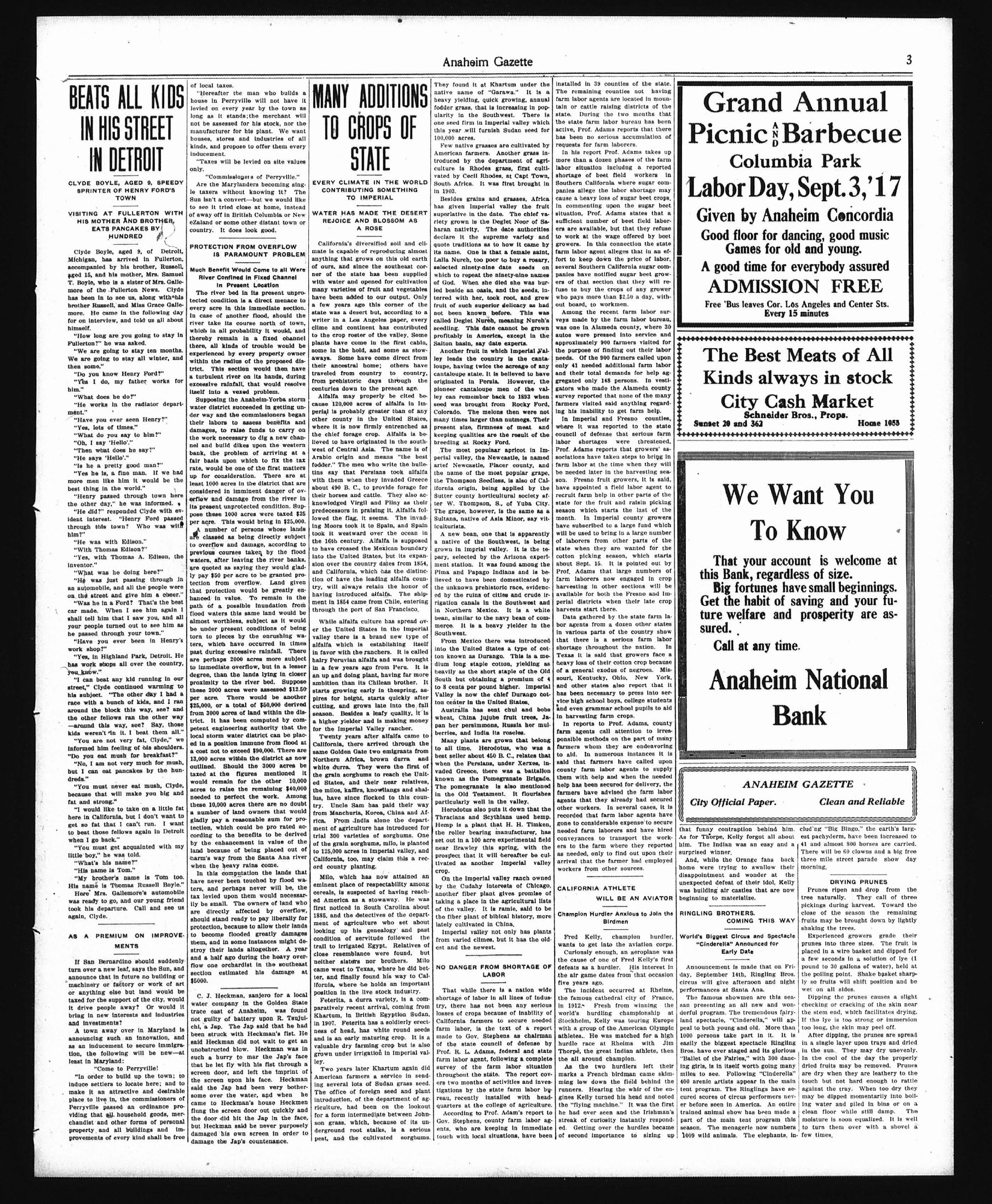
Searchable text
BEATS ALL KIDS IN HIS STREET IN DETROIT
CLYDE BOYLE, AGED 9, SPEEDY SPRINTER OF HENRY FORD'S TOWN
VISITING AT FULLERTON WITH HIS MOTHER AND BROTHER, EATS PANCAKES BY HUNDRED
Clyde Boyle, aged 9, of Detroit, Michigan, has arrived in Fullerton, accompanied by his brother, Russell, aged 15, and his mother, Mrs. Samuel T. Boyle, who is a sister of Mrs. Gallemore of the Fullerton News. Clyde has been in to see us, along with his brother Russell, and Miss Grace Gallemore. He came in the following day for on interview, and told us all about himself.
"How long are you going to stay in Fullerton?" he was asked.
"We are going to stay ten months. We are going to stay all winter, and then some."
"Do you know Henry Ford?"
"Yes I do, my father works for him."
"What does he do?"
"He works in the radiator department."
"Have you ever seen Henry?"
"Yes, lots of times."
"What do you say to him?"
"Oh, I say 'Hello'."
of local taxes.
"Hereafter the man who builds a house in Perryville will not have it levied on every year by the town as long as it stands; the merchant will not be assessed for his stock, nor the manufacturer for his plant. We want houses, stores and industries of all kinds, and propose to offer them every inducement.
"Taxes will be levied on site values only.
"Commissioners of Perryville."
Are the Marylanders becoming single taxers without knowing it? The Sun isn't a convert—but we would like to see it tried close at home, instead of away off in British Columbia or New eZaland or some other distant town or country. It does look good.
PROTECTION FROM OVERFLOW IS PARAMOUNT PROBLEM
Much Benefit Would Come to all Were River Confined in Fixed Channel In Present Location
The river bed in its present unprotected condition is a direct menace to every acre in this immediate section. In case of another flood, should the river take its course north of town, which in all probability it would, and thereby remain in a fixed channel there, all kinds of trouble would be experienced by every property owner within the radius of the proposed district. This section would then have a turbulent river on its hands, during excessive rainfall, that would resolve itself into a vexed problem.
Supposing the Anaheim-Yorba storm water district succeeded in getting under way and the commissioners began their labors to assess benefits and damages, to raise funds to carry on the work necessary to dig a new channel and build dikes upon the western California's diverse mate is capable of anything that grows of ours, and since no one of the state with water and open many varieties of frost have been added to a few years ago the state was a desert writer in a Los Angeles clime and continental to the crop roster of plants have come some in the hold, always. Some have their ancestral hometraveled from countryside from prehistoric d centuries down to Alfalfa may cause 120,000 acres perial is probably given other county in where it is now firthe chief forage cropslieved to have origin west of Central Arkansas.
We are going to stay all winter, and then some."
"Do you know Henry Ford?"
"Yes I do, my father works for him."
"What does he do?"
"He works in the radiator department."
"Have you ever seen Henry?"
"Yes, lots of times."
"What do you say to him?"
"Oh, I say 'Hello'."
"Then what does he say?"
"He says 'Hello'."
"Is he a pretty good man?"
"Yes he is, a fine man. If we had more men like him it would be the best thing in the world."
"Henry passed through town here the other day," he was informed.
"He did?" responded Clyde with evident interest. "Henry Ford passed through this town? Who was with him?"
"He was with Edison."
"With Thomas Edison?"
"Yes, with Thomas A. Edison, the inventor."
"What was he doing here?"
"He was just passing through in an automobile, and all the people were on the street and give him a cheer."
"Was he in a Ford? That's the best car made. When I see him again I shall tell him that I saw you, and all your people turned out to see him as he passed through your town."
"Have you ever been in Henry's work shop?"
"Yes, in Highland Park, Detroit. He has work shops all over the country, you know."
"I can beat any kid running in our street," Clyde continued warming to his subject. "The other day I had a race with a bunch of kids, and I ran around the block this way, see? and the other fellows ran the other way—around this way, see? Say, those kids weren't in it. I beat them all."
"We are not very fat, Clyde," we informed him feeling of his shoulders. "Do you eat mush for breakfast?"
"No, I am not very much for mush, but I can eat pancakes by the hundreds."
"You must never eat mush, Clyde, because that will make you big and fat and strong."
"I would like to take on a little fat here in California, but I don't want to get so fat that I can't run. I want to beat those fellows again in Detroit when I go back."
"You must get acquainted with my experience by every property owner within the radius of the proposed district. This section would then have a turbulent river on its hands, during excessive rainfall, that would resolve itself into a vexed problem.
Supposing the Anaheim-Yorba storm water district succeeded in getting under way and the commissioners began their labors to assess benefits and damages, to raise funds to carry on the work necessary to dig a new channel and build dikes upon the western bank, the problem of arriving at a fair basis upon which to fix the tax rate, would be one of the first matters up for consideration. There are at least 1000 acres in the district that are considered in imminent danger of overflow and damage from the river in its present unprotected condition. Suppose these 1000 acres were taxed $25 per acre. This would bring in $25,000.
A number of persons whose lands are classed as being directly subject to overflow and damage, according to previous courses taken by the flood waters, after leaving the river banks, are quoted as saying they would gladly pay $50 per acre to be granted protection from overflow. Land given that protection would be greatly enhanced in value. To remain in the path of a possible inundation from flood waters this same land would be almost worthless, subject as it would be under present conditions of being torn to pieces by the enrushing waters, which have occurred in times past during excessive rainfall. There are perhaps 2000 acres more subject to immediate overflow, but in a lesser degree, than the lands lying in closer proximity to the river bed. Suppose these 2000 acres were assessed $12.50 per acre. There would be another $25,000, or a total of $50,000 derived from 3000 acres of land within the district. It has been computed by competent engineering authority that the local storm water district can be placed in a position immune from flood at a cost not to exceed $90,000. There are 13,000 acres within the district as now outlined. Should the 3000 acres be taxed at the figures mentioned it would remain for the other 10,000 acres to raise the remaining $40,000 needed to perfect the work. Among these 10,000 acres there are no doubt a number of land owners that would gladly pay a reasonable sum for protection, which could be pro rated according to the benefits to be derived by the enhancement in value of the land because of being placed out of
Alfalfa may produce 120,000 acres perial is probably given other county in that where it is now firmed; the chief forage crop lieved to have origin west of Central Asia Arabic origin and fodder." The men wintins say that Perlwith them when they about 490 B.C., to their horses and cattle knownled Virgil i predecessors in praised the flag, it ing Moors took it took it westward to the 16th century. Ato have crossed them into the United States over the counties and California, whition of have lear try, will always re having introduced ment in 1854 came f through the port o
While alfalfa culterer the United State valley there is a alfalfa which is in favor with the rainy Peruvian alfalfa in a few years ago an up and doing plumb ambition than its starts growing early plres for height, s cutting, and grows season. Besides alfalfa a higher yielder and for the Imperial V
Twenty years after California, there are same Golden Gate Northern Africa white durra. Theythe grain sorghum ed States, and tha milos, kaffirs, kus have since flo try. Uncle Sam h from Manchuria, Krica. From India ment of agriculture trial 300 varieties of the grain sorghu
"Do you eat mush for breakfast?
'No, I am not very much for mush,
but I can eat pancakes by the hundreds.'
'You must never eat mush, Clyde,
because that will make you big and fat and strong.'
'I would like to take on a little fat here in California, but I don't want to get so fat that I can't run. I want to beat those fellows again in Detroit when I go back.'
'You must get acquainted with my little boy,' he was told.
'What's his name?'
'His name is Tom.'
'My brother's name is Tom too. His name is Thomas Russell Boyle.'
Here Mrs. Gallemore's automobile was ready to go, and our young friend took his departure. Call and see us again, Clyde.
AS A PREMIUM ON IMPROVEMENTS
If San Bernardino should suddenly turn over a new leaf, says the Sun, and announce that in future no building or machinery or factory or work of art or anything else but land would be taxed for the support of the city, would it drive people away? Or would it bring in new interests and industries and investments?
A town away over in Maryland is announcing such an innovation, and as an inducement to secure immigration, the following will be new—at least in Maryland:
"Come to Perryville!
'In order to build up the town; to induce settlers to locate here; and to make it an attractive and desirable place to live in, the commissioners of Perryville passed an ordinance providing that all household goods, merchandist and other forms of personal property and all buildings and improvements of every kind shall be free
C. J. Heckman, zanjero for a local water company in the Golden State trace east of Anaheim, was found not guilty of battery upon R. Tsujuchi, a Jap. The Jap said that he had been struck with Heckman's fist. He said Heckman did not wait to get an unobstructed blow. Heckman was in such a hurry to mar the Jap's face that he let fly with his fist through a screen door, and left the imprint of the screen upon his face. Heckman said the Jap had been very bother some over the water, and when he came to Heckman's house Heckmen flung the screen door out quickly and the door did hit the Jap in the face, but Heckman said he never purposely damaged his own screen in order to damage the Jap's countenance."
Northern Africa, white durra. They the grain sorghum ed States, and th the milos, kaffirs, kus, have since flo try. Uncle Sam B from Manchuria, Krica. From India ment of agriculture trial 300 varieties of the grain sorghum to 125,000 acres in California, too, ma ord county planting.
Milo, which has eminent place of re cereals, is suspected America as a s first noticed in So 1885, and the dete ctment of agriculture looking up his g condition of servi tral to irrigated E close resemblance neither sisters nor came west to Texas ter, and finally four lfornia, where he be position in the liv Feterita, a durra paratively recent at Khartum, in Britis 1907. Feterita hness of head, has and is an early ma valuable dry farm grown under irrigation.
Two years later American farmers ing several lots of The office of fore introduction, of th riculture, had be for a form intermer son grass, which derground root s pest, and the cu
MANY ADDITIONS TO CROPS OF STATE
EVERY CLIMATE IN THE WORLD CONTRIBUTING SOMETHING TO IMPERIAL
WATER HAS MADE THE DESERT REJOICE AND BLOSSOM AS A ROSE
California's diversified soil and climate is capable of reproducing almost anything that grows on this old earth of ours, and since the southeast corner of the state has been supplied with water and opened for cultivation many varieties of fruit and vegetables have been added to our output. Only a few years ago this corner of the state was a desert but, according to a writer in a Los Angeles paper, every clime and continent has contributed to the crop roster of the valley. Some plants have come in the first cabin, some in the hold, and some as stowaways. Some have come direct from their ancestral home; others have traveled from country to country, from prehistoric days through the centuries down to the present age.
Alfalfa may properly be cited because 120,000 acres of alfalfa in Imperial is probably greater than of any other county in the United States, where it is now firmly entrenched as the chief forage crop. Alfalfa is believed to have originated in the southwest of Central Asia. The name is of They found it at Khartum under the native name of "Garawa." It is a heavy yielding, quick growing, annual fodder grass, that is increasing in popularity in the Southwest. There is one seed firm in Imperial valley which this year will furnish Sudan seed for 100,000 acres.
Few native grasses are cultivated by American farmers. Another grass introduced by the department of agriculture is Rhodes grass, first cultivated by Cecil Rhodes, at Capt Town, South Africa. It was first brought in in 1903.
Besides grains and grasses, Africa has given Imperial valley the fruit superlative in the date. The chief variety grown is the Deglet Noor of Saharan nativity. The date authorities declare it the supreme variety and quote traditions as to how it came by its name. One is that a female saint, Lalla Nureh, too poor to buy a rosary, selected ninety-nine date seeds on which to repeat the ninety-nine names of God. When she died she was buried beside an oasis, and the seeds, interred with her, took root, and grew fruit of such superior delicacy as had not been known before. This was called Deglet Nureh, meaning Nureh's seedling. This date cannot be grown profitably in America, except in the Salton basin, say date experts.
Another fruit in which Imperial Valley leads the country is the cantaloupe, having twice the acreage of any cantaloupe state. It is believed to have originated in Persia. However, the pioneer cantaloupe men of the valley can remember back to 1893 when seed was brought from Rocky Ford, Colorado. The melons then were not many times larger than nutmegs. Their present size, firmness of meat and keeping qualities are the result of the breeding at Rocky Ford.
Installed in 39 counties of the state. The remaining counties not having farm labor agents are located in mountain or cattle raising districts of the state. During the two months that the state farm labor bureau has been active, Prof. Adams reports that there has been no serious accumulation of requests for farm laborers.
In his report Prof. Adams takes up more than a dozen phases of the farm labor situation including a reported shortage of beet field workers in Southern California where sugar companies allege the labor shortage may cause a heavy loss of sugar beet crops. In commenting upon the sugar beet situation, Prof. Adams states that a sufficient number of beet field laborers are available, but that they refuse to work at the wage offered by beet growers. In this connection the state farm labor agent alleges that in an effort to keep down the price of labor, several Southern California sugar companies have notified sugar beet growers of that section that they will refuse to buy the crops of any grower who pays more than $2.50 a day, without board, to workmen.
Among the recent farm labor surveys made by the farm labor bureau, was one in Alameda county, where 30 autos were pressed into service and approximately 900 farmers visited for the purpose of finding out their labor needs. Of the 900 farmers called upon only 41 needed additional farm labor and their total demands for help aggregated only 148 persons. In vestigators who made the Alameda county survey reported that none of the many farmers visited said anything regarding his inability to get farm help.
In Imperial and Fresno counties, where it was reported to the state council of defense that serious farm labor shortages were threatened, Prof Adams reports that growers'
Some have direct from their ancestral home; others have traveled from country to country, from prehistoric days through the centuries down to the present age.
Alfalfa may properly be cited because 120,000 acres of alfalfa in Imperial is probably greater than any other county in the United States, where it is now firmly entrenched as the chief forage crop. Alfalfa is believed to have originated in the southwest of Central Asia. The name is of Arabic origin and means "the best fodder." The men who write the bullets say that Persians took alfalfa with them when they invaded Greece about 490 B.C., to provide for their horses and cattle. They also acknowledged Virgil and Pliny as their predecessors in praising it. Alfalfa followed the flag, it seems. The invading Moors took it to Spain, and Spain took it westward over the ocean in the 16th century. Alfalfa is supposed to have crossed the Mexican boundary into the United States, but its expansion over the country dates from 1854, and California, which has the distinction of have the leading alfalfa country, will always retain the honor of having introduced alfalfa. The shipment in 1854 came from Chile, entering through the port of San Francisco.
While alfalfa culture has spread over the United States in the Imperial valley there is a brand new type of alfalfa which is establishing itself in favor with the ranchers. It is called hairy Peruvian alfalfa and was brought in a few years ago from Peru. It is an up and doing plant, having far more ambition than its Chilean brother. It starts growing early in the spring, aspires for height, starts quickly after cutting, and grows late into the fall season. Besides a leafy quality, it is a higher yielder and is making money for the Imperial Valley rancher.
Twenty years after alfalfa came to California, there arrived through the same Golden Gate two emigrants from Northern Africa, brown durra and white durra. They were the first of the grain sorghums to reach the United States, and their near relatives, the milos, kaffirs, knowliangs and shalus, have since flocked to this country. Uncle Sam has paid their way from Manchuria, Korea, China and Africa. From India alone the department of agriculture has introduced for trial 300 varieties of sorghums. One of the grain sorghums, milo, is planted at 125,000 acres in Imperial valley andley leads the country is the cantaloupe, having twice the acreage of any cantaloupe state. It is believed to have originated in Persia. However, the pioneer cantaloupe men of the valley can remember back to 1893 when seed was brought from Rocky Ford, Colorado. The melons then were not many times larger than nutmegs. Their present size, firmness of meat and keeping qualities are the result of the breeding at Rocky Ford.
The most popular apricot in Imperial valley, the Newcastle, is named artef Newcastle, Placer county, and the name of the most popular grape, the Thompson Seedless, is also of California origin, being applied by the Sutter county horticultural society after W. Thompson, S., of Yuba City. The grape, however, is the same as a Sultana, native of Asia Minor, say viticulturists.
A new bean, one that is apparently a native of the Southwest, is being grown in Imprial valley. It is the tapery, selected by the Arizona experiment station. It was found among the Pima and Papago Indians and is believed to have been domesticated by the unknown prehistoric race, evidenced by the ruins of cities and crude irrigation canals in the Southwest and in Northern Mexico. It is a white bean, similar to the navy bean of commerce. It is a heavy yielder in the Southwest.
From Mexico there was introduced into the United States a type of cotton known as Durango. This is a medium long staple cotton, yielding as heavily as the short staple of the Old South but obtaining a premium of 4 to 8 cents per pound higher. Imperial Valley is now the chief Durango cotton center in the United States.
Australia has sent chul and bobs wheat, China Jujube fruit trees, Japan her persimmons, Russia her mulberries, and India its roseles.
Many plants are grown that belong to all time. Herodotus, who was a best seller about 450 B.C., relates that when the Persians, under Xerxes, invaded Greece, there was a battallion known as the Pomegranate Brigade. The pomegranate is also mentioned in the Old Testament. It flourishes particularly well in the valley.
Herodotus also puts it down that the Thracians and Scythians used hemp. Hemp is a plant that H. H. Timken, the roller bearing manufacturer, has set out in a 100 acre experimental field near Brawley this spring, with the needs. Of the 900 farmers called upon only 41 needed additional farm labor and their total demands for help aggregated only 148 persons. In vestigators who made the Alameda county survey reported that none of the many farmers visited said anything regarding his inability to get farm help.
In Imperial and Fresno counties, where it was reported to the state council of defense that serious farm labor shortages were threatened. Prof. Adams reports that growers' associations have taken steps to bring in farm labor at the time when they will be needed later in the harvesting season. Fresno fruit growers, it is said, have appointed a field labor agent to recruit farm help in other parts of the state for the fruit and raisin picking season which starts the last of the month. In Imperial county growers have subscribed to a large fund which will be used to bring in a large number of laborers from other parts of the state when they are wanted for the cotton picking season, which starts about Sept. 15. It is pointed out by Prof. Adams that large numbers of farm laborers now engaged in crop harvesting in other sections will be available for both the Fresno and Imperial districts when their late crop harvests start there.
Data gathered by the state farm labor agents from a dozen other states in various parts of the country show that there is a serious farm labor shortage throughout the nation. In Texas it is said that growers face a heavy loss of their cotton crop because of a general exodus of negroes. Missouri, Kentucky, Ohio, New York, and other states also report that it has been necessary to press into service high school boys, college students and even grammar school pupils to aid in harvesting farm crops.
In reports to Prof. Adams, county farm agents call attention to irresponsible methods on the part of many farmers whom they are endeavoring to aid. In numerous instances it is said that farmers have called upon county farm labor agents to supply them with help and when the needed help has been secured for delivery, the farmers have advised the farm labor agents that they already had secured other workers. In several cases, it is recorded that farm labor agents have gone to considerable expense to secure needed farm laborers and have hired conveyances to transport the workers to the farm where they reported
Northern Africa, brown durra, and white durra. They were the first of the grain sorghums to reach the United States, and their near relatives, the milos, kaffirs, knowliangs and shalus, have since flocked to this country. Uncle Sam has paid their way from Manchuria, Korea, China and Africa. From India alone the department of agriculture has introduced for trial 300 varieties of sorghums. One of the grain sorghums, milo, is planted to 125,000 acres in Imperial valley, and California, too, may claim this a record county planting.
Milo, which has now attained an eminent place of respectability among cereals, is suspected of having reached America as a stowaway. He was first noticed in South Carolina about 1885, and the detectives of the department of agriculture who set about looking up his genealogy and past condition of servitude followed the trail to irrigated Egypt. Relatives of close resemblance were found, but neither sisters nor brothers. Milo came west to Texas, where he did better, and finally found his way to California, where he holds an important position in the live stock industry.
Feterita, a durra variety, is a comparatively recent arrival, coming from Khartum, in British Egypt Sudan, in 1907. Feterita has a soldierly erectness of head, has white round seeds and is an early maturing crop. It is a valuable dry farming crop but is also grown under irrigation in Imperial valley.
Two years later Khartum again did American farmers a service in sending several lots of Sudan grass seed. The office of foreign seed and plant introduction, of the department of agriculture, had been on the lookout for a form intermediate between Johnson grass, which, because of its underground root stalks, is a serious pest, and the cultivated sorghums.
That while there is a nation wide shortage of labor in all lines of industry, there has not been any serious losses of crops because of inability of California farmers to secure needed farm labor, is the text of a report made to Gov. Stephens as chairman of the state council of defense by Prof. R. L. Adams, federal and state farm labor agent, following a complete survey of the farm labor situation throughout the state. The report covers two months of activities and investigations by the state farm labor bureau, recently installed with headquarters at the college of agriculture.
According to Prof. Adam's report to Gov. Stephens, county farm labor agents, who are keeping in immediate touch with local situations, have been
In numerous instances it is said that farmers have called upon county farm labor agents to supply them with help and when the needed help has been secured for delivery, the farmers have advised the farm labor agents that they already had secured other workers. In several cases, it is recorded that farm labor agents have gone to considerable expense to secure needed farm laborers and have hired conveyances to transport the workers to the farm where they reported as needed, only to find out upon their arrival that the farmer had employed workers from other sources.
CALIFORNIA ATHLETE
WILL BE AN AVIATOR
Champion Hurdler Anxious to Join the Birdmen
Fred Kelly, champion hurdler, wants to get into the aviation corps.
Curiously enough, an aeroplane was the cause of one of Fred Kelly's first defeats as a hurdler. His interest in the air game dates from that occasion five years ago.
The incident occurred at Rheims, the famous cathedral city of France, in 1912. Fresh from winning the world's hurdling championship at Stockholm, Kelly was touring Europe with a group of the American Olympic athletes... He was matched for a high hurdle race at Rheims with Jim Thorpe, the great Indian athlete, then the all around champion.
As the two hurdlers left their marks a French birdman came skimming low down the field behind the runners. Hearing the whir of the engines Kelly turned his head and noted the "flying machine." It was the first he had ever seen and the Irishman's streak of curiosity instantly responded. Getting over the hurdles became of second importance to sizing up
Grand Annual Picnic AND Barbecue
Columbia Park
Labor Day, Sept. 3,'17
Given by Anaheim Concordia
Good floor for dancing, good music
Games for old and young.
A good time for everybody assured
ADMISSION FREE
Free 'Bus leaves Cor. Los Angeles and Center Sts.
Every 15 minutes
The Best Meats of All
Kinds always in stock
City Cash Market
Schneider Bros., Props.
Sunset 20 and 362
Home 1058
We Want You
To Know
That your account is welcome at this Bank, regardless of size.
Big fortunes have small beginnings. Get the habit of saving and your future welfare and prosperity are assured.
Call at any time.
Anaheim National Bank
ANAHEIM GAZETTE
City Official Paper. Clean and Reliable
ANAHEIM GAZETTE
City Official Paper. Clean and Reliable
that funny contraption behind him. As for Thorpe, Kelly forgot all about him. The Indian was an easy and a surprised winner.
And, while the Orange fans back home were trying to swallow their disappointment and wonder at the unexpected defeat of their idol, Kelly was building air castles that are now beginning to materialize.
RINGLING BROTHERS.
COMING THIS WAY
World's Biggest Circus and Spectacle "Cinderella" Announced for Early Date
Announcement is made that on Friday, September 14th, Ringling Bros. circus will give afternoon and night performances at Santa Ana.
The famous showmen are this season presenting an all new and wonderful program. The tremendous fairyland spectacle, "Cinderella," will appeal to both young and old. More than 1000 persons take part in it. It is easily the biggest spectacle Ringling Bros. have ever staged and its glorious "Ballet of the Fairies," with 300 dancing girls, is in itself worth going many miles to see. Following "Cinderella" 400 arenic artists appear in the main tent program. The Ringlings have secured scores of circus performers never before seen in America. An entire trained animal show has been made a part of the main tent program this season. The menagerie now numbers 1009 wild animals. The elephants, including "Big Bingo," the earth's largest pachyderm, have been increased to 41 and almost 800 horses are carried. There will be 60 clowns and a big free three mile street parade show day morning.
DRYING PRUNES
Prunes ripen and drop from the tree naturally. They call of three pickings during harvest. Toward the close of the season the remaining fruits may be brought down by lightly shaking the trees.
Experienced growers grade their prunes into three sizes. The fruit is placed in a wire basket and dipped for a few seconds in a solution of lye (1 pound to 30 gallons of water), held at the polling point. Shake basket sharply so fruits will shift position and be wet on all sides.
Dipping the prunes causes a slight checking or cracking of the skin near the stem end, which facilitates drying. If the lye is too strong or immersion too long, the skin may peel off.
After dipping, the prunes are spread in a single layer upon trays and dried in the sun. They may dry unevenly. In the cool of the day the properly dried fruits may be removed. Prunes are dry when they are leathery to the touch but not hard enough to rattle against the tray. When too dry they may be dipped momentarily into boiling water and piled in bins or on a clean floor while still damp. The moisture is soon equalized. It is well to turn them over with a shovel a few times.