anaheim-gazette 1917-08-16
Scanned page
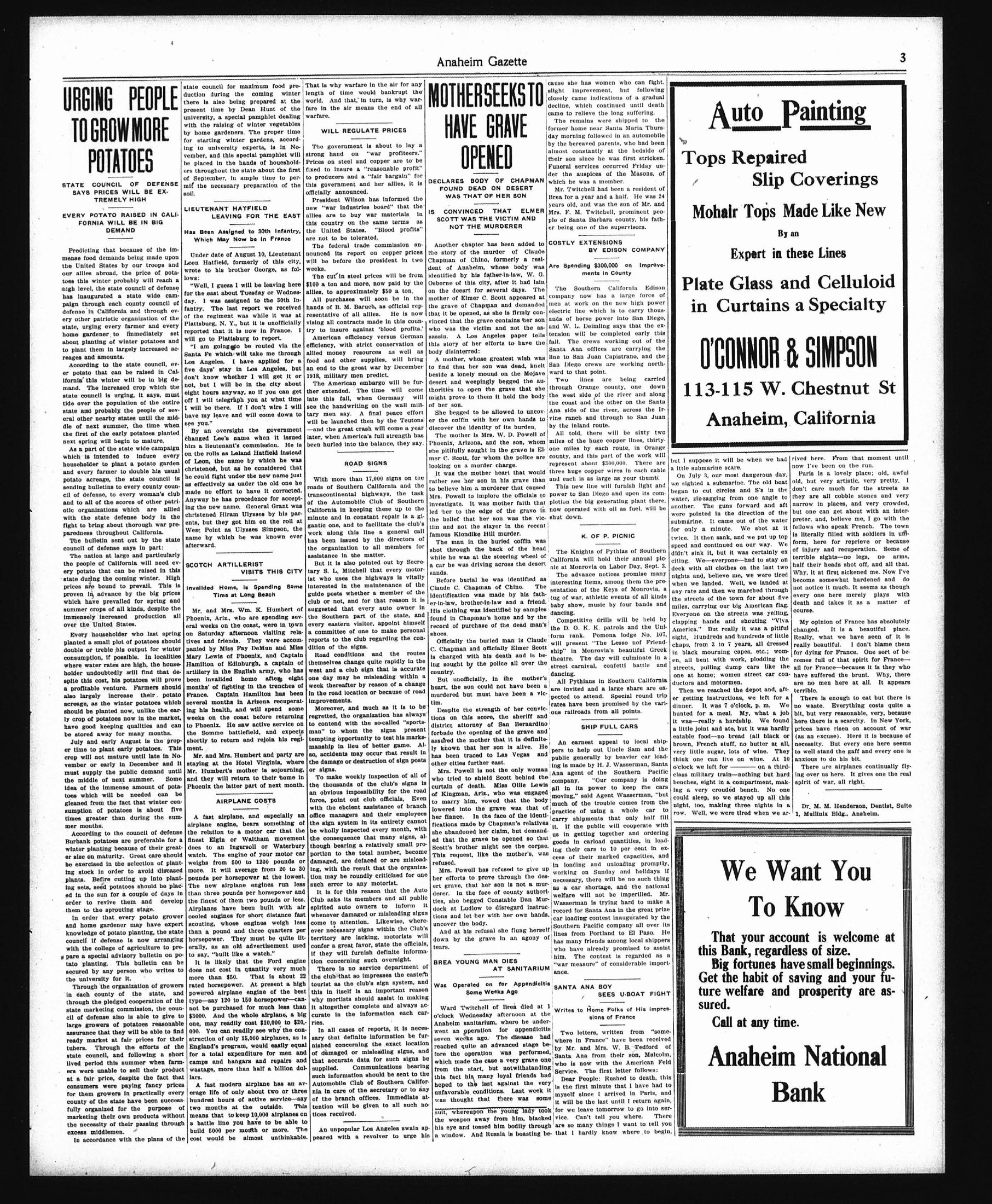
Searchable text
URGING PEOPLE TO GROW MORE POTATOES
STATE COUNCIL OF DEFENSE SAYS PRICES WILL BE EXTREMELY HIGH
EVERY POTATO RAISED IN CALIFORNIA WILL BE IN BIG DEMAND
Predicting that because of the immense food demands being made upon the United States by our troops and our allies abroad, the price of potatoes this winter probably will reach a high level, the state council of defense has inaugurated a state wide campaign through each county council of defense in California and through every other patriotic organization of the state, urging every farmer and every home gardener to immediately set about planting of winter potatoes and to plant them in largely increased acres and amounts.
According to the state council, ever potato that can be raised in California this winter will be in big demand. The increased crop which the state council is urging, it says, must tide over the population of the entire state and probably the people of several other nearby states until the middle of next summer, the time when the first of the early potatoes planted next spring will begin to mature.
As part of the statewide campaign state council for maximum food production during the coming winter there is also being prepared at the present time by Dean Hunt of the university, a special pamphlet dealing with the raising of winter vegetables by home gardeners. The proper time for starting winter gardens, according to university experts, is in November, and this special pamphlet will be placed in the hands of householders throughout the state about the first of September, in ample time to permit the necessary preparation of the soil.
LIEUTENANT HATFIELD LEAVING FOR THE EAST
Has Been Assigned to 30th Infantry, Which May Now be in France
Under date of August 10, Lieutenant Leon Hatfield, formerly of this city, wrote to his brother George, as follows:
"Well, I guess I will be leaving here for the east about Tuesday or Wednesday. I was assigned to the 30th Infantry. The last report we received of the regiment was while it was at Plattsburg, N. Y., but it is unofficially reported that it is now in France. I will go to Plattsburg to report.
"I am going to be routed via the Santa Fe which will take me through Los Angeles. I have applied for a five days' stay in Los Angeles, but don't know whether I will get it or not, but I will be in the city about eight hours anyway, so if you can get off I will telegraph you at what time I will be there. If I don't wire I will have my leave and will come down to see you."
By an oversight the government changed Lee's name when it issued him a lieutenant's commission. He is that is why warfare has length of time would world. And that, in fare in the air means warfare.
WILL REGULATE
The government is strong hand on "Prices on steel and fixed to insure a "rife to producers and a "this government and officially announced.
President Wilson has new "war industries allies are to buy ww this country on the United States. are not to be tolerate.
The federal trade nounced its report will be before the weeks.
The cut in steel prices $100 a ton and more, allies, to approximate.
All purchases will hands of B. M. Baruch resentative of all all vising all contracts m try to insure against American efficiency, with strict alled money resource food and other supplies an end to the great 1918, military men p The American emb her extended. The late this fall, where see the handwriting tary men say. A f will be launched then—and the great crash later, when America's been hurled into the
According to the state council, ever potato that can be raised in California this winter will be in big demand. The increased crop which the state council is urging, it says, must tide over the population of the entire state and probably the people of several other nearby states until the middle of next summer, the time when the first of the early potatoes planted next spring will begin to mature.
As a part of the state wide campaign which is intended to induce every householder to plant a potato garden and every farmer to double his usual potato acreage, the state council is sending bulletins to every county council of defense, to every woman's club and to all of the scores of other patriotic organizations which are allied with the state defense body in the fight to bring about thorough war preparedness throughout California.
The bulletin sent out by the state council of defense says in part:
The nation at large and particularly the people of California will need every potato that can be raised in this state during the coming winter. High prices are bound to prevail. This is proven in advance by the big prices which have prevailed for spring and summer crops of all kinds, despite the immensely increased production all over the United States.
Every householder who last spring planted a small plot of potatoes should double or treble his output for winter consumption, if possible. In localities where water rates are high, the householder undoubtedly will find that despite this cost, his potatoes will prove a profitable venture. Farmers should also largely increase their potato acreage, as the winter potatoes which should be planted now, unlike the early crop of potatoes now in the market, have good keeping qualities and can be stored away for many months.
July and early August is the proper time to plant early potatoes. This crop will not mature until late in November or early in December and it must supply the public demand until the middle of next summer. Some idea of the immense amount of potatoes which will be needed can be gleaned from the fact that winter consumption of potatoes is about five times greater than during the summer months.
According to the council of defense Burbank potatoes are preferable for a winter planting because of their great reages and amounts.
Santa Fe which take me through Los Angeles. I have applied for a five days' stay in Los Angeles, but don't know whether I will get it or not, but I will be in the city about eight hours anyway, so if you can get off I will telegraph you at what time I will be there. If I don't wire I will have my leave and will come down to see you."
By an oversight the government changed Lee's name when it issued him a lieutenant's commission. He is on the rolls as Leland Hatfield instead of Leon, the name by which he was christened, but as he considered that he could fight under the new name just as effectively as under the old one he made no effort to have it corrected. Anyway he has precedence for accepting the new name. General Grant was christened Hiram Ulysses by his parents, but they got him on the roll at West Point as Ulysses Simpson, the name by which he was known ever afterward.
SCOTCH ARTILLERIST
VISITS THIS CITY
Invalided Home, is Spending Some Time at Long Beach
Mr. and Mrs. Wm. K. Humbert of Phoenix, Ariz., who are spending several weeks on the coast, were in town on Saturday afternoon visiting relatives and friends. They were accompanied by Miss Fay DeMun and Miss Mary Lewis of Phoenix, and Captain Hamilton of Edinburgh, a captain of artillery in the English army, who has been invalidated home after eight months' of fighting in the trenches of France. Captain Hamilton has been several months in Arizona recuperating his health, and will spend some weeks on the coast before returning to Phoenix. He saw active service on the Somme battlefield, and expects shortly to return and rejoin his regiment.
Mr. and Mrs. Humbert and party are staying at the Hotel Virginia, where Mr. Humbert's mother is sojourning, and they will return to their home in Phoenix the latter part of next month.
AIRPLANE COSTS
A fast airplane, and especially an airplane engine, bears something of the relation to a motor car that the finest Elgin or Waltham movement does to an Ingersoll or Waterbury...
crop will not mature until late in November or early in December and it must supply the public demand until the middle of next summer. Some idea of the immense amount of potatoes which will be needed can be gleaned from the fact that winter consumption of potatoes is about five times greater than during the summer months.
According to the council of defense Burbank potatoes are preferable for a winter planting because of their greater size on maturity. Great care should be exercised in the selection of planting stock in order to avoid diseased plants. Before cutting up into planting sets, seed potatoes should be placed in the sun for a couple of days in order to revive them and develop them to the sprouting stage.
In order that every potato grower and home gardener may have expert knowledge of potato planting, the state council if defense is now arranging with the college of agriculture to prepare a special advisory bulletin on potato planting. This bulletin can be secured by any person who writes to the university for it.
Through the organization of growers in each county of the state, and through the pledged cooperation of the state marketing commission, the council of defense also is able to give to large growers of potatoes reasonable assurance that they will be able to find ready market at fair prices for their tubers. Through the efforts of the state council, and following a short lived period this summer when farmers were unable to sell their product at a fair price, despite the fact that consumers were paying fancy prices for them growers in practically every county of the state have been successfully organized for the purpose of marketing their own products without the necessity of their passing through excess middlemen.
In accordance with the plans of the
A fast airplane, and especially an airplane engine, bears something of the relation to a motor car that the finest Elgin or Waltham movement does to an Ingersoll or Waterbury watch. The engine of your motor car weighs from 500 to 1200 pounds or more. It will average from 20 to 30 pounds per horsepower at the lowest. The new airplane engines run less than three pounds per horsepower and the finest of them two pounds or less. Airplanes have been built with air cooled engines for short distance fast scouting, whose engines weigh less than a pound and three quarters per horsepower. They must be quite literally, as an old advertisement used to say, "built like a watch."
It is likely that the Ford engine does not cost in quantity very much more than $50. That is about 22 rated horsepower. At present a high powered airplane engine of the best type—say 120 to 150 horsepower—can not be purchased for much less than $3000. And the whole airplane, a big one, may readily cost $10,000 to $20,000. You can readily see why the construction of only 15,000 airplanes, as is England's program, would easily equal for a total expenditure for men and camps and hangars and repairs and wastage, more than half a billion dollars.
A fast modern airplane has an average life of only about two or three hundred hours of active service—say two months at the outside. This means that to keep 10,000 airplanes on a battle line you have to be able to build 5000 per month or more. The cost would be almost unthinkable.
Mr. and Mrs. Humbert and party are staying at the Hotel Virginia, where Mr. Humbert's mother is sojourning, and they will return to their home in Phoenix the latter part of next month.
AIRPLANE COSTS
A fast airplane, and especially an airplane engine, bears something of the relation to a motor car that the finest Elgin or Waltham movement does to an Ingersoll or Waterbury watch. The engine of your motor car weighs from 500 to 1200 pounds or more. It will average from 20 to 30 pounds per horsepower at the lowest. The new airplane engines run less than three pounds per horsepower and the finest of them two pounds or less. Airplanes have been built with air cooled engines for short distance fast scouting, whose engines weigh less than a pound and three quarters per horsepower. They must be quite literally, as an old advertisement used to say, "built like a watch."
It is likely that the Ford engine does not cost in quantity very much more than $50. That is about 22 rated horsepower. At present a high powered airplane engine of the best type—say 120 to 150 horsepower—can not be purchased for much less than $3000. And the whole airplane, a big one, may readily cost $10,000 to $20,000. You can readily see why the construction of only 15,000 airplanes, as is England's program, would easily equal for a total expenditure for men and camps and hangars and repairs and wastage, more than half a billion dollars.
A fast modern airplane has an average life of only about two or three hundred hours of active service—say two months at the outside. This means that to keep 10,000 airplanes on a battle line you have to be able to build 5000 per month or more. The cost would be almost unthinkable.
Mr. and Mrs. Humbert and party are staying at the Hotel Virginia, where Mr. Humbert's mother is sojourning, and they will return to their home in Phoenix the latter part of next month.
To make weekly flyings an obvious impossibility force, point out club with the ebclient assis office managers and the sign system in it be wholly inspected; the consequence thou bearing a reportion to the total damaged, are defacing, with the resultion may be roundly such error to any.
It is for this reason Club asks its members spirited auto owner whenever damaged come to attention. Ever necessary sign territory are lacking confer a great favor if they will furnish information concerning supers.
There is no service club that so impatient tourist as the club' this in itself is an why mortists should it altogether complete in the info ries.
In all cases of ransary that definite finished concerning damage or mis that accurate data supplied.
Comm such information show Automobile Club o nla in care of the branch office tention will be given tices received.
An unpopular Lo peared with a re
Anaheim Gazette
That is why warfare in the air for any length of time would bankrupt the world. And that, in turn, is why warfare in the air means the end of all warfare.
WILL REGULATE PRICES
The government is about to lay a strong hand on "war profiteers." Prices on steel and copper are to be fixed to insure a "reasonable profit" to producers and a "fair bargain" for this government and her allies, it is officially announced.
President Wilson has informed the new "war industries board" that the allies are to buy war materials in this country on the same terms as the United States. "Blood profits" are not to be tolerated.
The federal trade commission announced its report on copper prices will be before the president in two weeks.
The cut in steel prices will be from $100 a ton and more, now paid by the allies, to approximately $50 a ton.
All purchases will soon be in the hands of B. M. Baruch, as official representative of all allies. He is now vising all contracts made in this country to insure against 'blood profits.' American efficiency versus German efficiency, with strict conservation of allied money resources as well as food and other supplies, will bring an end to the great war by December 1918, military men predict.
The American embargo will be further extended. The time will come late this fall, when Germany will see the handwriting on the wall military men say. A final peace effort will be launched then by the Teutons—and the great crash will come a year later, when America's full strength has been hurled into the balance, they say.
MOTHERSEEKS TO HAVE GRAVE OPENED
DECLARES BODY OF CHAPMAN FOUND DEAD ON DESERT WAS THAT OF HER SON
IS CONVINCED THAT ELMER SCOTT WAS THE VICTIM AND NOT THE MURDERER
Another chapter has been added to the story of the murder of Claude Chapman of Chino, formerly a resident of Anaheim, whose body was identified by his father-in-law, W. G. Osborne of this city, after it had lain on the deserts for several days. The mother of Elmer C. Scott appeared at the grave of Chapman and demanded that it be opened, as she is firmly convinced that the grave contains her son who was the victim and not the assassin. A Los Angeles paper tells this story of her efforts to have the body disinterred:
A mother, whose greatest wish was to find that her son was dead, knelt beside a lonely mound on the Mojave desert and weepingly begged the authorities to open the grave that she might prove to them it held the body of her son.
She begged to be allowed to uncover the coffin with her own hands to discover the identity of its burden.
The mother is Mrs. W. D. Powell of Phoenix, Arizona, and the son, whom cause she has women who can fight. slight improvement, but following closely came indications of a gradual decline, which continued until death came to relieve the long suffering.
The remains were shipped to the former home near Santa Maria Thursday morning followed in an automobile by the bereaved parents, who had been almost constantly at the bedside of their son since he was first stricken. Funeral services occurred Friday under the auspices of the Masons, of which he was a member.
Mr. Twitchell had been a resident of Brea for a year and a half. He was 24 years old, and was the son of Mr. and Mrs. F. M. Twitchell, prominent people of Santa Barbara county, his father being one of the supervisors.
COSTLY EXTENSIONS BY EDISON COMPANY
Are Spending $300,000 on Improvements in County
The Southern California Edison company now has a large force of men at work on the new high power electric line which is to carry thousands of horsepower into San Diego, and W. L. Deimling says that the extension will be completed early this fall. The crews working out of the Santa Ana offices are carrying the line to San Juan Capistrano, and the San Diego crews are working northward to that point.
Two lines are being carried through Orange county, one down the west side of the river and along the coast and the other on the Santa Ana side of the river, across the Irvine ranch and through to San Juan by the inland route.
All told, there will be sixty two miles of the huge copper lines, thirty-one miles by each route, in Orange
ROAD SIGNS
With more than 17,000 signs on the roads of Southern California and the transcontinental highways, the task of the Automobile Club of Southern California in keeping these up to the minute and in constant repair is a gigantic one, and to facilitate the club's work along this line a general call has been issued by the directors of the organization to all members for assistance in the matter.
But it is also pointed out by Secretary S. L. Mitchell that every motorist who uses the highways is vitally interested in the maintenance of the guide posts whether a member of the club or not, and for that reason it is suggested that every auto owner in the Southern part of the state, and every eastern visitor, appoint himself a committee of one to make personal reports to the club regarding the condition of the signs.
Road conditions and the routes themselves change quite rapidly in the west and a club sign that is accurate one day may be misleading within a week thereafter by reason of a change in the road location or because of road improvements.
Moreover, and much as it is to be regretted, the organization has always to contend with the so-called "sportsman" to whom the signs present tempting opportunity to test his marksmanship in lieu of better game. Also, accidents may occur that result in the damage or destruction of sign posts or signs.
To make weekly inspection of all of the thousands of the club's signs is an obvious impossibility for the road force, point out club officials, Even with the ebcient assistance of branch office managers and their employees the sign system in its entirety cannot be wholly inspected every month, with the consequence that many signs, although bearing a relatively small proA mother, whose greatest wish was to find that her son was dead, knelt beside a lonely mound on the Mojave desert and weepingly begged the authorities to open the grave that she might prove to them it held the body of her son.
She begged to be allowed to uncover the coffin with her own hands to discover the identity of its burden.
The mother is Mrs. W. D. Powell of Phoenix, Arizona, and the son, whom she pitifully sought in the grave is Elmer C. Scott, for whom the police are looking on a murder charge.
It was the mother heart that would rather see her son in his grave than to believe him a murderer that caused Mrs. Powell to implore the officials to investigate. It was mother faith that led her to the edge of the grave in the belief that her son was the victim and not the slayer in the recent famous Klondike Hill murder.
The man in the buried coffin was shot through the back of the head while he was at the steering wheel of a car he was driving across the desert sands.
Before burial he was identified as Claude C. Chapman of Chino. The identification was made by his father-in-law, brother-in-law and a friend. His clothing was identified by samples found in Chapman's home and by the record of purchase of the dead man's shoes.
Officially the buried man is Claude C. Chapman and officially Elmer Scott is charged with his death and is being sought by the police all over the country.
But unofficially, in the mother's heart, the son could not have been a murdered but must have been a victim.
Despite the strength of her convictions on this score, the sheriff and district attorney of San Bernardino forbade the opening of the grave and assured the mother that it is definitely known that her son is alive. He has been traced to Las Vegas and other cities further east.
Mrs. Powell is not the only woman who tried to shield Scott behind the curtain of death. Miss Ollie Lewis of Kingman, Ariz., who was engaged to marry him, vowed that the body lowered into the grave was that of her fiance. In the face of the identifications made by Chapman's relatives she abandoned her claim, but demanded that the grave be opened so that Scott's brother might see the corpse.
K. OF P. PICNIC
The Knights of Pythias of Southern California will hold their annual picnic at Monrovia on Labor Day, Sept. 3.
The advance notices promise many interesting items, among them the presentation of the Keys of Monrovia, a tug of war, athletic events of all kinds baby show, music by four bands and dancing.
Competitive drills will be held by the D. O. K. K. patrols and the Uniform rank. Pomona lodge No. 107, will present "The Lesso no Friendship" in Monrovia's beautiful Greek theatre. The day will culminate in a street carnival, confetti battle and dancing.
All Pythians in Southern California are invited and a large share are expected to attend. Special round trip rates have been promised by the various railroads from all points.
SHIP FULL CARS
An earnest appeal to local shipers to help out Uncle Sam and the public generally by heavier car loading is made by H. J. Wasserman, Santa Ana agent of the Southern Pacific company.
"Our company is doing all in its power to keep the cars moving," said Agent Wasserman, "but much of the trouble comes from the practice of using a whole car to carry shipments that only half fill it. If the public will cooperate with us in getting together and ordering goods in carload quantities, in loading their cars to 10 per cent in ex-
To make weekly inspection of all of the thousands of the club's signs is an obvious impossibility for the road force, point out club officials, even with the ebclient assistance of branch office managers and their employees the sign system in its entirety cannot be wholly inspected every month, with the consequence that many signs, although bearing a relatively small proportion to the total number, become damaged, are defaced or are misleading, with the result that the organization may be roundly criticized for one such error to any motorist.
It is for this reason that the Auto Club asks its members and all public spirited auto owners to inform it whenever damaged or misleading signs come to attention. Likewise, wherever necessary signs within the Club's territory are lacking, motorists will confer a great favor, state the officials, if they will furnish definite information concerning such oversight.
There is no service department of the club that so impresses the eastern tourist as the club's sign system, and this in itself is an important reason why mortists should assist in making it altogether complete and always accurate in the information each carries.
In all cases of reports, it is necessary that definite information be furnished concerning the exact location of damaged or misleading signs, and that accurate data for such signs be supplied. Communications bearing such information should be sent to the Automobile Club of Southern California in care of the secretary or to any of the branch offices. Immediate attention will be given to all such notices received.
An unpopular Los Angeles swain appeared with a revolver to urge his
Mrs. Powell is not the only woman who tried to shield Scott behind the curtain of death. Miss Ollie Lewis of Kingman, Ariz., who was engaged to marry him, vowed that the body lowered into the grave was that of her fiance. In the face of the identifications made by Chapman's relatives she abandoned her claim, but demanded that the grave be opened so that Scott's brother might see the corpse. This request, like the mother's, was refused.
Mrs. Powell has refused to give up her efforts to prove through the desert grave, that her son is not a murderer. In the face of county authorities, she begged Constable Dan Murdock at Ludlow to disregard instructions and let her with her own hands, uncover the body.
And at his refusal she flung herself down by the grave in an agony of tears.
BREA YOUNG MAN DIES AT SANITARIUM
Was Operated on for Appendicitis Some Weeks Ago
Ward Twitchell of Brea died at 1 o'clock Wednesday afternoon at the Anaheim sanitarium, where he underwent an operation for appendicitis seven weeks ago. The disease had reached quite an advanced stage before the operation was performed, which made the case a very grave one from the start, but notwithstanding this fact his many loyal friends had hoped to the last against the very unfavorable conditions. Last week it was thought that there was some suit, whereupon the young lady took the weapon away from him, blacked his eye and tossed him bodily through a window. And Russia is boasting be-
public generally by heavier car loading is made by H. J. Wasserman, Santa Ana agent of the Southern Pacific company. "Our company is doing all in its power to keep the cars moving," said Agent Wasserman, "but much of the trouble comes from the practice of using a whole car to carry shipments that only half fill it. If the public will cooperate with us in getting together and ordering goods in carload quantities, in loading their cars to 10 per cent in excess of their marked capacities, and in loading and unloading promptly, working on Sunday and holidays if necessary, there will be no such thing as a car shortage, and the national welfare will not be imperilled. Mr. Wasserman is trying hard to make a record for Santa Ana in the great prize car loading contest inaugurated by the Southern Pacific company all over its lines from Portland to El Paso. He has many friends among local shippers who have already promised to assist him. The contest is regarded as a "war measure" of considerable importance.
SANTA ANA BOY SEES U-BOAT FIGHT
Writes to Home Folks of His impressions of France
Two letters, written from "somewhere in France" have been received by Mr. and Mrs. W. B. Tedford of Santa Ana from their son, Malcolm, who is now with the American Feld Service. The first letter follows:
Dear People: Rushed to death, this is the first minute that I have had to myself since I arrived in Paris, and it will be the last until I return again, for we leave tomorrow to go into service. Can't tell you where. There are so many things I want to tell you that I hardly know where to begin,
Auto Painting
Tops Repaired
Slip Coverings
Mohair Tops Made Like New
By an
Expert in these Lines
Plate Glass and Celluloid
in Curtains a Specialty
O'CONNOR & SIMPSON
113-115 W. Chestnut St
Anaheim, California
but I suppose it will be when we had a little submarine scare.
On July 3, our most dangerous day, we sighted a submarine. The old boat began to cut circles and S's in the water, ziz-zagging from one angle to another. The guns forward and aft were pointed in the direction of the submarine. It came out of the water for only a minute. We shot at it twice. It then sank, and we put up top speed and continued on our way. We didn't sink it, but it was certainly exiting. We—everyone—had to stay on deck with all clothes on the last two nights and, believe me, we were tired when we landed. Well, we landed at any rate and then we marched through the streets of the town for about five miles, carrying our big American flag. Everyone on the streets was yelling, clapping hands and shouting "Viva America." But really it was a pitiful sight. Hundreds and hundreds of little chaps, from 3 to 7 years, all dressed in black mourning capes, etc.; women, all bent with work, plodding the streets, pulling dump cars like the one at home; women street car conductors and motormen.
Then we reached the depot and, after getting instructions, we left for a dinner. It was 7 o'clock, p.m. We hunted for a meal. My, what a job it was—really a hardship. We found a little joint and ate, but it was hardly eatable food—no bread (all black or brown, French stuff, no butter at all, very little sugar, lots of wine). They think one can live on wine. At 10 o'clock we left for——on a third-class military train—nothing but hard benches, eight in a compartment, making a very crowded bench. No one could sleep, so we stayed up all this night, too, making three nights in a row. Well, we were tired when we arrived here. From that moment until now I've been on the run.
Paris is a lovely place; old, awful old, but very artistic, very pretty. I don't care much for the streets as they are all cobble stones and very narrow in places, and very crowded, but one can get about with an interpreter, and, believe me, I go with the fellows who speak French. The town is literally filled with soldiers in uniform, here for reprieve or because of injury and recuperation. Some of terrible sights—no legs, no arms, half their heads shot off, and all that. Why, it at first sickened me. Now I've become somewhat hardened and do not notice it much. It seems as though every one here merely plays with death and takes it as a matter of course.
My opinion of France has absolutely changed. It is a beautiful place. Really, what we have seen of it is really beautiful. I don't blame them for dying for France. One sort of becomes full of that spirit for France—all for France—becaues it is they who have suffered the brunt. Why, there are no men here at all. It appears terrible.
There is enough to eat but there is no waste. Everything costs quite a bit, but very reasonable, very, because here there is a scarcity. In New York, prices have risen on account of war (as an excuse). Here it is because of necessity. But every one here seems to well stand the gaff and every one is anxious to do his bit.
There are airplanes continually flying over us here. It gives one the real spirit of war, all right.
Dr. M. M. Henderson, Dentist, Suite 1, Mullinix Bldg., Anaheim.
We Want You
To Know
That your account is welcome at this Bank, regardless of size.
Big fortunes have small beginnings. Get the habit of saving and your future welfare and prosperity are assured.
Call at any time.
Anaheim National Bank