anaheim-gazette 1917-08-02
Scanned page
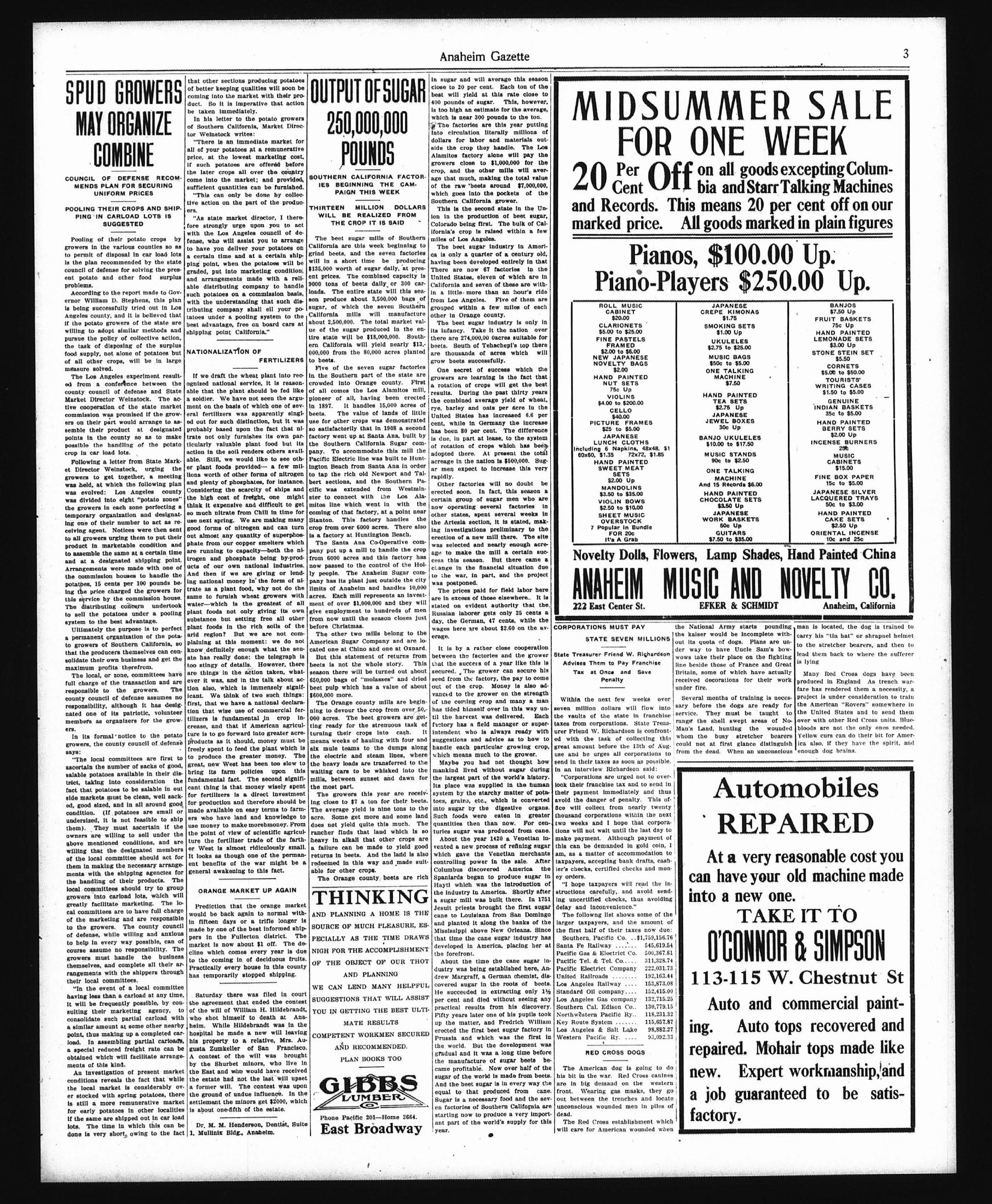
Searchable text
SPUD GROWERS MAY ORGANIZE COMBINE
COUNCIL OF DEFENSE RECOMMENDS PLAN FOR SECURING UNIFORM PRICES
POOLING THEIR CROPS AND SHIPPING IN CARLOAD LOTS IS SUGGESTED
Pooling of their potato crops by growers in the various counties so as to permit of disposal in car load lots is the plan recommended by the state council of defense for solving the present potato and other food surplus problems.
According to the report made to Governor William D. Stephens, this plan is being successfully tried out in Los Angeles county, and it is believed that if the potato growers of the state are willing to adopt similar methods and pursue the policy of collective action, the task of disposing of the surplus food supply, not alone of potatoes but of all other crops, will be in large measure solved.
The Los Angeles experiment resulted from a conference between the county council of defense and State Market Director Weinstock. The active cooperation of the state market commission was promised if the growers on their part would arrange to assemble their product at designated points in the county so as to make possible the handling of the potato that other sections producing potatoes of better keeping qualities will soon be coming into the market with their product. So it is imperative that action be taken immediately.
In his letter to the potato growers of Southern California, Market Director Weinstock writes:
“There is an immediate market for all of your potatoes at a remunerative price, at the lowest marketing cost, if such potatoes are offered before the later crops all over the country come into the market; and provided, sufficient quantities can be furnished.
“This can only be done by collective action on the part of the producers.
“As state market director, I therefore strongly urge upon you to act with the Los Angeles council of defense, who will assist you to arrange to have you deliver your potatoes on a certain time and at a certain shipping point, when the potatoes will be graded, put into marketing condition, and arrangements made with a reliable distributing company to handle such potatoes on a commission basis, with the understanding that such distributing company shall ell your potatoes under a pooling system to the best advantage, free on board cars at shipping point California.”
NATIONALIZATION OF FERTILIZERS
If we draft the wheat plant into recognized national service, it is reasonable that the plant should be fed like a soldier. We have not seen the argument on the basis of which one of several fertilizers was apparently singled out for such distinction, but it was probably based upon the fact that nitrate not only furnishes its own particularly valuable plant food but its use for other crops so satisfactorily than factory went up at the Southern California...
The Los Angeles experiment resulted from a conference between the county council of defense and State Market Director Weinstock. The active cooperation of the state market commission was promised if the growers on their part would arrange to assemble their product at designated points in the county so as to make possible the handling of the potato crop in car load lots.
Following a letter from State Market Director Weinstock, urging the growers to get together, a meeting was held, at which the following plan was evolved: Los Angeles county divided into eight "potato zones" the growers in each zone perfecting a temporary organization and designating one of their number to act as receiving agent. Notices were then sent to all growers urging them to put their product in marketable condition and to assemble the same at a certain time and at a designated shipping point. Arrangements were made with one of the commission houses to handle the potatoes, 15 cents per 100 pounds being the price charged the growers for this service by the commission house. The distributing concern undertook to sell the potatoes under a pooling system to the best advantage.
Ultimately the purpose is to perfect a permanent organization of the potato growers of Southern California, so that the producers themselves can consolidate their own business and get the maximum profits therefrom.
The local, or zone, committees have full charge of the transaction and are responsible to the growers. The county council of defense assumes no responsibility, although it has designated one of its patriotic, volunteer members as organizers for the growers.
In its formal notice to the potato growers, the county council of defense says:
"The local committees are first to ascertain the number of sacks of good, salable potatoes available in their district, taking into consideration the fact that potatoes to be salable in out side markets must be clean, well sacked, good sized, and in all around good condition. (If potatoes are small or undersized, it is not feasible to ship them). They must ascertain if the owners are willing to sell under the above mentioned conditions, and are willing that the designated members
If we draft the wheat plant into recognized national service, it is reasonable that the plant should be fed like a soldier. We have not seen the argument on the basis of which one of several fertilizers was apparently singled out for such distinction, but it was probably based upon the fact that nitrate not only furnishes its own particularly valuable plant food but its action in the soil renders others available. Still, we would like to see other plant foods provided—a few millions worth of other forms of nitrogen and plenty of phosphates, for instance. Considering the scarcity of ships and the high cost of freight, one might think it expensive and difficult to get so much nitrate from Chill in time for use next spring. We are making many good forms of nitrogen and can turn out almost any quantity of superphosphate from our copper smelters which are running to capacity—both the nitrogen and phosphate being by-products of our own national industries. And then if we are giving or lending national money in the form of nitrate as a plant food, why not do the same to furnish wheat growers with water—which is the greatest of all plant foods not only giving its own substance but setting free all other plant foods in the rich soils of the arid region? But we are not complaining at this moment: we do not know definitely enough what the senate has really done: the telegraph is too stingy of details. However, there are things in the action taken, whatever it was, and in the talk about action also, which is immensely significant. We think of two such things: first, that we have a national declaration that wise use of commercial fertilizers is fundamental in crop increase, and that if American agriculture is to go forward into greater acre-products as it should, money must be freely spent to feed the plant which is to produce the greater money. The great, new West has been too slow to bring its farm policies upon this fundamental fact. The second significant thing is that money wisely spent for production and therefore should be made available on easy terms to farmers who have land and knowledge to use money to make more money. From the point of view of scientific agriculture the fertilizer trade of the farther West is almost ridiculously small.
Five of the seven in the Southern part crowded into Orange of all comes the L pioneer of all, having in 1897. It handles beets. The value use for other crops so satisfactorily than factory went up at S Southern Calif pany. To accommodate Pacific Electric lineington Beach from S to tap the rich old bert sections, and cific was extended;ster to connect with mitos line which w coming of that factor Stanton. This fact crop from over 6000 is a factory at Hunt.
The Santa Ana pany put up a mill from 6000 acres and now passed to the city people. The Anas pany has its plant just limits of Anaheim a acres. Each mill rement of over $1,000 give employment to from now until the before Christmas.
The other two m American Sugar Coated one at Chino s.
But this statement beets is not the w season there will be 650,000 bags of "mea beet pulp which has $600,000 more.
The Orange counting to devour the 2000 acres. The beetting ready for the turning their crops means weeks of hauling six mule teams to the electric and se heavy loads are waiting cars to be mills, between sunrise most part.
The growers th ing close to $7 a t The average yield i acre. Some get me does not yield quite rancher finds that heavy in alkali th a failure can be m
"The local committees are first to ascertain the number of sacks of good, salable potatoes available in their district, taking into consideration the fact that potatoes to be salable in out side markets must be clean, well sacked, good sized, and in all around good condition. (If potatoes are small or undersized, it is not feasible to ship them). They must ascertain if the owners are willing to sell under the above mentioned conditions, and are willing that the designated members of the local committee should act for them in making the necessary arrangements with the shipping agencies for the handling of their products. The local committees should try to group growers into carload lots, which will greatly facilitate marketing. The local committees are to have full charge of the marketing and are responsible to the growers. The county council of defense, while willing and anxious to help in every way possible, can of course assume no responsibility. The growers must handle the business themselves, and complete all their arrangements with the shippers through their local committees.
"In the event of a local committee having less than a carload at any time, it will be frequently possible, by consulting their marketing agency, to consolidate such partial carload with a similar amount at some other nearby point, thus making up a completed carload. In assembling partial carloads, a special reduced freight rate can be obtained which will facilitate arrangements of this kind.
An investigation of present market conditions reveals the fact that while the local market is considerably over stocked with spring potatoes, there is still a more remunerative market for early potatoes in other localities if the same are shipped out in car load lots. The time in which this can be done is very short, owing to the fact
Prediction that the orange market would be back again to normal within fifteen days or a trifle longer is made by one of the best informed shippers in the Fullerton district. The market is now about $1 off. The decline which comes every year is due to the coming in of deciduous fruits. Practically every house in this county has temporarily stopped shipping.
Saturday there was filed in court the agreement that ended the contest of the will of William H. Hildebrandt, who shot himself to death at Anaheim. While Hildebrandt was in the hospital he made a new will leaving his property to a relative, Mrs. Augusta Zumkeller of San Francisco. A contest of the will was brought by the Shurbet minors, who live in the East and who would have received the estate had not the last will upset a former will. The contest was upon the ground of undue influence. In the settlement the minors get $2000, which is about one-fifth of the estate.
Dr. M. M. Henderson, Dentist, Suite 1, Mullinix Bldg., Anaheim."
Anaheim Gazette
OUTPUT OF SUGAR
250,000,000 POUNDS
SOUTHERN CALIFORNIA FACTORIES BEGINNING THE CAMPAIGN THIS WEEK
THIRTEEN MILLION DOLLARS WILL BE REALIZED FROM THE CROP IT IS SAID
The beet sugar mills of Southern California are this week beginning to grind beets, and the seven factories will in a short time be producing $135,000 worth of sugar daily, at present prices. The combined capacity is 9000 tons of beets daily or 300 carloads. The entire state will this season produce about 3,500,000 bags of sugar, of which the seven Southern California mills will manufacture about 2,500,000. The total market value of the sugar produced in the entire state will be $18,000,000. Southern California will yield nearly $13,000,000 from the 80,000 acres planted to beets.
Five of the seven sugar factories in the Southern part of the state are crowded into Orange county. First all comes the Los Alamitos mill, pioneer of all, having been erected in 1897. It handles 15,000 acres of beets. The value of lands of little use for other crops was demonstrated so satisfactorily that in 1908 a second factory went up at Santa Ana, built by the Southern California Sugar company and will average this season close to 20 per cent. Each ton of the best will yield at this rate close to 400 pounds of sugar. This, however, is too high an estimate for the average, which is near 300 pounds to the ton.
The factories are this year putting into circulation literally millions of dollars for labor and materials outside the crop they handle. The Los Alamitos factory alone will pay the growers close to $1,000,000 for the crop, and the other mills will average that much, making the total value of the raw 'beets around $7,000,000, which goes into the pockets of the Southern California grower.
This is the second state in the Union in the production of beet sugar, Colorado being first. The bulk of California's crop is raised within a few miles of Los Angeles.
The beet sugar industry in America is only a quarter of a century old, having been developed entirely in that there are now 67 factories in the United States, eleven of which are in California and seven of these are within a little more than an hour's ride from Los Angeles. Five of them are grouped within a few miles of each other in Orange county.
The beet sugar industry is only its infancy. Take it the nation over there are 274,000,000 acres suitable for beets. South of Tehachepli's top there are thousands of acres which will grow beets successfully.
One secret of success which the growers are learning is the fact that a rotation of crops will get the best results. During the past thirty years the combined average yield of wheat, rye, barley and oats per acre in the United States has increased 6.6 per cent, while in Germany the increase has been 80 per cent. The difference is due, in part at lease, to the system of rotation of crops which has been...
Five of the seven sugar factories in the Southern part of the state are crowded into Orange county. First of all comes the Los Alamitos mill, pioneer of all, having been erected in 1897. It handles 15,000 acres of beets. The value of lands of little use for other crops was demonstrated so satisfactorily that in 1908 a second factory went up at Santa Ana, built by the Southern California Sugar company. To accommodate this mill the Pacific Electric line was built to Huntington Beach from Santa Ana in order to tap the rich old Newport and Talbert sections, and the Southern Pacific was extended from Westminster to connect with the Los Alamitos line which went in with the coming of that factory, at a point near Stanton. This factory handles the crop from over 6000 acres. There also is a factory at Huntington Beach.
The Santa Ana Co-Operative company put up a mill to handle the crop from 6000 acres and this factory has now passed to the control of the Holly people. The Anaheim Sugar company has its plant just outside the city limits of Anaheim and handles 10,000 acres. Each mill represents an investment of over $1,000,000 and they will give employment to hundreds of men from now until the season closes just before Christmas.
The other two mills belong to the American Sugar Company and are located one at Chino and one at Oxnard.
But this statement of returns from beets is not the whole story. This season there will be turned out about 650,000 bags of "molasses" and dried beet pulp which has a value of about $600,000 more.
The Orange county mills are beginning to devour the crop from over 50,000 acres. The beet growers are getting ready for the strenuous task of turning their crops into cash. It means weeks of hauling with four and six mule teams to the dumps along the electric and steam lines, where the heavy loads are transferred to the waiting cars to be whisked into the mills, between sunset and dawn for the most part.
The growers this year are receiving close to $7 a ton for their beets. The average yield is nine tons to the acre. Some get more and some land does not yield quite this much. The rancher finds that land which is so heavy in alkali that other crops are a failure can be made to yield good
One secret of success which the growers are learning is the fact that a rotation of crops will get the best results. During the past thirty years the combined average yield of wheat, rye, barley and oats per acre in the United States has increased 6.6 per cent, while in Germany the increase has been 80 per cent. The difference is due, in part at lease, to the system of rotation of crops which has been adopted there. At present the total acreage in the nation is $500,000. Sugar men expect to increase this very rapidly.
Other factories will no doubt be erected soon. In fact, this season a certain group of sugar men who are now operating several factories in other states, spent several weeks in the Artesia section, it is stated, making investigations preliminary to the erection of a new mill there. The site was selected and nearly enough acreage to make the mill a certain success this season. But there came a change in the financial situation due to the war, in part, and the project was postponed.
The prices paid for field labor here are in excess of those elsewhere... It is stated on evident authority that the Russian laborer gets only 25 cents a day, the German, 47 cents, while the wages here are about $2.60 on the average.
It is by a rather close cooperation between the factories and the grower that the success of a year like this is secured. The grower can secure his seed from the factory, the pay to come out of the crop. Money is also advanced to the grower on the strength of the coming crop and many a man has tided himself over in this way until the harvest was delivered. Each factory has a field manager or superintendent who is always ready with suggestions and advice as to how to handle each particular growing crop, which means much to the grower.
Maybe you had not thought how mankind lived without sugar during the largest part of the world's history. Its place was supplied in the human system by the starchy matter of potatoes, grains, etc., which is converted into sugar by the digestive organs. Such foods were eaten in greater quantities then than now. For centuries sugar was produced from cane.
About the year 1420 a Venetian invented a new process of refining sugar
Corporations MUST PAY
STATE SEVEN MILLIONS
State Treasurer Friend W. Richardson
Advises Them to Pay Franchise
Tax at Once and Save
Penalty
Within the next few weeks over seven million dollars will flow into the vaults of the state in franchise taxes from corporations. State Treasurer Friend W. Richardson is confronted with the task of collecting this great amount before the 13th of August and he urges all corporations to send in their taxes as soon as possible. In an interview Richardson said:
"Corporations are urged not to overlook their franchise tax and to send in their payment immediately and thus avoid the danger of penalty. This office will collect from nearly twenty thousand corporations within the next two weeks and I hope that corporations will not wait until the last day to make payment. Although payment of this can be demanded in gold coin, I
THINKING
AND PLANNING A HOME IS THE SOURCE OF MUCH PLEASURE, ESPECIALLY AS THE TIME DRAWS NIGH FOR THE ACCOMPLISHMENT OF THE OBJECT OF OUR THOT AND PLANNING
WE CAN LEND MANY HELPFUL SUGGESTIONS THAT WILL ASSIST YOU IN GETTING THE BEST ULTIMATE RESULTS
COMPETENT WORKMEN SECURED AND RECOMMENDED.
PLAN BOOKS TOO
GIBBS LUMBER
Phone Pacific 201—Home 2664.
East Broadway
Maybe you had not thought how mankind lived without sugar during the largest part of the world's history. Its place was supplied in the human system by the starchy matter of potatoes, grains, etc., which is converted into sugar by the digestive organs. Such foods were eaten in greater quantities then than now. For centuries sugar was produced from cane.
About the year 1420 a Venetian invented a new process of refining sugar which gave the Venetian merchants controlling power in the sale. After Columbus discovered America the Spaniards began to produce sugar in Hayti which was the introduction of the industry in America. Shortly after a sugar mill was built there. In 1751 Jesuit priests brought the first sugar cane to Louisiana from San Domingo and planted it along the banks of the Mississippi above New Orleans. Since that time the cane sugar industry has developed in America, placing her at the forefront.
About the time the cane sugar industry was being established here, Andrew Margraff, a German chemist, discovered sugar in the roots of beets. He succeeded in extracting only 1½ per cent and died without seeing any practical results from his discovery. Fifty years later one of his pupils took up the matter, and Fredrich William erected the first beet sugar factory in Prussia and which was the first in the world. But the development was gradual and it was a long time before the manufacture of sugar beets became profitable. Now over half of the sugar of the world is made from beets. And the beet sugar is in every way the equal to that produced from cane. Sugar is a necessary food and the seven factories of Southern California are starting now to produce a very important part of the world's supply for this year.
RED CROSS DOGS
The American dog is going to do his bit in the war. Red Cross canines are in big demand on the western front. Wearing gas masks, they go out between the trenches and locate unconscious wounded men in piles of dead.
The Red Cross establishment which will care for American wounded when
SUMMER SALE
FOR ONE WEEK
Per Off on all goods excepting Columbia and Starr Talking Machines records. This means 20 per cent off on our price. All goods marked in plain figures
Pianos, $100.00 Up.
Inno-Players $250.00 Up.
MUSIC
NET
$1.00
ONETS
$25.00
ASTELS
MED
$6.00
JAPANESE
Y BAGS
$0.00
PAINTED
SETS
Up
INS
$200.00
LO
$1.00
FRAMES
$5.00
NESE
CLOTHS
JAPANESE
CREPE KIMONAS
$1.75
SMOKING SETS
$1.00 Up
UKULELES
$2.75 to $25.00
MUSIC BAGS
$50c to $5.00
ONE TALKING
MACHINE
$7.50
HAND PAINTED
TEA SETS
$2.75 Up
JAPANESE
JEWEL BOXES
30c Up
BANJO UKULELES
$10.00 to $17.50
BANJOS
$7.50 Up
FRUIT BASKETS
75c Up
HAND PAINTED
LEMONADE SETS
$3.00 Up
STONE STEIN SET
$5.50
CORNETS
$5.00 to $50.00
TOURISTS'
WRITING CASES
$1.50 to $5.00
GENUINE
INDIAN BASKETS
35c to $5.00
HAND PAINTED
BERRY SETS
$2.00 Up
INCENSE BURNERS
Dolls, Flowers, Lamp Shades, Hand Painted China
HEIM MUSIC AND NOVELTY CO.
Enter St. EFKER & SCHMIDT Anaheim, California
ST PAY
EVEN MILLIONS
H W. Richardson
Day Franchise
and Save
weeks over
will flow into
state in franchise
us. State Treasderson is confrontcollecting this
the 13th of Augcorporations to
soon as possible.
Hardson said:
urged not to overx and to send in
relatively and thus
penalty. This offnearly twenty
within the next
pe that corporall the last day to
ough payment of
1 in gold coin, I
the National Army starts pounding
the kaiser would be incomplete without its quota of dogs. Plans are under way to have Uncle Sam's bowwows take their place on the fighting line beside those of France and Great Britain, some of which have actually received decorations for their work under fire.
Several months of training is necessary before the dogs are ready for service. They must be taught to range the shell swept areas of No-Man's Land, hunting the wounded whom the busy stretcher bearers could not at first glance distinguish from the dead. When an unconscious man is located, the dog is trained to carry his "tin hat" or shrapnel helmet to the stretcher bearers, and then to lead them back to where the sufferer is lying.
Many Red Cross dogs have been produced in England As trench warfare has rendered them a necessity, a project is under consideration to train the American "Rovers" somewhere in the United States and to send them over with other Red Cross units. Bluebloods are not the only ones needed. Yellow curs can do their bit for America also, if they have the spirit, and enough dog brains.
Automobiles REPAIRED
Automobiles
REPAIRED
At a very reasonable cost you can have your old machine made into a new one.
TAKE IT TO
O'CONNOR & SIMPSON
113-115 W. Chestnut St
Auto and commercial painting. Auto tops recovered and repaired. Mohair tops made like new. Expert workmanship, and a job guaranteed to be satisfactory.