anaheim-gazette 1917-06-07
Scanned page
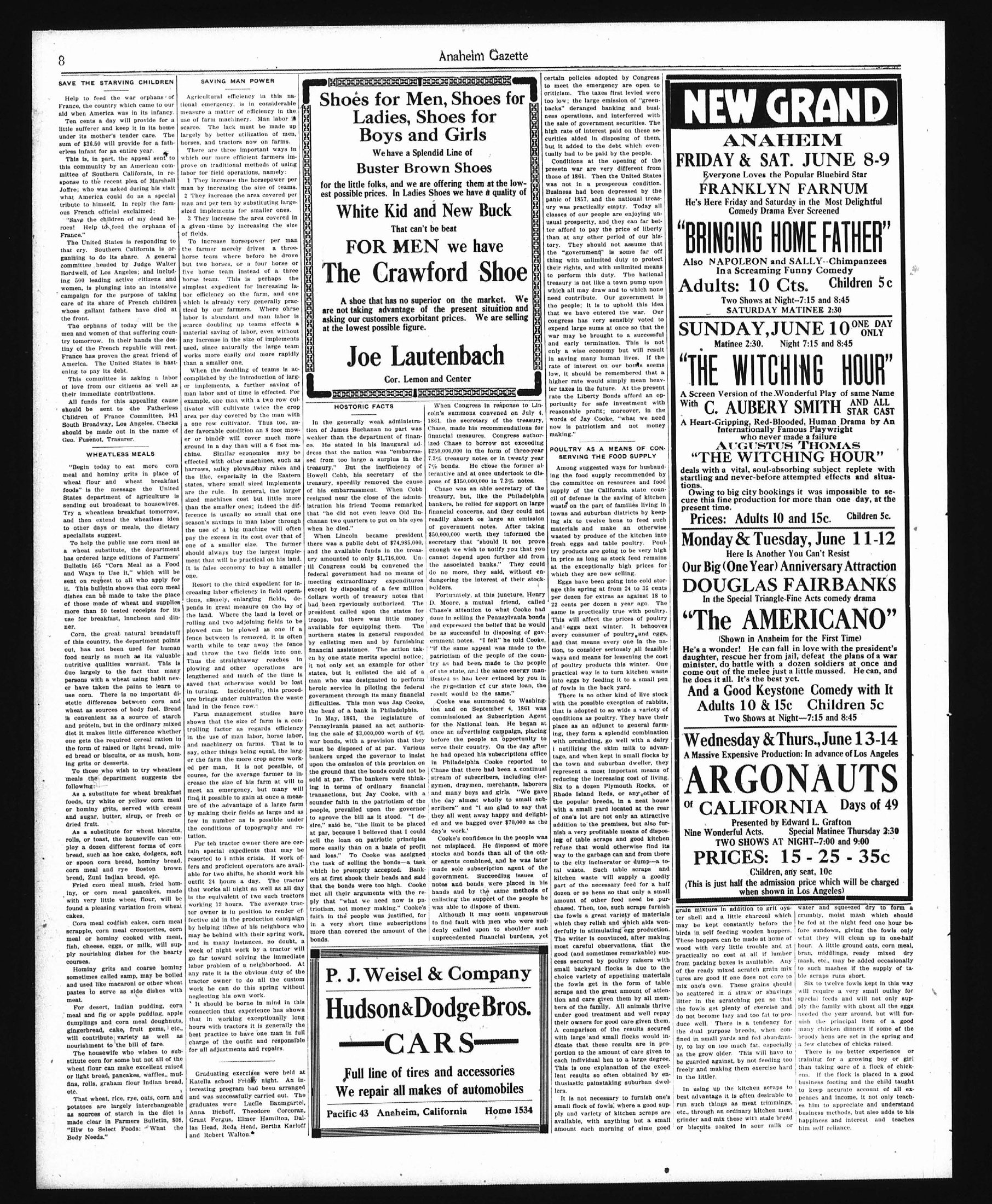
Searchable text
SAVE THE STARVING CHILDREN
Help to feed the war orphans of France, the country which came to our aid when America was in its infancy.
Ten cents a day will provide for a little sufferer and keep it in its home under its mother's tender care. The sum of $36.50 will provide for a fatherless infant for an entire year.
This is, in part, the appeal sent to this community by an American committee of Southern California, in response to the recent plea of Marshall Joffre; who was asked during his visit what America could do as a special tribute to himself. In reply the famous French official exclaimed:
"Save the children of my dead heroes! Help to feed the orphans of France."
The United States is responding to that cry. Southern California is organizing to do its share. A general committee headed by Judge Walter Bordwell, of Los Angeles; and including 500 leading active citizens and women, is plunging into an intensive campaign for the purpose of taking care of its share of French children whose gallant fathers have died at the front.
The orphans of today will be the men and women of that suffering country tomorrow. In their hands the destiny of the French republic will rest. France has proven the great friend of America. The United States is hastening to pay its debt.
This committee is asking a labor of love from our citizens as well as their immediate contributions.
All funds for this appealing cause should be sent to the Fatherless Children of France Committee, 941 South Broadway, Los Angeles. Checks should be made out in the name of Geo. Fusenot, Trasurer.
SAVING MAN POWER
Agricultural efficiency in this national emergency, is in considerable measure a matter of efficiency in the use of farm machinery. Man labor is scarce. The lack must be made up largely by better utilization of men, horses, and tractors now on farms.
There are three important ways in which our more efficient farmers improve on traditional methods of using labor for field operations, namely:
1. They increase the horsepower per man by increasing the size of teams.
2. They increase the area covered per man and per tem by substituting large-sized implements for smaller ones.
3. They increase the area covered in a given time by increasing the size of fields.
To increase horsepower per man the farmer merely drives a three-horse team where before he drove but two horses, or a four horse or five horse team instead of a three horse team. This is perhaps the simplest expedient for increasing labor efficiency on the farm, and one which is already very generally practiced by our farmers. Where ohrse labor is abundant and man labor is scarce doubling up teams effects a material saving of labor, even without any increase in the size of implements used, since naturally the large team works more easily and more rapidly than a smaller one.
When the doubling of teams is accomplished by the introduction of larger implements, a further saving of man labor and of time is effected. For example, one man with a two row cultivator will cultivate twice the crop area per day covered by the man with a one row cultivator. Thus too, under favorable condition an 8 foot mower or binder will cover much more ground in a day than will a 6 foot ma-
France has proven the great friend of America. The United States is hastening to pay its debt.
This committee is asking a labor of love from our citizens as well as their immediate contributions.
All funds for this appealing cause should be sent to the Fatherless Children of France Committee, 941 South Broadway, Los Angeles. Checks should be made out in the name of Geo. Fusenot, Trasurer.
WHEATLESS MEALS
"Begin today to eat more corn meal and hominy grits in place of wheat flour and wheat breakfast foods" is the message the United States department of agriculture is sending out broadcast to housewives. Try a wheatless breakfast tomorrow, and then extend the wheatless idea to other days or meals, the dietary specialists suggest.
To help the public use corn meal as a wheat substitute, the department has ordered large editions of Farmers' Bulletin 565 "Corn Meal as a Food and Ways to Use it," which will be sent on request to all who apply for it. This bulletin shows that corn meal dishes can be made to take the place of those made of wheat and supplies more than 50 tested receipts for its use for breakfast, inncheon and dinner.
Corn, the great natural breadstuff of this country, the department points out, has not been used for human food nearly as much as its valuable nutritive qualities warrant. This is due largely to the fact that many persons with a wheat using habit never have taken the pains to learn to use corn. There is no important dietetic difference between corn and wheat as sources of body fuel. Bread is convenient as a source of starch and protein, but in the ordinary mixed diet it makes little difference whether one gets the required cereal ration in the form of raised or light bread, mixed bread or biscuits, or as mush, homing grits or desserts.
To those who wish to try wheatless meals the department suggests the following:
As a substitute for wheat breakfast foods, try white or yellow corn meal or hominy grits, served with cream and sugar, butter, sirup, or fresh or dried fruit.
As a substitute for wheat biscuits, rolls, or toast, the housewife can employ a dozen different forms of corn works more easily and more rapidly than a smaller one.
When the doubling of teams is accomplished by the introduction of larger implements, a further saving of man labor and of time is effected. For example, one man with a two row cultivator will cultivate twice the crop area per day covered by the man with a one row cultivator. Thus too, under favorable condition an 8 foot mower or binder will cover much more ground in a day than will a 6 foot machine. Similar economies may be effected with other machines, such as harrows, sulky plows, hay rakes and the like, especially in the Eastern states, where small sized implements are the rule. In general, the larger sized machines cost but little more than the smaller ones; indeed the difference is usually so small that one season's savings in man labor through the use of a big machine will often pay the excess in its cost over that of one of a smaller size. The farmer should always buy the largest implement that will be practical on his land. It is false economy to buy a smaller one.
Resort to the third expedient for increasing labor efficiency in field operations, namely, enlarging fields, depends in great measure on the lay of the land. Where the land is level or rolling and two adjoining fields to be plowed can be plowed as one if a fence between is removed, it is often worth while to tear away the fence and throw the two fields into one. Thus the straightaway reaches in plowing and other operations are lengthened and much of the time is saved that otherwise would be lost in turning. Incidentally, this procedure brings under cultivation the waste land in the fence row.
Farm management studies have shown that the size of farm is a controlling factor as regards efficiency in the use of man labor, horse labor, and machinery on farms. That is to say, other things being equal, the larger the farm the more crop acres worked per man. It is not possible, of course, for the average farmer to increase the size of his farm at will to meet an emergency, but many will find it possible to gain at once a measure of the advantage of a large farm by making their fields as large and as few in number as is possible under the conditions of topography and rotation.
For teh tractor owner there are certain special expedients that may be used in terms of oil transactions, but Jasounder faith in these people, prevailed up to aprove the bill as sire," said he, "the at par, because I sell the loan on more easily than on..."
HOSTORIC
To those who wish to try wheatless meals the department suggests the following:
As a substitute for wheat breakfast foods, try white or yellow corn meal or hominy grits, served with cream and sugar, butter, sirup, or fresh or dried fruit.
As a substitute for wheat biscuits, rolls, or toast, the housewife can employ a dozen different forms of corn bread, such as hoe cake, dodgers, soft or spoon corn bread, hominy bread, corn meal and rye Boston brown bread, Zuni Indian bread, etc.
Fried corn meal mush, fried hominy, or corn meal pancakes, made with very little wheat flour, will be found a pleasing variation from wheat cakes.
Corn meal codfish cakes, corn meal scrapple, corn meal crouquettes, corn meal or hominy cooked with meat, fish, cheese, eggs, or milk, will supply nourishing dishes for the hearty courses.
Hominy grits and coarse hominy sometimes called samp, may be boiled and used like macaroni or other wheat pastes to serve as side dishes with meat.
For desert, Indian pudding, corn meal and fig or apple pudding, apple dumplings and corn meal doughnuts, gingerbread, cake, fruit gems, etc., will contribute variety as well as nourishment to the bill of fare.
The housewife who wishes to substitute corn for some but not all of the wheat flour can make excellent raised or light bread, pancakes, waffles,, muffins, rolls, graham flour Indian bread, etc.
That wheat, rice, rye, oats, corn and potatoes are largely interchangeable as sources of starch in the diet is made clear in Farmers Bulletin, 808,
"Hiw to Select Foods: What the Body Needs."
Graduating exercises were held at Katella school Friday night. An interesting program had been arranged and was successfully carried out. The graduates were Lucile Baumgartel, Anna Bichoff, Theodore Corcoran, Grant Fergus, Elmer Hamilton, Dallas Head, Reda Head, Bertha Karloff and Robert Walton.
Anaheim Gazette
Shoes for Men, Shoes for Ladies, Shoes for Boys and Girls
We have a Splendid Line of Buster Brown Shoes for the little folks, and we are offering them at the lowest possible prices. In Ladies Shoes we have a quality of White Kid and New Buck
That can't be beat
FOR MEN we have The Crawford Shoe
A shoe that has no superior on the market. We are not taking advantage of the present situation and asking our customers exorbitant prices. We are selling at the lowest possible figure.
Joe Lautenbach
Cor. Lemon and Center
HOSTORIC FACTS
In the generally weak administration of James Buchanan no part was weaker than the department of finance. He stated in his inaugural ad-
When Congress in response to Lincoln's summons convened on July 4, 1861, the secretary of the treasury, Chase, made his recommendations for financial measures. Congress authorized Chase to borrow not exceeding certain policies adopted by Congress to meet the emergency are open to criticism. The taxes first levied were too low; the large emission of "green-backs" deranged banking and business operations, and interfered with the sale of government securities. The high rate of interest paid on these securities aided in disposing of them, but it added to the debt which eventually had to be paid by the people.
Conditions at the opening of the presetn war are very different from those of 1861. Then the United States was not in a prosperous condition. Business had been depressed by the panic of 1857, and the national treasury was practically empty. Today all classes of our people are enjoying unusual prosperity, and they can far better afford to pay the price of liberty than at any other period of our history. They should not assume that the "government" is some far off thing with unlimited duty to protect their rights, and with unlimited means to perform this duty. The national treasury is not like a town pump upon which all may draw and to which none need contribute. Our government is the people; it is to uphold this idea that we have entered the war. Our congress has very sensibly voted to expend large sums at once so that the war may be brought to a successful and early termination. This is not only a wise economy but will result in saving many human lives. If the rate of interest on our bonds seems low, it should be remembered that a higher rate would simply mean heavier taxes in the future. At the present rate the Liberty Bonds afford an opportunity for safe investment with reasonable profit; moreover, in the words of Jay Cooke, "what we need now is patriotism and not money making."
Joe Lautenbach
Cor. Lemon and Center
HOSTORIC FACTS
In the generally weak administration of James Buchanan no part was weaker than the department of finance. He stated in his inaugural address that the nation was "embarrassed from too large a surplus in the treasury." But the inefficiency of Howell Cobb, his secretary of the treasury, speedily removed the cause of his embarrassment. When Cobb resigned near the close of the administration his friend Tooms remarked that "he did not even leave Old Buchanan two quarters to put on his eyes when he died."
When Lincoln became president there was a public debt of $74,985,000, and the available funds in the treasury amounted to only $1,716,000. Until Congress could be convened the federal government had no means of meeting extraordinary expenditures except by disposing of a few million dollars worth of treasury notes that had been rereply authorized. The president called upon the states for troops, but there was little money available for equipping them. The northern states in general responded by enlisting men and by furnishing financial assistance. The action taken by one state merits special notice; it not only set an example for other states, but it enlisted the aid of a man who was designated to perform heroic service in piloting the federal government through its many financial difficulties. This man was Jap Cooke, the head of a bank in Philadelphia.
In May, 1861, the legislature of Pennsylvania passed an act authorizing the sale of $3,000,000 worth of 6% war bonds, with a provision that they must be disposed of at par. Various bankers urged the governor to insist upon the omission of this provision on the ground that the bonds could not be sold at par. The bankers were thinking in terms of ordinary financial transactions, but Jay Cooke, with a sounder faith in the patriotism of the people, prevailed upon the governor to approve the bill as it stood. "I desire," said he, "the limit to be placed at par, because I believed that I could sell the loan on patriotic principles more easily than on a basis of profit.
When Congress in response to Lincoln's summons convened on July 4, 1861, the secretary of the treasury, Chase, made his recommendations for financial measures. Congress authorized Chase to borrow not exceeding $250,000,000 in the form of three-year 7.3% treasury notes or in twenty year 7% bonds. He chose the former alternative and at once undertook to dispose of $150,000,000 in 7.3% notes.
Chase was an able secretary of the treasury, but, like the Philadelphia bankers, he relied for support on large financial concerns, and they could not readily absorb os large an emission of government notes. After taking $50,000,000 worth they informed the secretary that "should it not prove enough we wish to notify you that you cannot depend upon further aid from the associated banks." They could do no more, they said, without endangering the interest of their stockholders.
Fortunately, at this juncture, Henry D. Moore, a mutual friend, called Chase's attention to what Cooke had done in selling the Pennsylvania bonds and expressed the belief that he would be as successful in disposing of government notes. "I felt" he told Cooke, "if the same appeal was made to the patriotism of the people of the country as had been made to the people of the state, and the same energy manifested as had been evinced by you in the negotiation of cur state loan, the result would be the same."
Cooke was summoned to Washington and on September 4, 1861 was commissioned as Subscription Agent for the National loan. He began at once an advertising campaign, placing before the people an opportunity to serve their country. On the day after he had opened his subscriptions office in Philadelphia Cooke reported to Chase that there had been a continual stream of subscribers, including clergymen, draymen, merchants, laborers and many boys and girls. "We gave the day almost wholly to small subscribers" and "I am glad to say that they all went away happy and delight-ed and we bagged over $70,000 as the day's work."
Cooke's confidence in the people was not misplaced. He disposed of more in saving many human lives. If the rate of interest on our bonds seems low, it should be remembered that a higher rate would simply mean heavier taxes in the future. At the present rate the Liberty Bonds afford an opportunity for safe investment with reasonable profit; moreover, in the words of Jay Cooke, "what we need now is patriotism and not money making."
POULTRY AS A MEANS OF CONSERVING THE FOOD SUPPLY
Among suggested ways for husbanding the food supply recommended by the committee on resources and food supply of the California state council of defense is the saving of kitchen waste on the part of families living in towns and suburban districts by keeping six to twelve hens to feed such materials and make an otherwise wasted by produce of the kitchen into fresh eggs and table poultry. Poultry products are going to be very high in price as long as stock feed remains at the exceptionally high prices for which they are now selling.
Eggs have been going into cold storage this spring at from 24 to 35 cents per dozen for extras as against 18 to 22 cents per dozen a year ago. The same is practically true with poultry. This will affect the prices of poultry and eggs next winter. It behooves every consumer of poultry and eggs, and that means every one in the nation, to consider seriously all feasible ways and means for lessening the cost of poultry products this winter. One practical way is to turn kitchen waste into eggs by feeding it to a small pen of fowls in the back yard.
There is no other kind of live stock with the possible exception of rabbits, that is adopted to so wide a variety of conditions as poultry. They have their place as an adjunct to general farming, they form a splendid combination with orcahrding, go well with a dairy i nutilizing the skim milk to advantage, and when kept in small flocks by the town and suburban dweller, they represent a most important means of reducing the increasing cost of living. Six to a dozen Plymouth Rocks, or Rhode Island Reds, or any other of the popular breeds, in a neat house with a small yard located at the rear of one's lot are not only an attractive addition to the premises, but also furnish a very profitable means of disposing of table scraps and good kitchen refuse that otherwise find its
bankers urged the governor to insist upon the omission of this provision on the ground that the bonds could not be sold at par. The bankers were thinking in terms of ordinary financial transactions, but Jay Cooke, with a sounder faith in the patriotism of the people, prevailed upon the governor to approve the bill as it stood. "I desire," said he, "the limit to be placed at par, because I believed that I could sell the loan on patriotic principles more easily than on a basis of profit and loss." To Cooke was assigned the task of selling the bonds—a task which he promptly accepted. Bankers at first shook their heads and said that the bonds were too high. Cooke met all their arguments with the reply that "what we need now is patriotism, not money making." Cooke's faith in the people was justified, for in a very short time subscriptions more than covered the amount of the bonds.
Cooke's confidence in the people was not misplaced. He disposed of more stocks and bonds than all of the other agents combined, and he was later made sole subscription agent of the government. Succeeding issues of notes and bonds were placed in his hands and by the same methods of enlisting the support of the people he was able to dispose of them.
Although it may seem ungenerous to find fault with men who were suddenly called upon to shoulder such unprecedented financial burdens, yet
P. J. Weisel & Company
Hudson&DodgeBros.
CARS
Full line of tires and accessories
We repair all makes of automobiles
Pacific 43 Anaheim, California Home 1534
NEW GRAND
ANAHEIM
FRIDAY & SAT. JUNE 8-9
Everyone Loves the Popular Bluebird Star
FRANKLYN FARNUM
He's Here Friday and Saturday in the Most Delightful Comedy Drama Ever Screened
"BRINGING HOME FATHER"
Also NAPOLEON and SALLY--Chimpanzees
In a Screaming Funny Comedy
Adults: 10 Cts. Children 5c
Two Shows at Night--7:15 and 8:45
SATURDAY MATINEE 2:30
SUNDAY, JUNE 10 ONE DAY ONLY
Matinee 2:30. Night 7:15 and 8:45
"The WITCHING HOUR"
A Screen Version of the Wonderful Play of same Name With C. AUBERY SMITH AND ALL STAR CAST
A Heart-Gripping, Red-Blooded, Human Drama by An Internationally Famous Playwright who never made a failure
AUGUSTUS THOMAS
"THE WITCHING HOUR"
A Screen Version of the Wonderful Play of same Name
With C. AUBERY SMITH AND ALL STAR CAST
A Heart-Gripping, Red-Blooded, Human Drama by An Internationally Famous Playwright
who never made a failure
AUGUSTUS THOMAS
"The WITCHING HOUR"
deals with a vital, soul-absorbing subject replete with startling and never-before attempted effects and situations.
Owing to big city bookings it was impossible to secure this fine production for more than one day, at the present time.
Prices: Adults 10 and 15c. Children 5c.
Monday & Tuesday, June 11-12
Here Is Another You Can't Resist
Our Big (One Year) Anniversary Attraction
DOUGLAS FAIRBANKS
In the Special Triangle-Fine Acts comedy drama
"The AMERICANO"
(Shown in Anaheim for the First Time)
He's a wonder! He can fall in love with the president's daughter, rescue her from jail, defeat the plans of a war minister, do battle with a dozen soldiers at once and come out of the melee just a little mussed. He can, and he does it all. It's the best yet.
And a Good Keystone Comedy with It
Adults 10 & 15c Children 5c
Two Shows at Night—7:15 and 8:45
Wednesday & Thurs., June 13-14
A Massive Expensive Production: In advance of Los Angeles
ARGONAUTS
Of CALIFORNIA Days of 49
Presented by Edward L. Grafton
Nine Wonderful Acts. Special Matinee Thursday 2:30
TWO SHOWS AT NIGHT--7:00 and 9:00
ARGONAUTS
Of CALIFORNIA Days of 49
Presented by Edward L. Grafton
Nine Wonderful Acts. Special Matinee Thursday 2:30
TWO SHOWS AT NIGHT--7:00 and 9:00
PRICES: 15 - 25 - 35c
Children, any seat, 10c
(This is just half the admission price which will be charged when shown in Los Angeles)
grain mixture in addition to grit oyster shell and a little charcoal which may be kept constantly before the birds in self feeding wooden hoppers. These hoppers can be made at home of wood with very little trouble and at practically no cost at all if lumber from packing boxes is available. Any of the ready mixed scratch grain mixtures are good if one does not care to mix one's own. These grains should be scattered in a straw or shavings litter in the scratching pen so that the fowls get plenty of exercise and do not become lazy and too fat to produce well. There is a tendency for the dual purpose breeds, when confined in small yards and fed abundantly, to lay on too much fat, especially as the grow older. This will have to be guarded against, by not feeding too freely and making them exercise hard in the littler.
In using up the kitchen scraps to best advantage it is often desirable to run such things as meat trimmings, etc., through an ordinary kitchen meat grinder and mix these with stale bread or biscuits soaked in sour milk or water and squeezed dry to form a crumbly, moist mash which should be fed at the night feed one hour before sundown, giving the fowls only what they will clean up in one-half hour. A little ground oats, corn meal, bran, middlings, ready mixed dry mash, etc., may be added occasionally to such mashes if the supply of table scraps runs short.
Six to twelve fowls kept in this way will require a very small outlay for special feeds and will not only supply the family with about all the eggs needed the year around, but will furnish the principal item of a good many chicken dinners if some of the broody hens are set in the spring and a few clutches of chicks raised.
There is no better experience or training for a growing boy or girl than taking care of a flock of chickens. If the flock is placed in a good business footing and the child taught to keep accurate account of all expenses and income, it not only teaches him to appreciate and understand business methods, but also adds to his happiness and interest and teaches him self reliance.