anaheim-gazette 1917-05-24
Scanned page
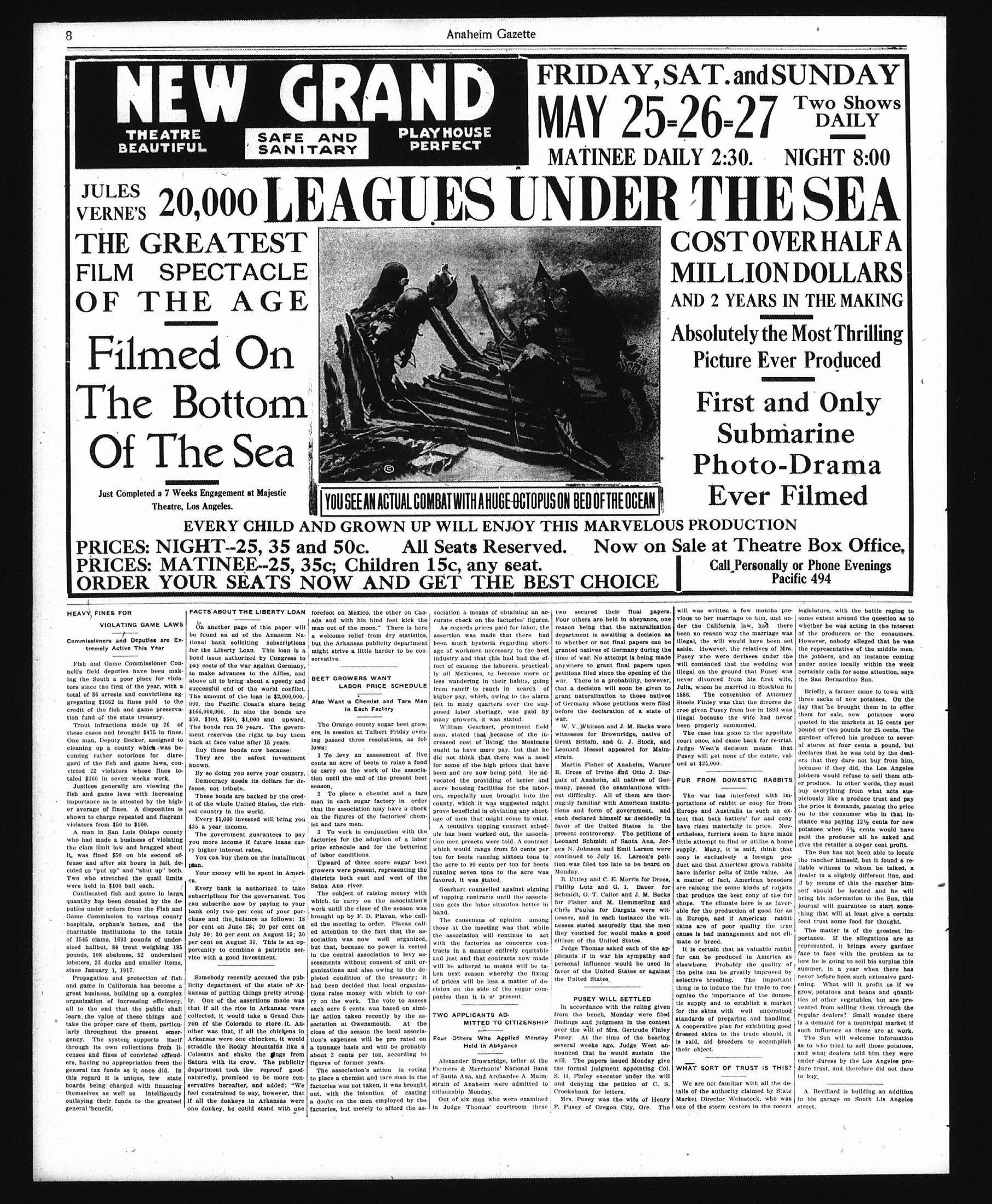
Searchable text
NEW GR
THEATRE
BEAUTIFUL
SAFE AND
SANITARY
JULES VERNE'S 20,000 LEAGUE
THE GREATEST
FILM SPECTACLE
OF THE AGE
Filmed On
The Bottom
Of The Sea
Filmed On
The Bottom
Of The Sea
Just Completed a 7 Weeks Engagement at Majestic
Theatre, Los Angeles.
EVERY CHILD AND GRO
PRICES: NIGHT--25, 35 and 50c.
PRICES: MATINEE--25, 35c; Ch
ORDER YOUR SEATS NOW A
HEAVY FINES FOR
VIOLATING GAME LAWS
Commissioners and Deputies are Extremely Active This Year
Fish and Game Commissioner Connell's field deputies have been making the South a poor place for violators since the first of the year, with a total of 86 arrests and convictions aggregating $1662 in fines paid to the credit of the fish and game preservation fund of the state treasury.
Trout infractions made up 26 of these cases and brought $475 in fines. One man, Deputy Becker, assigned to cleaning up a county which was becoming rather notorious for disregard of the fish and game laws, convicted 22 violators whose fines totaled $360 in seven weeks work.
Justices generally are viewing the fish and game laws with increasing importance as is attested by the higher average of fines. A disposition is shown to charge repeated and flagrant violators from $50 to $100.
A man in San Luis Obispo county who had made a business of violating the clam limit law and bragged about
FACTS ABOUT THE LIBERTY LOAN
On another page of this paper will be found an ad of the Ananelm National bank soliciting subscriptions for the Liberty Loan. This loan is a bond issue authorized by Congress to pay costs of the war against Germany, to make advances to the Allies, and above all to bring about a speedy and successful end of the world conflict. The amount of the loan is $2,000,000,000, the Pacific Coast's share being $166,000,000. In size the bonds are $50, $100, $500, $1,000 and upward. The bonds run 30 years. The government reserves the right to buy them back at face value after 15 years.
Buy these bonds now because:
They are the safest investment known.
By so doing you serve your country.
Democracy needs its dollars for defense, not tribute.
These bonds are backed by the credit of the whole United States, the richest country in the world.
Every $1,000 invested will bring you $35 a year income.
The government guarantees to pay you more income if future loans carry higher interest rates.
forefoot on Mexico,
ada and with his
man out of the moo
a welcome relief f
but the Arkansas p
might strive a little
servative.
BEET GROWERS
LABOR P
Also Want a Chem
In Each
The Orange counters, in session at T
ing passed three n
lows:
1 To levy an a
cents an acre of be
to carry on the w
tion until the end o
season.
2 To place a cl
man in each sugar
that the association
on the figures of th
ist and tare men.
3 To work in co
factories for the ad
price schedule and
coming rather notorious for disregard of the fish and game laws, convicted 22 violators whose fines totaled $360 in seven weeks work.
Justices generally are viewing the fish and game laws with increasing importance as is attested by the higher average of fines. A disposition is shown to charge repeated and flagrant violators from $50 to $100.
A man in San Luis Obispo county who had made a business of violating the clam limit law and bragged about it was fined $50 on his second offense and after six hours in jail, decided to "put up" and "shut up" both. Two who stretched the quail limits were held in $100 bail each.
Confiscated fish and game in large quantity has been donated by the deputies under orders from the Fish and Game Commission to various county hospitals, orphan's homes, and the charitable institutions to the totals of 1545 clams, 1693 pounds of undersized halibut, 84 trout weighing 185 pounds, 108 abalones, 52 undersized lobsters, 23 ducks and smaller items, since January 1, 1917.
Propagation and protection of fish and game in California has become a great business, building up a complex organization of increasing efficiency, all to the end that the public shall learn the value of these things and take the proper care of them, particularly throughout the present emergency. The system supports itself through its own collections from licenses and fines of convicted offenders, having no appropriation from the general tax funds as it once did. In this regard it is unique, few state boards being charged with financing themselves as well as intelligently outlaying their funds to the greatest general benefit.
Somebody recently accused the publicity department of the state of Arkansas of putting things pretty strongly. One of the assertions made was that if all the rice in Arkansas were collected, it would take a Grand Canyon of the Colorado to store it. Another was that, if all the chickens in Arkansas were one chincken, it would straddle the Rocky Mountains like a Colossus and shake the rings from Saturn with its crow. The publicity department took the reproof good-naturedly, promised to be more conservative hereafter, and added: "We feel constrained to say, however, that if all the donkeys in Arkansas were one donkey, he could stand with one
They are the safest investment known.
By so doing you serve your country.
Democracy needs its dollars for defense, not tribute.
These bonds are backed by the credit of the whole United States, the richest country in the world.
Every $1,000 invested will bring you $35 a year income.
The government guarantees to pay you more income if future loans carry higher interest rates.
You can buy them on the installment plan.
Your money will be spent in America.
Every bank is authorized to take subscriptions for the government. You can subscribe now by paying to your bank only two per cent of your purchase and the balance as follows: 18 per cent on June 28; 20 per cent on July 30; 30 per cent on August 15; 30 per cent on August 30. This is an opportunity to combine a patriotic service with a good investment.
The subject of raft which to carry one work until the close brought up by F. D. Ed the meeting to coed attention to the sociation was now but that, because m in the central associations without organizations and also completed condition of had been decided tha tions raise money w ry on the work. T each acre 5 cents w lar action taken re sociation at Owens close of the season' tion's expenses will a tonnage basis and about 3 cents per figures of former ye
The association's to place a chemist a factories was not tak out, with the inter alia doubt on the mer factories, but merely
Anaheim Gazette
GRAND
E AND
NITARY
PLAY HOUSE
PERFECT
FRIDAY,SAT
MAY 25=2
MATINEE DAILY
LEAGUES UNDER T
CO
MI
AND
Abs
P
YOU SEE AN ACTUAL COMBAT WITH A HUGE OCTOPUS ON BED OF THE OCEAN
AND GROWN UP WILL ENJOY THIS MARVELOUS PROJECT AND 50c. All Seats Reserved. Now on Sale, 35c; Children 15c, any seat.
NOW AND GET THE BEST CHOICE
forefoot on Mexico, the other on Canada and with his hind feet kick the man out of the moon." There is here a welcome relief from dry statistics, but the Arkansas publicity department might strive a little harder to be conservative.
BEET GROWERS WANT LABOR PRICE SCHEDULE
Also Want a Chemist and Tare Man In Each Factory
The Orange county sugar beet growers, in session at Talbert Friday evening passed three resolutions, as follows:
1 To levy an assessment of five cents an acre of beets to raise a fund to carry on the work of the association until the end of the present beet season.
2 To place a chemist and a tare man in each sugar factory in order that the association may have a check on the figures of the factories' chemist and tare men.
3 To work in conjunction with the factories for the adoption of a labor price schedule and for the bettering association a means of obtaining an accurate check on the factories' figures.
As regards prices paid for labor, the assertion was made that there had been much hysteria regarding shortage of workmen necessary to the beet industry and that this had had the effect of causing the laborers, practically all Mexicans, to become more or less wandering in their habits, going from ranch to ranch in search of higher pay, which, owing to the alarm felt in many quarters over the supposed labor shortage, was paid by many growers, it was stated.
William Gearhart, prominent field man, stated that because of the increased cost of living, the Mexicans ought to have more pay, but that he did not think that there was a need for some of the high prices that have been and are now being paid. He advocated the providing of better and more housing facilities for the laborers, especially men brought into the county, which it was suggested might prove beneficial in obviating any shortage of men that might come to exist.
A tentative topping contract schedule has been worked out, the association men preset were told. A contract which would range from 50 cents per two secured their final papers. Four others are held in abeyance, one reason being that the naturalization department is awaiting a decision as to whether or not final papers can be granted natives of Germany during the time of war. No attempt is being made anywhere to grant final papers upon petitions filed since the opening of the war. There is a probability, however, that a decision will soon be given to grant naturalization to those natives of Germany whose petitions were filed before the declaration of a state of war.
W. V. Whitson and J. M. Backs were witnesses for Brownridge, native of Great Britain, and G. J. Stock, and Leonard Hessel appeared for Malmstrain.
Martin Fisher of Anaheim, Warner R. Dross of Irvine and Otto J. Dargatz of Anaheim, all natives of Germany, passed the examiantions without difficulty. All of them are thoroughly familiar with American institutions and form of government, and each declared himself as decidedly in favor of the United States in the present controversy. The petitions of Leonard Schmidt of Santa Ana, Jorgen N. Johnson and Emil Larson were
1 To levy an assessment of five cents an acre of beets to raise a fund to carry on the work of the association until the end of the present beet season.
2 To place a chemist and a tare man in each sugar factory in order that the association may have a check on the figures of the factories' chemist and tare men.
3 To work in conjunction with the factories for the adoption of a labor price schedule and for the bettering of labor conditions.
Upward of three score sugar beet growers were present, representing the districts both east and west of the Satna Ana river.
The subject of raising money with which to carry on the association's work until the close of the season was brought up by F. D. Plavan, who called the meeting to order. Plavan called attention to the fact that the association was now well organized, but that, because no power is vested in the central association to levy assessments without consent of unit organizations and also owing to the depleted condition of the treasury; it had been decided that local organizations raise money with which to carry on the work. The vote to assess each acre 5 cents was based on similar action taken recently by the association at Owensmouth. At the close of the season the local association's expenses will be pro rated on a tonnage basis and will be probably about 3 cents per ton, according to figures of former years.
The association's action in voting to place a chemist and tare man in the factories was not taken, it was brought out, with the intention of casting a doubt on the men employed by the factories, but merely to afford the assistance with some of the high prices that have been and are now being paid. He advocated the providing of better and more housing facilities for the laborers, especially men brought into the county, which it was suggested might prove beneficial in obviating any shortage of men that might come to exist.
A tentative topping contract schedule has been worked out, the association men presen were told. A contract which would range from 50 cents per ton for beets running sixteen tons to the acre to 90 cents per ton for beets running seven tons to the acre was favored, it was stated.
Gearhart counselled against signing of topping contracts until the association gets the labor situation better in hand.
The consensus of opinion among those at the meeting was that while the association will continue to act with the factories as concerns contracts in a manner entirely equitable and just and that contracts now made will be adhered to means will be taken next season whereby the fixing of prices will be less a matter of decision on the side of the sugar companies than it is at present.
TWO APPLICANTS ADMITTED TO CITIZENSHIP
Four Others Who Applied Monday Held in Abeyance
Alexander Brownridge, teller at the Farmers & Merchants' National Bank of Santa Ana, and Archardee A. Malmstrain of Anaheim were admitted to citizenship Monday.
Out of six men who were examined in Judge Thomas' courtroom these Martin Fisher of Anaheim, Warner R. Dross of Irvine and Otto J. Dargatz of Anaheim, all natives of Germany, passed the examinations without difficulty. All of them are thoroughly familiar with American institutions and form of government, and each declared himself as decidedly in favor of the United States in the present controversy. The petitions of Leonard Schmidt of Santa Ana, Jorgen N. Johnson and Emil Larson were continued to July 16. Larson's petition was filed too late to be heard on Monday.
B. Uttley and C. E. Morris for Dross, Phillip Lutz and G. I. Bauer for Schmidt, O. T. Cailor and J. M. Backs for Fisher and M. Hemmerling and Chris Paulus for Dargatz were witnesses, and in each instance the witnesses stated assuredly that the men they vouched for would make a good citizen of the United States.
Judge Thomas asked each of the applicants if in war his sympathy and personal influence would be used in favor of the United States or against the United States.
PUSEY WILL SETTLED
In accordance with the ruling given from the bench, Monday were filed findings and judgment in the contest over the will of Mrs. Gertrude Finley Pusey. At the time of the hearing several weeks ago, Judge West announced that he would sustain the will. The papers issued Monday give the formal judgment appointing Col. S. H. Finley executor under the will and denying the petition of C. S. Crookshank for letters.
Mrs. Pusey was the wife of Henry F. Pusey of Oregon City, Ore. The
DAY,SAT.and SUNDAY
25=26=27 Two Shows DAILY
E DAILY 2:30. NIGHT 8:00
ER THE SEA
COST OVER HALF A MILLION DOLLARS
AND 2 YEARS IN THE MAKING
Absolutely the Most Thrilling Picture Ever Produced
First and Only Submarine
Picture Ever Produced
First and Only
Submarine
Photo-Drama
Ever Filmed
VELOUS PRODUCTION
new on Sale at Theatre Box Office,
Call Personally or Phone Evenings
PACIFIC 494
final papers.
in abeyance, one
the naturalization
ing a decision as
papers can be
many during the
opt is being made
normal papers upon
the opening of the
ability, however,
soon be given to
to those natives
citations were filed
of a state of
J. M. Backs were
bridge, native of
J. Stock, and
shared for Malmnaheim, Warner
and Otto J. Darnatives of Germaniants with
them are thorAmerican institument, and
as decided in Stats
in the
The petitions of
Santa Ana, Jormillarson were
will was written a few months previous to her marriage to him, and under the California law, had there been no reason why the marriage was illegal, the will would have been set aside. However, the relatives of Mrs. Pusey who were devisees under the will contended that the wedding was illegal on the ground that Pusey was never divorced from his first wife, Julia, whom he married in Stockton in 1886. The contention of Attorney Steele Finley was that the divorce decree given Pusey from her in 1893 was illegal because the wife had never been properly summoned.
The case has gone to the appellate court once, and came back for re-trial. Judge West's decision means that Pusey will get none of the estate, valued at $25,000.
FUR FROM DOMESTIC RABBITS
The war has interfered with importations of rabbit or cony fur from Europe and Australia to such an extent that both hatters' fur and cony have risen materially in price. Nevertheless, furriers seem to have made little attempt to find or utilize a home supply. Many, it is said, think that legislature, with the battle raging to some extent around the question as to whether he was acting in the interest of the producers or the consumers. However, nobody alleged that he was the representative of the middle men, the jobbers, and an instance coming under notice locally within the week certainly calls for some attention, says the San Bernardino Sun.
Briefly, a farmer came to town with three sacks of new potatoes. On the day that he brought them in to offer them for sale, new potatoes were quoted in the markets at 15 cents per pound or two pounds for 25 cents. The gardner offered his produce to several stores at four cents a pound, but declares that he was told by the dealers that they dare not buy from him, because if they did, the Los Angeles jobbers would refuse to sell them other produce. In other words, they must buy everything from what acts suspiciously like a produce trust and pay the price it demands, passing the price on to the consumer who in that instance was paying 12½ cents for new potatoes when 6¼ cents would have paid the producer all he asked and give the retailer a 50-per cent profit.
FUR FROM DOMESTIC RABBITS
The war has interfered with importations of rabbit or cony fur from Europe and Australia to such an extent that both hatters' fur and cony have risen materially in price. Nevertheless, furriers seem to have made little attempt to find or utilize a home supply. Many, it is said, think that cony is exclusively a foreign product and that American grown rabbits have inferior pelts of little value. As a matter of fact, American breeders are raising the same kinds of rabbits that produce the best cony of the fur shops. The climate here is as favorable for the production of good fur as in Europe, and if American rabbit skins are of poor quality the true cause is bad management and not climate or breed.
It is certain that as valuable rabbit fur can be produced in America as elsewhere. Probably the quality of the pelts can be greatly improved by selective breeding. The important thing is to induce the fur trade to recognize the importance of the domestic supply and to establish a market for the skins with well understood standards of preparing and handling. A cooperative plan for exhibiting good dressed skins to the trade should, it is said, aid breeders to accomplish their object.
WHAT SORT OF TRUST IS THIS?
We are not familiar with all the details of the authority claimed by State Market Director Weinstock, who was one of the storm centers in the recent ers that they dare not buy from him, because if they did, the Los Angeles jobbers would refuse to sell them other produce. In other words, they must buy everything from what acts suspiciously like a produce trust and pay the price it demands, passing the price on to the consumer who in that instance was paying 12½ cents for new potatoes when 6¼ cents would have paid the producer all he asked and give the retailer a 50-per cent profit.
The Sun has not been able to locate the rancher himself, but it found a reliable witness to whom he talked, a dealer in a slightly different line, and if by means of this the rancher himself should be located and he will bring his information to the Sun, this journal will guarantee to start something that will at least give a certain food trust some food for thought.
The matter is of the greatest importance. If the allegations are as represented, it brings every gardner face to face with the problem as to how he is going to sell his surplus this summer, in a year when there has never before been such extensive gardening. What will it profit us if we grow, potatoes and beans and quantities of other vegetables, but are prevented from selling them through the regular dealers? Small wonder there is a demand for a municipal market if such influence as these are at work.
The Sun will welcome information as to who tried to sell those potatoes, and what dealers told him they were under duress by the Los Angeles produce trust, and therefore did not dare to buy.
A. Bevillard is building an addition to his garage on South Lis Angeles street.