anaheim-gazette 1917-05-24
Scanned page
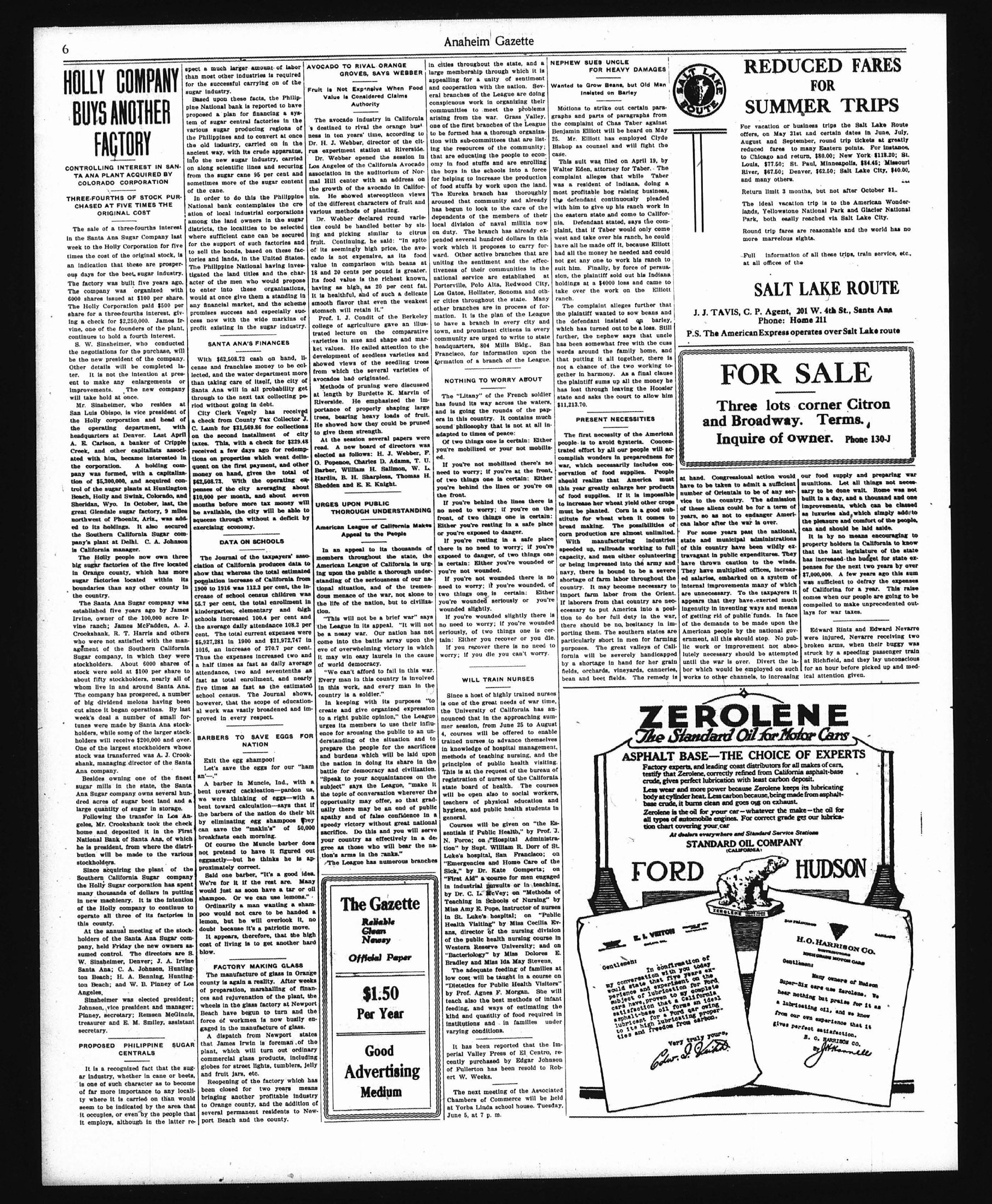
Searchable text
HOLLY COMPANY BUYS ANOTHER FACTORY
CONTROLLING INTEREST IN SAN-TA ANA PLANT ACQUIRED BY COLORADO CORPORATION
THREE-FOURTHS OF STOCK PURCHASED AT FIVE TIMES THE ORIGINAL COST
The sale of a three-fourths interest in the Santa Ana Sugar Company last week to the Holly Corporation for five times the cost of the original stock, is an indication that these are prosperous days for the beet, sugar industry. The factory was built five years ago. The company was organized with 6000 shares issued at $100 per share. The Holly Corporation paid $500 per share for a three-fourths interest, giving a check for $2,250,000. James Irvine, one of the founders of the plant, continues to hold a fourth interest.
S. W. Sinsheimer, who conducted the negotiations for the purchase, will be the new president of the company. Other details will be completed later. It is not the intention at present to make any enlargements or improvements. The new company will take hold at once.
Mr. Sinsheimer, who resides at San Luis Obispo, is vice president of the Holly corporation and head of the operating department, with headquarters at Denver. Last April A. E. Carlson, a banker of Cripple suspect a much larger amount of labor than most other industries is required for the successful carrying on of the sugar industry.
Based upon these facts, the Philippine National bank is reported to have proposed a plan for financing a system of sugar central factories in the various sugar producing regions of the Philippines and to convert at once the old industry, carried on in the ancient way, with its crude apparatus, into the new sugar industry, carried on along scientific lines and securing from the sugar cane 95 per cent and sometimes more of the sugar content of the cane.
In order to do this the Philippine National bank contemplates the creation of local industrial corporations among the land owners in the sugar districts, the localities to be selected where sufficient cane can be secured for the support of such factories and to sell the bonds, based on these factories and lands, in the United States. The Philippine National having investigated the land titles and the character of the men who would propose to enter into these organizations, would at once give them a standing in any financial market, and the scheme promises success and especially success now with the wide markings of profit existing in the sugar industry.
SANTA ANA'S FINANCES
With $62,508.72 cash on hand, license and franchise money to be collected, and the water department more than taking care of itself, the city of Santa Ana will in all probability get through to the next tax collecting period without going in debt.
City Clerk Vegely has received a check from County Tax Collector J. C. Lamb for $31,569.86 for collections on the second installment of city taxes. This, with a check for $229.48 AVOCADO TO RIVAL GROVES,
Fruit is Not Expensive Value is Considered Author
The avocado industry's destined to rival nature in ten years' time Dr. H. J. Webber, d.r.s experiment station Dr. Webber opens Los Angeles of the Association in the annual Hill center with the growth of the area. He showed some of the different characteristics of various methods of fruit. Continuing, it of its seemingly high cacao is not expensive value in comparison 18 and 20 cents per Its food value is to having as high as it is healthful, and smooth flavor that stomach will retain Prof. I. J. Condi college of agriculture treated lecture on varieties in size and market values. He calls development of seen views of from which the savocados had origin Methods of pruning at length by Burd Riverside. He emphasize importance of property trees, bearing heat He showed how they to give them strength At the session read. A new boar
be the new president of the company. Other details will be completed later. It is not the intention at present to make any enlargements or improvements. The new company will take hold at once.
Mr. Sinsheimer, who resides at San Luis Obispo, is vice president of the Holly corporation and head of the operating department, with headquarters at Denver. Last April A. E. Carlson, a banker of Cripple Creek, and other capitalists associated with him, became interested in the corporation. A holding company was formed, with a capitalization of $5,300,000, and acquired control of the sugar plants at Huntington Beach, Holly and Swink, Colorado, and Sheridan, Wyo. In October, last, the great Glendale sugar factory, 9 miles northwest of Phoenix, Ariz., was added to its holdings. It also secured the Southern California Sugar company's plant at Delhi. C. A. Johnson is California manager.
The Holly people now own three big sugar factories of the five located in Orange county, which has more sugar factories located within its boundaries than any other county in the country.
The Santa Ana Sugar company was established five years ago by James Irvine, owner of the 100,000 acre Irvine ranch; James McFadden, A. J. Crookshank, R. T. Harris and others who were not satisfied with the management of the Southern California Sugar company, in which they were stockholders. About 6000 shares of stock were sold at $100 per share to about fifty stockholders, nearly all of whom live in and around Santa Ana. The company has prospered, a number of big dividend melons having been cut since it began operations. By last week's deal a number of small fortunes were made by Santa Ana stockholders, while some of the larger stockholders will receive $200,000 and over. One of the largest stockholders whose stock was transferred was A. J. Crookshank, managing director of the Santa Ana company.
Besides owning one of the finest sugar mills in the state, the Santa Ana Sugar company owns several hundred acres of sugar beet land and a large quantity of sugar in storage.
Following the transfer in Los Angeles, Mr. Crookshank took the check home and deposited it in the First National Bank of Santa Ana, of which he is president, from where the distribution will be on hand, license and franchise money to be collected, and the water department more than taking care of itself, the city of Santa Ana will in all probability get through to the next tax collecting period without going in debt.
City Clerk Vegely has received a check from County Tax Collector J. C. Lamb for $31,569.86 for collections on the second installment of city taxes. This, with a check for $229.48 received a few days ago for redemptions on properties which went delinquent on the first payment, and other money on hand, gives the total of $62,508.73. With the operating expenses of the city averaging about $10,000 per month, and about seven months before more tax money will be available, the city will be able to squeeze through without a deficit by exercising economy.
DATA ON SCHOOLS
The Journal of the taxpayers' association of California produces data to show that whereas the total estimated population increase of California from 1900 to 1916 was 112.3 per cent, the increase of school census children was 55.7 per cent, the total enrollment in kindergarten; elementary and high schools increased 100.4 per cent and the average daily attendance 108.2 per cent. The total current expenses were $5,927,281 in 1900 and $21,972,747 in 1016, an increase of 270.7 per cent. Thus the expenses increased two and a half times as fast as daily average attendance, two and seventenths as fast as total enrollment, and nearly five times as fast as the estimated school census. The Journal shows, however, that the scope of educational work was vastly broadened and improved in every respect.
BARBERS TO SAVE EGGS FOR NATION
Exit the egg shampoo!
Let's save the eggs for our "ham'an"—."
A barber in Muncie, Ind., with a bent toward cackleation—pardon us, we were thinking of eggs—with a bent toward calculation—says that if the barbers of the nation do their bit by eliminating egg shampoos they can save the "makin's" of 50,000 breakfasts each morning.
Of course the Muncie barber does not figure out how much it will cost out there.
In an appeal to members through American League being upon the public standing of the national situation, dous menace of the life of the nation.
"This will not be a League in its nee be a neasy war." come into the back eye of overwhelm it may win easy world democracy.
"We can't afford Every man in this work and country is a soldier."
In keeping with create and give to a right public urges its member ence for arousing derstanding of prepare the people and burdens which the nation in de battle for democracy.
"Speak to your subject" says that the topic of convention opportunity may usually there may apathy and of speedy victory w sacrifice. Do tha your country an gree as those w
Besides owning one of the finest sugar mills in the state, the Santa Ana Sugar company owns several hundred acres of sugar beet land and a large quantity of sugar in storage.
Following the transfer in Los Angeles, Mr. Crookshank took the check home and deposited it in the First National Bank of Santa Ana, of which he is president, from where the distribution will be made to the various stockholders.
Since acquiring the plant of the Southern California Sugar company the Holly Sugar corporation has spent many thousands of dollars in putting in new machinery. It is the intention of the Holly company to continue to operate all three of its factories in this county.
At the annual meeting of the stockholders of the Santa Ana Sugar company, held Friday the new owners assumed control. The directors are S. W. Sinshelmer, Denver; J. A. Irvine Santa Ana; C. A. Johnson, Huntington Beach; H. A. Benning, Huntington Beach; and W. B. Pinney of Los Angeles.
Sinshelmer was elected president; Johnson, vice president and manager; Pinney, secretary; Remsen McGinnis, treasurer and E. M. Smiley, assistant secretary.
PROPOSED PHILIPPINE SUGAR CENTRALS
It is a recognized fact that the sugar industry, whether in cane or beets, is one of such character as to become of far more importance to any locality where it is carried on than would seem to be indicated by the area that it occupies, or even by the people that it employs, although in the latter re-
Exit the egg shampoo!
Let's save the eggs for our "ham an'—."
A barber in Muncie, Ind., with a bent toward cackleation—pardon us, we were thinking of eggs—with a bent toward calculation—says that if the barbers of the nation do their bit by eliminating egg shampoos they can save the "makin's" of 50,000 breakfasts each morning.
Of course the Muncie barber does not pretend to have it figured out eggsactly—but he thinks he is approximately correct.
Said one barber, "It's a good idea. We're for it if the rest are. Many would just as soon have a tar or oil shampoo. Or we can use lemons."
Ordinarily a man wanting a shampoo would not care to be handed a lemon, but he will overlook it, no doubt because it's a patriotic move.
It appears, therefore, that the high cost of living is to get another hard blow.
FACTORY MAKING GLASS
The manufacture of glass in Orange county is again a reality. After weeks of preparation, marshalling of finances and rejuvenation of the plant, the wheels in the glass factory at Newport Beach have begun to turn and the force of workmen is now busily engaged in the manufacture of glass.
A dispatch from Newport states that James Irwin is foreman of the plant, which will turn out ordinary commercial glass products, including globes for street lights, tumblers, jelly and fruit jars, etc.
Reopening of the factory which has been closed for two years means bringing another profitable industry to Orange county, and the addition of several permanent residents to Newport Beach and the county.
Anaheim Gazette
AVOCADO TO RIVAL ORANGE GROVES, SAYS WEBBER
Fruit is Not Expensive When Food Value is Considered Claims Authority
The avocado industry in California's destined to rival the orange business in ten years' time, according to Dr. H. J. Webber, director of the citrus experiment station at Riverside.
Dr. Webber opened the session in Los Angeles of the California Avocado association in the auditorium of Normal Hill center with an address on the growth of the avocado in California. He showed stereopticon views of the different characters of fruit and various methods of planting.
Dr. Webber declared round varieties could be handled better by sizing and picking similar to citrus fruit. Continuing, he said: "In spite of its seemingly high price, the avocado is not expensive, as its food value in comparison with beans at 18 and 20 cents per pound is greater. Its food value is the richest known, having as high as 20 per cent fat. It is healthful, and of such a delicate smooth flavor that even the weakest stomach will retain it."
Prof. I. J. Condit of the Berkeley college of agriculture gave an illustrated lecture on the comparative varieties in size and shape and market values. He called attention to the development of seedless varieties and showed views of the seedling trees from which the several varieties of avocados had originated.
Methods of pruning were discussed at length by Burdette K. Marvin of Riverside. He emphasized the importance of properly shaping large trees, bearing heavy loads of fruit. He showed how they could be pruned to give them strength.
At the session several papers were read. A new board of directors was in cities throughout the state, and a large membership through which it is appealing for a unity of sentiment and cooperation with the nation. Several branches of the League are doing conspicuous work in organizing their communities to meet the problems arising from the war. Grass Valley, one of the first branches of the League to be formed has a thorough organization with sub-committees that are listing the resources of the community; that are educating the people to economy in food stuffs and are enrolling the boys in the schools into a force for helping to increase the production of food stuffs by work upon the land. The Eureka branch has thoroughly aroused that community and already has begun to look to the care of the dependents of the members of their local division of naval militia now on duty. The branch has already expended several hundred dollars in this work which it proposes to carry forward. Other active branches that are uniting the sentiment and the effectiveness of their communities in the national service are established at Porterville, Polo Alta, Redwood City, Los Gatos, Hollister, Sonoma and other cities throughout the state. Many other branches are in process formation. It is the plan of the League to have a branch in every city and town, and prominent citizens in every community are urged to write to state headquarters, 804 Mills Bldg., San Francisco, for information upon the formation of a branch of the League.
NOTHING TO WORRY ABOUT
The "Litany" of the French soldier has found its way across the waters, and is going the rounds of the papers in this country. It contains much sound philosophy that is not at all adapted to times of peace:
Of two things one is certain: Either you're mobilized or your not mobilized.
NEPHEW SUES UNCLE FOR HEAVY DAMAGES
Wanted to Grow Beans, but Old Man Insisted on Barley
Motions to strike out certain paragraphs and parts of paragraphs from the complaint of Chas Taber against Benjamin Elliott will be heard on May 25. Mr. Elliott has employed Clyde Bishop as counsel and will fight the case.
This suit was filed on April 19, by Walter Eden, attorney for Taber. The complaint alleges that while Taber was a resident of Indiana, doing a most profitable hog raising business, the defendant continuously pleaded with him to give up his ranch work in the eastern state and come to California. Defendant stated, says the complaint, that if Taber would only come west and take over his ranch, he could have all he made off it, because Elliott had all the money he needed and could not get any one to work his ranch to suit him. Finally, by force of persuasion, the plaintiff sold out his Indiana holdings at a $4000 loss and came to take over the work on the Elliott ranch.
The complaint alleges further that the plaintiff wanted to sow beans and the defendant insisted on barley, which has turned out to be a loss. Still further, the nephew says that uncle has been somewhat free with the cuss words around the family home, and that putting it all together, there is not a chance of the two working together in harmony. As a final clause the plaintiff sums up all the money he has lost through leaving the Hoosler state and asks the court to allow him $11,213.70.
PRESENT NECESSITIES
The first necessity of the American people is to avoid hysteria. Concentrated effort by all our people will accom
development of seedless varieties and showed views of the seedling trees from which the several varieties of avocados had originated.
Methods of pruning were discussed at length by Burdette K. Marvin of Riverside. He emphasized the importance of properly shaping large trees, bearing heavy loads of fruit. He showed how they could be pruned to give them strength.
At the session several papers were read. A new board of directors was elected as follows: H. J. Webber, F. O. Popenoe, Charles D. Adams, T. U. Barber, William H. Sallmon, W. L. Hardin, B. H. Sharpless, Thomas H. Shedden and E. E. Knight.
URGES UPON PUBLIC THOROUGH UNDERSTANDING
American League of California Makes Appeal to the People
In an appeal to its thousands of members throughout the state, the American League of California is urging upon the public a thorough understanding of the seriousness of our national situation, and of the tremendous menace of the war, not alone to the life of the nation, but to civilization.
“This will not be a brief war” says the League in its appeal. “It will not be a neasy war. Our nation has not come into the battle array upon the eve of overwhelming victory in which it may win easy laurels in the cause of world democracy.
“We can’t afford to fall in this war. Every man in this country is involved in this work, and every man in the country is a soldier.”
In keeping with its purposes “to create and give organized expression to a right public opinion,” the League urges its members to use their influence for arousing the public to an understanding of the situation and to prepare the people for the sacrifices and burdens which will be laid upon the nation in doing its share in the battle for democracy and civilization.
“Speak to your acquaintances on the subject” says the League, “make it the topic of conversation wherever the opportunity may offer, so that gradually there may be an end of public apathy and of false confidence in a speedy victory without great national sacrifice. Do this and you will serve your country as effectively in a degree as those who will bear the na-
NOTHING TO WORRY ABOUT
The “Litany” of the French soldier has found its way across the waters, and is going the rounds of the papers in this country. It contains much sound philosophy that is not at all adapted to times of peace:
Of two things one is certain: Either you’re mobilized or your not mobilized.
If you’re not mobilized there’s no need to worry; if you’re at the front, of two things one is certain: Either you’re behind the lines or you’re on the front.
If you’re behind the lines there is no need to worry; if you’re on the front, of two things one is certain: Either you’re resting in a safe place or you’re exposed to danger.
If you’re resting in a safe place there is no need to worry; if you’re exposed to danger, of two things one is certain: Either you’re wounded or you’re not wounded.
If you’re not wounded there is no need to worry; if you’re wounded, of two things one is certain: Either you’re wounded seriously or you’re wounded slightly.
If you’re wounded slightly there is no need to worry; if you’re wounded seriously, of two things one is certain: Either you recover or you die.
If you recover there is no need to worry; if you die you can’t worry.
WILL TRAIN NURSES
Since a host of highly trained nurses is one of the great needs of war time, the University of California has announced that in the approaching summer session, from June 25 to August 4, courses will be offered to enable trained nurses to advance themselves in knowledge of hospital management, methods of teaching nursing, and the principles of public health visiting.
This is at the request of the bureau of registration of nurses of the California state board of health. The courses will be open also to social workers, teachers of physical education and hygiene, and public health students in general.
Courses will be given on “the Essentials if Public Health,” by Prof. J. N. Force; on “Hospital Administration” by Supt. William R. Dorr of St.
PRESENT NECESSITIES
The first necessity of the American people is to avoid hysteria. Concentrated effort by all our people will accomplish wonders in preparedness for war, which necessarily includes conservation of food supplies. People should realize that America must this year greatly enlarge her products of food supplies. If it is impossible to increase her wheat yield other crops must be planted. Corn is a good substitute for wheat when it comes to bread making. The possibilities of corn production are almost unlimited.
With manufacturing industries speeded up, railroads working to full capacity, and men either volunteering or being impressed into the army and navy, there is bound to be a severe shortage of farm labor throughout the country. It may become necessary to import farm labor from the Orient. If laborers from that country are necessary to put America into a position to do her full duty in the war, there should be no hesitancy in importing them. The southern states are particularly short in men for farming purposes. The great valleys of California will be severely handicapped by a shortage in hand for her grain fields, orchards, vineyards, canneries, bean and beet fields. The remedy is
The Gazette
Reliable
Clean
Newsy
Official Paper
$1.50
Per Year
Good
Advertising
Medium
and burdens which will be laid open
the nation in doing its share in the
battle for democracy and civilization.
"Speak to your acquaintances on the
subject" says the League, "make it
the topic of conversation wherever the
opportunity may offer, so that gradualy there may be an end of public apathy and of false confidence in a speedy victory without great national sacrifice. Do this and you will serve your country as effectively in a degree as those who will bear the nation's arms in the ranks."
The League has numerous branches
The adequate feeding of families at low cost will be taught in a course on "Dietetics for Public Health Visitors" by Prof. Agnes F. Morgan. She will teach also the best methods of infant feeding, and ways of estimating the kihd and quantity of food required in institutions and in families under varying conditions.
It has been reported that the Imperial Valley Press of El Centro, recently purchased by Edgar Johnson of Fullerton has been resold to Robert W. Weeks.
The next meeting of the Associated Chambers of Commerce will be held at Yorba Linda school house. Tuesday, June 5, at 7 p.m.
REDUCED FARES
FOR
SUMMER TRIPS
For vacation or business trips the Salt Lake Route offers, on May 31st and certain dates in June, July, August and September, round trip tickets at greatly reduced fares to many Eastern points. For instance, to Chicago and return, $80.00; New York $118.20; St. Louis, $77.50; St. Paul, Minneapolis, $84.45; Missouri River, $67.50; Denver, $62.50; Salt Lake City, $40.00, and many others.
Return limit 3 months, but not after October $1.
The ideal vacation trip is to the American Wonderlands, Yellowstone National Park and Glacier National Park, both easily reached via Salt Lake City.
Round trip fares are reasonable and the world has no more marvelous sights.
Full information of all these trips, train service, etc., at all offices of the
SALT LAKE ROUTE
J. J. TAVIS, C. P. Agent, 201 W. 4th St., Santa Ana
Phone: Home 211
P.S. The American Express operates over Salt Lake route
FOR SALE
Three lots corner Citron and Broadway. Terms.
Inquire of owner. Phone 130-J
FOR SALE
Three lots corner Citron and Broadway. Terms.
Inquire of owner. Phone 130-J
at hand. Congressional action would have to be taken to admit a sufficient number of Orientals to be of any service to the country. The admission of these allens could be for a term of years, so as not to endanger American labor after the war is over.
For some years past the national, state and municipal administrations of this country have been wildly extravagant in public expenditures. They have thrown caution to the winds. They have multiplied offices, increased salaries, embarked on a system of internal improvements many of which are unnecessary. To the taxpayers it appears that they have exerted much ingenuity in inventing ways and means of getting rid of public funds. In face of the demands to be made upon the American people by the national government, all this should stop. No public work or improvement not absolutely necessary should be attempted until the war is over. Divert the labor which would be employed on such works to other channels, to increasing our food supply and preparing war munitions. Let all things not necessary to be done wait. Rome was not built in a day, and a thousand and one improvements, which can be classed as luxuries and which simply add to the pleasure and comfort of the people, can and should be laid aside.
It is by no means encouraging to property holders in California to know that the last legislature of the state has increased the budget for state expenses for the next two years by over $7,000,000. A few years ago this sum was sufficient to defray the expenses of California for a year. This raise comes when our people are going to be compelled to make unprecedented outlays for war taxes.
Edward Rintz and Edward Nevarre were injured. Nevarre receiving two broken arms, when their buggy was struck by a speeding passenger train at Richfield, and they lay unconscious for an hour before picked up and medical attention given.
ZEROLENE
The Standard Oil for Motor Cars
ASPHALT BASE—THE CHOICE OF EXPERTS
Factory experts, and leading coast distributors for all makes of cars, testify that Zerolene, correctly refined from California asphalt-base crude, gives perfect lubrication with least carbon deposit.
Less wear and more power because Zerolene keeps its lubricating body at cylinder heat. Less carbon because, being made from asphalt-base crude, it burns clean and goes out on exhaust.
Zerolene is the oil for your car—whatever the make—the oil for all types of automobile engines. For correct grade get our lubrication chart covering your car.
At dealers everywhere and Standard Service Stations
STANDARD OIL COMPANY
Factory experts, and leading coast distributors for all makes of cars,
testify that Zerolene, correctly refined from California asphalt-base
crude, gives perfect lubrication with least carbon deposit.
Less wear and more power because Zerolene keeps its lubricating
body at cylinder heat. Less carbon because, being made from asphaltbase crude, it burns clean and goes oug on exhaust.
Zerolene is the oil for your car—whatever the make—the oil for
all types of automobile engines. For correct grade get our lubrication chart covering your car.
At dealers everywhere and Standard Service Stations
STANDARD OIL COMPANY
(CALIFORNIA)
FORD HUDSON
In confirmation of
conversation with you today
state that five years expense and experiment on the
object of lubrication for Ford
we have, proven to my complete
atisfaction that a California
aphalt-base oil forms an ideal
lubricant for a Ford car owing
to its high lubricating properties and freedom from carbon.
Very truly yours,
Colur J. Vitton
H.O. HARRISON CO.
DISTRIBUTORS
KENN GRADE MOTOR CARS
Gentlemen:
Many owners of Hudson
Super-Six cars use Zerolene. We
hear nothing but praise for it as
a lubricating oil, and we know
from our own experience that it
gives perfect satisfaction.
H. O. HARRISON CO.
BY J. Harrison