anaheim-gazette 1917-05-03
Scanned page
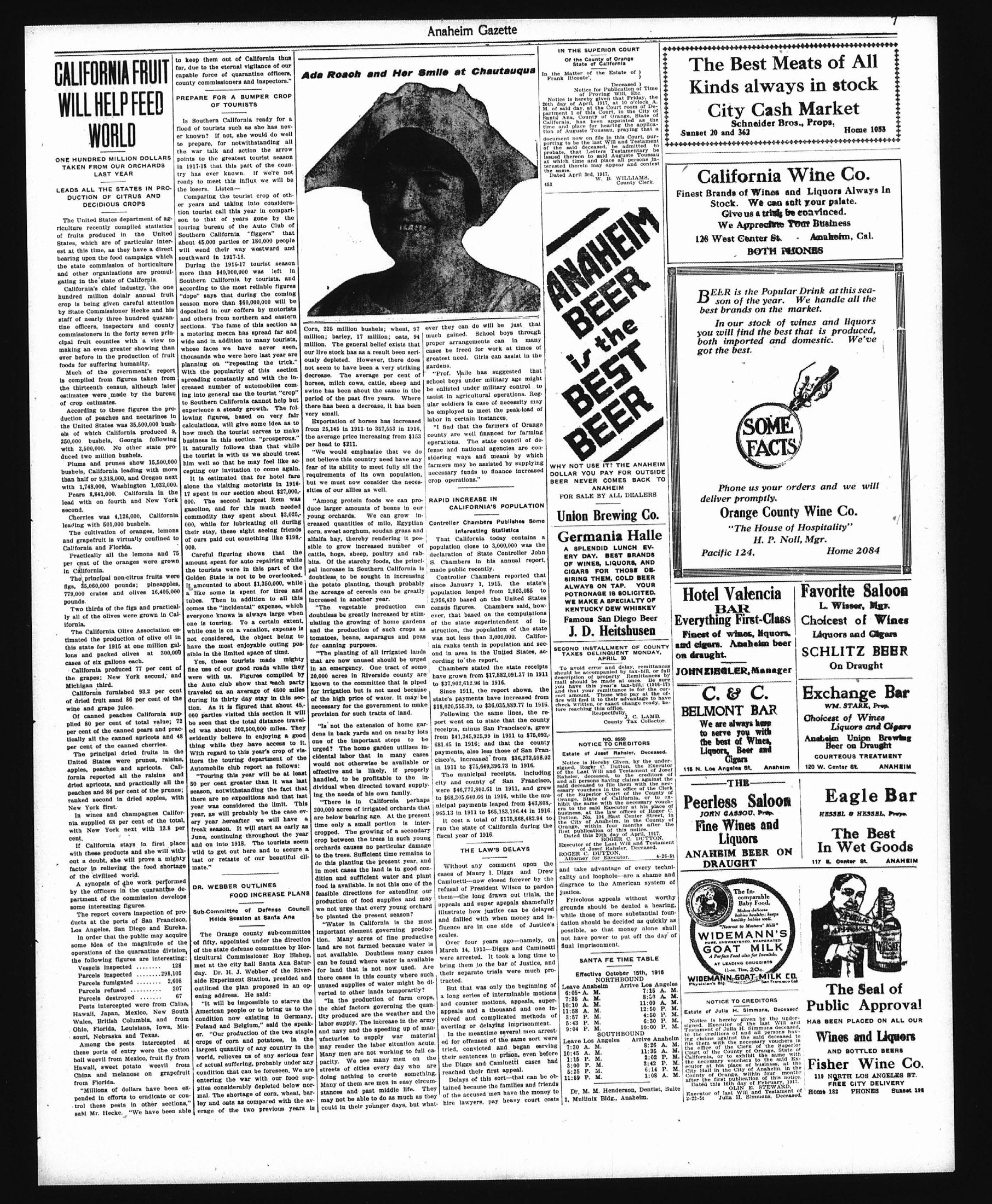
Searchable text
CALIFORNIA FRUIT WILL HELP FEED WORLD
ONE HUNDRED MILLION DOLLARS TAKEN FROM OUR ORCHARDS LAST YEAR
LEADS ALL THE STATES IN PRODUCTION OF CITRUS AND DECIDIOUS CROPS
The United States department of agriculture recently compiled statistics of fruits produced in the United States, which are of particular interest at this time, as they have a direct bearing upon the food campaign which the state commission of horticulture and other organizations are promoting in the state of California.
California's chief industry, the one hundred million dollar annual fruit crop is being given careful attention by State Commissioner Hecke and his staff of nearly three hundred quarantine officers, inspectors and county commissioners in the forty seven principal fruit counties with a view to making an even greater showing than ever before in the production of fruit foods for suffering humanity.
Much of the government's report is compiled from figures taken from the thirteenth census, although later estimates were made by the bureau of crop estimates.
According to these figures the production of peaches and nectarines in the United States was 35,500,000 bushels of which California produced 9,250,000 bushels. Georgia following with 2,500,000. No other state pro-
to keep them out of California thus far, due to the eternal vigilance of our capable force of quarantine officers, county commissioners and inspectors."
PREPARE FOR A BUMPER CROP OF TOURISTS
Is Southern California ready for a flood of tourists such as she has never known? If not, she would do well to prepare, for notwithstanding all the war talk and action the arrow points to the greatest tourist season in 1917-18 that this part of the country has ever known. If we're not ready to meet this influx we will be the losers. Listen—
Comparing the tourist crop of other years and taking into consideration tourist call this year in comparison to that of years gone by the touring bureau of the Auto Club of Southern California "figgers" that about 45,000 parties or 180,000 people will wend their way westward and southward in 1917-18.
During the 1916-17 tourist season more than $40,000,000 was left in Southern California by tourists, and according to the most reliable figures "dope" says that during the coming season more than $60,000,000 will be deposited in our coffers by motorists and others from northern and eastern sections. The fame of this section as a motoring mecca has spread far and wide and in addition to many tourists, whose faces we have never seen, thousands who were here last year are planning on "repeating the trick." With the popularity of this section spreading constantly and with the increased number of automobiles coming into general use the tourist "crop" to Southern California cannot help but experience a steady growth. The following figures, based on very fair calculations, will give some idea as to how much the tourist serves to make business in this section "prosperous." It naturally follows than that while
ever before in the production of fruit foods for suffering humanity.
Much of the government's report is compiled from figures taken from the thirteenth census, although later estimates were made by the bureau of crop estimates.
According to these figures the production of peaches and nectarines in the United States was 35,500,000 bushels of which California produced 9,250,000 bushels, Georgia following with 2,500,000. No other state produced two million bushels.
Plums and prunes show 15,500,000 bushels, California leading with more than half or 9,318,000, and Oregon next with 1,748,000, Washington 1,032,000.
Pears 8,841,000. California in the lead with on fourth and New York second.
Cherries was 4,126,000, California leading with 501,000 bushels.
The cultivation of oranges, lemons and grapefruit is virtually confined to California and Florida.
Practically all the lemons and 75 per cent of the oranges were grown in California.
The principal non-citrus fruits were figs, 35,060,000 pounds; pineapples, 779,000 crates and olives 16,405,000 pounds.
Two thirds of the figs and practically all of the olives were grown in California.
The California Olive Association estimated the production of olive oil in this state for 1915 at one million gallons and packed olives at 300,000 cases of six gallons each.
California produced 77 per cent of the grapes; New York second; and Michigan third.
California furnished 93.2 per cent of dried fruit sand 86 per cent of the wine and grape juice.
Of canned peaches California supplied 80 per cent of total value; 72 per cent of the canned pears and practically all the canned apricots and 48 per cent of the canned cherries.
The principal dried fruits in the United States were prunes, raisins, apples, peaches and apricots. California reported all the raisins and dried apricots, and practically all the peaches and 86 per cent of the prunes; ranked second in dried apples, with New York first.
In wines and champagnes California supplied 68 per cent of the total, with New York next with 13.8 per cent.
If California stays in first place thousands who were here last year are planning on "repeating the trick." With the popularity of this section spreading constantly and with the increased number of automobiles coming into general use the tourist "crop" to Southern California cannot help but experience a steady growth. The following figures, based on very fair calculations, will give some idea as to how much the tourist serves to make business in this section "prosperous."
It naturally follows than that while the tourist is with us we should treat him well so that he may feel like accepting our invitation to come again.
It is estimated that for hotel fare alone the visiting motorists in 1916-17 spent in our section about $27,000,-000. The second largest item was gasoline, and for this much needed commodity they spent about $2,025,-000, while for lubricating oil during their stay, these sight seeing friends of ours paid out something like $198,-000.
Careful figuring shows that the amount spent for auto repairing while the tourists were in this part of the Golden State is not to be overlooked. It amounted to about $1,350,000, while a like some is spent for tires and tubes. Then in addition to all this comes the "incidental" expense, which everyone knows is always large when one is touring. To a certain extent, while one is on a vacation, expense is not considered, the object being to have the most enjoyable outing possible in the limited space of time.
Yes, these tourists made mighty fine use of our good roads while they were with us. Figures compiled by the Auto club show that each party traveled on an average of 4500 miles during its thirty day stay in this section. As it is figured that about 45-ooo parties visited this section it will be seen that the total distance traveled was about 202,500,000 miles. They evidently believe in enjoying a good thing while they have access to it. With regard to this year's crop of visitors the touring department of the Automobile club report as follows:
"Touring this year will be at least 50 per cent greater than it was last season, notwithstanding the fact that there are no expositions and that last year was considered the limit. This year, as will probably be the case every year hereafter we will have a freak season. It will start as early as June, continuing throughout the year and on into 1918. The tourists seem willing to get out here and to secure a thousand who were here last year are planning on "repeating the trick." With the popularity of this section spreading constantly and with the increased number of automobiles coming into general use the tourist "crop" to Southern California cannot help but experience a steady growth. The following figures, based on very fair calculations, will give some idea as to how much the tourist serves to make business in this section "prosperous."
It naturally follows than that while the tourist is with us we should treat him well so that he may feel like accepting our invitation to come again.
It is estimated that for hotel fare alone the visiting motorists in 1916-17 spent in our section about $27,000,-000. The second largest item was gasoline, and for this much needed commodity they spent about $2,025,-000, while for lubricating oil during their stay, these sight seeing friends of ours paid out something like $198,-000.
Careful figuring shows that the amount spent for auto repairing while the tourists were in this part of the Golden State is not to be overlooked. It amounted to about $1,350,000, while a like some is spent for tires and tubes. Then in addition to all this comes the "incidental" expense, which everyone knows is always large when one is touring. To a certain extent, while one is on a vacation, expense is not considered, the object being to have the most enjoyable outing possible in the limited space of time.
Yes, these tourists made mighty fine use of our good roads while they were with us. Figures compiled by the Auto club show that each party traveled on an average of 4500 miles during its thirty day stay in this section. As it is figured that about 45-ooo parties visited this section it will be seen that the total distance traveled was about 202,500,000 miles. They evidently believe in enjoying a good thing while they have access to it. With regard to this year's crop of visitors the touring department of the Automobile club report as follows:
"Touring this year will be at least 50 per cent greater than it was last season, notwithstanding the fact that there are no expositions and that last year was considered the limit. This year, as will probably be the case every year hereafter we will have a freak season. It will start as early as June, continuing throughout the year and on into 1918. The tourists seem willing to get out here and to secure a thousand who were here last year are planning on "repeating the trick." With the popularity of this section spreading constantly and with the increased number of automobiles coming into general use the tourist "crop" to Southern California cannot help but experience a steady growth. The following figures, based on very fair calculations, will give some idea as to how much the tourist serves to make business in this section "prosperous."
It naturally follows than that while the tourist is with us we should treat him well so that he may feel like accepting our invitation to come again.
It is estimated that for hotel fare alone the visiting motorists in 1916-17 spent in our section about $27,000,-000. The second largest item was gasoline, and for this much needed commodity they spent about $2,025,-
United States were prunes, raisins,
apples, peaches and apricots. California reported all the raisins and dried apricots, and practically all the peaches and 86 per cent of the prunes; ranked second in dried apples, with New York first.
In wines and champagnes California supplied 68 per cent of the total, with New York next with 13.8 per cent.
If California stays in first place with these products and she will without a doubt, she will prove a mighty factor in relieving the food shortage of the civilized world.
A synopsis of the work performed by the officers in the quarantine department of the commission develops some interesting figures.
The report covers inspection of products at the ports of San Francisco, Los Angeles, San Diego and Eureka.
In order that the public may acquire some idea of the magnitude of the operations of the quarantine division, the following figures are interesting:
Vessels inspected ... 128
Parcels inspected ... 298,105
Parcels fumigated ... 2,608
Parcels refused ... 207
Parcels destroyed ... 67
Pests intercepted were from China, Hawaii, Japan, Mexico, New South Wales, British Columbia, and from Ohio, Florida, Louisiana, Iowa, Missouri, Nebraska and Texas.
Among the pests intercepted at these ports of entry were the cotton boll weevil from Mexico, fruit fly from Hawaii, sweet potato weevil from China and melanose on grapefruit from Florida.
"Millions of dollars have been expended in efforts to eradicate or control these pests in other sections," said Mr. Hecke. "We have been able toitors the touring department of the Automobile club report as follows:
"Touring this year will be at least 50 per cent greater than it was last season, notwithstanding the fact that there are no expositions and that last year was considered the limit. This year, as will probably be the case every year hereafter we will have a freak season. It will start as early as June, continuing throughout the year and on into 1918. The tourists seem wild to get out here and to secure a tast or retaste of our beautiful climate."
DR. WEBBER OUTLINES
FOOD INCREASE PLANS
Sub-Committee of Defense Council Holds Session at Santa Ana
The Orange county sub-committee of fifty, appointed under the direction of the state defense committee by Horizultural Commissioner Roy Bishop, met at the city hall Santa Ana Saturday. Dr. H. J. Webber of the Riverside Experiment Station, presided and outlined the plan proposed in an opening address. He said:
"It will be impossible to starve the American people or to bring us to the condition now existing in Germany, Poland and Belgium," said the speaker. "Our production of the two staple crops of corn and potatoes, in the largest quantity of any country in the world, relieves us of any serious fear of actual suffering, probably under any condition that can be foreseen. We are entering the war with our food supplies considerably depleted below normal. The shortage of corn, wheat, barley and oats as compared with the average of the two previous years is"
"Water in California important element. Many acres land are not farmed not available. Do can be found when for land that is there cases in this unused supplies converted to other lakes."
"In the produce the chief factors: quantity produced area labor supply. The and navy and the factories to su may render the Many men are new pacity. We see streets of cities doing nothing to Many of them are stances and pass may not be able could in their you
Ada Roach and Her Smile at Chautauqua
Corn, 225 million bushels; wheat, 97 million; barley, 17 million; oats, 94 million. The general belief exists that our live stock has as a result been seriously depleted. However, there does not seem to have been a very striking decrease. The average per cent of horses, milch cows, cattle, sheep and swine has been about the same in the period of the past five years. Where there has been a decrease, it has been very small.
Exportation of horses has increased from 25,145 in 1911 to 357,553 in 1916, the average price increasing from $153 per head to $211.
IN THE SUPERIOR COURT
Of the County of Orange
State of California
In the Matter of the Estate of )
Frank Ricoute'.
Deceased )
Notice for Publication of Time
of Proving Will, Etc.
Notice is hereby given that Friday, the 20th day of April, 1917, at 10 o'clock A.M. of said day, at the Court room of Department 1 of this Court, in the City of Santa Ana, County of Orange, State of California, has been appointed as the time and place for hearing the application of Auguste Toussau, praying that a document now on file in this Court, purporting to be the last Will and Testament of the said deceased, be admitted to probate, that Letters Testamentary be issued thereon to said Auguste Toussau at which time and place all persons interested therein may appear and contest the same.
Dated April 3rd, 1917.
W. B. WILLIAMS,
County Clerk.
ANAHEIM BEER
is the
BEST
BEER
EXPORTATION of horses has increased from 25,145 in 1911 to 357,553 in 1916, the average price increasing from $153 per head to $211.
"We would emphasize that we do not believe this country need have any fear of its ability to meet fully all the requirements of its own population, but we must now consider the necessities of our allies as well."
"Among protein foods we can produce larger amounts of beans in our young orchards. We can grow increased quantities of milo, Egyptian corn, sweet sorghum, soudan grass and alfalfa hay, thereby rendering it possible to grow increased number of cattle, hogs, sheep, poultry and rabbits. Of the starchy foods, the principal increase in Southern California is doubtless, to be sought in increasing the potato planting, though probably the acreage of cereals can be greatly increased in another year.
"The vegetable production can doubtless be greatly increased by stimulating the growing of home gardens and the production of such crops as tomatoes, beans, asparagus and peas for canning purposes.
"The planting of all irrigated lands that are now unused should be urged in an emergency. One tract of some 20,000 acres in Riverside county are known to the committee that is piped for irrigation but is not used because of the high price of water. It may be necessary for the government to make provision for such tracts of land.
"Is not the extension of home gardens in back yards and on nearby lots one of the important steps to be urged? The home garden utilizes incidental labor that in many cases would not otherwise be available or effective and is likely, if properly handled, to be profitable to the individual when directed toward supplying the needs of his own family.
"There is in California perhaps 200,000 acres of irrigated orchards that are below bearing age. At the present time only a small portion is intercropped. The growing of a secondary crop between the trees in such young orchards causes no particular damage greatest need. Girls can assist in the gardens.
"Prof. Valle has suggested that school boys under military age might be enlisted under military control to assist in agricultural operations. Regular soldiers in case of necessity may be employed to meet the peak-load of labor in certain instances.
"I find that the farmers of Orange county are well financed for farming operations. The state council of defense and national agencies are considering ways and means by which farmers may be assisted by supplying necessary funds to finance increased crop operations."
RAPID INCREASE IN CALIFORNIA'S POPULATION
Controller Chambers Publishes Some Interesting Statistics
That California today contains a population close to 3,000,000 was the declaration of State Controller John S. Chambers in his annual report, made public recently.
Controller Chambers reported that since January 1, 1915, the state's population leaped from 2,803,085 to 2,956,430 based on the United States census figures. Chambers said, however, that based on the computations of the state superintendent of instruction, the population of the state was not less than 3,000,000. California ranks tenth in population and second in area in the United States, according to the report.
Chambers stated the state receipts have grown from $17,882,091.37 in 1911 to $37,902,612.96 in 1916.
Since 1911, the report shows, the state's payments have increased from $18,020,555.39, to $36,035,889.77 in 1916.
Following the same lines, the report went on to state that the county receipts, minus San Francisco's, grew from $41,345,925.99 in 1911 to $75,092-681.45 in 1916; and that the county payments, also less those of San Francisco's, increased from $36,272,598.02 in 1911 to $75,649,396.73 in 1916.
The municipal receipts, including city and county of San Francisco, were $46,777,803.61 in 1911, and grew to $68,305,640.66 in 1916, while the municipal payments leaped from $43,808-965.13 in 1911 to $65,183,196.44 in 1916.
It cost a total of $175,868,482.94 to run the state of California during the fiscal year of 1916.
THE LAW'S DELAYS
WHY NOT USE IT? THE ANAHEIM DOLLAR YOU PAY FOR OUTSIDE BEER NEVER COMES BACK TO ANAHEIM FOR SALE BY ALL DEALERS
Union Brewing Co.
Germania Halle
A SPLENDID LUNCH EVERY DAY. BEST BRANDS OF WINES, LIQUORS, AND CIGARS FOR THOSE DESIRED THEM, COLD BEER ALWAYS ON TAP. YOUR POTRONAGE IS SOLICITED. WE MAKE A SPECIALTY OF KENTUCKY DEW WHISKEY
Famous San Diego Beer J. D. Heitshusen
SECOND INSTALLMENT OF COUNTY TAXES DELINQUENT MONDAY,
APRIL 30
To avoid error and delay, remittances should be accompanied by tax-bill, or full description of property. Remittances by mail should be made at once. Be sure you have this year's tax-bill: (1916-17) and that your remittance is for the correct amount. Those who pay at the office will find it to their advantage to have check written, or exact change ready, before reaching this office.
Respectfully,
J. C. LAMB,
County Tax Collector.
NO. 8550
NOTICE TO CREDITORS
Estate of Josef Rahler, Deceased.
Notice is Hereby Given, by the undersigned, Roger C. Dutton, the Executor of the Last Will and Testament of Josef Rahler, deceased; to the creditors of and all persons having claims against the said deceased to file them with the necessary vouchers in the office of the Clerk of the Superior Court of the County of Orange, State of California; or to exhibit the same with the necessary vouchers to the said Executor at his place of business; at the law offices of Roger C. Dutton. No. 104 East Center Street, in the City of Anaheim, in the County of Orange; within four months after the first publication of this notice.
Dated this 20th day of April, 1917.
ROGER C. DUTTON,
Executor of the Last Will and Testament of Josef Rahler, Deceased.
There is in California perhaps 200,000 acres of irrigated orchards that are below bearing age. At the present time only a small portion is intercropped. The growing of a secondary crop between the trees in such young orchards causes no particular damage to the trees. Sufficient time remains to do this planting the present year, and in most cases the land is in good condition and sufficient water and plant food is available. Is not this one of the feasible directions for extending our production of food supplies and may we not urge that every young orchard be planted the present season?
"Water in California is the most important element governing production. Many acres of fine productive land are not farmed because water is not available. Doubtless many cases can be found where water is available for land that is not now used. Are there cases in this county where such unused supplies of water might be diverted to other lands temporarily?
"In the production of farm crops, the chief factors governing the quantity produced are the weather and the labor supply. The increase in the army and navy and the speeding up of manufactures to supply war material may render the labor situation acute. Many men are not working to full capacity. We see many men on the streets of cities every day who are doing nothing to create something. Many of them are men in easy circumstances and past middle life. They may not be able to do as much as they could in their younger days, but what
The municipal receipts, including city and county of San Francisco, were $46,777,803.61 in 1911, and grew to $68,305,640.66 in 1916, while the municipal payments leaped from $43,808,965.13 in 1911 to $65,183,196.44 in 1916.
It cost a total of $175,868,482.94 to run the state of California during the fiscal year of 1916.
THE LAW'S DELAYS
Without any comment upon the cases of Maury I. Diggs and Drew Caminetti—now closed forever by the refusal of President Wilson to pardon them—the long drawn out trials, the appeals and super appeals shamefully illustrate how justice can be delayed and dallied with when money and influence are in one side of Justice's scales.
Over four years ago—namely, on March 14, 1913—Diggs and Caminetti were arrested. It took a long time to bring them to the bar of Justice, and their separate trials were much protracted.
But that was only the beginning of a long series of interminable motions and counter motions, appeals, super-appeals and a thousand and one involved and complicated methods of averting or delaying imprisonment.
In the meantime several men arrested for offenses of the same sort were tried, convicted and began serving their sentences in prison, even before the Diggs and Caminetti cases had reached their first appeal.
Delays of this sort—that can be obtained because the families and friends of the accused men have the money to hire lawyers, pay heavy court costs
Notice is Hereby Given, by the undersigned, Roger C. Dutton, the Executor of the Last Will and Testament of Josef Rahsel, deceased, to the creditors of all persons having claims against the said deceased to file them with the necessary yachters in the office of the Clerk of Superior Court of the County of Orange, State of California, or to exhibit the same with the necessary vouchers to the said Executor at his place of business, at the law offices of Roger C. Dutton, No. 104 East Center Street, in the City of Anaheim, in the County of Orange, within four months after the first publication of this notice.
Dated this 20th day of April, 1917.
ROGER C. DUTTON.
Executor of the Last Will and Testament of Josef Rahsel, Deceased.
ROGER C. DUTTON.
Attorney for Executor.
SANTA FE TIME TABLE
Effective October 15th, 1916
NORTHBOUND
Leave Anaheim Arrive Los Angeles
6:05 A.M. 7:15 A.M.
7:35 A.M. 8:50 A.M.
10:10 A.M. 11:00 A.M.
11:58 A.M. 12:50 P.M.
3:57 P.M. 4:50 P.M.
5:43 P.M. 6:30 P.M.
9:04 P.M. 10:00 P.M.
SOUTHBOUND
Leave Los Angeles Arrive Anaheim
7:30 A.M. 8:26 A.M.
10:45 A.M. 11:35 A.M.
1:15 P.M. 2:02 P.M.
3:00 P.M. 3:42 P.M.
5:25 P.M. 6:14 P.M.
11:59 P.M. 1:08 A.M.
Dr. M. M. Henderson, Dentist, Suite 1, Mullinix Bldg., Anaheim.
The Best Meats of All
Kinds always in stock
City Cash Market
Schneider Bros., Props,
Sunset 20 and 362
Home 1053
California Wine Co.
Finest Brands of Wines and Liquors Always In
Stock. We can suit your palate.
Give us a tiring be convinced.
We Appreciate Your Business
128 West Center St. - Anaheim, Cal.
BOTH PHONES
BEER is the Popular Drink at this season of the year. We handle all the best brands on the market.
In our stock of wines and liquors you will find the best that is produced, both imported and domestic. We've got the best.
SOME FACTS
SOME FACTS
Phone us your orders and we will deliver promptly.
Orange County Wine Co.
"The House of Hospitality"
H. P. Noll, Mgr.
Pacific 124, Home 2084
Hotel Valencia BAR
Everything First-Class
Finest of wines, liquors and cigars. Anaheim beer on draught.
JOHN ZIEGLER, Manager
Favorite Saloon
L. Wisser, Mgr.
Choicest of Wines
Liquors and Cigars
SCHLITZ BEER
On Draught
C. & C.
BELMONT BAR
We are always here to serve you with the best of Wines,
Liquors, Beer and Cigars
115 N. Los Angeles St. Anaheim
Exchange Bar
WM. STARK, Prop.
Choicest of Wines
Liquors and Cigars
Anaheim Union Brewing
Beer on Draught
COURTEOUS TREATMENT
120 W. Center St. Anaheim
THE
Peerless Saloon
JOHN GASSOU, Prop.
Fine Wines and Liquors
Eagle Bar
HESSEL & HESSEL, Prop.
The Best In Wet Goods
Cigars
115 N. Los Angeles St. Anaheim
THE
Peerless Saloon
JOHN CASSOU, Prop.
Fine Wines and Liquors
ANAHEIM BEER ON DRAUGHT
Eagle Bar
HESSBL & HESSBL, Props.
The Best
In Wet Goods
117 E. Center St. Anaheim
The Incomparable Baby Food.
Makes delicate babies healthy; keeps healthy babies well.
"Nearest to Mothers' Milk"
WIDEMANN'S
PURE, UNSWEETENED, EVAPORATED
GOAT MILK
A Perfect Food also for Invalides.
AT LEADING DRUGGISTS
11 oz. Tins, 20 c.
WIDEMANN GOAT MILK CO.
Physician's Big.
NOTICE TO CREDITORS
Estate of Julia H. Simmons, Deceased.
Notice is hereby given by the undersigned. Executor of the last Will and Testament of Julia H. Simmons deceased, to the creditors of and all persons having claims against the said deceased to file them with the necessary vouchers in the office of the Clerk of the Superior Court of the County of Orange, State of California, or to exhibit the same with the necessary vouchers to the said Executor at his place of business, at the City Hall in the City of Anaheim, in the County of Orange, within four months after the first publication of this notice.
Dated this 16th day of February, 1917.
OLIN E. STEWARD,
Executor of last Will and Testament of 2-22-5t
Julia H. Simmons, Deceased.
The Seal of Public Approval
HAS BEEN PLACED ON ALL OUR Wines and Liquors
AND BOTTLED BEERS
Fisher Wine Co.
119 NORTH LOS ANGELES ST.
FREE CITY DELIVERY
Home 182 PHONES Sunset 198