anaheim-gazette 1917-02-01
Scanned page
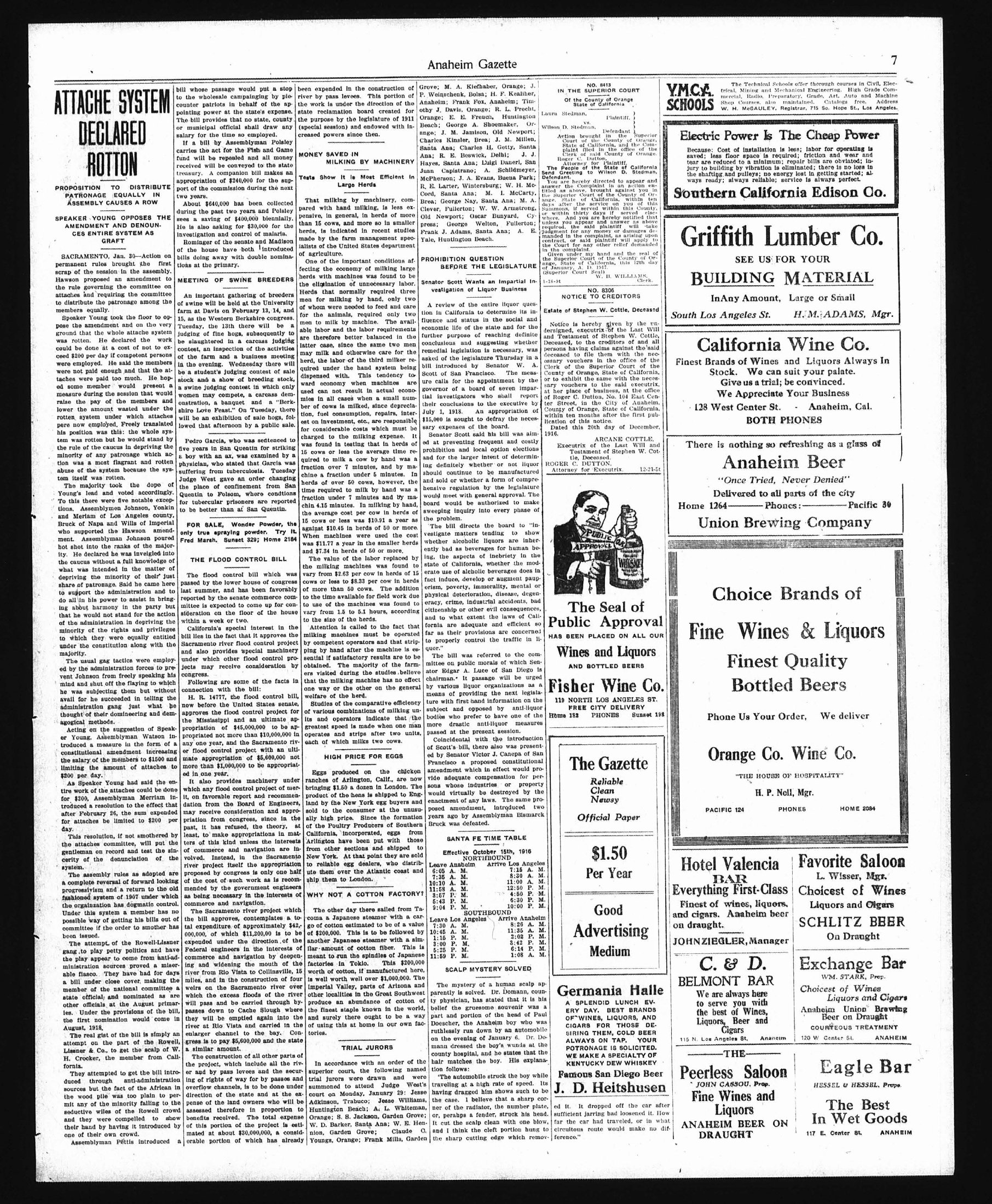
Searchable text
ATTACHE SYSTEM
DECLARED
ROTTON
PROPOSITION TO DISTRIBUTE
PATRONAGE EQUALLY IN
ASSEMBLY CAUSES A ROW
SPEAKER YOUNG OPPOSES THE
AMENDMENT AND DENOUNCES ENTIRE SYSTEM AS GRAFT
SACRAMENTO, Jan. 30—Action on permanent rules brought the first scrap of the session in the assembly. Hawson proposed an amendment to the rule governing the committee on attaches and requiring the committee to distribute the patronage among the members equally.
Speaker Young took the floor to oppose the amendment and on the very ground that the whole attache system was rotten. He declared the work could be done at a cost of not to exceed $200 per day if competent persons were employed. He said the members were not paid enough and that the attaches were paid too much. He hoped some member would present a measure during the session that would raise the pay of the members and lower the amount wasted under the rotten system under which attaches pere now employed. Freely translated his position was this: the whole system was rotten but he would stand by the rule of the caucus in depriving the bill whose passage would put a stop to the wholesale campaling by ple-counter patriots in behalf of the appointing power at the state's expense. The bill provides that no state, county or municipal official shall draw any salary for the time so employed.
If a bill by Assemblyman Polsley carries the act for the Fish and Game fund will be repealed and all money received will be conveyed to the state treasury. A companion bill makes an appropriation of $240,000 for the support of the commission during the next two years.
About $640,000 has been collected during the past two years and Polsley sees a saving of $400,000 biennially. He is also asking for $30,000 for the investigation and control of malaria.
Rominger of the senate and Madison of the house have both introduced bills doing away with double nominations at the primary.
MEETING OF SWINE BREEDERS
An important gathering of breeders of swine will be held at the University farm at Davis on February 13, 14, and 15, as the Western Berkshire congress. Tuesday, the 13th there will be a judging of fine hogs, subsequently to be slaughtered in a carcass judging contest, an inspection of the activities of the farm and a business meeting in the evening. Wednesday there will be a student's judging contest of sale stock and a show of breeding stock, a swine judging contest in which only women may compete, a carcass demonstration, a banquet and a "Berkshire Love Feast." On Tuesday, there will be an exhibition of sale hogs, followed that afternoon by a public sale.
Pedro Garcia, who was sentenced to five years in San Quentin for striking been expended in the river by pass levees. The work is under the state reclamation board; the purpose by the legislature (special session) and increased powers since then.
MONEY SAVED IN MILKING BY
Tests Show It Is More Large Here
That milking by man-pared with hand milking expensive, in general, in than 15 cows, and more herds, is indicated in made by the farm managers of the United States of agriculture.
One of the important factors affecting the economy of herds with machines was the elimination of unnatural men for milking by him of whom were needed to for the animals, require men to milk by machine able labor and the labor are therefore better bled latter case, since they may milk and otherwise herd, the labor of the t required under the hands dispensed with. This ward economy when used can not result in miles in all cases where ber of cows is milked, tion, fuel consumption, est on investment, etc., for considerable costs charged to the milkers was found in testing th
he said the members were not paid enough and that the attaches were paid too much. He hoped some member would present a measure during the session that would raise the pay of the members and lower the amount wasted under the rotten system under which attaches pere now employed. Freely translated his position was this: the whole system was rotten but he would stand by the rule of the caucus in depriving the minority of any patronage which action was a most flagrant and rotten abuse of the system because the system itself was rotten.
The majority took the dope of Young's lead and voted accordingly. To this there were five notable exceptions. Assemblymen Johnson, Yonkin and Merlam of Los Angeles county, Bruck of Napa and Wills of Imperial who supported the Hawson amendment. Assemblyman Johnson poured hot shot into the ranks of the majority. He declared he was invigiled into the caucus without a full knowledge of what was intended in the matter of depriving the minority of their just share of patronage. Said he came here to support the administration and to do all in his power to assist in bringing about harmony in the party but that he would not stand for the action of the administration in depriving the minority of the rights and privileges to which they were equally entitled under the constitution along with the majority.
The usual gag tactics were employed by the administration forces to prevent Johnson from freely speaking his mind and shut off the flaying to which he was subjecting them but without avail for he succeeded in telling the administration gang just what he thought of their domineering and demagogical methods.
Acting on the suggestion of Speaker Young, Assemblyman Watson introduced a measure in the form of a constitutional amendment increasing the salary of the members to $1500 and limiting the amount of attaches to $200 per day.
As Speaker Young had said the entire work of the attaches could be done for $200, Assemblyman Merriam introduced a resolution to the effect that after February 26, the sum expended for attaches be limited to $200 per day.
This resolution, if not smothered by the attaches committee, will put the millin on record and test the sin of the farm and a business meeting in the evening. Wednesday there will be a student's judging contest of sale stock and a show of breeding stock, a swine judging contest in which only women may compete, a carcass demonstration, a banquet and a "Berkshire Love Feast." On Tuesday, there will be an exhibition of sale hogs, followed that afternoon by a public sale.
Pedro Garcia, who was sentenced to five years in San Quentin for striking a boy with an ax, was examined by a physician, who stated that Garcia was suffering from tuberculosis. Tuesday Judge West gave an order changing the place of confinement from San Quentin to Folsom, where conditions for tubercular prisoners are reported to be better than at San Quentin.
FOR SALE, Wonder Powder, the only true spraying powder. Try it. Fred Marsh. Sunset 329; Home 2184
THE FLOOD CONTROL BILL
The flood control bill which was passed by the lower house of congress last summer, and has been favorably reported by the senate commerce committee is expected to come up for consideration on the floor of the house within a week or two.
California's special interest in the bill lies in the fact that it approves the Sacramento river flood control project and also provides special machinery under which other flood control projects may receive consideration by congress.
Following are some of the facts in connection with the bill:
H. R. 14777, the flood control bill, now before the United States senate, approves the flood control project for Mississippi and an ultimate appropriation of $45,000,000 to be appropriated not more than $10,000,000 in any one year, and the Sacramento river flood control project with an ultimate appropriation of $5,600,000 not more than $1,000,000 to be appropriated in one year.
It also provides machinery under which any flood control project of merit, on favorable report and recommendation from the Board of Engineers, may receive consideration and appropriation from congress, since in the past, it has refused, the theory, at least, to make appropriations in matters of this kind unless the interests of commerce and navigation are in good health.
Eggs produced on ranches of Arlington bring $1.50 a dozen product of the heens land by the New York sold to the consumerally high price. Sink of the Poultry Produce California, incorporates Arlington have been from other sections
the salary of the members to $1500 and limiting the amount of attaches to $200 per day.
As Speaker Young had said the entire work of the attaches could be done for $200, Assemblyman Merriam introduced a resolution to the effect that after February 26, the sum expended for attaches be limited to $200 per day.
This resolution, if not smothered by the attaches committee, will put the gentleman on record and test the sincerity of the denunciation of the system.
The assembly rules as adopted are a complete reversal of forward looking progressivism and a return to the old fashioned system of 1907 under which the orgainzation has dogmatic control. Under this system a member has no possible way of getting his bills out of committee if the order to smother has been issued.
The attempt of the Rowell-Lissner gang to play petty politics and have the play appear to come from anti-administration sources proved a miserable flasco. They have had for days a bill under close cover, making the member of the national committee a state official, and nominated as are other officials at the August primaries. Under the provisions of the bill, the first nomination would come in August, 1918.
The real gist of the bill is simply an attempt on the part of the Rowell, Lissner & Co., to get the scalp of W. H. Crocker, the member from California.
They attempted to get the bill introduced through anti-administration sources but the fact of the African in the wood pile was too plain to permit any of the minority falling to the seductive wiles of the Rowell crowd and they were compelled to show their hand by having it introduced by one of their own crowd.
Assemblyman Pettis introduced a mate appropriation of $5,600,000 not more than $1,000,000 to be appropriated in one year.
It also provides machinery under which any flood control project of merit, on favorable report and recommendation from the Board of Engineers, may receive consideration and appropriation from congress, since in the past, it has refused, the theory, at least, to make appropriations in matters of this kind unless the interests of commerce and navigation are involved. Instead, in the Sacramento river project itself the appropriation proposed by congress is only one half of the cost of such work as is recommended by the government engineers as being necessary in the interests of commerce and navigation.
The Sacramento river project which the bill approves, contemplates a total expenditure of approximately $42,000,000, of which $11,200,00 is to be expended under the direction of the Federal engineers in the interests of commerce and navigation by deepening and widening the mouth of the river from Rio Vista to Collinsville, 15 miles, and in the construction of four weirs on the Sacramento river over which the excess floods of the river will pass and be carried through bypasses down to Cache Slough where they will be emptied again into the river at Rio Vista and carried in the enlarger channel to the bay. Congress is to pay $5,600,000 and the state a similar amount.
The construction of all other parts of the project, which include all the river and by pass levees and the securing of rights of way for by passes and overflow channels, is to be done under direction of the state and at the expense of the land owners who will be assessed therefore in proportion to benefits received. The total expense of this portion of the project is estimated at about $30,000,000, a considerable portion of which has already
Eggs produced on ranches of Arlington bringing $1.50 a dozen product of the hens in land by the New York sold to the consumerally high price. Sine of the Poultry Producer California, incorpora Arlington have been from other sections New York. At that point re liable egg dealute them over the A ship them to London.
WHY NOT A COTTLE?
The other day there coma a Japanese steer go of cotton estimates of $200,000. This is another Japanese steer amount of cotton meant to run the spike factories in Tokio. worth of cotton, if m is well worth well own Imperial Valley, part other localities in th produce an abundance the finest staple knot and surely there out of using this at hometories.
TRIAL JUICE
In accordance with superior court, the trial jurors were d summoned to attend court on Monday, J Adkinson, Trabuco; Huntington Beach; Orange; S. S. Jacks; W. D. Barker, Santa nion, Garden Grove Youngs, Orange; Fr
Anaheim Gazette
been expended in the construction of river by pass levees. This portion of the work is under the direction of the state reclamation board created for the purpose by the legislature of 1911 (special session) and endowed with increased powers since then.
MONEY SAVED IN MILKING BY MACHINERY
Tests Show It Is Most Efficient in Large Herds
That milking by machinery, compared with hand milking, is less expensive, in general, in herds of more than 15 cows, and more so in smaller herds, is indicated in recent studies made by the farm management specialists of the United States department of agriculture.
One of the important conditions affecting the economy of milking large herds with machines was found to be the elimination of unnecessary labor. Herds that normally required three men for milking by hand, only two of whom were needed to feed and care for the animals, required only two men to milk by machine. The available labor and the labor requirements are therefore better balanced in the latter case, since the same two men may milk and otherwise care for the herd, the labor of the third milker required under the hand system being dispensed with. This tendency toward economy when machines are used can not result in actual economies in all cases when a small number of cows is milked, since depreciation, fuel consumption, repairs, interest on investment, etc., are responsible for considerable costs which must be charged to the milking expense. It was found in testing that in herds of Grove; M. A. Klefhaber, Orange; J. P. Weinschenk, Bolsa; H. F. Kealiher, Anaheim; Frank Fox, Anaheim; Timothy J. Davis, Orange; R. L. Precht, Orange; E. E. French, Huntington Beach; George A. Shoemaker, Orange; J. M. Jamison, Old Newport; Charles Kinsler, Brea; J. M. Millen, Santa Ana; Charles H. Getty, Santa Ana; R. E. Beswick, Delhi; J. J. Hayes, Santa Ana; Luigi Daneri, San Juan Capistrano; A. Schildmeyer, McPherson; J. A. Evans, Buena Park; R. E. Larter, Wintersburg; W. H. McCord, Santa Ana; M. I. McCarty, Brea; George Nay, Santa Ana; M. A. Clever, Fullerton; W. W. Armstrong, Old Newport; Oscar Bunyard, Cypress; George Welton, Fullerton; Frank J. Adams, Santa Ana; A. E. Yale, Huntington Beach.
PROHIBITION QUESTION BEFORE THE LEGISLATURE
Senator Scott Wants an Impartial Investigation of Liquor Business
A review of the entire liquor question in California to determine its influence and status in the social and economic life of the state and for the further purpose of reaching definite conclusions and suggesting whether remedial legislation is necessary, was asked of the legislature Thursday in a bill introduced by Senator W. A. Scott of San Francisco. The measure calls for the appointment by the governor of a board of seven impartial investigators who shall report their conclusions to the executive by July 1, 1918. An appropriation of $15,000 is sought to defray the necessary expenses of the board.
Senator Scott said his bill was aimed at preventing frequent and costly prohibition and local option elections.
NO. 8413 IN THE SUPERIOR COURT
Of the county of Orange State of California
Laura Stedman,
Plaintiff,
Wilson D. Stedman,
Defendant
Action brought in the Superior Court of the County of Orange, State of California, and the Complaint filed in the office of the Clerk of said County of Orange.
Roger C. Dutton,
Attorney for Plaintiff.
The People of the State of California Send Greeting to Wilson D. Stedman, Defendant.
You are hereby directed to appear and answer the Complaint in an action entitled as above, brought against you in the Superior Court of the County of Orange, State of California, within ten days after the service on you of this summons, if served within this County, or within thirty days if served elsewhere. And you are hereby notified that unless you appear and answer as above required, the said plaintiff will take judgment for any money or damages demanded in the complaint, as arising upon contract, or said plaintiff will apply to the Court for any other relief demanded.
Given under my hand and the seal of the Superior Court of the County of Orange, State of California, this 12th day of January, A. D. 1917.
(Superior Court Seal)
W. B. WILLIAMS,
Clerk.
NO. 8306 NOTICE TO CREDITORS
Estate of Stephen W. Cottle, Deceased
Notice is hereby given by the undersigned, executrix of the Last Will and Testament of Stephen W. Cottle, deceased, to the creditors of and all persons having claims against the said deceased to file them with the necessary vouchers in the office of the Clerk of the Superior Court of the County of Orange, State of California, within ten months after the first publication of this notice.
Dated this 20th day of December, 1916.
ARCANE COTTLE,
Executrix of the Last Will and
the labor of the third milker required under the hand system being dispensed with. This tendency toward economy when machines are used can not result in actual economies in all cases when a small number of cows is milked, since depreciation, fuel consumption, repairs, interest on investment, etc., are responsible for considerable costs which must be charged to the milking expense. It was found in testing that in herds of 15 cows or less the average time required to milk a cow by hand was a fraction over 7 minutes, and by machine a fraction under 5 minutes. In herds of over 50 cows, however, the time required to milk by hand was a fraction under 7 minutes and by machine 4.15 minutes. In milking by hand, the average cost per cow in herds of 15 cows or less was $10.91 a year as against $10.45 in herds of 50 or more. When machines were used the cost was $11.77 a year in the smaller herds and $7.34 in herds of 50 or more.
The value of the labor replaced by the milking machines was found to vary from $2.63 per cow in herds of 15 cows or less to $8.33 per cow in herds of more than 50 cows. The addition to the time available for field work due to use of the machines was found to vary from 1.5 to 5.1 hours, according to the size of the herds.
Attention is called to the fact that milking machines must be operated by competent operators and that stripping by hand after the machine is essential if satisfactory results are to be obtained. The majority of the farmers visited during the studies believe that the milking machine has no effect one way or the other on the general welfare of the herd.
Studies of the comparative efficiency of various combinations of milking units and operators indicate that the greatest speed is made when one man operates and strips after two units, each of which milks two cows.
HIGH PRICE FOR EGGS
Eggs produced on the chicken ranches of Arlington, Calif., are now bringing $1.50 a dozen in London. The product of the hens is shipped to England by the New York egg buyers and sold to the consumer at the unusually high price. Since the formation of the Poultry Producers of Southern California, incorporated, eggs from Arlington have been put with those from other sections and shipped to asked of the legislature Thursday in a bill introduced by Senator W. A. Scott of San Francisco. The measure calls for the appointment by the governor of a board of seven impartial investigators who shall report their conclusions to the executive by July 1, 1918. An appropriation of $15,000 is sought to defray the necessary expenses of the board.
Senator Scott said his bill was aimed at preventing frequent and costly prohibition and local option elections and for the larger intent of determining definitely whether or not liquor should continue to be manufactured and sold or whether a form of comprehensive regulation by the legislature would meet with general approval. The board would be authorized to make sweeping inquiry into every phase of the problem.
The bill directs the board to "investigate matters tending to show whether alcoholic liquors are inherently bad as beverages for human being, the aspects of inebriety in the state of California, whether the moderate use of alcoholic beverages does in fact induce, develop or augment pauperism, poverty, immorality, mental or physical deterioration, disease, degeneracy, crime, industrial accidents, bad citizenship or other evil consequences, and to what extent the laws of California are adequate and efficient so far as their provisions are concerned to properly control the traffic in liquor."
The bill was referred to the committee on public morals of which Senator Edgar A. Luce of San Diego is chairman. It passage will be urged by various liquor organizations as a means of providing the next legislation with first hand information on the subject and opposed by anti-liquor bodies who prefer to have one of the more drastic anti-liquor measures passed at the present session.
Coincidental with the introduction of Scott's bill, there also was presented by Senator Victor J. Canepa of San Francisco a proposed constitutional amendment which in effect would provide adequate compensation for persons whose industries or property would virtually be destroyed by the enactment of any laws. The same proposed amendment, introduced two years ago by Assemblyman Bismarck Bruck was defeated.
SANTA FE TIME TABLE
HIGH PRICE FOR EGGS
Eggs produced on the chicken ranches of Arlington, Calif., are now bringing $1.50 a dozen in London. The product of the hens is shipped to England by the New York egg buyers and sold to the consumer at the unusually high price. Since the formation of the Poultry Producers of Southern California, incorporated, eggs from Arlington have been put with those from other sections and shipped to New York. At that point they are sold to reliable egg dealers, who distribute them over the Atlantic coast and ship them to London.
WHY NOT A COTTON FACTORY?
The other day there sailed from Tacoma a Japanese steamer with a cargo of cotton estimated to be of a value of $200,000. This is to be followed by another Japanese steamer with a similar amount of cotton fiber. This is meant to run the spindles of Japanese factories in Toklo. This $200,000 worth of cotton, if manufactured here, is well worth well over $1,000,000. The Imperial Valley, parts of Arizona and other localities in the Great Southwest produce an abundance of cotton of the finest staple known in the world, and surely there ought to be a way of using this at home in our own factories.
TRIAL JURORS
In accordance with an order of the superior court, the following named trial jurors were drawn and were summoned to attend Judge West's court on Monday, January 29: Jesse Adkinson, Trabuco; Jesse Williams, Huntington Beach; A. L. Whiteman, Orange; S. S. Jackson, Garden Grove; W. D. Barker, Santa Ana; W. E. Henion, Garden Grove; Claude O. Youngs, Orange; Frank Mills, Garden
SANTA FE TIME TABLE
Effective October 15th, 1916
NORTHBOUND
Leave Anaheim Arrive Los Angeles
6:05 A.M. 7:15 A.M.
7:35 A.M. 8:30 A.M.
10:10 A.M. 11:00 A.M.
11:58 A.M. 12:50 P.M.
3:57 P.M. 4:50 P.M.
5:43 P.M. 6:30 P.M.
9:04 P.M. 10:00 P.M.
SOUTHBOUND
Leave Los Angeles Arrive Anaheim
7:30 A.M. 8:26 A.M.
10:45 A.M. 11:35 A.M.
1:15 P.M. 2:02 P.M.
3:00 P.M. 3:42 P.M.
5:25 P.M. 6:14 P.M.
11:59 P.M. 1:08 A.M.
SCALP MYSTERY SOLVED
The mystery of a human scalp apparently is solved. Dr. Domann, county physician, has stated that it is his belief the gruesome souvenir was a part and portion of the head of Paul Doescher, the Anaheim boy who was ruthlessly run down by an automobile on the evening of January 6. Dr. Domann dressed the boy's wounds at the county hospital, and he states that the hair matches the boy. His explanation follows:
"The automobile struck the boy while travelling at a high rate of speed. Its having dragged him shows such to be the case. I believe that a sharp corner of the radiator, the number plate, or perhaps a fender, struck his head. It cut the scalp clean with one blow, and I think the cleft portion hung to the sharp cutting edge which removed it. It dropped off the car after sufficient jarring had loosened it. How far the car had traveled, or in what circuitous route would make no difference."
V.M.C.A.
SCHOOLS
The Technical Schools offer thorough courses in Civil, Electrical, Mining and Mechanical Engineering. High Grade Commercial, Radio, Preparatory, Grade Art, Auto and Machine Shop Courses, also maintained. Catalogs free. Address W. H. McGAULEY, Registrar, 715 So. Hope St., Los Angeles.
Electric Power Is The Cheap Power
Because: Cost of installation is less; labor for operating is saved; less floor space is required; friction and wear and tear are reduced to a minimum; repair bills are obviated; injury to building by vibration is eliminated; there is no loss in the shafting and pulleys; no energy lost in getting started; always ready; always reliable; service is always perfect.
Southern California Edison Co.
Griffith Lumber Co.
SEE US FOR YOUR BUILDING MATERIAL
InAny Amount, Large or Small
South Los Angeles St. H.M. ADAMS, Mgr.
California Wine Co.
Finest Brands of Wines and Liquors Always In Stock. We can suit your palate.
Give us a trial; be convinced.
We Appreciate Your Business
128 West Center St. Anaheim, Cal.
BOTH PHONES
There is nothing so refreshing as a glass of
Finest Brands of Wines and Liquors Always In Stock. We can suit your palate.
Give us a trial; be convinced.
We Appreciate Your Business
128 West Center St. Anaheim, Cal.
BOTH PHONES
There is nothing so refreshing as a glass of
Anaheim Beer
"Once Tried, Never Denied"
Delivered to all parts of the city
Home 1264 Phones: Pacific 36
Union Brewing Company
Choice Brands of
Fine Wines & Liquors
Finest Quality
Bottled Beers
Phone Us Your Order, We deliver
Orange Co. Wine Co.
"The House of Hospitality"
H. P. Noll, Mgr.
PACIFIC 124 PHONES HOME 2084
Orange Co. Wine Co.
"The House of Hospitality"
H. P. Noll, Mgr.
PACIFIC 124 PHONES HOME 2084
Hotel Valencia BAR
Everything First-Class
Finest of wines, liquors and cigars. Anaheim beer on draught.
JOHNZIEGLER, Manager
Favorite Saloon
L. Wisser, Mgr.
Choicest of Wines
Liquors and Cigars
SCHLITZ BEER On Draught
C. & D.
BELMONT BAR
We are always here to serve you with the best of Wines,
Liquors, Beer and Cigars
115 N. Los Angeles St. Anaheim
Exchange Bar
WM. STARK, Prep.
Choicest of Wines
Liquors and Cigars
Anaheim Union Brewing
Beer on Draught
COURTEOUS TREATMENT
120 W. Center St. ANAHEIM
THE Peerless Saloon
JOHN CASSOU, Prop.
Fine Wines and Liquors
ANAHEIM BEER ON DRAUGHT
Eagle Bar
HESSEL & HESSEL, Propo.
The Best In Wet Goods
117 E. Center St. ANAHEIM