anaheim-gazette 1917-02-01
Scanned page
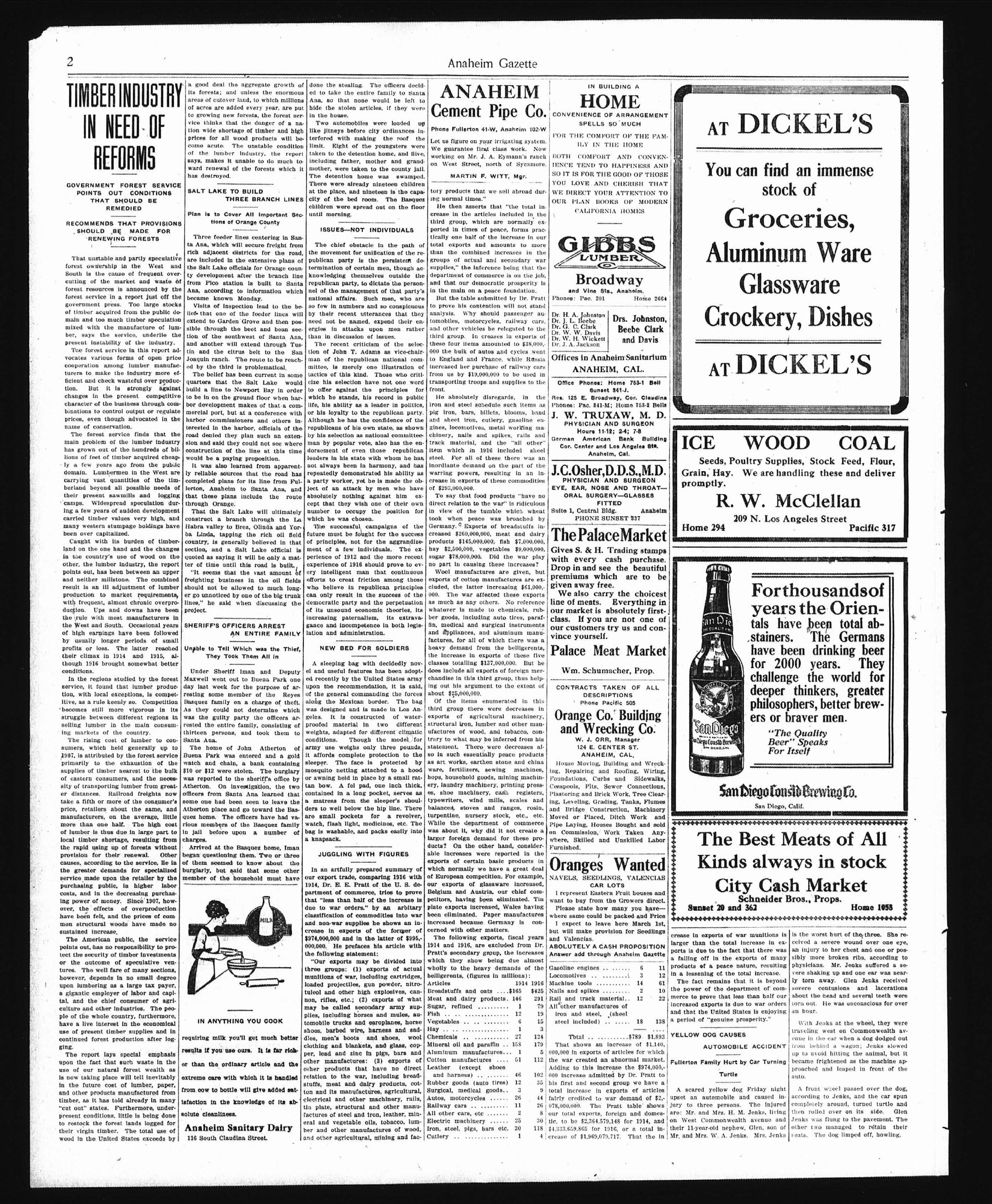
Searchable text
TIMBER INDUSTRY
IN NEED OF REFORMS
GOVERNMENT FOREST SERVICE POINTS OUT CONDITIONS THAT SHOULD BE REMEDIED
RECOMMENDS THAT PROVISIONS SHOULD BE MADE FOR RENEWING FORESTS
That unstable and partly speculative forest ownership in the West and South is the cause of frequent overcutting of the market and waste of forest resources is announced by the forest service in a report just off the government press. Too large stocks of timber acquired from the public domain and too much timber speculation mixed with the manufacture of lumber, says the service, underlie the present instability of the industry.
The forest service in this report advocates various forms of open price cooperation among lumber manufacturers to make the industry more efficient and check wasteful over production. But it is strongly against changes in the present competitive character of the business through combinations to control output or regulate prices, even though advocated in the name of conservation.
The forest service finds that the main problem of the lumber industry has grown out of the hundreds of bill-a good deal the aggregate growth of its forests; and unless the enormous areas of cutover land, to which millions of acres are added every year, are put to growing new forests, the forest service thinks that the danger of a nation wide shortage of timber and high prices for all wood products will become acute. The unstable condition of the lumber industry, the report says, makes it unable to do much toward renewal of the forests which it has destroyed.
SALT LAKE TO BUILD
THREE BRANCH LINES
Plan is to Cover All Important Sections of Orange County
Three feeder lines centering in Santa Ana, which will secure freight from rich adjacent districts for the road, are included in the extensive plans of the Salt Lake officials for Orange county development after the branch line from Pico station is built to Santa Ana, according to information which became known Monday.
Visits of inspection lead to the belief that one of the feeder lines will extend to Garden Grove and then possible through the beet and bean section of the southwest of Santa Ana, and another will extend through Tustin and the citrus belt to the San Joaquin ranch. The route to be reached by the third is problematical.
The belief has been current in some quarters that the Salt Lake would build a line to Newport Bay in order to be in on the ground floor when harbor development makes of that a commercial port, but at a conference with harbor commissioners and others interested in the harbor, officials of the road denied they plan such an extension and said they could not see where done the stealing. They ed to take the entire Ana, so that none hide the stolen artifact in the house.
Two automobiles like jitneys before or terfered with making limit. Eight of them taken to the detention including father, mother, were taken into the detention home. There were already at the place, and ninety city of the bed room children were spread until morning.
ISSUES—NOT I
The chief obstacle to the movement for urban publican party is the termination of certain knowledging themselves republican party, to enel of the management national affairs. Su so few in numbers as by their recent utter need not be named, ergies in attacks than in discussion of
The recent criticism of John T. Adler man of the republican mittee, is merely o tactics of this kind. size his selection ha to offer against ther which he stands, his life, his ability as a or his loyalty to ther Although he has ther republicans of his own by his selection as na man by popular vote
vocates various forms of open price cooperation among lumber manufacturers to make the industry more efficient and check wasteful over production. But it is strongly against changes in the present competitive character of the business through combinations to control output or regulate prices, even though advocated in the name of conservation.
The forest service finds that the main problem of the lumber industry has grown out of the hundreds of billions of feet of timber acquired cheaply a few years ago from the public domain. Lumbermen in the West are carrying vast quantities of the timberland beyond all possible needs of their present sawmills and logging camps. Widespread speculation during a few years of sudden development carried timber values very high, and many western stumpage holdings have been over capitalized.
Caught with its burden of timberland on the one hand and the changes in the country's use of wood on the other, the lumber industry, the report points out, has been between an upper and neither millstone. The combined result is an ill adjustment of lumber production to market requirements, with frequent, almost chronic overproduction. Ups and downs have been the rule with most manufacturers in the West and South. Occasional years of high earnings have been followed by usually longer periods of small profits or loss. The latter reached their climax in 1914 and 1915, although 1916 brought somewhat better conditions.
In the regions studied by the forest service, it found that lumber production, with local exceptions, is competitive, as a rule keenly so. Competition becomes still more vigorous in its struggle between different regions in selling lumber in the main consuming markets of the country.
The rising cost of lumber to consumers, which held generally up to 1967, is attributed by the forest service primarily to the exhaustion of the supplies of timber nearest to the bulk of eastern consumers, and the necessity of transporting lumber from greater distances. Railroad freights now take a fifth or more of the consumer's price, retailers about the same, and manufacturers, on the average, little more than one half. The high cost of lumber is thus due in large part to local timber shortage, resulting from the rapid using up of forests without
The belief has been current in some quarters that the Salt Lake would build a line to Newport Bay in order to be in on the ground floor when harbor development makes of that a commercial port, but at a conference with harbor commissioners and others interested in the harbor, officials of the road denied they plan such an extension and said they could not see where construction of the line at this time would be a paying proposition.
It was also learned from apparently reliable sources that the road has completed plans for its line from Fulerton, Anaheim to Santa Ana, and that these plans include the route through Orange.
That the Salt Lake will ultimately construct a branch through the La Habra valley to Brea, Olinda and Yorba Linda, tapping the rich oil field country, is generally believed in that section, and a Salt Lake official is quoted as saying it will be only a matter of time until this road is built.
"It seems that the vast amount of freighting business in the oil fields should not be allowed to much longer go unnoticed by one of the big trunk lines," he said when discussing the project.
SHERIFF'S OFFICERS ARREST AN ENTIRE FAMILY
Unable to Tell Which was the Thief, They Took Them All in
Under Sheriff Iman and Deputy Maxwell went out to Buena Park one day last week for the purpose of arresting some member of the Reyes Basquez family on a charge of theft. As they could not determine which was the guilty party the officers arrested the entire family, consisting of thirteen persons, and took them to Santa Ana.
The home of John Atherton of Buena Park was entered and a gold watch and chain, a bank containing $10 or $12 were stolen. The burglary was reported to the sheriff's office by Atherton. On investigation, the two officers from Santa Ana learned that some one had been seen to leave the Atherton place and go toward the Basquez home. The officers have had various members of the Basquez family in jail before upon a number of charges.
Arrived at the Basquez home, Iman
A sleeping bag with el and useful features; recently by the Un upon the recommendation of the general committee along the Mexican border was designed and is geles. It is construc proofed material in weights, adapted for conditions. Though army use weighs once it affords complete p sleeper. The face is mosquito netting attic or awning held in pla tan bow. A fel pad contained in a long p matress from there ders to well below tha are small pockets watch, flash light, me bag is washable, and a knapsack.
is attributed by the forest service primarily to the exhaustion of the supplies of timber nearest to the bulk of eastern consumers, and the necessity of transporting lumber from greater distances. Railroad freights now take a fifth or more of the consumer's price, retailers about the same, and manufacturers, on the average, little more than one half. The high cost of lumber is thus due in large part to local timber shortage, resulting from the rapid using up of forests without provision for their renewal. Other causes, according to the service, lie in the greater demands for specialized service made upon the retailer by the purchasing public, in higher labor costs, and in the decreasing purchasing power of money. Since 1907, however, the effects of overproduction have been felt, and the prices of common structural woods have made no sustained increase.
The American public, the service points out, has no responsibility to protect the security of timber investments or the outcome of speculative ventures. The well fare of many sections, however, depends in no small degree upon lumbering as a large tax payer, a gigantic employer of labor and capital, and the chief consumer of agriculture and other industries. The people of the whole country, furthermore, have a live interest in the economical use of present timber supplies and in continued forest production after logging.
The report lays special emphasis upon the fact that such waste in the use of our natural forest wealth as is now taking place will tell inevitably in the future cost of lumber, paper, and other products manufactured from timber, as it has told already in many "cut out" states. Furthermore, under-present conditions, little is being done to restock the forest lands logged for their virgin timber. The total use of wood in the United States exceeds by
IN ANYTHING YOU COOK
requiring milk you'll get much better results if you use ours. It is far richer than the ordinary article and the extreme care with which it is handled from cow to bottle will give added satisfaction in the knowledge of its absolute cleanliness.
Anaheim Sanitary Dairy
116 South Claudina Street.
Anaheim Gazette
done the stealing. The officers decided to take the entire family to Santa Ana, so that none would be left to hide the stolen articles, if they were in the house.
Two automobiles were loaded up like jitneys before city ordinances interfered with making the roof limit. Eight of the youngsters were taken to the detention home, and five, including father, mother and grandmother, were taken to the county jail. The detention home was swamped. There were already nineteen children at the place, and nineteen is the capacity of the bed room. The Basquez children were spread out on the floor until morning.
ISSUES—NOT INDIVIDUALS
The chief obstacle in the path of the movement for unification of the republican party is the persistent determination of certain men, though acknowledging themselves outside the republican party, to dictate the personnel of the management of that party's national affairs. Such men, who are so few in numbers and so conspicuous by their recent utterances that they need not be named, expend their energies in attacks upon men rather than in discussion of issues.
The recent criticism of the selection of John T. Adams as vice-chairman of the republican national committee, is merely one illustration of tactics of this kind. Those who criticize his selection have not one word to offer against the principles for which he stands, his record in public life, his ability as a leader in politics, or his loyalty to the republican party. Although he has the confidence of the republicans of his own state, as shown by his selection as national committee-man by popular vote, also has the endition to order him comwith in the tentenere.
ANAHEIM Cement Pipe Co.
Phone Fullerton 41-W, Anaheim 102-W
Let us figure on your irrigating system. We guarantee first class work. Now working on Mr. J. A. Eymann's ranch on West Street, north of Sycamore.
MARTIN F. WITT, Mgr.
tory products that we sell abroad during normal times."
He then asserts that "the total increase in the articles included in the third group, which are normally exported in times of peace, forms practically one half of the increase in our total exports and amounts to more than the combined increases in the groups of actual and secondary war supplies," the inference being that the department of commerce is on the job, and that our democratic prosperity is in the main on a peace foundation.
But the table submitted by Dr. Pratt to prove his contention will not stand analysis. Why should passenger automobiles, motorcycles, railway cars, and other vehicles be relegated to the third group. In creases in exports of these four items amounted to $38,000,000 the bulk of autos and cycles went to England and France, while Russia increased her purchase of railway cars from us by $19,000,000 to be used in transporting troops and supplies to the front.
He absolutely disregards, in the iron and steel schedule such items as pig iron, bars, billets, blooms, band and sheet iron, cutlery, gasoline engines, locomotives, metal working machinery, nails and spikes, rails and track material, and the "all other" items which have been included in this report.
IN BUILDING A HOME
CONVENIENCE OF ARRANGEMENT SPEELS SO MUCH
FOR THE COMFORT OF THE FAMILY IN THE HOME
EOTH COMFORT AND CONVENIENCE TEND TO HAPPINESS AND SO IT IS FOR THE GOOD OF THOSE YOU LOVE AND CHERISH THAT WE DIRECT YOUR ATTENTION TO OUR PLAN BOOKS OF MODERN CALIFORNIA HOMES
GIBBS LUMBER
Broadway and Vine Sts., Anaheim.
Phones: Pac. 201 Home 2664
Dr. H. A. Johnston
Dr. J. L. Beebe
Dr. G. C. Clark
Dr. W. W. Davis
Dr. W. H. Wickett
Dr. J. A. Jackson
Offices in Anaheim Sanitarium ANAHEIM, CAL.
Office Phones: Home 753-1 Bell Sunset 341-J.
Res. 125 E. Broadway, Cor. Claudina
Phones: Pac. 841-M; Home 753-2 Bells
J. W. TRUXAW, M. D.
PHYSICIAN AND SURGEON
Hours 11-12; 2-4; 7-8
German American Bank Building Cor. Center and Los Angeles Sts.
man of the republican national committee, is merely one illustration of tactics of this kind. Those who criticize his selection have not one word to offer against the principles for which he stands, his record in public life, his ability as a leader in politics, or his loyalty to the republican party. Although he has the confidence of the republicans of his own state, as shown by his selection as national committee-man by popular vote, also has the endorsement of even those republican leaders in his state with whom he has not always been in harmony, and has repeatedly demonstrated his ability as a party worker, yet he is made the object of an attack by men who have absolutely nothing against him except that they wish one of their own number to occupy the position for which he was chosen.
The successful campaigns of the future must be fought for the success of principles, not for the aggrandizement of a few individuals. The experience of 1912 and the more recent experience of 1916 should prove to every intelligent man that continuous efforts to creat friction among those who believe in republican principles can only result in the success of the democratic party and the perpetuation of its unsound economic theories, its increasing paternalism, its extravagance and incompetence in both legislation and administration.
NEW BED FOR SOLDIERS
A sleeping bag with decidedly novel and useful features has been adopted recently by the United States army upon the recommendation, it is said, of the general commanding the forces along the Mexican border. The bag was designed and is made in Los Angeles. It is constructed of waterproofed material in two different weights, adapted for different climatic conditions. Though the model for army use weighs only three pounds, it affords complete protection to the sleeper. The face is protected by mosquito netting attached to a hood or awning held in place by a small rattan bow. A fel pad, one inch thick, contained in a long pocket, serves as a mattress from the sleeper's shoulders to well below the hip line. There are small pockets for a revolver, watch, flash light, medicines, etc. The bag is washable, and packs easily into a knapsack.
He absolutely disregards, in the iron and steel schedule such items as pig iron, bars, billets, blooms, band and sheet iron, cutlery, gasoline engines, locomotives, metal working machinery, nails and spikes, rails and track material, and the "all other" item which in 1916 included steel steel. For all of these there was an inordiante demand on the part of the warring powers, resulting in an increase in exports of these commodities of $293,000,000.
To say that food products "have no direct relation to the war" is ridiculous in view of the tumble which wheat took when peace was broached by Germany. Exports of breadstuffs increased $260,000,000; meat and dairy products $145,000,000; fish $7,000,000; hay $2,500,000; vegetables $9,000,000; sugar $78,000,000. Did the war play no part in causing these increases?
Wool manufactures are given, but exports of cotton manufactures are excluded, the latter increasing $61,000.000. The war affected those exports as much as any others. No reference whatever is made to chemicals, rubber goods, including auto tires, paraffin, medical and surgical instruments and appliances, and aluminum manufactures, for all of which there was a heavy demand from the belligerents, the increase in exports of these five classes totalling $137,000,000. But he does include all exports of foreign merchandise in this third group, thus helping out his argument to the extent of about $25,000,000.
Of the items enumerated in this third group there were decreases in exports of agricultural machinery, structural iron, lumber and other manufactures of wood, and tobacco, contrary to what may be inferred from his statement. There were decreases also in such essentially peace products as art works, earthen stone and china ware, fertilizers, sewing machines, hops, household goods, mining machinery, laundry machinery, printing presses, shoe machinery, cash registers, typewriters, wind mills, scales and balanced stoves and ranges, rosin, turpentine, nursery stock, etc., etc. While the department of commerce was about it, why did it not create a larger foreign demand for these products? On the other hand, consider-
Offices in Anaheim Sanitarium
ANAHEIM, CAL.
Office Phones: Home 753-1 Bell Sunset 341-J.
Res. 125 E. Broadway, Cor. Claudina Phones: Pac. 341-M; Home 753-2 Bells
J. W. TRUXAW, M. D.
PHYSICIAN AND SURGEON
Hours 11-12; 2-4; 7-8
German American Bank Building
Cor. Center and Los Angeles St.
Anaheim, Cal.
J.C.Osher,D.D.S.,M.D.
PHYSICIAN AND SURGEON
EYE, EAR, NOSE AND THROAT—ORAL SURGERY—GLASSES FITTED
Suite 1, Central Bldg.
Anaheim
PHONE SUNSET 337
The PalaceMarket
Gives S. & H. Trading stamps with every cash purchase. Drop in and see the beautiful premiums which are to be given away free.
We also carry the choicest line of meats. Everything in our market is absolutely first-class. If you are not one of our customers try us and convince yourself.
Palace Meat Market
Wm. Schumacher, Prop.
CONTRACTS TAKEN OF ALL DESCRIPTIONS
Phone Pacific 505
Orange Co. Building and Wrecking Co.
W. J. ORR, Manager
124 E. CENTER ST.
ANAHEIM, CAL.
House Moving, Building and Wrecking,
Repairing and Roofing, Wiring,
Foundations, Curbs and Sidewalks,
Cesspools, Plits, Sewer Connections,
Plastering and Brick Work, Tree Clearing,
Leveling, Grading, Tanks, Flumes and Bridge Construction,
Machinery Moved or Placed, Ditch Work and Pipe Laying,Houses Bought and sold on Commission,Work Taken Anywhere,Skilled and Unskilled Labor Furnished。
JUGGLING WITH FIGURES
In an artfully prepared summary of our export trade, comparing 1916 with 1914, Dr. E. E. Pratt of the U. S. department of commerce, tries to prove that "less than half of the increase is due to war orders." by an arbitrary classification of commodities into war and non-war supplies he shows an increase in exports of the former of $974,000,000 and in the latter of $995,000,000. He prefaces his article with the following statement:
"Our exports may be divided into three groups: (1) exports of actual munitions of war, including cartridges, loaded projectiles, gun powder, nitro-tuleol and other high explosives, cannon, rifles, etc.; (2) exports of what may be called secondary army supplies, including horses and mules, automobile trucks and earoplanes, horse shoes, barbed wire, harness and saddles, men's boots and shoes, wool clothing and blankets, and glass, copper, lead and zinc in pigs, bars and other manufactures; (3) exports of other products that have no direct relation to the war, including breadstuffs, meat and dairy products, cotton and its manufactures, agricultural, electrical and other machinery, rails, tin plate, structural and other manufactures of steel and iron, leather, mineral and vegetable oils, tobacco, lumber and other manufactures of wood, and other agricultural, mining and facial works.
In artfully prepared summary of our export trade, comparing 1916 with 1914, Dr. E. E. Pratt of the U. S. department of commerce, tries to prove that "less than half of the increase is due to war orders." by an arbitrary classification of commodities into war and non-war supplies he shows an increase in exports of the former of $974,000,000 and in the latter of $995,000,000. He prefaces his article with the following statement:
"Our exports may be divided into three groups: (1) exports of actual munitions of war, including cartridges, loaded projectiles, gun powder, nitro-tuleol and other high explosives, cannon, rifles, etc.; (2) exports of what may be called secondary army supplies, including horses and mules, automobile trucks and earoplanes, horse shoes, barbed wire, harness and saddles, men's boots and shoes, wool clothing and blankets, and glass, copper, lead and zinc in pigs, bars and other manufactures; (3) exports of other products that have no direct relation to the war, including breadstuffs, meat and dairy products, cotton and its manufactures, agricultural, electrical and other machinery, rails, tin plate, structural and other manufactures of steel and iron, leather, mineral and vegetable oils, tobacco, lumber and other manufactures of wood, and other agricultural, mining and facial works."
On an artfully prepared summary of our export trade, comparing 1916 with 1914, Dr. E. E. Pratt of the U. S. department of commerce tries to prove that "less than half of the increase is due to war orders." by an arbitrary classification of commodities into war and non-war supplies he shows an increase in exports of the former of $974,000,000 and in the latter of $995,000,000. He prefaces his article with the following statement:
"Our exports may be divided into three groups: (1) exports of actual munitions of war, including cartridges, loaded projectiles, gun powder, nitro-tuleol and other high explosives, cannon, rifles, etc.; (2) exports of what may be called secondary army supplies, including horses and mules, automobile trucks and earoplanes, horse shoes, barbed wire, harness and saddles, men's boots and shoes, wool clothing and blankets, and glass, copper, lead and zinc in pigs, bars and other manufactures; (3) exports of other products that have no direct relation to the war,..."
The following exports fiscal years 1914 and 1916 are excluded from Dr. Pratt's secondary group; the increases which they show being due almost wholly to the heavy demands of the belligerents (figures in millions):
Articles 1914-1916
Breadstuffs and oats ...$165 ...$425
Meat and dairy products...146 ...291
Sugar...refined ...1 ...79
Fish ...12 ...19
Vegetables ...6 ...15
Hay ...1 ...3
Chemicals ...27 ...124
Mineral oil and paraffin ...158 ...179
Aluminum manufactures...1 ...5
Cotton manufactures ...51 ...112
Leather (except shoes and harness) ...46 ...102
Rubber goods (auto tires) ...12 ...35
Surgical medical goods...3 ...9
Autos motorcycles ...26 ...44
Railway cars ...11 ...26
All other cars etc...2 ...8
Electric machinery ...25 ...30
Iron steel pigs bars etc...30 ...118
Cutlery ...1 ...4
House Moving Building and Wrecking Repairing and Roofing Wirling Foundations Curbs and Sidewalks Cesspools Plits Sewer Connections Plastering and Brick Work Tree Clearing Leveling Grading Tanks Flumes and Bridge Construction Machinery Moved or Placed Ditch Work and Pipe Laying Houses Bought and sold on Commission Work Taken Anywhere Skilled Unskilled Labor Furnished.
Oranges Wanted
NAVELS SEEDLINGS VALENCIAS CAR LOTS
I represent Eastern Fruit houses and want to buy from the Growers direct.
Please state how many you have—where same could be packed and Price I expect to leave here March 1st but will make provision for Seedlings and Valencias.
ABOLUTELY A CASH PROPOSITION Answer add through Anaheim Gazette
Gasoline engines ...6 11
Locomotives ...3 12
Machine tools ...14 61
Nails and spikes ...2 12
Rail and track material...12 22
All other manufactures of iron and steel (sheel steel included) ...18 138
Total ...$789 $1,893
That shows an increase of $1,140,
000,000 in exports of articles for which the war created an abnormal market.
Adding to this increase the $974,000000 increase admitted by Dr. Pratt to his first and second group we have a total increase in exports of articles fairly credited to war demand of $2,
078,000,000. The Pratt table shows our total exports foreign and domestic to be $2,$364,$79,$148 for 1914,and $4,$333,$659,$865 for 1916,或 a total increase of $1,$969,$079,$717. That the in
AT DICKEL'S
You can find an immense stock of
Groceries,
Aluminum Ware
Glassware
Crockery, Dishes
AT DICKEL'S
ICE WOOD COAL
AT DICKEL'S
ICE WOOD COAL
Seeds, Poultry Supplies, Stock Feed, Flour,
Grain, Hay. We are handling these and deliver promptly.
R. W. McClellan
209 N. Los Angeles Street
Home 294 Pacific 317
Forthousandsof years the Orientals have been total abstainers. The Germans have been drinking beer for 2000 years. They challenge the world for deeper thinkers, greater philosophers, better brewers or braver men.
"The Quality Beer" Speaks For Itself
San Diego Consid Brewing Co.
San Diego, Calif.
The Best Meats of All
The Best Meats of All Kinds always in stock
City Cash Market
Schneider Bros., Props.
Sunset 20 and 362
Home 1053
in exports of war munitions is larger than the total increase in exports is due to the fact that there was a falling off in the exports of many products of a peace nature, resulting in a lessening of the total increase.
The fact remains that it is beyond the power of the department of commerce to prove that less than half our increased exports is due to war orders and that the United States is enjoying a period of "genuine prosperity."
YELLOW DOG CAUSES
AUTOMOBILE ACCIDENT
Fullerton Family Hurt by Car Turning Turtle
A scared yellow dog Friday night upset an automobile and caused injury to three persons. The injured are: Mr. and Mrs. H. M. Jenks, living on West Commonwealth avenue and their 11-year-old nephew, Glen, son of Mr. and Mrs. W. A. Jenks. Mrs. Jenks is the worst hurt of the three. She received a severe wound over one eye, an injury to her chest and one or possibly more broken ribs, according to physicians. Mr. Jenks suffered a severe shaking up and one ear was nearly torn away. Glen Jenks received severe contusions and lacerations about the head and several teeth were torn out. He was unconscious for over an hour.
With Jenks at the wheel, they were traveling west on Commonwealth avenue in the car when a dog dodged out from behind a wagon; Jenks slowed up to avoid hitting the animal, but it became frightened as the machine approached and leaped in front of the auto.
A front wheel passed over the dog, according to Jenks, and the car spun completely around, turned turtle and then rolled over on its side. Glen Jenks was flung to the pavement. The other two managed to retain their seats. The dog limped off, howling.