anaheim-gazette 1917-01-04
Scanned page
Searchable text
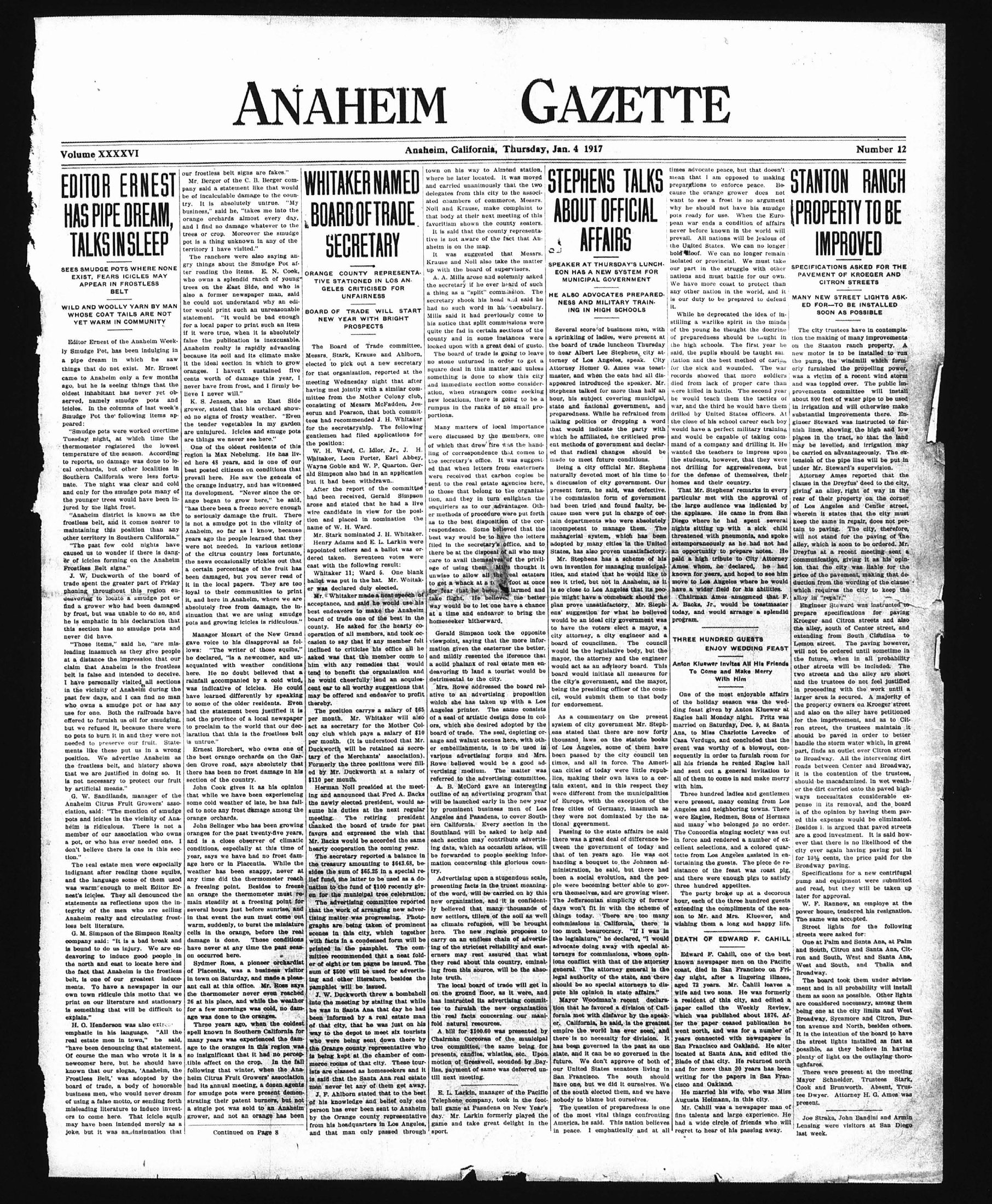
EDITOR ERNEST
HAS PIPE DREAM,
TALKS IN SLEEP
SEES SMUDGE POTS WHERE NONE EXIST, FEARS ICICLES MAY APPEAR IN FROSTLESS BELT
WILD AND WOOLLY YARN BY MAN WHOSE COAT TAILS ARE NOT YET WARM IN COMMUNITY
Editor Ernest of the Anaheim Weekly Smudge Pot, has been indulging in a pipe dream in which he saw things that do not exist. Mr. Ernest came to Anaheim only a few months ago, but he is seeing things that the oldest inhabitant has never yet observed, namely smudge pots and icicles. In the columns of last week's Smudge Pot the following items appeared:
"Smudge pots were worked overtime Tuesday night, at which time the thermometer registered the lowest our frostless belt signs are fakes."
Mr. Berger of the C. B. Berger company said a statement like that would be of incalculable damage to the country. It is absolutely untrue. "My business," said he, "takes me into the orange orchards almost every day, and I find no damage whatever to the trees or crop. Moreover the smudge pot is a thing unknown in any of the territory I have visited."
The ranchers were also saying angry things about the Smudge Pot after reading the items. E. N. Cook, who owns a splendid ranch of young trees on the East Side, and who is also a former newspaper man, said he could not understand why an editor would print such an unreasonable statement. "It would be bad enough for a local paper to print such an item if it were true, when it is absolutely false the publication is inexcusable. Anaheim realty is rapidly advancing because its soil and its climate make it the ideal section in which to grow oranges. I haven't sustained five cents worth of damage this year, I never have from frost, and I firmly believe I never will."
K. S. Jensen, also an East Side grower, stated that his orchard showed no signs of frosty weather. "Even the tender vegetables in my garden are uninjured. Iicicles and smudge pots are things we never see here."
One of the oldest residents of this
a pipe dream in which he saw things that do not exist. Mr. Ernest came to Anaheim only a few months ago, but he is seeing things that the oldest inhabitant has never yet observed, namely smudge pots and icicles. In the columns of last week's Smudge Pot the following items appeared:
"Smudge pots were worked overtime Tuesday night, at which time the thermometer registered the lowest temperature of the season. According to reports, no damage was done to local orchards, but other localities in Southern California were less fortunate. The night was clear and cold and only for the smudge pots many of the younger trees would have been injured by the light frost.
"Anaheim district is known as the frostless belt, and it comes nearer to maintaining this position than any other territory in Southern California."
"The past few cold nights have caused us to wonder if there is danger of icicles forming on the Anaheim Frostless Belt signs."
J. W. Duckworth of the board of trade spent the greater part of Friday phoning throughout this region endeavoring to locate a smudge pot or find a grower who had been damaged by frost, but was unable to do so, and he is emphatic in his declaration that this section has no smudge pots and never did have.
"Those items," said he, "are misleading inasmuch as they give people at a distance the impression that our claim that Anaheim is the frostless belt is false and intended to deceive. I have personally visited all sections in the vicinity of Anaheim during the past few days, and I can find no man who owns a smudge pot or has any use for one. Both the railroads have offered to furnish us oil for smudging, but we refused it, because there were no pots to burn it in and they were not needed to preserve our fruit. Statements like these put us in a wrong position. We advertise Anaheim as the frostless belt, and history shows that we are justified in doing so. It is not necessary to protect our fruit by artificial means."
G. W. Sandilands, manager of the Anaheim Citrus Fruit Growers' association, said: "The mention of smudge pots and icicles in the vicinity of Anaheim is ridiculous. There is not a member of our association who owns a pot, or who has ever needed one. I don't believe there is one in this section because its soil and its climate make it the ideal section in which to grow oranges. I haven't sustained five cents worth of damage this year, I never have from frost, and I firmly believe I never will."
K. S. Jensen, also an East Side grower, stated that his orchard showed no signs of frosty weather. "Even the tender vegetables in my garden are uninjured. Icicles and smudge pots are things we never see here."
One of the oldest residents of this region is Max Nebelung. He has lived here 48 years, and is one of our best posted citizens on conditions that prevail here. He saw the genesis of the orange industry, and has witnessed its development. "Never since the orange began to grow here," he said, "has there been a freeze severe enough to seriously damage the fruit. There is not a smudge pot in the vintery of Anaheim, so far as I know, because years ago the people learned that they were not needed. In various setions of the citrus country less fortunate, the news occasionally trickle out that a certain percentage of the fruit has been damaged, but you never read of it in the local papers. They are too loyal to their communities to print it, and here in Anaheim, where we are absolutely free from damage, the insination that we are using smudge pots and growing icicles is ridiculous."
Manager Mozart of the New Grand gave voice to his disapproval as follows: "The writer of those squibs," he declared, "is a newcomer, and unacquainted with weather conditions here. He no doubt believed that a rainfall accompanied by a cold wind, was indicative of icicles. He could have learned differently by speaking to some of the older residents. Even had the statement been justified it is not the province of a local newspaper to proclaim to the world that our declaration that this is the frostless belt is untrue."
Ernest Borchert, who owns one of the best orange orchards on the Garden Grove road, says absolutely that there has been no frost damage in his section of the country.
John Cook gives it as his opinion that while we have been experiencing some cold weather of late, he has failed to note any frost damage among the orange orchards.
John Selinger who has been growing oranges for the past twenty-five years, and is a close observer of climatic conditions, especially at this time of Messrs. Stark, Krause elected to pick out for that organization, meeting Wednesday having met jointly with mittee from the Motion consisting of Messrs. Serun and Pearson, thetees had recommended for the secretaryship gentlemen had filed the position:
W. H. Ward, C. H. Whitaker, Leon Porter Wayne Goble and W. Ald Simpson also had but it had been with After the report oad been received, arose and stated tha wire candidate in viition and placed in name of W. H. Ward Mr. Stark nominated Henry Adams and appointed tellers and dered taken. Seven cast with the followi Whitaker 11; War ballot was put in ther was declared duly Mr. Whitaker made acceptance, and said best endeavors to mboard of trade one county. He asked f operation of all mem casion to say that if inclined to criticise asked was that tha him with any remem tend to benefit tha he would cheerfully cent ear to all worthy may be offered and thereby.
The position carry per month. Mr. W act as secretary formony club which pay per month. (It is un Duckworth will be n tary of the Mercha Formerly the three p ed by Mr. Duckwort $110 per month.
Herman Noll presi ng and announced tha newly elected pr sume his duties at meeting. The re thanked the board favors and express Mr. Backs would be hearty cooperation t
We advertise Anaheim as the frostless belt, and history shows that we are justified in doing so. It is not necessary to protect our fruit by artificial means."
G. W. Sandilands, manager of the Anaheim Citrus Fruit Growers' association, said: "The mention of smudge pots and icicles in the vicinity of Anaheim is ridiculous. There is not a member of our association who owns a pot, or who has ever needed one. I don't believe there is one in this section."
The real estate men were especially indignant after reading those squibs, and the language some of them used was warm enough to melt Editor Ernest's icicles. They all denounced the statements as reflections upon the integrity of the men who are selling Anaheim realty and circulating frostless belt literature.
G. M. Simpson of the Simpson Realty company said: "It is a bad break and is bound to do us injury. We are endeavoring to induce good people in the north and east to locate here and the fact that Anaheim is the frostless belt, is one of our greatest inducements. To have a newspaper in our own town ridicule this motto that we print on our literature and stationary is something that will be difficult to explain."
H. O. Henderson was also extremely emphatic in his language. "All the real estate men in town," he said, "have been denouncing that statement. Of course the man who wrote it is a newcomer here, but he should have known that our slogan, 'Anaheim, the Frostless Belt,' was adopted by the board of trade, a body of honorable business men, who would never dream of using a false motto, or sending forth misleading literature to induce investors to come here. That icicle squib may have been intended merely as a joke, but it was an insinuation that John Cook gives it as his opinion that while we have been experiencing some cold weather of late, he has failed to note any frost damage among the orange orchards.
John Selinger who has been growing oranges for the past twenty-five years, and is a close observer of climatic conditions, especially at this time of year, says we have had no frost damage here or in Placentia. While the weather has been snappy, never at any time did the thermometer reach a freezing point. Besides to freeze an orange the thermometer must remain steadily at a freezing point for several hours just before sunrise, and in that event the sun must come out warm, suddenly, to burst the miniature cells in the orange, before the real damage is done. Those conditions have never at any time the past season occurred here.
Sydmer Ross, a pioneer orchardist of Placentia, was a business visitor in town on Saturday, and made a pleasant call at this office. Mr. Ross says the thermometer never even reached 26 at his place, and while the weather for a few mornings was cold, no damage was done to the oranges.
Three years ago, when the coldest spell known in Southern California for many years was experienced the damage to the oranges in this region was so insignificant that it had no perceptible effect on the crop. In the fall following that winter, when the Anaheim Citrus Fruit Growers' association had its annual meeting, a dozen agents for smudge pots were present demonstrating their patent burners, but not a single pot was sold to an Anaheim grower, and not an orange has been
Continued on Page 8
NAHEIM GAZETTE
Anaheim, California, Thursday, Jan. 4 1917
WHITAKER NAMED BOARD OF TRADE SECRETARY
ORANGE COUNTY REPRESENTATIVE STATIONED IN LOS ANGELES CRITICISED FOR UNFAIRNESS
BOARD OF TRADE WILL START NEW YEAR WITH BRIGHT PROSPECTS
The Board of Trade committee, Messrs. Stark, Krause and Ahlborn, elected to pick out a new secretary for that organization, reported at the meeting Wednesday night that after having met jointly with a similar committee from the Mother Colony club, consisting of Messrs McFadden, Jeserun and Pearson, that both committees had recommended J. H. Whitaker for the secretarialship. The following gentlemen had filed applications for the position:
town on his way to Almond station, where he later located. It was moved and carried unanimously that the two delegates from this city to the associated chambers of commerce, Messrs. Noll and Krause, make complaint to that body at their next meeting of this favoritism shown the county seaters.
It is said that the county representative is not aware of the fact that Anaheim is on the map.
It was suggested that Messrs. Krause and Noll also take the matter up with the board of supervisors.
A. A. Mills arose and solemnly asked the secretary if he ever heard of such a thing as a "split" commission. The secretary shook his head and said he had no such word in his vocabulary. Mills said it had previously come to his notice that split commissions were quite the fad in certain sections of the county and in some instances were looked upon with a great deal of gusto.
The board of trade is going to leave no stone unturned in order to get a square deal in this matter and unless something is done to show this city and immediate section some consideration, when strangers come seeking new locations, there is going to be a rumpus in the ranks of no small proportions.
Many matters of local importance were discussed by the members, one of which that drew fire was the hand-
STEPHENS TALKS ABOUT OFFICIAL AFFAIRS
SPEAKER AT THURSDAY'S LUNCH-EON HAS A NEW SYSTEM FOR MUNICIPAL GOVERNMENT
HE ALSO ADVOCATES PREPAREDNESS AND MILITARY TRAINING IN HIGH SCHOOLS
Several score of business men, with a sprinkling of ladies, were present at the board of trade luncheon Thursday to hear Albert Lee Stephens, city attorney of Los Angeles, speak. City Attorney Homer G. Ames was toast-master, and when the eats had all disappeared introduced the speaker. Mr. Stephens talked for more than half an hour, his subject covering municipal, state and national government, and preparedness. While he refrained from talking politics or dropping a word that would indicate the party with which he affiliated, he criticised methods of government and declared times advocating preparation cause the want to say why he should pots ready pean war never before prevail.
Athe United hold loof. isolated on our part nations and We have any other is our duty it.
While he stilling a of the you of prepare the high said, the petition and for the slim records s died from were killed he would war, and the drilled by the close would have wand of a
Messrs. Stark, Krause and Aniborn, elected to pick out a new secretary for that organization, reported at the meeting Wednesday night that after having met jointly with a similar committee from the Mother Colony club, consisting of Messrs McFadden, Jeserun and Pearson, that both committees had recommended J. H. Whitaker for the secretaryship. The following gentlemen had filed applications for the position:
W. H. Ward, C. Idlor, Jr., J. H. Whitaker, Leon Porter, Earl Abbey, Wayne Goble and W. P. Quarton. Gerald Simpson also had in an application but it had been withdrawn.
After the report of the committee had been received, Gerald Simpson arose and stated that he had a live candidate in view for the position and placed in nomination the name of W. H. Ward.
Mr. Stark nominated J. H. Whitaker.
Henry Adams and E. L. Larkin were appointed tellers and a ballot was ordered taken. Seventeen votes were cast with the following result:
Whitaker 11; Ward 5. One blank ballot was put in the hat. Mr. Whitaker was declared duly elected.
Mr. Whitaker made a neat speech of acceptance, and said he would use his best endeavors to make the Anaheim board of trade one of the best in the county. He asked for the hearty cooperation of all members, and took occasion to say that if any member felt inclined to criticise his office all he asked was that the member come to him with any remedies that would tend to benefit the organization and he would cheerfully lend an acquiescent ear to all worthy suggestions that may be offered and endeavor to profit thereby.
The position carries a salary of $65 per month. Mr. Whitaker will also act as secretary for the Mother Colony club which pays a salary of $10 per month. (It is understood that Mr. Duckworth will be retained as secretary of the Merchants' association). Formerly the three positions were filled by Mr. Duckworth at a salary of $110 per month.
Herman Noll presided at the meeting and announced that Fred A. Backs the newly elected president, would assume his duties at the next regular meeting. The retiring president thanked the board of trade for past favors and expressed the wish that Mr. Backs would be accorded the same hearty cooperation the coming year.
The board of trade is going to leave no stone unturned in order to get a square deal in this matter and unless something is done to show this city and immediate section some consideration, when strangers come seeking new locations, there is going to be a rumpus in the ranks of no small proportions.
Many matters of local importance were discussed by the members, one of which that drew fire was the handling of correspondence that comes to the secretary's office. It was suggested that when letters from easterners were received that carbon copies be sent to the real estate agencies here, to those that belong to the organization, and they in turn enlighten the enquiriers as to our advantages. Other methods of procedure were put forth as to the best disposition of the correspondence. Some believed that the best way would be to have the letters filed in the secretary's office, and to there be at the disposal of all who may care to avail themselves of the privilege of using them. Mike thought it unwise to allow all the real estates to get a whack at a time foot at once for fear that he beats clammed and take flight. He believed: the better way would be to let one have a chance at a time and endeavor to bring the homeseeker hitherward.
Gerald Simpson took the opposite viewpoint, saying that the more information given the easterner the better, and mildly resented the ifference that a solid phalanx of real estate men endeavoring to land a tourist would be detrimental to the city.
Mrs. Rowe addressed the board relative to an advertising proposition which she has taken up with a Los Angeles printer. The same consists of a seal of artistic design done in colors, which she desired adopted by the board of trade. The seal depicting orange and walnut scenes here, with other embellishments, is to be used in various advertising forms and Mrs. Rowe believed would be a good advertising medium. The matter was referred to the advertising committee.
A. B. McCord gave an interesting outline of an advertising program that will be launched early in the new year by prominent business men of Los Angeles and Pasadena, to cover Southern California. Every section in the Southland will be asked to help and each section may contribute advertising data, which as occasion arises, will
City Attorney Homer G. Ames was toothmaster, and when the eats had all disappeared introduced the speaker. Mr. Stephens talked for more than half an hour, his subject covering municipal, state and national government, and preparedness. While he refrained from talking politics or dropping a word that would indicate the party with which he affiliated, he criticised present methods of government and declared that radical changes should be made to meet future conditions.
Being a city official Mr. Stephens naturally devoted most of his time to a discussion of city government. Our present form, he said, was defective. The commission form of government had been tried and found faulty, because men were put in charge of certain departments who were absolutely incompetent to manage them. The managerial system, which has been adopted by many cities in the United States, has also proven unsatisfactory.
Mr. Stephens has a scheme of his own invention for managing municipalities, and stated that he would like to see it tried, but not in Anaheim, as it is so close to Los Angeles that its people might have a comeback should the plan prove unsatisfactory. Mr. Stephens' suggestion for what he believed would be an ideal city government was to have the voters elect a mayor, a city attorney, a city engineer and a board of councilmen. The council would be the legislative body, but the mayor, the attorney and the engineer would act as an advisory board. This board would initiate all measures for the city's government, and the mayor, being the presiding officer of the council, would submit them to that body for endorsement.
As a commentary on the present system of city government Mr. Stephens stated that there are now forty thousand laws on the statute books of Los Angeles, some of them have been passed by the city council ten times, and all in force. The American cities of today were little republics, making their own laws to a certain extent, and in this respect they were different from the municipalities of Europe, with the exception of the free cities of Germany, inasmuch as they were not dominated by the national government.
Passing to the state affairs he said there was a great deal of difference between the government of today and
Formerly the three positions were filled by Mr. Duckworth at a salary of $110 per month.
Herman Noll presided at the meeting and announced that Fred A. Backs the newly elected president, would assume his duties at the next regular meeting. The retiring president thanked the board of trade for past favors and expressed the wish that Mr. Backs would be accorded the same hearty cooperation the coming year.
The secretary reported a balance in the treasury amounting to $643.68, besides the sum of $65.25 in a special relief fund, the latter to be used as a donation to the fund of $100 recently given for the municipal tree celebration:
The advertising committee reported that the work of arranging new advertising matter was progressing. Photographs are being taken of prominent scenes in this city, which together with facts in a condensed form will be printed in the pamphlet. The committee recommended that a neat folder of eight or ten pages be issued. The sum of $500 will be used for advertising and other literature, besides the pamphlet will be issued.
J. W. Duckworth threw a bombshell into the meeting by stating that while he was in Santa Ana that day he had been informed by a real estate man of that city, that he was just on his way to the depot to meet six tourists who were being sent down there by the Orange county representative who is being kept at the chamber of commerce rooms of that city. These tourists are classed as homeseekers and it is said that the Santa Ana real estate men never let any of them get away.
J. F. Ahlborn stated that to the best of his knowledge and belief only one person has ever been sent to Anaheim by the Orange county representative from his headquarters in Los Angeles, and that man only passed through various advertising forms and Mrs. Rowe believed would be a good advertising medium. The matter was referred to the advertising committee.
A. B. McCord gave an interesting outline of an advertising program that will be launched early in the new year by prominent business men of Los Angeles and Pasadena, to cover Southern California. Every section in the Southland will be asked to help and each section may contribute advertising data, which as occasion arises, will be forwarded to people seeking information concerning this glorious country.
Advertising upon a stupendous scale, presenting facts in the truest meaning of the word, will be carried on by this new organization, and it is confidently believed that many thousands of new settlers, tillers of the soil as well as climate refugees, will be brought here. The new regime proposes to carry on an endless chain of advertising of the strictest reliability and easternness may rest assured that what they read about this country, eminating from this source, will be the absolute truth.
The local board of trade will get in on the ground floor, as it were, and has instructed its advertising committee to furnish the new organization the real facts concerning our manifold natural resources.
A bill for $100.60 was presented by Chairman Corcoran of the municipal tree committee, the same being for presents, candles, whistles, etc. Upon motion of Gresswell, seconded by Bayliss, payment of same was deferred until next meeting.
E. L. Larkin, manager of the Pacific Telephone company, took in the football game at Pasadena on New Year's day. Mr. Larkin formerly played the game and take great delight in the sport.
Mayor Woodman's recent declaration that he favored a division of California met with disfavor by the speaker. California, he said, is the greatest empire the world has ever seen, and there is no necessity for division. It has been governed in the past as one state, and it can be so governed in the future. We don't approve of both of our United States senators living in San Francisco. The south should have one, but we did it ourselves. We of the south elected them, and we have nobody to blame but ourselves.
The question of preparedness is one of the most vital things confronting America, he said. This nation believes in peace. I emphatically and at all
TALKS
OFFICIAL
S
DAY'S LUNCH
STEM FOR
ERNMENT
S PREPAREDR Y TRAINSCHOOLS
ness men, with
here present at
meon Thursday
aphens, city attspeak. City
ses was toastats had all disspeaker. Mr.
we than half an
ing municipal,
government, and
refrained from
tapping a word
the party with
criticised presenent and declar-
times advocate peace, but that doesn't mean that I am opposed to making preparations to enforce peace. Because the orange grower does not want to see a frost is no argument why he should not have his smudge pots ready for use. When the European war ends a condition of affairs never before known in the world will prevail. All nations will be jealous of the United States. We can no longer hold loof. We can no longer remain isolated or provincial. We must take our part in the struggle with other nations and must battle for our own. We have more coast to protect than any other nation in the world, and it is our duty to be prepared to defend it.
While he deprecated the idea of instilling a warlike spirit in the minds of the young he thought the doctrine of preparedness should be taught in the high schools. The first year he said, the pupils should be taught sanitation and the best method of caring for the sick and wounded. The war records showed that more soldiers died from lack of proper care than were killed in battle. The second year he would teach them the tactics of war, and the third he would have them drilled by United States officers. At the close of his school career each boy would have a perfect military training and would be capable of taking command of a company and drilling it. He
STANTON RANCH
PROPERTY TO BE IMPROVED
SPECIFICATIONS ASKED FOR THE PAVEMENT OF KROEGER AND CITRON STREETS
MANY NEW STREET LIGHTS ASKED FOR—TO BE INSTALLED SOON AS POSSIBLE
The city trustees have in contemplation the making of many improvements on the Stanton ranch property. A new motor is to be installed to run the pump, the windmill which formerly furnished the propelling power, was a victim of a recent wind storm and was toppled over. The public improvements committee will install about 800 feet of water pipe to be used in irrigation and will otherwise make substantial improvements there. Engineer Steward was instructed to furnish lines, showing the high and low places in the tract, so that the land may be levelled, and irrigation may
Mr. Stephens of his time to government. Our was defective of government and faulty, be charge of cer were absolutely them. The which has been in the United unsatisfactory scheme of his aging municipal would like to Anaheim, as it does that its peo back should the city. Mr. Stephen that he believed government was act a mayor, a engineer and a council body, but the engineer and a secretary board. This all measures for and the mayor, officer of the council to that body
in the present moment Mr. Stephen are now forty statute books of them have quality council tenance. The Ameriere little republic laws to a cerais respect they municipalities exception of the city, inasmuch as acted by the naffairs he said of difference be of today and
the pupils should be taught station and the best method of caring for the sick and wounded. The war records showed that more soldiers died from lack of proper care than were killed in battle. The second year he would teach them the tactics of war, and the third he would have them drilled by United States officers. At the close of his school career each boy would have a perfect military training and would be capable of taking command of a company and drilling it. He wanted the teachers to impress upon the students, however, that they were not drilling for aggressiveness, but for the defense of themselves, their homes and their country.
That Mr. Stephena' remarks in every particular met with the approval of the large audience was indicated by the applause. He came in from San Diego where he had spent several nights sitting up with a sick child threatened with pneumonia, and spoke extemporaneously as he had not had an opportunity to prepare notes. He paid a high tribute to City Attorney Ames whom, he declared, he had known for years, and hoped to see him move to Los Angeles where he would have a wider field for his abilities.
Chairman Ames announced that F. A. Backs, Jr., would be toastmaster today, and would arrange a splendid program.
THREE HUNDRED GUESTS ENJOY WEDDING FEAST
Anton Kluewer Invites All His Friends To Come and Make Merry With Him
One of the most enjoyable affairs of the holiday season was the wedding feast given by Anton Kluewer at Eagles hall Monday night. Fritz was married on Saturday, Dec. 9, at Santa Ana, to Miss Charlotte Levecke of Casa Verdugo, and concluded that the event was worthy of a blowout, consequently in order to furnish room for all his friends he rented Eagles hall and sent out a general invitation to all of them to come in and make merry with him.
Three hundred ladies and gentlemen were present, many coming from Los Angeles and neighboring towns. There were Eagles, Redmen, Sons of Herman and many who belonged to no order. The Concordia singing society was out in force and rendered a number of excellent selections, and a colored quar-
affairs he said of difference be- t of today and. He was not the Johnson ad- but there had been, and the peo- tter able to gov- erning wiser.plicity of former scheme of are too manyornia, there is. "If I was in declared, 'I would with special attnns, whose opin- of the attorney general is the estate, and there attorneys to dis- sitate affairs."
Recent declara- division of Cali- bor by the speak- is the greatest ever seen, and for division. It the past as one governed in the grove of both of nators living in south should sit ourselves. We them, and we have ourselves.
Sharedness is one things confronting nation believes really and at all sequently in order to furnish room for all his friends he rented Eagles hall and sent out a general invitation to all of them to come in and make merry with him.
Three hundred ladies and gentlemen were present, many coming from Los Angeles and neighboring towns. There were Eagles, Redmen, Sons of Herman and many who belonged to no order. The Concordia singing society was out in force and rendered a number of exe- lent selections, and a colored quartette from Los Angeles assisted in entertaining the guests. The piece de resistance of the feast was roast pig, and there were enough pigs to satisfy three hundred appetites.
The party broke up at a decorous hour, each of the three hundred guests extending the compliments of the season to Mr. and Mrs. Kluewer, and wishing them a long and happy life.
DEATH OF EDWARD F. CAHILL
Edward F. Cahill, one of the best known newspaper men on the Pacific coast, died in San Francisco on Friday night, after a lingering illness, aged 72 years. Mr. Cahill leaves a wife and two sons. He was formerly a resident of this city, and edited a paper called the Weekly Review, which was published about 1876. After the paper ceased publication he went north, and was for a number of years connected with newspapers in San Francisco and Oakland. He alter located at Santa Ana, and edited the Blade of that city. He returned north and for more than 20 years has been writing for the papers in San Francisco and Oakland.
He married his wife, who was Miss Augusta Helmann, in this city.
Mr. Cahill was a newspaper man of fine talents and large experience. He had a wide circle of friends who will regret to hear of his passing away.
All the intervening dirt roads between Center and Broadway, it is the contention of the trustees, should be macadamized. In wet weather the dirt carried onto the paved highways necessitates considerable expense in its removal, and the board is of the opinion by having them paved this expense would be eliminated. Besides it is argued that paved streets are a good investment. It is said however that there is no likelihood of the city ever again having paving put in for 10½ cents, the price paid for the Broadway paving.
Specifications for a new centrifugal pump and equipment were submitted and read, but they will be taken up later for approval.
W. F. Rannow, an employee at the power house, tendered his resignation. The same was accepted.
Street lights for the following streets were asked for:
One at Palm and Santa Ana, at Palm and South, Citron and Santa Ana, Citron and South, West and Santa Ana, West and South, and Thalia and Broadway.
The board took them under advisement and in all probability will install them as soon as possible. Other lights are considered necessary, among them being one at the city limits and West Broadway, Sycamore and Citron, Burton avenue and North, besides others. It is the intention of the board to have the street lights installed as fast as possible, as they believe in having plenty of light on the outlaying thoroughfares.
There were present at the meeting Mayor Schneider, Trustees Stark, Cook and Brunworth. Absent, Trustee Dwyer. Attorney H. G. Ames was present.
Joe Straka, John Bandini and Armin Lensing were visitors at San Diego last week.