anaheim-gazette 1916-12-21
Scanned page
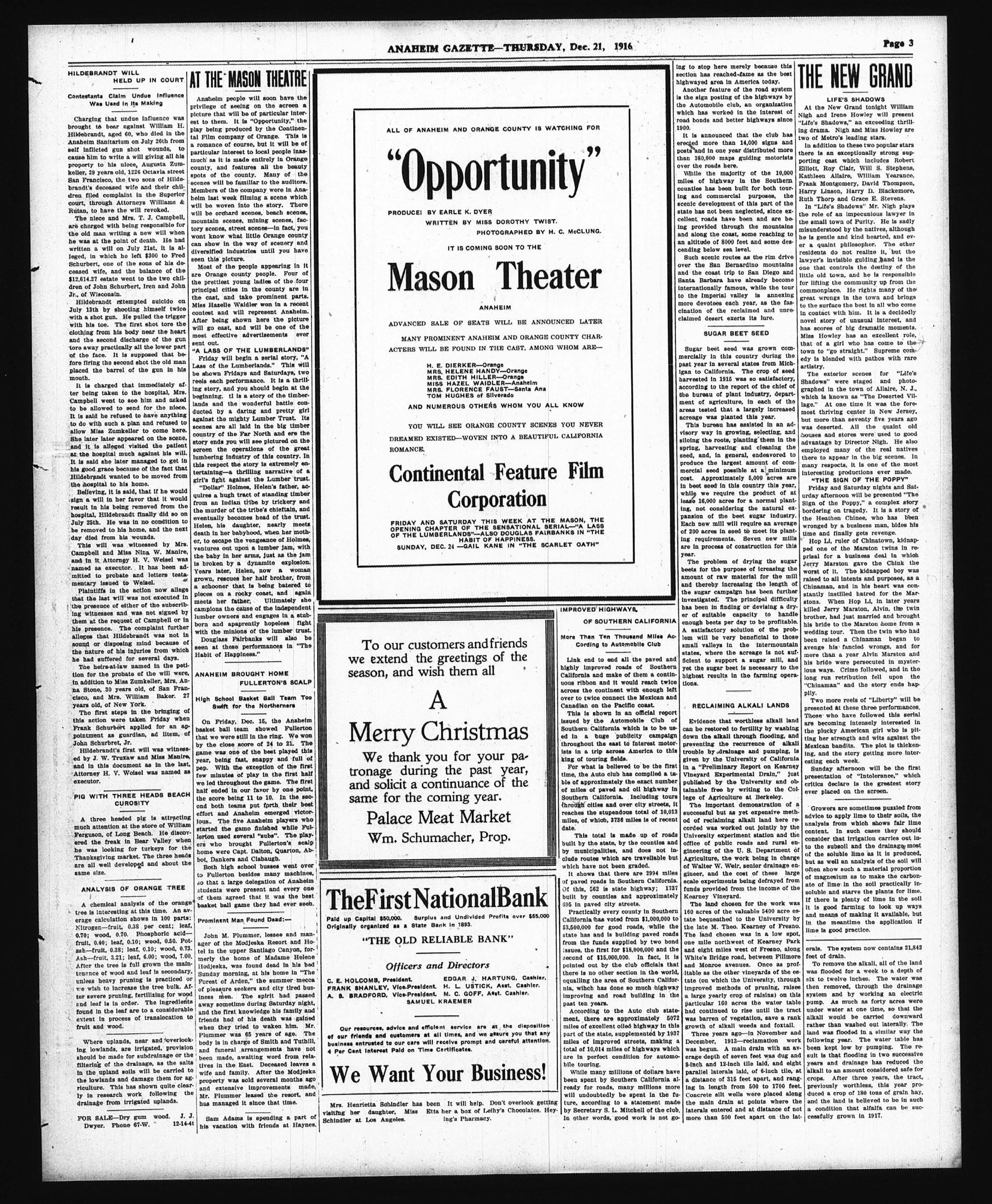
Searchable text
HILDEBRANDT WILL
HELD UP IN COURT
Contestants Claim Undue Influence
Was Used in Its Making
Charging that undue influence was brought to bear against William H. Hildebrandt, aged 60, who died in the Anaheim Sanitarium on July 26th from self inflicted gun shot wounds, to cause him to write a will giving all his property to his niece, Augusta Zumkeller, 29 years old, 1226 Octavia street San Francisco, the two sons of Hildebrandt's deceased wife and their children filed complaint in the Superior court, through Attorneys Williams & Rutan, to have the will revoked.
The niece and Mrs. T. J. Campbell, are charged with being responsible for the old man writing a new will when he was at the point of death. He had written a will on July 21st, it is alleged, in which he left $300 to Fred Schurbert, one of the sons of his deceased wife, and the balance of the $12,614.27 estate went to the two children of John Schurbert, Iren and John Jr., of Wisconsin.
Hildebrandt attempted suicide on July 13th by shooting himself twice with a shotgun. He pulled the trigger with his toe. The first shot tore the clothing from his body near the heart and the second discharge of the gun tore away practically all the lower part of the face. It is supposed that before firing the second shot the old man placed the barrel of the gun in his mouth.
It is charged that immediately after being taken to the hospital, Mrs. Campbell went to see him and asked to be allowed to send for the niece. It is said he refused to have anything to do with such a plan and refused to allow Miss Zumkeller to come here. She later later appeared on the scene, and it is alleged visited the patient AT THE MASON THEATRE
Anaheim people will soon have the privilege of seeing on the screen a picture that will be of particular interest to them. It is "Opportunity," the play being produced by the Continental Film company of Orange. This is a romance of course, but it will be of particular interest to local people in much as it is made entirely in Orange county, and features all the beauty spots of the county. Many of the scenes will be familiar to the auditors. Members of the company were in Anaheim last week filming a scene which will be woven into the story. There will be orchard scenes, beach scenes, mountain scenes, mining scenes, factory scenes, street scenes—in fact, you won't know what little Orange county can show in the way of scenery and diversified industries until you have seen this picture.
Most of the people appearing in it are Orange county people. Four of the prettiest young ladies of the four principal cities in the county are in the cast, and take prominent parts. Miss Hazelle Waldler won in a recent contest and will represent Anaheim. After being shown here the picture will go east, and will be one of the most effective advertisements ever sent out.
"A LASS OF THE LUMBERLANDS"
Friday will begin a serial story, "A Lass of the Lumberlands." This will be shown Fridays and Saturdays, two reels each performance. It is a thrilling story, and you should begin at the beginning. It is a story of the timberlands and the wonderful battle conducted by a daring and pretty girl against the mighty Lumber Trust. Its scenes are all laid in the big timber country of the Far North and ere the story ends you will see pictured on the screen the operations of the great
It is charged that immediately after being taken to the hospital, Mrs. Campbell went to see him and asked to be allowed to send for the niece. It is said he refused to have anything to do with such a plan and refused to allow Miss Zumkeller to come here. She later later appeared on the scene, and it is alleged visited the patient at the hospital much against his will. It is said she later managed to get in his good grace because of the fact that Hildebrandt wanted to be moved from the hospital to his home.
Believing, it is said, that if he would sign a will in her favor that it would result in his being removed from the hospital, Hildebrandt finally did so on July 25th. He was in no condition to be removed to his home, and the next day died from his wounds.
This will was witnessed by Mrs. Campbell and Miss Nina W. Manire, and in it Attorney H. V. Weisel was named as executor. It has been admitted to probate and letters testamentary issued to Weisel.
Plaintiffs in the action now allege that the last will was not executed in the presence of either of the subscribing witnesses and was not signed by them at the request of Campbell or in his presence. The complaint further alleges that Hildebrandt was not in sound or disposing mind because of the nature of his injuries from which he had suffered for several days.
The heirs-at-law named in the petition for the probate of the will were, in addition to Miss Zumkeller, Mrs. Anna Stone, 30 years old, of San Francisco, and Mrs. William Baker. 27 years old, of New York.
The first steps in the bringing of this action were taken Friday when Frank Schurbert applied for an appointment as guardian, ad litem, of John Schurbret, Jr.
Hildebrandt's first will was witnessed by J. W. Truxaw and Miss Manire, and in this document as in the last, Attorney H. V. Weisel was named as executor.
PIG WITH THREE HEADS BEACH CUROSITY
A three headed pig is attracting much attention at the store of William Ferguson, of Long Beach. He discovered the freak in Bear Valley when he was looking for turkeys for the Friday will begin a serial story, "A Lass of the Lumberlands." This will be shown Fridays and Saturdays, two reels each performance. It is a thrilling story, and you should begin at the beginning. It is a story of the timberlands and the wonderful battle conducted by a daring and pretty girl against the mighty Lumber Trust. Its scenes are all laid in the big timber country of the Far North and ere the story ends you will see pictured on the screen the operations of the great lumbering industry of this country. In this respect the story is extremely entertaining—a thrilling narrative of a girl's fight against the Lumber trust.
"Dollar" Holmes, Helen's father, acquires a hugh tract of standing timber from an Indian tribe by trickery and the murder of the tribe's chieftain, and eventually becomes head of the trust. Helen, his daughter, nearly meets death in her babyhood, when her mother, to escape the vengeance of Holmes, ventures out upon a lumber jam, with the baby in her arms, just as the jam is broken by a dynamite explosion. Years later, Helen, now a woman grown, rescues her half brother, from a schooner that is being battered to pieces on a rocky coast, and again meets her father. Ultimately she campions the cause of the independent lumber owners and engages in a stubborn and apaprenently hopeless fight with the minions of the lumber trust.
Douglass Fairbanks will also be seen at these performances in "The Habit of Happiness."
ANAHEIM BROUGHT HOME
FULLERTON'S SCALP
High School Basket Ball Team Too Swift for the Northerners
On Friday, Dec. 15, the Anaheim basket ball team showed Fullerton that we were still in the ring. We won by the close score of 24 to 21. The game was one of the best played this year, being fast, snappy and full of pep. With the exception of the first few minutes of play in the first half we led throughout the game. The first half ended in our favor by one point, the score being 11 to 10. In the second both teams put forth their best effort and Anaheim emerged victorious.. The five Anaheim players who started the game finished while Fullerton used several "subs". The players who brought Fullerton's scalp home sent Dalton Quarton Ab-
PIG WITH THREE HEADS BEACH CUROSITY
A three headed pig is attracting much attention at the store of William Ferguson, of Long Beach. He discovered the freak in Bear Valley when he was looking for turkeys for the Thanksgiving market. The three heads are all well developed and about the same size.
ANALYSIS OF ORANGE TREE
A chemical analysis of the orange tree is interesting at this time. An average calculation shows in 100 parts: Nitrogen—fruit, 0.38 per cent; leaf, 0.70; wood, 0.70. Phosphoric acid—fruit, 0.40; leaf, 0.10; wood, 0.50. Potash—fruit, 0.38; leaf, 0.10; wood, 0.73. Ash—fruit, 3.21; leaf, 6.00; wood, 7.00. After the tree is full grown the maintenance of wood and leaf is secondary, unless heavy pruning is practiced or we wish to increase the tree bulk. After severe pruning, fertilizing for wood and leaf is in order. The ingredients found in the leaf are to a considerable extent in process of translocation to fruit and wood.
Where uplands, near and overlooking lowlands, are irrigated, provision should be made for subdrainage or the filtering of the drainage, as the salts in the upland soils will be carried to the lowlands and damage them for agriculture. This has shown quite clearly in research work following the drainage from irrigated uplands.
FOR SALE—Dry gum wood. J. J. Dwyer. Phone 67-W. 12-14-4t
John M. Plummer, lessee and manager of the Modjeska Resort and Hotel in the upper Santiago Canyon, formerly the home of Madame Helene Hodjeska, was found dead in his bed Sunday morning, at his home in "The Forest of Arden," the summer mecca of pleasure seekers and city tired business men. The spirit had passed away sometime during Saturday night, and the first knowledge his family and friends had of his death was gained when they tried to waken him. Mr. Plummer was 65 years of age. The body is in charge of Smith and Tuthill, and funeral arrangements have not been made, awaiting word from relatives in the East. Deceased leaves a wife and family. After the Modjeska property was sold several months ago and extensive improvements made, Mr. Plummer leased the resort, and has managed it since that time.
Sam Adams is spending a part of his vacation with friends at Haynes.
ANAHEIM GAZETTE—THURSDAY, Dec. 21, 1916
ALL OF ANAHEIM AND ORANGE COUNTY IS WATCHING FOR
"Opportunity"
PRODUCED BY EARLE K. DYER
WRITTEN BY MISS DOROTHY TWIST.
PHOTOGRAPHED BY H. C. McCLUNG.
IT IS COMING SOON TO THE
Mason Theater
ANAHEIM
ADVANCED SALE OF SEATS WILL BE ANNOUNCED LATER
MANY PROMINENT ANAHEIM AND ORANGE COUNTY CHARACTERS WILL BE FOUND IN THE CAST, AMONG WHOM ARE—
H. E. DIERKER—Orange
MRS. HELENE HANDY—Orange
MRS. EDITH HILLER—Orange
MISS HAZEL WAIDLER—Anaheim
MRS. FLORENCE FAUST—Santa Ana
TOM HUGHES of Silverado
AND NUMEROUS OTHER'S WHOM YOU ALL KNOW
YOU WILL SEE ORANGE COUNTY SCENES YOU NEVER DREAMED EXISTED—WOVEN INTO A BEAUTIFUL CALIFORNIA ROMANCE
H. E. DIERKER—Orange
MRS. HELENE HANDY—Orange
MRS. EDITH HILLER—Orange
MISS HAZEL WAIDLER—Anaheim
MRS. FLORENCE FAUST—Santa Ana
TOM HUGHES of Silverado
AND NUMEROUS OTHER'S WHOM YOU ALL KNOW
YOU WILL SEE ORANGE COUNTY SCENES YOU NEVER DREAMED EXISTED—WOVEN INTO A BEAUTIFUL CALIFORNIA ROMANCE.
Continental Feature Film Corporation
FRIDAY AND SATURDAY THIS WEEK AT THE MASON, THE OPENING CHAPTER OF THE SENSATIONAL SERIAL—"A LASS OF THE LUMBERLANDS"—ALSO DOUGLAS FAIRBANKS IN "THE HABIT OF HAPPINESS.
SUNDAY, DEC. 24 —GAIL KANE IN "THE SCARLET OATH"
To our customers and friends we extend the greetings of the season, and wish them all
A Merry Christmas
We thank you for your patronage during the past year, and solicit a continuance of the same for the coming year.
Palace Meat Market
Wm. Schumacher, Prop.
We thank you for your patronage during the past year, and solicit a continuance of the same for the coming year.
Palace Meat Market
Wm. Schumacher, Prop.
TheFirstNationalBank
Paid up Capital $50,000. Surplus and Undivided Profits over $65,000 Originally organized as a State Bank in 1893.
"THE OLD RELIABLE BANK"
Officers and Directors
C. E. HOLCOMB, President. EDGAR J. HARTUNG, Cashier.
FRANK SHANLEY, Vice-President. H. L. USTICK, Asst. Cashier.
A. S. BRADFORD, Vice-President. M. C. GOFF, Asst. Cashier.
SAMUEL KRAEMER
Our resources, advice and efficient service are at the disposition of our friends and customers at all times, and we assure you that any business entrusted to our care will receive prompt and careful attention. 4 Per Cent Interest Paid on Time Certificates.
We Want Your Business!
Mrs. Henrietta Sohindler has been It will help. Don't overlook getting visiting her daughter, Miss Etta her a box of Leihy's Chocolates. Hey-Schindler at Los Angeles. ing's Pharmacy.
For what is believed to be the first time, the Auto club has compiled a table of approximately the exact number of miles of paved and oil highway in Southern California. Including tours through cities and over city streets, it reaches the stupendous total of 10,013 miles, of which, 3736 miles is of recent date.
This total is made up of roads built by the state, by the counties and by municipalities, and does not include routes which are travellable but which have not been graded.
It shows that there are 2994 miles of paved roads in Southern California. Of this, 562 is state highway; 1737 built by counties and approximately 695 in paved city streets.
Practically every county in Southern California has voted from $1,000,000 to $3,500,000 for good roads, while the state has and is building paved roads from the funds supplied by two bond issues, the first for $18,000,000 and the second of $15,000,000. In fact, it is pointed out by the club officials that there is no other section in the world, equalling the area of Southern California, which has done so much highway improving and road building in the past ten years.
According to the Auto club statement, there are approximately 5072 miles of excellent oiled highway in this part of the state, supplemented by 1937 miles of improved streets, making a total of 10,014 miles of highways which are in perfect condition for automobile touring.
While many millions of dollars have been spent by Southern California already for roads, many millions more will undoubtedly be spent in the future, according to a statement made by Secretary S. L. Mitchell of the club.
In other words, good work is not go-king of touring fields.
For what is believed to be the first time, the Auto club has compiled a table of approximately the exact number of miles of paved and oil highway in Southern California. Including tours through cities and over city streets, it reaches the stupendous total of 10,013 miles, of which, 3736 miles is of recent date.
This total is made up of roads built by the state, by the counties and by municipalities, and does not include routes which are travellable but which have not been graded.
It shows that there are 2994 miles of paved roads in Southern California. Of this, 562 is state highway; 1737 built by counties and approximately 695 in paved city streets.
Practically every county in Southern California has voted from $1,000,000 to $3,500,000 for good roads, while the state has and is building paved roads from the funds supplied by two bond issues, the first for $18,000,000 and the second of $15,000,000. In fact, it is pointed out by the club officials that there is no other section in the world, equalling the area of Southern California, which has done so much highway improving and road building in the past ten years.
According to the Auto club statement, there are approximately 5072 miles of excellent oiled highway in this part of the state, supplemented by 1937 miles of improved streets, making a total of 10,014 miles of highways which are in perfect condition for automobile touring.
While many millions of dollars have been spent by Southern California already for roads, many millions more will undoubtedly be spent in the future, according to a statement made by Secretary S. L. Mitchell of the club.
In other words, good work is not go-king of touring fields.
For what is believed to be the first time, the Auto club has compiled a table of approximately the exact number of miles of paved and oil highway in Southern California. Including tours through cities and over city streets, it reaches the stupendous total of 10,013 miles, of which, 3736 miles is of recent date.
This total is made up of roads built by the state, by the counties and by municipalities, and does not include routes which are travellable but which have not been graded.
It shows that there are 2994 miles of paved roads in Southern California. Of this, 562 is state highway; 1737 built by counties and approximately 695 in paved city streets.
Practically every county in Southern California has voted from $1,000,000 to $3,500,000 for good roads, while the state has and is building paved roads from the funds supplied by two bond issues, the first for $18,000,000 and the second of $15,000,000. In fact, it is pointed out by the club officials that there is no other section in the world, equalling the area of Southern California, which has done so much highway improving and road building in the past ten years.
According to the Auto club statement, there are approximately 5072 miles of excellent oiled highway in this part of the state, supplemented by 1937 miles of improved streets, making a total of 10,014 miles of highways which are in perfect condition for automobile touring.
While many millions of dollars have been spent by Southern California already for roads, many millions more will undoubtedly be spent in the future, according to a statement made by Secretary S. L. Mitchell of the club.
In other words, good work is not go-king of touring fields.
For what is believed to be the first time, the Auto club has compiled a table of approximately the exact number of miles of paved and oil highway in Southern California. Including tours through cities and over city streets, it reaches the stupendous total of 10,013 miles, of which, 3736 miles is of recent date.
This total is made up of roads built by the state, by the counties and by municipalities, and does not include routes which are travellable but which have not been graded.
It shows that there are 2994 miles of paved roads in Southern California. Of this, 562 is state highway; 1737 built by counties and approximately 695 in paved city streets.
Practically every county in Southern California has voted from $1,000,000 to $3,500,000 for good roads, while the state has and is building paved roads from the funds supplied by two bond issues, the first for $18,000,000 and the second of $15,000,000. In fact, it is pointed out by the club officials that there is no other section in the world, equalling the area of Southern California, which has done so much highway improving and road building in the past ten years.
According to the Auto club statement, there are approximately 5072 miles of excellent oiled highway in this part of the state, supplemented by 1937 miles of improved streets, making a total of 10,014 miles of highways which are in perfect condition for automobile touring.
While many millions of dollars have been spent by Southern California already for roads, many millions more will undoubtedly be spent in the future, according to a statement made by Secretary S. L. Mitchell of the club.
In other words,good work is not go-king of touring fields.
For what is believed to be the first time,the Auto club has compiled a table of approximately the exact number of miles of paved and oil highway in Southern California. Including tours through cities and over city streets,it reaches the stupendous total of 10,013 miles,of which,3736 miles is of recent date.
This total is made up of roads built by the state,by the counties和by municipalities,and does not include routes which are travellable but which have not been graded.
It shows that there are 2994 miles of paved roads in Southern California. Of this,562 is state highway;1737 built by counties和approximately 695 in paved city streets。
Practically every county in Southern California has voted from $1,ooo,ooo to $3,ooo,ooo for good roads,while the state has and is building paved roads from the funds supplied by two bond issues,the first for $18,ooo,ooo and the second for $15,ooo,ooo.In fact,它 pointed out by the club officials that there is no other section in the world,equalling the area of Southern California,which has done so much highway improving and road building in the past ten years。
According to the Auto club statement,there are approximately 5072 miles of excellent oiled highway in this part of the state,supplemented by 1937 miles of improved streets,making a total of 10,ooi4 miles of highways which are in perfect condition for automobile touring。
While many millions of dollars have been spent by Southern California already for roads,many millions more will undoubtedly be spent in the future,according to a statement made by Secretary S. L. Mitchell of the club。
In other words,good work is not go-king of touring fields。
ing to stop here merely because this section has reached fame as the best highwayed area in America today.
Another feature of the road system is the sign posting of the highways by the Automobile club, an organization which has worked in the interest of road bonds and better highways since 1900.
It is announced that the club has erected more than 14,000 signs and posts and in one year distributed more than 380,000 maps guiding motorists over the roads here.
While the majority of the 10,000 miles of highway in the Southern counties has been built for both touring and commercial purposes, the scenic development of this part of the state has not been neglected, since excellent roads have been and are being provided through the mountains and along the coast, some reaching to an altitude of 8000 feet and some descending below sea level.
Such scenic routes as the rim drive over the San Bernardino mountains and the coast trip to San Diego and Santa Barbara have already become internationally famous, while the tour to the Imperial valley is annexing more devotees each year, as the fascination of the reclaimed and unreclaimed desert exerts its lure.
SUGAR BEET SEED
Sugar beet seed was grown commercially in this country during the past year in several states from Michigan to California. The crop of seed harvested in 1915 was so satisfactory, according to the report of the chief of the bureau of plant industry, department of agriculture, in each of the areas tested that a largely increased acreage was planted this year.
This bureau has assisted in an advisory way in growing, selecting, and siloing the roots, planting them in the spring, harvesting and cleaning the
THE NEW GRAND
LIFE'S SHADOWS
At the New Grand tonight William Nigh and Irene Howley will present "Life's Shadows," an exceeding thrilling drama. Nigh and Miss Howley are two of Metro's leading stars.
In addition to these two popular stars there is an exceptionally strong supporting cast which includes Robert Elliott, Roy Clair, Will S. Stephens, Kathleen Allaire, William Yearance, Frank Montgomery, David Thompson, Harry Linson, Harry D. Blackemore, Ruth Thorp and Grace E. Stevens.
In "Life's Shadows" Mr. Nigh plays the role of an impecunious lawyer in the small town of Purlity. He is sadly misunderstood by the natives, although he is gentle and kind hearted, and ever a quaint philosopher. The other residents do not realize it, but the lawyer's invisible guiding hand is the one that controls the destiny of the little old town, and he is responsible for lifting the community up from the commonplace. He rights many of the great wrongs in the town and brings to the surface the best in all who come in contact with him. It is a decidedly novel story of unusual interest, and has scores of big dramatic moments. Miss Howley has an excellent role, that of a girl who has come to the town to "go straight." Supreme comedy is blended with pathos with rare artistry.
The exterior scenes for "Life's Shadows" were staged and photographed in the town of Allaire, N. J., which is known as "The Deserted Village." At one time it was the foremost thriving center in New Jersey, but more than seventy five years ago was deserted. All the quaint old houses and stores were used to good advantage by Director Nigh. He also employed many of the real natives.
merically in this country during the past year in several states from Michigan to California. The crop of seed harvested in 1915 was so satisfactory, according to the report of the chief of the bureau of plant industry, department of agriculture, in each of the areas tested that a largely increased acreage was planted this year.
This bureau has assisted in an advisory way in growing, selecting, and siloing the roots, planting them in the spring, harvesting and cleaning the seed, and, in general, endeavored to produce the largest amount of commercial seed possible at a minimum cost. Approximately 5,000 acres are in beet seed in this country this year, while we require the product of at lease 16,000 acres for a normal planting, not considering the natural expansion of the beet sugar industry. Each new mill will require an average of 200 acres in seed to meet its planting requirements. Seven new mills are in process of construction for this year.
The problem of drying the sugar beets for the purpose of increasing the amount of raw material for the mill and thereby increasing the length of the sugar campaign has been further investigated. The principal difficulty has been in finding or devising a dryer of suitable capacity to handle enough beets per day to be profitable. A satisfactory solution of the problem will be very beneficial to those small valleys in the intermountain states, where the acreage is not sufficient to support a sugar mill, and yet the sugar beet is necessary to the highest results in the farming operations.
RECLAIMING ALKALI LANDS
Evidence that worthless alkali land can be restored to fertility by washing down the alkali through flooding, and preventing the recurrence of alkali trouble by drainage and pumping, is given by the University of California in a "Preliminary Report on Kearney Vineyard Experimental Drain," just published by the University and obtainable free by writing to the College of Agriculture at Berkeley.
The important demonstration of a successful but as yet expensive method of reclaiming alkali land here recorded was worked out jointly by the University experiment station and the office of public roads and rural engineering of the U.S. Department of
edy is blended with pathos with rare artistry.
The exterior scenes for "Life's Shadows" were staged and photographed in the town of Allaire, N.J., which is known as "The Deserted Village." At one time it was the foremost thriving center in New Jersey, but more than seventy five years ago was deserted. All the quaint old houses and stores were used to good advantage by Director Nigh. He also employed many of the real natives there to appear in the big scenes. In many respects, it is one of the most interesting productions ever made.
"The SIGN OF THE POPPY"
Friday and Saturday nights and Saturday afternoon will be presented "The Sign of the Poppy," a complex story bordering on tragedy. It is a story of the Heathen Chinee, who has been wronged by a business man, blides his time and finally gets revenge.
Hop Li, ruler of Chinatown, kidnapped one of the Marston twins in reprisal for a business deal in which Jerry Marston gave the Chink the worst of it. The kidnapped boy was raised to all intents and purposes, as a Chinaman, and in his heart was constantly instilled hatred for the Marstons. When Hop Li, in later years killed Jerry Marston, Alvin, the twin brother, had just married and brought his bride to the Marston home from a wedding tour. Then the twin who had been raised a Chinaman began to avenge his fancied wrongs, and for more than a year Alvin Marston and his bride were persecuted in mysterious ways. Crime followed, and in the long run retribution fell upon the "Chinaman" and the story ends happily.
Two more reels of "Liberty" will be presented at these three performances. Those who have followed this serial are becoming intensely interested in the plucky American girl who is putting her strength and wits against the Mexican bandits. The plot is thickening, and the story getting more interesting each week.
Sunday afternoon will be the first presentation of "Intolerance," which critics declare is the greatest story ever placed on the screen.
Growers are sometimes puzzled from advice to apply lime to their soils, the analysis from which shows fair lime content. In such cases they should consider that irrigation carries out into the subsoll and the drainage most
Sunday afternoon will be the first presentation of "Intolerance," which critics declare is the greatest story ever placed on the screen.
Growers are sometimes puzzled from advice to apply lime to their soils, the analysis from which shows fair lime content. In such cases they should consider that irrigation carries out into the subsolil and the drainage most of the soluble lime as it is produced, but as well an analysis of the soil will often show such a material proportion of magnesium as to make the carbonate of lime in the soil practically insoluble and starve the plants for lime. If there is plenty of lime in the soil it is good farming to look up ways and means of making it available, but in the meantime the application if lime is good practice.
erals. The system now contains 21,842 feet of drain.
To remove the alkali, all of the land was flooded for a week to a depth of six to twelve inches. The water was then removed, through the drainage system and by working an electric pump. As much as forty acres were under water at one time, so that the alkali would be carried downward rather than washed out laterally. The land was flooded in a similar way the following year. The water table has been kept low by pumping. The result is that flooding in two successive years and drainage has reduced the alkali to an amount considered safe for crops. After three years, the tract, previously worthless, this year produced a crop of 180 tons of grain hay, and the land is believed to be in such a condition that alfalfa can be successfully grown in 1917.