anaheim-gazette 1916-10-05
Scanned page
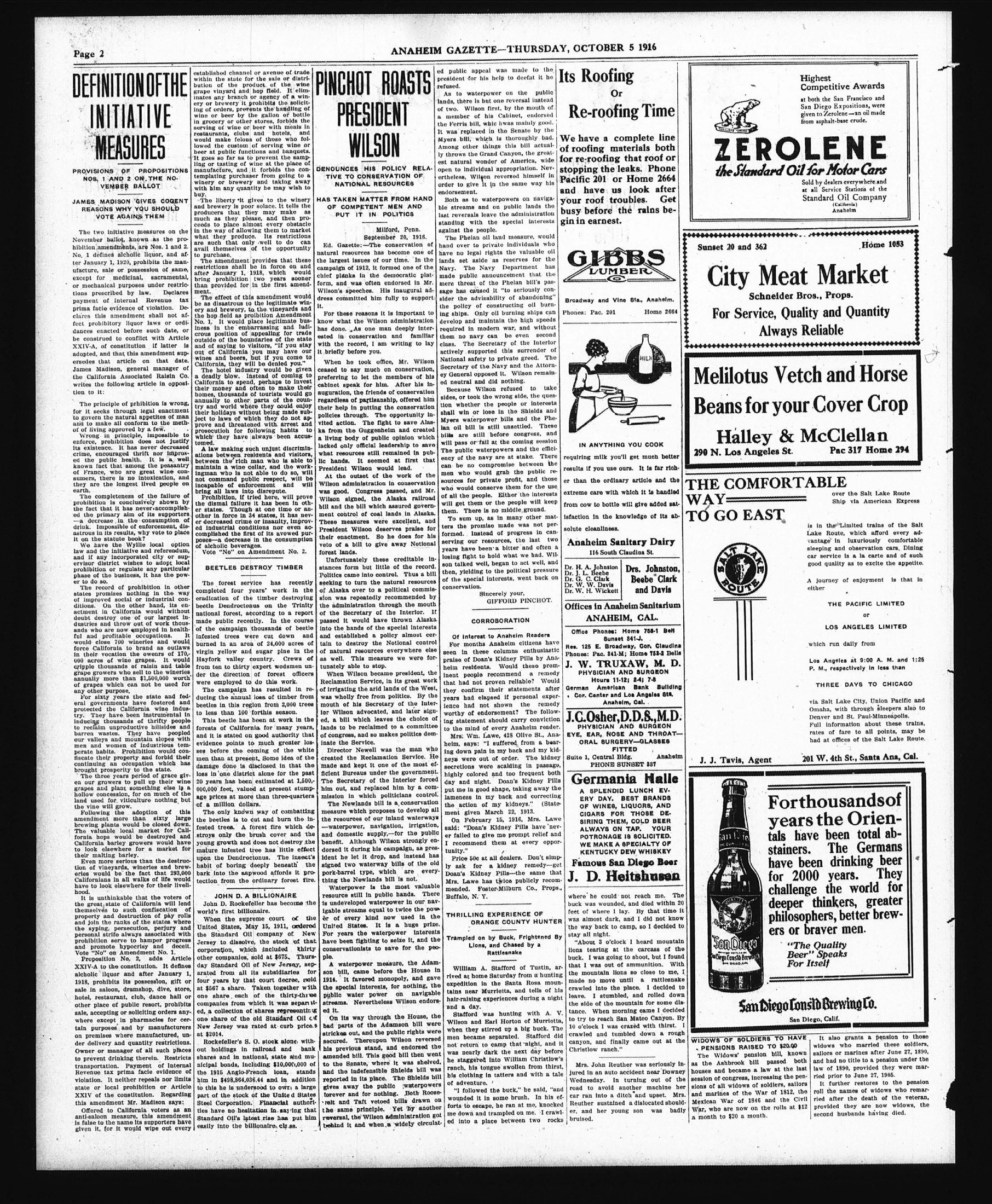
Searchable text
DEFINITION OF THE INITIATIVE MEASURES
PROVISIONS OF PROPOSITIONS
NO. 1 AND 2 ON. THE NOVEMBER BALLOT
JAMES MADISON GIVES COGNENT REASONS WHY YOU SHOULD VOTE AGAINST THEM
The two initiative measures on the November ballot, known as the prohibition amendments, are Nos. 1 and 2. No. 1 defines alcoholic liquor, and after January 1, 1920, prohibits the manufacture, sale or possession of same, except for medicinal, sacramental, or mechanical purposes under restrictions prescribed by law. Declares payment of Internal Revenue tax prima facie evidence of violation. Declares this amendment shall not affect prohibitory liquor laws or ordinances enacted before such date, or be construed to conflict with Article XXIV-A, of constitution if latter is adopted, and that this amendment supersedes that article on that date. James Madison, general manager of the California Associated Raisin Co., writes the following article in opposition to it:
The principle of prohibition is wrong, for it seeks through legal enactment to govern the natural appetites of man and to make all conform to the method of living approved by a few.
Wrong in principle, impossible to enforce, prohibition does not justify its existence. It has never decreased established channel or avenue of trade within the state for the sale or distribution of the product of the wine grape vinyard and hop field. It eliminates any branch or agency of a winery or brewery it prohibits the soliciting of orders, prevents the handling of wine or beer by the gallon or bottle in grocery or other stores, forbids the serving of wine or beer with meals in restaurants, clubs and hotels, and would make felons of those who followed the custom of serving wine or beer at public functions and banquets. It goes so far as to prevent the sampling or tasting of wine at the place of manufacture, and it forbids the contemplating purchaser from going to a winery or brewery and taking away with him any quantity he may wish to buy.
The liberty it gives to the winery and brewery is poor solace. It tells the producers that they may make as much as they please, and then proceeds to place almost every obstacle in the way of allowing them to market what they produce. Its restrictions are such that only well to do can avail themselves of the opportunity to purchase.
The amendment provides that these restrictions shall be in force on and after January 1, 1918, which would bring prohibition two years sooner than provided for in the first amendment.
The effect of this amendment would be as disastrous to the legitimate winery and brewery, to the vineyards and hop field as prohibition Amendment No. 1. It would place legitimate business in the embarrassing and ludicrous position of appealing for trade outside of the boundaries of the state and of saying to visitors, "If you stay out of California you may have our wines and beers, but if you come to California, they will be denied you."
The hotel industry would be given a deadly blow. Instead of coming to California to spend, perhaps to invest their money and often to make their homes, thousands of tourists would go annually to other parts of the country and world where they could enjoy their holidays without being made subject to laws of which they do not approve and threatened with arrest and prosecution for following habits to which they have always been accustomed.
A law making such unjust discriminatory
The principle of prohibition is wrong, for it seeks through legal enactment to govern the natural appetites of man and to make all conform to the method of living approved by a few.
Wrong in principle, impossible to enforce, prohibition does not justify its existence. It has never decreased crime, encouraged thrift nor improved the public health. It is a well-known fact that among the peasantry of France, who are great wine consumers, there is no intoxication, and they are the longest lived people on earth.
The completeness of the failure of prohibition is conclusively shown by the fact that it has never accomplished the primary aim of its supporters—a decrease in the consumption of drink. Impossible of enforcement, disastrous in its results, why vote to place it on the statute book?
We have the Wyllie local option law and the initiative and referendum, and if any incorporated city or supervisor district wishes to adopt local prohibition or regulate any particular phase of the business, it has the power to do so.
The record of prohibition in other states promises nothing in the way of improved social or industrial conditions. On the other hand, its enactment in California would without doubt destroy one of our largest industries and throw out of work thousands who are now employed in healthful and profitable occupations. It would close 700 wineries and would force California to brand as outlaws in their vocation the owenns of 170,000 acres of wine grapes. It would cripple thousands of raisin and table grape growers who sell to the wineries annually more than $1,500,000 worth of grapes which can not be used for any other purpose.
For sixty years the state and federal governments have fostered and protected the California wine industry. They have been instrumental in inducing thousands of thrifty people to reclaim unproductive hillsides and barren wastes. They have peopleled our valleys and mountain slopes with men and women of industrious temperate habits. Prohibition would conflocate their property and forbid their continuing an occupation which has brought prosperity to the state.
The three years period of grace given our growers to pull up their wine grapes and plant something else is a hollow concession, for on much of the land used for viticulture nothing but the vine will grow.
Following the adoption of this amendment more than sixty large brewing plants would be closed down. The valuable local market for California hops would be destroyed and California barley growers would have to look elsewhere for a market for wines and beers, but if you come to California, they will be denied you."
The hotel industry would be given a deadly blow. Instead of coming to California to spend, perhaps to invest their money and often to make their homes, thousands of tourists would go annually to other parts of the country and world where they could enjoy their holidays without being made subject to laws of which they do not approve and threatened with arrest and prosecution for following habits to which they have always been accustomed.
A law making such unjust discriminations between residents and visitors, between the rich man who is able to maintain a wine cellar, and the workingman who is not able to do so, will not command public respect, will be incapable of enforcement and will bring all laws into disrepute.
Prohibition, if tried here, will prove the dismal failure it has been in other states. Though at one time or another in force in 34 states, it has never decreased crime or insanity, improved industrial conditions nor even accomplished the first of its avowed purposes—a decrease in the consumption of alcoholic beverages.
Vote "No" on Amendment No. 2.
BEETLES DESTROY TIMBER
The forest service has recently completed four years' work in the eradication of the timber destroying beetle Dendroctonus on the Trinity national forest, according to a report made public recently. In the course of the campaign thousands of beetle infested trees were cut down and burned in an area of 24,000 acres of virgin yellow and sugar pine in the Hayfork valley country. Crews of from ten to thirty expert wodsmen under the direction of forest officers were employed to do this work.
The campaign has resulted in reducing the annual loss of timber from beetles in this region from 2,000 trees to less than 100 forthis season.
This beetle has been at work in the forests of California for many years, and it is stated on good authority that evidence points to much greater losses before the coming of the white men than at present. Some idea of the damage done is disclosed in that the loss in 'one district alone for the past 20 years has been estimated at 1,500,-000,000 feet, valued at present stumpage prices at more than three-quarters of a million dollars.
The only known way of combatting the beetles is to cut and burn the infested trees. A forest fire which destroys only the brush cover and the young growth and does not destroy the mature infested tree has little effect when he took ceased to say my preferring to let cabinet speak for auguration, the fright regardless of part their help in putting policies through.
vited action. The ka from the Guggenheim living body lacked only official what resources she ill hands. It is President Wilson.
At the outset Wilson administration was good. Congratulations Wilson signed, bill and the bill went control of these measures. President Wilson their enactment, veto of a bill to forest lands.
Unfortunately we stances form bus Politics came into seeking to turn off Alaska over itsSION was repeatedthe administration of the Secretary passed it would into the hands oland established tain to destroyof natural resourceas well. This resultunately able to When Wilson Reclamation Service of irrigating the was wholly free mouth of his Seior Wilson advocated,a bill which lands to be reciclof congress,andinate the Service Director Newer created the Recalledmade and kept sufficient Bureaus us The Secretary o him out, and remission in which The Newlands measure which pitsthe resources off—waterpower,and domestic s benefit.Although dorsed it during
fiscate their property and forbid their continuing an occupation which has brought prosperity to the state.
The three years period of grace given our growers to pull up their wine grapes and plant something else is a hollow concession, for on much of the land used for viticulture nothing but the vine will grow.
Following the adoption of this amendment more than sixty large brewing plants would be closed down. The valuable local market for California hops would be destroyed and California barley growers would have to look elsewhere for a market for their malting barley.
Even more serious than the destruction of vineyards, wineries and breweries would be the fact that 293,000 Californians in all walks of life would have to look elsewhere for their livelihood.
It is unthinkable that the voters of the great state of California will lend themselves to such confiscation of property and destruction of pay rolls and join the ranks of the states where the syping, persecution, perjury and personal strife always associated with prohibition serve to hamper progress and promote hypocrisy and deceit. Vote "No" on Amendment No. 1.
Proposition No. 2, adds Article XXIV-A to the constitution. It defines alcoholic liquor and after January 1, 1918, prohibits its possession, gift or sale in saloon, dramshop, dive, store, hotel, restaurant, club, dance hall or other place of public resort, prohibits sale, accepting or soliciting orders anywhere except in pharmacies for certain purposes and by manufacturers on premises where manufactured, under delivery and quantity restrictions. Owner or manager of all such places to prevent drinking therein. Restricts transportation. Payment of Internal Revenue tax prima facie evidence of violation. It neither repeals nor limits state or local prohibition or Article XXIV of the constitution. Regarding this amendment Mr. Madison says:
Offered to California voters as an anti-saloon measure, this amendment is false to the name its supporters have given it, for it would wipe out every men than at present. Some idea of the damage done is disclosed in that loss in one district alone for the past 20 years has been estimated at 1,500,000,000 feet, valued at present stumpage prices at more than three-quarters of a million dollars.
The only known way of combatting the beetles is to cut and burn the infested trees. A forest fire which destroys only the brush cover and the young growth and does not destroy the mature infested tree has little effect upon the Dendroctonus. The insect's habit of boring deeply beneath the bark into the sapwood affords it protection from the ordinary forest fire.
JOHN D. A BILLIONAIRE
John D. Rockefeller has become the world's first billionaire.
When the supreme court of the United States, May 15, 1911, ordered the Standard Oil company of New Jersey to dissolve, the stock of that corporation, which included thirty other companies, sold at $675. Thursday Standard Oil of New Jersey, separated from all its subsidiaries for four years by that court decree, sold at $567 a share. Taken together with one share each of the thirty-three companies from which it was separated, a collection of shares representing one share of the old Standard Oil of New Jersey was rated at curb prices at $2014.
Rockefeller's S. O. stock alone without holdings in railroad and bank shares and in national, state and municipal bonds, including $10,000,000 of the 1915 Anglo-French loan, stands him in $498,864,036.44 and in addition to this he is undersood to own a large part of the stock of the United States Steel Corporation. Financial authorities have no hesitation in saying that Standard Oil's latest rise has put him easily into the billionaire class.
Waterpower resource still intact is undeveloped vigile streams er of every kind United States. For years they have been fought conservationists ple.
A waterpower son bill, came in 1914. It favored the special interest public water p streams. Never ceased it.
On its way to bad parts of the stricken out, and secured. There his previous st amended bill. To the Senate, and the indefered reported in its gives away the forever and form rewritt the same principle reversal, the Witte behind it and w
PINCHOT ROASTS PRESIDENT WILSON
DENOUNCES HIS POLICY RELATIVE TO CONSERVATION OF NATIONAL RESOURCES
HAS TAKEN MATTER FROM HAND OF COMPETENT MEN AND PUT IT IN POLITICS
Milford, Penn.
September 20, 1916.
Ed. Gazette:—The conservation of natural resources has become one of the largest issues of our time. In the campaign of 1912, it formed one of the chief planks in the democratic platform, and was often endorsed in Mr. Wilson's speeches. His inaugural address committed him fully to support it.
For these reasons it is important to know what the Wilson administration has done. As one man deeply interested in conservation and familiar with the record, I am writing to lay it briefly before you.
When he took office, Mr. Wilson ceased to say much on conservation, preferring to let the members of his cabinet speak for him. After his inauguration, the friends of conservation regardless of partisanship, offered him their help in putting the conservation policies through. The opportunity invited action. The fight to save Alaska from the Guggenheim and created a living body of public opinion which lacked only official leadership to save public appeal was made to the president for his help to deefat it he refused.
As to waterpower on the public lands, there is but one reversal instead of two. Wilson first, by the mouth of a member of his Cabinet, endorsed the Ferris bill, which hwas mainly good. It was replaced in the Senate by the Myers bill, which is thoroughly bad. Among other things this bill actually throws the Grand Canyon, the greatest natural wonder of America, wide open to individual appropriation. Nevertheless, Wilson reversed himself in order to give it in the same way his endorsement.
Both as to waterpowers on navigable streams and on public lands the last reversals leave the administration standing with the special interests against the people.
The Phelan oil land measure, would hand over to private individuals who have no legal rights the valuable oil lands set aside as reserves for the Navy. The Navy Department has made public announcement that the mere threat of the Phelan bill's passage has caused it "to seriously consider the advisability of abandoning" the policy of constructing oil burning ships. Only oil burning ships can develop and maintain the high speeds required in modern war, and without them no navy can be even second class. The Secretary of the Interior actively supported this surrender of National safety to private greed. The Secretary of the Navy and the Attorney General opposed it. Wilson remained neutral and did nothing.
Because Wilson refused to take sides, or took the wrong side, the question whether the people or interests shall win or lose in the Shields and Myers waterpower bills and the Phelan oil bill is still unsettled. These bills are still before congress, and will pass or fail at the coming session.
Its Roofing Or Re-roofing Time
We have a complete line of roofing materials both for re-roofing that roof or stopping the leaks. Phone Pacific 201 or Home 2664 and have us look after your roof troubles. Get busy before the rains begin in earnest.
GIBBS LUMBER
Broadway and Vine Sts., Anaheim.
Phones: Pac. 201 Home 2664
IN ANYTHING YOU COOK
When he took office, Mr. Wilson ceased to say much on conservation, preferring to let the members of his cabinet speak for him. After his inauguration, the friends of conservation regardless of partisanship, offered him their help in putting the conservation policies through. The opportunity invited action. The fight to save Alaska from the Guggenheim and created a living body of public opinion which lacked only official leadership to save what resources still remained in public hands. It seemed at first that President Wilson would lead.
At the outset of the work of the Wilson administration in conservation was good. Congress passed, and Mr. Wilson signed, the Alaska railroad bill and the bill which assured government control of coal lands in Alaska. These measures were excellent, and President Wilson deserves praise for their enactment. So he does for his veto of a bill to give away Notional forest lands.
Unfortunately these creditable instances form but little of the record. Politics came into control. Thus a bill seeking to turn the natural resources of Alaska over to a political commission was repeatedly recommended by the administration through the mouth of the Secretary of the Interior. If passed it would have thrown Alaska into the hands of the special interests and established a policy almost certain to destroy the Notional control of natural resources everywhere else as well. This measure we were fortunately able to stop.
When Wilson became president, the Reclamation Service, in its great work of irrigating the arid lands of the West, was wholly free from politics. By the mouth of his Secretary of the Interior Wilson advocated, and later signed, a bill which leaves the choice of lands to be reclaimed to a committee of congress, and so makes politics dominate the Service.
Director Newell was the man who created the Reclamation Service. He made and kept it one of the most efficient Bureaus under the government. The Secretary of the Interior forced him out, and replaced him by a commission in which politicians control.
The Newlands bill is a conservation measure which proposes to develop all the resources of our inland waterways—waterpower, navigation, irrigation, and domestic supply.—for the public benefit. Although Wilson strongly endorsed it during his campaign, as presided by National safety to private greed. The Secretary of the Navy and the Attorney General opposed it. Wilson remained neutral and did nothing.
Because Wilson refused to take sides, or took the wrong side, the question whether the people or interests shall win or lose in the Shields and Myers waterpower bills and the Phelan oil bill is still unsettled. These bills are still before congress, and will pass or fail at the coming session. The public waterpowers and the efficiency of the navy are at stake. There can be no compromise between the men who would grab the public resources for private profit, and those who would conserve them for the use of all the people. Either the interests will get them or the people will keep them. There is no middle ground.
To sum up, as in many other matters the promise made was not performed. Instead of progress in conserving our resources, the last two years have been a bitter and often a losing fight to hold what we had. Wilson talked well, began to act well, and then, yielding to the political pressure of the special interests, went back on conservation.
Sincerely your,
GIFFORD PINCHOT.
CORROBORATION
Of Interest to Anaheim Readers
For months Anaheim citizens have seen in these columns enthusiastic praise of Doan's Kidney Pills by Anaheim residents. Would these prominent people recommend a remedy that had not proven reliable? Would they confirm their statements after years had elapsed if personal experience had not shown the remedy worthy of endorsement? The following statement should carry conviction to the mind of every Anaheim reader.
Mrs. Wm. Lawe, 428 Olive St., Anaheim, says: "I suffered from a bearing down pain in my back and my kidneys were out of order. The kidney secretions were scalding in passage, highly colored and too frequent both day and night. Doan's Kidney Pills put me in good shape, taking away the lameness in my back and correcting the action of my kidneys." (Statement given March 22, 1913.
On February 15, 1916, Mrs. Lawe said: "Doan's Kidney Pills have never failed to give me prompt relief and I recommend them at every opportunity."
A SPLENDID LUNCH EVERY DAY. BEST BRANDS OF WINES, LIQUORS, AND CIGARS FOR THOSE DESIRING THEM, COLD BEER ALWAYS ON TAP. YOUR POTRONAGE IS SOLICITED. WE MAKE A SPECIALTY OF KENTUCKY DEW WHISKEY
created the Reclamation Service. He made and kept it one of the most efficient Bureaus under the government. The Secretary of the Interior forced him out, and replaced him by a commission in which politicians control.
The Newlands bill is a conservation measure which proposes to develop all the resources of our inland waterways—waterpower, navigation, irrigation, and domestic supply;—for the public benefit. Although Wilson strongly endorsed it during his campaign, as president he let it drop, and instead has signed two waterway bills of the old pork-barrel type, which are everything the Newlands bill is not.
Waterpower is the most valuable resource still in public hands. There is undeveloped waterpower in our navigable streams equal to twice the power of every kind now used in the United States. It is a huge prize. For years the waterpower interests have been fighting to seize it, and the conservationists to save for the people.
A waterpower measure, the Adamson bill, came before the House in 1914. It favored monopoly, and gave the special interests, for nothing, the public water power on navigable streams. Nevertheless Wilson endorsed it.
On its way through the House, the bad parts of the Adamson bill were stricken out, and the public rights were secured. Thereupon Wilson reversed his previous stand, and endorsed the amended bill. This good bill then went to the Senate, where it was shelved, and the indefensible Shields bill was reported in its place. The Shields bill gives away the public waterpowers forever and for nothing. Both Roosevelt and Taft vetoed bills drawn on the same principle. Yet by another reversal, the Wilson administration got behind it and when a widely circulated news were out of order. The kidney secretions were scalding in passage, highly colored and too frequent both day and night. Doan's Kidney Pills put me in good shape, taking away the lameness in my back and correcting the action of my kidneys." (Statement given March 22, 1913.
On February 15, 1916, Mrs. Lawe said: "Doan's Kidney Pills have never failed to give me prompt relief and I recommend them at every opportunity."
Price 50c at all dealers. Don't simply ask for a kidney remedy—get Doan's Kidney Pills—the same that Mrs. Lawe has twice publicly recommended. Foster-Milburn Co., Props., Buffalo, N.Y.
THRILLING EXPERIENCE OF ORANGE COUNTY HUNTER
Trampled on by Buck, Frightened By Lions, and Chased by a Rattlesnake
William A. Stafford of Tustin, arrived at home Saturday from a hunting expedition in the Santa Rosa mountains near Murrietta, and tells of his hair-raising experiences during a night and a day.
Stafford was hunting with A. V. Wilson and Earl Horton of Murrietta, when they stirred up a big buck. The men became separated. Stafford did not return to camp that night, and it was nearly dark the next day before he staggered into William Christlow's ranch, his tongue swollen from thirst, his clothing in tatters and with a tale of adventure.
"I followed the buck," he said, "and wounded it in some brush. In his efforts to escape, he ran at me, knocked me down and trampled on me. I crawled into a place between two rocks where he could not reach me. The buck was wounded, and died within 20 feet of where I lay. By that time it was almost dark, and I did not know the way back to camp, so I decided to stay all night.
"About 3 o'clock I heard mountain lions tearing at the carcass of the buck. I was going to shoot, but I found that I was out of ammunition. With the mountain lions so close to me, I made no move until a rattlesnake crawled into the place. I decided to leave. I stumbled, and rolled down the side of the mountain for some distance. When morning came I decided to try to reach San Mateo Canyon. By 10 o'clock I was crazed with thirst. I crawled and tumbled down a rough canyon, and finally came out at the Christlow ranch."
Mrs. John Reuther was seriously injured in an auto accident near Downey Wednesday. In turning out of the road to avoid another machine her car ran into a ditch and upset. Mrs. Reuther sustained a dislocated shoulder, and her young son was badly bruised.
Highest Competitive Awards
at both the San Francisco and
San Diego Expositions, were
given to Zerolene—an oil made
from asphalt-base crude.
ZEROLENE
the Standard Oil for Motor Cars
Sold by dealers everywhere and
at all Service Stations of the
Standard Oil Company
(California)
Anaheim
Sunset 20 and 362 Home 1053
City Meat Market
Schneider Bros., Props.
For Service, Quality and Quantity
Always Reliable
Melilotus Vetch and Horse
Beans for your Cover Crop
Halley & McClellan
Melilotus Vetch and Horse Beans for your Cover Crop
Halley & McClellan
290 N. Los Angeles St. Pac 317 Home 294
THE COMFORTABLE WAY TO GO EAST
over the Salt Lake Route
Ship via American Express
is in the Limited trains of the Salt Lake Route, which afford every advantage in luxuriously comfortable sleeping and observation cars. Dining car service is a la carte and of such good quality as to excite the appetite.
A journey of enjoyment is that in either
THE PACIFIC LIMITED
or
LOS ANGELES LIMITED
which run daily from
Los Angeles at 9:00 A. M. and 1:25 P. M., respectively in less than
THREE DAYS TO CHICAGO
via Salt Lake City, Union Pacific and Omaha, with through sleepers also to Denver and St. Paul-Minneapolis.
Full information about these trains, rates of fare to all points, may be had at offices of the Salt Lake Route.
J. J. Tavis, Agent
201 W. 4th St., Santa Ana, Cal.
Forthousandsof years the Oriental tals have been total ab-stainers The Germans
Forthousandsof years the Orientals have been total abstainers. The Germans have been drinking beer for 2000 years. They challenge the world for deeper thinkers, greater philosophers, better brewers or braver men.
"The Quality Beer" Speaks For Itself
San Diego Consld Brewing Co.
San Diego, Calif.
WIDOWS OF SOLDIERS TO HAVE PENSIONS RAISED TO $20.00
The Widows' pension bill, known as the Ashbrook bill passed both houses and became a law at the last session of congress, increasing the pensions of all widows of soldiers, sailors and marines of the War of 1812, the Mexican War of 1846 and the Civil War, who are now on the rolls at $12 a month to $20 a month.
It also grants a pension to those widows who married these soldiers, sailors or marines after June 27, 1890, and had no title to a pension under the law of 1890, provided they were married prior to June 27, 1905.
It further restores to the pension roll the names of widows who remarried after the death of the veteran, provided they are now widows, the second husbands having died.