anaheim-gazette 1916-09-21
Scanned page
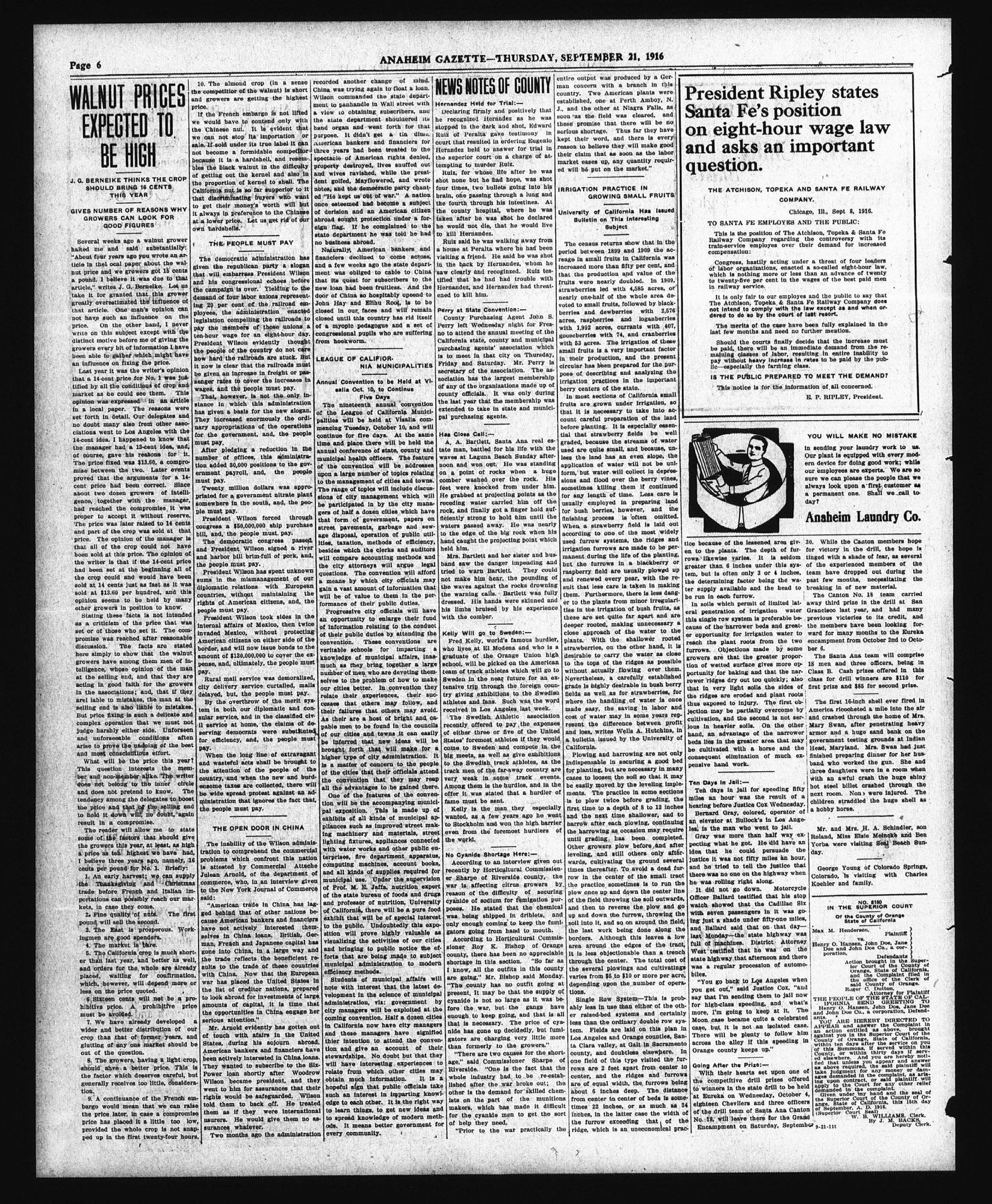
Searchable text
WALNUT PRICES EXPECTED TO BE HIGH
J. G. BERNEIKE THINKS THE CROP SHOULD BRING 16 CENTS THIS YEAR
GIVES NUMBER OF REASONS WHY GROWERS CAN LOOK FOR GOOD FIGURES
Several weeks ago a walnut grower halted me and said substantially: "About four years ago you wrote an article in the ocal paper about the walnut price and we growers got 15 cents a pound. I believe it was due to that article," writes J. G. Bernelke. Let us take it for granted that this grower greatly overestimated the influence of that article. One man's opinion can not have such an influence on the price. On the other hand, I never write on this subject except with the distinct motive before me of giving the growers every bit of information I have been able to gather which might have an influence on fixing the price.
Last year it was the writer's opinion that a 14-cent price for No. 1 was justified by all the conditions of crop and market as he could see them. This opinion was expressed in an article in a local paper. The reasons were set forth in detail. Our delegates and no doubt many also from other associations went to Los Angeles with the 14-cent idea. I happened to know that the manager had a 13-cent idea, and,
10. The almond crop (in a sense the competitor of the walnut) is short and growers are getting the highest price.
If the French embargo is not lifted we would have to contend only with the Chinese nut. It is evident that we can not stop its importation or sale. If sold under its true label it cannot become a formidable competitor because it is a hardshell, and resembles the black walnut in the difficulty of getting out the kernel and also in the proportion of kernel to shell. The California nut is so far superior to it that discriminating buyers who want to get their money's worth will but it always in preference to the Chinese at a lower price. Let us get rid of our own hardshells.
THE PEOPLE MUST PAY
The democratic administration has given the republican party a slogan that will embarrass President Wilson and his congressional echoes before the campaign is over. Yielding to the demand of four labor unions representing 20 per cent of the railroad employees, the administration enacted legislation compelling the railroads to pay the members of those unions a ten-hour wage for an eight-hour day. President Wilson evidently thought the people of the country do not care how hard the railroads are stuck. But it now is clear that the railroads must be given an increase in freight or passenger rates to cover the increases in wages, and the people must pay.
That, however, is not the only instance in which this administration has given a basis for the new slogan. They increased enormously the ordinary appropriations of the operations for the government, and, the people must pay.
recorded another China was trying a Wilson commanded ment to panhandle a view to obtain the state department hand organ and w purpose. It didn't American bankers three years had b spectacle of America property destroyed and wives ravished golfed, Mayfif notes, and the dem ed "He kept us our once esteemed head of derision and a abroad sought proign flag. If he state department no business abroad.
Naturally, Americans declined and a few weeks ago was obliged that its quest for new loan had been door of China so John Hay and El closed in our face closed until this case of a myopic pedal congressional pupil from hookworm.
LEAGUE OF CA NIA
Annual Convention salla Oct. 1 Five
The nineteenth of the League of palities will be mencing Tuesday, continue for five time and place th
Last year it was the writer's opinion that a 14-cent price for No. 1 was justified by all the conditions of crop and market as he could see them. This opinion was expressed in an article in a local paper. The reasons were set forth in detail. Our delegates and no doubt many also from other associations went to Los Angeles with the 14-cent idea. I happened to know that the manager had a 13-cent idea, and, of course, gave his reasons for it. The price fixed was $13.60, a compromise between the two. Later events proved that the arguments for a 14-cent price had been correct. Since about two dozen growers of intelligence, together with the manager, had reached the compromise it was proper to accept it without reserve. The price was later raised to 14 cents and part of the crop was sold at that price. The opinion of the manager is that all of the crop could not have been sold at this price. The opinion of the writer is that if the 14-cent price had been set at the beginning all of the crop could and would have been sold at 14 cents just as fast as it was sold at $13.60 per hundred, and this opinion seems to be held by many other growers in position to know.
Stating these facts is not intended as a criticism of the price that was set or of those who set it. The compromise was reached after reasonable discussion. The facts are stated here simply to show that the walnut growers have among them men of intelligence, whose opinion of the man at the selling end, and that they are acting in good faith for the growers in the associations; and, that if they are liable to mistakes, the man at the selling end is also liable to mistakes. But price fixing is such a delicate and complex operation that we must not judge harshly either side. Unforeseen and unforseeable conditions often arise to prove the undoing of the best and most conscientious effort.
What will be the price this year? This question interests the member and non-member alike. The writer does not belong to the inner circle and does not pretend to know. The tendency among the delegates to boost the price and that of the selling end to hold it down will, no doubt, again result in a compromise.
The reader will allow me to state some of the factors that should give the growers this year, at least, as high how hard the railroads are stuck. But it now is clear that the railroads must be given an increase in freight or passenger rates to cover the increases in wages, and the people must pay.
That, however, is not the only instance in which this administration has given a basis for the new slogan. They increased enormously the ordinary appropriations of the operations for the government, and, the people must pay.
After pledging a reduction in the number of offices, this administration added 80,000 positions to the government payroll, and, the people must pay.
Twenty million dollars was appropriated for a government nitrate plant somewhere in the south, and, the people must pay.
President Wilson forced through congress a $50,000,000 ship purchase bill, and, the people must pay.
The democratic congress passed, and President Wilson signed a river and harbor bill brim-full of pork, and, the people must pay.
President Wilson has spent unknown sums in the mismanagement of our diplomatic relations with European countries, without maintaining the rights of American citizens, and, the people must pay.
President Wilson took sides in the internal affairs of Mexico, then twice invaded Mexico, without protecting American citizens on either side of the border, and will now issue bonds to the amount of $130,000,000 to cover the expense, and, ultimately, the people must pay.
Rural mail service was demoralized, city delivery service curtailed, mails delayed, but, the people must pay.
By the overthrow of the merit system in both diplomatic and consular service, and in the classified civil service at home, the claims of deserving democrats were substituted for efficiency, and, the people must pay.
When the long line of extravagant and wasteful acts shall be brought to the attention of the people of the country, and when the new and burdensome taxes are collected, there will be wide spread protest against an administration that ignores the fact that, the people must pay.
THE OPEN DOOR IN CHINA
The inability of the Wilson administration to comprehend the commercial how hard the railroads are stuck. But it now is clear that the railroads must be given an increase in freight or passenger rates to cover the increases in wages, and the people must pay.
That, however, is not the only instance in which this administration has given a basis for the new slogan. They increased enormously the ordinary appropriations of the operations for the government, and, the people must pay.
After pledging a reduction in the number of offices, this administration added 80,000 positions to the government payroll, and, the people must pay.
Twenty million dollars was appropriated for a government nitrate plant somewhere in the south, and, the people must pay.
President Wilson forced through congress a $50,000,000 ship purchase bill, and, the people must pay.
The democratic congress passed, and President Wilson signed a river and harbor bill brim-full of pork, and, the people must pay.
President Wilson has spent unknown sums in the mismanagement of our diplomatic relations with European countries, without maintaining the rights of American citizens, and, the people must pay.
President Wilson took sides in the internal affairs of Mexico, then twice invaded Mexico, without protecting American citizens on either side of the border, and will now issue bonds to the amount of $130,000,000 to cover the expense, and ultimately, the people must pay.
Rural mail service was demoralized, city delivery service curtailed, mails delayed, but, the people must pay.
By the overthrow of the merit system in both diplomatic and consular service, and in the classified civil service at home, the claims of deserving democrats were substituted for efficiency, and, the people must pay.
When the long line of extravagant and wasteful acts shall be brought to the attention of the people of the country, and when the new and burdensome taxes are collected, there will be wide spread protest against an administration that ignores the fact that, the people must pay.
One of the fociion will be ther pal exposition. exhibits of all liplances such as ing machinery lighting fixtures with water work
What will be the price this year? This question interests the member and non-member alike. The writer does not belong to the inner circle and does not pretend to know. The tendency among the delegates to boost the price and that of the selling end to hold it down will, no doubt, again result in a compromise.
The reader will allow me to state some of the factors that should give the growers this year, at least, as high a price as ten highest we have had, I believe three years ago, namely, 16 cents per pound for No. 1. Briefly:
1. An early harvest; we can supply the Thanksgiving and Christmas trade before French and Italian importations can possibly reach our markets, in case they come.
2. Fine quality of nuts. The first pound will sell the second.
3. The East is prosperous. Workingmen are good spenders.
4. The market is bare.
5. The California crop is much shorter than last year, and better as well, and orders for the whole are already placed, waiting for confirmation, which, however, will depend more or less on the price quoted.
6. Sixteen cents will not be a prohibitive price. A prohibitive price must be avoided.
7. We have already developed a wider and better distribution of our crop than that of former years, and glutting of any one market should be out of the question.
8. The growers, having a light crop, should abve a better price. This is the factor which deserves careful, but generally receives too little consideration.
9. A continuance of the French embargo would mean that we can raise the price later, in case a compromise price has placed it a little too low, provided the whole crop is not snapped up in the first twenty-four hours.
When the long line of cartwagans and wasteful acts shall be brought to the attention of the people of the country, and when the new and burdensome taxes are collected, there will be wide spread protest against an administration that ignores the fact that, the people must pay.
THE OPEN DOOR IN CHINA
The inability of the Wilson administration to comprehend the commercial problems which confront this nation is attested by Commercial Attache Julean Arnold, of the department of commerce, who, in an interview given to the New York Journal of Commerce said:
"American trade in China has lagged behind that of other nations because American bankers and financiers have not actively interested themselves in China loans. British, German, French and Japanese capital has gone into China, in a large way and the trade reflects the beneficial results to the trade of these countries with China. Now that the European war has placed the United States in the list of creditor nations, prepared to look abroad for investments of large amounts of capital, it is time that the opportunities in China engage her serious attention."
Mr. Arnold evidently has gotten out of touch with affairs in the United States, during his sojourn abroad. American bankers and financiers have been actively interested in China loans. They wanted to subscribe to the Six-Power loan shortly after Woodrow Wilson became president, and they went to him for assurances that their rights would be safeguarded. Wilson told them to back off. He treated them as if they were international usurers. He would give them no assurances whatever.
Two months ago the administration
ANAHEIM GAZETTE—THURSDAY, SEPTEMBER 21, 1916
NEWS NOTES OF COUNTY
Hernandez Held for Trial:
Declaring firmly and positively that he recognized Herandez as he was stopped in the dark and shot, Edward Ruiz of Peralta gave testimony in court that resulted in ordering Eugenio Herandez held to answer for trial in the superior court on a charge of attempting to murder Ruiz.
Ruiz, for whose life after he was shot none but he had hope, was shot four times, two bullets going into his brain, one passing through a lung and the fourth through his intestines. At the county hospital, where he was taken after he was shot he declared he would not die, that he would live to kill Hernandez.
Ruiz sald he was walking away from a house at Peralta where he had been visiting a friend. He said he was shot in the back by Hernandez, whom he saw clearly and recognized. Ruiz testified that he had had trouble with Hernandez, and Hernandez had threatened to kill him.
Perry at State Convention:
County Purchasing Agent John S. Perry left Wednesday night for Fresno to attend the annual meeting of the California state, county and municipal purchasing agents' association which is to meet in that city on Thursday, Friday and Saturday. Mr. Perry is secretary of the association. The association has the largest membership of any of the organizations made up of county officials. It was only during the last year that the membership was extended to take in state and municipal purchasing agents.
Has Close Call:
A. A. Bartlett, Santa Ana real estate man battled for his life with the entire output was produced by a German concern with a branch in this country. Two American plants were established, one at Perth Amboy, N.J., and the other at Niagra Falls, as soon as the field was cleared, and these promise that there will be no serious shortage. Thus far they have kept their word, and there is every reason to believe they will make good their claim that as soon as the labor market eases up, any quantity required will be put on the market."
IRRIGATION PRACTICE IN GROWING SMALL FRUITS
University of California Has Issued Bulletin on This Interesting Subject
The census returns show that in the period between 1899 and 1909 the average in small fruits in California was increased more than fifty per cent, and that the production and value of the fruits were nearly doubled. In 1909, strawberries led with 4,585 acres, or nearly one-half of the whole area devoted to small fruits, followed by blackberries and dewberries with 2,576 acres, raspberries and loganberries with 1,992 acres, currants with 407, gooseberries with 74, and cranberries with 53 acres. The irrigation of these small fruits is a very important factor in their production, and the present circular has been prepared for the purpose of describing and analyzing the irrigation practices in the important berry centers of the state.
In most sections of California small fruits are grown under irrigation, so that it is necessary to take into account careful preparation of the land before planting. It is especially essential that strawberry fields be well graded, because the streams of water used are quite small and because un-
LEAGUE OF CALIFORNIA MUNICIPALITIES
Annual Convention to be Held at Visalia Oct. 10, to Continue Five Days
The nineteenth annual convention of the League of California Municipalities will be held at Visalia commencing Tuesday, October 10, and will continue for five days. At the same time and place there will be held the annual conference of state, county and municipal health officers. The feature of the convention will be addresses upon a large number of topics relating to the management of cities and towns. The range of topics will include discussions of city management which will be participated in by the city managers of half a dozen cities which have that form of government, papers on street pavements, garbage and sewage disposal, operation of public utilities, taxation, methods of efficiency, besides which the clerks and auditors will compare accounting methods and the city attorneys will argue legal questions. The convention will afford a means by which city officials may gain a vast amount of information that will be of value to them in the performance of their public duties.
Progressive city officials will have an opportunity to enlarge their fund of information relating to the conduct of their public duties by attending the convention. These conventions are veritable schools for imparting a knowledge of municipal affairs, inasmuch as they bring together a large number of men who are devoting themselves to the problem of how to make our cities better. In convention they relate their experiences, their successes that others may follow, and their failures that others may avoid. As their are a host of bright and capable men to be found in the councils of our cities and towns it can easily be inferred that new ideas will be brought forth that will make for a higher type of city administration. It is a matter of concern to the people of the cities that their officials attend the convention that they may reap all the advantages to be gained there.
One of the features of the convention will be the accompanying municipal exposition. This is made up of exhibits of all kinds of municipal appliances such as improved street making machinery and materials, street lighting fixtures, appliances connected with water works, and other public enisles to meet in that city on Thursday, Friday and Saturday. Mr. Perry is secretary of the association. The association has the largest membership of any of the organizations made up of county officials. It was only during the last year that the membership was extended to take in state and municipal purchasing agents.
Has Close Call:
A. A. Bartlett, Santa Ana real estate man, battled for his life with the waves at Laguna Beach Sunday afternoon and won out. He was standing on a point of rocks when a huge camber washed over the rock. His feet were knocked from under him. He grabbed at projecting points as the receding water carried him off the rock, and finally got a finger hold sufficiently strong to hold him until the waters passed away. He was nearly to the edge of the big rock when his hand caught the projecting point which held him.
Mrs. Bartlett and her sister and husband saw the danger impending and tried to warn Bartlett. They could not make him hear, the pounding of the waves against the rocks drowning the warning calls. Bartlett was fully dressed. His hands were skinned and his limbs bruised by his experience with the comber.
Kelly Will go to Sweden:
Fred Kelly, world’s famous hurdler, who lives at El Modena and who is a graduate of the Orange Union high school, will be picked on the American team of track athletes which will go to Sweden in the near future for an extensive trip through the foreign country giving exhibitions to the Swedish athletes and fans. Such was the word received in Los Angeles last week.
The Swedish Athletic association recently offered to pay the expenses of either three or five of the United States’ foremost athletes if they would come to Sweden and compete in the big meets, as well as give exhibitions to the Swedish track athletes, as the track men of the far-away country are very weak in some track events. Among them is the hurdles, and in the offer it was stated that a hurdler of fame must be sent.
Kelly is the man they especially wanted, as a few years ago he went to Stockholm and won the high barrier even from the foremost hurdlers of the world.
In their production, and the present circular has been prepared for the purpose of describing and analyzing the irrigation practices in the important berry centers of the state.
In most sections of California small fruits are grown under irrigation, so that it is necessary to take into account careful preparation of the land before planting. It is especially essential that strawberry fields be well graded, because the streams of water used are quite small, and because, unless the land has an even slope, the application of water will not be uniform, but water will collect in depressions and flood over the berry vines, sometimes killing them if continued for any length of time. Less care is usually employed in preparing land for bush berries, however, and the finishing process is often omitted. When a strawberry field is laid out according to one of the most widely used furrow systems, the ridges and irrigation furrows are made to be permanent during the life of the planting, but the furrows in a blackberry or raspberry field are usually plowed up and renewed every year, with the result that less care is taken in making them. Furthermore, there is less danger to the plants from minor irregularities in the irrigation of bush fruits, as these are set quite far apart and are deeper rooted, making unnecessary a close approach of the water to the plants. With the shallow rooted strawberries, on the other hand, it is desirable to carry the water as close to the tops of the ridges as possible without actually flowing over them. Nevertheless, a carefully established grade is highly desirable in bush berry fields as well as for strawberries, for where the handling of water is once made easy, saving labor and cost of water may in some years represent the difference between profit and loss, writes Wells A. Hutchins, in a bulletin issued by the University of California.
Plowing and harrowing are not only indispensable in securing a good bed for planting, but are necessary in many cases to loosen the soil so that it may be easily moved by the leveling implements. The practice in some sections is to plow twice before grading, the first time to a depth of 8 to 12 inches and the next time shallower, and to harrow after each plowing, continuing the harrowing as occasion may require until grading has been completed. Other growers plow before and after
higher type of city administration. It is a matter of concern to the people of the cities that their officials attend the convention that they may reap all the advantages to be gained there.
One of the features of the convention will be the accompanying municipal exposition. This is made up of exhibits of all kinds of municipal appliances such as improved street making machinery and materials, street lighting fixtures, appliances connected with water works and other public enterprises, fire department apparatus, computing machines, account books, and all kinds of supplies required for municipal use. Under the supervision of Prof. M. E. Jaffa, nutrition expert of the state bureau of foods and drugs and professor of nutrition, University of California, there will be a pure food exhibit that will be of special interest to the public. Undoubtedly this exposition will prove highly valuable in visualizing the activities of our cities and bringing to public notice the efforts that are being made to subject municipal administration to modern efficiency methods.
Students of municipal affairs will note with interest that the latest development in the science of municipal administration, viz: government by city managers will be exploited at the coming convention. Half a dozen cities in California now have city managers and these managers have signified their intention to attend the convention and give an account of their stewardships. No doubt but that they will have interesting experiences to relate from which other cities may obtain much information. It is a hopeful sign that public officials take such an interest in imparting knowledge to each other. It is the right way to learn things, to get new ideas and to spread knowledge of modern methods. It means better government for every community.
No Cyanide Shortage Here:
According to an interview given out recently by Horticultural Commissioner Sharpe of Riverside county, the war is affecting citrus growers by reason of the difficulty of securing cyanide of sodium for fumigation purposes. He stated that the chemical was being shipped in driplets, and only enough coming to keep the fumigators going from hand to mouth.
According to Horticultural Commissioner Roy K. Bishop of Orange county, there has been no appreciable shortage in this section. "So far as I know, all the outfits in this county are going," Mr. Bishop said Monday. "The county has no outfit going at present. It may be that the supply of cyanide is not so large as it was before the war, but the gangs have enough to keep going, and that is all that is necessary. The price of cyanide has gone up decidedly, but fumigators are charging very little more than formerly to the growers."
"There are two causes for the shortage," said Commissioner Sharpe of Riverside. "One is the fact that the whole industry had to be re-established after the war broke out; the other is the demand for skilled chemists on the part of the munitions makers, which has made it difficult for the cyanide men to get the sort of help they need.
"Prior to the war practically the big meets, as well as give consultations to the Swedish track athletes, as the track men of the far-away country are very weak in some track events. Among them is the hurdles, and in the offer it was stated that a hurdler of fame must be sent.
Kelly is the man they especially wanted, as a few years ago he went to Stockholm and won the high barrier even from the foremost hurdlers of the world.
Flowering and harrowing are indispensable in securing a good bed for planting, but are necessary in many cases to loosen the soil so that it may be easily moved by the leveling implements. The practice in some sections is to plow twice before grading, the first time to a depth of 8 to 12 inches and the next time shallower, and to harrow after each plowing, continuing the harrowing as occasion may require until grading has been completed. Other growers plow before and after leveling, and still others only afterwards, cultivating the ground several times thereafter. To avoid a dead furrow in the center of the small tract the practice sometimes is to run the plow once up and down the center line of the field throwing the soil outwards, and then to reverse the plow and go up and down the furrow, throwing the soil into it, and so on around the field, the last work being done along the borders. Although this leaves a low area around the edges of the tract, it is less objectionable than a trench through the center. The total cost of the several plowings and cultivatings varies from $5 to $10 or more per acre, depending upon the number of operations.
Single Row System—This is probably less in use than either of the other raised-bed systems and certainly less than the ordinary double row system. Fields are laid on this plan in Los Angeles and Orange counties, Santa Clara valley, at Galt in Sacramento county, and doubtless elsewhere. In one field of this type visited the furrows are 2 feet apart from center to center, and the ridges and furrows are of equal width, the furrows being about 6 inches deep. The distance from center to center of beds is sometimes 22 inches, or as much as 34 inches, in the latter case the width of the furrow exceeding that of the ridge, which is an uneconomical prac-
President Ripley states Santa Fe’s position on eight-hour wage law and asks an important question.
THE ATCHISON, TOPEKA AND SANTA FE RAILWAY COMPANY.
Chicago, Ill., Sept 8, 1916.
TO SANTA FE EMPLOYES AND THE PUBLIC:
This is the position of The Atchison, Topeka & Santa Fe Railway Company regarding the controversy with its train-service employees over their demand for increased compensation:
Congress, hastily acting under a threat of four leaders of labor organizations, enacted a so-called eight-hour law, which is nothing more or less than an advance of twenty to twenty-five per cent in the wages of the best paid men in railway service.
It is only fair to our employes and the public to say that The Atchison, Topeka & Santa Fe Railway Company does not intend to comply with the law except as and when ordered to do so by the court of last resort.
The merits of the case have been fully explained in the last few months and need no further mention.
Should the courts finally decide that the increase must be paid, there will be an immediate demand from the remaining classes of labor, resulting in entire inability to pay without heavy increase in rates to be paid by the public—especially the farming class.
IS THE PUBLIC PREPARED TO MEET THE DEMAND?
This notice is for the information of all concerned.
E. P. RIPLEY, President.
YOU WILL MAKE NO MISTAKE
In sending your laundry work to us. Our plant is equipped with every modern device for doing good work; while our employees are experts. We are so sure we can please the people that we always look upon a first customer as a permanent one. Shall we call today?
Anaheim Laundry Co.
lice because of the lessened area given to the plants. The depth of furrows likewise varies. It is seldom greater than 6 inches under this system, but is often only 3 or 4 inches, the determining factor being the water supply available and the head to be run in each furrow.
In soils which permit of limited lateral penetration of irrigation water this single row system is preferable because of the narrower beds and greater opportunity for irrigation water to reach the plant roots from the two furrows. Objections made by some growers are that the greater proportion of wetted surface gives more opportunity for baking and that the narrower ridges dry out too quickly; also that in very light soils the sides of the ridges are eroded and plant roots thus exposed to injury. The first objection may be partially overcome by cultivation, and the second is not serious in heavier soils. On the other hand, an advantage of the narrower beds lies in the greater area that may be cultivated with a horse and the consequent elimination of much expensive hand work.
Ten Days in Jail:
Ten days in jail for speeding fifty miles an hour was the result of a hearing before Justice Cox Wednesday.
Bernard Gray, colored, operator of an elevator at Bullock's in Los Angeles is the man who went to jail.
Gray was more than half way expecting what he got. He did have an idea that he could persuade the
30. While the Canton members hope for victory in the drill, the hope is tinged with a shade of fear, as several of the experienced members of the team have dropped out during the past few months, necessitating the breaking in of new material.
The Canton No. 18 team carried away third prize in the drill at San Francisco last year, and had many previous victories to its credit, and the members have been looking forward for many months to the Eureka encampment from October 2nd to October 6.
The Santa Ana team will comprise 18 men and three officers, being in Class B. Cash prizes offered in this class for drill winners are $110 for first prize and $85 for second prize.
The first 16-inch shell ever fired in America ricocheted a mile into the air and crashed through the home of Mrs. Mary Swan, after penetrating heavy armor and a huge sand bank on the government testing grounds at Indian Head, Maryland. Mrs. Swan had just finished preparing dinner for her husband who worked the gun. She and three daughters were in a room when with an awful crash the huge shiny hot steel billet crashed through the next room. None were injured. The children straddled the huge shell as a hobby horse.
Mr. and Mrs. H. A. Schindler, son Roland, Miss Elsie Meincke and Ben Yorba were visiting Seal Beach Sun-
Ten Days in Jail:
Ten days in jail for speeding fifty miles an hour was the result of a hearing before Justice Cox Wednesday.
Bernard Gray, colored, operator of an elevator at Bullock's in Los Angeles, is the man who went to jail.
Gray was more than half way expecting what he got. He did have an idea that he could persuade the justice it was not fifty miles an hour, and he tried to tell the justice that there was no one on the highway when he was rolling right along.
It did not go down. Motorcycle Officer Ballard testified that his stop watch showed that the Cadillac Six with seven passengers in it was going just a shade under fifty-one miles, and Ballard said that on that day—last Monday—the state highway was full of machines. District Attorney West testified that he was on the state highway that afternoon and there was a regular procession of automobiles.
"You go back to Los Angeles when you get out," said Justice Cox, "and say that I'm sending them to jail now for high-class speeding, and what's more, I'm going to keep at it. The Moon case became quite a celebrated case, but it is not an isolated case. There will be plenty to follow him across the alley if this speeding in Orange county keeps up."
Going After the Prize:
With their hearts set upon one of the competitive drill prizes offered to winners in the state drill to be held at Eureka on Wednesday, October 4, eighteen Chevilers and three officers of the drill team of Santa Ana Canton No. 18, will leave there for the Grand Encampment on Saturday, September 9-21-11t
Mr. and Mrs. H. A. Schindler, son Roland, Miss Elsie Meincke and Ben Yorba were visiting Seal Beach Sunday.
George Young of Colorado Springs, Colorado, is visiting with Charles Koehler and family.
NO. 8160
IN THE SUPERIOR COURT
Of the County of Orange State of California
Max M. Henderson,
Plaintiff
Henry O. Hansen, John Doe, Jane Doe and John Doe Co., a corporation,
Defendants
Action brought in the Superior Court of the County of Orange, State of California, and the Complaint filed in the office of the Clerk of said County of Orange.
Roger C. Dutton,
Attorney for Plaintiff
THE PEOPLE OF THE STATE OF CALIFORNIA SEND GREETING TO Henry O. Hansen, John Doe, Jane Doe and John Doe Co., a corporation, Defendants.
YOU ARE HEREBY DIRECTED TO APPEAR and answer the Complaint in an action entitled as above, brought against you in the Superior Court of the County of Orange, State of California, within ten days after the service on you of this Summons, if served within this County, or within thirty days if served elsewhere. And you are hereby notified that unless you appear and answer as above required, the said plaintiff will take judgment for any money or damages demanded in the complaint, as arising upon contract, or said plaintiff will apply to the Court for any other relief demanded in the complaint.
Given under my hand and the seal of the Superior Court of the County of Orange, State of California, this 15th day of September, A. D. 1916.
(Superior Court Seal)
W. B. WILLIAMS, Clerk,
By J. M. BACKS,
Deputy Clerk.