anaheim-gazette 1916-07-27
Scanned page
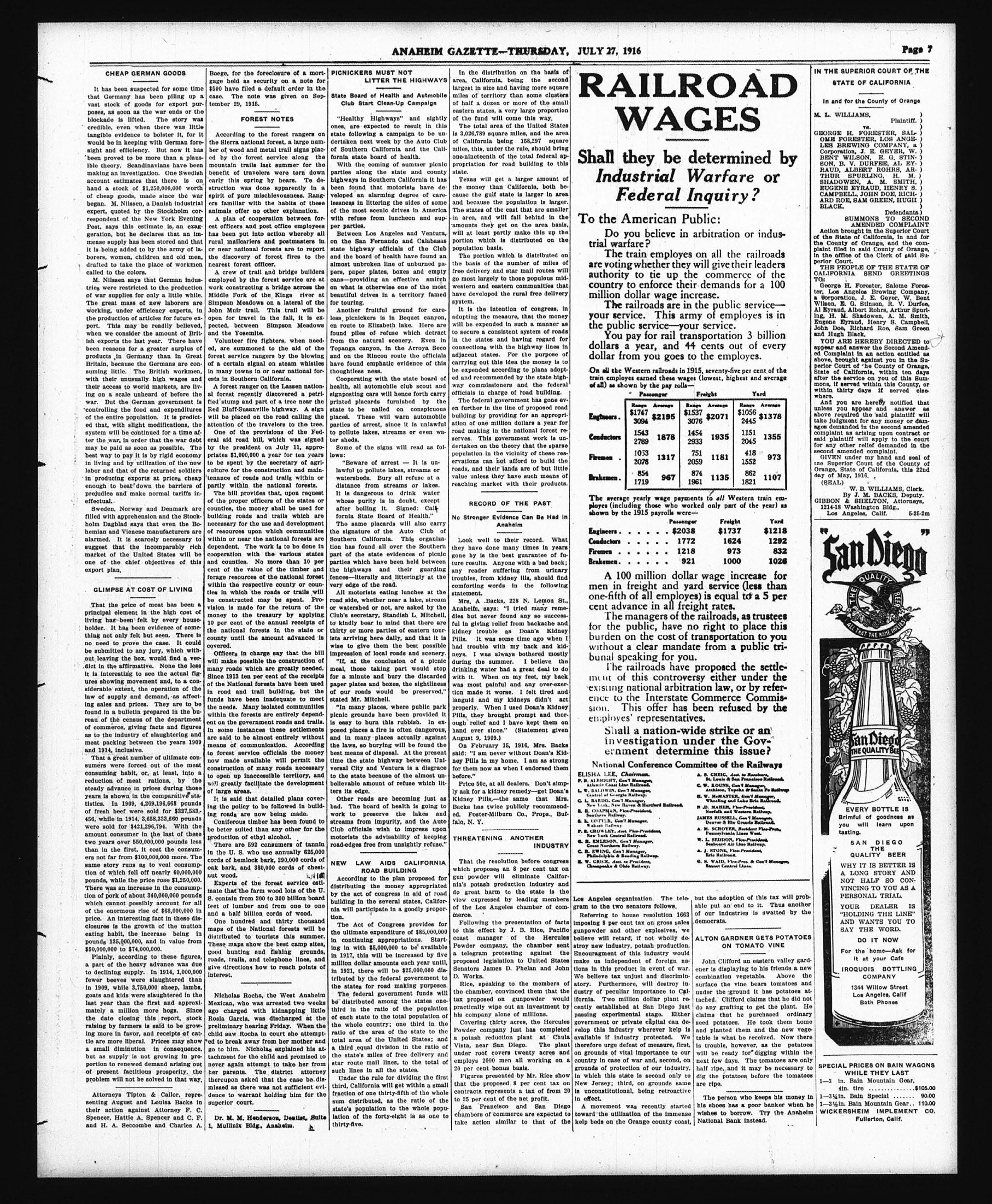
Searchable text
CHEAP GERMAN GOODS
It has been suspected for some time that Germany has been piling up a vast stock of goods for export purposes, as soon as the war ends or the blockade is lifted. The story was credible, even when there was little tangible evidence to bolster it, for it would be in keeping with German fore-sight and efficiency. But now it has been proved to be more than a plausible theory. Scandinavians have been making an investigation. One Swedish account estimates that there is on hand a stock of $1,250,000,000 worth of cheap goods, made since the war began. M. Nilssen, a Danish industrial expert, quoted by the Stockholm correspondent of the New York Evening Post, says this estimate is, an exaggeration, but he declares that an immense supply has been stored and that it is being added to by the army of laborers, women, children and old men, drafted to take the place of workmen called to the colors.
M. Nilssen says that German industries were restricted to the production of war supplies for only a little while. The great mass of new laborers are working, under efficiency experts, in the production of articles for future export. This may be readily believed, when we consider the amount of British exports the last year. There have been reasons for a greater surplus of products in Germany than in Great Britain, because the Germans are consuming little. The British workmen, with their unusually high wages and their access to world markets, are living on a scale unheard of before the war. But the German government is controlling the food and expenditures of the entire population. It is predicted that, with slight modifications, the system will be continued for a time after the war, in order that the war debt may be paid as soon as possible. The Boege, for the foreclosure of a mortgage held as security on a note for $500 have filed a default order in the case. The note given on September 29, 1915.
FOREST NOTES
According to the forest rangers on the Sierra national forest, a large number of wood and metal trail signs placed by the forest service along the mountain trails last summer for the benefit of travelers were torn down early this spring by bears. To destruction was done apparently in a spirit of pure mischievousness. Rangers familiar with the habits of these animals offer no other explanation.
A plan of cooperation between forest officers and post office employees has been put into action whereby all rural mail carriers and postmasters in or near national forests are to report the discovery of forest fires to the nearest forest officer.
A crew of trail and bridge builders employed by the forest service are at work constructing a bridge across the Middle Fork of the Kings river at Simpson Meadows on a lateral of the John Muir trail. This trail will be open for travel in the fall, it is expected, between Simpson Meadows and the Yosemite.
Volunteer fire fighters, when needed, are summoned to the aid of the forest service rangers by the blowing of a certain signal on steam whistles in many towns in or near national forests in Southern California.
A forest ranger on the Lassen national forest recently discovered a petrified stump and part of a tree near the Red Bluff-Susanville highway. A sign will be placed on the road calling the attention of the travelers to the tree.
One of the provisions of the Federal aid road bill, which was signed by the president on July 11, approves health, all auxiliary signposting can be printed placetate state to be places. These parties of arm to pollute lake sheds.
PICNICKEREL
State Board Club Stars
"Healthy ones, are extreme state following dertaken next of Southern fornia state state With the parties along highways in S been found developed an lessness in life of the most with refuse per parties.
Between Lake on the San State highway and the board almost unbroken papers, paper pans—providing on what is often beautiful drive for touring.
Another free less picnicken route to K found piles o from the nat Topanga canny and on the R have found e thoughtless n Cooperating health, all auxiliary signposting can be printed placetate state to be places. These parties of arm to pollute lake sheds.
Some of th
GLIMPSE AT COST OF LIVING
That the price of meat has been a principal element in the high cost of living has been felt by every householder. It has been evidence of something not only felt but seen. There is no need to prove the case. It could be submitted to any jury, which without leaving the box, would find a verdict in the affirmative. None the less it is interesting to see the actual figures showing movement and, to a considerable extent, the operation of the law of supply and demand, as affecting sales and prices. They are to be found in a bulletin prepared in the bureau of the census of the department of commerce, giving facts and figures as to the industry of slaughtering and meat packing between the years 1909 and 1914, inclusive.
That a great number of ultimate consumers were forced out of the meat consuming habit, or, at least, into a reduction of meat rations, by the steady advance in prices during those years is shown in the comparative statistics. In 1909, 4,209,196,668 pounds of fresh beef were sold for $327,583,-456, while in 1914, 3,658,333,660 pounds were sold for $421,296,794. With the amount consumer in the last of these two years over 550,000,000 pounds less than in the first, it cost the consum-
forest service rangers by the blowing of a certain signal on steam whistles in many towns or near national forests in Southern California.
A forest ranger on the Lassen national forest recently discovered a petrified stump and part of a tree near the Red Bluff-Susanville highway. A sign will be placed on the road calling the attention of the travelers to the tree.
One of the provisions of the Federal aid road bill, which was signed by the president on July 11, appropriates $1,000,000 a year for ten years to be spent by the secretary of agriculture for the construction and maintenance of roads and trails within or partly within the national forests.
The bill provides that, upon request of the proper officers of the states or counties, the money shall be used for building roads and trails which are necessary for the use and development of resources upon which communities within or near the national forests are dependent. The work is to be done in cooperation with the various states and counties. No more than 10 per cent of the value of the timber and forage resources of the national forest within the respective county or counties in which the roads or trails will be constructed may be spent. Provision is made for the return of the money to the treasury by applying 10 per cent of the annual receipts of the national forests in the state or county until the amount advanced is covered.
Officers in charge say that the bill will make possible the construction of many roads which are greatly needed. Since 1913 ten per cent of the receipts of the National forests have been used in road and trail building, but the funds have been inadequate to meet the needs. Many isolated communities within the forests are entirely dependent on the government roads and trails. In some instances these settlements are said to be almost entirely without means of communication. According to forest service officials the money now made available will permit the construction of many roads necessary to open up inaccessible territory, and will greatly facilitate the development of large areas.
It is said that detailed plans covering the policy to be followed in building roads are now being made.
Coniferous timber has been found to be better suited than any other for the production of ethyl alcohol.
There are 592 consumers of tannin and on the Rivers have found even thoughtless mills.
Cooperating health, all auxiliary signposting can be printed placard state to be places. These parties of arm to pollute lake terds.
Some of these lowes:
"Beware lawful to poach watersheds distance free It is danger whose purity after boiling formia State The same is the signature Southern Californias has found part of the parties whichthe highways fences—literally very edge of its All motorists road side, where or watershed Club's secret to kindly bear thirty or more artists arriving wise to give impression of "If, at their meal, those for a minute paper plates sit of our roads stated Mr. M.
"In many picnic grounds is easy to buy posed places and in many laws,the laws so best means of time the state versal City and to the state b believable attractors its edge.
Other road bad. The book work to pre-streams from Club officials motorists theroad-edges fro
That a great number of ultimate consumers were forced out of the meat consuming habit, or, at least, into a reduction of meat rations, by the steady advance in prices during those years is shown in the comparative statistics. In 1909, 4,209,196,668 pounds of fresh beef were sold for $327,583,456, while in 1914, 3,658,333,660 pounds were sold for $421,296,794. With the amount consumer in the last of these two years over 550,000,000 pounds less than in the first, it cost the consumers not far from $100,000,000 more. The same story runs as to veal consumption of which fell off nearly 60,000,000 pounds, while the price rose $1,250,000. There was an increase in the consumption of pork of about 340,000,000 pounds which cannot possibly account for all of the enormous rise of $68,000,000 in price. An interesting fact in these disclosures is the growth of the mutton eating habit, the incerase being in pounds 135,000,000, and in value from $50,000,000 to $74,000,000.
Plainly, according to these figures, a part of the heavy advance was due to declining supply. In 1914, 1,000,000 fewer beeves were slaughtered than in 1909, while 3,750,000 sheep, lambs, goats and kids were slaughtered in the last year than the first and approximately a million more hogs. Since the date closing this report, stock raising by farmers is said to be growing more in favor, and receipts of cattle are more liberal. Prices may show a small diminution in consequence, but as supply is not growing in proportion to renewed demand arising out of present factitious prosperity, the problem will not be solved in that way.
Attorneys Tipton & Callor, representing August and Louisa Backs in their action against Attorney F. C. Spencer, Hattie A. Spencer and C. F. and H. A. Seccombe and Charles A.
Nicholas Rocha, the West Anaheim Mexican, who was arrested two weeks ago charged with kidnapping little Rosla Garcia, was discharged at the preliminary hearing Friday. When the child saw Rocha in court she attempted to break away from her mother and go to him. Nicholas explained his attachment for the child and promised to never again attempt to take her from her parents. The district attorney thereupon asked that the case be dismissed as there was not sufficient evidence to warrant holding him for the superior court.
Dr. M. M. Henderson, Dentist, Suite 1, Mullinix Bldg., Anaheim.
ANAHEIM GAZETTE—THURSDAY, JULY 27, 1916
PICNICKERS MUST NOT LITTER THE HIGHWAYS
State Board of Health and Automobile Club Start Clean-Up Campaign
"Healthy Highways" and sightly ones, are expected to result in this state following a campaign to be undertaken next week by the Auto Club of Southern California and the California state board of health.
With the coming of summer picnic parties along the state and county highways in Southern California it has been found that motorists have developed an alarming degree of carelessness in littering the sides of some of the most scenic drives in America with refuse from luncheon and supper parties.
Between Los Angeles and Ventura, on the San Fernando and Calabasas state highway officials of the Club and the board of health have found an almost unbroken line of unburned papers, paper plates, boxes and empty cans—providing an effective smirch on what is otherwise one of the most beautiful drives in a territory famed for touring.
Another fruitful ground for careless picnickers is in Boquet canyon, en route to Elizabeth lake. Here are found piles of refuse which detract from the natural scenery. Even in Topanga canyon, in the Arroya Seco and on the Rincon route the officials have found emphatic evidence of this thoughtlessness.
Cooperating with the state board of health, all automobile club scout and signposting cars will hence forth carry printed placards furnished by the state to be nailed on conspicuous places. These will warn automobile parties of arrest, since it is unlawful to pollute lakes, streams or even water sheds.
Some of the signs will read as follows:
In the distribution on the basis of area, California, being the second largest in size and having more square miles of territory than some clusters of half a dozen or more of the small eastern states, a very large proportion of the fund will come this way.
The total area of the United States is 3,026,789 square miles, and the area of California being 158,297 square miles, this, under the rule, should bring one-ninetenth of the total federal appropriation for road building to this state.
Texas will get a larger amount of the money than California, both because the gulf state is larger in area and because the population is larger. The states of the east that are smaller in area, and will fall behind in the amounts they get on the area basis, will at least partly make this up the portion which is distributed on the population basis.
The portion which is distributed on the basis of the number of miles of free delivery and star mail routes will go most largely to those populous midwestern and eastern communities that have developed the rural free delivery system.
It is the intention of congress, in adopting the measure, that the money will be expended in such a manner as to secure a consistent system of roads in the states and having regard for connections with the highway lines in adjacent states. For the purpose of carrying out this idea the money is to be expended according to plans adopted and recommended by the state highway commissioners and the federal officials in charge of road building.
The federal government has gone even further in the line of proposed road building by providing for an appropriation of one million dollars a year for road making in the national forest reserves. This government work is undertaken on the theory that the sparse
and on the Rincon route the officials have found emphatic evidence of this thoughtlessness.
Cooperating with the state board of health, all automobile club scout and signposting cars will hence forth carry printed placards furnished by the state to be nailed on conspicuous places. These will warn automobile parties of arrest, since it is unlawful to pollute lakes, streams or even water sheds.
Some of the signs will read as follows:
"Beware of arrest — It is unlawful to pollute lakes, streams or watersheds. Bury all refuse at a distance from streams or lakes. It is dangerous to drink water whose purity is in doubt, except after boiling it. Signed: California State Board of Health."
The same placards will also carry the signature of the Auto Club of Southern California. This organization has found all over the Southern part of the state evidences of picnic parties which have been held between the highways and their guarding fences—literally and bitterly at the very edge of the road.
All motorists eating lunches at the road side, whether near a lake, stream or watershed or not, are asked by the Club's secretary, Standish L. Mitchell, to kindly bear in mind that there are thirty or more parties of eastern tourists arriving here daily, and that it is wise to give them the best possible impression of local roads and scenery.
"If, at the conclusion of a picnic meal, those taking part would stop for a minute and bury the discarded paper plates and boxes, the sightliness of our roads would be preserved," stated Mr. Mitchell.
"In many places, where public park picnic grounds have been provided it is easy to burn this rubbish. In exposed places a fire is often dangerous, and in many places actually against the laws, so burying will be found the best means of disposal. At the present time the state highway between Universal City and Ventura is a disgrace to the state because of the almost unbelievable amount of refuse which litters its edge.
Other roads are becoming just as bad. The board of health is going to work to preserve the lakes and streams from impurity, and the Auto Club officials wish to impress upon motorists the advisability of keeping road-edges free from unsightly refuse."
RECORD OF THE PAST
No Stronger Evidence Can Be Had in Anaheim
Look well to their record. What they have done many times in years gone by is the best guarantee of future results. Anyone with a bad back; any reader suffering from urinary troubles, from kidney ills, should find comforting words in the following statement.
Mrs. A. Backs, 228 N. Lemon St., Anaheim, says: "I tried many remedies but never found any so successful in giving relief from backache and kidney trouble as Doan's Kidney Pills. It was some time ago when I had trouble with my back and kidneys. I was always bothered mostly during the summer. I believe the drinking water had a great deal to do with it. When on my feet, my back was most painful and any over-exertion made it worse. I felt tired and langued and my kidneys didn't act properly. When I used Doan's Kidney Pills, they brought prompt and thorough relief and I have kept them on hand ever since." (Statement given August 9, 1909.)
On February 15, 1916, Mrs. Backs said: "I am never without Doan's Kidney Pills in my home. I am as strong for them now as when I endorsed them before."
Price 50c, at all dealers. Don't simply ask for a kidney remedy—get Doan's Kidney Pills—the same that Mrs. Backs has twice publicly recommended. Foster-Milburn Co., Props., Buffalo, N. Y.
THREATENING ANOTHER INDUSTRY
NEW LAW AIDS CALIFORNIA ROAD BUILDING
According to the plan proposed for distributing the money appropriated by the act of congress in aid of road building in the several states, California will participate in a goodly proportion.
The Act of Congress provides for the ultimate expenditure of $85,000,000 in continuing appropriations. Starting in with $5,000,000 to be available in 1917, this will be increased by five million dollar amounts each year until, in 1921, there will be $25,000,000 distributed by the federal government to the states for road making purposes.
The federal government funds will be distributed among the states one-third in the ratio of the population of each state to the total population of the whole country; one third in the ratio of the area of the state to the total area of the United States; and a third equal division in the ratio of the state's miles of free delivery and star route mail lines, to the total of such lines in all the states.
Under the rule for dividing the first third, California will get within a small fraction of one thirty-fifth of the whole distributed, as the ratio of the state's population to the whole population of the forty-eight is as one to thirty-five.
That the resolution before congress which proposes an 8 per cent tax on gun powder will eliminate California's potash production industry and do great harm to the state is the view expressed by leading members of the Los Angeles chamber of commerce.
Following the presentation of facts to this effect by J. B. Rice, Pacific coast manager of the Hercules Powder company, the chamber sent a telegram protesting against the proposed legislation to United States Senators James D. Phelan and John D. Works.
Rice, speaking to the members of the chamber, convinced them that the tax proposed on gunpowder would practically wipe out an investment by his company alone of millions.
Covering thirty acres, the Hercules Powder company just has completed a potash reduction plant at Chula Vista, near San Diego. The plant under roof covers twenty acres and employs 2000 men all working on a 20 per cent bonus basis.
Figures presented by Mr. Rice show that the proposed 8 per cent tax on contracts represents a tax of from 20 to 25 per cent of the net profit.
San Francisco and San Diego chambers of commerce are expected to take action similar to that of the
Los Angeles organization. The telegram to the two senators follows.
Referring to house resolution 1663 imposing 8 per cent tax on gross sales gunpowder and other explosives, we believe will retard, if not wholly destroy new industry, potash production. Encouragement of this industry would make us independent of foreign nations in this product in event of war. We believe tax unjust and discriminatory. Furthermore, will destroy industry of peculiar importance to California. Two million dollar plant recently established at San Diego just passing experimental stage. Either government or private capital can develop this industry wherever kelp is available if industry protected. We therefore urge defeat of measure, first, on grounds of vital importance to our country in case of war and, second, on grounds of protection of our industry, in which this state is second only to New Jersey; third, on grounds same is unconstitutional, being retroactive in effect.
A movement was recently started toward the utilization of the immense kelp beds on the Orange county coast,
RAILROAD WAGES
Do they be determined by Industrial Warfare or Federal Inquiry?
American Public:
Do you believe in arbitration or industrial warfare?
The train employs on all the railroads whether they will give their leaders authority to tie up the commerce of the city to enforce their demands for a 100 dollar wage increase.
The railroads are in the public service—service. This army of employees is in public service—your service.
Pay for rail transportation 3 billion a year, and 44 cents out of every from you goes to the employes.
Western railroads in 1915, seventy-five per cent of the employees earned these wages (lowest, highest and average known by the pay rolls—
IN THE SUPERIOR COURT OF THE STATE OF CALIFORNIA
In and for the County of Orange
M. L. WILLIAMS,
Plaintiff.
GEORGE H. FORESTER, SALOME FORESTER, LOS ANGELES BREWING COMPANY, a Corporation, J. E. GEYER, W. BENT WILSON, E. G. STINSON, B. V. DURFEE, AL EYRAUD, ALBERT ROHRS, ARTHUR SPURLING, H. M. SHADOWEN, A. M. SMITH, EUGENE EYRAUD, HENRY S. CAMPBELL, JOHN DOE, RICHARD ROE, SAM GREEN, HUGH BLACK.
Defendants.
SUMMONS TO SECOND AMENDED COMPLAINT
Action brought in the Superior Court of the State of California, in and for the County of Orange, and the complaint filed in said County of Orange, in the office of the Clerk of said Superior Court.
THE PEOPLE OF THE STATE OF CALIFORNIA SEND GREETINGS TO:
George H. Forester, Salome Forester, Los Angeles Brewing Company, a Corporation, J. E. Geyer, W. Bent Wilson, E. G. Stinson, R. V. Durfee, Al Eyraud, Albert Rohrs, Arthur Spurling, H. M. Shadowen, A. M. Smith, Eugene Eyraud, Henry S. Campbell, John Doe, Richard Roe, Sam Green and Hugh Black.
YOU ARE HEREBY DIRECTED to appear and answer the Second Amended Complaint in an action entitled as above, brought against you in the Superior Court of the County of Orange, State of California, within ten days after the service on you of this summons, if served within this County, or within thirty days if served elsewhere.
And you are hereby notified that unless you appear and answer as above required the said plaintiff will take judgment for any money or damages demanded in the second amended complaint as arising upon contract or said plaintiff will apply to the court for any other relief demanded in the
Western railroads in 1915, seventy-five per cent of the employees earned these wages (lowest, highest and average known by the pay rolls—
Passenger Freight Yard
Range Average Range Average Range Average
$1747 $2195 $1537 $2071 $1056 $1378
3094 3076 3076 3076 2445 2445
1543 1878 1454 1935 1151 1355
2789 2933 2933 2933 2045 2045
1053 1317 751 1181 418 973
2078 2059 2059 2059 1552 1552
854 967 874 1135 862 1107
1719 1961 1961 1961 1821 1821
Age yearly wage payments to all Western train em- including those who worked only part of the year) as the 1915 payrolls were—
Passenger Freight Yard
Range Average Range Average Range Average
$2038 $1737 $1218
1772 1624 1292
1218 973 832
921 1000 1026
$00 million dollar wage increase for freight and yard service (less than half of all employes) is equal to a 5 per cent advance in all freight rates.
The managers of the railroads, as trustees on the cost of transportation to you, at a clear mandate from a public tri- speaking for you.
The railroads have proposed the settle- of this controversy either under the national arbitration law, or by refer- to the Interstate Commerce Commis- This offer has been refused by the states' representatives.
Will a nation-wide strike or an investigation under the Gov- ment determine this issue?
All Conference Committee of the Railways
Chairman,
Sen't Manager,
Lane Railroad.
Sen't Manager,
Railway.
Manager,
Haven & Hartford Railroad.
Sen't President,
Railway.
Manager,
Haven & Hartford Railroad.
Sen't President,
Railway.
A. S. GREIG, Act. to Recollect, St. Louis & San Francisco Railroad.
C. W. KOUNS, Con't Manager, Atchison, Topka & Santa Fe Railways.
H. W. McMASTER, Con't Manager, Wheeling and Lake Erie Railroad.
N. D. MARER, Vice-President, Norfolk and Western Railway.
JAMES RUSSELL, Con't Manager, Denver & Rio Grande Railroad.
A. M. SCHOYER, Resident Plea-Pronto, Pennsylvania Lines West.
W. L. SEDDON, Vice-President, Seaboard Air Line Railway.
EVERY BOTTLE IS Brimful of goodness as you will learn upon tasting.
SAN DIEGO THE
ALTON GARDNER GETS POTATOES ON TOMATO VINE
John Clifford an eastern valley gardener is displaying to his friends a new combination vegetable. Above the surface the vine bears tomatoes and under the ground it has potatoes attached. Clifford claims that he did not do any grafting to get the plant. He claims that he purchased ordinary seed potatoes. He took them home and planted them and the new vegetable is what he received. Now there is trouble, however, as the potatoes will be ready for digging within the next few days. The tomatoes are only half ripe, and it may be necessary to dig the potatoes before the tomatoes are ripe.
The person who keeps his money in his shoes has a poor banker when he wishes to borrow. Try the Anaheim National Bank instead.
EVERY BOTTLE IS Brimful of goodness as you will learn upon tasting.
SAN DIEGO
THE QUALITY BEER
WHY IT IS BETTER IS A LONG STORY AND NOT HALF SO CONVINCING TO YOU AS A PERSONAL TRIAL.
YOUR DEALER IS "HOLDING THE LINE" AND WANTS YOU TO SAY THE WORD.
DO IT NOW
For the home—Ask for it at your Cafe
IROQUOIS BOTTLING COMPANY
1344 Willow Street Los Angeles, Calif Both Phones
SPECIAL PRICES ON BAIN WAGONS WHILE THEY LAST
1—3 in. Bain Mountain Gear,
4in. tire ... $105.00
1—3¼in. Bain Special ... 90.00
1—3½in. Bain Mountain Gear... 110.00
WICKERSHEIM IMPLEMENT CO.
Fullerton, Calif.