anaheim-gazette 1916-06-29
Scanned page
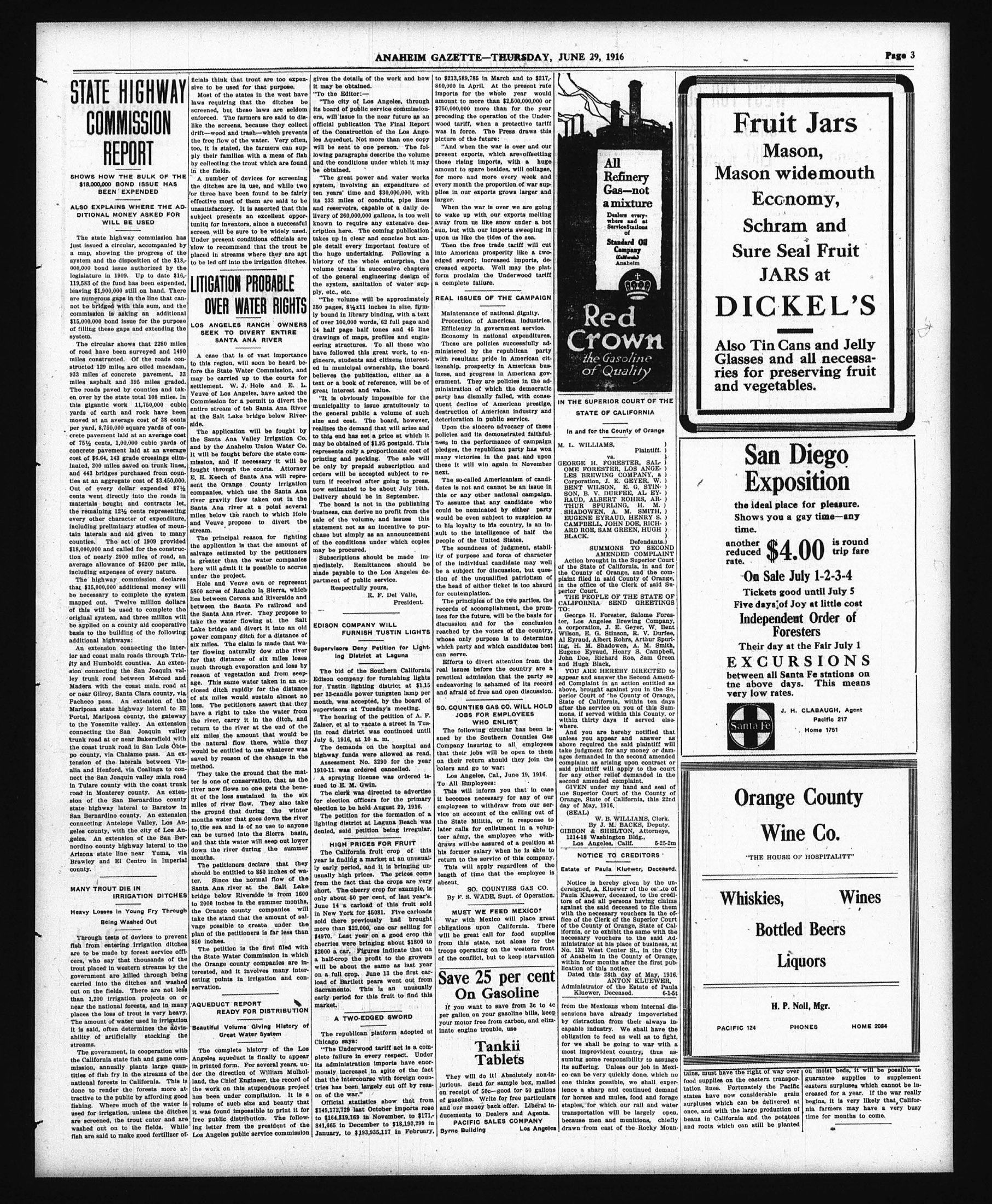
Searchable text
STATE HIGHWAY COMMISSION REPORT
SHOWS HOW THE BULK OF THE $18,000,000 BOND ISSUE HAS BEEN EXPENDED
ALSO EXPLAINS WHERE THE ADDITIONAL MONEY ASKED FOR WILL BE USED
The state highway commission has just issued a circular, accompanied by a map, showing the progress of the system and the disposition of the $18,000,000 bond issue authorized by the legislature in 1909. Up to date $16,-119,583 of the fund has been expended, leaving $1,900,000 still on hand. There are numerous gaps in the line that cannot be bridged with this sum, and the commission is asking an additional $15,000,000 bond issue for the purpose of filling these gaps and extending the system.
The circular shows that 2280 miles of road have been surveyed and 1490 miles constructed. Of the roads constructed 129 miles are oiled macadam, 933 miles of concrete pavement, 33 miles asphalt and 395 miles graded. The roads paved by counties and taken over by the state total 108 miles. In this gigantic work 11,750,000 cubic yards of earth and rock have been moved at an average cost of 38 cents per yard, 8,750,000 square yards of concrete pavement laid at an average cost of 75½ cents, 1,000,000 cubic yards of officials think that trout are too expensive to be used for that purpose.
Most of the states in the west have laws requiring that the ditches be screened, but these laws are seldom enforced. The farmers are said to dislike the screens, because they collect drift—wood and trash—which prevents the free flow of the water. Very often, too, it is stated, the farmers can supply their families with a mess of fish by collecting the trout which are found in the fields.
A number of devices for screening the ditches are in use, and while two or three have been found to be fairly effective most of them are said to be unsatisfactory. It is asserted that this subject presents an excellent opportunity for inventors, since a successful screen will be sure to be widely used. Under present conditions officials are slow to recommend that the trout be placed in streams where they are apt to be led off into the irrigation ditches.
LITIGATION PROBABLE OVER WATER RIGHTS
LOS ANGELES RANCH OWNERS SEEK TO DIVERT ENTIRE SANTA ANA RIVER
A case that is of vast importance to this region, will soon be heard before the State Water Commission, and may be carried up to the courts for settlement. W. J. Hole and E. L. Veuve of Los Angeles, have asked the Commission for a permit to divert the entire stream of teh Santa Ana River at the Salt Lake bridge below River-side.
The application will be fought by the Santa Ana Valley Irrigation Co. and by the Anahelm Union Water Co.
gives the details of it may be obtained.
"To the Editor:——
"The city of Los Angeles board of public officers will issue in this official publication of the Construction les Aqueduct. Not only will be sent to one lowing paragraphs and the conditions be obtained.
"The great power system, involving ten years' time and its 233 miles of coast and reservoirs, cap livery of 260,000,000 known to require description here. They takes up in clear air ple detail every in the huge undertaking history of the whole volume treats in all of the general engine systems, sanitation plly, etc."
"The volume will 350 pages, 8½×11 inches bound in library of over 100,000 works 24 half page half drawings of maps, eering structures. Have followed this gineers, students and ed in municipal own believes the public text or a book of great interest and."
"It is obviously municipality to issue the general public size and cost. The realizes the demands to this end has set may be obtained."
miles constructed. Of the roads constructed 129 miles are oiled macadam, 933 miles of concrete pavement, 33 miles asphalt and 395 miles graded. The roads paved by counties and taken over by the state total 108 miles. In this gigantic work 11,750,000 cubic yards of earth and rock have been moved at an average cost of 38 cents per yard, 8,750,000 square yards of concrete pavement laid at an average cost of 75½ cents, 1,000,000 cubic yards of concrete pavement laid at an average cost of $6.64, 143 grade crossings eliminated, 200 miles saved on trunk lines, and 443 bridges purchased from counties at an aggregate cost of $3,450,000. Out of every dollar expended 87½ cents went directly into the roads in materials bought and contracts let, the remaining 12½ cents representing every other character of expenditure, including preliminary studies of mountain laterals and aid given to many counties. The act of 1909 provided $18,000,000 and called for the construction of nearly 2900 miles of road, an average allowance of $6200 per mile, including expenses of every nature.
The highway commission declares that $15,000,000 additional money will be necessary to complete the system mapped out. Twelve million dollars of this will be used to complete the original system, and three million will be applied on a county aid cooperative basis to the building of the following additional highways:
An extension connecting the interior and coast main roads through Trinity and Humboldt counties. An extension connecting the San Joaquin valley trunk road between Merced and Madera with the coast main road at or near Gilroy, Santa Clara county, via Pacheco pass. An extension of the Mariposa state highway lateral to El Portal, Mariposa county, the gateway to the Yosemite valley. An extension connecting the San Joaquin valley trunk road at or near Bakersfield with the coast trunk road in San Luis Obispo county, via Chalame pass. An extension of the laterals between Visalia and Henford, via Coalinga to connect the San Joaquin valley main road in Tulare county with the coast trunk road in Monterey county. An extension of the San Bernardino county state highway lateral to Barstow in San Bernardino county. An extension connecting Antelope Valley, Los Angeles county, with the city of Los Angeles. An extension of the San Bernardino county highway lateral to the
A case that is of vast importance to this region, will soon be heard before the State Water Commission, and may be carried up to the courts for settlement. W. J. Hole and E. L. Veuve of Los Angeles, have asked the Commission for a permit to divert the entire stream of teh Santa Ana River at the Salt Lake bridge below River-side.
The application will be fought by the Santa Ana Valley Irrigation Co. and by the Anaheim Union Water Co. It will be fought before the state commission, and if necessary it will be fought through the courts. Attorney E. E. Keech of Santa Ana will represent the Orange County irrigation companies, which use the Santa Ana river gravity flow taken out in the Santa Ana river at a point several miles below the ranch to which Hole and Veuve propose to divert the stream.
The principal reason for fighting the application is that the amount of salvage estimated by the petitioners is greater than the water companies here will admit it is possible to accrue under the project.
Hole and Veuve own or represent 5800 acres of Rancho la Sierra, which lies between Corona and Riverside and between the Santa Fe railroad and the Santa Ana river. They propose to take the water flowing at the Salt Lake bridge and divert it into an old power company ditch for a distance of six miles. The claim is made that water flowing naturally downthe river for that distance of six miles loses much through evaporation and loss by reason of vegetation and from seepage. This same water taken in an enclosed ditch rapidly for the distance of six miles would sustain almost no loss. The petitioners assert that they have a right to take the water from the river, carry it in the ditch, and return to the river at the end of the six miles the amount that would be the natural flow there, while they would be entitled to use whatever was saved by reason of the change in the method.
They take the ground that the matter is one of conservation, that as river now flows no one gets benefit of the loss sustained in the six miles of river flow. They also take the ground that during the winter months water that goes down the river to the sea and is of no use to anyone can be turned into the Sierra basin, and that this water will seep out lower down the river during the summer.
"It is obviously not municipality to issue the general public size and cost. The realizes the demand to this end has set it may be obtained only a print printing and packing be only by prepay orders will be accepted turn if received after now estimated to be Delivery should be."
The board is now business, can derive sale of the volume statement not as a chase but simply a of the conditions may be procured.
Subscriptions should mediate. Remit made payable to the partment of public Respectfully
EDISON COMPANY
FURNISHING DISTRICT
The bid of the Edison company for Tustin lighting per 32-candle power month, was accepted supervisors at Tuesday.
The hearing of the Zaiser, et al to vacillin road district July 5, 1916, at 10:30.
The demands on highway funds were Assessment No. 1910-11 was ordered.
A spraying license sued to E. M. Gwil.
The clerk was done for election office election to be held.
The petition for lighting district at denied, said petitions
MANY TROUT DIE IN IRRIGATION DITCHES
Heavy Losses in Young Fry Through Being Washed Out
Through tests of devices to prevent fish from entering irrigation ditches are to be made by forest service officers, who say that thousands of the trout placed in western streams by the government are killed through being carried into the ditches and washed out on the fields. There are not less than 1,200 irrigation projects on or near the national forests, and in many places the loss of trout is very heavy. The amount of water used in irrigation it is said, often determines the advisability of artificially stocking the streams.
The government, in cooperation with the California state fish and game commission, annually plants large quantities of fish fry in the streams of the national forests in California. This is done to render the forests more attractive to the public by affording good fishing. Where much of the water is used for irrigation, unless the ditches are screened, the trout enter and are washed out on to the fields. While fish are said to make good fertilizer of
AQUEDUCT REPORT READY FOR DISTRIBUTION
Beautiful Volume Giving History of Great Water System
The complete history of the Los Angeles aqueduct is finally to appear in printed form. For several years, under the direction of William Mulholland, the Chief Engineer, the record of the work on this stupendous project has been under compilation. It is a volume of such size and beauty that it was found impossible to print it for free public distribution. The following letter from the president of the Los Angeles public service commission
ANAHEIM GAZETTE—THURSDAY, JUNE 29, 1916
gives the details of the work and how it may be obtained.
"To the Editor:—
"The city of Los Angeles, through its board of public service commissioners, will issue in the near future an official publication The Final Report of the Construction of the Los Angeles Aqueduct. Not more than one copy will be sent to one person. The following paragraphs describe the volume and the conditions under which it may be obtained.
"The great power and water works system, involving an expenditure of ten years' time and $30,000,000, with its 233 miles of conduits, pipe lines and reservoirs, capable of a daily delivery of 260,000,000 gallons, is too well known to require any extensive description here. The coming publication takes up in clear and concise but ample detail every important feature of the huge undertaking. Following a history of the whole enterprise, the volume treats in successive chapters of the general engineering design of the system, sanitation of water supply, etc., etc.
"The volume will be approximately 350 pages, 8½ x 11 inches in size, firmly bound in library binding, with a text of over 100,000 words, 62 full page and 24 half page half tones and 45 line drawings of maps, profiles and engineering structures. To all those who have followed this great work, to engineers, students and citizens interested in municipal ownership, the board believes the publication, either as a text or a book of reference, will be of great interest and value.
"It is obviously impossible for the municipality to issue gratuitously to the general public a volume of such size and cost. The board, however, realizes the demand that will arise and to this end has set a price at which it may be obtained of $1.95 postpaid. This to $213,589,785 in March and to $217,800,000 in April. At the present rate imports for the whole year would amount to more than $2,500,000,000 or $750,000,000 more than for the year preceding the operation of the Underwood tariff, when a protective tariff was in force. The Press draws this picture of the future:
"And when the war is over and our present exports, which are offsetting those rising imports, with a huge amount to spare besides, will collapse, for more and more every week and every month the proportion of war supplies in our exports grows larger and larger.
When the war is over we are going to wake up with our exports melting away from us like snow under a hot sun, but with our imports sweeping in upon us like the tides of the sea.
Then the free trade tariff will cut into American prosperity like a two-edged sword; increased imports, decreased exports. Well may the platform proclaim the Underwood tariff a complete failure."
REAL ISSUES OF THE CAMPAIGN
Maintenance of national dignity.
Protection of American industries.
Efficiency in government service.
Economy in national expenditures.
These are policies successfully administered by the republican party with resultant pride in American citizenship. Prosperity in American business, and progress in American government. They are policies in the administration of which the democratic party has dismally failed, with consequent decline of American prestige, destruction of American industry and deterioration in public service.
Upon the sincere advocacy of these policies and its demonstrated faithfulness in the performance of campaign pledges the republican party has won
IN THE SUPERIOR COURT OF THE STATE OF CALIFORNIA
In and for the County of Orange
M. L. WILLIAMS,
Plaintiff.
VS.
GEORGE H. FORESTER, SAL-OME FORESTER, LOS ANGELES BREWING COMPANY, a Corporation, J. E. GEYER, W. BENT WILSON, E. G. STINSON, B. V. DURFEE, AL EYRAUD, ALBERT ROHRS, ARTHUR SPURLING, H. M. SHADOWEN, A. M. SMITH, EUGENE EYRAUD, HENRY S. CAMPBELL, JOHN DOE, RICHARD ROE, SAM GREEN, HUGH BLACK.
Defendants.
SUMMONS TO SECOND AMENDED COMPLAINT
Action brought in the Superior Court of the State of California, in and for the County of Orange, and the complaint filed in said County of Orange, in the office of the Clerk of said Superior Court.
THE PEOPLE OF THE STATE OF CALIFORNIA SEND GREETINGS TO:
George H. Forester, Salome Forester, Los Angeles Brewing Company, a corporation, J. E. Geyer, W. Bent Wilson, E. G. Stinson, R. V. Durfee, Al Eyraud, Albert Rohrs, Arthur Spurling, H. M. Shadowen, A. M. Smith, Eugene Eyraud, Henry S. Campbell, John Doe, Richard Roe, Sam Green and Hugh Black.
YOU ARE HEREBY DIRECTED to appear and answer the Second Amended Complaint in an action entitled as above, brought against you in the Superior Court of the County of Orange, State of California, within ten days after the service on you of this Summons, if served within this County, or within thirty days if served elsewhere.
And you are hereby notified that unless you appear and answer as above required the said plaintiff will take judgment for any money or damages demanded in the second amended complaint as arising upon contract or said plaintiff will apply to the court for any other relief demanded in the second amended complaint.
GIVEN under my hand and seal of une Superior Court of the County of Orange, State of California, this 22nd day of May, 1916.
(SEAL)
W. B. WILLIAMS, Clerk.
By J. M. BACKS, Deputy.
GIBBON & SHELTON, Attorneys,
1214-18 Washington Blvd., Los Angeles, Calif.
5-25-2m
HIGH PRICES FOR FRUIT
The California fruit crop of this year is finding a market at an unusually early period, and it is bringing unusually high prices. The prices come from the fact that the crops are very short. The cherry crop for example, is only about 50 per cent, of last year's June 14 carload of this fruit sold in New York for $5081. Five carloads sold there previously had brought more than $22,000, one car selling for $4970. Last year on a good crop the cherries were bringing about $1800 to $2000 a car. Figures indicate that on a half-crop the profit to the growers will be about the same as last year on a full crop. June 13 the first carload of Bartlett pears went out from Sacramento. This is an unusually early period for this fruit to find this market.
A TWO-EDGED SWORD
The republican platform adopted at Chicago says:
"The Underwood tariff act is a complete failure in every respect. Under its administration imports have enormously increased in spite of the fact that the intercourse with foreign countries has been largely cut off by reason of the war."
Official statistics show that from $149,172,729 last October imports rose to $164,319,169 in November, to $171,841,665 in December to $18,192,299 in January, to $193,935,117 in February,
Save 25 per cent On Gasoline
If you want to save from 3c to 4c per gallon on your gasoline bills, keep your motor free from carbon, and eliminate engine trouble, use
Tankii Tablets
They will do it! Absolutely non-injurious. Send for sample box, malled on receipt of 50c—good for 50 gallons of gasoline. Write for free particulars and our money back offer. Liberal inducements to Dealers and Agents.
PACIFIC SALES COMPANY
Byrne Building
Los Angeles
on their return should they join the colors and go to war:
Los Angeles, Cal., June 19, 1916.
To All Employees:
This will inform you that in case it becomes necessary for any of our employees to withdraw from our service on account of the calling out of the State Militia, or in response to later calls for enlistment in a volunteer army, the employee who withdraws will be assured of a position at his former salary when he is able to return to the service of this company.
This will apply regardless of the length of time that the employee is absent.
SO. COUNTIES GAS CO.
By F. S. WADE, Supt. of Operation.
MUST WE FEED MEXICO?
War with Mexico will place great obligations upon California. There will be great call for food supplies from this state, not alone for the troops operating on the western front of the conflict, but to keep starvation
Anton Kluewer,
Administrator of the Estate of Paula Kluewer, Deceased.
from the Mexicans whom internal disensions have already impoverished by distraction from their always incapable industry. We shall have the obligation to feed as well as to fight, for we shall be going to war with a most improvident country, thus assuming some responsibility to assuage its suffering. Unless our job in Mexico can be very quickly done, which no one thinks possible, we shall experience a sharp and continued demand for horses and mules, food and forage staples, for which our rail and water transportation will be largely open, because men and munitions, chiefly drawn from east of the Rocky Mountains, food satiation states surplus once, beans and r
Fruit Jars
Mason,
Mason widemouth
Economy,
Schram and
Sure Seal Fruit
JARS at
DICKEL'S
Also Tin Cans and Jelly
Glasses and all necessaries for preserving fruit
and vegetables.
San Diego
Exposition
the ideal place for pleasure.
Shows you a gay time—any
time.
another $4.00 is round
reduced trip fare
rate.
On Sale July 1-2-3-4
Tickets good until July 5
Five days of Joy at little cost
Independent Order of
Foresters
Their day at the Fair July 1
EXCURSIONS
between all Santa Fe stations on
the above days. This means
very low rates.
J. H. CLABAUGH, Agent
Pacific 217
Home 1751
Orange County
Wine Co.
Orange County
Wine Co.
"THE HOUSE OF HOSPITALITY"
Whiskies, Wines
Bottled Beers
Liquors
H. P. Noll, Mgr.
PACIFIC 124 PHONES HOME 2084
tains, must have the right of way over food supplies on the eastern transportation lines. Fortunately the Pacific states have now considerable grain surpluses which can be delivered at once, and with the large production of beans in California and the potatoes and roots which can still be planted on moist beds, it will be possible to guarantee supplies to supplement eastern surpluses which cannot be increased for a year. If the war really begins, it is very likely that California farmers may have a very busy time for months to come.