anaheim-gazette 1916-06-22
Scanned page
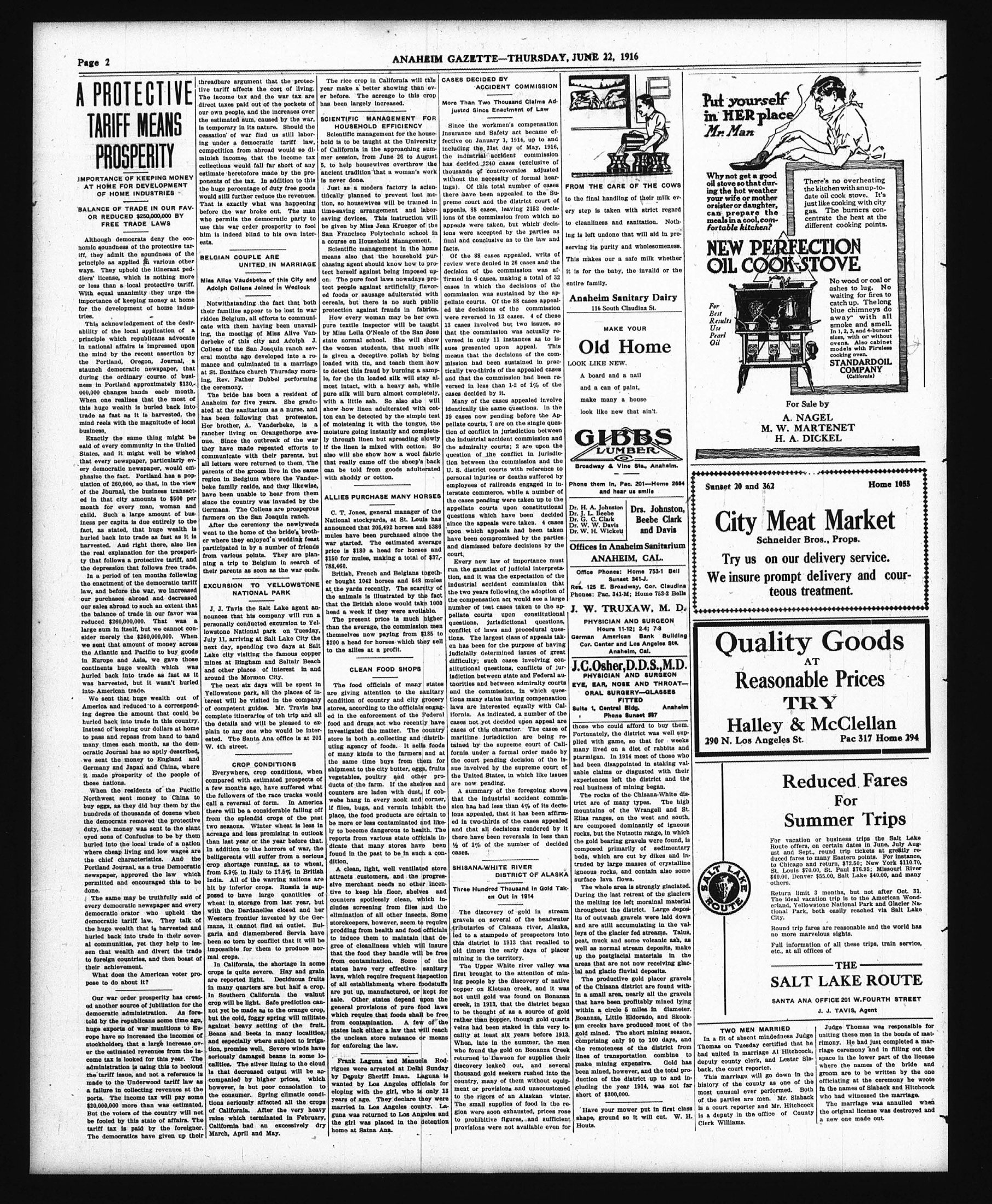
Searchable text
A PROTECTIVE TARIFF MEANS PROSPERITY
IMPORTANCE OF KEEPING MONEY AT HOME FOR DEVELOPMENT OF HOME INDUSTRIES
BALANCE OF TRADE IN OUR FAVOR REDUCED $250,000,000 BY FREE TRADE LAWS
Although democrats deny the economic soundness of the protective tariff, they admit the soundness of the principle as applied in various other ways. They uphold the itinerant peddlers' license, which is nothing more or less than a local protective tariff. With equal unanimity they urge the importance of keeping money at home for the development of home industries.
This acknowledgement of the desirability of the local application of a principle which republicans advocate in national affairs is impressed upon the mind by the recent assertion by the Portland, Oregon, Journal, a staunch democratic newspaper, that during the ordinary course of business in Portland approximately $130,-000,000 changes hands each month. When one realizes that the most of this huge wealth is hurled into trade as fast as it is harvested, the mind reels with the magnitude of local business.
Exactly the same thing might be said of every community in the United States.
threadbare argument that the protective tariff affects the cost of living. The income tax and the war tax are direct taxes paid out of the pockets of our own people, and the increases over the estimated sum, caused by the war, is temporary in its nature. Should the cessation of war find us still laboring under a democratic tariff law, competition from abroad would so diminish incomes that the income tax collections would fall far short of any estimate heretofore made by the proponents of the tax. In addition to this the huge percentage of duty free goods would still further reduce the revenues. That is exactly what was happening before the war broke out. The man who permits the democratic party to use this war order prosperity to fool him is indeed blind to his own interests.
BELGIAN COUPLE ARE UNITED IN MARRIAGE
Miss Alice Vaudebeke of this City and Adolph Collens Joined in Wedlock
Notwithstanding the fact that both their families appear to be lost in war ridden Belgium, all efforts to communicate with them having been unavailing, the meeting of Miss Alive Vanderbeke of this city and Adolph J. Collens of the San Joaquin ranch several months ago developed into a romance and culminated in a marriage at St. Boniface church Thursday morning, Rev. Father Dubbel performing the ceremony.
The bride has been a resident of Anaheim for five years. She graduated at the sanitarium as a nurse, and has been following that profession. Her brother, A. Vanderbeke, is a rancher living on Orangethorpe avenue. Since the outbreak of the war they have made repeated efforts to
The rice crop year make a better before. The has been largely
SCIENTIFIC MANHOUSE
Scientific manhood is to be taught of California in mer session, from 5, to help house ancient tradition is never done.
Just as a mostifically planned tion, so housewife time-saving arranges saving devices, be given by Miss San Francisco a course on Household Science manhood means also that chasing agent shect herself again on. The pure forest people against foods or sauces cereals, but the protection again.
How every woman pure textile insists by Miss Lella O'Neale state normal so the women stuil is given a decree loaded with timetable to detect this friele, for the tin linen most intact, will pure silk will be with a little ass show how linen ton can be detected of moistening it moisture going ly through linen if the linen is
the mind by the recent assertion by the Portland, Oregon, Journal, a staunch democratic newspaper, that during the ordinary course of business in Portland approximately $130,000,000 changes hands each month. When one realizes that the most of this huge wealth is hurled back into trade as fast as it is harvested, the mind reels with the magnitude of local business.
Exactly the same thing might be said of every community in the United States, and it might well be wished that every newspaper, particularly every democratic newspaper, would emphasize the fact. Portland has a population of 260,000, so that, in the view of the Jburnal, the business transacted in that city amounts to $500 per month for every man, woman and child. Such a large amount of business per capita is due entirely to the fact, as stated, that huge wealth is hurled back into trade as fast as it is harvested. And right there, also lies the real explanation for the prosperity that follows a protective tariff, and the depression that follows free trade.
In a period of ten months following the enactment of the democratic tariff law, and before the war, we increased our purchases abroad and decreased our sales abroad to such an extent that the balance of trade in our favor was reduced $260,000,000. That was a large sum in itself, but we cannot consider merely the $260,000,000. When we sent that amount of money across the Atlantic and Pacific to buy goods in Europe and Asia, we gave those continents huge wealth which was hurled back into trade as fast as it was harvested, but it wasn't hurled into American trade.
We sent that huge wealth out of America and reduced to a corresponding degree the amount that could be hurled back into trade in this country. Instead of keeping our dollars at home to pass and repass from hand to hand many times each month, as the democratic Journal has so aptly described, we sent the money to England and Germany and Japan and China, where it made prosperity of the people of those nations.
When the residents of the Pacific Northwest sent money to China to buy eggs, as they did buy them by the hundreds of thousands of dozens when the democrats removed the protective duty, the money was sent to the slant eyed sons of Confucius to be by them hurled into the local trade of a nation where living and low wages are
eral months ago developed into a romance and culminated in a marriage at St. Boniface church Thursday morning, Rev. Father Dubbel performing the ceremony.
The bride has been a resident of Anaheim for five years. She graduated at the sanitarium as a nurse, and has been following that profession. Her brother, A. Vanderbeke, is a rancher living on Orangethorpe avenue. Since the outbreak of the war they have made repeated efforts to communicate with their parents, but all letters were returned to them. The parents of the groom live in the same region in Bedgium where the Vanderbeke family reside, and they likewise have been unable to hear from them since the country was invaded by the Germans. The Collens are prosperous farmers on the San Joaquin ranch.
After the ceremony the newlyweds went to the home of the bride's brother where they enjoyed a wedding feast participated in by a number of friends from various points. They are planning a trip to Belgium in search of their parents as soon as the war ends.
EXCURSION TO YELLOWSTONE NATIONAL PARK
J. J. Tavis the Salt Lake agent announces that his company will run a personally conducted excursion to Yellowstone National park on Tuesday, July 11, arriving at Salt Lake City the next day, spending two days at Salt Lake city visiting the famous copper mines at Bingham and Saltair Beach and other places of interest in and around the Mormon City.
The next six days will be spent in Yellowstone park, all the places of interest will be visited in the company of competent guides. Mr. Travis has complete itineraries of teh trip and all the details and will be pleased to explain to any one who would be interested. The Santa Ana office is at 201 W. 4th street.
CROP CONDITIONS
Everywhere, crop conditions, when compared with estimated prospects of a few months ago, have suffered what the followers of the race tracks would call a reversal of form. In America there will be a considerable falling off from the splendid crops of the past two seasons. Winter wheat is less in acreage and less promising in outlook than last year or the year before that. In addition to the horrors of war, the
we sent the money to England and Germany and Japan and China, where it made prosperity of the people of those nations.
When the residents of the Pacific Northwest sent money to China to buy eggs, as they did buy them by the hundreds of thousands of dozens when the democrats removed the protective duty, the money was sent to the slant eyed sons of Confucius to be by them hurled into the local trade of a nation where cheap living and low wages are the chief characteristics. And the Portland Journal, as a true Democratic newspaper, approved the law which permitted and encouraged this to be done.
The same may be truthfully said of every democratic newspaper and every democratic orator who upheld the democratic tariff law. They talk of the huge wealth that is harvested and hurled back into trade in their several communities, yet they help to lessen that wealth and divert the trade to foreign countries, and then boast of their achievement.
What does the American voter propose to do about it?
Our war order prosperity has created another source of jubilation for the democratic administration. As foretold by the republicans some time ago, huge exports of war munitions to Europe have so increased the incomes of stockholders that a large increase over the estimated revenues from the income tax is looked for this year. The administration is using this to becloud the tariff issue, and not a reference is made to the Underwood tariff law as a failure in collecting revenues at the ports. The income tax will pay some $20,000,000 more than was estimated. But the voters of the country will not be fooled by this state of affairs. The tariff tax is paid by the foreigner. The democratics have given up their CROP CONDITIONS
Everywhere, crop conditions, when compared with estimated prospects of a few months ago, have suffered what the followers of the race tracks would call a reversal of form. In America there will be a considerable falling off from the splendid crops of the past two seasons. Winter wheat is less in acreage and less promising in outlook than last year or the year before that. In addition to the horrors of war, the belligerents will suffer from a serious crop shortage running, as to wheat, from 5.9% in Italy to 17.5% in British India. All of the warring nations are hit by inferior crops. Russia is supposed to have large quantities of wheat in storage from last year, but with the Dardanelles closed and her Western frontier invested by the Germans, it cannot find an outlet. Bulgaria and dismembered Servia have been so torn by conflict that it will be impossible for them to produce normal crops.
In California, the shortage in some crops is quite severe. Hay and grain are reported light. Deciduous fruits in many quarters are but half a crop. In Southern California the walnut crop will be light. Safe prediction cannot yet be made as to the orange crop, but the cold, foggy spring will militate against heavy setting of the fruit. Beans and beets in many localities, and especially where subject to irrigation, promise well. Severe winds have seriously damaged beans in some localities. The silver lining to the cloud is that decreased output will be accompanied by higher prices, which however, is but poor consolation to the consumer. Spring climatic conditions seriously affected all the crops of California. After the very heavy rains which terminated in February, California had an excessively dry March, April and May.
A clean, light attracts customers; sive merchants to keep counters spoolcludes screen-elimination o storekeepers; prodding fromto induce thereeeof cleanethat the foodfrom contaminatedstates havelawsswhich resultof all establishmentsare put up,mrsale. Othergeneralproviderswhichrequirefromcontainstates lackelthe uncleanfor enforcing.
Frank Lagriguez wereby Deputy S wanted by Eloplingwithyears of age.married in I guna was retiredthe girl washome at Satr
ANAHEIM GAZETTE—THURSDAY, JUNE 22, 1916
The rice crop in California will this year make a better showing than ever before. The acreage to this crop has been largely increased.
SCIENTIFIC MANAGEMENT FOR HOUSEHOLD EFFICIENCY
Scientific management for the household is to be taught at the University of California in the approaching summer session, from June 26 to August 5, to help housewives overthrow the ancient tradition that a woman's work is never done.
Just as a modern factory is scientifically planned to prevent lost motion, so housewives will be trained in time-saving arrangement and labor-saving devices. This instruction will be given by Miss Jean Krueger of the San Francisco Polytechnic school in a course on Household Management.
Scientific management in the home means also that the household purchasing agent should know how to protect herself against being imposed upon. The pure food laws nowadays protect people against artificially flavored foods or sausage adulterated with cereals, but there is no such public protection against frauds in fabrics.
How every woman may be her own pure textile inspector will be taught by Miss Lella O'Neale of the San Jose state normal school. She will show the women students, that much silk is given a deceptive polish by being loaded with tin, and teach them how to detect this fraud by burning a sample, for the tin loaded silk will stay almost intact, with a heavy ash, while pure silk will burn almost completely, with a little ash. So also she will show how linen adulterated with cotton can be detected by the simple test of moistening it with the tongue, the moisture going instantly and completely through linen but spreading slowly if the linen is mixed with cotton. So many of the cases appealed involve identically the same questions. In the 39 cases now pending before the Appellate courts, 7 are on the single question of conflict in jurisdiction between the industrial accident commission and the admiralty courts; 2 are upon the
CASES DECIDED BY ACCIDENT COMMISSION
More Than Two Thousand Claims Adjusted Since Enactment of Law
Since the workmen's compensation Insurance and Safety act became effective on January 1, 1914, up to and including the 31st day of May, 1916, the industrial accident commission has decided 2240 cases (exclusive of thousands of controversies adjusted without the necessity of formal hearings). Of this total number of cases there have been appealed to the Supreme court and the district court of appeals, 88 cases, leaving 2152 decisions of the commission from which no appeals were taken, but which decisions were accepted by the parties as final and conclusive as to the law and facts.
Of the 88 cases appealed, writs of review were denied in 26 cases and the decision of the commission was affirmed in 6 cases, making a total of 32 cases in which the decisions of the commission was sustained by the appellate courts. Of the 88 cases appealed the decisions of the commission were reversed in 13 cases. 4 of these 13 cases involved but two issues, so that the commission was actually reversed in only 11 instances as to issues presented upon appeal. This means that the decisions of the commission had been sustained in practically two-thirds of the appealed cases and that the commission had been reversed in less than 1-2 of 1% of the cases decided by it.
Many of the cases appealed involve identically the same questions. In the 39 cases now pending before the Appellate courts, 7 are on the single question of conflict in jurisdiction between the industrial accident commission and the admiralty courts; 2 are upon the
ALLIES PURCHASE MANY HORSES
C. T. Jones, general manager of the National stockyards, at St. Louis has announced that 205,492 horses and 5386 mules have been purchased since the war started. The estimated average price is $180 a head for horses and $150 for mules, making a total of $37,788,460.
British, French and Belgians together bought 1042 horses and 548 mules at the yards recently. The scarcity of the animals is illustrated by the fact that the British alone would take 1000 head a week if they were available.
The present price is much higher than the average, the commission men themselves now paying from $185 to $200 a head for horses which they sell to the allies at a profit.
CLEAN FOOD SHOPS
The food officials of many states are giving attention to the sanitary condition of country and city grocery stores, according to the officials engaged in the enforcement of the Federal food and drugs act who recently have investigated the matter. The country store is both a collecting and distributing agency of foods. It sells foods of many kinds to the farmers and at the same time buys from them for shipment to the city butter, eggs, fruits vegetables, poultry and other products of the farm. If the shelves and counters are laden with dust, if cobwebs hang in every nook and corner, if flies, bugs, and vermin inhabit the place, the food products are certain to be more or less contaminated and likely to become dangerous to health. The reports from various state officials indicate that many stores have been loaded with tin, and teach them how to detect this fraud by burning a sample, for the tin loaded silk will stay almost intact, with a heavy ash, while pure silk will burn almost completely, with a little ash. So also she will show how linen adulterated with cotton can be detected by the simple test of moistening it with the tongue, the moisture going instantly and completely through linen but spreading slowly if the linen is mixed with cotton. So also will she show how a wool fabric that really came off the sheep's back can be told from goods adulterated with shoddy or cotton.
Many of the cases appealed involve identically the same questions. In the 39 cases now pending before the Appellate courts, 7 are on the single question of conflict in jurisdiction between the industrial accident commission and the admiralty courts; 2 are upon the question of the conflict in jurisdiction between the commission and the U.S. district courts with reference to personal injuries or deaths suffered by employees of railroads engaged in interstate commerce, while a number of the cases pending were taken up to the appellate courts upon constitutional questions which have been decided since the appeals were taken. 4 cases upon which appeals had been taken have been compromised by the parties and dismissed before decisions by the court.
Every new law of importance must run the gauntlet of judicial interpretation, and it was the expectation of the industrial accident commission that two years following the adoption of the compensation act would see a large number of test cases taken to the appellate courts upon constitutional questions, jurisdictional questions, conflict of laws and procedural questions. The largest class of appeals taken has been for the purpose of having judiciously determined issues of great difficulty; such cases involving constitutional questions, conflicts of jurisdiction between state and Federal authorities and between admiralty courts and the commission, in which questions many states having compensation laws are interested equally with California. As indicated, a number of the cases not yet decided upon appeal are cases of this character. The cases of maritime jurisdiction are being retained by the supreme court of California under a formal order made by the court pending decision of the issue involved by the supreme court of the United States, in which like issues are now pending.
A summary of the foregoing shows that the industrial accident commission has had less than 4% of its decisions appealed, that it has been affirmed in two-thirds of the cases appealed and that all decisions rendered by it there have been reversals in less than ½ of 1% of the number of decided means that the decisions of the commission had been sustained in practically two-thirds of the appealed cases and that the commission had been reversed in less than 1-2 of 1% of the cases decided by it.
AGIBS LUMBER
Broadway & Vine Sta., Anaheim.
Phone them in, Pac. 201—Home 2664 and hear us smile
Dr. H. A. Johnston
Dr. J. L. Beebe
Dr. G. C. Clark
Dr. W. W. Davis
Dr. W. H. Wickett
Offices in Anaheim Sanitarium ANAHEIM, CAL.
Office Phones: Home 753-1 Bell Sunset 341-J.
Res. 125 E. Broadway, Cor. Claudina
Phones: Pac. 341-M; Home 753-2 Bells
J. W. TRUXAW, M. D.
PHYSICIAN AND SURGEON
Hours 11-12; 2-4; 7-8
German American Bank Building
Cor. Center and Los Angeles Sta.
Anaheim, Cal.
J.C.Osher,D.D.S.,M.D.
PHYSICIAN AND SURGEON
EYE, EAR, NOSE AND THROAT—ORAL SURGERY—GLASSES FITTED
Suite 1, Central Bldg.
Anaheim Phone Sunset 387
those who could afford to buy them. Fortunately, the district was well supplied with game, so that for weeks many lived on a diet of rabbits and ptarmigan. In 1914 most of those who had been disappointed in staking valuable claims or disgusted with their experiences left the district and the real business of mining began.
The rocks of the Chisana-White district are of many types. The high mountains of the Wrangell and St. Ellas ranges, on the west and south, are composed dominantly of igneous rocks, but the Nutzotin range, in which the gold bearing gravels were found, is composed primarily of sedimentary
In some and grain juices half a crop. The walnut production crop will militate. In the fruit industry localities, act to irrigate winds have in some lo-
the same time buys from them for shipment to the city butter, eggs, fruits vegetables, poultry and other products of the farm. If the shelves and counters are laden with dust, if cobwebs hang in every nook and corner, if flies, bugs, and vermin inhabit the place, the food products are certain to be more or less contaminated and likely to become dangerous to health. The reports from various state officials indicate that many stores have been found in the past to be in such a condition.
A clean, light, well ventilated store attracts customers, and the progressive merchant needs no other incentive to keep his floor, shelves and counters spotlessly clean, which includes screening from flies and the elimination of all other insects. Some storekeepers, however, seem to require prodding from health and food officials to induce them to maintain that degree of cleanliness which will insure that the food they handle will be free from contamination. Some of the states have very effective sanitary laws, which require frequent inspection of all establishments where foodstuffs are put up, manufactured, or kept for sale. Other states depend upon the general provisions of pure food laws which require that foods shall be free from contamination. A few of the states lack either a law that will reach the unclean store nuisance or means for enforcing the law.
Frank Laguna and Manuela Rodriguez were arrested at Delhi Sunday by Deputy Sheriff Iman. Laguna is wanted by Los Angeles officials for eloping with the girl, who is only 13 years of age. They declare they were married in Los Angeles county. Laguna was returned to Los Angeles and the girl was placed in the detention home at Satna Ana.
SHISANA-WHITE RIVER
DISTRICT OF ALASKA
Three Hundred Thousand In Gold Taken Out In 1914
The discovery of gold in stream gravels on several of the headwater tributaries of Chisana river, Alaska, led to a stampede of prospectors into this district in 1913 that recalled to old timers the early days of placer mining in the territory.
The Upper White river valley was first brought to the attention of mining people by the discovery of native copper on Kletsan creek, and it was not until gold was found on Bonanza creek, in 1913, that the district began to be thought of as a source of gold rather than copper, though gold quartz veins had been staked in this very locality at least six years before 1913. When, late in the summer, the men who found the gold on Bonanza Creek returned to Dawson for supplies their discovery leaked out, and several thousand gold seekers rushed into the country, many of them without equipment or provisions and unaccustomed to the rigors of an Alaskan winter. The small supplies of food in the region were soon exhausted, prices rose to prohibitive figures, and sufficient provisions were not available even for the court pending decision of the issue involved by the supreme court of the United States, in which like issues are now pending.
A summary of the foregoing shows that the industrial accident commission has had less than 4% of its decisions appealed, that it has been affirmed in two-thirds of the cases appealed and that all decisions rendered by it there have been reversals in less than ½ of 1% of the number of decided cases.
The rocks of the Chisana-White district are of many types. The high mountains of the Wrangell and St. Ellas ranges, on the west and south, are composed dominantly of igneous rocks, but the Nutzotin range, in which the gold bearing gravels were found, is composed primarily of sedimentary beds, which are cut by dikes and intruded by large masses of crystalline igneous rocks, and contain also some surface lava flows.
The whole area is strongly glaciated. During the last retreat of the glaciers the melting ice left moraine material throughout the district. Large deposits of outwash gravels were laid down and are still accumulating in the valleys of the glacier fed streams. Talus, peat, muck and some volcanic ash, as well as normal stream deposits, make up the postglacial materials in the areas that are not now receiving glacial and glacio fluvial deposits.
The productive gold placer gravels of the Chisana district are found within a small area, nearly all the gravels that have been profitably mined lying within a circle 5 miles in diameter. Boannza, Little Eldorado, and Skookum creeks have produced most of the gold mined. The short mining season, comprising only 90 to 100 days, and the remoteness of the district from lines of transportation combine to make mining expensive. Gold has been mined, however, and the total production of the district up to and including the year 1914, was not far short of $300,000.
Have your mower put in first class shape, ground so it will cut. W.H. Houts.
Put yourself in HER place
Mr. Man
Why not get a good oil stove so that during the hot weather your wife or mother or sister or daughter, can prepare the meals in a cool, comfortable kitchen?
There’s no overheating the kitchen with an up-to-date oil cook stove. It’s just like cooking with city gas. The burners concentrate the heat at the different cooking points.
NEW PERFECTION
OIL COOK-STOVE
For Best Results Use Pearl Oil
No wood or coal or ashes to lug. No waiting for fires to catch up. The long blue chimneys do away with all smoke and smell. In 1,2,3,and 4-burner sizes,with or without ovens. Also cabinet models with Fireless cooking oven.
STANDARDOIL COMPANY
(California)
For Sale by
A. NAGEL
M. W. MARTENET
H. A. DICKEL
For Sale by
A. NAGEL
M. W. MARTENET
H. A. DICKEL
Sunset 20 and 362 Home 1053
City Meat Market
Schneider Bros., Props.
Try us on our delivery service.
We insure prompt delivery and courteous treatment.
Quality Goods
AT
Reasonable Prices
TRY
Halley & McClellan
290 N. Los Angeles St. Pac 317 Home 294
Reduced Fares
For
Summer Trips
For vacation or business trips the Salt Lake Route offers, on certain dates in June, July Aug-
Reduced Fares
For
Summer Trips
For vacation or business trips the Salt Lake Route offers, on certain dates in June, July August and Sept., round trip tickets at greatly reduced fares to many Eastern points. For instance, to Chicago and return, $72.50; New York $110.70, St. Louis $70.00, St. Paul $76.95; Missouri River $60.00, Denver $55.00, Salt Lake $40.00, and many others.
Return limit 3 months, but not after Oct. 31. The ideal vacation trip is to the American Wonderland, Yellowstone National Park and Glacier National Park, both easily reached via Salt Lake City.
Round trip fares are reasonable and the world has no more marvelous sights.
Full information of all these trips, train service, etc., at all offices of
THE
SALT LAKE ROUTE
SANTA ANA OFFICE 201 W.FOURTH STREET
J. J. TAVIS, Agent
TWO MEN MARRIED
In a fit of absent mindedness Judge Thomas on Tuesday certified that he had united in marriage Al Hitchcock, deputy county clerk, and Lester Slaback, the court reporter.
This marriage will go down in the history of the county as one of the most unusual ever performed. Both of the parties are men. Mr. Slaback is a court reporter and Mr. Hitchcock is a deputy in the office of County Clerk Williams.
Judge Thomas was responsible for uniting these men in the bonds of matrimony. He had just completed a marriage ceremony and in filling out the space in the lower part of the license where the names of the bride and groom are to be written by the one officiating at the ceremony he wrote in the names of Slaback and Hitchcock who had witnessed the marriage.
The marriage was annulled when the original license was destroyed and a new one made out.