anaheim-gazette 1916-05-18
Scanned page
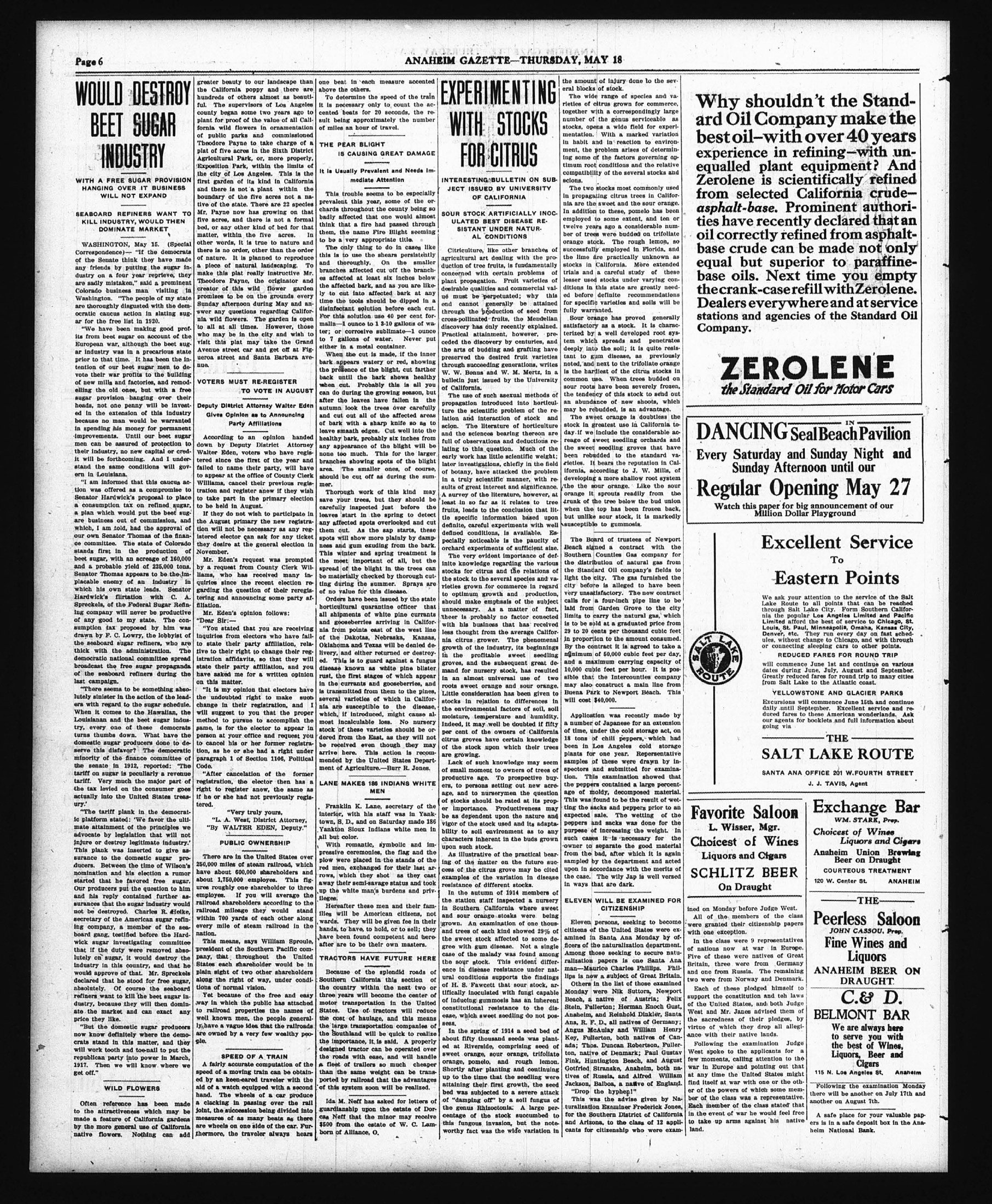
Searchable text
WOULD DESTROY BEET SUGAR INDUSTRY
WITH A FREE SUGAR PROVISION HANGING OVER IT BUSINESS WILL NOT EXPAND
SEABOARD REFINERS WANT TO KILL INDUSTRY, WOULD THEN DOMINATE MARKET
WASHINGTON, May 15. (Special Correspondence)—"If the democrats of the Senate think they have made any friends by putting the sugar industry on a four year reprieve, they are sadly mistaken," said a prominent Colorado business man visiting in Washington. "The people of my state are thoroughly disgusted with the democratic caucus action in slating sugar for the free list in 1920.
"We have been making good profits from beet sugar on account of the European war, although the beet sugar industry was in a precarious state prior to that time. It has been the intention of our beet sugar men to devote their war profits to the building of new mills and factories, and remodelling the old ones, but with a free sugar provision hanging over their heads, not one penny will be invested in the extension of this industry because no man would be warranted in spending his money for permanent improvements. Until our beet sugar men can be assured of protection to greater beauty to our landscape than the California poppy and there are hundreds of others almost as beautiful. The supervisors of Los Angeles county began some two years ago to plant for proof of the value of all California wild flowers in ornamentation of public parks and commissioned Theodore Payne to take charge of a plat of five acres in the Sixth District Agricultural Park, or, more properly, Exposition Park, within the limits of the city of Los Angeles. This is the first garden of its kind in California and there is not a plant within the boundary of the five acres not a native of the state. There are 22 species Mr. Payne now has growing on that five acres, and there is not a formal bed, or any other kind of bed for that matter, within the five acres. In other words, it is true to nature and there is no order, other than the order of nature. It is planned to reproduce a piece of natural landscaping. To make this plat really instructive Mr. Theodore Payne, the originator and creator of this wild flower garden promises to be on the grounds every Sunday afternoon during May and answer any questions regarding California wild flowers. The garden is open to all at all times. However, those who may be in the city and wish to visit this plat may take the Grand Avenue street car and get off at Figueroa street and Santa Barbara avenue.
VOTERS MUST RE-REGISTER TO VOTE IN AUGUST
Deputy District Attorney Walter Eden Gives Opinion as to Announcing Party Affiliations
According to an opinion handed down by Deputy District Attorney one beat in each above the others.
To determine that it is necessary or cented beats for suit being approved of miles an hour.
THE PEAR BLUE IS CAUSING
It is Usually Premediat
This trouble seems prevalent this year chards throughout badly affected that think that a fire them, the name to be a very app.
The only thing this is to use the and thoroughly branches affected as affected at least the affected barkly to cut into a time the tools she disinfectant solution For this solution malin—1 ounce ter; or corrosive to 7 gallons of either in a metal.
When the cut bark appears was the presence of t back until the when cut. Prob can do during th after the leaves autumn look there and cut out all of bark with a leave smath edge healthy bark, pro any appearance
prior to that time. It has been the intention of our beet sugar men to devote their war profits to the building of new mills and factories, and remodelling the old ones, but with a free sugar provision hanging over their heads, not one penny will be invested in the extension of this industry because no man would be warranted in spending his money for permanent improvements. Until our beet sugar men can be assured of protection to their industry, no new capital or credit will be forthcoming. And I understand the same conditions will govern in Louisiana.
"I am informed that this caucus action was offered as a compromise to Senator Hardwick's proposal to place a consumption tax on refined sugar, a plan which would put the beet sugar business out of commission, and which, I am told, had the approval of our own Senator Thomas of the finance committee. The state of Colorado stands first in the production of beet sugar, with an acreage of 160,000 and a probable yield of 225,000 tons. Senator Thomas appears to be the implacable enemy of an industry in which his own state leads. Senator Hardwick's flirtation with C. A. Spreckels, of the Federal Sugar Refining company will never be productive of any good to my state. The consumption tax proposed by him was drawn by F. C. Lowry, the lobbyist of the seaboard sugar refiners, who are thick with the administration. The democratic national committee spread broadcast the free sugar propaganda of the seaboard refiners during the last campaign.
"There seems to be something absolutely sinister in the action of the leaders with regard to the sugar schedule. When it comes to the Hawaiian, the Louisianaan and the beet sugar industry, every one of these democrats turns thumbs down. What have the domestic sugar producers done to deserve this disfavor? The democratic minority of the finance committee of the senate in 1912, reported: 'The tariff on sugar is peculiarly a revenue tariff. Very much the major part of the tax levied on the consumer goes actually into the United States treasury.'
"The tariff plank in the democratic platform stated: "We favor the ultimate attainment of the principles we advocate by legislation that will not injure or destroy legitimate industry." This plank was inserted to give useroa street and Santa Barbara avenue.
VOTERS MUST RE-REGISTER TO VOTE IN AUGUST
Deputy District Attorney Walter Eden Gives Opinion as to Announcing Party Affiliations
According to an opinion handed down by Deputy District Attorney Walter Eden, voters who have registered since the first of the year and failed to name their party, will have to appear at the office of County Clerk Williams, cancel their previous registration and register anew if they wish to take part in the primary election to be held in August.
If they do not wish to participate in the August primary the new registration will not be necessary as any registered elector can ask for any ticket they desire at the general election in November.
Mr. Eden's request was prompted by a request from County Clerk Williams, who has received many inquiries since the recent election regarding the question of their reregistering and announcing some party affiliation.
Mr. Eden's opinion follows:
"Dear Sir—
"You stated that you are receiving inquiries from electors who have fail-to state their party affiliation, relative to their right to change their registration affidavits, so that they will state their party affiliation, and you have asked me for a written opinion on this matter.
"It is my opinion that electors have the undoubted right to make suon change in their registration, and I will suggest to you that the proper method to pursue to accomplish the same, is for the elector to appear in person at your office and request you to cancel his or her former registration, as he or she had a right under paragraph 1 of Section 1106, Political Code.
"After cancelation of the former registration, the elector then has a right to register anew, the same as if he or she had not previously registered.
"Very truly yours,
"L. A. West, District Attorney,
"By WALTER EDEN, Deputy."
PUBLIC OWNERSHIP
When the cut bark appears was the presence of back until the when cut. Probably can do during this after the leaves autumn look them and cut out all of bark with a leave smaath edge healthy bark, probably any appearance none too much. branches showing area. The small should be cut off mer.
Thorough work save your trees carefully inspect leaves start in any affected spot them cut. As spots will show nature and gum exert This winter and the most important spread of the blight be materially chewing during the day of no value for orders have been horticultural quail all shipments off and gooseberries nia from points of the Dakotas Oklahoma and Texas livery, and either ed. This is to get disease known a rust, the first stair in the currants is transmitted from several varieties nia are susceptible which, if introduced most incalculable stock of these vies dered from the blight be received even arrive here. The mended by the Ument of Agriculture
LANE MAKES
Franklin K. L interior, with his town, S. D., and e Yankton Sloux all but color.
With romantic
minority of the finance committee of the senate in 1912, reported: 'The tariff on sugar is peculiarly a revenue tariff. Very much the major part of the tax levied on the consumer goes actually into the United States treasury.'
"The tariff plank in the democratic platform stated: 'We favor the ultimate attainment of the principles we advocate by legislation that will not injure or destroy legitimate industry.' This plank was inserted to give assurance to the domestic sugar producers. Between the time of Wilson's nomination and his election a rumor started that he favored free sugar. Our producers put the question to him and his reply contained further assurances that the sugar industry would not be destroyed. Charles R. Aftelke, secretary of the American sugar refining company, a member of the seaboard gang, testified before the Hardwick sugar investigating committee that if the duty were removed absolutely on sugar, it would destroy the industry in this country, and that he would approve of that. Mr. Spreckels declared that he stood for free sugar, absolutely. Of course the seaboard refiners want to kill the beet sugar industry, because they will then dominate the market and can exact any price they like.
"But the domestic sugar producers now know definitely where the democrats stand in this matter, and they will work tooth and toe-nail to put the republican party into power in March, 1917. Then we will know where we get off."
WILD FLOWERS
Often reference has been made to the attractiveness which may be made a feature of California gardens by the more general use of California native flowers. Nothing can add paragraph 1 of Section 1106, Political Code.
"After cancelation of the former registration, the elector then has a right to register anew, the same as if he or she had not previously registered.
"Very truly yours,
'L. A. West, District Attorney,
'By WALTER EDEN, Deputy.'"
PUBLIC OWNERSHIP
There are in the United States over 250,000 miles of steam railroad, which have about 600,000 shareholders and about 1,750,000 employees. This figures roughly one shareholder to three employes. If you will average the railroad shareholders according to the railroad mileage they would stand within 700 yards of each other along every mile of steam railroad in the nation.
This means, says William Sproule, president of the Southern Pacific company, that throughout the United States each shareholder would be in plain sight of two other shareholders along the right of way, under conditions of normal vision.
Yet because of the free and easy way in which the public has attached to railroad properties the names of well known men, the people generally have a vague idea that the railroads are owned by a very few wealthy people.
SPEED OF A TRAIN
A fairly accurate computation of the speed of a moving train can be obtained by an keen-eared traveler with the aid of a watch equipped with a second hand. The wheels of a car produce a clacking in passing over the rail joint, the succession being divided into measures of as many beats as there are wheels on one side of the car. Furthermore, the traveler always hears
ANAHEIM GAZETTE—THURSDAY, MAY 18
ONE BEAT IN EACH MEasure ACCEPTED ABOVE THE OTHERS.
To determine the speed of the train it is necessary only to count the accented beats for 20 seconds, the result being approximately the number of miles an hour of travel.
THE PEAR BLIGHT IS CAUSING GREAT DAMAGE
It is Usually Prevalent and Needs Immediate Attention
This trouble seems to be especially prevalent this year, some of the orchards throughout the county being so badly affected that one would almost think that a fire had passed through them, the name Fire Blight seeming to be a very appropriate title.
The only thing to do in cases like this is to use the shears persistently and thoroughly. On the smaller branches affected cut off the branches affected at least six inches below the affected bark, and as you are likely to cut into affected bark at any time the tools should be dipped in a disinfectant solution before each cut. For this solution use 40 per cent formalin—1 ounce to 1-3-10 gallons of water; or corrosive sublimate—1 ounce to 7 gallons of water. Never put either in a metal container.
When the cut is made, if the inner bark appears watery or red, showing the presence of the blight, cut farther back until the bark shows healthy when cut. Probably this is all you can do during the growing season, but after the leaves have fallen in the autumn look the trees over carefully and cut out all of the affected areas of bark with a sharp knife so as to leave smath edges. Cut well into the healthy bark, probably six inches from any appearance of the blight will be
EXPERIMENTING WITH STOCKS FOR CITRUS
INTERESTING BULLETIN ON SUBJECT ISSUED BY UNIVERSITY OF CALIFORNIA
SOUR STOCK ARTIFICIALLY INOCULATED BEST DISEASE RESISTANT UNDER NATURAL CONDITIONS
Citriculture, like other branches of agricultural art dealing with the production of tree fruits, is fundamentally concerned with certain problems of plant propagation. Fruit varieties of desirable qualities and commercial value must be perpetuated; why this end cannot generally be attained through the production of seed from cross-pollinated fruits, the Mendelian discovery has only recently explained. Practical attainment, however, preceded the discovery by centuries, and the arts of budding and grafting have preserved the desired fruit varieties through succeeding generations, writes W. W. Bonns and W. M. Mertz, in a bulletin just issued by the University of California.
The use of such asexual methods of propagation introduced into horticulture the scientific problem of the relation and interaction of stock and scion. The literature of horticulture and the sciences bearing thereon are full of observations and deductions relating to this question. Much of the amount of injury done to the several blocks of stock.
The wide range of species and varieties of citrus grown for commerce, together with a correspondingly large number of the genus serviceable as stocks, opens a wide field for experimentation. With a marked variation in habit and in reaction to environment, the problem arises of determining some of the factors governing optimum root conditions and the relative compatibility of the several stocks and scions.
The two stocks most commonly used in propagating citrus trees in California are the sweet and the sour orange. In addition to these, pomelo has been employed to some extent, and ten or twelve years ago a considerable number of trees were budded on trifoliate orange stock. The rough lemon, so successfully employed in Florida, and the lime are practically unknown as stocks in California. More extended trials and a careful study of these lesser used stocks under varying conditions in this state are greatly needed before definite recommendations for specific varieties and soils will be fully warranted.
Sour orange has proved generally satisfactory as a stock. It is characterized by a well developed root system which spreads and penetrates deeply into the soil; it is quite resistant to gum disease, as previously noted, and next to the trifollate orange is the hardest of the citrus stocks in common use. When trees budded on sour roots have been severely frozen, the tendency of this stock to send out an abundance of new shoots, which may be rebudded, is an advantage.
The sweet orange is doubtless the stock in greatest use in California today-if we include the considerable acreage of sweet seedling orchards and the sweet seedling groves that have
When the cut is made, if the inner bark appears watery or red, showing the presence of the blight, cut farther back until the bark shows healthy when cut. Probably this is all you can do during the growing season, but after the leaves have fallen in the autumn look the trees over carefully and cut out all of the affected areas of bark with a sharp knife so as to leave smaath edges. Cut well into the healthy bark, probably six inches from any appearance of the blight will be none too much. This for the larger branches showing spots of the blight area. The smaller ones, of course, should be cut off as during the summer.
Thorough work of this kind may save your trees, but they should be carefully inspected just before the leaves start in the spring to detect any affected spots overlooked and cut them out. As the sap starts, these spots will show more plainly by dampness and gum exuding from the bark. This winter and spring treatment is the most important of all, but the spread of the blight in the trees can be materially checked by thorough cutting during the summer. Sprays are of no value for this disease.
Orders have been issued by the state horticultural quarantine officer that all shipments of white pine currants and gooseberries arriving in California from points east of the west line of the Dakotas, Nebraska, Kansas, Oklahoma and Texas will be denied delivery, and either returned or destroyed. This is to guard against a fungus disease known as white pine bilster rust, the first stages of which appear in the currants and gooseberries, and is transmitted from them to the pines, several varieties of which in California are susceptible to the disease, which, if introduced, might cause almost incalculable loss. No nursery stock of these varieties should be ordered from the East, as they will not be received even though they may arrive here. This action is recommended by the United States Department of Agriculture.—Burr R. Jones.
LANE MAKES 186 INDIANS WHITE MEN
Franklin K. Lane, secretary of the interior, with his staff was in Yanktown, S. D., and on Saturday made 186 Yankton Sloux Indians white men in all but color.
With romantic, symbolic and im- preserved the desired fruit varieties through succeeding generations, writes W. W. Bonns and W. M. Mertz, in a bulletin just issued by the University of California.
The use of such asexual methods of propagation introduced into horticulture the scientific problem of the relation and interaction of stock and scion. The literature of horticulture and the sciences bearing thereon are full of observations and deductions relating to this question. Much of the early work has little scientific weight; later investigations, chiefly in the field of botany, have attacked the problem in a truly scientific manner, with results of great interest and significance.
A survey of the literature, however, at least in so far as it relates to tree fruits, leads to the conclusion that little specific information based upon definite, careful experiments with well defined conditions, is available. Especially noticeable is the paucity of orchard experiments of sufficient size.
The very evident importance of definite knowledge regarding the various stocks for citrus and the relations of the stock to the several species and varieties grown for commerce in regard to optimum growth and production, should make emphasis of the subject unnecessary. As a matter of fact, sheer is probably no factor connected with his business that has received less thought from the average California citrus grower. The phenomenal growth of the industry, its beginnings in the profitable sweet seedling groves, and the subsequent great demand for nursery stock, has resulted in an almost universal use of two roots sweet orange and sour orange. Little consideration has been given to stocks in relation to differences in the environmental factors of soil, soil moisture, temperature and humidity. Indeed, it may well be doubted if fifty per cent of the owners of California citrus groves have certain knowledge of the stock upon which their trees are growing.
Lack of such knowledge may seem of small moment to owners of trees of productive age. To prospective buyers, to persons setting out new acreage, and to nurserymen the question of stocks should be rated at its proper importance. Productiveness may be as dependent upon the nature and vigor of the stock used and its adaptability to soil environment as to any characters inherent in the buds grown upon such stock.
The Board of trustees of Newport Beach signed a contract with the Southern Counties Gas company for the distribution of natural gas from the Standard Oil company's fields to light the city. The gas furnished the city before is alleged to have been very unsatisfactory. The new contract calls for a four-inch pipe line to be laid from Garden Grove to the city limits to carry the natural gas, which is to be sold at a graduated price from 29 to 20 cents per thousand cubic feet in proportion to the amount consumed. By the contract it is agreed to take a minimum of 50,000 cubic feet per day, and a maximum carrying capacity of 10,000 cubic feet per hour. It is possible that the Intercounties company may also construct a main line from Buena Park to Newport Beach. This will cost $40,000.
Application was recently made by a number of Japanese for an extension of time, under the cold storage act, on 18 tons of chill peppers, which had been in Los Angeles cold storage plants for one year. Representative samples of these were drawn by inspectors and submitted for examination. This examination showed that the peppers contained a large percentage of moldy, decomposed material. This was found to be the result of wetting the sacks and peppers prior to an expected sale. The wetting of the peppers and sacks was done for the purpose of increasing the weight. In such cases it is necessary for the owner to separate the good material
LANE MAKES 186 INDIANS WHITE MEN
Franklin K. Lane, secretary of the interior, with his staff was in Yanktown, S. D., and on Saturday made 186 Yankton Sioux Indians white men in all but color.
With romantic, symbolic and impressive ceremonies, the flag and the plow were placed in the stands of the red men, exchanged for their last arrows, which they shot as they cast away their semi-savage status and took up the white man's burdens and privileges.
Hereafter these men and their families will be American citizens, not wards. They will be given fee in their hands, to have, to hold, or to sell; they have been found competent and hereafter are to be their own masters.
TRACTORS HAVE FUTURE HERE
Because of the splendid roads of Southern California this section of the country within the next two or three years will become the center of motor transportation in the United States. Use of tractors will reduce the cost of haulage, and this means the large transportation companies of the Southland will be quick to realize the importance, it is said. A properly designed tractor can be operated over the roads with ease, and will handle a fleet of trailers so much cheaper than the same weight can be transported by railroad that the advantages of this system soon will be realized.
Ida M. Neff has asked for letters of guardianship upon the estate of Dorcas Neff that the minor may receive $500 from the estate of W. C. Lamborn of Alliance, O.
Lack of such knowledge may seem of small moment to owners of trees of productive age. To prospective buyers, to persons setting out new acreage, and to nurserymen the question of stocks should be rated at its proper importance. Productiveness may be as dependent upon the nature and vigor of the stock used and its adaptability to soil environment as to any characters inherent in the buds grown upon such stock.
As illustrative of the practical bearing of the matter on the future success of the citrus grove may be cited examples of the variation in disease resistance of different stocks.
In the autumn of 1914 members of the station staff inspected a nursery in Southern California where sweet and sour orange stosks were being grown. An examination of one thousand trees of each kind showed 29% of the sweet stock affected to some degree with gum disease. Not a single case of the malady was found among the sour stock. This evident difference in disease resistance under natural conditions supports the findings of H. S. Fawcett that sour stock, artificially inoculated with fungi capable of inducing gummosis has an inherent constitutional resistance to the disease, which sweet seedling do not possess.
In the spring of 1914 a seed bed of about fifty thousand seeds was planted at Riverside, comprising seed of sweet orange, sour orange, trifoliate orange, pomelo, and rough lemon. Shortly after planting and continuing up to the time that the seedling were attaining their first growth, the seed bed was subjected to a severe attack of "damping off" by a soil fungus of the genus Rhizoctonia. A large percentage of the stock succumbed to this fungous invasion, but the noteworthy fact was the wide variation in samples of these were drawn by inspectors and submitted for examination. This examination showed that the peppers contained a large percentage of moldy, decomposed material. This was found to be the result of wetting the sacks and peppers prior to an expected sale. The wetting of the peppers and sacks was done for the purpose of increasing the weight. In such cases it is necessary for the owner to separate the good material from the bad, after which it is again sampled by the department and acted upon in accordance with the merits of the case. The wily Jap is well versed in ways that are dark.
ELEVEN WILL BE EXAMINED FOR CITIZENSHIP
Eleven persons, seeking to become citizens of the United States were examined in Santa Ana Monday by officers of the naturalization department. Among those seeking to secure naturalization papers is one Santa Ana man—Maurice Charles Phillips. Phillips is now a subject of Great Britain.
Others in the list of those examined Monday were Nik Suttona, Newport Beach, a native of Austria; Felix Stein, Fallerton; Herman Enoch Gust, Anaheim, and Reinhold Dinkler, Santa Ana, R. F. D., all natives of Germany; Angus McAulay and William Henry Key, Fullerton, both natives of Canada; Thos. Duncan Robertson, Fullerton, native of Denmark; Paul Gustav Fink, Huntington Beach, and August Gotfried Stranske, Anaheim, both natives of Russia, and Alfred William Jackson, Balboa, a native of England.
"Drop the hypen!" This was the advise given by Naturalization Examiner Frederick Jones, for the Southern District of California and Arizona, to the class of 12 applicants for citizenship who were exam-
Why shouldn’t the Standard Oil Company make the best oil—with over 40 years experience in refining—with unequalled plant equipment? And Zerolene is scientifically refined from selected California crude—asphalt-base. Prominent authorities have recently declared that an oil correctly refined from asphalt-base crude can be made not only equal but superior to paraffine-base oils. Next time you empty the crank-case refill with Zerolene. Dealers everywhere and at service stations and agencies of the Standard Oil Company.
ZEROLENE
the Standard Oil for Motor Cars
DANCING IN Seal Beach Pavilion
ZEROLENE
the Standard Oil for Motor Cars
DANCING SealBeach Pavilion
Every Saturday and Sunday Night and
Sunday Afternoon until our
Regular Opening May 27
Watch this paper for big announcement of our
Million Dollar Playground
Excellent Service
To
Eastern Points
We ask your attention to the service of the Salt Lake Route to all points that can be reached through Salt Lake City. Form Southern California the popular Los Angeles Limited and Pacific Limited afford the best of service to Chicago, St. Louis, St. Paul, Minneapolis, Omaha, Kansas City, Denver, etc. They run every day on fast schedules, without change to Chicago, and with through or connecting sleeping cars to other points.
REDUCED FARES FOR ROUND TRIP
will commence June 1st and continue on various dates during June, July, August and September. Greatly reduced fares for round trip to many cities from Salt Lake to the Atlantic coast.
YELLOWSTONE AND GLACIER PARKS
Excursions will commence June 15th and continue daily until September. Excellent service and reduced fares to these American wonderlands. Ask our agents for booklets and full information about going via.
THE
SALT LAKE ROUTE
SANTA ANA OFFICE 201 W.FOURTH STREET
J. J. TAVIS, Agent
Favorite Saloon
L. Wisser, Mgr.
Choicest of Wines
Exchange Bar
WM. STARK, Prep.
Choicest of Wines
Liquors and Cigars
Favorite Saloon
L. Wisser, Mgr.
Choicest of Wines
Liquors and Cigars
SCHLITZ BEER
On Draught
ined on Monday before Judge West.
All of the members of the class were granted their citizenship papers with one exception.
In the class were 9 representatives of nations now at war in Europe. Five of these were natives of Great Britain, three were from Germany and one from Russia. The remaining two were from Norway and Denmark.
Each of these pledged himself to support the constitution and teh laws of the United States, and both Judge West and Mr. Janes advised them of the sacredness of their pledges, by virtue of which they drop all allegiance with their native lands.
Following the examination Judge West spoke to the applicants for a few moments, calling attention to the war in Europe and pointing out that at any time the United States might find itself at war with one or the other of the powers of which some member of the class was a representative. Each member of the class stated that in the event of war he would feel free to take up arms against his native land.
Exchange Bar
WM. STARK, Prop.
Choicest of Wines
Liquors and Cigars
Anaheim Union Brewing Beer on Draught
COURTEOUS TREATMENT
120 W. Center St. ANAHEIM
THE
Peerless Saloon
JOHN CASSOU, Prop.
Fine Wines and Liquors
ANAHEIM BEER ON DRAUGHT
C. & D.
BELMONT BAR
We are always here to serve you with the best of Wines,
Liquors, Beer and Cigars
115 N. Los Angeles St. Anaheim
Following the examination Monday there will be another on July 17th and another on August 7th.
A safe place for your valuable papers is in a safe deposit box in the Anaheim National Bank.