anaheim-gazette 1916-05-18
Scanned page
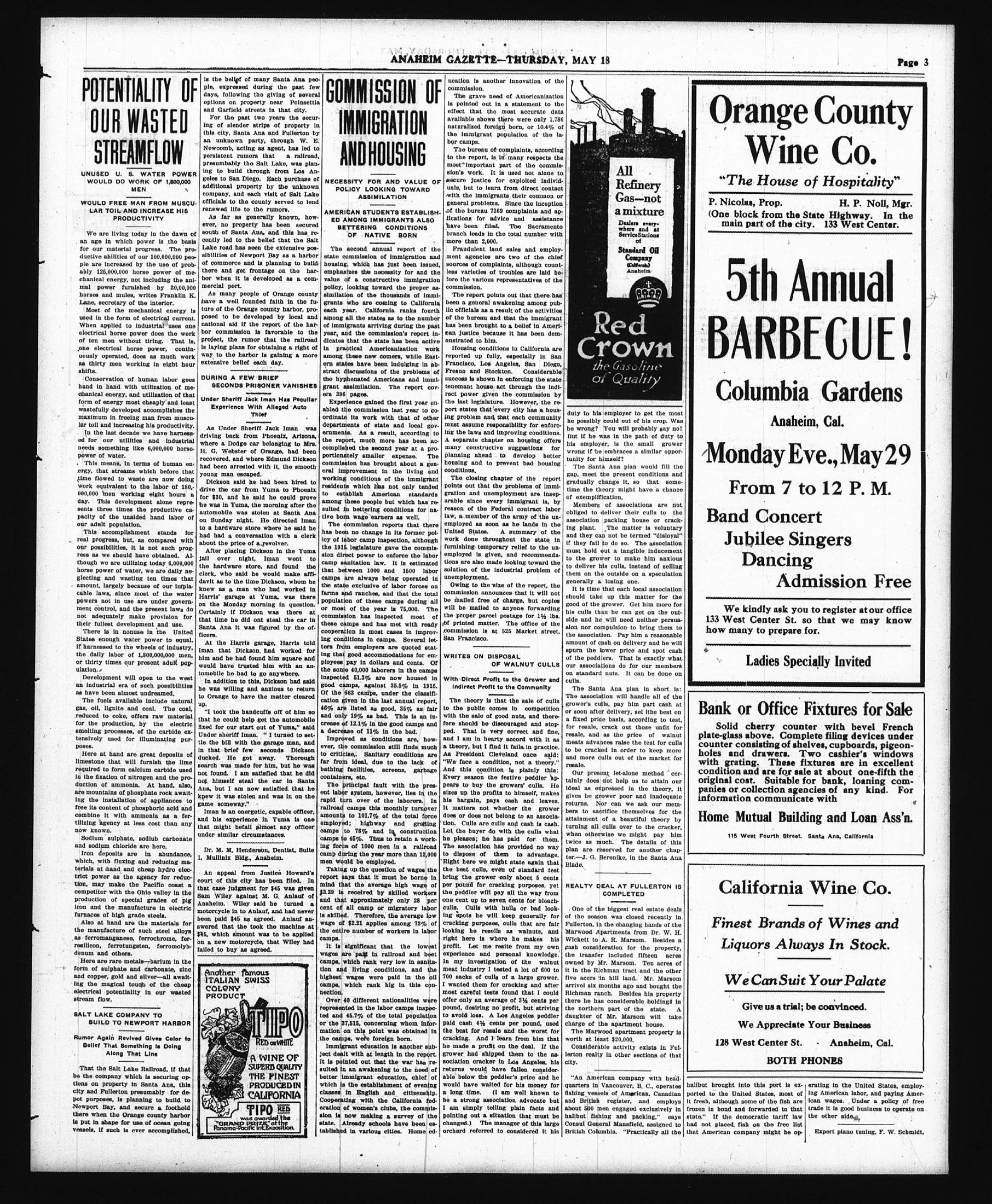
Searchable text
POTENTIALITY OF
OUR WASTED
STREAMFLOW
UNUSED U. S. WATER POWER
WOULD DO WORK OF 1,800,000 MEN
WOULD FREE MAN FROM MUSCU-LAR TOIL AND INCREASE HIS PRODUCTIVITY
We are living today in the dawn of an age in which power is the basis for our material progress. The productive abilities of our 100,000,000 people are increased by the use of probably 125,000,000 horsepower of mechanical energy, not including the animal power furnished by 30,000,000 horses and mules, writes Franklin K. Lane, secretary of the interior.
Most of the mechanical energy is used in the form of electrical current. When applied to industrial uses one electrical horse power does the work of ten men without tiring. That is, one electrical horse power, continuously operated, does as much work as thirty men working in eight hour shifts.
Conservation of human labor goes hand in hand with utilization of mechanical energy, and utilization of that form of energy most cheaply and least wastefully developed accomplishes the maximum in freeing man from muscular toll and increasing his productivity.
In the last decade we have harnessed for our utilities and industrial needs something like 6,000,000 horse-
is the belief of many Santa Ana people, expressed during the past few days, following the giving of several options on property near Poinsettia and Garfield streets in that city.
For the past two years the securing of slender strips of property in this city, Santa Ana and Fullerton by an unknown party, through W. E. Newcomb, acting as agent, has led to persistent rumors that a railroad, presumably the Salt Lake, was planning to build through from Los Angeles to San Diego. Each purchase of additional property by the unknown company, and each visit of Salt Lake officials to the county served to lend renewed life to the rumors.
As far as generally known, however, no property has been secured south of Santa Ana, and this has recently led to the belief that the Salt Lake road has seen the extensive possibilities of Newport Bay as a harbor of commerce and is planning to build there and get frontage on the harbor when it is developed as a commercial port.
As many people of Orange county have a well founded faith in the future of the Orange county harbor, proposed to be developed by local and national aid if the report of the harbor commission is favorable to the project, the rumor that the railroad is laying plans for obtaining a right of way to the harbor is gaining a more extensive belief each day.
DURING A FEW BRIEF SECONDS PRISONER VANISHES
Under Sheriff Jack Iman Has Peculiar Experience With Alleged Auto Thief
As Under Sheriff Jack Iman was driving back from Phoenix, Arizona, where a Dodge car belonging to Mrs.
Conservation of human labor goes hand in hand with utilization of mechanical energy, and utilization of that form of energy most cheaply and least wastefully developed accomplishes the maximum in freeing man from muscular toll and increasing his productivity.
In the last decade we have harnessed for our utilities and industrial needs something like 6,000,000 horsepower of water.
This means, in terms of human energy, that streams which before that time flowed to waste are now doing work equivalent to the labor of 180,000,000 men working eight hours a day. This development alone represents three times the productive capacity of the unaided hand labor of our adult population.
This accomplishment stands for real progress, but, as compared with our possibilities, it is not such progress as we should have obtained. Although we are utilizing today 6,000,000 horsepower of water, we are daily neglecting and wasting ten times that amount, largely because of our implacable laws, since most of the water powers not in use are under government control, and the present laws do not adequately make provision for their fullest development and use.
There is in nonuse in the United States enough water power to equal, if harnessed to the wheels of industry, the daily labor of 1,800,000,000 men, or thirty times our present adult population.
Development will open to the west an industrial era of such possibilities as have been almost undreamed.
The fuels available include natural gas, oil, lignite and coal. The coal, reduced to coke, offers raw material for the production, by the electric smelting processes, of the carbide extensively used for illuminating purposes.
Here at hand are great deposits of limestone that will furnish the lime required to form calcium carbide used in the fixation of nitrogen and the production of ammonia. At hand, also, are mountains of phosphate rock awaiting the installation of appliances to free its content of phosphoric acid and combine it with ammonia as a fertilizing agency at less cost than any now known.
Sodium sulphate, sodium carbonate and sodium chloride are here.
DURING A FEW BRIEF SECONDS PRISONER VANISHES
Under Sheriff Jack Iman Has Peculiar Experience With Alleged Auto Thief
As Under Sheriff Jack Iman was driving back from Phoenix, Arizona, where a Dodge car belonging to Mrs. H. G. Webster of Orange, had been recovered, and where Edmund Dickson had been arrested with it, the smooth young man escaped.
Dickson said he had been hired to drive the car from Yuma to Phoenix for $30, and he said he could prove he was in Yuma, the morning after the automobile was stolen at Santa Ana on Sunday night. He directed Iman to a hardware store where he said he had had a conversation with a clerk about the price of a revolver.
After placing Dickson in the Yuma jail over night, Iman went to the hardware store, and found the clerk, who said he would make affidavit as to the time Dickson, whom he knew as a man who had worked in Harris' garage at Yuma, was there on the Monday morning in question. Certainly if Dickson was there at that time he did not steal the car in Santa Ana it was figured by the officers.
At the Harris garage, Harris told Iman that Dickson had worked for him and he had found him square and would have trusted him with an automobile he had to go anywhere.
In addition to this, Dickson had said he was willing and anxious to return to Orange to have the matter cleared up.
"I took the handcuffs off of him so that he could help get the automobile fixed for our start out of Yuma," said Under Sheriff Iman. "I turned to settle the bill with the garage man, and in that brief few seconds Dickson ducked. He got away. Thorough search was made for him, but he was not found. I am satisfied that he did not himself steal the car in Santa Ana, but I am now satisfied that he knew it was stolen and was in on the game somewhat."
Iman is an energetic, capable officer, and his experience in Yuma is one that might befall almost any officer under similar circumstances.
Dr. M. M. Henderson Dentist Suite way to the harbor is gaining a more extensive belief each day.
Experience gave the commander its work departments of ernments. As the report, much complained the portionately small commission has eral improvement working conditions residents which to establish among these people resulted in betterive born wage.
The commission has been no change of labor camp; the 1915 legislation direct power camp sanitation that between 18 camps are always the state exclusive farms and ranch population of th or most of the commission has these camps and cooperation in m ing conditions in ters from employ ing that good ac ployees pay in on the some 40,000 inspected 51.3% good camps, aga Of the 663 cam pication given in th 46% are listed and only 19% are crease of 12.1% a decrease of 12%. Improved as ever, the commi tion to criticise. Sa far from ideal, bathing facilities containers, etc.
The principal ent labor system rapid turn over railroad camps to amounts to 101.7 employed; high camps to 78% camps to 45%. Ing force of 100
Here at hand are great deposits of limestone that will furnish the lime required to form calcium carbide used in the fixation of nitrogen and the production of ammonia. At hand, also, are mountains of phosphate rock awaiting the installation of appliances to free its content of phosphoric acid and combine it with ammonia as a fertilizing agency at less cost than any now known.
Sodium sulphate, sodium carbonate and sodium chloride are here.
Iron deposits are in abundance, which, with fluxing and reducing materials at hand and cheap hydro electric power as the agency for reduction, may make the Pacific coast a competitor with the Ohio valley in the production of special grades of pig iron and the manufacture in electric furnaces of high grade steels.
Also at hand are the materials for the manufacture of such steel alloys as ferromanganese, ferrochrome, ferrosilicon, ferrotungsten, ferromolybdenum and others.
Here are rare metals—barium in the form of sulphate and carbonate, zinc and copper, gold and silver—all awaiting the magical touch of the cheap electrical potentiality in our wasted stream flow.
SALT LAKE COMPANY TO BUILD TO NEWPORT HARBOR
Rumor Again Revived Gives Color to Belief That Something is Doing Along That Line
That the Salt Lake Railroad, if that be the company which is securing options on property in Santa Ana, this city and Fullerton presumably for depot purposes, is planning to build to Newport Bay, and secure a foothold there when the Orange county harbor is put in shape for use of ocean going vessels, if such is ever accomplished,
Another famous ITALIAN SWISS COLONY PRODUCT
TIPO RED OR WHITE
A WINE OF SUPERD QUALITY THE FINEST PRODUCED IN CALIFORNIA
TIPO RED
was awarded the "GRAND PRIZE" at the Panama-Pacific Exposition.
ANAHEIM GAZETTE—THURSDAY, MAY 18
GOMMISSION OF IMMIGRATION AND HOUSING
NECESSITY FOR AND VALUE OF POLICY LOOKING TOWARD ASSIMILATION
AMERICAN STUDENTS ESTABLISHED AMONG IMMIGRANTS ALSO BETTERING CONDITIONS OF NATIVE BORN
The second annual report of the state commission of immigration and housing, which has just been issued, emphasizes the necessity for and the value of a constructive immigration policy, looking toward the proper assimilation of the thousands of immigrants who are coming to California each year. California ranks fourth among all the states as to the number of immigrants arriving during the past year, and the commission's report indicates that the state has been active in practical Americanization work among these new comers, while Eastern states have been indulging in abstract discussions of the problems of the hyphenated Americans and immigrant assimilation. The report covers 396 pages.
Experience gained the first year enabled the commission last year to coordinate its work with that of other departments of state and local governments. As a result, according to the report, much more has been accomplished the second year at a pro-education is another innovation of the commission.
The grave need of Americanization is pointed out in a statement to the effect that the most accurate data available shows there were only 1,786 naturalized foreign born, or 10.4% of the immigrant population of the labor camps.
The bureau of complaints, according to the report, is in many respects the most important part of the commission's work. It is used not alone to secure justice for exploited individuals, but to learn from direct contact with the immigrants their common or general problems. Since the inception of the bureau 7369 complaints and applications for advice and assistance have been filed. The Sacramento branch leads in the total number with more than 2,000.
Fraudulent land sales and employment agencies are two of the chief sources of complaints, although countless varieties of troubles are laid before the various representatives of the commission.
The report points out that there has been a general awakening among public officials as a result of the activities of the bureau and that the immigrant has been brought to a belief in American justice because it has been demonstrated to him.
Housing conditions in California are reported up fully, especially in San Francisco, Los Angeles, San Diego, Fresno and Stockton. Considerable success is shown in enforcing the state tenement house act through the indirect power given the commission by the last legislature. However, the report states that every city has a housing problem and that each community must assume responsibility for enforcing the laws and improving conditions. A separate chapter on housing offers many constructive suggestions for
among these new comers, while Eastern states have been indulging in abstract discussions of the problems of the hyphenated Americans and immigrant assimilation. The report covers 396 pages.
Experience gained the first year enabled the commission last year to coordinate its work with that of other departments of state and local governments. As a result, according to the report, much more has been accomplished the second year at a proportionately smaller expense. The commission has brought about a general improvement in the living and working conditions of the immigrant residents which has not only tended to establish American standards among these people but which has resulted in better conditions for native born wage earners as well.
The commission reports that there has been no change in its former policy of labor camp inspection, although the 1915 legislature gave the commission direct power to enforce the labor camp sanitation law. It is estimated that between 1000 and 1500 labor camps are always being operated in the state exclusive of labor forces on farms and ranches, and that the total population of these camps during all or most of the year is 75,000. The commission has inspected most of these camps and has met with ready cooperation in most cases in improving conditions in camps. Several letters from employers are quoted stating that good accommodations for employees pay in dollars and cents. Of the some 40,000 laborers in the camps inspected 51.3% are now housed in good camps, against 35.5% in 1915. Of the 663 camps, under the classification given in the last annual report, 46% are listed as good, 35% as fair and only 19% as bad. This is an increase of 12.1% in the good camps and a decrease of 11% in the bad.
Improved as conditions are, however, the commission still finds much to criticise. Sanitary conditions are far from ideal, due to the lack of bathing facilities, screens, garbage containers, etc.
The principal fault with the present labor system, however, lies in the rapid turn over of the laborers. In railroad camps this monthly turnover amounts to 101.7% of the total force employed; highway and grading camps to 78% and in construction camps to 45%. Thus to retain a working force of 1000 men in a railroad reported up fully, especially in San Francisco, Los Angeles, San Diego, Fresno and Stockton. Considerable success is shown in enforcing the state tenement house act through the indirect power given the commission by the last legislature. However, the report states that every city has a housing problem and that each community must assume responsibility for enforcing the laws and improving conditions. A separate chapter on housing offers many constructive suggestions for planning ahead to develop better housing and to prevent bad housing conditions.
The closing chapter of the report points out that the problems of immigration and unemployment are inseparable since every immigrant is, by reason of the Federal contract labor law, a member of the army of the unemployed as soon as he lands in the United States. A summary of the work done throughout the state in furnishing temporary relief to the unemployed is given, and recommendations are also made looking toward the solution of the industrial problem of unemployment.
Owing to the size of the report, the commission announces that it will not be mailed free of charge, but copies will be mailed to anyone forwarding the proper parcel postage for 1½ lbs. of printed matter. The office of the commission is at 525 Market street, San Francisco.
WRITES ON DISPOSAL OF WALNUT CULLS
With Direct Profit to the Grower and Indirect Profit to the Community
The theory is that the sale of culls to the public comes in competition with the sale of good nuts, and therefore should be discouraged and stopped. That is very correct and fine, and I am in hearty accord with it as a theory, but I find it fails in practice. As President Cleveland once said: "We face a condition, not a theory." And this condition is plainly this: Every season the festive peddler appears to buy the growers' culls. He sizes up the profits to himself, makes his bargain, pays cash and leaves. It matters not whether the grower does or does not belong to an association. Culls are culls and cash is cash. Let the buyer do with the culls what he pleases; he has paid for them. The association has provided no way duty to his employer to get the most he possibly could out of his crop. Was he wrong? You will probably say no! But if he was in the path of duty to his employer, is the small grower wrong if he embraces a similar opportunity for himself?
The Santa Ana plan would fill the gap, meet the present conditions and gradually change it, so that sometime the theory might have a chance of exemplification.
Members of associations are not obliged to deliver their culls to the association packing house or cracking plant. The matter is voluntary and they can not be termed "disloyal" if they fail to do so. The association must hold out a tangible inducement to the grower to make him anxious to deliver his culls, instead of selling them on the outside on a speculation generally a losing one.
It is time that each local association should take up this matter for the good of the grower. Get him more for his culls than he can get on the outside and he will need neither persuasion nor compulsion to bring them to the association. Pay him a reasonable amount of cash on delivery and he will spurn the lower price and spot cash of the peddlers. That is exactly what our associations do for our members on standard nuts. It can be done on culls.
The Santa Ana plan in short is: The association will handle all of the grower's culls, pay him part cash at or soon after delivery, sel it best on a fixed price basis, according to test, for resale, crack out those unfit for resale, and as the price of walnut meats advances raise the test for culls to be cracked in order to keep more and more culls out of the market for resale.
Our present let-alone method certainly does not help us to attain our ideal as expressed in the theory, it gives he grower poor and inadequate returns. Nor can we ask our members to sacrifice themselves for the attainment of a beautiful theory by turning all culls over to the cracker, when otherwise we might pay him twice as much. The details of this plan are reserved for another chap-
The principal fault with the present labor system, however, lies in the rapid turn over of the laborers. In railroad camps this monthly turnover amounts to 101.7% of the total force employed; highway and grazing camps to 78% and in construction camps to 45%. Thus to retain a working force of 1000 men in a railroad camp during the year more than 12,000 men would be employed.
Taking up the question of wages the report says that it must be borne in mind that the average high wage of $3.39 is received by skilled workers and that approximately only 28 per cent of all camp or migratory labor is skilled. Therefore, the average low wage of $2.21 applies among 72% of the entire number of workers in labor camps.
It is significant that the lowest wages are paid in railroad and beet camps, which rank very low in sanitation and living conditions, and the highest wages were paid in the oil camps, which rank big in this connection.
Over 40 different nationalities were represented in the labor camps inspected and 45.7% of the total population or the 37,515, concerning whom information on this point was obtained in the camps, were foreign born.
Immigrant education is another subject dealt with at length in the report. It is pointed out that the war has resulted in an awakening to the need of better immigrant education, chief of which is the establishment of evening classes in English and citizenship. Cooperating with the California federation of women's clubs, the commission is now making a survey of the state. Already schools have been established in various cities. Home ed-
"We face a condition, not a theory."
And this condition is plainly this: Every season the festive peddler appears to buy the growers' culls. He sizes up the profits to himself, makes his bargain, pays cash and leaves. It matters not whether the grower does or does not belong to an association. Culls are culls and cash is cash. Let the buyer do with the culls what he pleases; he has paid for them. The association has provided no way to dispose of them to advantage. Right here we might state again that the best culls, even of standard test bring the grower only about 5 cents per pound for cracking purposes, yet the peddler will pay all the way from one cent up to seven cents for bleach-culls. Culls with hulls or bad looking spots he will keep generally for cracking purposes, culls that are fair looking he resells as walnuts, and right here is where he makes his profit. Let me resite from my own experience and personal knowledge. In my investigation of the walnut meat industry I tested a lot of 600 to 700 sacks of culls of a large grower. I wanted them for cracking and after most careful tests found that I could offer only an average of 3½ cents per pound, desiring no profit, but striving to avoid loss. A Los Angeles peddler paid cash 4½ cents per pound, used the best for resale and the worst for cracking. And I learn from him that he made a profit on the deal. If the grower had shipped them to the association cracker in Los Angeles, his returns would have fallen considerable below the peddler's price and he would have waited for his money for a long time. (I am well known to be a strong association advocate but I am simply telling plain facts and pointing out a situation that must be changed.) The manager of this large orchard referred to considered it his
"An American company with headquarters in Vancouver, B. C., operates fishing vessels of American, Canadian and British register, and employs about 500 men engaged exclusively in halibut fishing and packing," says Consul General Mansfield, assigned to British Columbia. "Practically all the
Orange County
Wine Co.
"The House of Hospitality"
P. Nicolas, Prop. H. P. Noll, Mgr.
(One block from the State Highway. In the main part of the city. 133 West Center.
5th Annual
BARBECUE!
Columbia Gardens
Anaheim, Cal.
Columbia Gardens
Anaheim, Cal.
Monday Eve., May 29
From 7 to 12 P. M.
Band Concert
Jubilee Singers
Dancing
Admission Free
We kindly ask you to register at our office
133 West Center St. so that we may know how many to prepare for.
Ladies Specially Invited
Bank or Office Fixtures for Sale
Solid cherry counter with bevel French plate-glass above. Complete filing devices under counter consisting of shelves, cupboards, pigeonholes and drawers. Two cashier's windows with grating. These fixtures are in excellent condition and are for sale at about one-fifth the original cost. Suitable for bank, loaning companies or collection agencies of any kind. For information communicate with
Home Mutual Building and Loan Ass'n.
115 West Fourth Street. Santa Ana, California
California Wine Co.
Finest Brands of Wines and Liquors Always In Stock.
We Can Suit Your Palate
Give us a trial; be convinced.
We Appreciate Your Business
128 West Center St. - Anaheim, Cal.
BOTH PHONES
halibut brought into this port is exported to the United States, most of it fresh, although some of the fish are frozen in bond and forwarded to that state." If the democratic tariff law had not placed fish on the free list that American company might be operating in the United States, employing American labor, and paying American wages. Under a policy of free trade it is good business to operate on the other side.
Expert plano tuning. F. W. Schmidt.