anaheim-gazette 1916-05-11
Scanned page
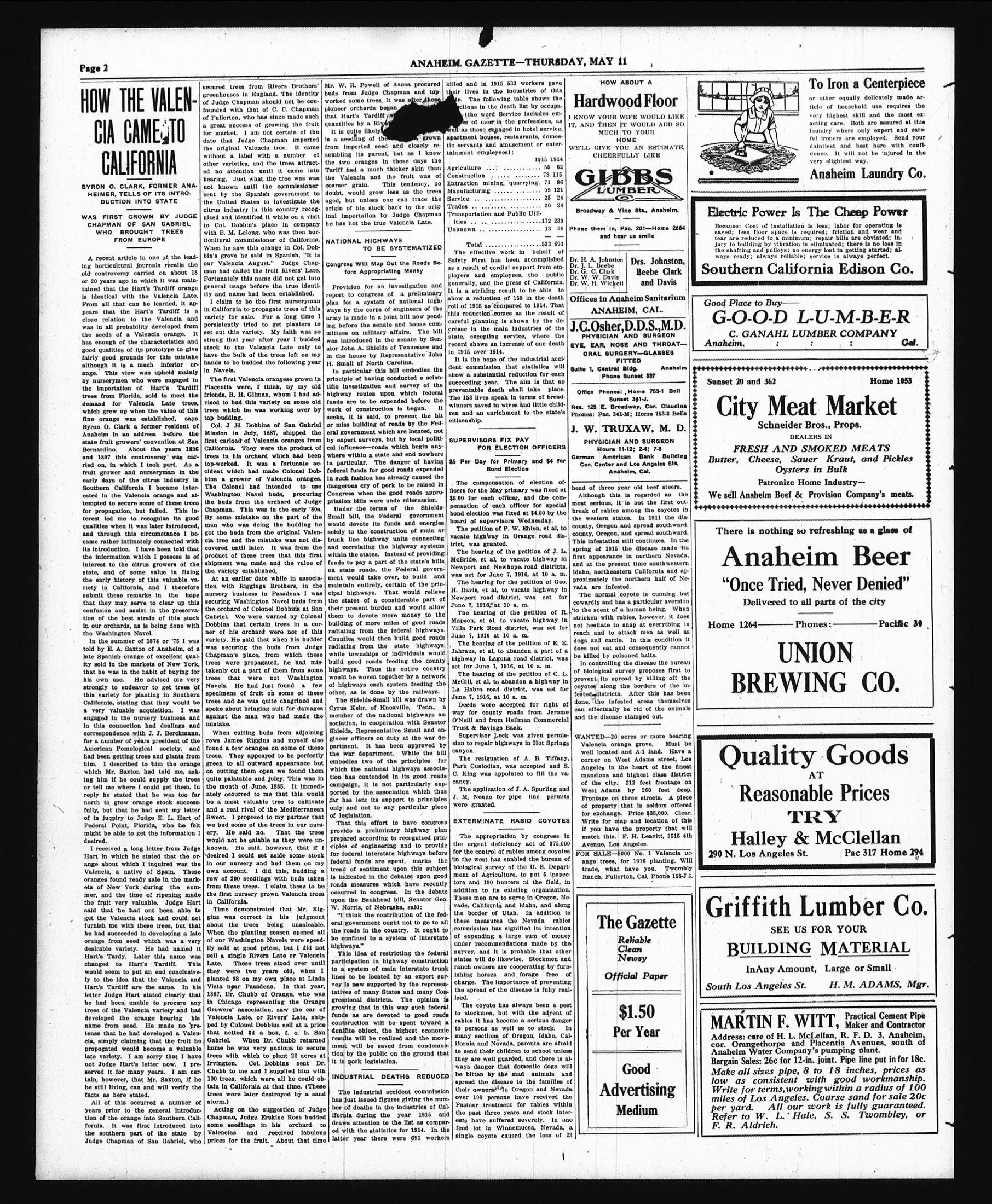
Searchable text
HOW THE VALENCIA CAME TO
CALIFORNIA
BYRON O. CLARK, FORMER ANAHEIMER, TELLS OF ITS INTRODUCTION INTO STATE
WAS FIRST GROWN BY JUDGE
CHAPMAN OF SAN GABRIEL
WHO BROUGHT TREES
FROM EUROPE
A recent article in one of the leading horticultural journals recalls the old controversy carried on about 18 or 20 years ago in which it was maintained that the Hart's Tardiff orange is identical with the Valencia Late. From all that can be learned, it appears that the Hart's Tardiff is a close relation to the Valencia and was in all probability developed from the seeds of a Valencia orange. It has enough of the characteristics and good qualities of its prototype to give fairly good grounds for this mistake although it is a much inferior orange. This view was upheld mainly by nurserymen who were engaged in the importation of Hart's Tardiff trees from Florida, sold to meet the demand for Valencia Late trees, which grew up when the value of this fine orange was established, says Byron O. Clark a former resident of Anaheim in an address before the state fruit growers' convention at San Bernardino.
About the year 1896 secured trees from Rivers Brothers' greenhouses in England. The identity of Judge Chapman should not be confounded with that of C. C. Chapman of Fullerton, who has since made such a great success of growing the fruit for market. I am not certain of the date that Judge Chapman imported the original Valencia tree. It came without a label with a number of other varieties, and the trees attracted no attention until it came into bearing. Just what the tree was was not known until the commissioner sent by the Spanish government to the United States to investigate the citrus industry in this country recognized and identified it while on a visit to Col. Dobbin's place in company with B. M. Lelong, who was then horticultural commissioner of California. When he saw this orange in Col. Dobbin's grove he said in Spanish, "It is our Valencia August." Judge Chapman had called the fruit Rivers' Late. Fortunately this name did not get into general usage before the true identity and name had been established.
I claim to be the first nurseryman in California to propagate trees of this variety for sale. For a long time I persistently tried to get planters to set out this variety. My faith was so strong that year after year I budded stock to the Valencia Late only to have the bulk of the trees left on my hands to be budded the following year in Navels.
The first Valencia oranges grown in Placentia were, I think, by my old friends, R. H. Gilman, whom I had advised to bud this variety on some old trees which he was working over by top budding.
Col. J.H. Dobbins of San Gabriel Mission in July, 1887, shipped the first carload of Valencia oranges from California. They were the product of Mr. W.R. Powell buds from Judge worked some time pioneer orchard that Hart's Tariff quantities by a lot.
It is quite like is a seedling or from imported sembling its pests the two orange Tariff had a new the Valencia coarser grain doubt, would go aged, but unlike origin of his initial importation he has not them.
NATIONAL HISTORY
Congress Will Fore Appoint
Provision for report to congress plan for a system ways by the army is made before the mittees on milieu was introducedator John A.S. in the house H. Small of N.
In particular principle of hard title investigation highway route funds are to be work of conste seeks, it is so or miss buildingeral government by expert survey cal influence—
fairly good grounds for this mistake although it is a much inferior orange. This view was upheld mainly by nurserymen who were engaged in the importation of Hart's Tardiff trees from Florida, sold to meet the demand for Valencia Late trees, which grew up when the value of this fine orange was established, says Byron O. Clark a former resident of Anaheim in an address before the state fruit growers' convention at San Bernardino. About the years 1896 and 1897 this controversy was carried on, in which I took part. As a fruit grower and nurseryman in the early days of the citrus industry in Southern California I became interested in the Valencia orange and attempted to secure some of these trees for propagation, but failed. This interest led me to recognize its good qualities when it was later introduced, and through this circumstance I became rather intimately connected with its introduction. I have been told that the information which I possess is of interest to the citrus growers of the state, and of some value in fixing the early history of this valuable variety in California, and I therefore submit these remarks in the hope that they may serve to clear up this confusion and assist in the preservation of the best strain of this stock in our orchards, as is being done with the Washington Navel.
In the summer of 1874 or '75 I was told by E. A. Saxton of Anaheim, of a late Spanish orange of excellent quality sold in the markets of New York, that he was in the habit of buying for his own use. He advised me very strongly to endeavor to get trees of this variety for planting in Southern California, stating that they would be a very valuable acquisition. I was engaged in the nursery business and in this connection had dealings and correspondence with J. J. Berckmann, for a number of years president of the American Pomological society, and had been getting trees and plants from him. I described to him the orange which Mr. Saxton had told me, asking him if he could supply the trees or tell me where I could get them. In reply he stated that he was too far north to grow orange stock successfully, but that he had sent my letter of in juqpiry to Judge E. L. Hart of Federal Point, Florida, who felt might be able to get the information I desired.
I received a long letter from Judge The first Valencia oranges grown in Placentia were, I think, by my old friends, R. H. Gilman, whom I had advised to bud this variety on some old trees which he was working over by top budding.
Col. J .H. Dobbins of San Gabriel Mission in July, 1887, shipped the first carload of Valencia oranges from California. They were the product of trees in his orchard which had been top-worked. It was a fortunate accident which had made Colonel Dobbins a grower of Valencia oranges. The Colonel had intended to use Washington Navel buds, procuring the buds from the orchard of Judge Chapman. This was in the early '80s. By some mistake on the part of the man who was doing the budding he got the buds from the original Valencia tree and the mistake was not discovered until later. It was from the product of these trees that this first shipment was made and the value of the variety established.
At an earlier date while in association with Riggings Brothers, in the nursery business in Pasadena I was securing Washington Navel buds from the orchard of Colonel Dobbins at San Gabriel. We were warned by Colonel Dobbins that certain trees in a corner of his orchard were not of this variety. He said that when his budder was securing the buds from Judge Chapman's place, from which these trees were propagated, he had mistakenly cut a part of them from some trees that were not Washington Navels. He had just found a few specimens of fruit on some of these trees and he was quite chagrined and spoke about bringing suit for damages against the man who had made the mistake.
When cutting buds from adjoining rows James Riggins and myself also found a few oranges on some of these trees. They appeared to be perfectly green to all outward appearance but on cutting them open we found them quite palatable and juicy. This was in the month of June, 1885. It immediately occurred to me that this would be a most valuable tree to cultivate and a real rival of the Mediterranean Sweet. I proposed to my partner that we bud some of the trees in our nursery. He said no. That the trees would not be salable as they were unknown. He said, however, that if I have the bulk of the trees left on my hands to be budded the following year in Navels.
The first Valencia oranges grown in Placentia were, I think, by my old friends, R. H. Gilman, whom I had advised to bud this variety on some old trees which he was working over by top budding.
Col. J .H. Dobbins of San Gabriel Mission in July, 1887, shipped the first carload of Valencia oranges from California. They were the product of trees in his orchard which had been top-worked. It was a fortunate accident which had made Colonel Dobbins a grower of Valencia oranges. The Colonel had intended to use Washington Navel buds, procuring the buds from the orchard of Judge Chapman. This was in the early '80s. By some mistake on the part of the man who was doing the budding he got the buds from the original Valencia tree and the mistake was not discovered until later. It was from the product of these trees that this first shipment was made and the value of the variety established.
At an earlier date while in association with Riggings Brothers, in the nursery business in Pasadena I was securing Washington Navel buds from the orchard of Colonel Dobbins at San Gabriel. We were warned by Colonel Dobbins that certain trees in a corner of his orchard were not of this variety. He said that when his budder was securing the buds from Judge Chapman's place, from which these trees were propagated, he had mistakenly cut a part of them from some trees that were not Washington Navels. He had just found a few specimens of fruit on some of these trees and he was quite chagrined and spoke about bringing suit for damages against the man who had made the mistake.
When cutting buds from adjoining rows James Riggins and myself also found a few oranges on some of these trees. They appeared to be perfectly green to all outward appearance but on cutting them open we found them quite palatable and juicy. This was in the month of June, 1885. It immediately occurred to me that this would be a most valuable tree to cultivate and a real rival of the Mediterranean Sweet. I proposed to my partner that we bud some of the trees in our nursery. He said no. That the trees would not be salable as they were unknown. He said, however, that if I have the bulk of the trees left on my hands to be budded the following year in Navels.
The first Valencia oranges grown in Placentia were, I think, by my old friends, R. H. Gilman, whom I had advised to bud this variety on some old trees which he was working over by top budding.
Col. J .H. Dobbins of San Gabriel Mission in July, 1887, shipped the first carload of Valencia oranges from California. They were the product of trees in his orchard which had been top-worked. It was a fortunate accident which had made Colonel Dobbins a grower of Valencia oranges. The Colonel had intended to use Washington Navel buds, procuring the buds from the orchard of Judge Chapman. This was in the early '80s. By some mistake on the part of the man who was doing the budding he got the buds from the original Valencia tree and the mistake was not discovered until later. It was from the product of these trees that this first shipment was made and the value of the variety established.
At an earlier date while in association with Riggings Brothers, in the nursery business in Pasadena I was securing Washington Navel buds from the orchard of Colonel Dobbins at San Gabriel. We were warned by Colonel Dobbins that certain trees in a corner of his orchard were not of this variety. He said that when his budder was securing the buds from Judge Chapman's place, from which these trees were propagated, he had mistakenly cut a part of them from some trees that were not Washington Navels. He had just found a few specimens of fruit on some of these trees and he was quite chagrined and spoke about bringing suit for damages against the man who had made the mistake.
When cutting buds from adjoining rows James Riggins and myself also found a few oranges on some of these trees. They appeared to be perfectly green to all outward appearance but on cutting them open we found them quite palatable and juicy. This was in the month of June, 1885. It immediately occurred to me that this would be a most valuable tree to cultivate and a real rival of the Mediterranean Sweet. I proposed to my partner that we bud some of these trees in our nursery. He said no. That the trees would not be salable as they were unknown. He said, however, that if I have the bulk of the trees left on my hands to be budded the following year in Navels.
The first Valencia oranges grown in Placentia were, I think, by my old friends, R. H. Gilman, whom I had advised to bud this variety on some old trees which he was working over by top budding.
Col. J .H. Dobbins of San Gabriel Mission in July, 1887, shipped the first carload of Valencia oranges from California. They were the product of trees in his orchard which had been top-worked. It was a fortunate accident which had made Colonel Dobbins a grower of Valencia oranges. The Colonel had intended to use Washington Navel buds, procuring the buds from the orchard of Judge Chapman. This was in the early '80s. By some mistake on the part of the man who was doing the budding he got the buds from the original Valencia tree and the mistake was not discovered until later. It was from the product of these trees that this first shipment was made and the value of the variety established.
At an earlier date while in association with Riggings Brothers, in the nursery business in Pasadena I was securing Washington Navel buds from the orchard of Colonel Dobbins at San Gabriel. We were warned by Colonel Dobbins that certain trees in a corner of his orchard were not of this variety. He said that when his budder was securing the buds from Judge Chapman's place, from which these trees were propagated, he had mistakenly cut a part of them from some trees that were not Washington Navels. He had just found a few specimens of fruit on some of these trees and he was quite chagrined and spoke about bringing suit for damages against the man who had made the mistake.
When cutting buds from adjoining rows James Riggins and myself also found a few oranges on some of these trees. They appeared to be perfectly green to all outward appearance but on cutting them open we found them quite palatable and juicy. This was in the month of June, 1885. It immediately occurred to me that this would be a most valuable tree to cultivate and a real rival of the Mediterranean Sweet. I proposed to my partner that we bud some of these trees in our nursery. He said no. That the trees would not be salable as they were unknown. He said, however, that if I have the bulk of the trees left on my hands to be budded the following year in Navels.
The first Valencia oranges grown in Placentia were, I think, by my old friends, R.H.Gilman, whom I had advised to bud this variety on some old trees which he was working over by top budding.
Col. J .H .Dobbins of San Gabriel Mission in July 1887, shipped the first carload of Valencia oranges from California. They were the product of trees in his orchard which had been top-worked. It was a fortunate accident which had made Colonel Dobbins a grower of Valencia oranges. The Colonel had intended to use Washington Navel buds, procuring the Buds fromthe orchardof Judge ChapmanThiswasintheearly'80sBysomemistakeonthepartofthemanwhowasdoingthebuddinghegotthebuddsfromtheoriginalValenciatreeandthemistakewasnotdiscovereduntillaterItwassfromtheproductofthesewtreesthatthisfirstshipmentwasmadeandthevalueofthevarietyestablished
At an earlier date while in association with Riggings Brothers, in the nursery business in Pasadena I was securing Washington Navel buds fromthe orchardof Colonel Dobbins at San Gabriel. We were warned by Colonel Dobbins that certain trees in a corner of his orchard were not of this variety. He said that when his budder was securingthebudsfromJudgeChapman'splacefromwhichthesetreeswerepropagatedhehadmistakenlycutapartofthemenfromsometreesthatwerenotWashingtonNavelsHehadjustfounda fewspecimensoffruitonsomeofthesetreesandhewasquitechagrinedandspokenaboutbringingsuitfordamagesagainstthemanwhohadmadethemistake
When cutting buds from adjoining rows James Riggins and myself also found a few oranges on some of these trees.ThereaspectsofthismistakeonthepartofthemanwhohadmadethemistakewasnotdiscovereduntillaterItwassfromtheproductofthesewtreesthatthisfirstshipmentwasmadeandthevalueofthevarietyestablished
At an earlier date while in association with Riggings Brothers, in the nursery business in Pasadena I was securing Washington Navel buds fromthe orchardof Colonel Dobbins at San Gabriel. We were warned by Colonel Dobbins that certain trees in a corner of his orchard were not of this variety. He said that when his budder was securingthebudsfromJudgeChapman'splacefromwhichthesetreeswerepropagatedhehadmistakenlycutapartofthemenfromsometreesthatwerenotWashingtonNavelsHehadjustfounda fewspecimensoffruitonsomeofthesetreesandhewasquitechagrinedandspokenaboutbringingsuitfordamagesagainstthemanwhohadmadethemistake
When cutting buds from adjoining rows James Riggins and myself also found a few oranges on some of these trees.ThereaspectsofthismistakeonthepartofthemanwhohadmadethemistakewasnotdiscovereduntillaterItwassfromtheproductofthesewtreesthatthisfirstshipmentwasmadeandthevalueofthevarietyestablished
At an earlier date while in association with Ruggings Brothers, in the nursery business in Pasadena I was securing Washington Navel buds fromthe orchardof Colonel Dobbins at San Gabriel. We were warned by Colonel Dobbins that certain trees in a corner of his orchard were not of this variety. He said that when his budder was securingthebudsfromJudgeChapman'splacefromwhichthesetreeswerepropagatedhehadmistakenlycutapartofthemenfromsometreesthatwerenotWashingtonNavelsHehadjustfounda fewspecimensoffruitonsomeofthesetreesandhewasquitechagrinedandspokenaboutbringingsuitfordamagesagainstthemanwhohadmadethemistake
When cutting buds from adjoining rows James Riggins and myself also found a few oranges on some of these trees.ThereaspectsofthismistakeonthepartofthemanwhohadmadethemistakewasnotdiscovereduntillaterItwassfromtheproductofthesewtreesthatthisfirstshipmentwasmadeandthevalueofthevarietyestablished
At an earlier date while in association with Ruggings Brothers, in the nursery business in Pasadena I was securing Washington Navel buds fromthe orchardof Colonel Dobbins at San Gabriel. We were warned by Colonel Dobbins that certain树木在树干上生长,树干上的水分保持在树干上生长,树干上的水分保持在树干上生长,树干上的水分保持在树干上生长,树干上的水分保持在树干上生长,树干上的水分保持在树干上生长,树干上的水分保持在树干上生长,树干上的水分保持在树干上生长,树干上的水分保持在树干上生长,树干上的水分保持在树干上生长,树干上的水分保持在树干上生长,树干上的水分保持在树干上生长,树干上的水分保持在树干上生长,树干上的水分保持在树干上生长,树干上的水分保持在树干上生长,树干上的水分保持在树干上生长,树干上的水分保持在树干上生长,树干上的水分保持在树干上生长,树干上的水分保持在树干上生长,树干上的水分保持在树干上生长,树干上的水分保持在树干上生长,树干上的水分保持在树干上生长,树干上的水分保持在树干上生长,树干上的水分保持在树干上生长,树干上的水分保持在树干上生长,树干上的水分保持在树干上生长,树干上的水分保持在树干上生长,树干上的水分保持在树干上生长,树干上的水分保持在树干上生长,树干上的水分保持在树干上生长,树千上的水分保持在树干上生长,树千上的水分保持在树干上生长,树千上的水分保持在树干上生长,树千上的水分保持在树干上生长,树千上的水分保持在树干上生长,树千上的水分保持在树干上生长,树千上的水分保持在树干上生长,树千上的水分保持在树干上生长,树千上的水分保持在树干上生长,树千上的水分保持在树干上生长,树千上的水分保持在树干上生长,树千上的水分保持在树干上生长,树千上的水分保持在树干上生长,树千上的水分保持在树干上生长,树千上的水分保持在
I received a long letter from Judge Hart in which he stated that the orange about which I inquired was the Valencia, a native of Spain. These oranges found ready sale in the markets of New York during the summer, and the time of ripening made the fruit very valuable. Judge Hart said that he had not been able to get the Valencia stock and could not furnish me with these trees, but that he had succeeded in developing a late orange from seed which was a very desirable variety. He had named it Hart's Tardy. Later this name was changed to Hart's Tardiff. This would seem to put an end conclusively to the idea that the Valencia and Hart's Tardiff are the same. In his letter Judge Hart stated clearly that he had been unable to procure any trees of the Valencia variety and had developed the orange bearing his name from seed. He made no pretense that he had developed a Valencia, simply claiming that the fruit he propagated would become a valuable late variety. I am sorry that I have not Judge Hart's letter now. I preserved it for many years. I am certain, however, that Mr. Saxton, if he be still living, can and will verify the facts as here stated.
All of this occurred a number of years prior to the general introduction of the orange into Southern California. It was first introduced into the southern part of the state by Judge Chapman of San Gabriel, who
They appeared to be perfectly green to all outward appearance but on cutting them open we found them quite palatable and juicy. This was in the month of June, 1885. It immediately occurred to me that this would be a most valuable tree to cultivate and a real rival of the Mediterranean Sweet. I proposed to my partner that we bud some of the trees in our nursery. He said no. That the trees would not be salable as they were unknown. He said, however, that if I desired I could set aside some stock in our nursery and bud them on my own account. I did this, budding a row of 200 seedlings with buds taken from these trees. I claim these to be the first nursery grown Valencia trees in California.
Time demonstrated that Mr. Riggins was correct in his judgment about the trees being unsaleable. When the planting season opened all of our Washington Navels were speedily sold at good prices, but I did not sell a single Rivers Late or Valencia Late. These trees stood over until they were two years old, when I planted 98 on my own place at Linda Vista near Pasadena. In that year, 1887, Dr. Chubb of Orange, who was in Chicago representing the Orange Growers' association, saw the car of Valencia Late, or Rivers' Late, shipped by Colonel Dobbins sell at a price that netted $4 a box, f. o. b. San Gabriel. When Dr. Chubb returned home he was very anxious to secure trees with which to plant 20 acres at Irvington. Col. Dobbins sent Dr. Chubb to me and I supplied him with 100 trees, which were all he could obtain in California at that time. (These trees were later destroyed by a sand storm.) Acting on the suggestion of Judge Chapman, Judge Erskine Ross budded some seedlings in his orchard to Valencias and received fabulous prices for the fruit. About that time
ANAHEIM GAZETTE—THURSDAY, MAY 11
Mr. W. R. Powell of Azusa procured buds from Judge Chapman and top-worked some trees. It was after these pioneer orchards began that Hart's Tardiff was quantities by a River. It is quite likely that it is a seedling of the tree grown from imported seed and closely resembling its parent, but as I knew the two oranges in those days the Tariff had a much thicker skin than the Valencia and the fruit was of coarser grain. This tendency, no doubt, would grow less as the trees aged, but unless one can trace the origin of his stock back to the original importation by Judge Chapman he has not the true Valencia Late.
NATIONAL HIGHWAYS TO BE SYSTEMATIZED
Congress Will Map Out the Roads Before Appropriating Money
Provision for an investigation and report to congress of a preliminary plan for a system of national highways by the corps of engineers of the army is made in a joint bill now pending before the senate and house committees on military affairs. The bill was introduced in the senate by Senator John A. Shields of Tennessee and in the house by Representative John H. Small of North Carolina.
In particular this bill embodies the principle of having conducted a scientific investigation and survey of the highway routes upon which federal funds are to be expended before the work of construction is begun. It seeks, it is said, to prevent the hit or miss building of roads by the Federal government which are located, not by expert surveys, but by local political influence—roads which begin any-killed and in 1915 533 workers gave their lives in the industries of this state. The following table shows the reductions in the death list by occupations (the word Service includes employees of men in the professions, as well as those engaged in hotel service, apartment houses, restaurants, domestic servants and amusement or entertainment employees):
1915 1914
Agriculture ... 55 62
Construction ... 78 115
Extraction mining, quarrying. 71 86
Manufacturing ... 99 121
Service ... 25 24
Trades ... 20 24
Transportation and Public Utilities ... 172 239
Unknown ... 13 20
Total ... 533 691
The effective work in behalf of Safety First has been accomplished as a result of cordial support from employers and employees, the public generally, and the press of California. It is a striking result to be able to show a reduction of 158 in the death roll of 1915 as compared to 1914. That this reduction comes as the result of careful planning is shown by the decrease in the main industries of the state, excepting service, where the record shows an increase of one death in 1915 over 1914.
It is the hope of the industrial accident commission that statistics will show a substantial reduction for each succeeding year. The aim is that no preventable death shall take place. The 153 lives speak in terms of breadwinners saved to wives and little children and an enrichment to the state's citizenship.
SUPERVISORS FIX PAY FOR ELECTION OFFICERS
In particular this bill embodies the principle of having conducted a scientific investigation and survey of the highway routes upon which federal funds are to be expended before the work of construction is begun. It seeks, it is said, to prevent the hit or miss building of roads by the Federal government which are located, not by expert surveys, but by local political influence—roads which begin anywhere within a state and end nowhere in particular. The danger of having federal funds for good roads expended in such fashion has already caused the dangerous cry of pork to be raised in Congress when the good roads appropriation bills were unde rdiscussion.
Under the terms of the Shields-Small bill, the Federal government would devote its funds and energies solely to the construction of main or trunk line highway units connecting and correlating the highway systems within the states. Instead of providing funds to pay a part of the state's bills on state roads, the Federal government would take over, to build and maintain entirely, certain of the principal highways. That would relieve the states of a considerable part of their present burden and would allow them to devote more money to the building of more miles of good roads radiating from the federal highways. Counties would then build good roads radiating from the state highways, while townships or individuals would build good roads feeding the county highways. Thus the entire country would be woven together by a network of highways each system feeding the other, as is done by the railways.
The Shields-Small bill was drawn by Cyrus Kehr, of Knoxville, Tenn., a member of the national highways association, in cooperation with Senator Shields, Representative Small and engineer officers on duty at the war department. It has been approved by the war department. While the bill embodies two of the principles for which the national highways association has contended in its good roads campaign, it is not particularly supported by the association which thus far has lent its support to principles only and not to any particular piece of legislation.
That this effort to have congress provide a preliminary highway plan prepared according to recognized principles of engineering and to provide it is the hope of the industrial accident commission that statistics will show a substantial reduction for each succeeding year. The aim is that no preventable death shall take place. The 158 lives speak in terms of breadwinners saved to wives and little children and an enrichment to the state's citizenship.
SUPERVISORS FIX PAY FOR ELECTION OFFICERS
$5 Per Day for Primary and $4 for Bond Election
The compensation of election officers for the May primary was fixed at $5.00 for each officer, and the compensation of each officer for special bond election was fixed at $4.00 by the board of supervisors Wednesday.
The petition of P. W. Ehlen, et al, to vacate highway in Orange road district, was granted.
The hearing of the petition of J. L. McBride, et al, to vacate highway in Newport and Newhope road districts, was set for June 7, 1916, at 10 a.m.
The hearing for the petition of Geo. H. Davis, et al, to vacate highway in Newport road district, was set for June 7, 1916, at 10 a.m.
The hearing of the petition of R. Mapson, et al, to vacate highway in Villa Park Road district, was set for June 7, 1916 at 10 a.m.
The hearing of the petition of E. E. Jahraus, et al, to abandon a part of a highway in Laguna road district, was set for June 7, 1916, at 10 a.m.
The hearing of the petition of C. L. McGill, et al, to abandon a highway in La Habra road district, was set for June 7, 1916, at 10 a.m.
Deeds were accepted for right of way for county roads from Jerome O'Neill and from Hellman Commercial Trust & Savings Bank.
Supervisor Lock was given permission to repair highways in Hot Springs canyon.
The resignation of A. B. Tiffany, Park Custodian, was accepted and S. C. King was appointed to fill the vacancy.
The application of J. A. Spurling and J. M. Nenno for pipe line permits were granted.
EXTERMINATE RABID COYOTES
The appropriation by congress in the urgent deficiency act of $75,000 for the control of rabies among cooters.
WANTED—20 acres or more bearing Valencia orange grove. Must be well located and A-1 land. Have a corner on West Adams street, Los Angeles in the heart of the finest mansions and highest class district of the city. 212 feet frontage on West Adams by 260 feet deep. Frontage on three streets. A piece of property that is seldom offered for exchange. Price $35,000. Clear. Write for map and location of this if you have the property that will match this. F. H. Leavitt, 3515 4th Avenue, Los Angeles.
embodied two of the principles for which the national highways association has contended in its good roads campaign, it is not particularly supported by the association which thus far has lent its support to principles only and not to any particular piece of legislation.
That this effort to have congress provide a preliminary highway plan prepared according to recognized principles of engineering and to provide for federal interstate highways before federal funds are spent, marks the trend of sentiment upon this subject is indicated in the debates upon good roads measures which have recently occurred in congress. In the debate upon the Bankhead bill, Senator Geo. W. Norris, of Nebraska, said:
"I think the contribution of the federal government ought not to go to all the roads in the country. It ought to be confined to a system of interstate highways."
This idea of restricting the federal participation in highway construction to a system of main interstate trunk lines to be located by an expert survey is now supported by the representatives of many States and many Congressional districts. The opinion is growing that in this way such federal funds as are devoted to good roads construction will be spent toward a denifite object, the highest economic results will be realized and the movement will be saved from condemnation by the public on the ground that it is pork legislation.
INDUSTRIAL DEATHS REDUCED
The industrial accident commission has just issued figures giving the number of deaths in the industries of California during the year 1915 and draws attention to the list as compared with the statistics for 1914. In the latter year there were 691 workers
The resignation of A. B. Tiffany, Park Custodian, was accepted and S. C. King was appointed to fill the vacancy.
The application of J. A. Spurling and J. M. Nenno for pipe line permits were granted.
EXTERMINATE RABID COYOTES
The appropriation by congress in the urgent deficiency act of $75,000 for the control of rabies among coyotes in the west has enabled the bureau of biological survey of the U.S. Department of Agriculture, to put 5 inspectors and 190 hunters ni the field, in addition to its existing organization. These men are to serve in Oregon, Nevada, California and Idaho, and along the border of Utah. In addition to these measures the Nevada rabies commission has signified its intention of expending a large sum of money under recommendations made by the survey, and it is probable that other states will do likewise. Stockmen and ranch owners are cooperating by furnishing horses and forage free of charge. The importance of preventing the spread of the disease is fully realized.
The coyote has always been a pest to stockmen, but with the adyent of rabies it has become a serious danger to persons as well as to stock. In many sections of Oregon, Idaho, California and Nevada, parents are afraid to send their children to school unless they are well guarded, and there is always danger that domestic dogs will be bitten by the mad animals and spread the disease to the families of their owners. In Oregon and Nevada over 100 persons have received the Pasteur treatment for rabies within the past three years and stock interests have suffered severely. In one feed lot in Winnemucca, Nevada, a single coyote caused the loss of 23
ABOUT A
ood Floor
WIFE WOULD LIKE
T WOULD ADD SO
TO YOUR
HOME
YOU AN ESTIMATE,
BULLY LIKE
BBS
MBER
ine Sts., Anaheim.
Pac. 201—Home 2664
ar us smile
Drs. Johnston,
Beebe Clark
and Davis
aheim Sanitarium
EIM, CAL.
,D.D.S., M.D.
AND SURGEON
BE AND THROAT—
ERY—GLASSES
TTED
Bldg.
Anaheim
Sunset 337
To Iron a Centerpiece
or other equally delicately made artticle of household use requires the
very highest skill and the most exacting care. Both are assured at this
laundry where only expert and careful ironers are employed. Send your
daintiest and best here with confidence. It will not be injured in the
very slightest way.
Anaheim Laundry Co.
Electric Power Is The Cheap Power
Because: Cost of installation is less; labor for operating is
saved; less floor space is required; friction and wear and
tear are reduced to a minimum; repair bills are obviated; injujury to building by vibration is eliminated; there is no loss in
the shafting and pulleys; no energy lost in getting started; always ready; always reliable; service is always perfect.
Southern California Edison Co.
Good Place to Buy—
G-O-O-D L-U-M-B-E-R
C. GANAHL LUMBER COMPANY
Anaheim. : : : Gal.
Sunset 20 and 362 Home 1053
City Meat Market
Schneider Bros., Props.
DEALERS IN
FRESH AND SMOKED MEATS
Sunset 20 and 362 Home 1053
City Meat Market
Schneider Bros., Props.
DEALERS IN
FRESH AND SMOKED MEATS
Butter, Cheese, Sauer Kraut, and Pickles
Oysters in Bulk
Patronize Home Industry—
We sell Anaheim Beef & Provision Company's meats.
There is nothing so refreshing as a glass of
Anaheim Beer
"Once Tried, Never Denied"
Delivered to all parts of the city
Home 1264 Phones: Pacific 30
UNION
BREWING CO.
Quality Goods
AT
Reasonable Prices
TRY
Halley & McClellan
Quality Goods
AT
Reasonable Prices
TRY
Halley & McClellan
290 N. Los Angeles St. Pac 317 Home 294
Griffith Lumber Co.
SEE US FOR YOUR
BUILDING MATERIAL
InAny Amount, Large or Small
South Los Angeles St. H. M. ADAMS, Mgr.
MARTIN F. WITT, Practical Cement Pipe Maker and Contractor
Address: care of H. L. McLellan, R. F. D. 3, Anaheim, cor. Orangethorpe and Placentia Avenues, south of Anahelm Water Company's pumping plant.
Bargain Sales: 26c for 12-in. joint. Pipe line put in for 18c.
Make all sizes pipe, 8 to 18 inches, prices as low as consistent with good workmanship.
Write for terms, working within a radius of 100 miles of Los Angeles. Coarse sand for sale 20c per yard. All our work is fully guaranteed.
Refer to W. L. Hale, S. S. Twombley, or F. R. Aldrich.