anaheim-gazette 1916-04-13
Scanned page
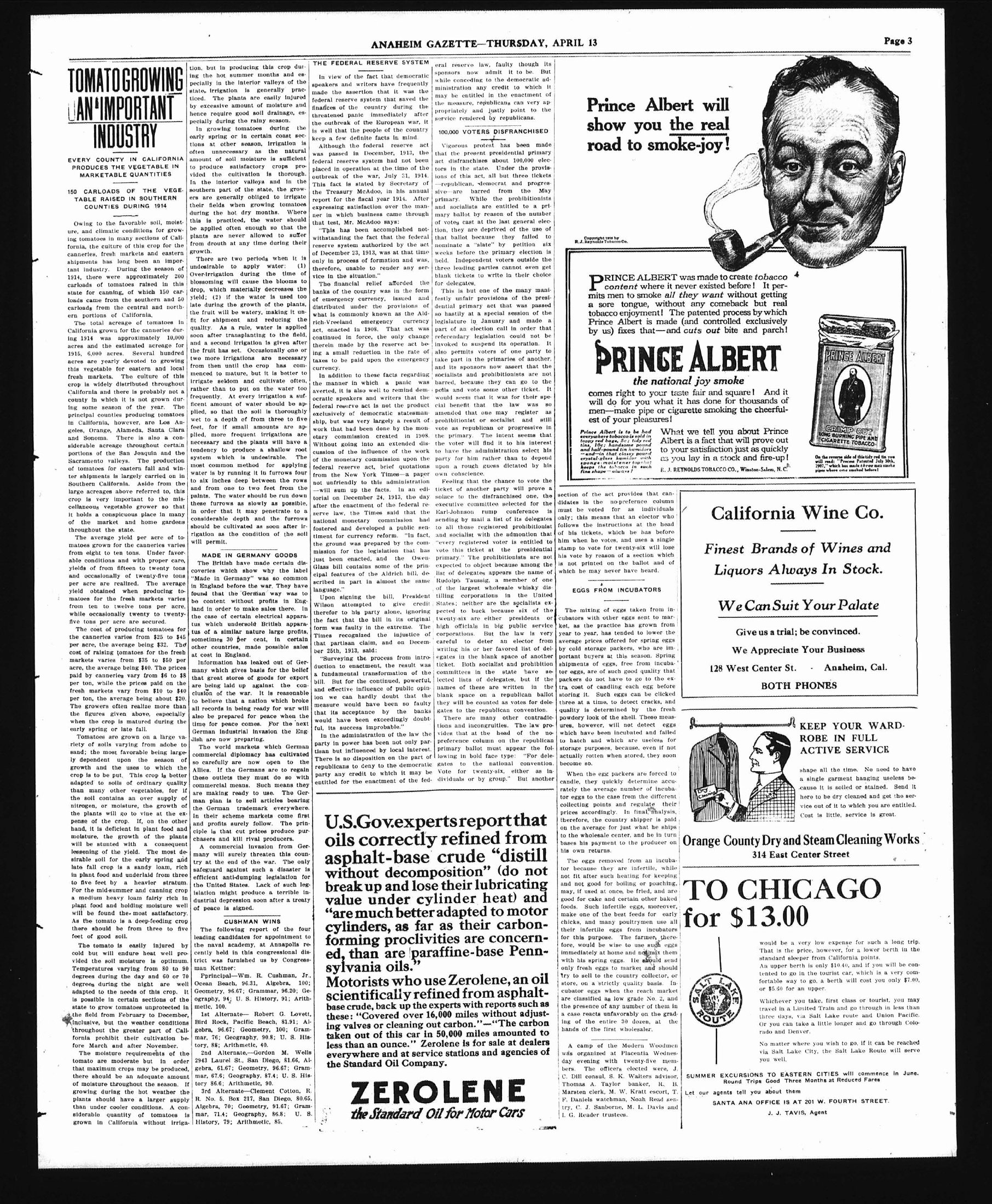
Searchable text
TOMATO GROWING AN IMPORTANT INDUSTRY
EVERY COUNTY IN CALIFORNIA PRODUCES THE VEGETABLE IN MARKETABLE QUANTITIES
150 CARLOADS OF THE VEGETABLE RAISED IN SOUTHERN COUNTIES DURING 1914
Owing to the favorable soil, moisture, and climatic conditions for growing tomatoes in many sections of California, the culture of this crop for the canneries, fresh markets and eastern shipments has long been an important industry. During the season of 1914, there were approximately 200 carloads of tomatoes raised in this state for canning, of which 150 carloads came from the southern and 50 carloads from the central and northern portions of California.
The total acreage of tomatoes in California grown for the canneries during 1914 was approximately 10,000 acres and the estimated acreage for 1915, 6,000 acres. Several hundred acres are yearly devoted to growing this vegetable for eastern and local fresh markets. The culture of this crop is widely distributed throughout California and there is probably not a county in which it is not grown during some season of the year. The principal counties producing tomatoes in California, however, are Los Angeles, Orange, Alameda, Santa Clara and Sonoma. There is also a considerable acreage throughout certain tion, but in producing this crop during the hot summer months and especially in the interior valleys of the state, irrigation is generally practiced. The plants are easily injured by excessive amount of moisture and hence require good soil drainage, especially during the rainy season.
In growing tomatoes during the early spring or in certain coast sections at other season, irrigation is often unnecessary as the natural amount of soil moisture is sufficient to produce satisfactory crops provided the cultivation is thorough. In the interior valleys and in the southern part of the state, the growers are generally obliged to irrigate their fields when growing tomatoes during the hot dry months. Where this is practiced, the water should be applied often enough so that the plants are never allowed to suffer from drought at any time during their growth.
There are two periods when it is undesirable to apply water: (1) Over-irrigation during the time of blossoming will cause the blooms to drop, which materially decreases the yield; (2) if the water is used too late during the growth of the plants, the fruit will be watery, making it unfit for shipment and reducing the quality. As a rule, water is applied soon after transplanting to the field, and a second irrigation is given after the fruit has set. Occasionally one or two more irrigations are necessary from then until the crop has commenced to mature, but it is better to irrigate seldom and cultivate often, rather than to put on the water too frequently. At every irrigation a sufficient amount of water should be applied, so that the soil is thoroughly wet to a depth of from three to five feet, for if small amounts are applied, more frequent irrigations are necessary and the plants will have a tendency to produce a shallow root.
THE FEDERAL REPUBLIC
In view of the fact speakers and writers made the assertion federal reserve system financed of the country threatened panic the outbreak of the war is well that the people keep a few definite Although the fecal was passed in De federal reserve system placed in operation outbreak of the war This fact is stated the Treasury McA report for the fiscal expressing satisfaction in which business that test, Mr. McA "This has been withstanding the fa reserve system autumn of December 23, 1914 only in process of therefore, unable vice in the situation The financial re banks of the coun of emergency curr ent distributed under what is commonly rich-Vreeland em act, enacted in 1914 continued in force therein made by ty ing a small reduced taxes to be paid u currency.
In addition to th the manner in wh averted, it is also w ocratic speakers and federal reserve act exclusively of dem ship, but was very work that had been etary commission Without going into
1915, 6,000 acres. Several hundred acres are yearly devoted to growing this vegetable for eastern and local fresh markets. The culture of this crop is widely distributed throughout California and there is probably not a county in which it is not grown during some season of the year. The principal counties producing tomatoes in California, however, are Los Angeles, Orange, Alameda, Santa Clara and Sonoma. There is also a considerable acreage throughout certain portions of the San Joaquin and the Sacramento valleys. The production of tomatoes for eastern fall and winter shipments is largely carried on in Southern California. Aside from the large acreages above referred to, this crop is very important to the miscellaneous vegetable grower so that it holds a conspicuous place in many of the market and home gardens throughout the state.
The average yield per acre of tomatoes grown for the canneries varies from eight to ten tons. Under favorable conditions and with proper care, yields of from fifteen to twenty tons and occasionally of twenty-five tons per acre are realized. The average yield obtained when producing tomatoes for the fresh markets varies from ten to twelve tons per acre, while occasionally twenty to twenty-five tons per acre are secured.
The cost of producing tomatoes for the canneries varies from $25 to $45 per acre, the average being $32. The cost of raising tomatoes for the fresh markets varies from $35 to $50 per acre, the average being $40. The prices paid by canneries vary from $6 to $8 per ton, while the prices paid on the fresh markets vary from $10 to $40 per ton, the average being about $20. The growers often realize more than the figures given above, especially when the crop is matured during the early spring or late fall.
Tomatoes are grown on a large variety of soils varying from adobe to sand; the most favorable being largely dependent upon the season of growth and the uses to which the crop is to be put. This crop is better adapted to soils of ordinary quality than many other vegetables, for if the soil contains an over supply of nitrogen, or moisture, the growth of the plants will go to vine at the expense of the crop. If, on the other hand, it is deficient in plant food and moisture, the growth of the plants will be stunted with a consequent two more irrigations are necessary from then until the crop has commenced to mature, but it is better to irrigate seldom and cultivate often, rather than to put on the water too frequently. At every irrigation a sufficient amount of water should be applied, so that the soil is thoroughly wet to a depth of from three to five feet, for if small amounts are applied, more frequent irrigations are necessary and the plants will have a tendency to produce a shallow root system which is undesirable. The most common method for applying water is by running it in furrows four to six inches deep between the rows and from one to two feet from the palnts. The water should be run down these furrows as slowly as possible, in order that it may penetrate to a considerable depth and the furrows should be cultivated as soon after irrigation as the condition of the soil will permit.
MADE IN GERMANY GOODS
The British have made certain discoveries which show why the label "Made in Germany" was so common in England before the war. They have found that the German way was to be content without profits in England in order to make sales there. In the case of certain electrical apparatus which undersold British apparatus of a similar nature large profits, sometimes 30 per cent, in certain other countries, made possible sales at cost in England.
Information has leaked out of Germany which gives basis for the belief that great stores of goods for export are being laid up against the conclusion of the war. It is reasonable to believe that a nation which broke all records in being ready for war will also be prepared for peace when the time for peace comes. For the next German industrial invasion the English are now preparing.
The world markets which German commercial diplomacy has cultivated so carefully are now open to the Allies. If the Germans are to regain these outlets they must do so with commercial means. Such means they are making ready to use. The German plan is to sell articles bearing the German trademark everywhere. In their scheme markets come first and profits surely follow. The principle is that cut prices produce purchasers and kill rival producers.
A commercial invasion from Ger-
ly dependent upon the season of growth and the uses to which the crop is to be put. This crop is better adapted to soils of ordinary quality than many other vegetables, for if the soil contains an over supply of nitrogen, or moisture, the growth of the plants will go to vine at the expense of the crop. If, on the other hand, it is deficient in plant food and moisture, the growth of the plants will be stunted with a consequent lessening of the yield. The most desirable soil for the early spring and late fall crop is a sandy loam, rich in plant food and underlaid from three to five feet by a heavier stratum. For the mid-summer and canning crop a medium heavy loam fairly rich in plant food and holding moisture well will be found the most satisfactory. As the tomato is a deep-feeding crop there should be from three to five feet of good soil.
The tomato is easily injured by cold but will endure heat well provided the soil moisture is optimum. Temperatures varying from 80 to 90 degrees during the day and 60 or 70 degrees during the night are well adapted to the needs of this crop. It is possible in certain sections of the state to grow tomatoes unprotected in the field from February to December, inclusive, but the weather conditions throughout the greater part of California prohibit their cultivation before March and after November.
The moisture requirements of the tomato are moderate but in order that maximum crops may be produced, there should be an adequate amount of moisture throughout the season. If growing during the hot weather the plants should have a larger supply than under cooler conditions. A considerable quantity of tomatoes is grown in California without irrigation.
CUSHMAN WINS
The following report of the four leading candidates for appointment to the naval academy, at Annapolis recently held in this congressional district was furnished us by Congressman Kettner:
Pprincipal—Wm. R. Cushman, Jr., Ocean Beach, 96.31; Algebra, 100; Geometry, 96.67; Grammar, 96.20; Geography, 94; U. S. History, 91; Arithmetic, 100.
1st Alternate—Robert G. Lovett, Bird Rock, Pacific Beach, 81.91; Algebra, 96.67; Geometry, 100; Grammar, 76; Geography, 90.8; U. S. History, 88; Arithmetic, 40.
2nd Alternate—Gordon M. Wells 2943 Laurel St., San Diego, 81.66; Algebra, 61.67; Geometry, 96.67; Grammar, 67.6; Geography, 87.4; U. S. History 86.6; Arithmetic, 90.
3rd Alternate—Clement Cotton, R. R. No. 5, Box 217, San Diego, 80.65; Algebra, 70; Geometry, 91.67; Grammar, 71.4; Geography, 86.8; U. S. History, 79; Arithmetic, 85.
THE FEDERAL RESERVE SYSTEM
In view of the fact that democratic speakers and writers have frequently made the assertion that it was the federal reserve system that saved the finances of the country during the threatened panic immediately after the outbreak of the European war, it is well that the people of the country keep a few definite facts in mind.
Although the federal reserve act was passed in December, 1913, the federal reserve system had not been placed in operation at the time of the outbreak of the war, July 31, 1914. This fact is stated by Secretary of the Treasury McAdoo, in his annual report for the fiscal year 1914. After expressing satisfaction over the manner in which business came through that test, Mr. McAdoo says:
"This has been accomplished notwithstanding the fact that the federal reserve system authorized by the act of December 23, 1913, was at that time only in process of formation and was, therefore, unable to render any service in the situation."
The financial relief afforded the banks of the country was in the form of emergency currency, issued and distributed under the provisions of what is commonly known as the Aldrich-Vreeland emergency currency act, enacted in 1908. That act was continued in force, the only change therein made by the reserve act being a small reduction in the rate of taxes to be paid upon the emergency currency.
In addition to these facts regarding the manner in which a panic was averted, it is also well to remind democratic speakers and writers that the federal reserve act is not the product exclusively of democratic statesmanship, but was very largely a result of work that had been done by the monetary commission created in 1908. Without going into an extended discussion law, faulty though its sponsors now admit it to be. But while conceding to the democratic administration any credit to which it may be entitled in the enactment of the measure, republicans can very appropriately and justly point to the service rendered by republicans.
100,000 VOTERS DISFRANCHISED
Vigorous protest has been made that the present presidential primary act disfranchises about 100,000 electors in the state. Under the provisions of this act, all but three tickets—republican, democrat and progressive—are barred from the May primary. While the prohibitionists and socialists are entitled to a primary ballot by reason of the number of votes cast at the last general election, they are deprived of the use of that ballot because they failed to nominate a "slate" by petition six weeks before the primary election is held. Independent voters outside the three leading parties cannot even get blank tickets to write in their choice for delegates.
This is but one of the many manifestly unfair provisions of the presidential primary act that was passed so hastily at a special session of the legislature in January and made a part of an election call in order that referendum legislation could not be invoked to suspend its operation. It also permits voters of one party to take part in the primaries of another, and its sponsors now assert that the socialists and prohibitionists are not barred, because they can go to the polls and vote some other ticket. It would seem that it was for their special benefit that the law was so amended that one may register as prohibitionist or socialist and still vote as republican or progressive in the primary. The intent seems that the voter will find it to his interest.
PRINCE ALBERT was no content where it never mits men to smoke all they a sore tongue, without any tobacco enjoyment! The patrician Prince Albert is made (and by us) fixes that—and cuts PRINCE ALBERT comes right to your taste fair will do for you what it has men—make pipe or cigarette est of your pleasures!
What we Albert is a
U.S.Gov.experts report that oils correctly refined from taxes to be paid upon the emergency currency.
In addition to these facts regarding the manner in which a panic was averted, it is also well to remind democratic speakers and writers that the federal reserve act is not the product exclusively of democratic statesmanhip, but was very largely a result of work that had been done by the monetary commission created in 1908. Without going into an extended discussion of the influence of the work of the monetary commission upon the federal reserve act, brief quotations from the New York Times—a paper not unfriendly to this administration—will sum up the facts. In an editorial on December 24, 1913, the day after the enactment of the federal reserve law, the Times said that the national monetary commission had fostered and developed a public sentiment for currency reform. "In fact, the ground was prepared by the commission for the legislation that has just been enacted, and the Owen-Glass bill contains some of the principal features of the Aldrich bill, described in part in almost the same language."
Upon signing the bill, President Wilson attempted to give credit therefor to his party alone, ignoring the fact that the bill in its original form was faulty in the extreme. The Times recognized the injustice of that partisan claim, and on December 25th, 1913, said:
"Surveying the process from introduction to enactment, the result was a fundamental transformation of the bill. But for the continued, powerful, and effective influence of public opinion we can hardly doubt that the measure would have been so faulty that its acceptance by the banks would have been exceedingly doubtful, its success improbable."
In the administration of the law the party in power has been not only partisan but influenced by local interest. There is no disposition on the part of republicans to deny to the democratic party any credit to which it may be entitled for the enactment of the federal take part in the primaries of another, and its sponsors now assert that the socialists and prohibitionists are not barred, because they can go to the polls and vote some other ticket. It would seem that it was for their special benefit that the law was so amended that one may register as prohibitionist or socialist and still vote as republican or progressive in the primary. The intent seems that the voter will find it to his interest to have the administration select his party for him rather than to depend upon a rough guess dictated by his own conscience.
Feeling that the chance to vote the ticket of another party will prove a solace to the disfranchised one, the executive committee selected for the Earl-Johnson rump conference is sending by mail a list of its delegates to all those registered prohibitionist and socialist with the admonition that "every registered voter is entitled to vote this ticket at the presidential primary." The prohibitionists are not expected to object because among the list of delegates appears the name of Rudolph Taussig, a member of one of the largest wholesale whisky distilling corporations in the United States; neither are the socialists expected to buck because six of the twenty-six are either presidents or high officials in big public service corporations. But the law is very careful to deter an elector from writing his or her favored list of delegates in the blank space of another ticket. Both socialist and prohibition committees in the state have selected lists of delegates, but if the names of these are written in the blank space on a republican ballot they will be counted as votes for delegates to the republican convention.
There are many other contradictions and incongruities. The law provides that at the head of the no-preference column on the republican primary ballot must appear the following in bold face type: "For delegates to the national convention. Vote for twenty-six, either as individuals or by group." But another section of the act provides that candidates in the no-preference column must be voted for as individuals only; this means that an elector who follows the instructions at the head of his tickets, which he has before him when he votes, and uses a single stamp to vote for twenty-six will lose his vote by reason of a section which is not printed on the ballot and of which he may never have heard.
The mixing of eggs taken from incubators with other eggs sent to market, as the practice has grown from year to year, has tended to lower the average prices offered for spring eggs by cold storage packers, who are important buyers at this season. Spring shipments of eggs, free from incubator eggs, are of such good quality that packers do not have to go to the extra cost of candling each egg before storing it. Such eggs can be clicked three at a time, to detect cracks, and quality is determined by the fresh powdery look of the shell. These measures, however, will not detect eggs which have been incubated and failed to hatch and which are useless for storage purposes, because, even if not actually rotten when stored, they soon become so.
When the egg packers are forced to candle, they quickly determine accurately the average number of incubator eggs to the case from the different collecting points and regulate their prices accordingly. In final analysis, therefore, the country shipper is paid on the average for just what he ships to the wholesale center, and he in turn bases his payment to the producer on his own returns.
U.S.Gov.experts report that oils correctly refined from asphalt-base crude "distill without decomposition" (do not break up and lose their lubricating value under cylinder heat) and "are much better adapted to motor cylinders, as far as their carbon-forming proclivities are concerned, than are paraffine-base Pennsylvania oils."
Motorists who use Zerolene, an oil scientifically refined from asphalt-base crude, back up the experts with reports such as these: "Covered over 16,000 miles without adjusting valves or cleaning out carbon."—“The carbon taken out of this car in 50,000 miles amounted to less than an ounce.” Zerolene is for sale at dealers everywhere and at service stations and agencies of the Standard Oil Company.
ZEROLENE
the Standard Oil for Motor Cars
When the egg packers are forced to candle, they quickly determine accurately the average number of incubator eggs to the case from the different collecting points and regulate their prices accordingly. In final analysis, therefore, the country shipper is paid on the average for just what he ships to the wholesale center, and he in turn bases his payment to the producer on his own returns.
The eggs removed from an incubator because they are infertile, while not fit after such heating for keeping and not good for boiling or poaching, may, if used at once, be fried, and are good for cake and certain other baked foods. Such infertile eggs, moreover, make one of the best feeds for early chicks, and many poultrymen use all their infertile eggs from incubators for this purpose. The farmer, therefore, would be wise to use such eggs immediately at home and not mix them with his spring eggs. He should send only fresh eggs to market and should try to sell to the country collector, or store, on a strictly quality basis. Incubator eggs when the reach market are classified as low grade No. 2, and the presence of any number of them in a case reacts unfavorably on the grading of the entire 30 dozen, at the hands of the first wholesaler.
A camp of the Modern Woodmen was organized at Placentia Wednesday evening with twenty-five members. The officers elected were, J. C. Dill consul, S. K. Walters advisor, Thomas A. Taylor banker, R. B. Marsten clerk, M. W. Kratt escort, T. F. Daniels watchman, Noah Read sentry, C. J. Sanborne, M. L. Davis and I. G. Reader trustees.
ce Albert will
you the real
to smoke-joy!
CE ALBERT was made to create tobacco
tent where it never existed before! It perm to smoke all they want without getting
tongue, without any comeback but real
enjoyment! The patented process by which
Albert is made (and controlled exclusively
mixes that—and cuts out bite and parch!
RINGE ALBERT
the national joy smoke
ight to your taste fair and square! And it
for you what it has done for thousands of
take pipe or cigarette smoking the cheerfulour pleasures!
What we tell you about Prince
Albert is a fact that will prove out
to your satisfaction just as quickly
PRINCE ALBERT
the national joy smoke
right to your taste fair and square! And it
for you what it has done for thousands of
take pipe or cigarette smoking the cheerfulpleasures!
What we tell you about Prince Albert is a fact that will prove out
to your satisfaction just as quickly
as you lay in a stock and fire-up!
R. J. REYNOLDS TOBACCO CO., Winston-Salem, N.C.
California Wine Co.
Finest Brands of Wines and
Liquors Always In Stock.
We Can Suit Your Palate
Give us a trial; be convinced.
We Appreciate Your Business
128 West Center St. Anaheim, Cal.
BOTH PHONES
KEEP YOUR WARDROBE IN FULL ACTIVE SERVICE
shape all the time. No need to have
a single garment hanging useless because it is soiled or stained. Send it
here to be dry cleaned and get the service out of it to which you are entitled.
Cost is little, service is great.
Orange County Dry and Steam Cleaning Works
Orange County Dry and Steam Cleaning Works
314 East Center Street
TO CHICAGO
for $13.00
would be a very low expense for such a long trip.
That is the price, however, for a lower berth in the standard sleeper from California points.
An upper berth is only $10.40, and if you will be contented to go in the tourist car, which is a very comfortable way to go, a berth will cost you only $7.00,
or $5.60 for an upper.
Whichever you take, first class or tourist, you may travel in a Limited Train and go through in less than three days, via Salt Lake route and Union Pacific.
Or you can take a little longer and go through Colorado and Denver.
No matter where you wish to go, if it can be reached via Salt Lake City, the Salt Lake Route will serve you well.
SUMMER EXCURSIONS TO EASTERN CITIES will commence in June.
Round Trips Good Three Months at Reduced Fares
Let our agents tell you about them
SANTA ANA OFFICE IS AT 201 W. FOURTH STREET.
J. J. TAVIS, Agent