anaheim-gazette 1916-03-16
Scanned page
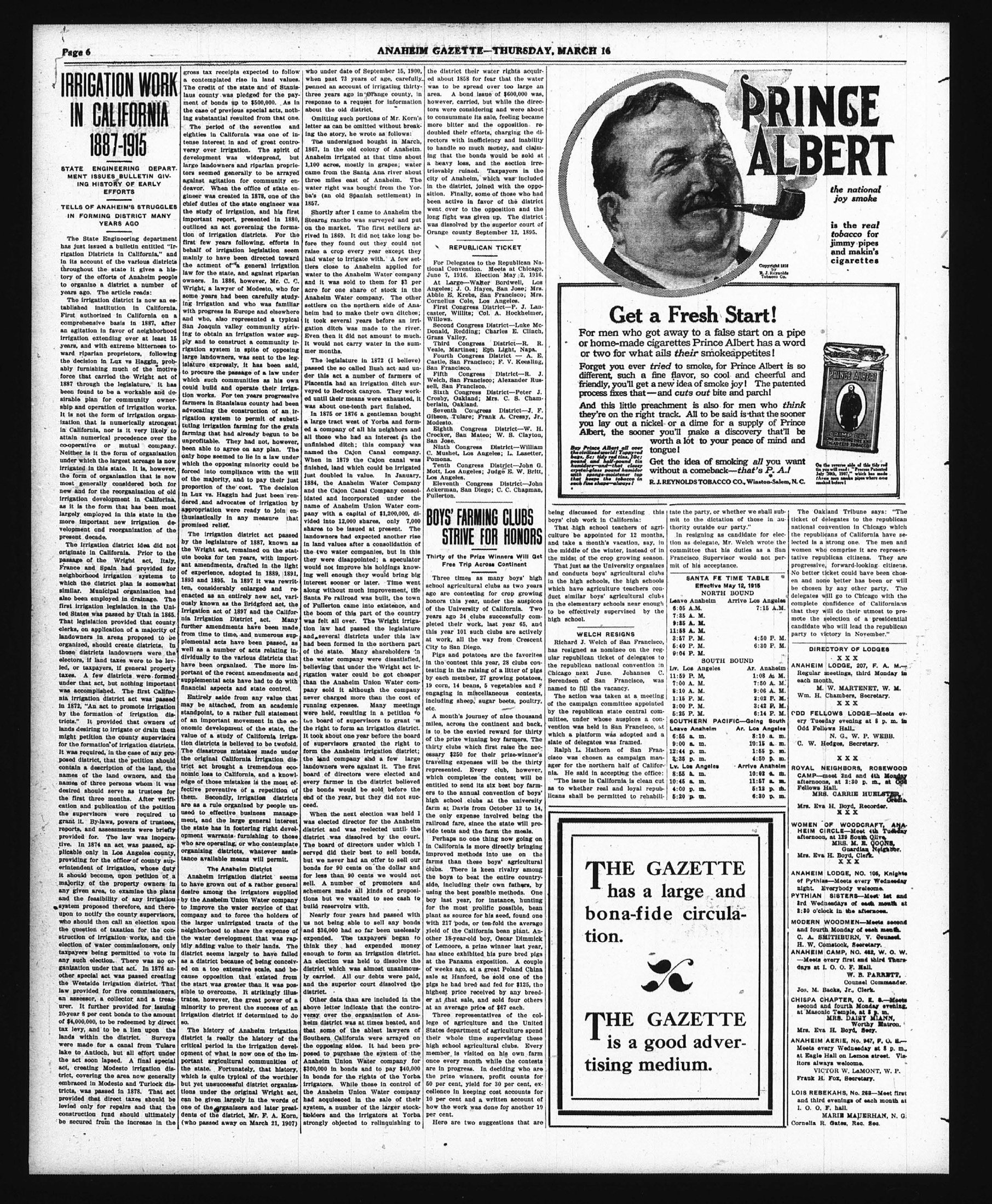
Searchable text
IRRIGATION WORK IN CALIFORNIA 1887-1915
STATE ENGINEERING DEPARTMENT ISSUES BULLETIN GIVING HISTORY OF EARLY EFFORTS
TELLS OF ANAHEIM'S STRUGGLES IN FORMING DISTRICT MANY YEARS AGO
The State Engineering department has just issued a bulletin entitled "Irrigation Districts in California," and in its account of the various districts throughout the state it gives a history of the efforts of Anaheim people to organize a district a number of years ago. The article reads:
The irrigation district is now an established institution in California. First authorized in California on a comprehensive basis in 1887, after an agitation in favor of neighborhood irrigation extending over at least 15 years, and with extreme bitterness toward riparian proprietors, following the decision in Lux vs Haggin, probably furnishing much of the motive force that carried the Wright act of 1887 through the legislature. It has been found to be a workable and desirable plan for community ownership and operation of irrigation works. It is not the form of irrigation organization that is numerically strongest in California, nor is it very likely to attain numerical precedence over the co-operative or mutual company.
gross tax receipts expected to follow a contemplated rise in land values. The credit of the state and of Stanislaus county was pledged for the payment of bonds up to $500,000. As in the case of previous special acts, nothing substantial resulted from that one.
The period of the seventies and eighties in California was one of intense interest in and of great controversy over irrigation. The spirit of development was widespread, but large landowners and riparian proprietors seemed generally to be arrayed against agitation for community endeavor. When the office of state engineer was created in 1878, one of the chief duties of the state engineer was the study of irrigation, and his first important report, presented in 1880, outlined an act governing the formation of irrigation districts. For the first few years following, efforts in behalf of irrigation legislation seem mainly to have been directed toward the actment of a general irrigation law for the state, and against riparian owners. In 1886, however, Mr. C. C. Wright, a lawyer of Modesto, who for some years had been carefully studying irrigation and who was familiar with progress in Europe and elsewhere and who, also represented a typical San Joaquin valley community striving to obtain an irrigation water supply and to construct a community irrigation system in spite of opposing large landowners, was sent to the legislature expressly, it has been said, to procure the passage of a law under which such communities as his own could build and operate their irrigation works. For ten years progressive farmers in Stanislaus county had been advocating the construction of an irrigation system to permit substituting irrigation farming for the grain farming that had already begun to be unprofitable. They had not, however, been able to agree on any plan. The who under date of September when past 73 years passed an account of three years ago in response to a request about the old district.
Omitting such portions letter as can be omitted ing the story, he wrote.
The undersigned by 1867, in the old color Anaheim irrigated at 1,100 acres, mostly came from the Santa Ana hills east of water right was bought ba's (an old Spanish 1857.
Shortly after I came Stearns rancho was sold on the market. The arrived in 1869. It did fore they found out raise a crop every year had water to irrigate tillers close to Anaheim water to the Anaheim and it was sold to aacre for one share Anaheim Water competters settlers on the northern heim had to make thit took several years gation ditch was ma Even then it did not it would not carry wmer months.
The legislature in passed the so called der this act a number Placentia had an irrivedy to Bedrock can ed until their means w was about one-tenth.
In 1875 or 1876 a g large tract west of ed a company of all h all those who had an unfinished ditch; thi
The irrigation district idea did not originate in California. Prior to the passage of the Wright act, Italy, France and Spain had provided for neighborhood irrigation systems to which the district plan is somewhat similar. Municipal organization had also been employed in drainage. The first irrigation legislation in the United States was passed by Utah in 1865. That legislation provided that county clerks, on application of a majority of landowners in areas proposed to be organized, should create districts. In those districts landowners were the electors, if land taxes were to be levied, or taxpayers, if general property taxes. A few districts were formed under that act, but nothing important was accomplished. The first California irrigation district act was passed in 1872, "An act to promote irrigation by the formation of irrigation districts." It provided that owners of lands desiring to irrigate or drain them might petition the county supervisors for the formation of irrigation districts. It was required, in the case of any proposed district, that the petition should contain a description of the land, the names of the land owners, and the names of three persons whom it was desired should serve as trustees for the first three months. After verification and publication of the petition the supervisors were required to grant it. By-laws, powers of trustees, reports, and assessments were briefly provided for. The law was inoperative. In 1874 an act was passed, applicable to ward riparian proprietors, following the decision in Lux vs Haggin, probably furnishing much of the motive force that carried the Wright act of 1887 through the legislature, it has been found to be a workable and desirable plan for community ownership and operation of irrigation works. It is not the form of irrigation organization that is numerically strongest in California, nor is it very likely to attain numerical precedence over the co-operative or mutual company. Neither is it the form of organization under which the largest acreage is now irrigated in this state. It is, however, the form of organization that is now most generally considered both for new and for the reorganization of old irrigation development in California, as it is the form that has been most largely employed in this state in the more important new irrigation development and reorganization of the present decade.
The irrigation district idea did not originate in California. Prior to the passage of the Wright act, Italy, France and Spain had provided for neighborhood irrigation systems to which the district plan is somewhat similar. Municipal organization had also been employed in drainage. The first irrigation legislation in the United States was passed by Utah in 1865. That legislation provided that county clerks, on application of a majority of landowners in areas proposed to be organized, should create districts. In those districts landowners were the electors, if land taxes were to be levied, or taxpayers, if general property taxes. A few districts were formed under that act, but nothing important was accomplished. The first California irrigation district act was passed in 1872, "An act to promote irrigation by the formation of irrigation districts." It provided that owners of lands desiring to irrigate or drain them might petition the county supervisors for the formation of irrigation districts. It was required, in the case of any proposed district, that the petition should contain a description of the land, the names of the land owners, and the names of three persons whom it was desired should serve as trustees for the first three months. After verification and publication of the petition the supervisors were required to grant it. By-laws, powers of trustees, reports, and assessments were briefly provided for. The law was inoperative. In 1874 an act was passed, applicable to ward riparian proprietors, following the decision in Lux vs Haggin, probably furnishing much of the motive force that carried the Wright act of 1887 through the legislature, it has been found to be a workable and desirable plan for community ownership and operation of irrigation works. It is not the form of irrigation organization that is numerically strongest in California, nor is it very likely to attain numerical precedence over the co-operative or mutual company. Neither is it the form of organization under which the largest acreage is now irrigated in this state. It is, however, the form of organization that is now most generally considered both for new and for the reorganization of old irrigation development in California, as it is the form that has been most largely employed in this state in the more important new irrigation development and reorganization of the present decade.
The irrigation district act passed by the legislature of 1887, known as the Wright act, remained on the statute books for ten years, with important amendments, drafted in the light of experience, adopted in 1889, 1891, 1893 and 1895. In 1897 it was rewritten, considerably enlarged and renacted as an entirely new act, variously known as the Bridgford act, the Irrigation act of 1897 and the California Irrigation District act. Many further amendments have been made from time to time, and numerous supplemental acts have been passed, as well as a number of acts relating individually to the various districts that have been organized. The more important of the recent amendments and supplemental acts have had to do with financial aspects and state control.
Entirely aside from any value that may be attached, from an academic standpoint, to a rather full statement of an important movement in the economic development of the state, the value of a study of California irrigation districts is believed to be twofold. The disastrous mistakes made under the original California irrigation district act brought a tremendous economic loss to California, and a knowledge of those mistakes is the most effective preventive of a repetition of them. Secondly, irrigation districts are as a rule organized by people unused to effective business management, and the large general interest the state has in fostering right development warrants furnishing to those who are operating, or who contemplate organizing districts whatsoever.
The legislature in New York passed the so called Lawder this act a number Placentia had an irritationveyed to Bedrock canyed until their means were about one-tenth year.
In 1875 or 1876 a large tract west of New York had a company of all kinds who had an unfinished ditch; this named the Cajon Creek When in 1879 the Cajon finished, land which could just doubled in value 1884, the Anaheim River and the Cajon Canal implicated and incorporated name of Anaheim Union company with a capital divided into 12,000 shares to be issued to landowners had expected in land values after all they were disappointed would not improve his ing well enough they interest sooner or later along without much in Santa Fe railroad was Fullerton came into boom of this part was felt all over. The tension law had passed and several districts had been formed in this state. Many water companies believing that under their irrigation water could be than the Anaheim Union company sold it although never charged more than running expenses. Were held resulting from board of supervisors right to form an office. It took about one year of supervisors granted form the Anaheim Irrigation land company and landowners were against board of directors when every farmer in the area bonds would be end of the year, but thieved.
When the next election was elected director for district and was reelected district was dissolved The board of directors
posed district, that the petition should contain a description of the land, the names of the land owners, and the names of three persons whom it was desired should serve as trustees for the first three months. After verification and publication of the petition the supervisors were required to grant it. By-laws, powers of trustees, reports, and assessments were briefly provided for. The law was inoperative. In 1874 an act was passed, applicable only in Los Angeles county, providing for the office of county superintendent of irrigation, whose duty it should become, upon petition of a majority of the property owners in any given area, to examine the plans and the feasibility of any irrigation system proposed therefore, and thereupon to notify the county supervisors, who should then call an election upon the question of taxation for the construction of irrigation works, and the election of water commissioners, only taxpayers being permitted to vote in any such election. There was no organization under that act. In 1876 another special act was passed creating the Westside irrigation district. That law provided for five commissioners, an assessor, a collector and a treasurer. It further provided for issuing 20-year 8 per cent bonds to the amount of $4,000,000, to be redeemed by direct tax levy, and to be a lien upon the lands within the district. Surveys were made for a canal from Tulare lake to Antioch, but all effort under the act soon lapsed. A final special act, creating Modesto irrigation district, covering the area now generally embraced in Modesto and Turlock districts, was passed in 1878. That act provided that direct taxes should be levied only for repairs and that the construction fund should ultimately be secured from the increase in the original California irrigation district act brought a tremendous economic loss to California, and a knowledge of those mistakes is the most effective preventive of a repetition of them. Secondly, irrigation districts are as a rule organized by people unused to effective business management, and the large general interest the state has in fostering right development warrants furnishing to those who are operating, or who contemplate organizing districts, whatever assistance available means will permit.
The Anaheim District
Anaheim irrigation district seems to have grown out of a rather general desire among the irrigators supplied by the Anaheim Union Water company to improve the water service of that company and to force the holders of the larger unirrigated tracts of the neighborhood to share the expense of the water development that was rapidly adding value to their lands. The district seems largely to have failed as a district because of being concealed on a too extensive scale, and because opposition that existed from the start was greater than it was possible to overcome. It strikingly illustrates, however, the great power of a minority to prevent the success of an irrigation district if determined to do so.
The history of Anaheim irrigation district is really the history of the critical period in the irrigation development of what is now one of the important agricultural communities of the state. Fortunately, that history, which is quite typical of the worthier but yet unsuccessful district organizations under the original Wright act, can be given largely in the words of one of the organizers and later presidents of the district, Mr. F. A. Korn, (who passed away on March 21, 1907)
When the next election was elected director for district and was reelected district was dissolved. The board of directors served did their best but we never had an bonds for 90 cents one for less than 90 cents sell. A number of schemers made all kifications but we wanted to build reservoirs with.
Nearly four years later us not being able to and $36,000 had so far expended. The taxpayer think they had enough to form an irrigation An election was held district which was already carried. All our dues and the superior court district.
Other data than are above letter indicate verses over the organi- heim district was at that some of the ab Southern California wives opposing sides. I posed to purchase the Anaheim Union Water $300,000 in bonds and in bonds for the right irrigators. While those the Anaheim Union had acquiesced in this system, a number of holders and the irrig- strongly objected to
ANAHEIM GAZETTE—THURSDAY, MARCH 16
who under date of September 15, 1900, when past 73 years of age, carefully penned an account of irrigating thirty-three years ago in Orange county, in response to a request for information about the old district.
Omitting such portions of Mr. Korn's letter as can be omitted without breaking the story, he wrote as follows:
The undersigned bought in March, 1867, in the old colony of Anaheim. Anaheim irrigated at that time about 1,100 acres, mostly in grapes; water came from the Santa Ana river about three miles east of Anaheim. The water right was bought from the Yorba's (an old Spanish settlement) in 1857.
Shortly after I came to Anaheim the Stearns rancho was surveyed and put on the market. The first settlers arrived in 1869. It did not take long before they found out they could not raise a crop every year except they had water to irrigate with. A few settlers close to Anaheim applied for water to the Anaheim Water company and it was sold to them for $3 per acre for one share of stock in the Anaheim Water company. The other settlers on the northern side of Anaheim had to make their own ditches; it took several years before an irrigation ditch was made to the river. Even then it did not amount to much. It would not carry water in the summer months.
The legislature in 1872 (I believe) passed the so-called Bush act and under this act a number of farmers of Placentia had an irrigation ditch surveyed to Bedrock canyon. They worked until their means were exhausted, it was about one-tenth part finished.
In 1875 or 1876 a gentleman bought a large tract west of Yorba and formed a company of all his neighbors and all those who had an interest in the unfinished ditch; this company was the district their water rights acquired about 1858 for fear that the water was to be spread over too large an area. A bond issue of $600,000 was, however, carried, but while the directors were considering and were about to consummate its sale, feeling became more bitter and the opposition doubled their efforts, charging the directors with inefficiency and inability to handle so much money, and claiming that the bonds would be sold at a heavy loss, and the section irretrievably ruined. Taxpayers in the city of Anaheim, which was included in the district, joined with the opposition. Finally, some of those who had been active in favor of the district went over to the opposition and the long fight was given up. The district was dissolved by the superior court of Orange county September 12, 1895.
REPUBLICAN TICKET
For Delegates to the Republican National Convention. Meets at Chicago, June 7, 1916. Election May 2, 1916.
At Large—Water Bordwell, Los Angeles; J. O. Hayes, San Jose; Mrs. Abbie E. Krebs, San Francisco; Mrs. Cornelius Cole, Los Angeles.
First Congress District—P. J. Lancaster, Willits; Col. A. Hockheimer, Willows.
Second Congress District—Luke McDonald, Redding; Charles E. Clinch, Grass Valley.
Third Congress District—R. R. Veale, Martinez; Eph Light, Napa.
Fourth Congress District —A. E. Castle, San Francisco; F. V. Keesling, San Francisco.
Fifth Congress District—R. J. Welch, San Francisco; Alexander Russell, San Francisco.
Sixth Congress District—Peter J. Crosby, Oakland; Mrs. C. S. Chamberlain, Oakland.
Seventh Congress District—J. F. Gibson, Tulare; Frank A. Cressy, Jr., Modesto.
Eighth Congress District—W. H. Crocker, San Mateo; W. S. Clayton, San Jose.
Ninth Congress District—William
The legislature in 1872 (I believe) passed the so called Bush act and under this act a number of farmers of Placentia had an irrigation ditch surveyed to Bedrock canyon. They worked until their means were exhausted, it was about one-tenth part finished.
In 1875 or 1876 a gentleman bought a large tract west of Yorba and formed a company of all his neighbors and all those who had an interest in the unfinished ditch; this company was named the Cajon Canal company. When in 1879 the Cajon canal was finished, land which could be irrigated just doubled in value. In January, 1884, the Anaheim Water Company and the Cajon Canal Company consolidated and incorporated under the name of Anaheim Union Water company with a capital of $1,200,000, divided into 12,000 shares, only 7,000 shares to be issued at present. The landowners had expected another rise in land values after a consolidation of the two water companies, but in this they were disappointed; a speculator would not improve his holdings knowing well enough they would bring big interest sooner or later. Time went along without much improvement, the Santa Fe railroad was built, the town of Fullerton came into existence, and the boom of this part of the country was felt all over. The Wright irrigation law had passed the legislature and several districts under this law had been formed in the northern part of the state. Many shareholders in the water company were dissatisfied, believing that under the Wright act irrigation water could be got cheaper than the Anaheim Union Water company sold it although the company never charged more than the cost of running expenses. Many meetings were held, resulting in a petition to the board of supervisors to grant us the right to form an irrigation district. It took about one year before the board of supervisors granted the right to form the Anaheim irrigation district; the land company and a few large landowners were against it. The first board of directors were elected and every farmer in the district believed the bonds would be sold before the end of the year, but they did not succeed.
When the next election was held I was elected director for the Anaheim district and was reelected until the district was dissolved by the court. The board of directors under which I
the land company and a few large landowners were against it. The first board of directors were elected and every farmer in the district believed the bonds would be sold before the end of the year, but they did not succeed.
When the next election was held I was elected director for the Anaheim district and was reelected until the district was dissolved by the court. The board of directors under which I served did their best to sell bonds, but we never had an offer to sell our bonds for 90 cents on the dollar and for less than 90 cents we would not sell. A number of promoters and schemers made all kinds of propositions but we wanted to see cash to build reservoirs with.
Nearly four years had passed with us not being able to sell any bonds and $36,000 had so far been uselessly expended. The taxpayers began to think they had expended money enough to form an irrigation district. An election was held to dissolve the district which was almost unanimously carried. All our debts were paid, and the superior court dissolved the district.
Other data than are included in the above letter indicate that controversy over the organization of Anaheim district was at times heated, and that some of the ablest lawyers of Southern California were arrayed on the opposing sides. It had been proposed to purchase the system of the Anaheim Union Water company for $300,000 in bonds and to pay $40,000 in bonds for the rights of the Yorba irrigators. While those in control of the Anaheim Union Water company had acquiesced in the sale of their system, a number of the larger stockholders and the irrigators at Yorba strongly objected to relinquishing to
essary $200 for their prize-winner's traveling expenses will be the thirty represented. Every club, however, which completes the contest will be entitled to send its six best boy farmers to the annual convention of boys' high school clubs at the university farm at Davis from October 12 to 14, the only expense involved being the railroad fare, since the state will provide tents and the farm the meals.
Perhaps no one thing now going on in California is more directly bringing improved methods into use on the farms than these boys' agricultural clubs. There is keen rivalry among the boys to beat the entire countryside, including their own fathers, by using the best possible methods. One boy last year, for instance, hunting for the most prolific possible, bean plant as source for his seed, found one with 217 pods, or ten-fold the average yield of the California bean plant. Another 18-year-old boy, Oscar Dimmick of Lemoore, a prize winner last year, has since exhibited his pure bred pigs at the Panama exposition. A couple of weeks ago, at a great Poland China sale at Hanford, he sold one of the pigs he had bred and fed for $125, the highest price received by any breeder at that sale, and sold four others at an average price of $67 each.
Three representatives of the college of agriculture and the United States department of agriculture spend their whole time supervising these high school agricultural clubs. Every member is visited on his own farm once every month while the contests are in progress. In deciding who are the prize winners, profit counts for 50 per cent, yield for 30 per cent, excellence in keeping cost accounts for 10 per cent and a written account of how the work was done for another 10 per cent.
Here are two suggestions that are
PRINCE
ALBERT
the national
joy smoke
is the real
tobacco for
jimmy pipes
and makin's
cigarettes
Copyright 1816
by
R. J. Reynolds
Tobacco Co.
Get a Fresh Start!
who got away to a false start on a pipe
made cigarettes Prince Albert has a word
or what ails their smokeappetites!
ever tried to smoke, for Prince Albert is so
such a fine flavor, so cool and cheerful and
you'll get a new idea of smoke joy! The patented
es that—and cuts out bite and parch!
little preachment is also for men who think
the right track. All to be said is that the sooner
but a nickel or a dime for a supply of Prince
sooner you'll make a discovery that'll be
worth a lot to your peace of mind and
ever tried to smoke, for Prince Albert is so much a fine flavor, so cool and cheerful and you'll get a new idea of smoke joy! The patented dies that—and cuts out bite and parch!
little preachment is also for men who think the right track. All to be said is that the sooner but a nickel or a dime for a supply of Prince you’ll make a discovery that’ll be worth a lot to your peace of mind and tongue!
Get the idea of smoking all you want without a comeback—that’s P. A.!
R.J.REYNOLDS TOBACCO CO., Winston-Salem, N.C.
The Oakland Tribune says: "The ticket of delegates to the republican national convention in Chicago which the republicans of California have selected is a strong one. The men and women who comprise it are representative republican citizens. They are progressive, forward-looking citizens. No better ticket could have been chosen and none better has been or will be chosen by any other party. The delegates will go to Chicago with the complete confidence of Californians that they will do their utmost to promote the selection of a presidential candidate who will lead the republican party to victory in November."
DIRECTORY OF LODGES
XX X
ANAHEIM LODGE, 207, F. A. M.—Regular meetings, third Monday in each month.
M. W. MARTENET, W. M.
Wm. H. Chambers, Secretary.
XX X
CDD FELLOWS LODGE—Meets every Tuesday evening at 8 p.m. in Odd Fellows Hall.
N. G., W. P. WEBB.
C. W. Hedges, Secretary.
XX X
ROYAL NEIGHBORS, ROSEWOOD
CAMP—meet 2nd and 4th Mondays afternoons, at 2:30 p.m., at Odd Fellows Hall.
MRS. CARRIE HUELSTER,
Oradia.
Mrs. Eva H. Boyd, Recorder.
XX X
WOMEN OF WOODCRAFT, ANAHEIM CIRCLE—Meet 4th Tuesday afternoon, at 129 South Olive.
MRS. M. E. QOONS,
Guardian Neighbor.
ROYAL NEIGHBORS, ROSEWOOD
CAMP—meet 2nd and 4th Monday afternoons, at 2:30 p.m., at Old Fellows Hall.
MRS. CARRIE HUELSTER,
Oredia.
Mrs. Eva H. Boyd, Recorder.
XX X
WOMEN OF WOODCRAFT, ANAHEIM CIRCLE—Meet 4th Tuesday afternoon, at 129 South Olive.
MRS. M. E. COONS, Guardian Neighbor.
Mrs. Eva H. Boyd, Clerk.
XX X
ANAHEIM LODGE, NO. 105, Knights of Pythias—Meets every Wednesday night. Everybody welcome.
PYTHIAN SISTERS—Meet let and 3rd Wednesdays of each month at 2:30 o'clock in the afternoon.
MODERN WOODMEN—Meets second and fourth Monday of each month.
C. A. SMITHBURN, V. Counsel.
H. W. Comstock, Secretary.
ANAHEIM CAMP, NO. 482, W. O. W.—Meets every first and third Thursdays at I. O. O. F. Hall.
W. B. PARRETT, Counsel Commander.
Jos. M. Backs, Jr., Clerk.
CHISPA CHAPTER, O. E. S.—Meets second and fourth Monday evening, at Masonic Temple, at $ p.m.
MRS. DAISY MIANN, Worthy Matron.
Mrs. Eva H. Boyd, Secy.
ANAHEIM AERIE, No. 947, F. O. E.—Meets every Wednesday at $ p.m., at Eagle Hall on Lemon street. Visitors always welcome.
VICTOR W. LAMONT, W. P.
Frank H. Fox, Secretary.
LOIS REBEKAHS, No. 268—Meet first and third evenings of each month at I. O. O. F. hall.
MARINE MAJERHAN, N. G.
Cornella R. Gates, Rec. Sec.