anaheim-gazette 1916-03-09
Scanned page
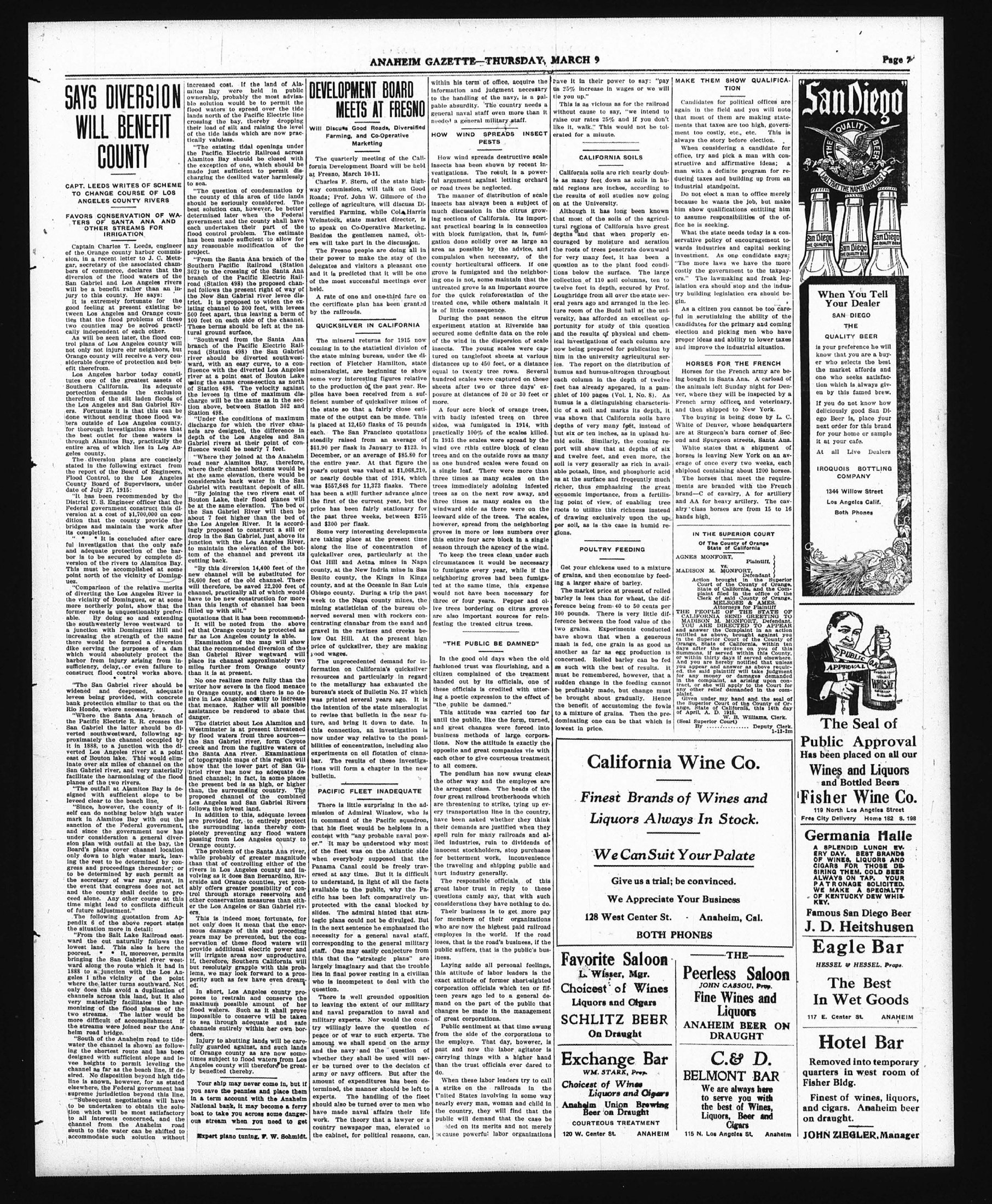
Searchable text
SAYS DIVERSION WILL BENEFIT COUNTY
CAPT. LEEDS WRITES OF SCHEME TO CHANGE COURSE OF LOS ANGELES COUNTY RIVERS
FAVORS CONSERVATION OF WATERS OF SANTA ANA AND OTHER STREAMS FOR IRRIGATION
Captain Charles T. Leeds, engineer of the Orange county harbor commission, in a recent letter to J. C. Metzgar, secretary of the associated chambers of commerce, declares that the diversion of the flood waters of the San Gabriel and Los Angeles rivers will be a benefit rather than an injury to this county. He says:
It is extremely fortunate for the good feeling at present existing between Los Angeles and Orange counties that the flood problems of these two counties may be solved practically independent of each other.
As will be seen later, the flood control plans of Los Angeles county will not only not injure ehr neighbors, but Orange county will receive a very considerable degree of protection and benefit therefrom.
Los Angeles harbor today constitutes one of the greatest assets of Southern California. Its adequate portfection demands the exclusion therefrom of the silt laden floods of the Los Angeles and San Gabriel Rivers. Fortunately it is that this can be done without sending those flood waters outside of Los Angeles county, for thorough investigation shows that the best outlet for these waters is through Alamitos Bay, practically the entire area of which lies in Los An-
increased cost. If the land of Alamitos Bay were held in public ownership, probably the most advisable solution would be to permit the flood waters to spread over the tide lands north of the Pacific Electric line crossing the bay, thereby dropping their load of silt and raising the level of the tide lands which are now practically valueless.
"The existing tidal openings under the Pacific Electric Railroad across Alamitos Bay should be closed with the exception of one, which should be made just sufficient to permit discharging the deslited water harmlessly to sea.
"The question of condemnation by the county of this area of tide lands should be seriously considered. The best solution can, however, be better determined later when the Federal government and the county shall have each undertaken their part of the flood control problem. The estimate has been made sufficient to allow for any reasonable modification of the project.
"From the Santa Ana branch of the Southern Pacific Railroad (Station 302) to the crossing of the Santa Ana branch of the Pacific Electric Railroad (Station 498) the proposed channel follows the present right of way of the New San Gabriel river levee district. It is proposed to widen the existing channel to 300 feet, with levees 500 feet apart, thus leaving a berm of 100 feet on each side of the channel. These berms should be left at the natural ground surface.
"Southward from the Santa Ana branch of the Pacific Electric Railroad (Station 498) the San Gabriel river should be diverted southward, with an easy curve, to a confluence with the diverted Los Angeles river at a point east of Bouton Lake using the same cross-section as north of Station 498. The velocity against the levees in time of maximum discharge will be the same as in the section above, between Station 302 and Station 498.
"Under the conditions of maximum discharge for which the river channels are designed, the difference in depth of the Los Angeles and San Gabriel rivers at their point of confluence would be nearly 7 feet."
DEVELOPMENT MEETS
Will Discuss Good Farming, and Market
The quarterly meeting fornia Development at Fresno, March 10
Charles F. Stern, way commission, w Roads; Prof. John V college of agriculture versified Farming, Weinstock, state m to speak on Co-Open Besides the gentle ers will take part in
The Fresno people their power to make delegates and visitors and it is predicted that of the most success held.
A rate of one and the certificate plan by the railroads.
QUICKSILVER IN
The mineral return coming in to the state the state mining bureauction of Fletcher mineralogist, are b some very interesting to the production o plies have been reefficient number of quia state so that a mate of the output is placed at 12,450 f each. The San Fran steadily raised fro $51.90 per flask in
Orange county will receive a very considerable degree of protection and benefit therefrom.
Los Angeles harbor today constitutes one of the greatest assets of Southern California. Its adequate portfection demands the exclusion therefrom of the silt laden floods of the Los Angeles and San Gabriel Rivers. Fortunate it is that this can be done without sending those flood waters outside of Los Angeles county, for thorough investigation shows that the best outlet for these waters is through Alamitos Bay, practically the entire area of which lies in Los Angeles county.
The diversion plans are concisely stated in the following extract from the report of the Board of Engineers, Flood Control, to the Los Angeles County Board of Supervisors, under date of July 27, 1915:
"It has been recommended by the District U. S. Engineer officer that the Federal government construct this diversion at a cost of $1,700,000 on condition that the county provide the bridges and maintain the work after its completion.
"It is concluded after careful investigation that the only safe and adequate protection of the harbor is to be secured by complete diversion of the rivers to Alamitos Bay. This must be accomplished at some point north of the vicinity of Dominguez.
"Comparison of the relative merits of diverting the Los Angeles River in the vicinity of Dominguez, or at some more northerly point, show that the former route is unquestionably preferable. By doing so and extending the southwesterly levee westward to a junction with Dominguez Hill and increasing the strength of the same there would be formed a diversion dike serving the purposes of a dam which would absolutely protect the harbor from injury arising from sufficiency, delay, or even failure to construct flood control works above.
"The San Gabriel river should be widened and deepened, adequate levees being provided, with concrete bank protection similar to that on the Rio Hondo, where necessary.
"Where the Santa Ana branch of the Pacific Electric R. R. crosses the San Gabriel the latter should be diverted southwestward, following approximately the channel occupied by it in 1888, to a junction with the diverted Los Angeles river at a point east of Bouton lake. This would eliminate over six miles of channel on the San Gabriel river, and very materially facilitate the harmonizing of the flood planes of the two rivers.
"The outfall at Alamitos Bay is designed with sufficient slope to be leveled clear to the beach line.
"Since, however, the county of itself can do nothing below high water mark in Alamitos Bay with out the sanction of the Federal government, and since the government now has under consideration a general diversion plan with outfall at the bay, the Board's plans cover channel location river should be diverted southwestward, with an easy curve, to a confluence with the diverted Los Angeles river at a point east of Bouton Lake using the same cross-section as north of Station 498. The velocity against the levees in time of maximum discharge will be the same as in the section above, between Station 302 and Station 498.
"Under the conditions of maximum discharge for which the river channels are designed, the difference in depth of the Los Angeles and San Gabriel rivers at their point of confluence would be nearly 7 feet.
"Where they joined at the Anaheim road near Alamitos Bay, therefore, where their channel bottoms would be at the same elevation, there would be considerable back water in the San Gabriel with resultant deposit of silt.
"By joining the two rivers east of Bouton Lake, their flood planes will be at the same elevation. The bed of the San Gabriel River will then be about 7 feet higher than the bed of the Los Angeles River. It is accordingly proposed to construct a sill or drop in the San Gabriel, just above its junction with the Los Angeles River, to maintain the elevation of the bottom of the channel and prevent its cutting back.
"By this diversion 14,400 feet of the new channel will be substituted for 36,600 feet of the old channel. There will therefore, be saved 22,200 feet of channel, practically all of which would have to be new construction for more than this length of channel has been filled up with slit."
quotations that it has been recommend-
It will be noted from the above ed that Orange county be protected as far as Los Angeles county is able.
Examination of the map will show that the recommended diversion of the San Gabriel River westward will place its channel approximately two miles further from Orange county than it is at present.
No one realizes more fully than the writer how severe is the flood menace in Orange county, and there is no desire in Los Angeles county to increase that menace. Rather will all possible assistance be rendered to abate that danger.
The district about Los Alamitos and Westminster is at present threatened by flood waters from three sources—the San Gabriel river, form Coyote creek and from the fugitive waters of the Santa Ana river. Examinations of topographic maps of this region will show that the lower part of San Gabriel river has now no adequate defined channel; in fact, in some places the present bed is as high, or higher than the surrounding country. The proposed channel of the combined Los Angeles and San Gabriel Rivers follows the lowest land.
In addition to this, adequate levees are provided for, to entirely protect the surrounding lands thereby completely preventing any flood waters passing from Los Angeles county to Orange county.
The problem of the Santa Ana river should be diverted southwestward, with an easy curve, to a confluence with the diverted Los Angeles river at a point east of Bouton Lake using the same cross-section as north of Station 498. The velocity against the levees in time of maximum discharge will be the same as in the section above, between Station 302 and Station 498.
"Under the conditions of maximum discharge for which the river channels are designed, the difference in depth of the Los Angeles and San Gabriel rivers at their point of confluence would be nearly 7 feet.
"Where they joined at the Anaheim road near Alamitos Bay, therefore, where their channel bottoms would be at the same elevation, there would be considerable back water in the San Gabriel with resultant deposit of silt.
"By joining the two rivers east of Bouton Lake their flood planes will be at the same elevation. The bed of the San Gabriel River will then be about 7 feet higher than the bed of the Los Angeles River. It is accordingly proposed to construct a sill or drop in the San Gabriel just above its junction with the Los Angeles River, to maintain the elevation of the bottom of the channel and prevent its cutting back.
"By this diversion 14,400 feet of the new channel will be substituted for 36,600 feet of the old channel. There will therefore, be saved 22,200 feet of channel, practically all of which would have to be new construction for more than this length of channel has been filled up with slit."
quotations that it has been recommend-
It will be noted from the above ed that Orange county be protected as far as Los Angeles county is able.
Examination of the map will show that the recommended diversion of the San Gabriel River westward will place its channel approximately two miles further from Orange county than it is at present.
No one realizes more fully than the writer how severe is the flood menace in Orange county, and there is no desire in Los Angeles county to increase that menace. Rather will all possible assistance be rendered to abate that danger.
The district about Los Alamitos and Westminster is at present threatened by flood waters from three sources—the San Gabriel river, form Coyote creek and from the fugitive waters of the Santa Ana river. Examinations of topographic maps of this region will show that the lower part of San Gabriel river has now no adequate defined channel; in fact, in some places the present bed is as high, or higher than the surrounding country. The proposed channel of the combined Los Angeles and San Gabriel Rivers follows the lowest land.
In addition to this, adequate levees are provided for, to entirely protect the surrounding lands thereby completely preventing any flood waters passing from Los Angeles county to Orange county.
The problem of the Santa Ana river should be diverted southwestward, with an easy curve, to a confluence with the diverted Los Angeles river at a point east of Bouton Lake using the same cross-section as north of Station 498. The velocity against the levees in time of maximum discharge will bethe same as in the section above, between Station 302 and Station 498.
"Under the conditions of maximum discharge for which the river channels are designed, the difference in depth of the Los Angeles and San Gabriel rivers at their point of confluence would be nearly 7 feet.
"Where they joined at the Anaheim road near Alamitos Bay, therefore, where their channel bottoms would be atthe same elevation,there wouldbe considerable backwaterintheSanGabrielfwithresultantdepositofsilt.
"By joiningthetworiverseastofBoutonLake,theirfloodplanstwillbetatethesameelevationoftheleveesintimeofmaximumdischargewillbethesameasinthesectionabovebetweenStation498.ThevelocityagainsttheleveesintimeofmaximumdischargewillbethesameasinthesectionabovebetweenStation498.ThevelocityagainsttheleveesintimeofmaximumdischargewillbethesameasinthesectionabovebetweenStation498.ThevelocityagainsttheleveesintimeofmaximumdischargewillbethesameasinthesectionabovebetweenStation498.ThevelocityagainsttheleveesintimeofmaximumdischargewillbethesameasinthesectionabovebetweenStation498.ThevelocityagainsttheleveesintimeofmaximumdischargewillbethesameasinthesectionabovebetweenStation498.ThevelocityagainsttheleveesintimeofmaximumdischargewillbethesameasinthesectionabovebetweenStation498.ThevelocityagainsttheleveesintimeofmaximumdischargewillbethesameasinthesectionabovebetweenStation498.ThevelocityagainsttheleveesintimeofmaximumdischargewillbethesameasinthesectionabovebetweenStation498.ThevelocityagainsttheleveesintimeofmaximumdischargewillbethesameasinthesectionabovebetweenStation498.ThevelocityagainsttheleveesintimeofmaximumdischargewillbethesameasinthesectionabovebetweenStation498.ThevelocityagainsttheleveesintimeofmaximumdischargewillbethesameasinthesectionabovebetweenStation498.ThevelocityagainsttheleveesintimeofmaximumdischargewillbethesameasinthesectionabovebetweenStation498.ThevelocityagainsttheleveesintimeofmaximumdischargewillbethesameasinthesectionabovebetweenStation498.Thevelocityagainsttheleveesintimeofmaximumdischargewill bethesameasinthesectionabovebetweenStation498.Thevelocityagainsttheleveesin(timeofmaximumdischargewillbethesameasinthesectionabovebetweenStation498.Thevelocityagainsttheleveesin(timeofmaximumdischargewillbethesameasinthesectionabovebetweenStation498.Thevelocityagainsttheleveesin(timeofmaximumdischargewillbethesameasinthesectionabovebetweenStation498.Thevelocityagainsttheleveesin(timeofmaximumdischargewill bethesameasinthesectionabovebetweenStation498.Thevelocityagainsttheleveesin(timeofmaximumdischargewill bethesameasinthesectionabovebetweenStation498.Thevelocityagainsttheleveesin(timeofmaximumdischargewill bethesameasinthesectionabovebetweenStation498.Thevelocityagainsttheleveesin(timeofmaximumdischargewill bethesameasinthesectionabovebetweenStation498.Thevelocityagainsttheleveesin(timeofmaximumdischargewill bethesameasinthesectionabovebetweenStation498.Thevelocityagainsttheleveesin(timeofmaximumdischargewill bethesameasinthesectionabovebetweenStation498.Thevelocityagainsttheleveesin(timeofmaximumdischargewill bethesameasinthesectionabovebetweenStation498.Thevelocityagainsttheleveesin(timeofmaximumdischargewill betthesameasinthesectionabovebetweenStation498.Thevelocityagainsttheleveesin(timeofmaximumdischargewill betthesameasinthesectionabovebetweenStation498.Thevelocityagainsttheleveesin(timeofmaximumdischargewill betthesameasinthesectionabovebetweenStation498.Thevelocityagainsttheleveesin(timeofmaximumdischargewill betthesameasinthesectionabovebetweenStation498.Thevelocityagainsttheleveesin(timeofmaximumdischargewill betthesameasinthesectionabovebetweenStation498.Thevelocityagainsttheleveesin(timeofmaximumdischargewill betthesameasinthesectionabovebetweenStation498.Thevelocityagainsttheleveesin(timeofmaximumdischargewill betthesameasinthesectionabovebetweenStation498.Thevelocityagainsttheleveesin(timeofmaximumdischargewill betthesameasinthesectionabovebetweenStation498.Thevelocityagainsttheleveesin(timeofmaximumdischargewill betthesameasinthesectionabovebetweenStation498.Thevelocityagainsttheleveesin(timeofmaximumdischargewill betthesameasinthesectionabovebetweenStation498.Thevelocityagainsttheleveesin(timeofmaximumdischargewill betthesameasinthesectionabovebetweenStation498.Thevelocityagainsttheleveesin(timeofmaximumdischargewill betthesameasinthesectionabovebetweenStation498.Thevelocityagainsttheleveesin(timeofmaximumdischarge will betthesameasinthesectionabovebetweenStation498.Thevelocityagainsttheleveesin(timeofmaximumdischarge will betthesameasinthesectionabovebetweenStation498.Thevelocityagainsttheleveesin(timeofmaximum dischargewill betthesameasinthesectionabovebetweenStation498.Thevelocityagainsttheleveesin(timeofmaximum dischargewill betthesameasinthesectionabovebetweenStation498.Thevelocityagainsttheleveesin(timeofmaximum dischargewill betthesAMEASINTHESECTIONABOVE THESECTIONABOVE THESECTIONABOVE THESECTIONABOVE THESECTIONABOVE THESECTIONABOVE THESECTIONABOVE THESECTIONABOVE THESECTIONABOVE THESECTIONABOVE THESECTIONABOVE THESECTIONABOVE THESECTIONABOVE THESECTIONABOVE THESECTIONABOVE THESECTIONABOVE THESECTIONABOVE THESECTIONABOVE THESECTIONABOVE THESECTIONABOVE THESESection ABOVE THESESection ABOVE THESESection ABOVE THESESection ABOVE THESESection ABOVE THESESection ABOVE THESESection ABOVE THESESection ABOVE THESESection ABOVE THESESection ABOVE THESESection ABOVE THESESection ABOVE THESESection ABOVE THESESection ABOVE THESESection ABOVE THESESection ABOVE THESESection ABOVE THESESection ABOVE THESESection ABOVE THESESection ABOVETHESESection ABOVETHESESection ABOVETHESESection ABOVETHESESection ABOVETHESESection ABOVETHESESection ABOVETHESESection ABOVETHESESection ABOVETHESESection ABOVETHESESection ABOVETHESESection ABOVETHESESection ABOVETHESESection ABOVETHESESection ABOVETHESESection ABOVETHESESection ABOVEBELOWTHISRECORD IS DESIGNED FOR SUFFICIENT CONDUCTION OF FLEAESILVER OVER LAKE AND GRAVEN VALLEY WITH A DEPENDING DISTRICT OF SOUTHWESTWARD FROM ALAMITOS BAY WITH OUTSIDE SHOREWARD FROM BOUTON LAND WITH EAST SHOREWARD FROM BOUTON LAND WITH EAST SHOREWARD FROM BOUTON LAND WITH EAST SHOREWARD FROM BOUTON LAND WITH EAST SHOREWARD FROM BOUTON LAND WITH EAST SHOREWARD FROM BOUTON LAND WITH EAST SHOREWARD FROM BOUTON LAND WITH EAST SHOREWARD FROM BOUTON LAND WITH EAST SHOREWARD FROM BOUTON LAND WITH EAST SHOREWARD FROM BOUTON LAND WITH EAST SHOREWARD FROM BOUTON LAND WITH EAST SHOREWARD FROM BOUTON LAND WITH EAST SHOREWARD FROM BOUTON LAND WITH EAST SHOREWARD FROM BOUTON LAND WITH EAST SHOREWARD FROM BOUTON LAND WITH EAST SHOREWARD FROM BOUTON LAND WITH EAST SHOREWARD FROM BOUTON LAND WITH EAST SHOREWARD FROM BOUTON LAND WITH EAST SHOREWARD FROM BOUTON LAND WITH EAST SHOREWARD FROM BOUTON LAND WITH EAST SHOREWARD FROM BOUTON LAND WITH EAST SHOREWARD FROM BOUTON LAND WITH EAST SHOREWARD FROM BOUTON LAND WITH EAST SHOREWARD FROM BOUTON LAND WITH EAST SHOREWARD FROM BOUTON LAND WITH EAST SHOREWARD FROM BOUTON LAND WITH EAST SHOREWARD FROM BOUTON LAND WITH EAST SHOREWARD FROM BOUTON LAND WITH EAST SHOREWARD FROM BOUTON LAND WITH EAST SHOREWARD FROM BOUTON LAND WITH EAST SHOREWARD FROM BOUTON LAND WITH EAST SHOREWARD FROM BOUTON LAND WITH EAST SHOREWARD FROM BOUTON LAND WITH EAST SHOREWARD FROM BOUTON LAND WITH EAST SHOREWARD FROM BOUTON LAND WITH EAST SHOREWARD From BOUTON LAND WITH EAST SHOREWARD From BOUTON LAND WITH EAST SHOREWARD From BOUTON LAND WITH EAST SHOREWARD From BOUTON LAND WITH EAST SHOREWARD From BOUTON LAND WITH EAST SHOREWARD From BPUTTON LAND WITH EAST SHOREWARD From BPUTTON LAND WITH EAST SHOREWARD From BPUTTON LAND WITH EAST SHOREWARD From BPUTTON LAND WITH EAST SHOREWARD From BPUTTON LAND WITH EAST SHOREWARD From BPUTTON LAND WITH EAST SHOREWARD From BUETTON LAND WITH EAST SHOREWARD From BUETTON LAND WITH EAST SHOREWARD From BUETTON LAND WITH EAST SHOREWARD From BUETTON LAND WITH EAST SHOREWARD From BUETTON LAND WITH EAST SHOREWARD From BUETTON LAND WITH EAST SHOREWARD From BUETTON LAND WITH EAST SHOREWARD From BUETTON LAND WITH EAST SHORESHIELD FROM BUETTON LAND WITH EAST SHORESHIELD FROM BUETTON LAND WITH EAST SHORESHIELD FROM BUETTON LAND WITH EAST SHORESHIELD FROM BUETTON LAND WITH EAST SHORESHIELD FROM BUETTON LAND WITH EAST SHORESHIELD FROM BUETTON LAND WITH EAST SHORESHIELD FROM BUETTON LADDER TO BUETTON LADDER TO BUETTON LADDER TO BUETTON LADDER TO BUETTON LADDER TO BUETTON LADDER TO BUETTON LADDER TO BUETTON LADDER TO BUETTON LADDER TO BUETTON LADDER TO BUETTON LADDER TO BUETTON LADDER TO BUETTONLADDER TO BUETTONLADDER TO BUETTONLADDER TO BUETTONLADDER TO BUETTONLADDER TO BUETTONLADDER TO BUETTONLADDER TO BUETTONLADDER TO BUETTONLADDER TO BUETTONLADDER TO BUETTONLADDER TO BUETTONLADDER TOBUETTONLADDER TOBUETTONLADDER TOBUETTONLADDER TOBUETTONLADDER TOBUETTONLADDER TOBUETTONLADDER TOBUETTONLADDER TOBUETTONLADDER TOBUETTONLADDER TOBUETTONLADDER TOBUETTONLADDER TOBUETTONLADDERTOBUETONTOBUETONTOBUETONTOBUettonLadderToBuettonLadderToBuettonLadderToBuettonLadderToBuettonLadderToBuettonLadderToBuettonLadderToBuettonLadderToBuettonLadderToBuettonLadderToBuettonLadderToBuettonLadderToBuettonLadderToBuettonLadderToBuettonLadderToBUettonLadderToBuettonLadderToBuettonLadderToBuettonLadderToBuettonLadderToBuettonLadderTo BuettonLadderToBuettonLadderToBuettonLadderToBuettonLadderToBuettonLadderToBuettonLadderToBuettonLadderToBuettonLadderToBuettonLadderToBuettonLadderToBuettonLadderToBuettonLadderToBuettonLadderToBuettonLadder To BuettonLadderToBuettonLadderToBuettonLadderToBuettonLadderToBuettonLadderToBuettonLadderToBuettonLadderToBuettonLadderToBuettonLadderToBuettonLadderToBuettonLadderToBuettonLadderToBuettonLadder To BuettonLadder To BuettonLadder To BuettonLadder To BuettonLadder To BuettonLadder To BuетонЛадdernТо BuетонЛадdernТо BuетонЛадdernТо BuетонЛадdernТо BuетонЛадdernТо BuетонЛадdernТо BuетонЛадdernТо BuетонЛадdernТо BuетонЛадdernТо BuетонЛадdernТо BuетонЛадdernТо BuетонЛадdernТо BuетонЛадdernТо БуетонЛадdernТо BuетонЛадdernТо BuетонЛадdernТо BuетонЛадdernТо BuетонЛадdernТо BuетонЛадdernТо BuетонЛадdernТо BuетонЛадdernТо BuетонЛадdernТо BuетонЛадdernТо BuетонЛадdernТо БуетонЛадdernТо БуетонЛадdernТо БуетонЛадdernТо БуетонЛадdernТо БуетонЛадdernТо БуетонЛадdernТо БуетонЛадdernТо БуетонЛадdernТо БуетонЛадdernТо БуетонЛадdernТо БуетонЛадdern ТО БуетонЛадdern ТО БуетонЛадdern ТО БуетонЛадdern ТО БуетонЛадdern ТО БуетонЛадdern ТО БуетонЛадdern ТО БуетонЛадdern ТО Буетон Ладdern ТО Буетон Ладdern ТО Буетон Ладdern ТО Буетон Ладdern ТО Буетон Ладdern ТО Буетон Ладdern ТО Буетон Ладdern ТО Бучетон Леддерн ТО Бучетн Леддерн ТО Бучетн Леддерн ТО Бучетн Леддерн ТО Бучетн Леддерн ТО Бучетн Леддерн ТО Бучетн Леддерн ТО Бучетн Леддерн ТО Бучетн Леддерн ТО Бучетн Леддерн ТО Бучетн Леддерн ТО Бучетн Леддерн ТО Бучетн Леддерн ТО БУЕТН Леддерн ТО БУЕТН Леддерн ТО БУЕТН Леддерн ТО БУЕТН Леддерн ТО БУЕТН ЛеддERN ТО БУЕТН ЛеддERN ТО БУЕТН ЛеддERN ТО БУЕТН ЛеддERN ТО БУЕТН ЛеддERN ТО БУЕТН ЛеддERN ТО БУЕТН ЛеддERN ТО ВУЕТН ЛеддERN ТО ВУЕТН ЛеддERN ТО ВУЕТН ЛеддERN ТО ВУЕТН ЛеддERN ТО ВУЕТН ЛеддERN ТО ВУЕТН ЛеддERN ТО ВУЕТН ЛеддERN ТО ВУЕТН ЛеддERN ТО ВУЕТН ЛеддERN ТО ВУЕТАРЕН ТОВУЕТАРЕН ТОВУЕТАРЕН ТОВУЕТАРЕН ТОВУЕТАРЕН ТОВУЕТАРЕН ТОВУЕТАРЕН ТОВУЕТАРЕН ТОВУЕТАРЕН ТОВУЕТАРЕН ТОВУЕТАРЕН ГАЗДЕРЕН ГАЗДЕРЕН ГАЗДЕРЕН ГАЗДЕРЕН ГАЗДЕРЕН ГАЗ
east of Bouton lake. This would eliminate over six miles of channel on the San Gabriel river, and very materially facilitate the harmonizing of the flood planes of the two rivers.
"The outfall at Alamitos Bay is designed with sufficient slope to be leveed clear to the beach line.
"Since, however, the county of itself can do nothing below high water mark in Alamitos Bay with out the sanction of the Federal government, and since the government now has under consideration a general diversion plan with outfall at the bay, the Board's plans cover channel location only down to high water mark, leaving the rest to be determined by congress and proceedings thereunder; or to be determined by such permit as the secretary of war may grant, in the event that congress does not act and the county shall decide to proceed alone. Any other course at this time might lead to conflicts difficult of future adjustment."
The following quotation from Appendix 6 of the above report states the situation more in detail:
"From the Salt Lake Railroad eastward the cut naturally follows the lowest land. This also is here the poorest. It, moreover, permits bringing the San Gabriel river westward along the route which it had in 1888 to a junction with the Los Angeles lime vicinity of the point where the latter turns southward. Not only does this avoid a duplication of channels across this land, but it also very materially facilitates the harmonizing of the flood planes of the two streams. The latter would be more difficult of accomplishment if the streams were joined near the Anaheim road bridge.
"South of the Anaheim road to tide-water the channel is shown as following the shortest route and has been designed with sufficient slope and levee heights to permit leveling the channel as far as the beach line, if desired. No disposition beyond high tide line is snowed, however, for as stated elsewhere, the Federal government has supreme jurisdiction beyond this line.
"Subsequent negotiations will have to be undertaken to obtain the solution which will be most satisfactory to all interests concerned, and the channel from the Anaheim road south to tide water can be shifted to accommodate such solution without show that the lower part of San Gabriel river has now no adequate defined channel; in fact, in some places the present bed is as high, or higher than, the surrounding country. The proposed channel of the combined Los Angeles and San Gabriel Rivers follows the lowest land.
In addition to this, adequate levees are provided for, to entirely protect the surrounding lands thereby completely preventing any flood waters passing from Los Angeles county to Orange county.
The problem of the Santa Ana river, while probably of greater magnitude than that of controlling either of rivers in Los Angeles county and involving as it does San Bernardino, Riverside and Orange counties, yet probably offers greater possibility of control through storage reservoirs and other conservation measures than either the Los Angeles or San Gabriel rivers.
This is indeed most fortunate, for not only does it mean that the enormous damage of this and preceding years may be prevented, but the conservation of these flood waters will provide additional electric power and will irrigate areas now unproductive. If, therefore, Southern California will but resolutely grapple with this problems, we may look forward to a prosperity such as few have even dreamed.
In short, Los Angeles county proposes to restrain and conserve the maximum possible amount of her flood waters. Such as it shall prove impossible to conserve will be taken to sea through adequate and safe channels entirely within her own borders.
Injury to abutting lands will be carefully guarded against, and such lands of Orange county as are now sometimes subject to flood waters from Los Angeles county will therefore be greatly benefited thereby.
Your ship may never come in, but if you save the pennies and place them in a term account with the Anaheim National bank, it may become a ferry boat to take you across some dangerous stream when you need to get expert piano tuning. F. W. Schmidt."
ANAHEIM GAZETTE—THURSDAY, MARCH 9
DEVELOPMENT BOARD MEETS AT FRESNO
Will Discuss Good Roads, Diversified Farming, and Co-Operative Marketing
The quarterly meeting of the California Development Board will be held at Fresno, March 10-11.
Charles F. Stern, of the state highway commission, will talk on Good Roads; Prof. John W. Gilmore of the college of agriculture, will discuss Diversified Farming, while Col. Harris Weinstock, state market director, is to speak on Co-Operative Marketing. Besides the gentlemen named, others will take part in the discussion.
The Fresno people are doing all in their power to make the stay of the delegates and visitors a pleasant one and it is predicted that it will be one of the most successful meetings ever held.
A rate of one and one-third fare on the certificate plan has been granted by the railroads.
QUICKSILVER IN CALIFORNIA
The mineral returns for 1915 now coming in to the statistical division of the state mining bureau, under the direction of Fletcher Hamilton, state mineralogist, are beginning to show some very interesting figures relative to the production of the past year. Replies have been received from a sufficient number of quicksilver mines of the state so that a fairly close estimate of the output can be made. This is placed at 12,450 flasks of 75 pounds each. The San Francisco quotations steadily raised from an average of $51.90 per flask in January to $123. In within his term of office, acquire the information and judgment necessary to the handling of the navy, is a palpable absurdity. The country needs a general naval staff even more than it needed a general military staff.
HOW WIND SPREADS INSECT PESTS
How wind spreads destructive scale insects has been shown by recent investigations. The result is a powerful argument against letting orchard or road trees be neglected.
The manner of distribution of scale insects has always been a subject of much discussion in the citrus growing sections of California. Its important practical bearing is in connection with block fumigation, that is, fumigation done solidly over as large an area as possible by the advice, and compulsion when necessary, of the county horticultural officers. If one grove is fumigated and the neighboring one is not, some maintain that the untreated grove is an important source for the quick reinforestation of the treated one, while others maintain it is of little consequence.
During the past season the citrus experiment station at Riverside has secured some definite data on the role of the wind in the dispersion of scale insects. The young scales were captured on tanglefoot sheets at various distances up to 450 feet, or a distance equal to twenty tree rows. Several hundred scales were captured on these sheets after two or three days' exposure at distances of 20 or 30 feet or more.
A four acre block of orange trees, with badly infested trees on three sides, was fumigated in 1914, with practically 100% of the scales killed. In 1915 the scales were spread by the wind over this entire block of clean haze it in their power to say: "pay us 25% increase in wages or we will tie you up."
This is as vicious as for the railroad without cause to say, "we intend to raise our rates 25% and if you don't like it, walk." This would not be tolerated for a minute.
CALIFORNIA SOILS
California soils are rich nearly double as many feet down as soils in humid regions are inches, according to the results of soil studies now going on at the University.
Although it has long been known that most of the soils of the agricultural regions of California have great depths and that when properly encouraged by moisture and aeration the roots of trees penetrate downward for very many feet, it has been a question as to the plant food conditions below the surface. The large collection of 110 soil columns, ten to twelve feet in depth, secured by Prof. Loughridge from all over the state several years ago and arranged in the lecture room of the Budd hall at the university, has afforded an excellent opportunity for study of this question and the results of physical and chemical investigations of each column are now being prepared for publication by him in the university agricultural series. The report on the distribution of humus and humus-nitrogen throughout each column in the depth of twelve feet has already appeared, in a pamphlet of 100 pages (Vol. 1, No. 8). As humus is a distinguishing characteristic of a soil and marks its depth, it was shown that California soils have depths of very many feet, instead of but six or ten inches, as in upland humid soils. Similarly, the coming report will show that at depths of six MAKE THIS AGENT AGAIN IN THE TRANSFER OF MAN WITH DUCING TRAIN INDUSTRIES DO NOT BECOME AHMISM HOWEVER FOR THE SERVIVELY WARDED INVESTMENT "The most costly therem." The isolation of try building gin. As a careful in such candidate election proper loot and imprisonment HORSE-BRINGING BOUGHT THE ANIMAL VER WHEN French AND THERE THE BLUE WHITE OR ARE AT SAND AND WHITE
the state mining bureau, under the direction of Fletcher Hamilton, state mineralogist, are beginning to show some very interesting figures relative to the production of the past year. Replies have been received from a sufficient number of quicksilver mines of the state so that a fairly close estimate of the output can be made. This is placed at 12,450 flasks of 75 pounds each. The San Francisco quotations steadily raised from an average of $51.90 per flask in January to $123. in December, or an average of $85.80 for the entire year. At that figure the year's output was valued at $1,068,210, or nearly double that of 1914, which was $557,848 for 11,373 flasks. There has been a still further advance since the first of the current year, but the price has been fairly stationary for the past three weeks, between $275 and $300 per flask.
Some interesting developments are taking place at the present time along the line of concentration of quicksilver ores, particularly at the Oat Hill and Aetna mines in Napa county, at the New Indria mine in San Benito county, the Kings in Kings county, and at the Oceanic in San Luis Obispo county. During a trip the past week to the Napa county mines, the mining statistician of the bureau observed several men with rockers concentrating cinnabar from the sand and gravel in the ravines and creeks below Oat Hill. At the present high price of quicksilver, they are making good wages.
The unprecedented demand for information on California's quicksilver resources and particularly in regard to the metallurgy has exhausted the bureau's stock of Bulletin No. 27 which was printed several years ago. It is the intention of the state mineralogist to revise that bulletin in the near future, and bring it down to date. In this connection, an investigation is now under way relative to the possibilities of concentration, including also experiments on oil flotation of cinnabar. The results of these investigations will form a chapter in the new bulletin.
PACIFIC FLEET INADEQUATE
There is little surprising in the admission of Admiral Winslow, who is in command of the Pacific squadron, that his fleet would be helpless in a contest with "any probable naval power." It may be understood why most of the fleet was on the Atlantic side tured on tanglefoot sheets at various distances up to 450 feet, or a distance equal to twenty tree rows. Several hundred scales were captured on these sheets after two or three days' exposure at distances of 20 or 30 feet or more.
A four acre block of orange trees, with badly infested trees on three sides, was fumigated in 1914, with practically 100% of the scales killed. In 1915 the scales were spread by the wind over rthis entire block of clean trees and on the outside rows as many as one hundred scales were found on a single leaf. There were more than three times as many scales on the trees immediately adoining infested trees as on the next row away, and three times as many scales on the windward side as there were on the leeward side of the trees. The scales, however, spread from the neighboring groves in more or less numbers over this entire four acre block in a single season through the agency of the wind.
To keep the trees clean under such circumstances it would be necessary to fumigate every year, while if the neighboring groves had been fumigated at the same time, this expense would not have been necessary for three or four years. Pepper and olive trees bordering on citrus groves are also important sources for reinfesting the treated citrus trees.
"THE PUBLIC BE DAMNED"
In the good old days when the old fashioned trust was flourishing, and a citizen complained of the treatment handed out by its officials, one of these officials is credited with uttering a poetic expression to the effect of "the public be damned."
This attitude was carried too far until the public, like the form, turned, and great changes were forced into business methods of large corporations. Now the attitude is exactly the opposite and great companies vie with each other to give courteous treatment to all comers.
The pendulum has now swung clear the other way and the employees are the arrogant class. The heads of the four great railroad brotherhoods which are threatening to strike, tying up every transportation line in the country, have been asked whether they think their demands are justified when they spell ruin for many railroads and allied industries, ruin to dividends of innocent stockholders, stop purchases.
POULTRY FEEDING
Get your chickens used to a mixture of grains, and then economize by feeding a larger share of barley.
The market price at present of rolled barley is less than for wheat, the difference being from 40 to 50 cents per 100 pounds. There is very little difference between the food value of the two grains. Experiments conducted have shown that when a generous mash is fed, one grain is as good as another as far as egg production is concerned. Rolled barley can be fed as such with the best of results. It must be remembered, however, that a sudden change in the feeding cannot be profitably made, but change must be brought about gradually. Hence the benefit of accustoming the fowls to a mixture of grains. Then the predominating one can be that which is lowest in price.
HORSE Horses ing boughs animal ver, French and them
The but White oak are at S and ond and there
White horses is erage of shiploads
The h ment s brand—O and AA alry cla hands hi
PACIFIC FLEET INADEQUATE
There is little surprising in the admission of Admiral Winslow, who is in command of the Pacific squadron, that his fleet would be helpless in a contest with "any probable naval power." It may be understood why most of the fleet was on the Atlantic side when everybody supposed that the Panama Canal could be freely traversed at any time. But it is difficult to understand, in light of all the facts available to the public, why the Pacific has been left comparatively unprotected with the canal blocked by slides. The admiral hinted that strategic plans could not be divulged. But in the next sentence he emphasized the necessity for a general naval staff, corresponding to the general military staff. One may easily conjecture from this that the "strategic plans" are largely imaginary and that the trouble lies in final power resting in a civilian who is incompetent to deal with the question.
There is well grounded opposition to leaving the extent of our military and naval preparation to naval and military experts. Nor would the country willingly leave the question of peace or of war to such experts. The amount we shall spend on the army and the navy and the question of whether they shall be used will never be turned over to the decision of army or navy officers. But after the amount of expenditures has been determined, the manner should be left to experts. The handling of the fleet should also be turned over to men who have made naval affairs their life work. The theory that a lawyer or a country newspaper man, elevated to the cabinet, for political reasons, can,
The pendulum has now swung clear the other way and the employees are the arrogant class. The heads of the four great railroad brotherhoods which are threatening to strike, tying up every transportation line in the country, have been asked whether they think their demands are justified when they spell ruin for many railroads and allied industries, ruin to dividends of innocent stockholders, stop purchases for betterment work, inconvenience the traveling and shipping public and hurt industry generally.
The responsible officials of this great labor trust in reply to these questions camly say, that with such considerations they have nothing to do.
Their business is to get more pay for members of their organizations who are now the highest paid railroad employes in the world. If the road loses, that is the road's business, if the public suffers, that is the public's business.
Laying aside all personal feelings, this attitude of labor leaders is the exact attitude of former short-sighted corporation officials which ten or fifteen years ago led to a general demand on the part of the public that changes be made in the management of great corporations.
Public sentiment at that time swung from the side of the corporations to the employee. That day, however, is past and now the labor agitator is carrying things with a higher hand than the trust officials ever dared to do.
When these labor leaders try to call a strike on the railroads in the United States involving in some way nearly every man, woman and child in the country, they will find that the public will demand that the case beided on its merits and not merely because powerful labor organizations
MAKE THEM SHOW QUALIFICATION
Candidates for political offices are again in the field and you will note that most of them are making statements that taxes are too high, government too costly, etc., etc. This is always the story before election.
When considering a candidate for office, try and pick a man with constructive and affirmative ideas; a man with a definite program for reducing taxes and building up from an industrial standpoint.
Do not elect a man to office merely because he wants the job, but make him show qualifications entitling him to assume responsibilities of the office he is seeking.
What the state needs today is a conservative policy of encouragement towards industries and capital seeking investment. As one candidate says: "The more laws we have the more costly the government to the taxpayers." The lawmaking and freak legislation era should stop and the industry building legislation era should begin.
As a citizen you cannot be too careful in scrutinizing the ability of the candidates for the primary and coming election and picking men who have proper ideas and ability to lower taxes and improve the industrial situation.
HORSES FOR THE FRENCH
Horses for the French army are being bought in Santa Ana. A carload of the animals left Sunday night for Denver, where they will be inspected by a French army officer, and then shipped to New York.
The buying is being done by L. C. White of Denver, whose headquarters are at Sturgeon's barn corner of Second and Spurgeon streets, Santa Ana. White states that a shipment of
HORSES FOR THE FRENCH
Horses for the French army are being bought in Santa Ana. A carload of the animals left Sunday night for Denver, where they will be inspected by a French army officer and veterinary, and then shipped to New York.
The buying is being done by L. C. White of Denver, whose headquarters are at Sturgeon's barn corner of Second and Spurgeon streets, Santa Ana.
White states that a shipment of horses is leaving New York on an average of once every two weeks, each shipload containing about 1200 horses.
The horses that meet the requirements are branded with the French brand—C of cavalry, A for artillery and AA for heavy artillery. The cavalry class horses are from 15 to 16 hands high.
IN THE SUPERIOR COURT
Of The County of Orange State of California
AGNES MONFORT,
vs.
MADISON M. MONFORT,
Defendant
Action brought in the Superior Court of the County of Orange, State of California, and the Complaint filed in the office of the Clerk of said County of Orange, MELROSE & AMES.
Attorneys for Plaintiff
THE PEOPLE OF THE STATE OF CALIFORNIA SEND GREETING TO MADISON M. MONFORT, Defendant.
YOU ARE DIRECTED TO APPEAR and answer the Complaint in an action entitled as above, brought against you in the Superior Court of the County of Orange, State of California, within ten days after the servee on you of this Summons, if served within this County, or within thirty days if served elsewhere.
And you are hereby notified that unless you appear and answer as above required, the said plaintiff will take judgment for any money or damages demanded in the complaint, as arising upon contract, or she will apply to the Court for any other relief demanded in the complaint.
Given under my hand and the seal of the Superior Court of the County of Orange, State of California, this 14th day of April, A. D. 1915.
W. B. Williams, Clerk.
(Seal Superior Court)
By ..... Deputy Clerk.
1-13-2m
The Seal of Public Approval Has been placed on all our Wines and Liquors and Bottled Beers
Fisher Wine Co.
119 North Los Angeles Street
Free City Delivery Home 182 S. 198
Germania Halle
A SPLENDID LUNCH EV.
California Wine Co.
Brands of Wines and
Always In Stock.
Can Suit Your Palate
We us a trial; be convinced.
Appreciate Your Business
Center St. Anaheim, Cal.
BOTH PHONES
Saloon
Mgr.
Fine Wines
and Cigars
BEER
Drought
Ge Bar
Wines
and Cigars
on Brewing
Drought
TREATMENT
ANAHEIM
THE
Peerless Saloon
JOHN CASSOU, Prop.
Fine Wines and
Liquors
ANAHEIM BEER ON
DRAUGHT
C. & D.
BELMONT BAR
We are always here
to serve you with the best of Wines,
Liquors, Beer and
Cigars
115 N. Los Angeles St. Anaheim
Wines and Liquors
and Bottled Beers
Fisher Wine Co.
119 North Los Angeles Street
Free City Delivery Home 182 S. 198
Germania Halle
A splendid lunch every day. Best brands of wines, liquors and cigars for those desiring them. Cold beer always on tap. Your patronage solicited. We make a specialty of Kentucky dew whiskey.
Famous San Diego Beer
J. D. Heitshusen
Eagle Bar
HESSEL & HESSEL, Props.
The Best In Wet Goods
117 E. Center St. ANAHEIM
Hotel Bar
Removed into temporary quarters in west room of Fisher Bldg.
Finest of wines, liquors, and cigars. Anaheim beer on draught.
JOHN ZIEGLER, Manager