anaheim-gazette 1916-03-09
Scanned page
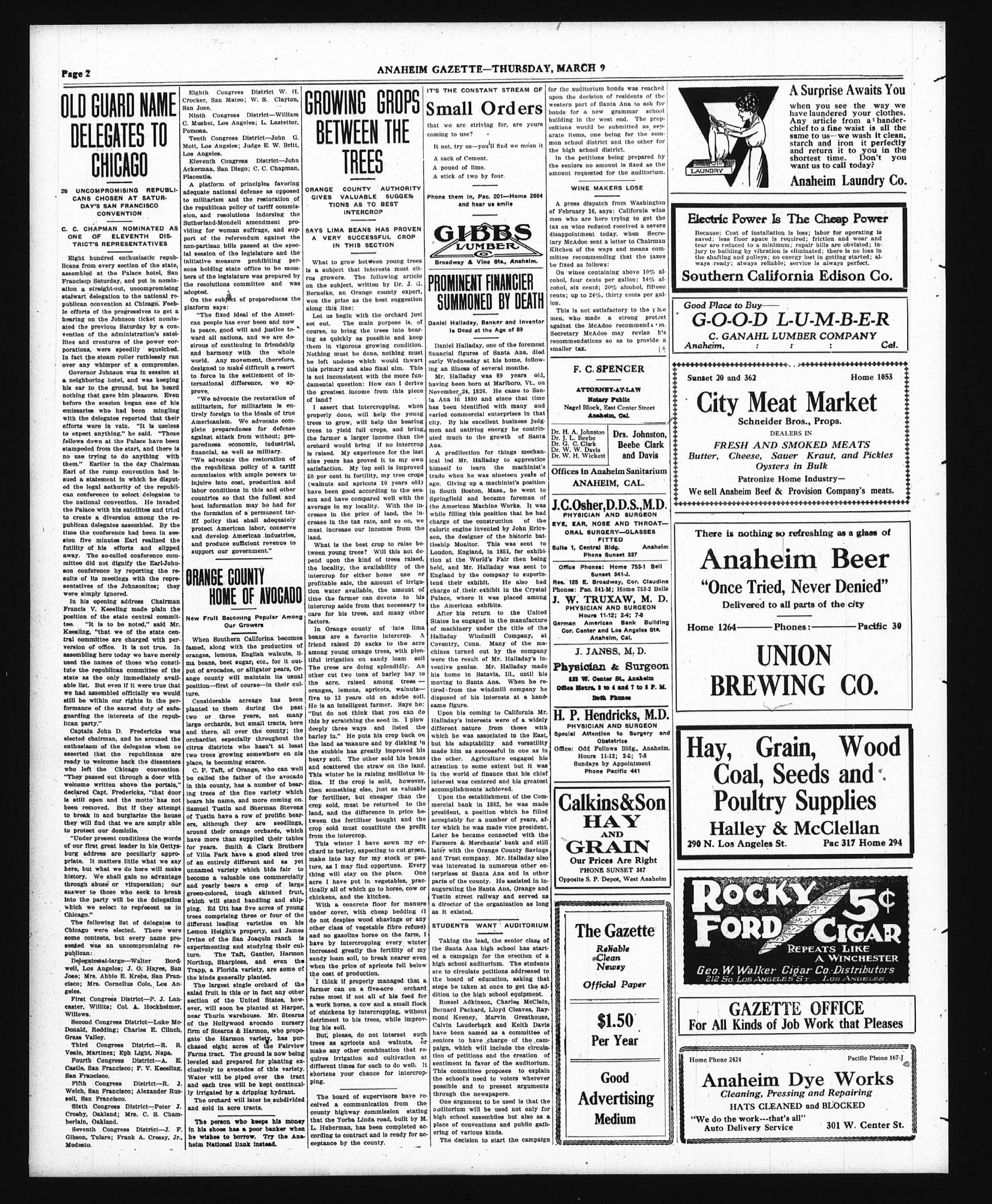
Searchable text
OLD GUARD NAME DELEGATES TO CHICAGO
26 UNCOMPROMISING REPUBLICANS CHOSEN AT SATURDAY'S SAN FRANCISCO CONVENTION
C. C. CHAPMAN NOMINATED AS ONE OF ELEVENTH DISTRICT'S REPRESENTATIVES
Eight hundred enthusiastic republicans from every section of the state, assembled at the Palace hotel, San Francisco Saturday, and put in nomination a straight-out, uncompromising stalwart delegation to the national republican convention at Chicago. Feeble efforts of the progressives to get a hearing on the Johnson ticket nominated the previous Saturday by a convention of the administration's satellites and creatures of the power corporations, were speedily squelched. In fact the steam roller ruthlessly ran over any whimper of a compromise.
Governor Johnson was in session at a neighboring hotel, and was keeping his ear to the ground, but he heard nothing that gave him pleasure. Even before the session began one of his emissaries who had been mingling with the delegates reported that their efforts were in vain. "It is useless to expect anything," he said. "Those fellows down at the Palace have been stammered from the start, and there is
Eighth Congress District W. H. Crocker, San Mateo; W. S. Clayton, San Jose.
Ninth Congress District—William C. Mushet, Los Angeles; L. Lastetter, Pomona.
Tenth Congress District—John G. Mott, Los Angeles; Judge E. W. Britt, Los Angeles.
Eleventh Congress District—John Ackerman, San Diego; C. C. Chapman, Placentia.
A platform of principles favoring adequate national defense as opposed to militarism and the restoration of the republican policy of tariff commission, and resolutions indorsing the Sutherland-Mondell amendment providing for woman suffrage, and support of the referendum against the non-partisan bills passed at the special session of the legislature and the initiative measure prohibiting persons holding state office to be members of the legislature was prepared by the resolutions committee and was adopted.
On the subject of preparedness the platform says:
"The fixed ideal of the American people has ever been and now is peace, good will and justice toward all nations, and we are desirous of continuing in friendship and harmony with the whole world. Any movement, therefore, designed to make difficult a resort to force in the settlement of international difference, we approve.
"We advocate the restoration of militarism, for militarism is entirely foreign to the ideals of true Americanism. We advocate complete preparedness for defense against attack from without; preparedness economic, industrial,
GROWING BETWEEN TREES
ORANGE COUNTY GIVES VALUABLE TIONS AS THE INTERCITY
SAYS LIMA BEANS A VERY SUCCESS IN THIS SEASON
What to grow between is a subject that invites growers. The on the subject, written Bernieke, an Orange won the prize as the along this line:
Let us begin with set out. The main course, to bring them as quickly as possible them in vigorous growth Nothing must be done be left undone while this primary and also is not inconsistent with damental question: Is the greatest income of land?
I assert that interest properly done, will trees to grow, will trees to yield full the farmer a larger orchard would bring
In fact the steam roller ruthlessly ran over any whimper of a compromise.
Governor Johnson was in session at a neighboring hotel, and was keeping his ear to the ground, but he heard nothing that gave him pleasure. Even before the session began one of his emissaries who had been mingling with the delegates reported that their efforts were in vain. "It is useless to expect anything," he said. "Those fellows down at the Palace have been stamped from the start, and there is no use trying to do anything with them." Earlier in the day Chairman Earl of the rump convention had issued a statement in which he disputed the legal authority of the republican conference to select delegates to the national convention. He invaded the Palace with his satellites and tried to create a diversion among the republican delegates assembled. By the time the conference had been in session five minutes Earl realized the futility of his efforts and slipped away. The so-called conference committee did not dignify the Earl-Johnson conference by reporting the results of its meetings with the representatives of the Johnsonites; they were simply ignored.
In his opening address Chairman Francis V. Keesling made plain the position of the state central committee. "It is to be noted," said Mr. Keesling, "that we of the state central committee are charged with perversion of office. It is not true. In assembling here today we have merely used the names of those who constitute the republican committee of the state as the only immediately available list. But even if it were true that we had assembled officially we would still be within our rights in the performance of the sacred duty of safeguarding the interests of the republican party."
Captain John D. Fredericks was elected chairman, and he aroused the enthusiasm of the delegates when he asserted that the republicans are ready to welcome back the dissenters who left the Chicago convention. "They passed out through a door with welcome written above the portals," declared Capt. Fredericks, "that door is still open and the motto has not been removed. But if they attempt to break in and burglarize the house they will find that we are amply able to protect our domicile.
"Under present conditions the words of our first great leader in his Gettysburg world. Any movement, therefore, designed to make difficult a resort to force in the settlement of international difference, we approve.
"We advocate the restoration of militarism, for militarism is entirely foreign to the ideals of true Americanism. We advocate complete preparedness for defense against attack from without; preparedness economic, industrial, financial, as well as military.
"We advocate the restoration of the republican policy of a tariff commission with ample powers to injure into cost, production and labor conditions in this and other countries so that the fullest and best information may be had for the formation of a permanent tariff policy that shall adequately protect American labor, conserve and develop American industries, and produce sufficient revenue to support our government."
ORANGE COUNTY HOME OF AVOCADO
New Fruit Becoming Popular Among Our Growers
When Southern California becomes famed, along with the production of oranges, lemons, English walnuts, lima beans, beet sugar, etc., for it output of avocados, or alligator pears, Orange county will maintain its usual position—first of course—in their culture.
Considerable acreage has been planted to them during the past two or three years, not many large orchards, but small tracts, here and there, all over the county; the orchardist especially throughout the citrus districts who hasn't at least two trees growing somewhere on his place, is becoming scarce.
C. P. Taft, of Orange, who can well be called the father of the avocado in this county, has a number of bearing trees of the fine variety which bears his name, and more coming on. Samuel Tustin and Sherman Stevens of Tustin have a row of prolific bearers, although they are seedlings, around their orange orchards, which have more than supplied their tables for years. Smith & Clark Brothers
ready to welcome back the dissenters who left the Chicago convention. "They passed out through a door with welcome written above the portals," declared Capt. Fredericks, "that door is still open and the motto has not been removed. But if they attempt to break in and burglarize the house they will find that we are amply able to protect our domicile."
"Under present conditions the words of our first great leader in his Gettysburg address are peculiarly appropriate. It matters little what we say here, but what we do here will make history. We shall gain no advantage through abuse or vituperation; our answer to those who seek to break into the party will be the delegation which we select to represent us in Chicago."
The following list of delegates to Chicago were elected. There were some contests, but every name presented was an uncompromising republican:
Delegates at-large—Walter Bordwell, Los Angeles; J. O. Hayes, San Jose; Mrs. Abbie E. Krebs, San Francisco; Mrs. Cornellius Cole, Los Angeles.
First Congress District—P. J. Lancaster, Willits; Col. A. Hockheimer, Willows.
Second Congress District—Luke McDonald, Redding; Charles E. Clinch, Grass Valley.
Third Congress District—R. R. Veale, Martinez; Eph Light, Napa.
Fourth Congress District—A. E. Castle, San Francisco; F. V. Keesling, San Francisco.
Fifth Congress District—R. J. Welch, San Francisco; Alexander Russell, San Francisco.
Sixth Congress District—Peter J. Crosby, Oakland; Mrs. C. S. Chamberlain, Oakland.
Seventh Congress District—J. F. Gibson, Tulare; Frank A. Cressy, Jr., Modesto.
C. P. Taft, of Orange, who can well be called the father of the avocado in this county, has a number of bearing trees of the fine variety which bears his name, and more coming on Samuel Tustin and Sherman Stevens of Tustin have a row of prolific bearers, although they are seedlings, around their orange orchards, which have more than supplied their tables for years. Smith & Clark Brothers of Villa Park have a good sized tree of an entirely different and as yet unnamed variety which bids fair to become a valuable one commercially and yearly bears a crop of large green-colored, tough skinned fruit, which will stand handling and shipping. Ed Utt has five acres of young trees comprising three or four of the different leading varieties on his Lemon Height's property, and James Irvine of the San Joaquin ranch is experimenting and studying their culture. The Taft, Gantler, Harmon Northup, Sharpless, and even the Trapp, a Florida variety, are some of the kinds generally planted.
The largest single orchard of the salad fruit in this or in fact any other section of the United States, however, will soon be planted at Harper, near Thurin warehouse. Mr. Stearns of the Hollywood avocado nursery firm of Stearns & Harmon, who propagate the Harmon variety, has purchased eight acres of the Fairview Farms tract. The ground is now being leveled and prepared for planting exclusively to avocados of this variety. Water will be piped over the tract and each tree will be kept continually irrigated by a dripping hydrant.
The orchard will later be subdivided and sold in acre tracts.
The person who keeps his money in his shoes has a poor banker when he wishes to borrow. Try the Anaheim National Bank instead.
This winter I have chard to barley, expect make into hay for future use, as I may find it thing will stay on a acre I have put in technically all of which g chickens, and the k
With a concrete under cover, with do not despise wood other class of vegetation and no gasoline home have by intercropping increased greatly the sandy loam soil, to when the price of s cost of production.
I think if proper farmer can on a f raise most if not all a work horse, a cow of chickens by interdiment to his tracing his soil.
But please, do my trees as apricots as make any other co quires irrigation a different times for e shortens your charping.
The board of su ceived a communi county highway con that the Yorba Lind L. Huberman, has b cording to contract a ceptance by the co
GROWING GROPS BETWEEN THE TREES
ORANGE COUNTY AUTHORITY GIVES VALUABLE SUGGESTIONS AS TO BEST INTERCROP
SAYS LIMA BEANS HAS PROVEN A VERY SUCCESSFUL CROP IN THIS SECTION
What to grow between young trees is a subject that interests most citrus growers. The following article on the subject, written by Dr. J. G. Berneike, an Orange county expert, won the prize as the best suggestion along this line:
Let us begin with the orchard just set out. The main purpose is, of course, to bring the trees into bearing as quickly as possible and keep them in vigorous growing condition. Nothing must be done, nothing must be left undone which would thwart this primary and also final aim. This is not inconsistent with the more fundamental question: How can I derive the greatest income from this piece of land?
I assert that intercropping, when properly done, will help the young trees to grow, will help the bearing trees to yield full crops, and bring the farmer a larger income than the orchard would bring if no intercrop
IT'S THE CONSTANT STREAM OF Small Orders that we are striving for, are yours coming to use?
It not, try us—you'll find we mean it
A sack of Cement.
A pound of lime.
A stick of two by four.
Phone them In, Pac. 201—Home 2664 and hear us smile
GIBBS LUMBER Broadway & Vine St., Anaheim.
PROMINENT FINANCIER SUMMONED BY DEATH
Daniel Halladay, Banker and Inventor Is Dead at the Age of 89
Daniel Halladay, one of the foremost financial figures of Santa Ana, died early Wednesday at his home, following an illness of several months.
Mr. Halladay was 89 years old, having been born at Marlboro, Vt., on November 24, 1826. He came to Santa Ana in 1880 and since that time has been identified with many and varied commercial enterprises in that city. By his excellent business judgmen and untiring energy he contributed much to the growth of Santa Ana.
for the auditorium bonds was reached upon the decision of residents of the western part of Santa Ana to ask for bonds for a new grammar school building in the west end. The propositions would be submitted as separate items, one being for the common school district and the other for the high school district.
In the petitions being prepared by the seniors no amount is fixed as the amount requested for the auditorium.
WINE MAKERS LOSE
A press dispatch from Washington of February 16, says: California wine men who are here trying to get the tax on wine reduced received a severe disappointment today, when Secretary McAdoo sent a letter to Chairman Kitchen of the ways and means committee recommending that the taxes be fixed as follows:
On wines containing above 10% alcohol, four cents per gallon; 14% alcohol, six cents; 20% alcohol, fifteen cents; up to 24%, thirty cents per gallon.
This is not satisfactory to the vine men, who made a strong protest against the McAdoo recommendation. Secretary McAdoo may revise his recommendations so as to provide a smaller tax.
F. C. SPENCER
ATTORNEY-AT-LAW
Notary Public
Nagel Block, East Center Street
Anaheim, Cal.
Dr. H. A. Johnston
Dr. J. L. Beebe
Dr. G. C. Clark
Dr. W. Davis
Nothing must be done, nothing must be left undone which would thwart this primary and also final aim. This is not inconsistent with the more fundamental question: How can I derive the greatest income from this piece of land?
I assert that intercropping, when properly done, will help the young trees to grow, will help the bearing trees to yield full crops, and bring the farmer a larger income than the orchard would bring if no intercrop is raised. My experience for the last nine years has proved it to my own satisfaction. My top soil is improved 50 per cent in fertility, my tree crops (walnuts and apricots 10 years old) have been good according to the season and have compared well with the average in my locality. With the increase in the price of land, the increase in the tax rate, and so on, we must increase our incomes from the land.
What is the best crop to raise between young trees? Will this not depend upon the kind of trees raised, the locality, the availability of the intercrop for either home use or profitable sale, the amount of irrigation water available, the amount of time the farmer can devote to his intercrop aside from that necessary to care for his trees, and many other factors.
In Orange county of late lima beans are a favorite intercrop. A friend raised 20 sacks to the acre among young orange trees, with plentiful irrigation on sandy loam soil The trees are doing splendidly. An other cut two tons of barley hay to the acre, raised among trees — oranges, lemons, apricots, walnuts— five to 12 years old on adobe soil. He is an intelligent farmer. Saye he: "But do not think that you can do this by scratching the seed in. I plow deeply three ways and listed the barley in." He puts his crop back on the land as manure and by disking in the stubble has greatly improved his heavy soil. The other sold his beans and scattered the straw on the land. This winter he is raising mellilot indica. If the crop is sold, however, then something else, just as valuable for fertilizer, but cheaper than the crop sold, must be returned to the land, and the difference in price between the fertilizer bought and the crop sold constitute the profit from the intercrop.
This winter I have sown my orchard to barley expecting to cut green financial figures of Santa Ana early Wednesday at his home, following an illness of several months.
Mr. Halladay was 89 years old, having been born at Marlboro, Vt., on November 24, 1826. He came to Santa Ana in 1880 and since that time has been identified with many and varied commercial enterprises in that city. By his excellent business judgmen and untiring energy he contributed much to the growth of Santa Ana.
A predilection for things mechanical led Mr. Halladay to apprentice himself to learn the machinist's trade when he was nineteen years of age. Giving up a machinist's position in South Boston, Mass., he went to Springfield and became foreman of the American Machine Works. It was while filling this position that he had charge of the construction of the caloric engine invented by John Ericson, the designer of the historic battleship Monitor. This was sent to London, England, in 1851, for exhibition at the World's Fair then being held, and Mr. Halladay was sent to England by the company to superintend their exhibit. He also had charge of their exhibit in the Crystal Palace, where it was placed among the American exhibits.
After his return to the United States he engaged in the manufacture of machinery under the title of the Halladay Windmill Company, at Coventry, Conn. Many of the machines turned out by the company were the result of Mr. Halladay's inventive genius. Mr. Halladay made his home in Batavia, Ill., until his moving to Santa Ana. When he retired from the windmill company he disposed of his interests at a handsame figure.
Upon his coming to California Mr. Halladay's interests were of a widely different nature from those with which he was associated in the East, but his adaptability and versatility made him as successful in one as in another. Agriculture engaged his attention to some extent but it was in the world of finance that his chief interest was centered and his greatest accomplishments achieved.
Upon the establishment of the Commercial bank in 1882, he was made president, a position which he filled acceptably for a number of years, after which he was made vice president. Later he became connected with the Farmers & Merchants' bank and still later with the Orange County Savings
heavy soil. The other sold his beans and scattered the straw on the land. This winter he is raising melilot indica. If the crop is sold, however, then something else, just as valuable for fertilizer, but cheaper than the crop sold, must be returned to the land, and the difference in price between the fertilizer bought and the crop sold must constitute the profit from the intercrop.
This winter I have sown my orchard to barley, expecting to cut green, make into hay for my stock or pasture, as I may find opportune. Every thing will stay on the place. One acre I have put in vegetables, practically all of which go to horse, cow or chickens, and the kitchen.
With a concrete floor for manure under cover, with cheap bedding (I do not despise wood shavings or any other class of vegetable fibre refuse) and no gasoline horse on the farm, I have by intercropping every winter increased greatly the fertility of my sandy loam soil, to break nearer even when the price of apricots fell below the cost of production.
I think if properly managed that a farmer can on a five-acre orchard raise most if not all of his feed for a work horse, a cow and a small flock of chickens by intercropping, without detriment to his trees, while improving his soil.
But, please, do not interset such trees as apricots and walnuts, or make any other combination that requires irrigation and cultivation at different times for each to do well. It shortens your chance for intercroping.
The board of supervisors have received a communication from the county highway commission stating that the Yorba Linda road, built by M. L. Huberman, has been completed according to contract and is ready for acceptance by the county.
Agriculture engaged his attention to some extent but it was in the world of finance that his chief interest was centered and his greatest accomplishments achieved.
Upon the establishment of the Commercial bank in 1882, he was made president, a position which he filled acceptably for a number of years, after which he was made vice president. Later he became connected with the Farmers & Merchants' bank and still later with the Orange County Savings and Trust company. Mr. Halladay also was interested in numerous other enterprises at Santa Ana and in other parts of the county. He assisted in inaugurating the Santa Ana, Orange and Tustin street railway and served as a director of the organization as long as it existed.
STUDENTS WANT AUDITORIUM
Taking the lead, the senior class of the Santa Ana high school has started a campaign for the erection of a high school auditorium. The students are to circulate petitions addressed to the board of education, asking that steps be taken at once to get the addition to the high school equipment.
Russel Adkinson, Charles McClain, Bernard Packard, Lloyd Cleaves, Raymond Keeney, Marvin Greathouse, Calvin Lauderback and Keith Davis have been named as a committee of seniors to have charge of the campaign, which will include the circulation of petitions and the creation of sentiment in favor of the auditorium. This committee proposes to explain the school's need to voters wherever possible and to present arguments through the newspapers.
One argument to be used is that the auditorium will be used not only for high school assemblies but also as a place of conventions and public gathering of various kinds.
The decision to start the campaign
A Surprise Awaits You
when you see the way we have laundered your clothes.
Any article from a hander-chief to a fine waist is all the same to us—we wash it clean, starch and iron it perfectly and return it to you in the shortest time. Don't you want us to call today?
Anaheim Laundry Co.
Electric Power Is The Cheap Power
Because: Cost of installation is less; labor for operating is saved; less floor space is required; friction and wear and tear are reduced to a minimum; repair bills are obviated; injury to building by vibration is eliminated; there is no loss in the shafting and pulleys; no energy lost in getting started; always ready; always reliable; service is always perfect.
Southern California Edison Co.
Good Place to Buy
G-O-O-D L-U-M-B-E-R
C. GANAHL LUMBER COMPANY
Anaheim, Cal.
Sunset 20 and 362 Home 1053
City Meat Market
Schneider Bros., Props.
DEALERS IN
FRESH AND SMOKED MEATS
Sunset 20 and 362 Home 1053
City Meat Market
Schneider Bros., Props.
DEALERS IN
FRESH AND SMOKED MEATS
Butter, Cheese, Sauer Kraut, and Pickles
Oysters in Bulk
Patronize Home Industry—
We sell Anaheim Beef & Provision Company's meats.
There is nothing so refreshing as a glass of
Anaheim Beer
"Once Tried, Never Denied"
Delivered to all parts of the city
Home 1264 Phones: Pacific 30
UNION
BREWING CO.
Hay, Grain, Wood
Coal, Seeds and
Poultry Supplies
Halley & McClellan
290 N. Los Angeles St. Pac 317 Home 294
Coal, Seeds and
Poultry Supplies
Halley & McClellan
290 N. Los Angeles St. Pac 317 Home 294
Rocky Ford Cigar
Repeats Like
A Winchester
Geo.W. Walker Cigar Co. Distributors
212 So. Los Angeles St., Los Angeles
GAZETTE OFFICE
For All Kinds of Job Work that Pleases
Home Phone 2424 Pacific Phone 167-J
Anaheim Dye Works
Cleaning, Pressing and Repairing
HATS CLEANED and BLOCKED
“We do the work---that’s all”
Auto Delivery Service 301 W. Center St.