anaheim-gazette 1916-01-13
Scanned page
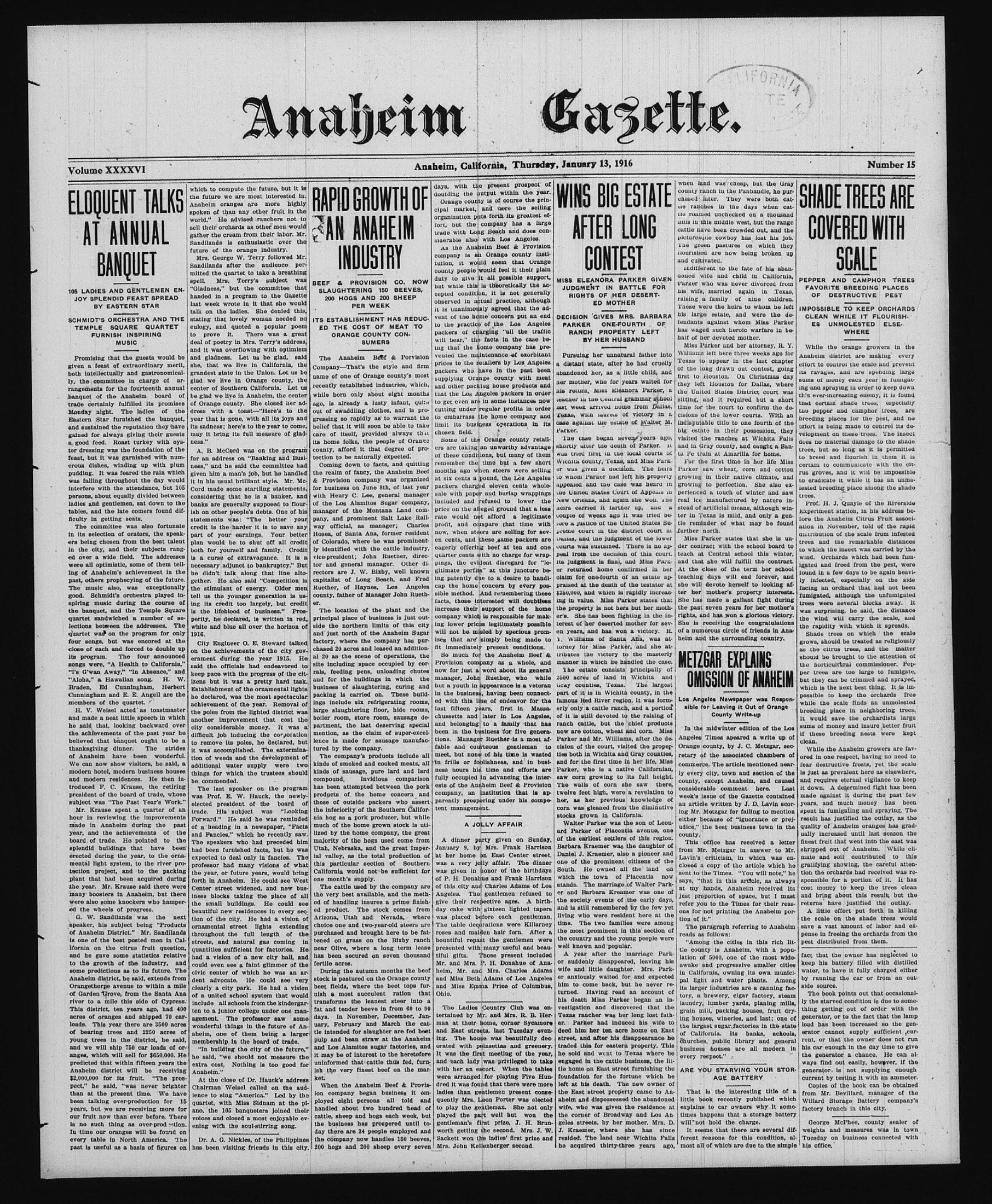
Searchable text
ELOQUENT TALKS AT ANNUAL BANQUET
105 LADIES AND GENTLEMEN ENJOY SPLENDID FEAST SPREAD BY EASTERN STAR
SCHMIDT'S ORCHESTRA AND THE TEMPLE SQUARE QUARTET FURNISH INSPIRING MUSIC
Promising that the guests would be given a feast of extraordinary merit, both intellectually and gastronomically, the committee in charge of arrangements for the fourteenth annual banquet of the Anaheim board of trade certainly fulfilled its promises Monday night. The ladies of the Eastern Star furnished the banquet, and sustained the reputation they have gained for always giving their guests a good feed. Roast turkey with oysters which to compute the future, but it is the future we are most interested in. Anaheim oranges are more highly spoken of than any other fruit in the world." He advised ranchers not to sell their orchards as other men would gather the cream from their labor. Mr. Sandilands is enthusiastic over the future of the orange industry.
Mrs. George W. Terry followed Mr. Sandilands after the audience permitted the quartet to take a breathing spell. Mrs. Terry's subject was "Gladness," but the committee that handed in a program to the Gazette last week wrote in it that she would talk on the ladies. She denied this, stating that lovely woman needed no eulogy, and quoted a popular poem to prove it. There was a great deal of poetry in Mrs. Terry's address, and it was overflowing with optimism and gladness. Let us be glad, said she, that we live in California, the grandest state in the Union. Let us be glad we live in Orange county, the center of Southern California. Let us be glad we live in Anaheim, the center of Orange county. She closed her address with a toast—"Here's to the year that is gone, with all its joys and its sadness; here's to the year to come, may it bring its full measure of gladness."
RAPID GRACE AN ANNUAL INDUCTION
BEEF & PROVINCE
SLAUGHTERING
200 HOGS AN
PER VIEW
ITS ESTABLISHMENT
ED THE COST
ORANGE COUNTY
The Anaheim Company—That's the name of one of Orange recently established while born only ago, is already out of swaddling grooming so rapidly belief that it will care of itself, produce its home folks, the county afforded it.
Promising that the guests would be given a feast of extraordinary merit, both intellectually and gastronomically, the committee in charge of arrangements for the fourteenth annual banquet of the Anaheim board of trade certainly fulfilled its promises Monday night. The ladies of the Eastern Star furnished the banquet, and sustained the reputation they have gained for always giving their guests a good feed. Roast turkey with oyster dressing was the foundation of the feast, but it was garnished with numerous dishes, winding up with plum pudding. It was feared the rain which was falling throughout the day would interfere with the attendance, but 105 persons, about equally divided between ladies and gentlemen, sat down to the tables, and the late comers found difficulty in getting seats.
The committee was also fortunate in its selection of orators, the speakers being chosen from the best talent in the city, and their subjects ranged over a wide field. The addresses were all optimistic, some of them telling of Anaheim's achievement in the past, others prophecying of the future. The music also, was exceptionally good. Schmidt's orchestra played inspiring music during the course of the banquet, and the Temple Square quartet sandwiched a number of selections between the addresses. The quartet was on the program for only four songs, but was enced at the close of each and forced to double up its program. The four announced songs were, "A Health to California," "I's G'wan Away," "In Absence," and "Aloha," a Hawaiian song. H. W. Braden, Ed Cunningham, Herbert Cunningham and E. E. Angell are the members of the quartet.
H. V. Weisel acted as toastmaster and made a neat little speech in which he said that, looking backward over the achievements of the past year he believed that banquet ought to be a thanksgiving dinner. The strides of Anaheim have been wonderful. We can now show visitors, he said, a modern hotel, modern business houses and modern residences. He then introduced F. C. Krause, the retiring president of the board of trade, whose subject was "The Past Year's Work."
Mr. Krause spent a quarter of an hour in reviewing the improvements made in Anaheim during the past year, and the achievements of the board of trade. He pointed to the splendid buildings that have been
and gladness. Let us be glad, said she, that we live in California, the grandest state in the Union. Let us be glad we live in Orange county, the center of Southern California. Let us be glad we live in Anaheim, the center of Orange county. She closed her address with—"Here's to the year that is gone, with all its joys and its sadness; here's to the year to come, may it bring its full measure of gladness."
A. B. McCord was on the program for an address on "Banking and Business," and he said the committee had given him a man's job, but he handled it in his usual brilliant style. Mr. McCord made some startling statements, considering that he is a banker, and banks are generally supposed to flourish on other people's debts. One of his statements was: "The better your credit is the harder it is to save any part of your earnings. Your better plan would be to shut off all credit both for yourself and family. Credit is a curse of extravagance. It is a necessary adjunct to bankruptcy." But he didn't talk along that line altogether. He also said "Competition is the stimulant of energy. Older men tell us the younger generation is using its credit too largely, but credit is the lifeblood of business." Prosperity, he declared, is written in red, white and blue all over the horizon of 1916.
City Engineer O. E. Steward talked on the achievements of the city government during the year 1915. He said the officials had endeavored to keep pace with the progress of the citizens but it was a pretty hard task. Establishment of the ornamental lights he declared, was the most spectacular achievement of the year. Removal of the poles from the lighted district was another improvement that cost the city considerable money. It was a difficult job inducing the corporation to remove its poles, he declared, but it was accomplished. The extermination of weeds and the development of additional water supply were two things for which the trustees should be commended.
The last speaker on the program was Prof. E. W. Hauck, newly-elected president of the board of trade. His subject was "Looking Forward." He said he was reminded of a heading in a newspaper, "Facts and Fancies," which he recently saw. The speakers who had preceded him had been furnished facts, but he was
The Anaheim Company—That's the name of one Of Orders recently established while born only ago, is already a part of swaddling oil greasing so rapidly belief that it will soon care of itself, protect its home folks, the county, afford it to protection to be natural.
Coming down to the realm of fancy, & Provision compares for business on June with Henry C. Leed of the Los Alamitos manager of the Mansion, and promotes way official, as in Hosea, of Santa Ana of Colorado, where he identified with a vice-president; Job tor and general mrectors are J. W., capitalist of Long Ruether, of Hayne county, father of Mister.
The location of principal place of b side the northern n and just north of f factory, where they chased 20 acres and al 20 as the scenic site including space rals, feeding pens and for the buildi business of slaughter packing is carried ing include six large slaughtering boiler room, store department, the last mention, as the clience is made for tured by the compu
The company's kinds of smoked and kinds of sausage compound. Inv has been attempted products of thie those of outside p inferiority of thie nia hog as a pork much of the home lized by the home majority of the ho Utah, Nebraska, an
We can now show visitors, he said, a modern hotel, modern business houses and modern residences. He then introduced F. C. Krause, the retiring president of the board of trade, whose subject was "The Past Year's Work."
Mr. Krause spent a quarter of an hour in reviewing the improvements made in Anaheim during the past year, and the achievements of the board of trade. He pointed to the splendid buildings that have been erected during the year, to the ornamental light system, to the river protection project, and to the packing plant that had been acquired during the year. Mr. Krause said there were many boosters in Anaheim, but there were also some knockers who hampered the wheels of progress.
G. W. Sandilands was the next speaker, his subject being "Products of Anaheim District." Mr. Sandilands is one of the best posted men in California on the citrus fruit question, and he gave some statistics relative to the growth of the industry, and some predictions as to its future. The Anaheim district, he said, extends from Orangethorpe avenue to within a mile of Garden Grove, from the Santa Ana river to a mile this side of Cypress. This district, ten years ago, had 400 acres of oranges and shipped 70 carloads. This year there are 3500 acres of bearing trees and 2250 acres of young trees in the district, he said, and we will ship 750 car loads of oranges, which will sell for $650,000. He predicted that within fifteen years the Anaheim district will be receiving $2,000,000 for its fruit. "The prospect," he said, "was never brighter than at the present time. We have been talking over-production for 15 years, but we are receiving more for our fruit now than ever before. There is no such thing as over-production. In time our oranges will be found on every table in North America. The past is useful as a basis of figures on
The last speaker on the program was Prof. E. W. Hauck, the newly-elected president of the board of trade. His subject was "Looking Forward." He said he was reminded of a heading in a newspaper, "Facts and Fancies," which he recently saw. The speakers who had preceded him had been furnished facts, but he was expected to deal only in fancies. The professor had many visions of what the year, or future years, would bring forth in Anaheim. He could see West Center street widened, and new business blocks taking the place of all the small buildings. He could see beautiful new residences in every section of the city. He had a vision of ornamental street lights extending throughout the full length of the streets, and natural gas coming in quantities sufficient for factories. He had a vision of a new city hall, and could even see a faint glimmer of the civic center of which he was an ardent advocate. He could see very clearly a city park. He had a vision of a united school system that would include all schools from the kindergarten to a junior college under one management. The professor saw some wonderful things in the future of Anaheim, one of them being a larger membership in the board of trade.
"In building the city of the future," he said, "we should not measure the extra cost. Nothing is too good for Anaheim."
At the close of Dr. Hauck's address Chairman Weisel called on the audience to sing "America." Led by the quartet, with Miss Sidnam at the piano, the 105 banqueters joined their voices and closed a most enjoyable evening with the soul-stirring song.
Dr. A. G. Nickles, of the Philippines has been visiting friends in this city.
The company's kinds of smoked and kinds of sausage, compound. Invite has been attempted products of the house those of outside park the inferiority of the nia hog as a pork much of the home illized by the home majority of the house Utah, Nebraska, and al valley, as the this particular sea California would not one month's supply.
The cattle used in the very best available of handling insured product. The Arizona, Utah and choice one and two purchased and brominated on grass or near Olive, where has been secured fertile acres.
During the autumn stock is pastured on beet fields, wherein nish a most successful transforms the leaf fat and tender beef days. In November, February and tle intended for slap pulp and bean strand Los Alamitos it may be of interest uninformed that cachish the very finest ket.
When the Anahion company began played eight person handled about two cattle, sheep and hhe business has day there are 34 pthe company now 200 hogs and 200
Anaheim Gazette
Anaheim, California, Thursday, January 13, 1916
RAPID GROWTH OF AN ANAHEIM INDUSTRY
BEEF & PROVISION CO. NOW SLAUGHTERING 150 BEEVES, 200 HOGS AND 200 SHEEP PER WEEK
ITS ESTABLISHMENT HAS REDUCED THE COST OF MEAT TO ORANGE COUNTY CONSUMERS
The Anaheim Beef & Porvision Company—That's the style and firm name of one of Orange county's most recently established industries, which, while born only about eight months ago, is already a lusty infant, quite out of swaddling clothes, and is progressing so rapidly as to warrant the belief that it will soon be able to take care of itself, provided always that its home folks, the people of Orange county, afford it that degree of prodays, with the present prospect of doubling the output within the year.
Orange county is of course the principal market, and here the selling organization puts forth its greatest effort, but the company has a large trade with Long Beach and does considerable also with Los Angeles.
As the Anaheim Beef & Provision company is an Orange county institution, it would seem that Orange county people would feel it their plain duty to give it all possible support, but while this is theoretically the accepted condition, it is not generally observed in actual practice, although it is unanimously agreed that the advent of the home concern put an end to the practice of the Los Angeles packers of charging "all the traffic will bear," the facts in the case being that the home company has prevented the maintenance of exorbitant prices to the retailers by Los Angeles packers who have in the past been supplying Orange county with meat and other packing house products and that the Los Angeles packers in order to get even are in some instances now cutting under regular profits in order to embarrass the home company and limit its business operations in its chosen field.
Some of the Orange county retailers are taking an unworthy advantage
WINS BIG ESTATE AFTER LONG CONTEST
MISS ELEANORA PARKER GIVEN JUDGMENT IN BATTLE FOR RIGHTS OF HER DESERTED MOTHER
DECISION GIVES MRS. BARBARA PARKER ONE-FOURTH OF RANCH PROPERTY LEFT BY HER HUSBAND
Pursuing her unnatural father into a distant state, after he had cruelly abandoned her, as a little child, and nor mother, who for years waited for his return, Miss Eleanora Parker, a teacher in the central grammar school last week arrived home from Dallas, Texas, with laurels of victory in a case against the estate of Walter M. Parker.
The case began seven years ago, shortly after the death of Parker.
The Anaheim Beef & Porvision Company—That’s the style and firm name of one of Orange county’s most recently established industries, which, while born only about eight months ago, is already a lusty infant, quite out of swaddling clothes, and is progressing so rapidly as to warrant the belief that it will soon be able to take care of itself, provided always that its home folks, the people of Orange county, afford it that degree of protection to be naturally expected.
Coming down to facts, and quitting the realm of fancy, the Anaheim Beef & Provision company was organized for business on June 8th, of last year with Henry C. Lee, general manager of the Los Alamitos Sugar company, manager of the Montana Land company, and prominent Salt Lake Railway official, as manager; Charles Hosea, of Santa Ana, former resident of Colorado, where he was prominently identified with the cattle industry, vice-president; John Ruether, director and general manager. Other directors are J. W. Bixby, well known capitalist of Long Beach, and Fred Ruether, of Haynes, Los Angeles county, father of Manager John Ruether.
The location of the plant and the principal place of business is just outside the northern limits of this city and just north of the Anaheim Sugar factory, where the company has purchased 20 acres and leased an additional 20 as the scene of operations, the site including space occupied by corrals, feeding pens, unloading chutes and for the buildings in which the business of slaughtering, curing and packing is carried on. These buildings include six refrigerating rooms, large slaughtering floor, hide rooms, boiler room, store room, sausage department, the last deserving special mention, as the claim of super-excellence is made for sausage manufactured by the company.
The company’s products include all kinds of smoked and cooked meats, all kinds of sausage, pure lard and lard compound. Invidious comparison has been attempted between the pork products of the home concern and those of outside packers who assert the inferiority of the Southern California hog as a pork producer, but while much of the home grown stock is utilized by the home company, the great majority of the hogs used come from Utah, Nebraska, and the great Imperial farm.
Some of the Orange county retailers are taking an unworthy advantage of these conditions, but many of them remember the time but a few short months ago when steers were selling at six cents a pound, the Los Angeles packers charged eleven cents wholesale with paper and burlap wrappings included and refused to lower the price on the alleged ground that a less rate would not afford a legitimate profit, and compare that time with now, when steers are selling for seven cents, and these same packers are eagerly offering beef at ten and one quarter cents with no charge for wrappings, the evident disregard for “legitimate porfite” at this juncture being patently due to a desire to handle the home concern by every possible method. And remembering these facts, those interested will doubtless increase their support of the home company which is responsible for making lower prices legitimately possible will not be misled by specious promises that are simply being made to fit immediately present conditions.
So much for the Anaheim Beef & Provision company as a whole, and now for just a word about its general manager, John Ruether, who while but a youth in appearance is a veteran in the business, having been connected with this line of endeavor for the last fifteen years, first in Massachussetts and later in Los Angeles, and belonging to a family that has been in the business for five generations. Manager Ruether is a most affable and courteous gentleman to meet, but none of his time is wasted in frills or foolishness, and in business hours his time and efforts are fully occupied in advancing the interests of the Anaheim Beef & Provision company, an institution that is apparently prospering under his competent management.
A JOLLY AFFAIR
A dinner party given on Sunday, January 9, by Mrs. Frank Harrison
Pursuing her unnatural father into a distant state, after he had cruelly abandoned her, as a little child, and her mother, who for years waited for his return, Miss Eleanora Parker, a teacher in the Central grammar school last week arrived home from Dallas, Texas, with laures of victory in a case against the estate of Walter M. Parker.
The case began seven years ago, shortly after the death of Parker. It was tried first in the local courts of Wichita county, Texas, and Miss Parker was given a decision. The heirs to whom Parker nad left his property appeared and the case was heard in the United States Court of Appeals in New Orleans, and again she won. The heirs carried it together up, and a couple of weeks ago it was tried before a justice of the United States Supreme court in the district court at Dallas, and the judgment of the lower courts was sustained. There is no appeal from the decision of this court. Its judgment is final, and Miss Parker returned home confirmed in her claim for one-fourth of an estate appraised at the death of the testator at $250,000, and which is rapidly increasing in value. Miss Parker states that the property is not hers but her mother’s. She has been fighting in the interest of her deserted mother for seven years, and has won a victory. R. Y. Williams of Santa Ana, was attorney for Miss Parker, and she attributes the victory to the masterly manner in which he handled the case.
The estate consists principally of 2500 acres of land in Wichita and Gray counties, Texas. The largest part of it is in Wichita county, in the famous Red River region. It was formed only by a cattle ranch, and a portion of it is still devoted to the raising of ranch cattle, but the chief products now are cotton, wheat and corn. Miss Parker and Mr. Williams, after the decision of the court, visited the properties both in Wichita and Gray counties, and for the first time in her life, Miss Parker, who is a native Californian, saw corn growing to its full height. The walls of corn she saw there, twelve feet high; were a revelation to her, as her previous knowledge of corn was gleaned from the diminutive stocks grown in California.
Walter Parker was the son of Leonard Parker of Placentia avenue, one of the earliest settlers of this region. Barbara Kraemer was the daughter of
The company’s products include all kinds of smoked and cooked meats, all kinds of sausage, pure lard and lard compound. Invidious comparison has been attempted between the pork products of the home concern and those of outside packers who assert the inferiority of the Southern California hog as a pork producer, but while much of the home grown stock is utilized by the home company, the great majority of the hogs used come from Utah, Nebraska, and the great Imperial valley, as the total production of this particular section of Southern California would not be sufficient for one month’s supply.
The cattle used by the company are the very best available, and the method of handling insures a prime finished product. The stock comes from Arizona, Utah and Nevada, where choice one and two-year-old steers are purchased and brought here to be fattened on grass on the Bixby ranch near Olive, where a long term lease has been secured on seven thousand fertile acres.
During the autumn months the beef stock is pastured on the Orange county beet fields, where the beet tops furnish a most succulent ration that transforms the leanest steer into a fat and tender beeve in from 60 to 90 days. In November, December, January, February and March the cattle intended for slaughter are fed beet pulp and bean straw at the Anaheim and Los Alamitos sugar factories, and it may be of interest to the heretofore uninformed that cattle thus fed, furnish the very finest beef on the market.
When the Anaheim Beef & Provision company began business it employed eight persons all told and handled about two hundred head of cattle, sheep and hogs each week, but the business has prospered until today there are 34 people employed and the company now handles 150 beeves, 200 hogs and 200 sheep every seven
A dinner party given on Sunday, January 9, by Mrs. Frank Harrison at her home on East Center street, was a very jolly affair. The dinner was given in honor of the birthdays of P. H. Donahue and Frank Harrison of this city and Charles Adams of Los Angeles. The gentlemen refused to give their respective ages. A birthday cake with sixteen lighted tapers was placed before each gentleman. The table decorations were Killarney roses and maiden hair fern. After a bountiful repast the gentlemen were presented with many useful and beautiful gifts. Those present included Mr. and Mrs. P. H. Donahue of Anaheim, Mrs. and Mrs. Charles Adams and Miss Beth Adams of Los Angeles and Miss Emma Price of Columbus, Ohio.
The Ladies Country Club was entertained by Mr. and Mrs. R. B. Herman at their home, corner Sycamore and East streets, last Tuesday evening. The house was beautifully decorated with poinsettias and greenery. It was the first meeting of the year, and each lady was privileged to take with her an escort. When the tables were arranged for playing Five Hundred it was found that there were more ladies than gentlemen present consequently Mrs. Leon Porter was elected to play the gentleman. She not only played the part well but won the gentleman's first prize, J. H. Brunworth getting the second. Mrs. J. W. Sackett won the ladies' first prize and Mrs. John Kellenberger second.
Walter Parker was the son of Leonard Parker of Placentia avenue, one of the earliest settlers of this region. Barbara Kraemer was the daughter of Daniel J. Kraemer, also a pioneer and one of the prominent citizens of the South. He owned all the land on which the town of Placentia now stands. The marriage of Walter Parker and Barbara Kreamer was one of the society events of the early days, and is still remembered by the few yet living who were resident here at the time. The two families were among the most prominent in this section of the country and the young people were well known and popular.
A year after the marriage Parker suddenly disappeared, leaving his wife and little daughter. Mrs. Parker anxiously waited for and expected him to come back, but he never returned. Having read an account of his death Miss Parker began an investigation and discovered that the Texas rancher was her long lost father. Parker had induced his wife to deed him her ten acre home on East street, and after his disappearance he traded this for eastern property. This he sold and went to Texas where he engaged in the cattle business, the little home on East street furnishing the foundation for the fortune which he left at his death. The new owner of the East street property came to Anaheim and dispossessed the abandoned wife, who was given the residence at the corner of Broadway and Los Angeles streets, by her mother, Mrs. D. J. Kraemer, where she has since resided. The land near Wichita Falls he acquired thirty-three years ago,
---
*A JOLLY AFFAIR*
A dinner party given on Sunday, January 9, by Mrs. Frank Harrison at her home on East Center street, was a very jolly affair. The dinner was given in honor of the birthdays of P. H. Donahue and Frank Harrison of this city and Charles Adams of Los Angeles. The gentlemen refused to give their respective ages. A birthday cake with sixteen lighted tapers was placed before each gentleman. The table decorations were Killarney roses and maiden hair fern. After a bountiful repast the gentlemen were presented with many useful and beautiful gifts. Those present included Mr. and Mrs. P. H. Donahue of Anaheim, Mrs. and Mrs. Charles Adams and Miss Beth Adams of Los Angeles and Miss Emma Price of Columbus, Ohio.
The Ladies Country Club was entertained by Mr. and Mrs. R. B. Herman at their home, corner Sycamore and East streets, last Tuesday evening. The house was beautifully decorated with poinsettias and greenery. It was the first meeting of the year, and each lady was privileged to take with her an escort. When the tables were arranged for playing Five Hundred it was found that there were more ladies than gentlemen present consequently Mrs. Leon Porter was elected to play the gentleman. She not only played the part well but won the gentleman's first prize, J. H. Brunworth getting the second. Mrs. J. W. Sackett won the ladies' first prize and Mrs. John Kellenberger second.
Walter Parker was the son of Leonard Parker of Placentia avenue, one of the earliest settlers of this region. Barbara Kraemer was the daughter of Daniel J. Kraemer, also a pioneer and one of the prominent citizens of the South. He owned all the land on which the town of Placentia now stands. The marriage of Walter Parker and Barbara Kreamer was one of the society events of the early days, and is still remembered by the few yet living who were resident here at the time. The two families were among the most prominent in this section of the country and the young people were well known and popular.
A year after the marriage Parker suddenly disappeared, leaving his wife and little daughter. Mrs. Parker anxiously waited for and expected him to come back, but he never returned. Having read an account of his death Miss Parker began an investigation and discovered that the Texas rancher was her long lost father. Parker had induced his wife to deed him her ten acre home on East street, and after his disappearance he traded this for eastern property. This he sold and went to Texas where he engaged in the cattle business, the little home on East street furnishing the foundation for the fortune which he left at his death. The new owner of the East street property came to Anaheim and dispossessed the abandoned wife, who was given the residence at the corner of Broadway and Los Angeles streets, by her mother, Mrs. D. J. Kraemer, where she has since resided. The land near Wichita Falls he acquired thirty-three years ago,
---
*AMOLE COUNTY COUNTRY FARMING*
ESTATE LONG EST
PARKER GIVEN BATTLE FOR DESERT-THER
MRS. BARBARA COURTH OF PARTY LEFT SSBAND
natural father into he had cruelly little child, and years waited for anora Parker, a grammar school time from Dallas of victory in a state of Walter M.
seven years ago, death of Parker.
when land was cheap, but the Gray county ranch in the Panhandle, he purchased later. They were both cattle ranches in the days when cattle roamed unchecked on a thousand acres in this middle west, but the range cattle have been crowded out, and the picturesque cowboy has lost his job. The green pastures on which they nourished are now being broken up and cultivated.
indifferent to the fate of his abandoned wife and child in California, Parker who was never divorced from his wife, married again in Texas, raising a family of nine children. These were the heirs to whom he left his large estate, and were the defendants against whom Miss Parker has waged such heroic warfare in behalf of her devoted mother.
Miss Parker and her attorney, R. Y. Williams left here three weeks ago for Texas to appear in the last chapter of the long drawn out contest, going first to Houston. On Christmas day they left Houston for Dallas, where the United States District court was sitting, and it required but a short time for the court to confirm the decisions of the lower courts. With an indisputable title to one fourth of the big estate in their possession, they visited the ranches at Wichita Falls and in Gray county, and caught a San Francisco tree.
SHADE TREES ARE COVERED WITH SCALE
PEPPER AND CAMPHOR TREES FAVORITE BREEDING PLACES OF DESTRUCTIVE PEST
IMPOSSIBLE TO KEEP ORCHARDS CLEAN WHILE IT FLOURISHES UNMOLOSTED ELSEWHERE
While the orange growers in the Anaheim district are making every effort to control the scale and prevent its ravages, and are spending large sums of money each year in fumigating and spraying in order to keep down this ever-increasing enemy, it is found that certain shade trees, especially the pepper and camphor trees, are breeding places for the pest, and no effort is being made to control its development on these trees. The insect does no material damage to the shade trees, but so long as it is permitted
NATURAL father into which he had cruelly little child, and years waited for Ananora Parker, a grammar school home from Dallas, of victory in a state of Walter M.
seven years ago, birth of Parker. It is local courts of law, and Miss Parkson. The heirs left his property he was heard in court of Appeals in him she won. He up, and it was tried by United States Supreme Court atment of the lower There is no apon of this court, and Miss Park confirmed in her of an estate ap of the testator at rapidly increasearker states that but her mother's property interests. She has made a gallant fight during the past seven years for her mother's rights, and has won a glorious victory. She is receiving the congratulations of a numerous circle of friends in Anaheim and the surrounding country.
METZGAR EXPLAINS OMISSION OF ANAHEIM
Los Angeles Newspaper was Responsible for Leaving it Out of Orange County Write-up
In the midwinter edition of the Los Angeles Times appeared a write up of Orange county, by J. C. Metzgar, secretary of the associated chambers of commerce. The article mentioned nearly every city, town and section of the county, except Anaheim, and caused considerable comment here. Last week's issue of the Gazette contained an article written by J. D. Lavin scoring Mr. Metzgar for failing to mention either because of "ignorance or prejudice," the best business town in the county.
This office has received a letter from Mr. Metzgar in answer to Mr. Anaheim district are making every effort to control the scale and prevent its ravages, and are spending large sums of money each year in fumigating and spraying in order to keep down this ever-increasing enemy; it is found that certain shade trees, especially the pepper and camphor trees, are breeding places for the pest, and no effort is being made to control its development on these trees. The insect does no material damage to the shade trees, but so long as it is permitted to breed and flourish in them it is certain to communicate with the citrus groves, and it will be impossible to eradicate it while it has an unmolested breeding place among the shade trees.
Prof. H. J. Quayle of the Riverside Experiment station, in his address before the Anaheim Citrus Fruit association in November, told of the rapid distribution of the scale from infested trees and the remarkable distances to which the insect was carried by the wind. Orchards which had been fumigated and freed from the pest, were found in a few days to be again heavily infected, especially on the side facing an orchard that had not been fumigated, although the unfumigated trees were several blocks away. It was surprising, he said, the distance the wind will carry the scale, and the rapidity with which it spreads.
Shade trees on which the scale grows, should be treated as religiously as the citrus trees, and the matter should be brought to the attention of the horticultural commissioner. Peper trees are too large to fumigate, but they can be trimmed and sprayed, which is the next best thing. It is impossible to keep the orchards free while the scale finds an unmolested breeding place in neighboring trees. It would save the orchardists large sums of money and insure better fruit if these breeding nests were kept clean.
While the Anaheim growers are favored in one respect, having no need to fear destructive frosts, yet the scale is just as prevalent here as elsewhere, and requires eternal vigilance to keep it down. A determined fight has been made against it during the past few years, and much money has been spent in fumigating and spraying. The result has justified the outlay, as the quality of Anaheim oranges has gradually increased until last season the finest fruit that went into the east was shipped out of Anaheim. While cli-
in her life, Miss
active Californian,
to its full height,
she saw there,
be a revelation to
its knowledge of
from the diminutive
california.
the son of Leonntia avenue, one
ars of this region.
is the daughter of
also a pioneer and
citizens of the
full land on
Placentia now
of Walter Parkmer was one of
the early days,
and by the few yet
indent here at the
miles were among
this section of
young people were
marriage Parkpared, leaving his
mother. Mrs. Parkfor, and expected
but he never read an account of
ker began an incovered that the
near long lost fathuced his wife to
are home on East
disappearance he
own property. This
Texas where he
business, the little furnishing the
fortune which he
the new owner of
perry came to Andrew the abandoned
at the residence at
away and Los Anr mother, Mrs. D.
she has since
dear Wichita Falls
three years ago,
article mentioned nearly
every city, town and section of
county, except Anaheim, and caused considerable comment here. Last week's issue of the Gazette contained an article written by J. D. Lavin scoring Mr. Metzgar for failing to mention either because of "ignorance or prejudice," the best business town in the county.
This office has received a letter from Mr. Metzgar in answer to Mr. Lavin's criticism, in which was enclosed a copy of the article which he sent to the Times. "You will note," he says, "that in this article, as always at my hands, Anaheim received its just proportion of space, but I must refer you to the Times for their reasons for not printing the Anaheim portion of it."
The paragraph referring to Anaheim reads as follows:
"Among the cities in this rich little county is Anaheim, with a population of 5000, one of the most wide awake and progressive smaller cities in California, owning its own municipal light and water plants. Among its larger industries are a canning factory, a brewery, cigar factory, steam laundry, lumber yards, planing mills, grain mill, packing houses, fruit drying houses, wineries, and last; one of the largest sugar factories in the state of California. Its banks, schools, churches, public library and general business houses are all modern in every respect."
ARE YOU STARVING YOUR STORAGE BATTERY
That is the interesting title of a little book recently published which explains to car owners why it sometimes happens that a storage battery will not hold the charge.
It seems that there are several different reasons for this condition, almost all of which are due to the simple ored in one respect, having no need to fear destructive frosts, yet the scale is just as prevalent here as elsewhere, and requires eternal vigilance to keep it down. A determined fight has been made against it during the past few years, and much money has been spent in fumigating and spraying. The result has justified the outlay, as the quality of Anaheim oranges has gradually increased until last season the finest fruit that went into the east was shripped out of Anaheim. While climate and soil contributed to this gratifying showing, the careful attention the orchards had received was responsible for a portion of it. It has cost money to keep the trees clean and bring about this result, but the returns have justified the outlay.
A little effort put forth in killing the scale on the shade trees would save a vast amount of labor and expense in freeing the orchards from the pest distributed from them.
fact that the owner has neglected to keep his battery filled with distilled water, to have it fully charged either by running the car or from an outside source.
The book points out that occasionally the starved condition is due to something getting out of order with the generator, or to the fact that the lamp load has been increased so the generator cannot supply sufficient current, or that the owner does not run his car enough in the day time to give the generator a chance. He can always find out easily, however, if the generator is not supplying enough current by testing it with an ammeter.
Copies of the book can be obtained from Mr. Bevillard, manager of the Willard Storage Battery company's factory branch in this city.
George McPhee, county sealer of weights and measures was in town Tuesday on business connected with his office.