anaheim-gazette 1916-01-06
Scanned page
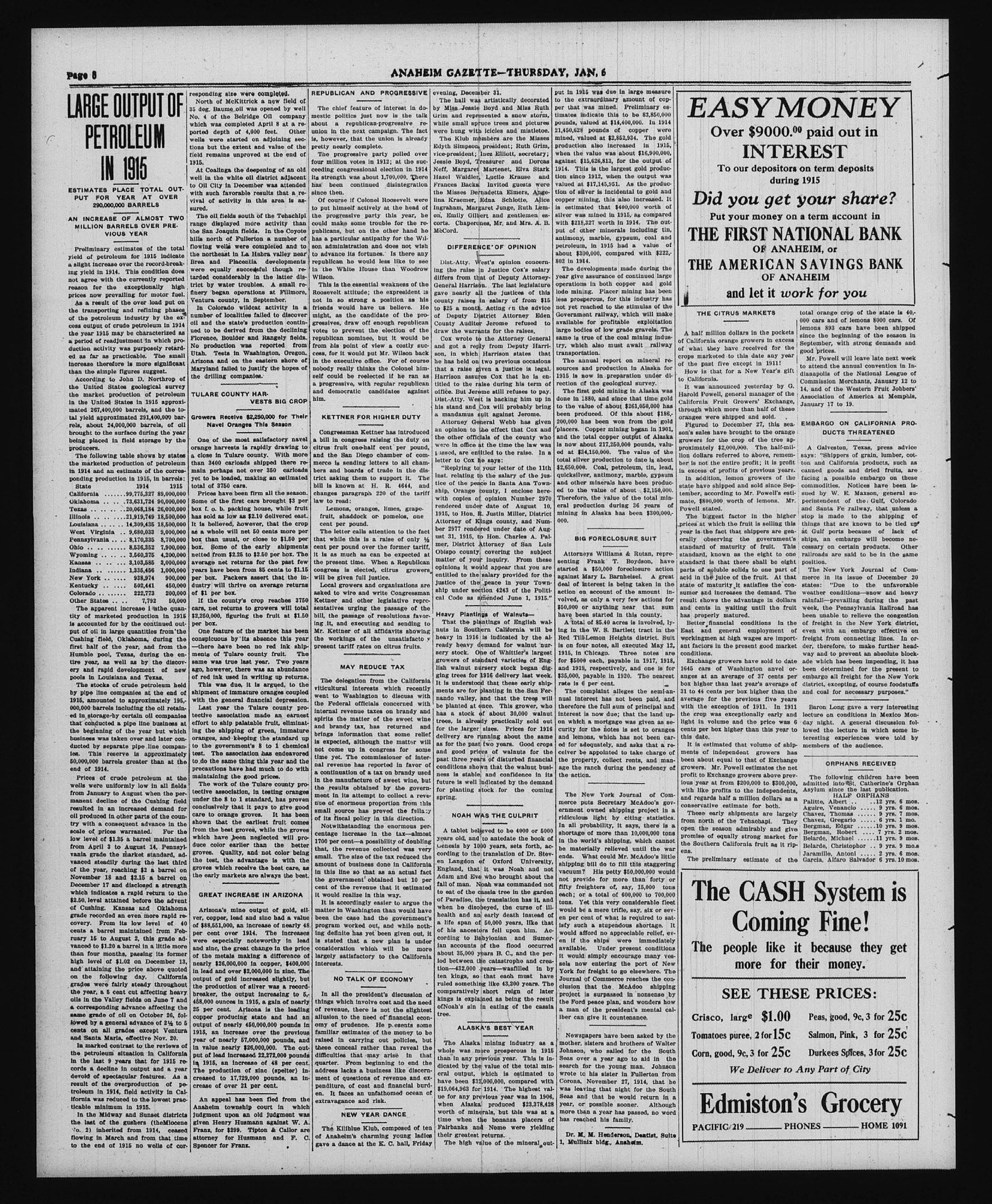
Searchable text
LARGE OUTPUT OF PETROLEUM IN 1915
ESTIMATES PLACE TOTAL OUTPUT FOR YEAR AT OVER 290,000,000 BARRELS
AN INCREASE OF ALMOST TWO MILLION BARRELS OVER PREVIOUS YEAR
Preliminary estimates of the total yield of petroleum for 1915 indicate a slight increase over the record-breaking yield in 1914. This condition does not agree with the currently reported reason for the exceptionally high prices now prevailing for motor fuel.
As a result of the over load put on the transporting and refining phases of the petroleum industry by the excess output of crude petroleum in 1914 the year 1915 may be characterized as a period of readjustment in which production activity was purposely retarded as far as practicable. The small increase therefore is more significant than the simple figures suggest.
According to John D. Northrop of the United States geological survey the market production of petroleum in the United States in 1915 approximated 267,400,000 barrels, and the total yield approximated 291,400,000 barrels, about 24,000,000 barrels, of oil brought to the surface during the year being placed in field storage by the producers.
responding size were completed.
North of McKittrick a new field of 35 deg. Baume oil was opened by well No. 4 of the Belridge Oil company which was completed April 8 at a reported depth of 4,000 feet. Other wells were started on adjoining sections but the extent and value of the field remains unproved at the end of 1915.
At Coalinga the deepening of an old well in the white oil district adjacent to Oil City in December was attended with such favorable results that a revival of activity in this area is assured.
The oil fields south of the Tehachipl range displayed more activity than the San Joaquin fields. In the Coyote hills north of Fullerton a number of flowing wells were completed and to the northeast in La Habra valley near Brea and Placentia developments were equally successful though retarded considerably in the latter district by water troubles. A small refinery began operations at Fillmore, Ventura county, in September.
In Colorado wildcat activity in a number of localities failed to discover oil and the state's production continued to be derived from the declining Florence, Boulder and Rangeley fields. No production was reported from Utah. Tests in Washington, Oregon, Arizona and on the eastern shore of Maryland failed to justify the hopes of the drilling companies.
TULARE COUNTY HARVESTS BIG CROP
Growers Receive $2,250,000 for Their Navel Oranges This Season
One of the most satisfactory navel orange harvests is rapidly drawing to REPUBLICAN ANNOUNCEMENT
The chief feature of mestic politics just about a republican union in the next oceans is, however, that they pretty nearly compete.
The progressive four million votes in ceeding congressionally its strength was abolished has been continuous since then.
Of course if Colorado put himself active the progressive party could make some publicans, but on has a particular antagonist administration to advance its fortress republican he would in the White House Wilson.
This is the essential Roosevelt attitude; not in so strong friends would have might, as the cannerygressives, draw off votes to prevent the republican nominee from his point of success, for it would pave in the executive office nobody really think self could be reeled a progressive, with and democratic him.
KETTNER FORUM
Congressman Ketton a bill in congress citrus fruit one-half
The small increase therefore is more significant than the simple figures suggest.
According to John D. Northrop of the United States geological survey the market production of petroleum in the United States in 1915 approximated 267,400,000 barrels, and the total yield approximated 291,400,000 barrels, about 24,000,000 barrels, of oil brought to the surface during the year being placed in field storage by the producers.
The following table shows by states the marketed production of petroleum in 1914 and an estimate of the corresponding production in 1915, in barrels:
| State | 1914 | 1915 |
| :--- | :--- | :--- |
| California | 99,775,327 | 89,000,000 |
| Oklahoma | 73,631,724 | 90,000,000 |
| Texas | 20,068,184 | 26,000,000 |
| Illinois | 21,919,749 | 18,500,000 |
| Louisiana | 14,309,435 | 18,500,000 |
| West Virginia | 9,680,033 | 9,000,000 |
| Pennsylvania | 8,170,335 | 8,700,000 |
| Ohio | 8,536,352 | 7,900,000 |
| Wyoming | 3,560,375 | 4,200,000 |
| Kansas | 3,103,585 | 3,000,000 |
| Indiana | 1,335,456 | 1,000,000 |
| New York | 938,974 | 900,000 |
| Kentucky | 502,441 | 450,000 |
| Colorado | 222,773 | 200,000 |
| Other States | 7,792 | 50,000 |
The apparent increase in the quantity of marketed production in 1915 is accounted for by the continued output of oil in large quantities from the Cushing field, Oklahoma, during the first half of the year, and from the Humble pool, Texas, during the entire year, as well as by the discovery and rapid development of new pools in Louisiana and Texas.
The stocks of crude petroleum held by pipe line companies at the end of 1915, amounted to approximately 195,000,000 barrels including the oil retained in storage by certain oil companies that conducted a pipe line business at the beginning of the year but which business was taken over and later conducted by separate pipe line companies. This reserve is approximately 50,000,000 barrels greater than at the end of 1914.
Prices of crude petroleum at the wells were uniformly low in all fields from January to August when the permanent decline of the Cushing field resulted in an increased demand for oil produced in other parts of the country with a consequent advance in the scale of prices warranted. For the low level of $1.35 a barrel maintained from April 3 to August 14, Pennsylvanian tests in Washington, Oregon, Arizona and on the eastern shore of Maryland failed to justify the hopes of the drilling companies.
TULARE COUNTY HARVESTS BIG CROP
Growers Receive $2,250,000 for Their Navel Oranges This Season
One of the most satisfactory navel orange harvests is rapidly drawing to a close in Tulare county. With more than 3400 carloads shipped there remain perhaps not over 350 carloads yet to be loaded, making an estimated total of 3750 cars.
Prices have been firm all the season. Some of the first cars brought $3 per box f. o. b. packing house, while fruit has sold as low as $2.10 delivered east. It is believed, however, that the crop as a whole will net 50 cents more per box than usual, or close to $1.50 per box. Some of the early shipments netted from $2.25 to $2.50 per box. The average net returns for the past few years have been from 85 cents to $1.15 per box. Packers assert that the industry will thrive on average returns of $1 per box.
If the county's crop reaches 3750 cars, net returns to growers will total $2,250,000, figuring the fruit at $1.50 per box.
One feature of the market has been conspicuous by its absence this year—there have been no red ink shipments of Tulare county fruit. The same was true last year. Two years ago, however, there was an abundance of red ink used in writing up returns.
This was due, it is argued, to the shipment of immature oranges coupled with the general financial depression.
Last year the Tulare county protective association made an earnest effort to ship palatable fruit, eliminating the shipping of green, immature oranges, and keeping the standard up to the government's 8 to 1 chemical test. The association has endeavored to do the same thing this year and the precautions have had much to do with maintaining the good prices.
The work of the Tulare county protective association, in testing oranges under the 8 to 1 standard, has proven conclusively that it pays to give good care to orange groves. It has been shown that the earliest fruit comes from the best groves, while the groves which have been neglected will produce color earlier than the better Utah.
Tests in Washington, Oregon,
Arizona and on the eastern shore of Maryland failed to justify the hopes of
the drilling companies.
KETTNER FORCE
Congressman Kettner a bill in congress citrus fruit one-half and the San Diego merce is sending bers and boards on trict asking them a bill is known at changes paragraph law to read:
Lemons, orange fruit, shaddock cent per pound.
The letter calls that while this is cent per pound over it is as much as the present time,
congress is elected will be given full jj
Local growers are asked to wire and Kettner and other sentatives urging it,the passage o ing it,and executi Mr.Kettner of all
the workings of o present tariff rates
MAY RED
The delegation of viticultural interest went to Washington
the Federal office internal revenue t spiritis the matter and brandy tax,b brings information is expected although not come up in o time yet.The com nal revenue has re a continuation of al in the manufacture th results obtain ment in its attemp nue of enormous p small source has o of its fiscal policy
Notwithstanding centage increase e 1700 per cent—a pe that,the revenue
Prices of crude petroleum at the wells were uniformly low in all fields from January to August when the permanent decline of the Cushing field resulted in an increased demand for oil produced in other parts of the country with a consequent advance in the scale of prices warranted. For the low level of $1.35 a barrel maintained from April 3 to August 14, Pennsylvania grade the market standard, advanced steadily during the last third of the year, reaching $2 a barrel on November 18 and $2.15 a barrel on December 17 and disclosed a strength which indicates a rapid return to the $2.50 level attained before the advent of Cushing. Kansas and Oklahoma grade recorded an even more rapid recovery. From its low level of 40 cents a barrel maintained from February 15 to August 2, this grade advanced to $1.20 a barrel in a little more than four months, passing its former high level of $1.02 on December 13, and attaining the price above quoted on the following day. California grades were fairly steady throughout the year, a 5 cent cut affecting heavy oils in the Valley fields on June 7 and a corresponding advance affecting the same grade of oil on October 26, followed by a general advance of 2½ to 5 cents on all grades except Ventura and Santa Maria, effective Nov. 20.
In marked contrast to the reviews of the petroleum situation in California in the last 9 years that for 1915 records a decline in output and a year devoid of spectacular features. As a result of the overproduction of petroleum in 1914, field activity in California was reduced to the lowest practicable minimum in 1915.
In the Midway and Sunset districts the last of the gushers (the Miocene No. 2) inherited from 1914, ceased flowing in March and from that time to the end of 1915 no wells of cor-
GREAT INCREASE IN ARIZONA
Arizona's mine output of gold, silver, copper, lead and zinc had a value of $88,551,000, an increase of nearly 48 per cent over 1914. The increases were especially noteworthy in lead and zinc, the great change in the price of the metals making a difference of nearly $26,000,000 in copper, $400,000 in lead and over $2,000,000 in zinc. The output of gold increased slightly, but the production of silver was a record-breaker, the output increasing to 5,458,000 ounces in 1915, a gain of nearly 25 per cent. Arizona is the leading copper producing state and had an output of nearly 450,000,000 pounds in 1915, an increase over the previous year of nearly 57,000,000 pounds, and in value nearly $26,000,000. The output of lead increased 22,272,000 pounds in 1915, an increase of 48 per cent. The production of zinc (spelter) increased to 17,729,000 pounds, an increase of over 21 per cent.
An appeal has been fled from the Anaheim township court in which judgment upon an old judgment was given Henry Husmann against W. A. Franz, for $299. Tipton & Callor are attorney for Husmann and F. C. Spencer for Franz.
Notwithstanding centage increase in 1700 per cent—a poor that, the revenue is small. The size of amount of business in this line so that the government' s cent of the revenue it would realize in It is accordingly matter in Washington been the case had program worked oing definite has yet stated that a consideration which largely satisfactories.
NO TALK O
In all the presi things which involve of revenue, there allusion to the newomy of prudence. familiar estimates raised in carrying these conceal rati difficulties that m quarter. From be address lacks a bu ment of questions penditure, of cost en. It faces an u extravagance and
NEW YEAR
The Killiblue Kliff of Anaheim's chag gave a dance at th
REPUBLICAN AND PROGRESSIVE
The chief feature of interest in domestic politics just now is the talk about a republican-progressive reunion in the next campaign. The fact is, however, that the union is already pretty nearly complete.
The progressive party polled over four million votes in 1912; at the succeeding congressional election in 1914 its strength was about 1,700,000. There has been continued disintegration since then.
Of course if Colonel Roosevelt were to put himself actively at the head of the progressive party this year, he could make some trouble for the republicans, but on the other hand he has a particular antipathy for the Wilson administration and does not wish to advance its fortunes. Is there any republican he would less like to see in the White House than Woodrow Wilson.
This is the essential weakness of the Roosevelt attitude; the expresident is not in so strong a position as his friends would have us believe. He might, as the candidate of the progressives, draw off enough republican votes to prevent the election of the republican nominee, but it would be from his point of view a costly success, for it would put Mr. Wilson back in the executive office. For of course nobody really thinks the Colonel himself could be reelected if he ran as a progressive, with regular republican and democratic candidates against him.
KETTNER FOR HIGHER DUTY
Congressman Kettner has introduced a bill in congress raising the duty on citrus fruit one-half cent per pound.
Evening, December 31.
The hall was artistically decorated by Miss Jessie Boyd and Miss Ruth Grim and represented a snow storm, while small spruce trees and pictures were hung with icicles and mistletoe.
The Klub members are the Misses Edyth Simpson president; Ruth Grim, vice-president; Inez Elliott, secretary; Jessie Boyd, Treasurer and Dorcas Neff, Margaret Martenet, Elva Stark Hazel Waldler, Lucile Krause and Frances Backs. Invited guests were the Misses Bernadetta Elmers, Angelina Kraemer, Edna Schlotte, Alice Ingraham, Margaret Junge, Ruth Lemon, Emily Gilbert and gentlemen escorts. Chaperones, Mr. and Mrs. A. B. McCord.
DIFFERENCE OF OPINION
Dist.-Atty. West's opinion concerning the raise in Justice Cox's salary differs from that of Deputy Attorney-General Harrison. The last legislature gave nearly all the justices of this county raises in salary of from $15 to $25 a month. Acting on the advice of Deputy District Attorney Eden County Auditor Jerome refused to draw the warrants for the raises.
Cox wrote to the Attorney General and got a reply from Deputy Harrison, in which Harrison states that he has held on two previous occasions that a raise given a justice is legal. Harrison assures Cox that he is entitled to the raise during his term of office. But Jerome still refuses to pay Dist.-Atty. West is backing him up in his stand and Cox will probably bring a mandamus suit against Jerome.
Attorney General Webb has given an opinion to the effect that Cox and the other officials of the county who were in office at the time the law was put in 1915 was due in large measure to the extraordinary amount of copper that was mined. Preliminary estimates indicate this to be 83,850,000 pounds, valued at $14,400,000. In 1914 21,450,628 pounds of copper were mined, valued at $2,852,934. The gold production also increased in 1915 when the value was about $16,900,000, against $15,626,813, for the output of 1914. This is the largest gold production since 1912, when the output was valued at $17,145,951. As the production of silver is incidental to gold and copper mining, this also increased. It is estimated that $400,000 worth of silver was mined in 1915, as compared with $218,327 worth in 1914. The output of other minerals including tin, antimony, marble, gypsum, coal and petroleum, in 1915 had a value of about $300,000, compared with $222,-802 in 1914.
The developments made during the year give assurance of continued large operations in both copper and gold lode mining. Placer mining has been less prosperous, for this industry has not yet reached to the stimulus of the Government railway, which will make available for profitable exploitation large bodies of low grade gravels. The same is true of the coal mining industry, which also must await railway transportation.
The annual report on mineral resources and production in Alaska for 1915 is now in preparation under direction of the geological survey.
The first gold mining in Alaska was done in 1880, and since that time gold to the value of about $261,050,000 has been produced. Of this about $186,-200,000 has been won from the gold placers. Copper mining began in 1901, and the total copper output of Alaska is now about 217,250,000 pounds, valu-
KETTNER FOR HIGHER DUTY
Congressman Kettner has introduced a bill in congress raising the duty on citrus fruit one-half cent per pound, and the San Diego chamber of commerce is sending letters to all chambers and boards of trade in the district asking them to support it. The bill is known at H. R. 4644, and changes paragraph 220 of the tariff law to read:
Lemons, oranges, limes, grape-fruit, shaddock or pomelos, one cent per pound.
The letter calls attention to the fact that while this is a raise of only ½ cent per pound over the former tariff, it is as much as can be expected at the present time. When a Republican congress is elected, citrus growers will be given full justice.
Local growers and organizations are asked to wire and write Congressman Kettner and other legislative representatives urging the passage of the bill, the passage of resolutions favoring it, and executing and sending to Mr. Kettner of all affidavits showing the workings of the unsatisfactory present tariff rates on citrus fruits.
MAY REDUCE TAX
The delegation from the California viticultural interests which recently went to Washington to discuss with the Federal officials concerned with internal revenue taxes on brandy and spirits the matter of the sweet wine and brandy tax, has returned and brings information that some relief is expected, although the matter will not come up in congress for some time yet. The commissioner of internal revenue has reported in favor of a continuation of a tax on brandy used in the manufacture of sweet wine, but the results obtained by the government in its attempt to collect a revenue of enormous proportion from this small source has proved the fallacy of its fiscal policy in this direction.
Notwithstanding the enormous percentage increase in the tax—almost 1700 per cent—a possibility of doubling that, the revenue collected was very
Heavy Plantings of Walnuts—
That the plantings of English walnuts in Southern California will be heavy in 1916 is indicated by the already heavy demand for walnut nursery stock. One of Whittier's largest growers of standard varieties of English walnut nursery stock began digging trees for 1916 delivery last week. It is understood that these early shipments are for planting in the San Fernando valley, and that the trees will be planted at once. This grower, who has a stock of about 30,000 walnut trees, is already practically sold out for the larger sizes. Prices for 1916 delivery are running about the same as for the past two years. Good crops and good prices of walnuts for the past three years of disturbed financial conditions shown that the walnut business is stable and confidence in its future is well indicated by the demand for planting stock for the coming spring.
NOAH WAS THE CULPRIT
A tablet believed to be 4000 or 5000 years old, and to antedate the book of Genesis by 1000 years, sets forth, ac
The annual report on mineral resources and production in Alaska for 1915 is now in preparation under direction of the geological survey.
The first gold mining in Alaska was done in 1880, and since that time gold to the value of about $261,050,000 has been produced. Of this about $186,-200,000 has been won from the gold placers. Copper mining began in 1901, and the total copper output of Alaska is now about 217,250,000 pounds, valued at $34,150,000. The value of the total silver production to date is about $2,650,000. Coal, petroleum, tin, lead, quicksilver, antimony, marble, gypsum and other minerals have been produced to the value of about $2,150,000. Therefore, the value of the total mineral production during 36 years of mining in Alaska has been $300,000-000.
BIG FORECLOSURE SUIT
Attorneys Williams & Rutan, representing Frank T. Boydson, have started a $50,000 foreclosure action against Mary L. Barnheisel. A great deal of interest is being taken in the action on account of the amount involved, as only a very few actions for $50,000 or anything near that sum have been started in this county.
A total of 85.40 acres is involved, lying in the W. S. Bartlett tract in the Red Till-Lemon Heights district. Suit is on four notes, all executed May 12, 1915, in Chicago. Three notes are for $5000 each, payable in 1917, 1918, and 1919, respectively, and one is for $35,000, payable in 1920. The nearest rate is 6 per cent.
The complaint alleges the semi-annual interest has not been paid, and therefore the full sum of principal and interest is now due; that the land upon which a mortgage was given as security for the notes is set to oranges and lemons, which has not been carved for adequately, and asks that a receiver be appointed to take charge of the property, collect rents, and manage the ranch during the pendency of the action.
The New York Journal of Commerce puts Secretary McAdoo's government owned shipping project in a ridiculous light by citing statistics. In all probability, it says, there is a shortage of more than 10,000,000 tons in the world's shipping, which cannot be materially relieved until the war
time yet. The commissioner of internal revenue has reported in favor of a continuation of a tax on brandy used in the manufacture of sweet wine, but the results obtained by the government in its attempt to collect a revenue of enormous proportion from this small source has proved the fallacy of its fiscal policy in this direction.
Notwithstanding the enormous percentage increase in the tax—almost 1700 per cent—a possibility of doubling that, the revenue collected was very small. The size of the tax reduced the amount of business done in California in this line so that as an actual fact the government obtained but 10 per cent of the revenue that it estimated it would realize in this way.
It is accordingly easier to argue the matter in Washington than would have been the case had the government's program worked out, and while nothing definite has yet been given out, it is stated that a new plan is under consideration which will be more largely satisfactory to the California interests.
NO TALK OF ECONOMY
In all the president's discussion of things which involve cost and the need of revenue, there is not the slightest allusion to the need of financial economy of prudence. He p. presents some familiar estimates of the money to be raised in carrying out policies, but these conceal rather than reveal the difficulties that may arise in that quarter. From beginning to end the address lacks a business like discernment of questions of revenue and expenditure, of cost and financial burden. It faces an unfathomed ocean of extravagance and risk.
NEW YEAR DANCE
The Kiliblue Klub, composed of ten of Anaheim's charming young ladies gave a dance at the K. C. hall, Friday past three years of disturbed financial conditions shown that the walnut business is stable and confidence in its future is well indicated by the demand for planting stock for the coming spring.
NOAH WAS THE CULPRIT
A tablet believed to be 4000 or 5000 years old, and to antedate the book of Genesis by 1000 years, sets forth, according to the translation of Dr. Steven Langdon of Oxford University, England, that it was Noah and not Adam and Eve who brought about the fall of man. Noah was commanded not to eat of the cassia tree in the garden of Paradise, the translation has it, and when he disobeyed, the curse of ill-health and an early death instead of a life span of 50,000 years, like that of his ancestors fell upon him. According to Babylonian and Sumerian accounts of the flood occurred about 35,000 years B. C., and the period between the catastrophe and creation—432,000 years—was filled in by ten kings, so that each must have ruled something like 43,200 years. The comparatively short reign of later kings is explained as being the result of Noah's sin in eating of the cassia tree.
ALASKA'S BEST YEAR
The Alaska mining industry as a whole was more prosperous in 1915 than in any previous year. This is indicated by the value of the total mineral output, which is estimated to have been $32,000,000, compared with $19,064,963 for 1914. The highest value for any previous year was in 1906, when Alaska produced $23,378,428 worth of minerals, but this was at a time when the bonanza placers of Fairbanks and Nome were yielding their greatest returns.
The high value of the mineral out-
the property, collect rents, and manage the ranch during the pendency of the action.
The New York Journal of Commerce puts Secretary McAdoo's government owned shipping project in a ridiculous light by citing statistics. In all probability, it says, there is a shortage of more than 10,000,000 tons in the world's shipping, which cannot be materially relieved until the war ends. What could Mr. McAdoo's little shipping bill do to fill this staggering vacuum? His petty $50,000,000 would not provide for more than forty or fifty freighters of, say, 15,000 tons each; or a total of 600,000 to 700,000 tons. Yet this very considerable fleet would be a mere trifle, say, six or seven per cent of what is required to satisfy such a stupendous shortage. It would afford no appreciable relief, even if the ships were immediately available. Under present conditions it would simply encourage many vessels now entering the port of New York for freight to go elsewhere. The Journal of Commerce reaches the conclusion that the McAdoo shipping project is surpassed in nonsense by the Ford peace plan, and wonders how a man of the president's mental caliber can give it countenance.
Newspapers have been asked by the mother, sisters and brothers of Walter Johnson, who sailed for the South Seas over a year ago to aid in the search for the young man. Johnson wrote to his sister in Fullerton from Corona, November 27, 1914, that he was leaving that night for the South Seas and that he would return in a year, or possible sooner. Although more than a year has passed, no word has reached his family.
Dr. M. M. Henderson, Deatist, Suite 1, Mullinix bldg., Anaheim.
EASY MONEY
Over $9000.00 paid out in INTEREST
To our depositors on term deposits during 1915
Did you get your share?
Put your money on a term account in
THE FIRST NATIONAL BANK
OF ANAHEIM, or
THE AMERICAN SAVINGS BANK
OF ANAHEIM
and let it work for you
THE CITRUS MARKETS
A half million dollars in the pockets of California orange growers in excess of what they have received for the crops marketed to this date any year of the past five except in 1911!
How is that for a New Year's gift to California.
It was announced yesterday by G. Harold Powell, general manager of the California Fruit Growers' Exchange, through which more than half of these oranges were shipped and sold.
Figured to December 27, this season's sales have brought to the orange growers for the crop of the tree approximately $2,000,000. The half-mil-
total orange crop of the state is 40,000 cars and of lemons 8000 cars. Of lemons 893 cars have been shipped since the beginning of the season in September, with strong demands and good prices.
Mr. Powell will leave late next week to attend the annual convention in Indianapolis of the National League of Commission Merchants, January 12 to 14, and of the Western Fruit Jobbers' Association of America at Memphis, January 17 to 19.
EMBARGO ON CALIFORNIA PRODUCTS THREATENED
A Galveston, Texas, press advice
EMBARGO ON CALIFORNIA PRODUCTS THREATENED
A Galveston, Texas, press advice says: "Shippers of grain, lumber, cotton and California products, such as canned goods and dried fruits, are facing a possible embargo on these commodities. Notices have been issued by W. E. Maxson, general superintendent of the Gulf, Colorado and Santa Fe railway, that unless a stop is made to the shipping of things that are known to be tied up at Gulf ports because of lack of ships, an embargo will become necessary on certain products. Other railroads are said to be in the same position.
The New York Journal of Commerce in its issue of December 20 states: "Due to the unfavorable weather conditions—snow and heavy rainfall—prevailing during the past week, the Pennsylvania Railroad has been unable to relieve the congestion of freight in the New York district, even with an embargo effective on freight from connecting lines. In order, therefore, to make further headway and to prevent an absolute blockade which has been impending, it has been determined for the present to embargo all freight for the New York district, excepting, of course foodstuffs and coal for necessary purposes."
Baron Long gave a very interesting lecture on conditions in Mexico Monday night. A general discussion followed the lecture in which some interesting experiences were told by members of the audience.
ORPHANS RECEIVED
The following children have been admitted into St. Catherine's Orphan Asylum since the last publication.
HALF ORPHANS
Palitte, Albert ... 12 yrs. 6 mos.
Aguire, Venancio ... 9 yrs. 6 mos.
Chavez, Thomas ... 9 yrs. 7 mos.
Chavez, Gregario ... 6 yrs. 1 mo.
Bergman, Edgar ... 10 yrs. 9 mos.
Bergman, Robert ... 7 yrs. 2 mos.
Belarde, Michael ... 11 yrs. 9 mos.
Belarde, Christophor ... 9 yrs. 9 mo.s
The CASH System is Coming Fine!
The people like it because they get more for their money.
SEE THESE PRICES:
Crisco, large $1.00 Peas, good, 9c, 3 for 25c
Tomatoes puree, 2 for 15c Salmon, Pink, 3 for 25c
Corn, good, 9c, 3 for 25c Durkees Spices, 3 for 25c
We Deliver to Any Part of City
Edmiston's Grocery
PACIFIC/219 PHONES HOME 1091