anaheim-gazette 1915-12-30
Scanned page
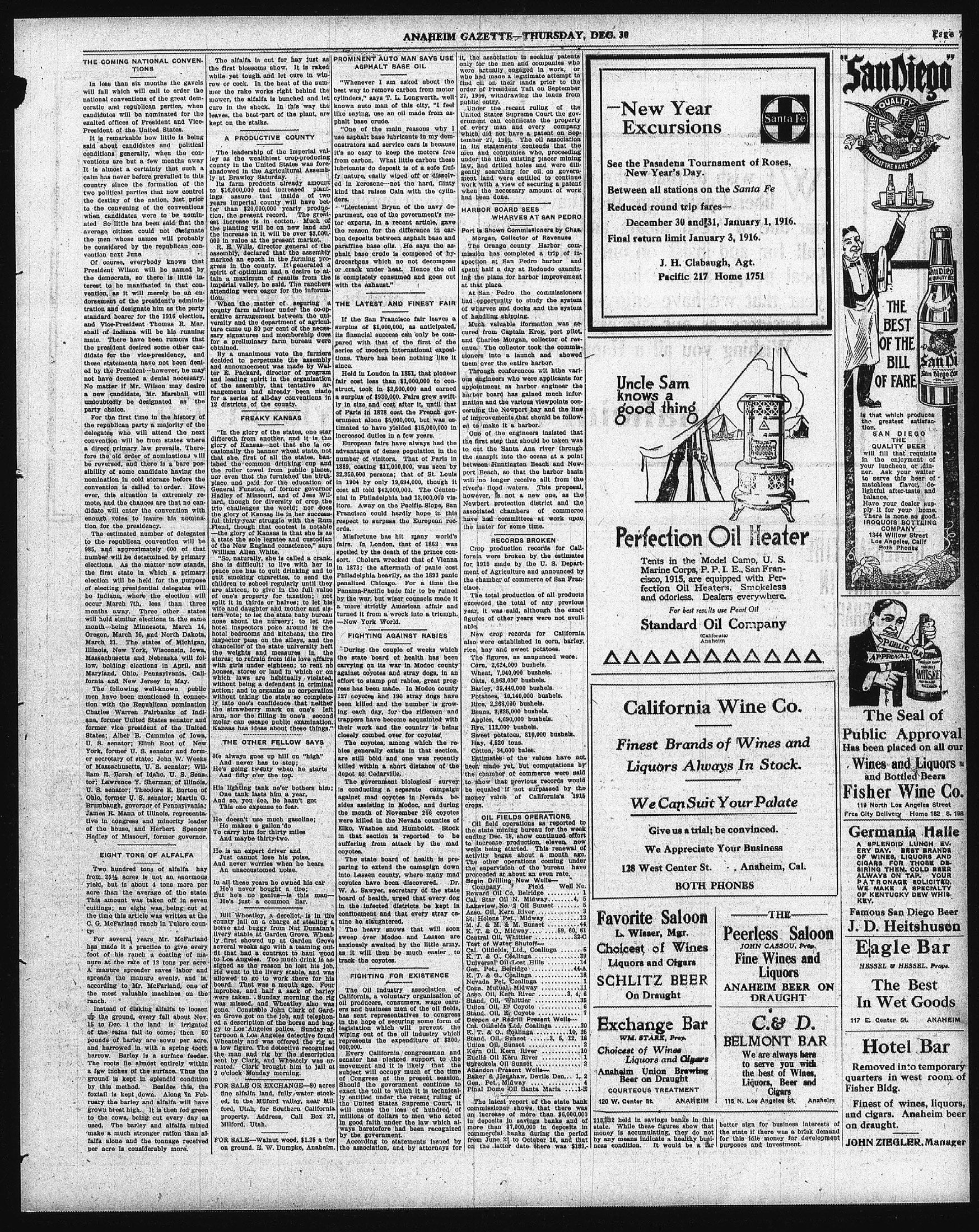
Searchable text
THE COMING NATIONAL CONVENTIONS
In less than six months the gavels will fall which will call to order the national conventions of the great democratic and republican parties, when candidates will be nominated for the exalted offices of President and Vice-President of the United States.
It is remarkable how little is being said about candidates and political conditions generally, when the conventions are but a few months away. It is almost a certainty that such a calm has never before prevailed in this country since the formation of the two political parties that now control the destiny of the nation, just prior to the convening of the conventions when candidates were to be nominated. So little has been said that the average citizen could not designate the men whose names will probably be considered by the republican convention next June.
Of course, everybody knows that President Wilson will be named by the democrats, so there is little interest to be manifested in that convention, as it will merely be an endorsement of the president's administration and designate him as the party standard bearer for the 1916 election, and Vice-President Thomas R. Marshall of Indiana will be his running mate. There have been rumors that the president desired some other candidate for the vice-presidency, and these statements have not been denied by the President—however, he may not have deemed a denial necessary. No matter if Mr. Wilson may desire a new candidate, Mr. Marshall will undoubtedly be designated as the party choice.
For the first time in the history of the republican party a majority of the delegates who will attend the next convention will be from states where a direct primary law prevails. Therefore the old order of nominations will
The alfalfa is cut for hay just as the first blossoms show. It is raked while yet tough and let cure in window or cock. In the heat of the summer the rake works right behind the mower, the alfalfa is bunched and let cure in the shock. In this way the leaves, the best part of the plant, are kept on the stalks.
A PRODUCTIVE COUNTY
The leadership of the Imperial valley as the wealthiest crop-producing county in the United States was foreshadowed in the Agricultural Assembly at Brawley Saturday.
Its farm products already amount to $16,000,000 and increased plantings assure that inside of two years Imperial county will have better than $20,000,000 yearly production, the present record. The greatest increase is in cotton. Much of the planting will be on new land and the increase in it will be over $3,000,000 in value at the present market.
R. E. Wills, director general of the assembly, declared that the assembly marked an epoch in the farming progress in the county. It generated a spirit of optimism and a desire to attain a maximum of results from the Imperial valley, he said. The ranchers attending were eager for the information.
When the matter of securing a county farm adviser under the cooperative arrangement between the university and the department of agriculture came up 80 per cent of the necessary signatures and membership dues for a preliminary farm bureau were obtained.
By a unanimous vote the farmers decided to perpetuate the assembly and announcement was made by Walter E. Packard, director of program and leading spirit in the organization of the assembly, that tentative arrangements had already been made for a series of all-day conventions in 12 districts of the county.
FREAKY KANSAS
"In the glory of the states, one star differeth from another, and it is the glory of Kansas—not that she is occasionally the banner wheat state, not that she, first of all the states, ban-
FREAKY KANSAS
"In the glory of the states, one star differeth from another, and it is the glory of Kansas—not that she is occasionally the banner wheat state, not that she, first of all the states, banished the common drinking cup and the roller towel from public places, nor even that the furnished the birthplace and paid for the education of General Funston, of former governor Hadley of Missouri, and of Jess Willard, though for diversity of crop the trio challenges the world; nor does the glory of Kansas lie in her successful thirty-year struggle with the Rum Flend, though that contest is notable—the glory of Kansas is that she is as a state the sole legatee and custodian of the New England conscience," says William Allen White.
"So, naturally, she is called a crank. She is difficult: to live with her in peace one has to quit drinking and to quit smoking cigarettes, to send the children to school regularly until they are sixteen, to give in the full value of one's property for taxation; not split it in thirds or halves; to let his wife and daughter and mother and sisters vote; to let the state baby bureau nose about the nursery; to let the hotel inspectors poke around in the hotel bedrooms and kitchens, the fire inspector pass on the alloys, and the chancellor of the state university heft the weights and measures in the stores; to refrain from idle love affairs with girls under eighteen; to rent no houses, stores or land in which or on which laws are habitually violated, without being a defendant in criminal action; and to organize no corporation without taking the state so completely into one's confidence that neither the strawberry mark on one's left arm, nor the filling in one's second molar can escape public examination. Kansas has ideas about these things."
THE OTHER FELLOW SAYS
He always goes up hill on "high"
And never has to stop;
He's going twenty when he starts
And fifty o'er the top.
His lighting tank ne'er bothers him;
One tank lasts him a year,
And so, you see, he hasn't got
This one expense to fear.
He doesn't use much gasoline;
He makes a gallon do
To carry him for thirty miles
And maybe thirty-two.
He is an expert driver and
Just cannot lose his police,
And never worries when he hears
An unaccustomed noise.
EIGHT TONS OF ALFALFA
Two hundred tons of alfalfa hay
EIGHT TONS OF ALFALFA
Two hundred tons of alfalfa hay from 25½ acres is not an enormous yield, but is about 4 tons more per acre than the average of the state. This amount was taken off in seven cuttings; an eight was being cut at the time this article was written at the C. G. McFarland ranch in Tulare county.
For several years Mr. McFarland has made it a practice to give every foot of his ranch a coating of manure at the rate of 12 tons per acre. A manure spreader saves labor and spreads the manure evenly, and is, according to Mr. McFarland, one of the most valuable machines on the ranch.
Instead of disking alfalfa to loosen up the ground, every fall about Nov. 15 to Dec. 1 the land is irrigated of the rains fall to come; then 50 pounds of barley are sown per acre, and harrowed in with a spring tooth harrow. Barley is a surface feeder. The roots lie almost entirely within a few inches of the surface. Thus the ground is kept in splendid condition by this method. Besides this, the foxtail is kept down. Along in February the barley and alfalfa will have grown breast high. It is then fed green to the cows, being cut every day as used. The barley and alfalfa mixed make a much stronger ration than alfalfa alone and the tonnage received per acre is considerably more.
His lighting tank ne'er bothers him; One tank lasts him a year, And so, you see, He hasn't got This one expense to fear.
He doesn't use much gasoline; He makes a gallon do To carry him for thirty miles And maybe thirty-two.
He is an expert driver and Just cannot lose his poise, And never worries when he hears An unaccustomed noise.
In all these years he owned his car He's never bought a tire; But he's no genius—is this man—He's just a common liar.
Bill Wheatley, a derelict, is in the county jail on a charge of stealing a horse and buggy from Nat Dunatain's livery stable at Garden Grove. Wheatly first showed up at Garden Grove several weeks ago with a teaming outfit that had a contract to haul wood to Los Angeles. Too much drink is assigned as the reason he lost his job. He went to the livery stable, and was allowed to go to work there for his board. That was a month ago. Four laprobes, and half a sack of barley were taken. Sunday morning the rig was missed, and Wheatley also was gone. Constable John Clark of Garden Grove got on the job, and telephoned a description of the horse and buggy to Los Angeles police. Sunday afternoon a Los Angeles detective found Wheatley and was offered the rig at a low figure. The detective recognized the man and rig by the description sent by Clark, and Wheatley was arrested. Clark brought him to jail at 2 o'clock Monday morning.
FOR SALE OR EXCHANGE—80 acres fine alfalfa land, fully water stocked, in the Milford valley, near Milford, Utah, for Southern California property. Address: Call Box 27, Milford, Utah.
FOR SALE—Walnut wood, $1.25 a tier on ground. E. W. Dumpke, Anaheim.
PROMINENT AUTO MAN SAYS USE ASPHALT BASE OIL
"Whenever I am asked about the best way to remove carbon from motor cylinders," says T. L. Longworth, well-known auto man of this city, "I feel like saying, use an oil made from asphalt base crude.
"One of the main reasons why I use asphalt base lubricants in my demonstrators and service cars is because it's so easy to keep the motors free from carbon. What little carbon these lubricants do deposit is of a sofe fluffy nature, easily wiped off or dissolved in kerosene—not the hard, flinty kind that raises Cain with the cylinders.
"Lieutenant Bryan of the navy department, one of the government's motor exports, in a recent article, gave the reason for the difference in carbon deposits between asphalt base and paraffine base oils. He says the asphalt base crude is composed of hydrocarbons which no not decompose or crack under heat. Hence the oil is completely consumed and goes out with the exhaust."
THE LATEST AND FINEST FAIR
If the San Francisco fair leaves a surplus of $1,000,000, as anticipated, its financial success can only be compared with that of the first of the series of modern international expositions. There has been nothing like it since.
Held in London in 1851, that pioneer fair cost less than $1,000,000 to construct, took in $2,500,000 and earned a surplus of $930,000. Fairs grew swiftly in size and cost after it, until that of Paris in 1878 cost the French government alone $5,000,000, but was estimated to have yielded $15,000,000 in increased duties in a few years.
European fairs have always had the advantages of dense population in the number of visitors. That of Paris in it, the association is seeking patents only for the men and companies who were actually engaged in work, or who had made a legitimate attempt to find oil on their lands prior to the order of President Taft on September 27, 1999, withdrawing the lands from public entry.
Under the recent ruling of the United States Supreme Court the government can confiscate the property of every man and every company which did not have a patent on September 27, 1999. The oil association in its statements contends that the men and companies who proceed under the then existing placer mining law, had drilled holes and were diligently searching for oil on government land were entitled to continue work with a view of securing a patent when the necessary amount of work had been done.
HARBOR BOARD SEES
WHARVES AT SAN PEDRO
Port is Shown Commissioners by Chas.
Morgan, Collector of Revenues
The Orange county Harbor commission has completed a trip of inspection at San Pedro harbor and spent half a day at Redondo examining the plans for harbor improvement at that place.
At San Pedro the commissioners had opportunity to study the system of wharves and docks and the system of handling shipping.
Much valuable information was secured from Captain Krog, port pilot, and Charles Morgan, collector of revenue. The collector took the commissioners into a launch and showed them over the entire harbor.
Through conferences wit hthe various engineers who were applicants for appointment as harbor engineer the harber board has gained much information and the various viewpoints concerning the Newport bay and the line of improvements that should be followed to make it a harbor.
One of the engineers insisted that the first step that should be taken was to cut the Santa Ana river through the sanspit into the ocean at a point...
Held in London in 1851, that pioneer fair cost less than $1,000,000 to construct, took in $2,500,000 and earned a surplus of $930,000. Fairs grew swiftly in size and cost after it, until that of Paris in 1878 cost the French government alone $5,000,000, but was estimated to have yielded $15,000,000 in increased duties in a few years.
European fairs have always had the advantages of dense population in the number of visitors. That of Paris in 1889, costing $11,000,000, was seen by 32,350,000 persons; that of St. Louis in 1904 by only 19,694,000, though it cost all told $42,000,000. The Centennial in Philadelphia had 13,000,000 visitors. Away on the Pacific Slope, San Francisco could hardly hope in this respect to surpass the European records.
Misfortune has hit many world's fairs. In London, that of 1862 was spolled by the death of the prince consort. Cholera wrecked that of Vienna in 1873; the aftermath of panic cost Philadelphia heavily, as the 1893 panic penalized Chicago. For a time the Panama-Pacific bade fair to be ruined by the war, but wiser counsels made it a more strictly American affair and turned it from a wreck into a triumph.—New York World.
FIGHTING AGAINST RABIES
During the couple of weeks which the state board of health has been carrying on its war in Modoc county against coyotes and stray dogs, in an effort to stamp out rabies, great progress has been made. In Modoc county 127 coyotes and 190 stray dogs have been killed and the number is growing each day, for the riflemen and trappers have become acquainted with their work and the country is being closely combed over for coyotes.
The coyotes, among which the rebies generally exists in that section, are still bold and one was recently killed within a short distance of the depot at Cedarville.
The government biological survey is conducting a separate campaign against mad coyotes in Nevada besides assisting in Modoc, and during the month of November 266 coyotes were killed in the Nevada counties of Elko, Washoe and Humboldt. Stock in that section is reported to be suffering from attack by the mad coyotes.
The state board of health is preparing to extend the camapign down them over the entire harbor.
Through conferences wit hthe various engineers who were applicants for appointment as harbor engineer the harber board has gained much information and the various viewpoints concerning the Newport bay and the line of improvements that should be followed to make it a harbor.
One of the engineers insisted that the first step that should be taken was to cut the Santa Ana river through the sanspit into the ocean at a point between Huntington Beach and Newport Beach, so that the harbor basin will no longer receive silt from the river's flood waters. This proposal, however, is not a new one, as the Newbert protection district and the associated chambers of commerce have had committees at work upon the matter for some time.
RECORDS BROKEN
Crop production records for California were broken by the estimates for 1915 made by the U.S. Department of Agriculture and announced by the chamber of commerce of San Francisco.
The total production of all products exceeded the total of any previous year. It was said, although the exact figures of other years were not available.
New crop records for California also were established in corn, barley, rice hay and sweet potatoes.
The figures, as announced were:
Corn, 2,624,000 bushels.
Wheat, 7,040,000 bushels.
Oats, 6,963,000 bushels.
Barley, 39,440,000 bushels.
Potatoes, 10,140,000 bushels.
Rice, 2,268,000 bushels.
Beans, 3,825,000 bushels.
Apples, 4,690,000 bushels.
Rye, 112,000 bushels.
Sweet potatoes, 810,000 bushels.
Hay, 4,520 tons.
Cotton, 34,000 bales.
Estimates of the values have not been made yet, but computations by the chamber of commerce were said to show that previous records would be equaled if not surpassed by the money value of California's 1915 crops.
OIL FIELDS OPERATIONS
Oil field operations as reported to the state mining bureau for the week ending Dec. 18, show continued effort to increase production, eleven new wells being started. This renewal of activity began about a month ago. The other operations coming under the supervision of the bureau have...
The government biological survey is conducting a separate campaign against mad coyotes in Nevada besides assisting in Modoc, and during the month of November 266 coyotes were killed in the Nevada counties of Elko, Washoe and Humboldt. Stock in that section is reported to be suffering from attack by the mad coyotes.
The state board of health is preparing to extend the campaign down into Lassen county, where many mad coyotes have been discovered. Dr. W. A. Sawyer, secretary of the state board of health, urged that every dog in the infected districts be kept in confinement and that every stray canine be slaughtered.
The heavy snows that will soon sweep over Modoo and Lassen are anxiously awaited by the little army, as it will then be much easier to track the coyotes.
FIGHTING FOR EXISTENCE
The Oil Industry association of California, a voluntary organization of oil producers, consumers, wage earners and business men of the oil fields, has sent representatives to congress in the hope of securing some form of legislation which will prevent the wiping out of the oil industry which represents the expenditure of $300,000,000.
Every California congressman and senator has pledged support to the movement and it is likely that the subject will occupy much of the time of Congress at the present session. Should the government continue to exact the toll to which it is technically entitled under the recent ruling of the United States Supreme Court, it will cause the loss of hundred of millions of dollars to men who acted in good faith under the law which always heretofore had been recognized by the government.
According to statements issued by the association, and by attorneys for
OIL FIELDS OPERATIONS
Oil field operations as reported to the state mining bureau for the week ending Dec. 18, show continued effort to increase production, eleven new wells being started. This renewal of activity began about a month ago. The other operations coming under the supervision of the bureau have proceeded at about an even rate.
Begin Drilling New Wells—Company Field Well No.
Reward Oil Co. Belridge ... 1
Cal. Star Oil N. Midway ... 4, 5
Lakeview No. 2 Oil Sunset ... 5
Assc. Oil, Kern River ... 3
St. Helens Pet., Midway ... 12
M. J. & M. & M. Sunset ... 44
K. T. & O., Midway ... 59, 60, 61
Central Oil, Whittier ... 32-C
Test of Water Shutoff—Cal. Oilfields, Ltd., Coaliga ... 5
K. T. & O., Coaliga ... 29
Universal Oil Lost Hills ... 14
Gen. Pet., Belridge ... 44-A
K. T. & O., Coaliga ... 18
Nevada Pet., Coaliga ... 1
Cons. Mutual, Midway ... 11
Assc. Oil, Kern River ... 3, 4, 6
Stand, Oil, Whittier ... 35
Union Oil, E. Coyote ... 6
Stand, Oil, E. Coyote ... 7
Deepen or Redrill Present Wells—Cal. Oilfields Ltd., Coaliga ... 20
K. T. & O., Coaliga ... 10, 25
Stand, Oil Sunset ... 3, 5, 12, 18
Union Oil Sunset ... 2
Kern Oil Kern River ... 10
Eucldl Oil Kern River ... 1
Spreckels Oil Sunset ... 2
Anandon Present Wells—Baker & Henshaw, Devils Den,... 1, 2
Gen. Pet., Midway ... 4
Pinal Dome Oil Santa Marla ... 1-E
The latest report of the state bank commissioner shows that there was an increase of more than $6,000,000 in deposits in savings banks and of more than $7,000,000 in commercial banks during the period from June 22 to October 16, and that on the latter date there was $189,-
Favorite Saloon
L. Wisser, Mgr.
Choicest of Winery
Liquors and Oligars
SCHLITZ BELLE
On Draught
Exchange Bank
WM. STARK, Prop.
Choicest of Wines
Liquors and Oligars
Anaheim Union Brewery
Beer on Draught
COURTEOUS TREATMENTS
120 W. Center St.
ANAHEIM
215,332 held in savings banks state. While these figures show money is accumulating, they by any means indicate a health condition. It would be
-New Year Excursions
Santa Fe
see the Pasadena Tournament of Roses,
New Year's Day.
between all stations on the Santa Fe
reduced round trip fares—
December 30 and January 1, 1916.
final return limit January 3, 1916.
J. H. Clabaugh, Agt.
Pacific 217 Home 1751
Uncle Sam knows a good thing
"San Diego"
THE QUALITY BEER
ALL THAT THE NAME INFLUES
THE BEST OF THE BILL OF FARE
is that which produces
the greatest satisfaction.
SAN DIEGO
THE
QUALITY BEER
will fill that requalita
Uncle Sam knows a good thing
Perfection Oil Heater
Tents in the Model Camp, U. S.
Marine Corps, P. P. I. E., San Francisco, 1915, are equipped with Perfection Oil Heaters. Smokeless and odorless. Dealers everywhere.
For best results use Pearl Oil
Standard Oil Company
(California) Anaheim
California Wine Co.
Finest Brands of Wines and Liquors Always In Stock.
We Can Suit Your Palate
Give us a trial; be convinced.
We Appreciate Your Business
128 West Center St. Anaheim, Cal.
DILL OF FARE
is that which produces the greatest satisfaction.
SAN DIEGO
THE QUALITY BEER
will fill that requisite in the enjoyment of your luncheon or dinner. Ask your waiter to serve this beer of matchless flavor, delightful after-taste and balance.
Have your dealer supply it for your home. There is none so good.
IROQUOIS BOTTLING COMPANY
1344 Willow Street Los Angeles, Calif
Both Phones
The Seal of Public Approval
Has been placed on all our Wines and Liquors and Bottled Beers
Fisher Wine Co.
119 North Los Angeles Street Free City Delivery Home 182 S. 198
Germania Halle
A SPLENDID LUNCH EVERY DAY. BEST BRANDS OF WINES, LIQUORS AND CIGARS FOR THOSE DE-SIRING THEM. GOLD BEER
We Can Suit Your Palate
Give us a trial; be convinced.
We Appreciate Your Business
128 West Center St. Anaheim, Cal.
BOTH PHONES
Favorite Saloon
L. Wisser, Mgr.
Oleest of Wines
Liquors and Cigars
HLITZ BEER
On Draught
Exchange Bar
WM. STARK, Prop.
Oleest of Wines
Liquors and Cigars
Heim Union Brewing
Beer on Draught
OURTEOUS TREATMENT
N. Center St. Anaheim
THE
Peerless Saloon
JOHN CASSOU, Prop.
Fine Wines and Liquors
ANAHEIM BEER ON DRAUGHT
C. & D.
BELMONT BAR
We are always here to serve you with the best of Wines,
Liquors, Beer and Cigars
115 N. Los Angeles St. Anaheim
and Bottled Beers
Fisher Wine Co.
119 North Los Angeles Street
Free City Delivery Home 182 S. 198
Germania Halle
A splendid lunch every day. Best brands of wines, liquors and cigars for those desiring them. Cold beer always on tap. Your patronage solicited. We make a specialty of Kentucky dew whiskey.
Famous San Diego Beer
J. D. Heitshusen
Eagle Bar
HESSEL & HESSEL, Props.
The Best In Wet Goods
117 E. Center St. Anaheim
Hotel Bar
Removed into temporary quarters in west room of Fisher Bldg.
Finest of wines, liquors, and cigars. Anaheim beer on draught.
JOHN ZIEGLER, Manager