anaheim-gazette 1915-12-23
Scanned page
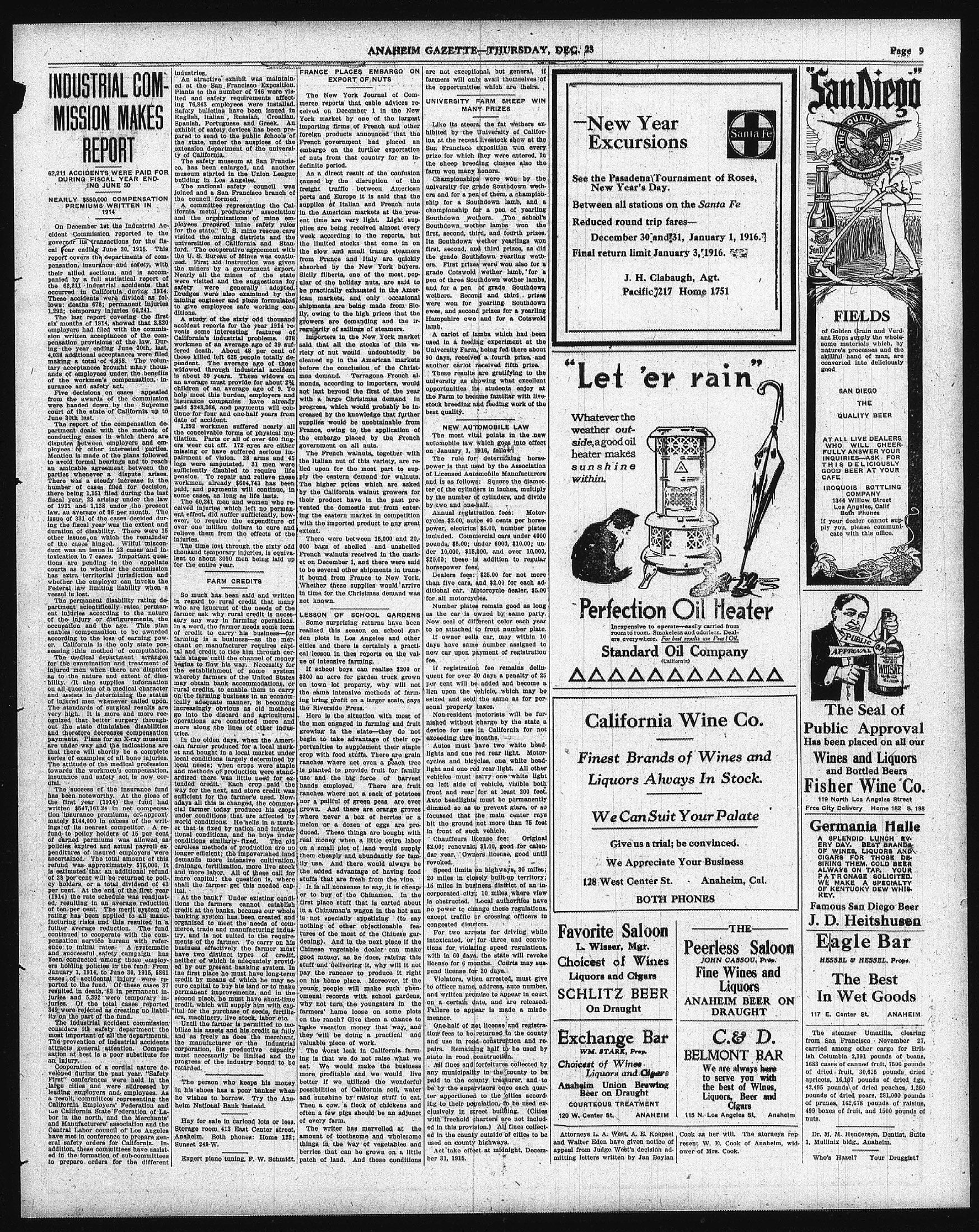
Searchable text
INDUSTRIAL COMMISSION MAKES REPORT
62,211 ACCIDENTS WERE PAID FOR DURING FISCAL YEAR ENDING JUNE 30
NEARLY $550,000 COMPENSATION PREMIUMS WRITTEN IN 1914
On December 1st the Industrial Accident Commission reported to the governor its transactions for the fiscal year ending June 30, 1915. This report covers the departments of compensation, insurance and safety, with their allied sections, and is accompanied by a full statistical report of the 62,211 industrial accidents that occurred in California during 1914. These accidents were divided as follows: deaths 678; permanent injuries 1,292; temporary injuries 60,241.
The last report covering the first six months of 1914, showed that 2,820 employers had filed with the commission written acceptances of the compensation provisions of the law. During the year ending June 30th, last, 4,038 additional acceptances were filed making a total of 6,858. The voluntary acceptances brought many thousands of employees under the benefits of the workmen's compensation, insurance and safety act.
Five decisions on cases appealed from the awards of the commission were handed down by the Supreme court of the state of California up to June 30th last.
The report of the compensation department deals with the methods of conducting cases in which there are disputes between employers and employees or other interested parties. Mention is made of the plans followed industrials.
An attractive exhibit was maintained at the San Francisco Exposition. Plants to the number of 746 were visited and safety requirements affecting 76,843 employees were installed. Safety bulletins have been issued in English, Italian, Russian, Croatian, Spanish, Portuguese and Greek. An exhibit of safety devices has been prepared to send to the public schools of the state, under the auspices of the extension department of the university of California.
The safety museum at San Francisco, has been enlarged, and another museum started in the Union League building in Los Angeles.
The national safety council was joined and a San Francisco branch of the council formed.
A committee representing the California metal producers' association and the organizations of mine employees prepared mine safety rules for the state. U.S. mine rescue cars visited the mining districts and the universities of California and Stanford. The cooperative agreement with the U.S. Bureau of Mines was continued. First aid instruction was given by the miners by a government expert. Nearly all the mines of the state were visited and the suggestions for safety were generally adopted. Dredges were also examined by the mining engineer and plans formulated to give employees safe working conditions.
A study of the sixty odd thousand accident reports for the year 1914 reveals some interesting features of California's industrial problems. 678 workers of an average age of 39 suffered death. About 48 per cent of those killed left 625 people totally dependent. The average age of those widowed through industrial accident is about 39 years. These widows on an average must provide for about 2½ children of an average age of 9. To help meet this burden, employers and insurance companies have already paid $243,366, and payments will continue for four and one-half years from date of accident.
1,292 workmen suffered nearly all the conceivable forms of physical mutilation. Parts or all of over 600 fingers weer cut off. 172 eyes are either missing or have suffered serious impairment of vision. 28 arms and 45 industries.
FRANCE PLACES EXPORT OF
The New York Mercury reports that a cargo arrived on December 1st in York market by one importing firm of foreign products and French government embargo on the funeral period.
As a direct result caused by the disaffect traffic between ports and Europe it supplies of Italian oil in the American mankind time are very low. Plies are being received week according to the limited stocks to slow and small from France and Italy absorbed by the Nicilly filberts, one ocular of the holiday be practically exhausted in Iran markets, and shipments are being owing to the highest growers are demanding regularity of sailings.
Importers in the New York said that all the sturdy of nut would be cleaned up in the Abyssinian before the conclusion mas demand. Tariffs monds, according to not last beyond the end with a large Christmas progress, which would increase by the known supplies would be used France, owing to that the embargo placed government on all railways.
The report of the compensation department deals with the methods of conducting cases in which there are disputes between employers and employees or other interested parties. Mention is made of the plans followed to avoid formal hearings and to reach an amicable agreement between the parties whenever a dispute arises. There was a steady increase in the number of cases filed for decision, there being 1,151 filed during the last fiscal year, 23 arising under the law of 1911 and 1,128 under the present law, an average of 96 per month. The issue of 331 of the cases decided during the fiscal year was the extent and duration of disability. There were 15 other issues on which the remainder of the cases hinged. Wilful misconduct was an issue in 23 cases and intoxication in 7 cases. Important questions are pending in the appellate courts as to whether the commission has extra territorial jurisdiction and whether the employer can invoke the Federal law limiting liability when a vessel is lost.
The permanent disability rating department scientifically rates permanent injuries according to the nature of the injury or disfigurements, the occupation and the age. This plan enables compensation to be awarded according to the loss of earning power. California is the only state possessing this method of computation.
The medical department arranges for the examination and treatment of injured men when there are disputes as to the nature and extent of disability. It also supplies information on all questions of a medical character and assists in determining the status of injured men whenever called upon. The standards of surgical results are very high. It is more and more recognized that better surgery throughout the state diminishes disabilities and therefore decreases compensation payments. Plans for an X-ray museum are under way and the indications are that there will shortly be a complete series of examples of all bone injuries. The attitude of the medical profession towards the workmen's compensation, insurance and safety act is now cordial.
The success of the insurance fund has been noteworthy. At the close of the first year (1914) the fund had written $547,161.24 in net compensation insurance premiums, or approximately $144,000 in excess of the writings of its nearest competitor. A refund to policy holders of 15 per cent of earned permiums was allowed as policies expired and actual payroll expenditures of insured employers were ascertained. The total amount of this refund was approximately $75,000. It is estimated that a total of 39 years. These widows on an average must provide for about 2½ children of an average age of 9. To help meet this burden, employers and insurance companies have already paid $243,366, and payments will continue for four and one-half years from date of accident.
1,292 workmen suffered nearly all the conceivable forms of physical mutilation. Parts or all of over 600 fingers wee cut off. 172 eyes are either missing or have suffered serious impairment of vision. 28 arms and 45 legs were amputated. 31 men were sufficiently disabled to require life pension. To repair and relieve these workmen, already $604,743 has been paid, and payments will continue, in some cases, as long as life lasts.
The 60,241 men and women who received injuries which left no permanent effect, did suffer sufficiently, however, to require the expenditure of over one million dollars to cure and relieve them from the effects of the injuries.
The time lost through the sixty odd thousand temporary injuries, is equivalent to about 3000 men being laid up for the entire year.
FARM CREDITS
So much has been said and written in regard to rural credit that many who are ignorant of the needs of the farmer ask why rural credit is necessary any way in farming operations. In a word, the farmer needs some form of credit to carry his business—for farming is a business—as the merchant or manufacturer requires capital and credit to tide him through certain stages until the channel of money begins to flow his way. Necessity for the establishment of some system whereby farmers of the United States may obtain bank accommodations, or rural credits, to enable them to carry on the farming business in an economically adequate manner, is becoming increasingly obvious as old methods go into the discard and agricultural operations are conducted more and more along the lines of other industries.
In the olden days, when the American farmer produced for a local market and bought in a local market under local conditions largely determined by local needs; when crops were staple and methods of production were standardized there was little need for extended credit. Each crop paid the way for the next, and store credit was sufficient for the farmer's need. Nowadays all this is changed, the commercial farmer today produces his crops under conditions that are affected by world conditions. He sells in a market that is fixed by nation and international conditions, and he buys under conditions similarly fixed. The old careless methods of production are no longer efficient; the impoverished land demands more intensive cultivation, drainage, fertilization, more live stock dependent on industrial accidents.
The average age of those widowed through industrial accident is about 39 years. These widows on an average must provide for about 2½ children of an average age of 9. To help meet this burden, employers and insurance companies have already paid $243,366, and payments will continue for four and one-half years from date of accident.
1,292 workmen suffered nearly all the conceivable forms of physical mutilation. Parts or all of over 600 fingers wee cut off. 172 eyes are either missing or have suffered serious impairment of vision. 28 arms and 45 legs were amputated. 31 men were sufficiently disabled to require life pension. To repair and relieve these workmen, already $604,743 has been paid, and payments will continue, in some cases, as long as life lasts.
The 60,241 men and women who received injuries which left no permanent effect, did suffer sufficiently, however, to require the expenditure of over one million dollars to cure and relieve them from the effects of the injuries.
The time lost through the sixty odd thousand temporary injuries, is equivalent to about 3000 men being laid up for the entire year.
LESSON OF SCHOOL
Some surprising realizations this season den plots in Los Angeles cities and there is no cal lesson in these re-use of intensive farming.
If school boys can earn $300 an acre for grapes on town lot properties the same intensive bring profit on at the Riverside Press.
Here is the situation: the men engaged in growing in the state begin to take advantage portentities to supply crop with food stuffs ranches where not even is planted to provide use and the big fox hands employed ranches where not nor a pailful of green grown. And there are where never a box melon or a dozen reduced. These things real money when asked on a small plot of land them cheaply and ably use. And there
The success of the insurance fund has been noteworthy. At the close of the first year (1914) the fund had written $547,161.24 in net compensation insurance premiums, or approximately $144,000 in excess of the writings of its nearest competitor. A refund to policy holders of 15 per cent of earned premiums was allowed as policies expired and actual payroll expenditures of insured employers were ascertained. The total amount of this refund was approximately $75,000. It is estimated that an additional refund of 28 per cent will be returned to policy holders, or a total dividend of 43 per cent. At the end of the first year (1914) the rate schedule was readjusted, resulting in an average reduction of ten per cent. The merit system of rating has been applied to all manufacturing risks and this resulted in a further average reduction. The fund continued to cooperate with the compensation service bureau with reference to initial rates. A systematic and successful safety campaign has been conducted among those employers holding policies in the fund. From January 1, 1914, to June 30, 1915, 5861 cases of accidental injury were reported to the fund. Of these cases 37 resulted in death, 83 in permanent injuries and 5,392 were temporary injuries. Of the total cases reported 349 were rejected as creating no liability on the part of the fund.
The industrial accident commission considers its safety department the most important of all the departments. The prevention of industrial accidents attracts general attention. Compensation at best is a poor substitute for an injury.
Cooperation of a cordial nature developed during the past year. "Safety First" conferences were held in the large cities and were addressed by leading employers and employees. As a result, committees representing the California Employers' Federation and the California State Federation of Labor in the north, and the Merchants' and Manufacturers' association and the Central Labor council of Los Angeles have met in conference to prepare general safety orders for California. In addition, these committees have assisted in the formation of sub-committees to prepare orders for the different
At the bank? Under existing conditions the farmers cannot establish credit at the banks, because our whole banking system has been created and organized to meet the needs of commerce, trade and manufacturing industry, and is not suited to the requirements of the farmer. To carry on his business effectively the farmer must have two distinct types of credit, neither of which is adequately provided by our present banking system. In the first place he must have long-term credit by means of which he may secure capital to buy his land or to make permanent improvements, and in the second place, he must have short-time credit, which will supply him with capital for the purchase of seeds, fertilizers, machinery, live stock, labor etc.
Until the farmer is permitted to mobilize his assets and his credit as fully and as freely as does the merchant, the manufacturer or the industrial corporation, his productive capacity must necessarily be limited and the progress of the industry bound to be retarded.
The person who keeps his money in his shoes has a poor banker when he wishes to borrow. Try the Anaheim National Bank instead.
Hay for sale in carload lots or less. Storage room 413 East Center street, Anaheim. Both phones: Home 123; Sunset 249-W.
Expert piano tuning, F. W. Schmidt.
Use and the big font hands employed. Ranches where not a nor a painful of greedy grown. And there are where never a box melon or a dozen ceduce. These things real money when taken on a small plot of land them cheaply and ably use. And there are the added advantage stuffs that are fresh.
It is all nonsense thereto buy of the C.C.'first place stuff than in a Chinaman's wage is not specially app nothing of other ol' dening). And in the Chinese vegetable good money, as he stuff and delivering pay the rancor to on his home place. Young people will no omenal records with why not turn the ye farmers' hame loosen on the ranch? Give make vacation money they will be doing valuable piece of weat.
The worst leak ing is that we do not eat. We would more profitable and better if we utilized possibilities of Californias sunshine by raining Then a cow, a flock often a few pigs shoot of every farm.
The writer has no amount of toothsome things in the way berries that can be patch of land. And
FRANCE PLACES EMBARGO ON EXPORT OF NUTS
The New York Journal of Commerce reports that cable advices received on December 1 in the New York market by one of the largest importing firms of French and other foreign products announced that the French government had placed an embargo on the further exportation of nuts from that country for an indefinite period.
As a direct result of the confusion caused by the disruption of the freight traffic between American ports and Europe it is said that the supplies of Italian and French nuts in the American markets at the present time are very light. Light supplies are being received almost every week according to the reports, but the limited stocks that come in on the slow and small tramp steamers from France and Italy are quickly absorbed by the New York buyers. Sicily filiberts, one of the most popular of the holiday nuts, are said to be practically exhausted in the American markets, and only occasional shipments are being made from Sicily, owing to the high prices that the growers are demanding and the irregularity of sailings of steamers.
Importers in the New York market said that all the stocks of this variety of nut would undoubtedly be cleaned up in the American markets before the conclusion of the Christmas demand. Tarragona French almonds, according to importers, would not last beyond the first of the year with a large Christmas demand in progress, which would probably be increased by the knowledge that further supplies would be unobtainable from France, owing to the application of the embargo placed by the French government on all nuts.
The French walnuts, together with are not exceptional, but general, if farmers will only avail themselves of the opportunities which are theirs.
UNIVERSITY FARM SHEEP WIN MANY PRIZES
Like its steers, the fat wethers exhibited by the University of California at the recent livestock show at the San Francisco exposition won every prize for which they were entered. In the sheep breeding classes also the farm won many honors.
Championships were won by the university for grade Southdown wethers and for a pen of them, a championship for a Southdown lamb, and a championship for a pen of yearling Southdown wethers. The school's Southdown wetter lambs won the first, second, third, and fourth prizes. Its Southdown wetter yearlings won first, second, and third prizes, as did the grade Southdown yearling wetthers. First prizes were won also for a grade Cotswold wetter lamb, for a pen of three Southdown wetter lambs, and for a pen of grade Southdown wetters. Second and third prizes were won for yearling Southdown ewes, and second prizes for a yearling Hampshire ewe and for a Cotswold lamb.
A carlot of lambs which had been used in a feeding experiment at the University Farm, being fed there about 90 days, received a fourth prize, and another carlot received fifth prize.
These results are gratifying to the university as showing what excellent opportunities its students enjoy at the Farm to become familiar with livestock breeding and feeding work of the best quality.
NEW AUTOMOBILE LAW
The most vital points in the new automobile law which goes into effect on January 1, 1916, follow:
The rule for determining horse-
before the conclusion of the Christmas demand. Tarragona French almonds, according to importers, would not last beyond the first of the year with a large Christmas demand in progress, which would probably be increased by the knowledge that further supplies would be unobtainable from France, owing to the application of the embargo placed by the French government on all nuts.
The French walnuts, together with the Italian nut of this variety, are relied upon for the most part to supply the eastern demand for walnuts. The higher prices which are asked by the California walnut growers for their product have in the past prevented the domestic nut from entering the eastern market in competition with the imported product to any great extent.
There were between 15,000 and 20,000 bags of shelled and unshelled French walnuts received in the market on December 1, and there were said to be several other shipments in transit bound from France to New York. Whether these supplies would arrive in time for the Christmas demand was not known.
LESSON OF SCHOOL GARDENS
Some surprising returns have been realized this season on school garden plots in Los Angeles and other cities and there is certainly a practical lesson in these reports on the value of intensive farming.
If school boys can realize $200 or $300 an acre for garden truck grown on town lot property, why will not the same intensive methods of farming bring profit on a larger scale, says the Riverside Press.
Here is the situation with most of the men engaged in farming and fruit growing in the state—they do not begin to take advantage of their opportunities to supplement their staple crop with food stuffs. There are grain ranches where not even a peach tree is planted to provide fruit for family use and the big force of harvest hands employed. There are fruit ranches where not a sack of potatoes nor a pallful of green peas are ever grown. And there are orange groves where never a box of berries or a melon or a dozen of eggs are produced. These things are bought with real money when a little extra labor on a small plot of land would supply them cheaply and abundantly for family use. And there would always be another carlot received fifth prize.
These results are gratifying to the university as showing what excellent opportunities its students enjoy at the Farm to become familiar with livestock breeding and feeding work of the best quality.
NEW AUTOMOBILE LAW
The most vital points in the new automobile law which goes into effect on January 1, 1916, follow:
The rule for determining horsepower is that used by the Association of Licensed Automobile Manufacturers and is as follows: Square the diameter of the cylinders in inches, multiply by the number of cylinders, and divide by two and one-half.
Annual registration fees: Motorcycles $2.00, autos 40 cents per horsepower, electrics $5.00, number plates included. Commercial cars under 4000 pounds, $5.00; under 6000, $10.00; under 10,000, $15,000, and over 10,000, $20.00; these in addition to regular horsepower fees.
Dealers fees: $25.00 for not more than five cars, and $2.00 for each additional car. Motorcycle dealer, $5.00 for all motorcycles.
Number plates remain good as long as the car is owned by same party. New seal of different color each year to be attached to front number plate.
If owner sells car, may within 10 days have same number assigned to new car upon payment of registration fee.
If registration fee remains delinquent for over 30 days a penalty of 25 per cent will be added and become a lien upon the vehicle, which may be seized and sold the same as for personal property taxes.
Non-resident motorists will be furnished without charge by the state a device for use in California for not exceeding three months.
Autos must have two white headlights and one red rear light. Motorcycles and bicycles, one white headlight and one red rear light. All other vehicles must carry one white light on left side of vehicle, visible both front and rear for at least 200 feet. Auto headlights must be permanently dimmed so as to prevent glare, or so focussed that the main center rays hit the ground not more than 75 feet in front of such vehicle.
Chauffeurs license fee: Original $2.00; renewals $1.00, good for calendar year. Owners license, good until revoked.
Speed limits on highways: 30 miles
use and the big force of harvest hands employed. There are fruit ranches where not a sack of potatoes nor a pailful of green peas are ever grown. And there are orange groves where never a box of berries or a melon or a dozen of eggs are produced. These things are bought with real money when a little extra labor on a small plot of land would supply them cheaply and abundantly for family use. And there would always be the added advantage of having food stuffs that are fresh from the vine.
It is all nonsense to say, it is cheaper to buy of the Chinamen. In the first place stuff that is carted about in a Chinaman's wagon in the hot sun is not specially appetizing (to say nothing of other objectionable features of the most of the Chinese gardening). And in the next place if the Chinese vegetable dealer can make good money, as he does, raising this stuff and delivering it, why will it not pay the rancorer to produce it right on his home place. Moreover, if the young people will make such phenomenal records with school gardens, why not turn the youngsters in the farmers' hame loose on some plots on the ranch? Give them a chance to make vacation money that way, and they will be doing a practical and valuable piece of work.
The worst leak in California farming is that we do not raise what we eat. We would make the business more profitable and we would live better if we utilized the wonderful possibilities of California soil, water and sunshine by raising stuff to eat. Then a cow, a flock of chickens and often a few pigs should be an adjunct of every farm.
The writer has marvelled at the amount of toothsome and wholesome things in the way of vegetables and berries that can be grown on a little patch of land. And those conditions vehicles must carry one white light on left side of vehicle, visible both front and rear for at least 200 feet. Auto headlights must be permanently dimmed so as to prevent glare, or so focussed that the main center rays hit the ground not more than 75 feet in front of such vehicle.
Chauffeurs license fee: Original $2.00; renewals $1.00, good for calendar year. Owners license, good until revoked.
Speed limits on highways, 30 miles; 20 miles in closely built-up territory; 15 miles in business district of an incorporated city; 10 miles where view is obstructed. Local authorities have no power to change these regulations, except traffic or crossing officers in congested districts.
For two arrests for driving while intoxicated, or for three and convictions for violating speed regulations, with in 60 days, the state will revoke license for 6 months. Courts may suspend license for 30 days.
Violators, when arrested, must give to officer name, address, auto number, and written promise to appear in court on a certain date, and are released. Failure to appear is made a misdemeanor.
One-half of net license and registration fees to be returned to the county and use in road construction and repairs. Remaining half to be used by state in road construction.
All fines and forfeitures collected by any municipality in the county to be paid to the county treasurer, and to be by the supervisors once each quarter apportioned to the cities according to their population, to be used exclusively in street building. (Cities with freehold charters are not included in this provision.) All fines collected in the county outside of cities to be used on county highways.
Act take effect at midnight, December 31, 1915.
New Year
cursions
Pasadena Tournament of Roses,
Year's Day.
All stations on the Santa Fe
round trip fares—
November 30 and January 1, 1916.
Turn limit January 3, 1916.
J. H. Clabaugh, Agt.
Pacific]217 Home 1751
San Diego
THE QUALITY BEER
ALLIMATE THE NAME INHILES
FIELDS
of Golden Grain and Verdant Hops supply the wholesome materials which, by nature's processes and the skillful hand of man, are converted into deliciously good
SAN DIEGO
THE
QUALITY BEER
AT ALL LIVE DEALERS
WHO WILL CHEER-FULLY ANSWER YOUR INQUIRIES—ASK FOR
t 'er rain
er the
outood oil
makes
ine
Section Oil Heater
nexpensive to operate—easily carried from
room to room. Smokeless and odorless. Dealers everywhere. For best results use Pearl Oil.
Standard Oil Company
(California)
California Wine Co.
Best Brands of Wines and
Liquors Always In Stock.
We Can Suit Your Palate
Give us a trial; be convinced.
We Appreciate Your Business
converted into deliciously good
SAN DIEGO
THE
QUALITY BEER
AT ALL LIVE DEALERS
WHO WILL CHEERFULLY ANSWER YOUR
INQUIRIES—ASK. FOR
THIS DELICIOUSLY
GOOD BEER AT YOUR
CAFE
IROQUOIS BOTTLING COMPANY
1344 Willow Street
Los Angeles, Calif.
Both Phones
If your dealer cannot supply you, please communicate with this office.
The Seal of Public Approval
Has been placed on all our
Wines and Liquors
and Bottled Beers
Fisher Wine Co.
119 North Los Angeles Street
Free City Delivery Home 182 S. 198
Germania Halle
A SPLENDID LUNCH EVERY DAY. BEST BRANDS OF WINES, LIQUORS AND CIGARS FOR THOSE DESIRING THEM. COLD BEER ALWAYS ON TAP. YOUR
Fisher Wine Co.
119 North Los Angeles Street
Free City Delivery Home 182 S. 198
Germania Halle
A SPLENDID LUNCH EVEN DAY. BEST BRANDS OF WINES, LIQUORS AND CIGARS FOR THOSE DESIRED THEM. COLD BEER ALWAYS ON TAP. YOUR PATRONAGE SOLICITED. WE MAKE A SPECIALTY OF KENTUCKY DEW WHISKEY.
Famous San Diego Beer
J. D. Heitshusen
Eagle Bar
HESSEL & HESSEL, Props.
The Best In Wet Goods
117 E. Center St. ANAHEIM
The steamer Umatilla, clearing from San Francisco November 27, carried among other cargo for British Columbia 2,191 pounds of beans, 1683 cases of canned fruit, 7500 pounds of dried fruit, 30,625 pounds dried apricots, 16,107 pounds of dried figs, 42,495 pounds of dried peaches, 1,250 pounds of dried pears, 281,000 pounds of prunes, 162,678 pounds of raisins, 499 boxes of fruit, and 1500 pounds of nuts.
Dr. M. M. Henderson, Dentist, Suite 1, Mullinix bldg., Anaheim.
Who's Hazel? Your Druggist?