anaheim-gazette 1915-12-02
Scanned page
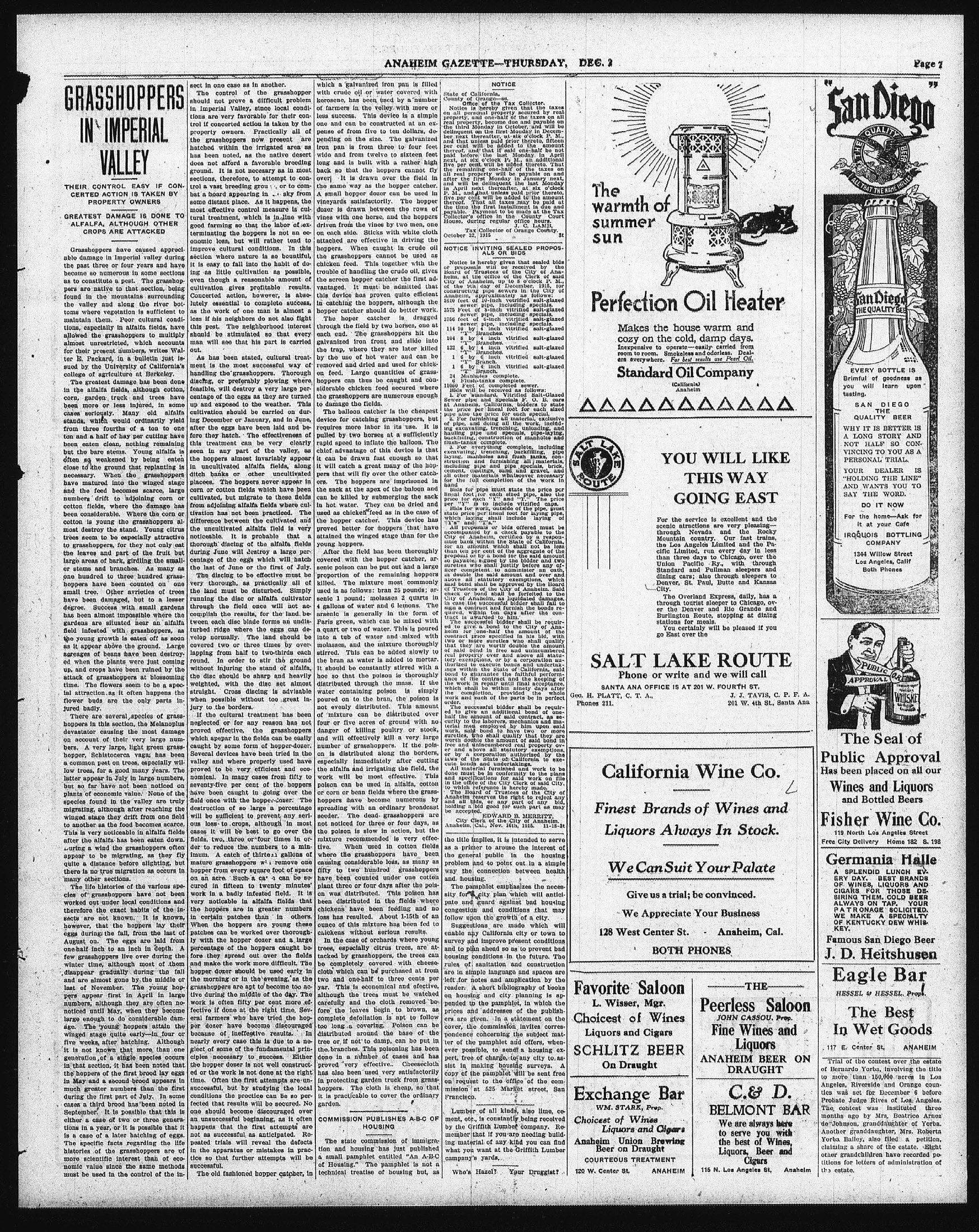
Searchable text
GRASSHOPPERS IN IMPERIAL VALLEY
THEIR CONTROL EASY IF CONCERTED ACTION IS TAKEN BY PROPERTY OWNERS
GREATEST DAMAGE IS DONE TO ALFALFA, ALTHOUGH OTHER CROPS ARE ATTACKED
Grasshoppers have caused appreciable damage in Imperial valley during the past three or four years and have become so numerous in some sections as to constitute a pest. The grasshoppers are native to that section, being found in the mountains surrounding the valley and along the river bottoms where vegetation is sufficient to maintain them. Poor cultural conditions, especially in alfalfa fields, have allowed the grasshoppers to multiply almost unrestricted, which accounts for their present numbers, writes Walter E. Packard, in a bulletin just issued by the University of California's college of agriculture at Berkeley.
The greatest damage has been done in the alfalfa fields, although cotton, corn, garden truck and trees have been more or less injured, in some cases seriously. Many old alfalfa stands, which would ordinarily yield from three fourths of a ton to one ton and a half of hay per cutting have been eaten clean, nothing remaining but the bare stems. Young alfalfa is often so weakened by being eaten sect in one case as in another.
The control of the grasshopper should not prove a difficult problem in Imperial Valley, since local conditions are very favorable for their control if concerted action is taken by the property owners. Practically all of the grasshoppers now present are hatched within the irrigated area as has been noted, as the native desert does not afford a favorable breeding ground. It is not necessary as in most sections, therefore, to attempt to control a vast breeding group, or to combat a hoard appearing in sky from some distant place. As it happens, the most effective control measure is cultural treatment, which is in line with good farming so that the labor of exterminating the hoppers is not an economic loss, but will rather tend to improve cultural conditions. In this section where nature is so bountiful, it is easy to fall into the habit of doing as little cultivation as possible, even though a reasonable amount of cultivation gives profitable results. Concerted action, however, is absolutely essential to complete success, as the work of one man is almost a loss if his neighbors do not also fight this pest. The neighborhood interest should be stimulated so that every man will see that his part is carried out.
As has been stated, cultural treatment is the most successful way of handling the grasshoppers. Thorough discling, or preferably plowing where feasible, will destroy a very large percentage of the eggs as they are turned up and exposed to the weather. This cultivation should be carried on during December or January, and in June, after the eggs have been laid and before they hatch. The effectiveness of this treatment can be very clearly seen in any part of the valley, as the hoppers almost invariably appear which a galvanized with crude oil has been of farmers in the less success. One and can be pence of from pending on the iron pan is free wide and from long and is bu back so that over! It is drie the same way A small hopper vineyards satisfy dozer is drawn vines with one driven from the on each side. S attached are e hopers. When the grasshopper chicken feed. T trouble of handling the screen hopper vantaged. It r this device has in catching tho hopper catcher.
The hopper through the field each end. The galvanized from the trap, where by the use of removed and dried feed. Large hoppers can ther siderable chicke the grasshopper to damage the f
The balloon o device for catch requires more pullled by two rapid speed to chief advantage it can be drawn
sued by the University of California's college of agriculture at Berkeley.
The greatest damage has been done in the alfalfa fields, although cotton, corn, garden truck and trees have been more or less injured, in some cases seriously. Many old alfalfa stands, which would ordinarily yield from three fourths of a ton to one ton and a half of hay per cutting have been eaten clean, nothing remaining but the bare stems. Young alfalfa is often so weakened by being eaten close to the ground that replanting is necessary. When the grasshoppers have matured into the winged stage and the feed becomes scarce, large numbers drift to adjoining corn or cotton fields, where the damage has been considerable. Where the corn or cotton is young the grasshoppers almost destroy the stand. Young citrus trees seem to be especially attractive to grasshoppers, for they not only eat the leaves and part of the fruit but large areas of bark, girdling the smaller stems and branches. As many as one hundred to three hundred grasshoppers have been counted on one small tree. Other avrieties of trees have been damaged, but to a lesser degree. Success with small gardens has been almost impossible where the gardens are situated near an alfalfa field infested with grasshoppers, as the young growth is eaten off as soon as it appear above the ground. Large aggregates of beans have been destroyed when the plants were just coming up, and crops have been ruined by the attack of grasshoppers at blossoming time. The flowers seem to be a special attraction as it often happens the flower buds are the only parts injured badly.
There are several species of grasshoppers in this section, the Melanoplus devastator causing the most damage on account of their very large numbers. A very large, light green grasshopper, Schistocerca vagna, has been a common pest on trees, especially willow trees, for a good many years. The latter appear in July in large numbers, but so far have not been noticed on plants of economic value. None of the species found in the valley are truly migrating, although after reaching the winged stage they drift from one field to another as the food becomes scarce. This is very noticeable in alfalfa fields after the alfalfa has been eaten down during a wind the grasshoppers often appear to be migrating, as they fly quite a distance before alighting, but there is no time migration as occurs in
ment is the most successful way of handling the grasshoppers. Thorough discing, or preferably plowing where feasible, will destroy a very large percentage of the eggs as they are turned up and exposed to the weather. This cultivation should be carried on during December or January, and in June, after the eggs have been laid and before they hatch. The effectiveness of this treatment can be very clearly seen in any part of the valley, as the hoppers almost invariably appear in uncultivated alfalfa fields, along ditch banks or other uncultivated placees. The hoppers never appear in corn or cotton fields which have been cultivated, but migrate to these fields from adjoining alfalfa fields where cultivation has not been practiced. The difference between the cultivated and the uncultivated alfalfa field is very noticeable. It is probable that a thorough discing of the alfalfa fields during June will destroy a large percentage of the eggs which will hatch the last of June or the first of July.
The discing to be effective must be very thorough, as practically all of the land must be disturbed. Simply running the disc or alfalfa cultivator through the field once will not accomplish the results, for the land between each disc blade forms an undisturbed ridge where the eggs can develop normally. The land should be covered two or three times by overlapping from half to two-thirds each round. In order to stir the ground without injuring the stand of alfalfa, the disc should be sharp and heavily weighted, with the disc set almost straight. Cross discing is advisable when possible without too great injury to the borders.
If the cultural treatment has been neglected or for any reason has not proved effective, the grasshoppers which apear in the fields can be easily caught by some form of hopper-dozer. Several devices have been tried in the valley and where properly used have proved to be very efficient and economical. In many cases from fifty to seventy-five per cent of the hoppers have been caught in going over the field once with the hopper-dozer. The destruction of so large a percentage will be sufficient to prevent any serious loss to crops, although in most cases it will be best to go over the fields, two, three or four times in order to reduce the numbers to a minimum. A catch of thirteen gallons of mature grasshoppers will remove one hopper from every square foot of space removed and dried on feed. Large hoppers can then siderable chickens; the grasshoppers to damage the fences.
The balloon device for catch requires more pull by two hours rapid speed to be chief advantage it can be drawn it will catch a few persons that will flyers. The hoppers sack at the can be killed by hot water. It used as chickens; the hopper catch proved better than attained the wild young hoppers.
After the field covered with this semic poison can proportion of killed. The man used is as follows: six pounds; 4 gallons of water; arsenic is genetically Paris green, with a quart or two cups into a tub of molasses, and stirred. This oil on the bran as waste. It should be cooled so that it distributed through water contained poured on to it not evenly distilled of mixture can four or five acetyl danger of killing and will effect number of grass on is distribut especially immature alfalfa and work will be best to go over the fields, two, three or four times in order to reduce the numbers to a minimum. A catch of thirteen gallons of mature grasshoppers will remove one hopper from every square foot of space removed and dried on feed. Large hoppers can then siderable chickens; the grasshoppers to damage the fences.
The balloon device for catch requires more pull by two hours rapid speed to be chief advantage it can be drawn it will catch a few persons that will flyers. The hoppers sack at the can be killed by hot water. It used as chickens; the hopper catch proved better than attained the wild young hoppers.
After the field covered with this semic poison can proportion of killed. The man used is as follows: six pounds; 4 gallons of water; arsenic is genetically Paris green, with a quart or two cups into a tub of molasses, and stirred. This oil on the bran as waste. It should be cooled so that it distributed through water contained poured on to it not evenly distilled of mixture can four or five acetyl danger of killing and will effect number of grass on is distribut especially immature alfalfa and work will be best to go over the fields, two, three or four times in order to reduce the numbers to a minimum. A catch of thirteen gallons of mature grasshoppers will remove one hopper from every square foot of space removed and dried on feed. Large hoppers can then siderable chickens; the grasshoppers to damage the fences.
The balloon device for catch requires more pull by two hours rapid speed to be chief advantage it can be drawn it will catch a few persons that will flyers. The hoppers sack at the can be killed by hot water. It used as chickens; the hopper catch proved better than attained the wild young hoppers.
After the field covered with this semic poison can proportion of killed. The man used is as follows: six pounds; 4 gallons of water; arsenic is genetically Paris green, with a quart or two cups into a tub of molasses, and stirred. This oil on the bran as waste. It should be cooled so that it distributed through water contained poured on to it not evenly distilled of mixture can four or five acetyl danger of killing and will effect number of grass on is distribut especially immature alfalfa and work will be best to go over the fields, two, three or four times in order to reduce the numbers to a minimum. A catch of thirteen gallons of mature grasshoppers will remove one hopper from every square foot of space removed and dried on feed. Large hoppers can then siderable chickens; the grasshoppers to damage the fences.
The balloon device for catch requires more pull by two hours rapid speed to be chief advantage it can be drawn it will catch a few persons that will flyers. The hoppers sack at the can be killed by hot water. It used as chickens; the hopper catch proved better than attained the wild young hppers.
After the field covered with this semic poison can proportion of killed. The man used is as follows: six pounds; 4 gallons of water; arsenic is genetically Paris green, with a quart or two cups into a tub of molasses, and stirred. This oil on the bran as waste. It should be cooled so that it distributed through water contained poured on to it not evenly distilled of mixture can four or five acetyl danger of killing and will effect number of grass on is distribut especially immature alfalfa and work will be best to go over the fields, two, three or four times in order to reduce the numbers to a minimum. A catch of thirteen gallons of mature grasshoppers will remove one hopper from every square foot of space removed and dried on feed. Large hoppers can then siderable chickens; the grasshoppers to damage the fences.
The balloon device for catch requires more pull by two hours rapid speed to be chief advantage it can be drawn it will catch a few persons that will flyers. The hoppers sack at the can be killed by hot water. It used as chickens; the hopper catch proved better than attained the wild young hppers.
After the field covered with this semic poison can proportion of killed. The man used is as follows: six pounds; 4 gallons of water; arsenic is genetically Paris green, with a quart or two cups into a tub of molasses, and stirred. This oil on the bran as waste. It should be cooled so that it distributed through water contained poured on to it not evenly distilled of mixture can four or five acetyl danger of killing and will effect number of grass on is distribut especially immature alfalfa and work will be best to go over the fields, two, three or four times in order to reduce the numbers to a minimum. A catch of thirteen gallons of mature grasshoppers will remove one hopper from every square foot of space removed and dried on feed. Large hoppers can then siderable chickens; the grasshoppers to damage the fences.
The balloon device for catch requires more pull by two hours rapid speed to be chief advantage it can be drawn it will catch a few persons that will flyers. The hoppers sack at the can be killed by hot water. It used as chickens; the hopper catch proved better than attained the wild young hppers.
After the field covered with this semic poison can proportion of killed. The man used is as follows: six pounds; 4 gallons of water; arsenic is genetically Paris green, with a quart or two cups into a tub of molasses, and stirred. This oil on the bran as waste. It should be cooled so that it distributed through water contained poured on to it not evenly distilled of mixture can four or five acetyl danger of killing and will effect number of grass on is distribut especially immature alfalfa and work will be best to go over the fields, two, three or four times in order to reduce the numbers to a minimum. A catch of thirteen gallons of mature grasshoppers will remove one hopper from every square foot of space removed and dried on feed. Large hoppers can then siderable chickens; the grasshoppers to damage the fences.
The balloon device for catch requires more pull by two hours rapid speed to be chief advantage it can be drawn it will catch a few persons that will flyers. The hoppers sack at the can be killed by hot water. It used as chickens;the hopper catch proved better than attained the wild young hppers.
After the field covered with this semic poison can proportion of killed. The man used is as follows: six pounds; 4 gallons of water; arsenic is genetically Paris green, with a quart or two cups into a tub of molasses, and stirred. This oil on the bran as waste. It should be cooled so that it distributed through water contained poured on to it not evenly distilled of mixture can four or five acetyl danger of killing and will effect number of grass on is distribut especially immature alfalfa and work will be best to go over the fields, two, three or four times in order to reduce the numbers to a minimum. A catch of thirteen gallons of mature grasshoppers will remove one hopper from every square foot of space removed and dried on feed. Large hoppers can then siderable chickens;the grasshoppers to damage the fences.
The balloon device for catch requires more pull by two hours rapid speed to be chief advantage it can be drawn it will catch a few persons that will flyers. The hoppers sack at the can be killed by hot water. It used as chickens;the hopper catch proved better than attained the wild young hppers.
After the field covered with this semic poison can proportion of killed. The man used is as follows: six pounds; 4 gallons of water; arsenic is genetically Paris green, with a quart or two cups into a tub of molasses, and stirred. This oil on the bran as waste. It should be cooled so that it distributed through water contained poured on to it not evenly distilled of mixture can four or five acetyl danger of killing and will effect number of grass on is distribut especially immature alfalfa and work will be best to go over the fields, two, three or four times in order to reduce the numbers to a minimum. A catch of thirteen gallons of mature grasshoppers will remove one hopper from every square foot of space removed and dried on feed. Large hoppers can then siderable chickens;the grasshoppers to damage the fences.
The balloon device for catch requires more pull by two hours rapid speed to be chief advantage it can be drawn it will catch a few persons that will flyers. The hoppers sack at the can be killed by hot water. It used as chickens;the hopper catch proved better than attained the wild young hppers.
After the field covered with this semic poison can proportion of killed. The man used is as follows: six pounds; 4 gallons of water; arsenic is genetically Paris green, with a quart or two cups into a tub of molasses, and stirred. This oil on the bran as waste. It should be cooled so that it distributed through water contained poured on to it not evenly distilled of mixture can four or five acetyl danger of killing and will effect number of grass on is distribut especially immature alfalfa and work will be best to go over the fields, two, three or four times in order to reduce the numbers to a minimum. A catch of thirteen gallons of mature grasshoppers will remove one hopper from every square foot of space removed and dried on feed. Large hoppers can then siderable chickens;the grasshoppers to damage the fences.
The balloon device forcatch requires more pull by two hours rapid speed to be chief advantage it can be drawn it will catch a few persons that will flyers. The hoppers sack at the can be killed by hot water. It used as chickens;the hopper catch proved better than attained the wild young hppers.
Afterthefieldcoveredwiththissemicpoisoncanproportionofkilled.Themanusedisasfollowings:六磅的谷物wasthedifficultyofmovinghandlingthegrasshoppers.Throughdiscingleorpreferablyplowingwherefeasiblewilldestroyaverylargepercentageoftheeggsastheyareturnedupandoverthelandmustbedisturbed.Simplyrunningthediscipleorhopperdozerthroughthefieldoncewillnotaccomplishtheresultsforbethreefieldsbetweeneachdiscbladeformuntildisturbedridgewheretheeggscandevelopnormally.Thelandshouldbecoveredtwoorthreetimesbyoverslappingfrom半to两thirdsecondsaround.Inordertostirthegroundwithoutinjuringthestandofalfalfa,thediscipleshouldbesharpandheavyweightedwiththediscsetalmoststraight.Crossdiscingleorpreferablyplowingwherefeasiblewillbebesttogooverthefieldoncewillbebesttogooverthefieldmustbedisturbedbridgewheretheeggscandevelopnormally.Thelandshouldbecoveredtwoorthreetimesbyoverslappingfrom半to两thirdsecondsaround.Inordertostirthegroundwithoutinjuringthestandofalfalfa,thediscipleshouldbesharpandheavyweightedwiththediscsetalmoststraight.Crossdiscingleorpreferablyplowingwherefeasiblewillbebesttogooverthefieldoncewillbebesttogooverthefieldmustbedisturbedbridgewheretheeggscandevelopnormally.Thelandshouldbecoveredtwoorthreetimesbyoverslappingfrom半to两thirdsecondsaround.Inordertostirthegroundwithoutinjuringthestandofalfalfa,thediscipleshouldbesharpandheavyweightedwiththediscsetalmoststraight.Crossdiscingleorpreferablyplowingwherefeasiblewillbebesttogooverthefieldoncewillbebesttogooverthefieldmustbedisturbedbridgewheretheeggscandevelopnormally.Thelandshouldbecoveredtwoorthreetimesbyoverslappingfrom半to两thirdsecondsaround.Inordertostirthegroundwithoutinjuringthestandofalfalfa,thediscipleshouldbesharpandheavyweightedwiththediscsetalmoststraight.Crossdiscingleorpreferablyplowingwherefeasiblewillbebesttogooverthefieldoncewillbebesttogooverthefieldmustbedisturbedbridgewheretheeggscandevelopnormally.Thelandshouldbecoveredtwoorthreetimesbyoverslappingfrom半to两thirdsecondsaround.Inordertostirthegroundwithoutinjuringthestandofalfalfa,thediscipleshouldbesharpandheavyweightedwiththediscsetalmoststraight.Crossdiscingleorpreferablyplowingwherefeasiblewillbebesttogooverthefieldoncewillbebesttogooverthefieldmustbedisturbedbridgewheretheeggscandevelopnormally.Thelandshouldbecoveredtwoorthreetimesbyoverslappingfrom半to两thirdsecondsaround.Inordertostirthegroundwithoutinjuringthestandofalfalfa,thediscipleshouldbesharpandheavyweightedwiththediscsetalmoststraight.Crossdiscingleorpreferablyplowingwherefeasiblewillbebesttogooverthefieldoncewillbebesttogooverthefieldmustbedisturbedbridgewheretheeggscandevelopnormally.Thelandshouldbecoveredtwoorthreetimesbyoverslappingfrom半to两thirdsecondsaround.Inordertostirthegroundwithoutinjuringthestandofalfalfa,thediscipleshouldbesharpandheavyweightedwiththediscsetalmoststraight.Crossdiscingleorpreferablyplowingwherefeasiblewillbebesttogooverthefieldoncewillbebesttogooverthefieldmustbedisturbedbridgewheretheeggscandevelopnormally.Thelandshouldbecoveredtwoorthreetimesbyoverslappingfrom半to两thirdsecondsaround.Inordertostirthegroundwithoutinjuringthestandofalfalfa,thediscipleshouldbesharpandheavyweightedwiththediscsetalmoststraight.Crossdiscingleorpreferablyplowingwherefeasiblewillbebesttogooverthefieldoncewillbebesttogooverthefieldmustbedisturbedbridgewheretheeggscandevelopnormally.Thelandshouldbecoveredtwoorthreetimesbyoverslappingfrom半to两thirdsecondsaround.Inordertostirthegroundwithoutinjuringthestandofalfalfa,thediscipleshouldbesharpandheavyweightedwiththediscsetalmoststraight.Crossdiscingleorpreferablyplowingwherefeasiblewillbebesttogooverthefieldoncewillbebesttogooverthefieldmustbedisturbedbridgewheretheeggscandevelopnormally.Thelandshouldbecoveredtwoorthreetimesbyoverslappingfrom半to两thirdsecondsaround.Inordertostirthegroundwithoutinjuringthestandofalfalfa,thediscipleshouldbesharpandheavyweightedwiththediscsetalmoststraight.Crossdiscingleorpreferablyplowingwherefeasiblewillbebesttogooverthefieldoncewillbebesttogooverthefieldmustbedisturbedbridgewheretheeggscandevelopnormally.Thelandshouldbecoveredtwoorthreetimesbyoverslappingfrom半to两 thirdseconds around.Inordertostirthegroundwithoutinjuringthestandofalfalfa,thediscipleshouldbesharpandheavyweightedwiththediscsetalmoststraight.Crossdiscingleorpreferablyplowingwherefeasiblewillbebesttogooverthefieldoncewillbebesttogooverthefieldmust被disturbedbridgewhere-theeggscandevelopnormally.Thelandshould被覆盖两个或三个场位,两个或三个场位,两个或三个场位,两个或三个场位,两个或三个场位,两个或三个场位,两个或三个场位,两个或三个场位,两个或三个场位,两个或三个场位,两个或三个场位,两个或三个场位,两个或三个场位,两个或三个场位,两个或三个场位,两个或三个场位,两个或三个场位,两个或三个场位,两个或三个场位,两个或三个场位,两个或三个场位,两个或三个场位,两个或三个场位,两个或三个场位,两个或三个场位,两个或三个场位,两个或三个场位,两个或三个场位,两个或三个场位,两个或三个场位,两个或三个场位,两个或三个场位,两个或三个场位,两个或三个场位,两个或三个场位,两个或三个场位,两个或三个场位,两个或三个场位,两个或三个场位,两个或三个场位,两个或三个场位,两个或三个场位,两个或三个场位,两个或三个场位,两个或三个场位,两个或三个场位,两个或三个场位,两个或三个场位,两个或三个场位,两个或三个场位,第二个或第三个场位,每个或者每个,或者每个,或者每个,或者每个,或者每个,或者每个,或者每个,或者每个,或者每个,或者每个,或者每个,或者每个,或者每个,或者每个,或者每个,或者每个,或者每个,或者每个,或者每个,或者每个,或者每个,或者每个,或者每个,或者每个,或者每个,或者每个,或者每个,或者每个,或者每个,或者每个,或者每个,或者每个,或者每个,或者每个,或者每个,或者个或者个或者个或者个或者个或者个或者个或者个或者个或者个或者个或者个或者个或者个或者个或者个或者个或者个或者个或者个或者个或者个或者个或者个或者个或者个或者个或者个或者个或者个或者个或者个或者个或者个或者个或者个或者个或者个或者个或者个或者个或者个或者个或者个或者个或者个或者个或者个或者个或者个或者是这个或者是这个或者是这个或者是这个或者是这个或者是这个或者是这个或者是这个或者是这个或者是这个或者是这个或者是这个或者是这个或者是这个或者是这个或者是这个或者是这个或者是这个或者是这个或者是这个或者是这个或者是这个或者是这个或者是这个或者是这个或者是这个或者是这个或者是这个或者是这个或者是这个或者是这个或者是这个或者是这个或者是这个或者是这个或者是这个或是这个或者是这个或者是这个或者是这个或者是这个或者是这个或者是这个或者是这个或者是这个或者是这个或者是这个或者是这个或者是这个是这样的或者是这样的或者是这样的或者是这样的或是这样的或是这样的或是这样的或是这样的或是这样的或是这样的或是这样的或是这样的或是这样的或是这样的或是这样的或是这样的或是这样的或是这样的或是这样的或是这样的或是这样的或是这样的或是这样的或是这样的或是这样的或是这样的或是这样的或是这样的或是这样的或是这样的或是这样的或是这样的或是这样的或是这样的或是这样的或是这样的或是这样的或是这样的或是这样的或是这样的或是这样的或是这样的或是这样的或是这样的或是这样的或是这样的或是这样的或是这样的或是这样的是那样的或是那样的是那样的是那样的是那样的是那样的是那样的是那样的是那样的是那样的是那样的是那样的是那样的是那样的是那样的是那样的是那样的是那样的是那样的是那样的是那样的是那样的是那样的是那样的是那样的是那样的是那样的是那样的是那样的是那样的是那样的是那样的是那样的是那样的是那样的是那样的是那样的是那样的是那样的是那样的是那样的是那样的是那样的是那样的是那样的是那样的是那样的是,这样的是,这样的,是,这样的,是,这样的,是,这样的,是,这样的,是,这样的,是,这样的,是,这样的,是,这样的,是,这样的,是,这样的,是,这样的,是,这样的,是,这样的,是,这样的,是,这样的,是,这样的,是,这样的,是,这样的,是,这样的,是,这样的,是,这样的,是,这样的,是,这样的,是,这样的,是,这样的,是,这样的,是,这样的,是,这样的,是,这样的,是,这样的,是,这样的,是,这样的,是,这样的,是,这样的,是,这样的,是,这样的,是。这样的,是,这样的,是,这样的,是,这样的,是,这样的,是,这样的,是,这样的,是,这样的,是,这样的,是,这样的,是,这样的,是,这样的,是,这样的,是,这样的,是,这样的,是,这样的,是,这样的,是,这样的,是,这样的,是,这样的,是,这样的,是,这样的,是,这样的.is.the.is.the.is.the.is.the.is.the.is.the.is.the.is.the.is.the.is.the.is.the.is.the.is.the.is.the.is.the.is.the.is.the.is.the.is.the.is.the.is.the.is.the.is.the.is.the.is.the.is.the.is.the.is.the.is.the.is.the.is.the.is.the.is.the.is.the.is.the.is.the.is.the.is.the.is.the.is.the.is.the.is.the.is.the.is.the.is.the.is.the.is.the.is.the.is.the.is.the.Is.the.Is.The.Is.The.Is.The.Is.The.Is.The.Is.The.Is.The.Is.The.Is.The.Is.The.Is.The.Is.The.Is.The.Is.The.Is.The.Is.The.Is.The.Is.The.Is.The.Is.The.Is.The.Is.The.Is.The.Is>The.Is>The.Is>The.IsoIsThe.IsoIsThe.IsoIsThe.IsoIsThe.IsoIsThe.IsoIsThe.IsoIsThe.IsoIsThe.IsoIsThe.IsoIsThe.IsoIsThe.IsoIsThe.IsoIsThe.IsoIsThe.IsoIsThe.IsoIsThe.IsoIsThe.IsoIsThe.IsoIsThe.IsoIsThe.IsoIsThe.IsoIsThe.IsoIsThe.IsoIsThe.IsoIsThe.IsoIsThe.IsoIsThe.IsoIsThe.IsoIsThe.IsoIsThe.IsoIsThe.IsoIsThe.IsoIsThe.IsoIsThe.IsoIsThe.IsoIsThe.IsoISThe.IsoISThe.IsoISThe.IsoISThe.IsoISThe.IsoISThe.IsoISThe.IsoISThe.IsoISThe.IsoISThe.IsoISThe.IsoISThe.IsoISThe.IsoISThe.IsoISThe.IsoISThe.IsoISThe.IsoISThe.IsoISThe.IsoISThe.IsoISThe.IsoISThe.IsoISThe.IsoISThe.IsoISThe.IsoIS
latter appear in July in large numbers, but so far have not been noticed on plants of economic value. None of the species found in the valley are truly migrating, although after reaching the winged stage they drift from one field to another as the food becomes scarce. This is very noticeable in alfalfa fields after the alfalfa has been eaten down. During a wind the grasshoppers often appear to be migrating, as they fly quite a distance before alighting, but there is no true migration as occurs in many other sections.
The life histories of the various species of grasshoppers have not been worked out under local conditions and therefore the exact habits of the insects are not known. It is known, however, that the hoppers lay their eggs during the fall, from the last of August on. The eggs are laid from one-half inch to an inch in depth. A few grasshoppers live over during the winter time, although most of them disappear gradually during the fall and are almost gone by the middle or last of November. The young hoppers appear first in April in large numbers, although they are often not noticed until May, when they become large enough to do considerable damage. The young hoppers attain the winged stage quite early—in four or five weeks, after hatching. Although it is not known that more than one generation of a single species occurs in that section, it has been noted that the hoppers of the first brood lay eggs in May and a second brood appears in much greater numbers than the first during the first part of July. In some cases a third brood has been noted in September. It is possible that this is either a case of two or three generations in a year, or it is possible that it is a case of a later hatching of eggs. The specific facts regarding the life histories of the grasshoppers are of more scientific interest than of economic value since the same methods must be used in the control of the in-
nomical. In many cases from fifty to seventy-five per cent of the hoppers have been caught in going over the field once with the hopper dozer. The destruction of so large a percentage will be sufficient to prevent any serious loss to crops, although in most cases it will be best to go over the fields, two, three or four times in order to reduce the numbers to a minimum. A catch of thirteen gallons of mature grasshoppers will remove one hopper from every square foot of space on an acre. Such a catch can be secured in fifteen to twenty minutes' work in a badly infested field. It is very noticeable in alfalfa fields that the hoppers are in greater numbers in certain patches than in others. When the hoppers are young these patches can be worked over thoroughly with the hopper dozer and a large percentage of the hoppers caught before they spread out over the fields and make the work more difficult. The hopper dozer should be used early in the morning or in the evening, as the grasshoppers are apt to become too active during the middle of the day. The work is often fifty per cent more effective if done at the right time. Several farmers who have tried the hopper dozer have become discouraged because of ineffective results. In nearly every case this is due to a neglect of some of the fundamental principles necessary to success. Either the hopper dozer is not well constructed or the work is not done at the right time. Often the first attempts are unsuccessful, but by studying the local conditions the practice can be so perfected that results will be secured. No one should become discouraged over an unsuccessful beginning, as it often happens that the first attempts are not as successful as anticipated. Repeated trials will reveal the defects in the apparatus or mistakes in practice so that further attempts will be successful.
The old fashioned hopper catheter, in
ANAHEIM GAZETTE—THURSDAY, DEC. 2
which a galvanized iron pan is filled with crude oil or water covered with kerosene, has been used by a number of farmers in the valley with more or less success. This device is a simple one and can be constructed at an expense of from five to ten dollars, depending on the size. The galvanized iron pan is from three to four feet wide and from twelve to sixteen feet long and is built with a rather high back so that the hoppers cannot fly over. It is drawn over the field in the same way as the hopper catcher. A small hopper dozer can be used in vineyards satisfactorily. The hopper dozer is drawn between the rows of vines with one horse, and the hoppers driven from the vines by two men, one on each side. Sticks with white cloth attached are effective in driving the hoppers. When caught in crude oil the grasshoppers cannot be used as chicken feed. This together with the trouble of handling the crude oil, gives the screen hopper catcher the first advantage. It must be admitted that this device has proven quite efficient in catching the hoppers, although the hopper catcher should do better work.
The hopper catcher is dragged through the field by two horses, one at each end. The grasshoppers hit the galvanized iron front and slide into the trap, where they are later killed by the use of hot water and can be removed and dried and used for chicken feed. Large quantities of grasshoppers can thus be caught and considerable chicken feed secured where the grasshoppers are numerous enough to damage the fields.
The balloon catcher is the cheapest device for catching grasshoppers, but requires more labor in its use. It is pulled by two horses at a sufficiently rapid speed to inflate the balloon. The chief advantage of this device is that it can be drawn fast enough so that
removed and dried and used for chick-en feed. Large quantities of grasshoppers can thus be caught and considerable chicken feed secured where the grasshoppers are numerous enough to damage the fields.
The balloon catcher is the cheapest device for catching grasshoppers, but requires more labor in its use. It is pulled by two horses at a sufficiently rapid speed to inflate the balloon. The chief advantage of this device is that it can be drawn fast enough so that it will catch a great many of the hoppers that will fly over the other catchers. The hoppers are imprisoned in the sack at the apex of the baloon and can be killed by submerging the sack in hot water. They can be dried and used as chicken feed as in the case of the hopper catcher. This device has proved better for hoppers that have attained the winged stage than for the young hoppers.
After the field has been thoroughly covered with the hopper catcher, arsenic poison can be put out and a large proportion of the remaining hoppers killed. The mixture most commonly used is as follows: bran 25 pounds; arsenic 1 pound; molasses 2 quarts in 4 gallons of water and 6 lemons. The arsenic is generally in the form of Paris green, which can be mixed with a quart or two of water. This is poured into a tub of water and mixed with molasses, and the mixture thoroughly stirred. This can be added slowly to the bran as water is added to mortar. It should be constantly stirred with a hoe so that the poison is thoroughly distributed through the mass. If the water containing poison is simply poured on to the bran, the poison is not evenly distributed. This amount of mixture can be distributed over four or five acres of ground with no danger of killing poultry or stock, and will effectively kill a very large number of grasshoppers. If the poison is distributed along the borders, especially immediately after cutting the alfalfa and irrigating the field, the work will be most effective. This poison can be used in alfalfa, cotton or corn or bean fields where the grasshoppers have become numerous by spreading with an ordinary broadcast seeder. The dead grasshoppers are not noticed for three or four days, as the poison is slow in action, but the mixture recommended is very effective. When used in cotton fields where the grasshoppers have been causing considerable loss, as many as fifty to hundred grasshoppers
1. 6 by 4 inch vitrified salt-glazed "T" Branch.
2. Manhole complete.
3. Flush-tanks complete.
4. 11000 Feet of completed sewer.
Bids will be received as follows:
1. For standard, Vitrified Salt-Glazed Sewer pipe and Specials F. O. B. cars at Ananeim, California, bidders to state the price per lineal foot for each sized pipe also the price for each special.
2. For furnishing all material, exclusive of pipe, and doing all the work, including excavating, trenching, unloading, and hauling pipe and specials, pipe-laying, backfilling, construction of manholes and flush-tanks complete.
3. For everything complete, including excavating, trenching, backfilling, pipe laying, manholes and flush tanks, construction and furnishing all materials, including pipe and pipe specials, brick, cement, castings, sand and gravel, and all other materials whatsoever necessary for the full completion of the work in hand.
Bids for pipe must state the price per lineal foot for each sized pipe also the price per each unit and "Y". The price per Y" is to include vitrified cage.
Bids for work outside of the pipe, must state price per lineal foot for laying pipe, which laying shall include laying of "Ys" and "Ys'."
All proposals or bids offered must be accompanied by a check payable to the City of Ananeim, certified by a responsible bank within the State of California, for an amount which shall not be less than ten per cent of the aggregate of the proposal on by a bond for the said amount so payable signed by the bidder and two officers shall justify before any officer competent to administer on cash, double the said amount and over and above all statutory exemptions, which said bond shall be approved by the Board of Trustees of the City of Ananeim. Said check or bond shall be forfeited to the City of Ananeim, as liquidated damages, in case the successful bidder shall fail to sign a contract and furnish the bonds required, within ten days after the contract is awarded to him.
The successful bidder shall be required to give a bond to the City of Ananeim one-half the amount of the contract price specified in his bid, with two or more sureties who shall qualify that they are worth double the amount of said bond in free and unincumbered real property over and above all statutory exemptions, or by a corporation authorized to execute bonds and undertakings within the State of California, said bond to guarantee the faithful performance of the contract and the keeping of the work in repair until final acceptance, which shall be within ninety days after the completion, provided the whole work and each of the parts be in perfect order.
The successful bidder shall be required to give an additional bond of one-half the amount of said contract, as security to the laborers, mechanics and material men employed by him upon said work, said bond to have two or more sureties who shall qualify that they are worth double the amount of said bond in free and unincumbered real property over and above all statutory exemptions, or by a corporation authorized by the law of the State of California to execute bonds and undertakings.
All material furnished to work to be done must be in conformity to the plans and specifications for said work on file in the office of the City Clerk of said City, to which reference is hereby made.
The Board of Trustees of the City of Ananeim reserves the right to reject any and all bids, or any part of any bid, holding a bid good for such part as may be accepted.
EDWARD B. MERRITT,
City Clerk of the City of Ananeim.
Analeim, Cal., Nov. 16th, 1915.
the title implies it is intended to serve as a primer to arouse the interest of the general public in the housing problem and to point out in a simple way the connection between health
work will be most effective. This poison can be used in alfalfa, cotton or corn or bean fields where the grasshoppers have become numerous by spreading with an ordinary broadcast seeder. The dead grasshoppers are not noticed for three or four days, as the poison is slow in action, but the mixture recommended is very effective. When used in cotton fields where the grasshoppers have been causing considerable loss, as many as fifty to two hundred grasshoppers have been counted under one cotton plant three or four days after the poison was distributed. This poison has been distributed in the fields where chickens have been feeding and no loss has resulted. About 1-15th of an ounce of this mixture has been fed to chickens without serious results.
In the case of orchards where young trees, especially citrus trees, are attacked by grasshoppers, the trees can be completely covered with cheesecloth which can be purchased at from two and one-half to three cents per yard. This is economical and effective, although the trees must be watched carefully and the cloth removed before the leaves begin to brown, as complete defoliation is apt to follow too long a covering. Poison can be distributed around the base of the tree or if not to damp, can be put in the branches. This poisoning has been done in a number of cases and has proved very effective.. Cheesecloth has also been used very satisfactorily in protecting garden truck from grasshoppers. The cloth is cheap, so that it is practicable to cover the ordinary garden.
COMMISSION PUBLISHES A-B-C OF HOUSING
The state commission of immigration and housing has just published a small pamphlet entitled "An A-B-C of Housing." The pamphlet is not a technical treatise of housing but, as
the title implies, it is intended to serve as a primer to arouse the interest of the general public in the housing problem and to point out in a simple way the connection between health and housing.
The pamphlet emphasizes the necessity for a city plan which will anticipate and guard against bad housing congestion and conditions that may follow upon the growth of a city.
Suggestions are made which will enable any California city or town to survey and improve present conditions and to plan ahead so as to prevent bad housing conditions in the future. The rules of sanitation and construction are in simple language and spaces are left for notes and amplication by the reader. A short bibliography of books on housing and city planning is appended to the pamphlet, in which the prices and addresses of the publishers are given. In a statement on the cover, the commission invites correspondence concerning the subject matter of the pamphlet and offers, whenever possible, to send a housing expert, free of charge, to any city to assist in making housing surveys. A copy of the pamphlet will be sent free on request to the office of the commission at 525 Market street, San Francisco.
Lumber of all kinds, also lime, cement, etc., is constantly being received by the Griffith Lumber company. Remember that if you are needing building material of any kind you can find what you want at the Griffith Lumber company's yards.
Who's Hazel? Your Druggist?
The warmth of summer
Perfection Oil Heater
Makes the house warm and cozy on the cold, damp days.
Inexpensive to operate—easily carried from room to room. Smokeless and odorless. Dealers everywhere. For best results use Pearl Oil.
Standard Oil Company
(California)
Anaheim
San Diego
THE QUALITY BEER
EVERY BOTTLE IS Brimful of goodness as you will learn upon tasting.
SAN DIEGO
THE QUALITY BEER
WHY IT IS BETTER IS A LONG STORY AND NOT HALF SO CONVINCING TO YOU AS A PERSONAL TRIAL.
Standard Oil Company
(California)
Anaheim
YOU WILL LIKE
THIS WAY
GOING EAST
For the service is excellent and the scenic attractions are very pleasing—through Nevada and the Rocky Mountain country. Our fast trains, the Los Angeles Limited and the Pacific Limited, run every day in less than three days to Chicago, over the Union Pacific Railway, with through Standard and Pullman sleepers and dining cars; also through sleepers to Denver, St. Paul, Butte and Kansas City.
The Overland Express, daily, has a through tourist sleeper to Chicago, over the Denver and Rio Grande and Burlington Route, stopping at dining stations for meals.
You certainly will be pleased if you go East over the Salt Lake Route
Phone or write and we will call
TA ANA OFFICE IS AT 201 W. FOURTH ST.
TT, C. T. A., J. J. TAVIS, C. P. F. A.
201 W. 4th St., Santa Ana
California Wine Co.
Best Brands of Wines and Liquors Always In Stock.
We Can Suit Your Palate
EVERY BOTTLE IS Brimful of goodness as you will learn upon tasting.
SAN DIEGO
THE QUALITY BEER
WHY IT IS BETTER IS A LONG STORY AND NOT HALF SO CONVINCING TO YOU AS A PERSONAL TRIAL.
YOUR DEALER IS "HOLDING THE LINE" AND WANTS YOU TO SAY THE WORD.
DO IT NOW
For the home—Ask for it at your Cafe
IROQUOIS BOTTLING COMPANY
1344 Willow Street
Los Angeles, Calif
Both Phones
The Seal of Public Approval Has been placed on all our Wines and Liquors and Bottled Beers
Fisher Wine Co.
119 North Los Angeles Street
Free City Delivery Home 182 S. 198
Germania Halle
California Wine Co.
Nest Brands of Wines and Liquors Always In Stock.
We Can Suit Your Palate
Give us a trial; be convinced.
We Appreciate Your Business
West Center St. Anaheim, Cal.
BOTH PHONES
Wines and Liquors and Bottled Beers
Fisher Wine Co.
119 North Los Angeles Street
Free City Delivery Home 182 S. 198
Germania Halle
A SPLENDID LUNCH EVERY DAY. BEST BRANDS OF WINES, LIQUORS AND CIGARS FOR THOSE DESIRING THEM. COLD BEER ALWAYS ON TAP. YOUR PATRONAGE SOLICITED. WE MAKE A SPECIALTY OF KENTUCKY DEW WHISKEY.
Famous San Diego Beer
J. D. Heitshusen
Eagle Bar
HESSEL & HESSEL, Props.
The Best In Wet Goods
117 E. Center St. ANAHEIM
Trial of the contest over the estate of Bernardo Yorba, involving the title to more than 150,000 acres in Los Angeles, Riverside and Orange counties was set for December 6 before Probate Judge Rives of Los Angeles. The contest was instituted three months ago by Mrs. Beatrice Arnez de Johnson, granddaughter of Yorba. Another granddaughter, Mrs. Roberta Yorba Bailey, also filed a petition, claiming a share of the estate. Eight other grandchildren have recorded petitions for letters of administration of the estate.