anaheim-gazette 1915-12-02
Scanned page
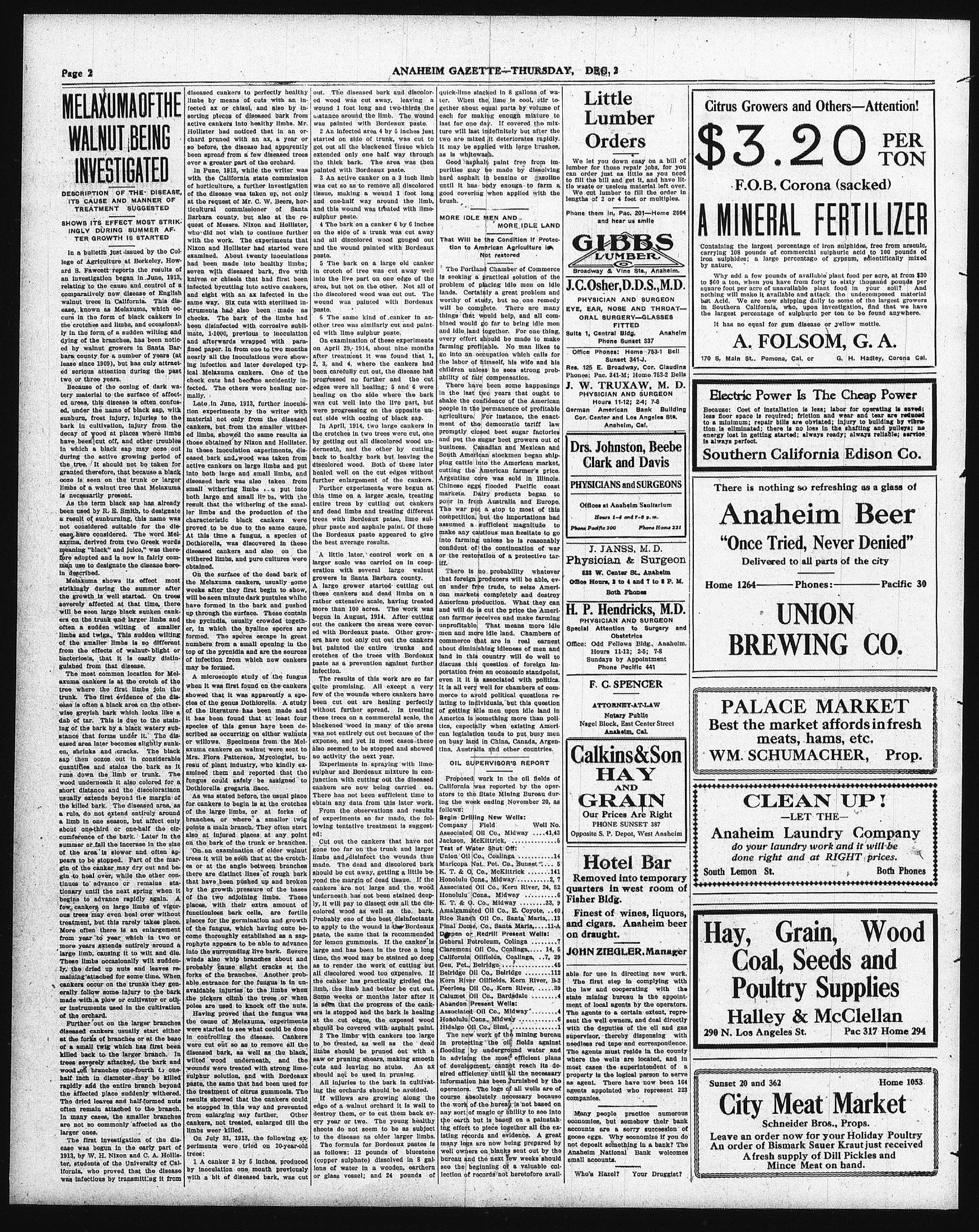
Searchable text
MELAXUMA OF THE WALNUT BEING INVESTIGATED
DESCRIPTION OF THE DISEASE, ITS CAUSE AND MANNER OF TREATMENT SUGGESTED
SHOWS ITS EFFECT MOST STRIKINGLY DURING SUMMER AFTER GROWTH IS STARTED
In a bulletin just issued by the College of Agriculture at Berkeley, Howard S. Fawcett reports the results of an investigation began in June, 1913, relating to the cause and control of a comparatively new disease of English walnut trees in California. This disease, known as Melaxuma, which occurs in the form of black cankers in the crotches and limbs, and occasionally in the form of a sudden wilting and dying of the branches, has been noticed by walnut growers in Santa Barbara county for a number of years (at lease since 1909), but has only attracted serious attention during the past two or three years.
Because of the oozing of dark watery material to the surface of affected areas, this disease is often confused, under the name of black sap, with sunburn, frost injury, injuries to the bark in cultivation, injury from the decay of wood at places where limbs have been cut off, and other troubles in which a black sap may ooze out during the active growing period of diseased cankers to perfectly healthy limbs by means of cuts with an infected ax or chisel, and also by inserting pieces of diseased bark from active cankers into healthy limbs. Mr. Hollister had noticed that in an orchard pruned with an ax, a year or so before, the disease had apparently been spread from a few diseased trees over a greater part of the orchard.
In Pune, 1913, while the writer was with the California state commission of horticulture, a further investigation of the disease was taken up, not only at the request of Mr. C. W. Beers, horticultural commissioner of Santa Barbara county, but also at the request of Messrs. Nixon and Hollister, who did not wish to continue further with the work. The experiments that Nixon and Hollister had started were examined. About twenty inoculations had been made into healthy limbs; seven with diseased bark, five with knives or chisels that had first been infected by cutting into active cankers, and eight with an ax infected in the same way. Six cuts with sterilized instruments had also been made as checks. The bark of the limbs had been disinfected with corrosive sublimate, 1-1000, previous to inoculation and afterwards wrapped with parafined paper. In from one to two months nearly all the inoculations were showing infection and later developed typical Melaxuma cankers. One of the check cuts had become accidently infected. The others were healing normally.
Late in June, 1913, further inoculation experiments by the writer with material not only from the diseased cankers, but from the smaller withered limbs, showed the same results as those obtained by Nixon and Hollister. In these inoculation experiments, diseased bark and wood was taken from out. The disease ed wood was cut wound 1 foot long distance around it was painted with 2 An infected started on side get out all the be extended only on the thick bark. painted with Bons 3 An active can was cut so as to tissue, making and one-half ww and this wound sulphur paste. 4 The bark on on the side of a and all discoloration and the wound paste. 5 The bark on in crotch of tree into the live pan area, but not on the discolored wound was painte. 6 The same k other tree was shaded with lime sulphur On examination on April 29, 1913 after treatment 2, 3, and 4, wh been carefully cut progressed no f edges were all he healing on the was cut well in were progressing cut side with oo. In April, 1914, the crotches in ty by getting out al derneath, and th back to healthy
lease since 1909), but has only attracted serious attention during the past two or three years.
Because of the oozing of dark water material to the surface of affected areas, this disease is often confused, under the name of black sap, with sunburn, frost injury, injuries to the bark in cultivation, injury from the decay of wood at places where limbs have been cut off, and other troubles in which a black sap may ooze out during the active growing period of the tree. It should not be taken for granted therefore, that because a black ooze is seen on the trunk or larger limbs of a walnut tree that Melaxuma is necessarily present.
As the term black sap has already been used by R. E. Smith, to designate a result of sunburning, this name was not considered suitable for the disease here considered. The word Melaxuma, derived from two Greek words meaning "black" and juice," was therefore adopted and is now in fairly common use to designate the disease herein described.
Melaxuma shows its effect most strikingly during the summer after the growth is well started. On trees severely affected at that time, there will be seen large black sunken cankers on the trunk and larger limbs and often a sudden wilting of smaller limbs and twigs. This sudden wilting of the smaller limbs is so different from the effects of walnut blight or bacteriosis, that it is easily distinguished from that disease.
The most common location for Melaxuma cankers is at the crotch of the tree where the first limbs join the trunk. The first evidence of the disease is often a black area on the otherwise greyish bark which looks like a dab of tar. This is due to the staining of the bark by a black watery substance that forms under it. The diseased area later becomes slightly sunken, shrinks and cracks. The black sap then oozes out in considerable quantities and stains the bark as it runs down the limb or trunk. The wood underneath it also colored for a short distance and the discoloration usually extends beyond the margin of the killed bark. The diseased area, as a rule, do not extend entirely around a limb in one season, but affect only about one-third or one-half the circumference of the bark. Later in the summer or fall the incerase in the size of the area is slower and often appears to be stopped. Part of the margin of the canker may dry out and be ing infection and later developed typical Melaxuma cankers. One of the check cuts had become accidentally infected. The others were healing normally.
Late in June, 1913, further inoculation experiments by the writer with material not only from the diseased cankers, but from the smaller withered limbs, showed the same results as those obtained by Nixon and Hollister. In these inoculation experiments, diseased bark and wood was taken from active cankers on large limbs and put into both large and small limbs, and diseased bark was also taken from small withering limbs... put into both large and small limbs, with the result that the withering of the smaller limbs and the production of the characteristic black cankers were proved to be due to the same cause. At this time a fungus, a species of Dothiorella, was discovered in these diseased cankers and also on the withered limbs, and pure cultures were obtained.
On the surface of the dead bark of the Melaxuma cankers, usually some weeks after they first begin to show, will be seen minute dark pustules while have formed in the bark and pushed up through the surface. These contain the pycindia, usually crowded together, in which the hyaline spores are formed. The spores escape in great numbers from a small opening in the top of the pycindia and are the sources of infection from which new cankers may be formed.
A microscopic study of the fungus when it was first found on the cankers showed that it was apparently a species of the genus Dothiorella. A study of the literature has been made and it has been found that at least four species of this genus have been described as occurring on either walnuts or willows. Specimens from the Melaxuma cankers on walnut were sent to Mrs. Flora Patterson, Mycologist, bureau of plant industry, who kindly examined them and reported that the fungus could safely be assigned to Dothiorella gregaria Sacc.
As was stated before, the usual place for cankers to begin is at the crotches of the large limbs, or at forks of branches, or where a smaller twig points a main branch. They often start also at injured places at any point on the bark of the trunk or branches.
On an examination of older walnut trees it will be seen that at the crotches or at the angle between branches
2, 3, and 4, which been carefully cut progressed no far edges were all but healing on the was cut well in; were progressing cut side with ooze.
In April, 1914, the crotches in two by getting out all derneath, and then back to healthy discolored wood. Healed well on to further enlargen.
Further experience this time on a entire trees by two trees with Bordeaux phur paste and at the Bordeaux phur paste as the best average.
A little later, larger scale was eration with seed growers in Santa Ana. A large grower these cankers are rather extensive more than 100 a begun in August out the cankers ed with Bordeaux have not only but painted them crotches of the paste as a prevent infection.
The results of quite promising few of the wound been cut out without further these trees on a blackened wood was not entirely expense, and yet also seemed to be no activity there.
Experiments in sulphur and Bordeaux junction with cut cankers are now There has not been obtain any data.
From the observations of experiments lowing tentative ed:
Cut out the corte gone too far on limbs and disinfect made. The dead
runs down the limb or trunk. The wood underneath it also colored for a short distance and the discoloration usually extends beyond the margin of the killed bark. The diseased area, as a rule, do not extend entirely around a limb in one season, but affect only about one-third or one-half the circumference of the bark. Later in the summer or fall the incerase in the size of the area is slower and often appears to be stopped. Part of the margin of the canker may dry out and begin to heal over, while the other continues to advance or remains stationary until the next spring when it begins to advance rapidly again. A few cankers on large limbs of vigorous trees may even heal over without treatment, but this rarely takes place. More often there is an enlargement from year to year which in two or more years extends entirely around a large limb, causing it to wilt and die. These limbs occasionally wilt suddenly, the dried up nuts and leaves remaining attached for some time. When cankers occur on the trunks they generally follow some injury to the bark made with a plow or cultivator or other instruments used in the cultivation of the orchard.
Further out on the larger branches diseased cankers usually start either at the forks of branches or at the base of a small twig which has first been killed back to the larger branch. In trees severely attacked, the bark and wood on branches one-fourth to one-half inch in diameter may be killed rapidly and the entire branch beyond the affected place suddenly withered. The dried leaves and half-formed nuts often remain attached to the branch. In many cases, the smaller branches are not so commonly affected as the larger ones.
The first investigation of the disease was begun in the early part of 1913, by W. H. Nixon and C. A. Hollister, students of the University of California, who proved that the disease was infectious by transmitting it from
As was stated before, the usual place for cankers to begin is at the crotches of the large limbs, or at forks of branches, or where a smaller twig points a main branch. They often start also at injured places at any point on the bark of the trunk or branches.
On an examination of older walnut trees it will be seen that at the crotches or at the angle between branches there are distinct lines of rough bark that have been pushed up and broken by the growth pressure of the bases of the two adjoining limbs. These places, with their extra amount of functionless bark cells, are fertile places for the germination and growth of the fungus, which having once become thoroughly established as a saprophyte appears to be able to advance into the surrounding live bark. Severe winds also whip branches about and probably cause slight cracks at the forks of the branches. Another probable entrance for the fungus is in unavailable injuries to the limbs when the pickers climb the trees or when poles are used to knock off the nuts.
Having proved that the fungus was the cause of Melaxuma, experiments were started to see what could be done in controlling the disease. Cankers were cut out so as to remove all the diseased bark, as well as the black, wilted wood underneath, and the wounds were treated with strong lime-sulphur solution, and with Bordeaux paste, the same that had been used for the treatment of citrus gummosis. The results showed that the cankers could be stopped in this way and prevented from enlarging any further. Other cankers, not treated, enlarged till the limbs wee killed.
On July 31, 1913, the following experiments were tried on 20-year-old trees:
1 A canker 2 by 5 inches, produced by inoculation one month previously with a bit of diseased bark, was cut
Probably one of these to apply to the waxy paste, the same for lemon gumma large and has been time, the wood must as to render them all discolored when the canker has piled limb, the limb has Some weeks or it is seen that the ers is stopped and at the cut edge should be covered.
2 The limbs were to be treated, and limbs should be saw or pruning since cuts and leaving should not be used.
All injuries to ing the orchards.
If willows are edge of a walnut destroy them, or ery year or two shoots do not show to the disease.
The formula f as follows: 12(copper sulphate lons of water in or glass vessel;
ANAHEIM GAZETTE—THURSDAY, DEC, 2
healthy man in by ink from bos. Mr. an or near or currently all trees dred.
was missionigation not only horrs Santa the re-ollister, further that were relations limbs;
with been tankers, in the sized inside as had sublulation paramonths show typed of the tilt ing norocular with seased with seased with seased with seased with seased with seased with seased with seased with seased with seased with seased with seased with seased with seased with seased with seased with seased with seased with seased with seased with seased with seased with seased with seased with seased with seased with seated with seated with seated with seated with seated with seated with seated with seated with seated with seated with seated with seated with seated with seated with seated with seated with seated with seated with seated with seated with seated with seated with seated with seated with seated with seated with seated with seated with seated with seated with seated with seated with seated with sippled.
out. The diseased bark and discolor-ed wood was cut away, leaving a wound 1 foot long and two-thirds the distance around the limb. The wound was painted with Bordeaux paste.
2 An infected area 4 by 5 inches just started on side of trunk, was cut to get out all the blackened tissue which extended only one half way through the thick bark. The area was then painted with Bordeaux paste.
3 An active canker on a 3 inch limb was cut so as to remove all discolored tissue, making a wound 1 foot long and one-half way around the limb, and this wound was treated with lime-sulphur paste.
4 The bark on a canker 6 by 6 inches on the side of a trunk was cut away and all discolored wood gouged out and the wound painted with Bordeaux paste.
5 The bark on a large old canker in crotch of tree was cut away well into the live part on one edge of the area, but not on the other. Not all of the discolored wood was cut out. The wound was painted with Bordeaux paste.
6 The same kind of canker in another tree was similarly cut and painted with lime sulphur paste.
On examination of these experiments on April 29, 1914, about nine months after treatment it was found that 1, 2, 3, and 4, where the cankers had been carefully cut out, the disease had progressed no further and the cut edges were all healing; 5 and 6 were healing on the side where the bark was cut well into the live part, but were progressing on the opposite uncut side with oozing of black sap.
In April, 1914, two large cankers in the crotches in two trees were cut, one by getting out all discolored wood underneath, and the other by cutting back to healthy bark but leaving the quick-lime slacked in 8 gallons of water. When the lime is cool, stir together about equal parts by volume of each for making enough mixture to last for one day. If covered the mixture will last indefinitely but after the two are mixed it deteriorates rapidly. It may be applied with large brushes, as is whitewash.
Good asphalt paint free from impurities may be made by dissolving hard asphalt in benzine or asoline until it has body enough to farm a good covering when applied with the brush.
MORE IDLE MEN AND MORE IDLE LAND
That Will be the Condition If Protection to American Agriculture Is Not restored
The Portland Chamber of Commerce is seeking a practical solution of the problem of placing idle men on idle lands. Certainly a great problem and worthy of study, but no one remedy will be complete. There are many things that would help, and all combined would far to bring idle men and idle land together. For one thing, every effort should be made to make farming profitable. No man likes to go into an occupation which calls for the labor of himself, his wife and his children unless he sees strong probability of fair compensation.
There have been some happenings in the last two years that ought to shake the confidence of the American people in the permanence of profitable agriculture. For instance, the enactment of the democratic tariff law promptly closed beet sugar factories and put the sugar beet growers out of business. Canadian and Mexican and South American stockmen began ship-
In April, 1914, two large cankers in the crotches in two trees were cut, one by getting out all discolored wood underneath, and the other by cutting back to healthy bark but leaving the discolored wood. Both of these later healed well on the cut edges without further enlargement of the cankers.
Further experiments were begun at this time on a larger scale, treating entire trees by cutting out cankers and dead limbs and treating different trees with Bordeaux paste, lime sulphur paste and asphale paint. Of these the Bordeaux paste appeared to give the best average results.
A little later, control work on a larger scale was carried out in cooperation with several large walnut growers in Santa Barbara county. A large grower started cutting out these cankers and dead limbs on a rather extensive scale, having treated more than 100 acres. The work was begun in August, 1914. After cutting out the cankers the areas were covered with Bordeaux paste. Other growers have not only cut out the cankers but painted the entire trunks and crotches of the trees with Bordeaux paste as a prevention against further infection.
The results of this work are so far quite promising. All except a very few of the wounds where cankers have been cut out are healing perfectly without further spread. In treating these trees on a commercial scale, the blackened wood in many of the areas was not entirely cut out because of the expense, and yet in most cases these also seemed to be stopped and showed no activity the next year.
Experiments in spraying with lime-sulphur and Bordeaux mixture in conjunction with cutting out the diseased cankers are now being carried on. There has not been sufficient time to obtain any data from this later work.
From the observations and results of experiments so far made, the following tentative treatment is suggested:
Cut out the cankers that have not gone too far on the trunk and larger limbs and disinfect the wounds thus made. The dead and discolored bark
There have been some happenings in the last two years that ought to shake the confidence of the American people in the permanence of profitable agriculture. For instance, the enactment of the democratic tariff law promptly closed beet sugar factories and put the sugar beet growers out of business. Canadian and Mexican and South American stockmen began shipping cattle into the American market, cutting the American farmer's price. Argentine core was sold in Illinois. Chinese eggs flooded Pacific coast markets. Dairy products began to pour in from Australia and Europe. The war put a stop to most of this competition, but the importations had assumed a sufficient magnitude to make any cautious man hesitate to go into farming unless he is reasonably confident of the continuation of war or the restoration of a protective tariff.
There is no probability whatever that foreign producers will be able, even under free trade, to seize American markets completely and destroy American production. What they can and will do is cut the price the American farmer receives and make farming unprofitable. That means more idle men and more idle land. Chambers of commerce that are in real earnest about diminishing idleness of men and land in this country will do well to discuss this question of foreign importation from an economic standpoint, even if it is associated with politics.
It is all very well for chambers of commerce to avoid political questions relating to individuals, but this question of getting idle men upon idle land in America is something more than politics, especially when existing American legislation tends to put busy men on busy land in China, Canada, Argentina, Australia and other countries.
OIL SUPERVISOR'S REPORT
Proposed work in the oil fields of California was reported by the operators to the State Mining Bureau during the week ending November 20, as follows:
Begin Drilling New Wells:
Company Field Well No.
Associated Oil Co., Midway ...41,43
Jackson, McKittrick,...5
Test of Water Shut Off:
Union Oil Co., Coaliga...14
Maricopa Nat. Pet. Co., Sunset...5
sapier and Bordeaux mixture in conjunction with cutting out the diseased cankers are now being carried on. There has not been sufficient time to obtain any data from this later work.
From the observations and results of experiments so far made, the following tentative treatment is suggested:
Cut out the cankers that have not gone too far on the trunk and larger limbs and disinfect the wounds thus made. The dead and discolored bark should be cut away, getting a little beyond the margin of dead tissue. If the cankers are not large and the wood underneath has not been stained deeply, it will pay to dissect our all the colored wood as well as the bark. Probably one of the best disinfectants to apply to the wound is the Bordeaux paste, the same that is recommended for lemon gummosis. If the canker is large and has been in the tree a long time, the wood may be stained so deep as to render the work of cutting out all discolored wood too expensive. If the canker has practically girdled the limb, the limb had better be cut out. Some weeks or months later after it is seen that the progress of the cankers is stopped and the bark is healing at the cut edges, the exposed wood should be covered with asphalt paint.
2 The limbs with cankers too large to be treated, as well as the dead limbs should be pruned out with a saw or pruning shears, making smooth cuts and leaving no stubs. An ax should not be used in pruning.
All injuries to the bark in cultivating the orchards should be avoided.
If willows are growing along the edge of a walnut orchard it is well to destroy them, or to cut them back every year or two. The young healthy shoots do not seem to be as subject to the disease as older larger limbs.
The formula for Bordeaux pastes is as follows: 12 pounds of bluestone (copper sulphate) dissolved in 8 gallons of water in a wooden, earthern or glass vessel; and 24 pounds of
Proposed work in the oil fields of California was reported by the operators to the State Mining Bureau during the week ending November 20, as follows:
Begin Drilling New Wells:
Company Field Well No.
Associated Oil Co., Midway ... 41,43
Jackson, McKittrick, ... 5
Test of Water Shut Off:
Union Oil Co., Coalinga ... 14
Maricopa Nat. Pet. Co., Sunset ... 5
K. T. & O. Co., McKittrick ... 141
Honolulu Cons., Midway ... 2,7
Associated Oil Co., Kern River, 24,52
Honolulu Cons., Midway ... 6
K. T. & O. Co., Midway ... 33,9
Amalgamated Oil Co., E. Coyote, ... 40
Rice Ranch Oil Co., Santa Maria, ... 13
Pinal Dome, Co., Santa Maria, ... 11-A
Dopen or Redrill Present Wells:
General Petroleum, Colinga ... 7
Claremont Oil Co., Coalinga ... 14,5
California Oilfields, Coalinga, ... 7,29
Gen. Pet., Belridge ... 45
Belridge Oil Co., Belridge ... 112
Kern River Oilfields, Kern River, B-2
Peerless Oil Co., Kern River, ... 39
Calumet Oil Co., Bardsdale ... 4
Abandon Present Wells:
Associated Oil Co., Midway ... 4
Honolulu Cons., Midway ... 6
Hidalgo Oil Co., Siml...1
The new work of the mining bureau in protecting the oil fields against flooding by underground water and in advising the most efficient plans of development, cannot reach its desired efficiency until all the necessary information has been furnished by the operators. The logs of all wells are of course absolutely necessary because the work of the bureau is not based on any sort of magic or ability to see into the earth but is based on a painstaking effort to piece together all the existing records and evidence. A great many logs are now being prepared by well owners on blank sent out by the bureau and the next few weeks should see the beginning of a valuable collection of records not heretofore avail-
Citrus Growers and Others—Attention!
$3.20 PER TON
F.O.B. Corona (sacked)
A MINERAL FERTILIZER
Containing the largest percentage of iron sulphides, free from arsenic,
carrying 108 pounds of commercial sulphuric acid to 100 pounds of
iron sulphides; a large percentage of gypsum, scientifically mixed
by nature.
Why add a few pounds of available plant food per acre, at from $30
to $60 a ton, when you have from forty to sixty thousand pounds per
square foot per acre of unavailable plant food in your soil? And
nothing will make it available and attack the undecomposed material
but Acid. We are now shipping daily to some of the largest growers
in Southern California, who, upon investigation, find that we have
the largest percentage of sulphuric per ton to be found anywhere.
It has no equal for gum disease or yellow mottle.
A. FOLSOM, G. A.
170 S. Main St., Pomona, Cal. or G. H. Hadley, Corona Cal.
Electric Power Is The Cheap Power
Because: Cost of installation is less; labor for operating is saved;
less floor space is required; friction and wear and tear are reduced
to a minimum; repair bills are obviated; injury to building by vibration is eliminated; there is no loss in the shafting and pulleys; no
energy lost in getting started; always ready; always reliable; service
is always perfect.
Southern California Edison Co.
Electric Power Is The Cheap Power
Because: Cost of installation is less; labor for operating is saved;
less floor space is required; friction and wear and tear are reduced
to a minimum; repair bills are obviated; injury to building by vibration is eliminated; there is no loss in the shafting and pulleys; no
energy lost in getting started; always ready; always reliable; service
is always perfect.
Southern California Edison Co.
There is nothing so refreshing as a glass of
Anaheim Beer
“Once Tried, Never Denied”
Delivered to all parts of the city
Home 1264——Phones:——Pacific 30
UNION
BREWING CO.
PALACE MARKET
Best the market affords fresh
meats, hams, etc.
WM. SCHUMACHER, Prop.
CLEAN UP!
—LET THE—
Anaheim Laundry Company
do your laundry work and it will be
done right and at RIGHT prices.
CLEAN UP!
—LET THE—
Anaheim Laundry Company
do your laundry work and it will be
done right and at RIGHT prices.
South Lemon St. Both Phones
Hay, Grain, Wood
Coal, Seeds and
Poultry Supplies
Halley & McClellan
290 N. Los Angeles St. Pac 317 Home 294
Sunset 20 and 362 Home 1053
City Meat Market
Schneider Bros., Props.
Leave an order now for your Holiday Poultry
An order of Bismark Sauer Kraut just received
Afresh supply of Dill Pickles and
Mince Meat on hand.